Categories
stroke-recovery Uncategorized

Strokeaversary: All the Things It Wasn’t

This week, something unusual happened.

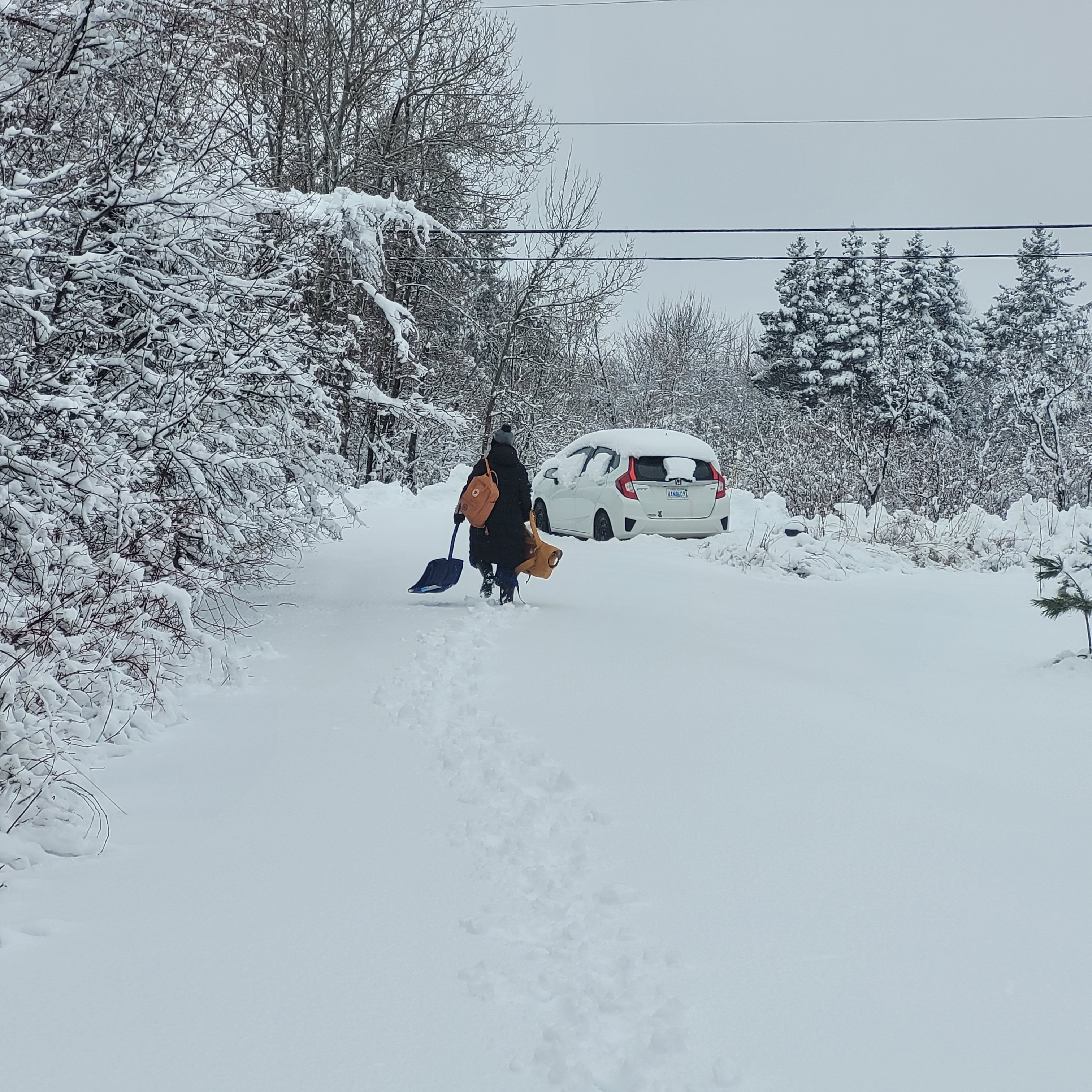
It wasn’t the snowstorm. Having to park the car by the road at the end of our lane to be sure we can get to work in the morning isn’t that strange, even though the snow-laden trees are beautiful. Here in Pomquet, in Antigonish County, a storm day requiring our neighbour to come plow us out is starting to feel like a bi-weekly event. I had some trouble keeping up with Sara on her march to the car. But no, it wasn’t that.
Nor was it the sauna. In December, on receiving unexpectedly good news after a scary cancer test, I decided I’m not getting any younger and I’d buy that sauna kit I’ve dreamt of for years (ever since being pastor to the wonderful Montreal Finns and enjoying the rite with them). With the help of local carpenter extraordinaire Evan Theriault (Theriault Timberworks) I’m hoping we soon have our very own sauna in action for relaxing in this deep-freeze. That will be great. But no, it wasn’t that.
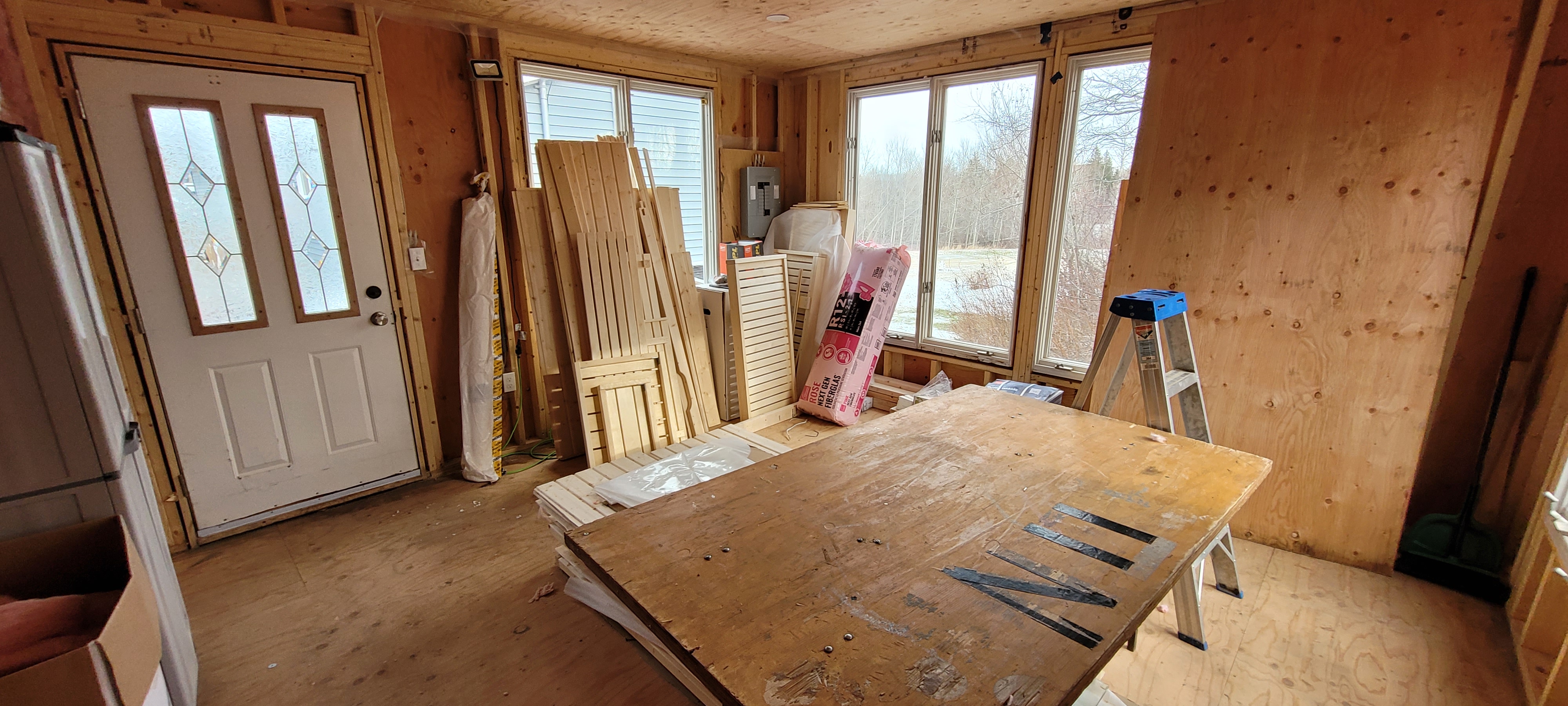
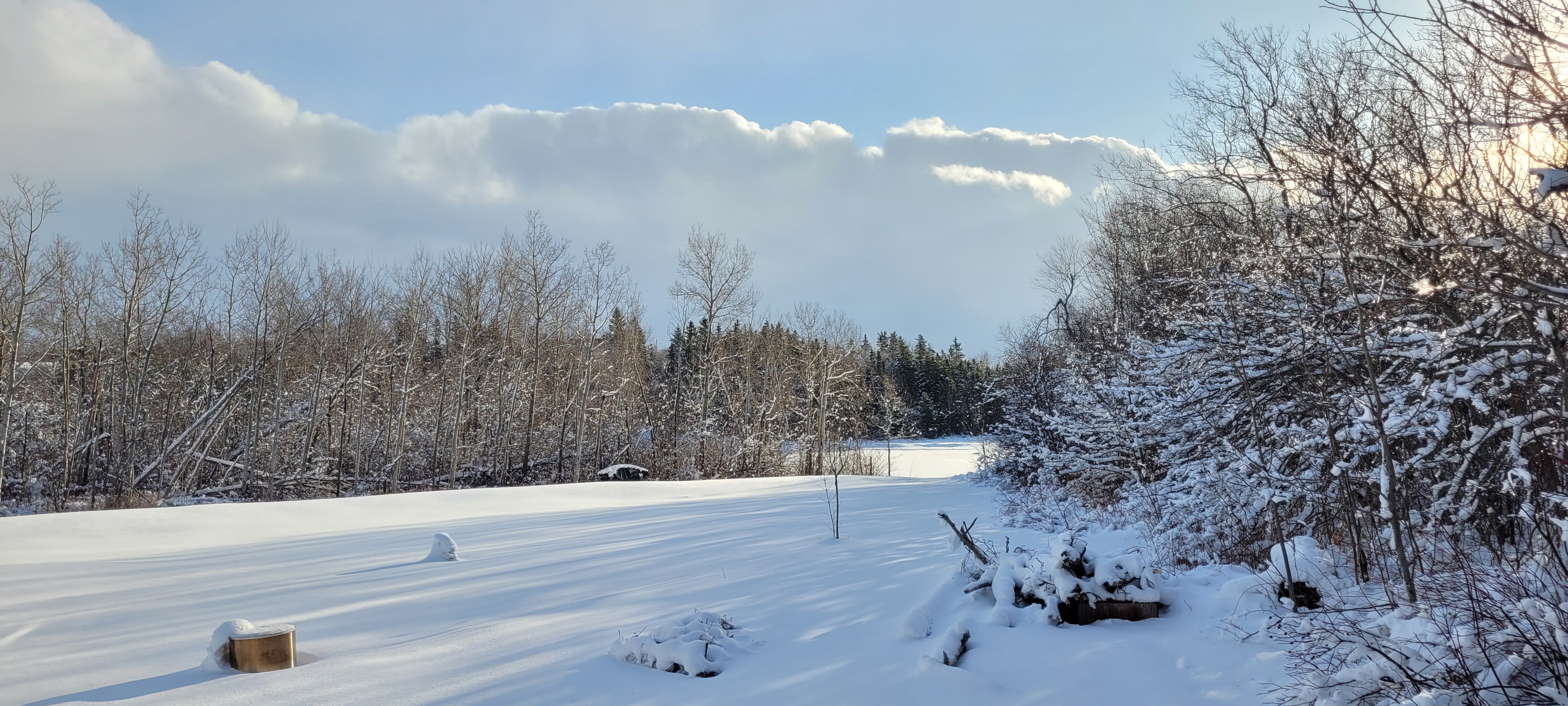
And no, it wasn’t that I’m starting to feel increasingly guilty about my handicapped parking sticker. Yesterday I felt badly using the space at the Farmers’ Market, although in the end I’m glad I did, since my balance on ice still isn’t the greatest. I’ve started to leave spots closest to the door for those who need them more. I guess that says something about my recovery and the general improvement to my walking! It’s easier and easier for me to tramp around the property, even on days like this (see below). But it’s still not that.
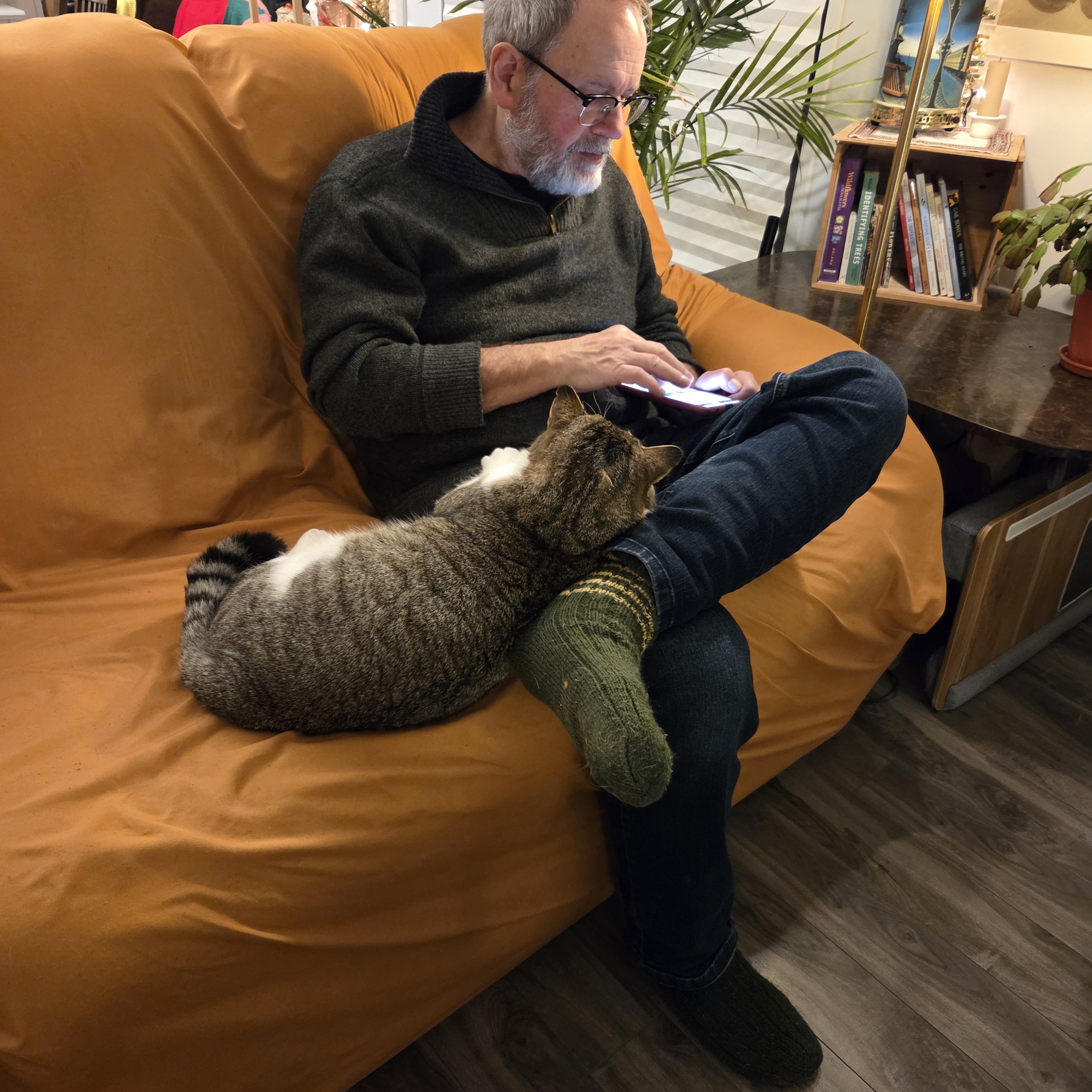
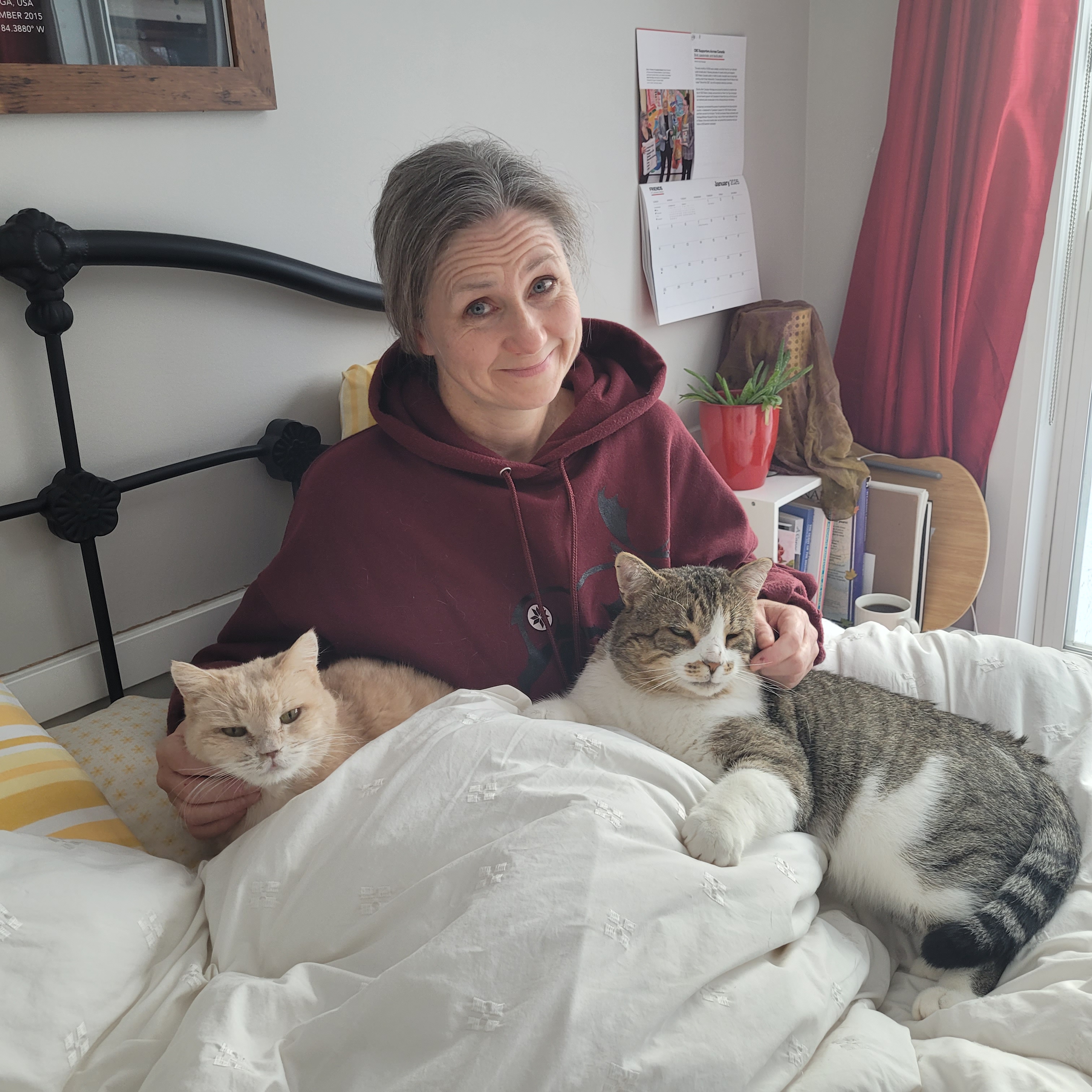
Nor is it that the big, furry feral feline we named Theodore, whom Sara trapped, neutered, and had patched up by the vet for his infected paw injury, didn’t immediately spring back out into the wild on his release. Instead he surprised us by turning into some kind of indoor love-bunny. He has apparently decided to adopt us. He’s incredibly smart and affectionate. As a dog person and someone with mild allergies I don’t encourage Theodore too much, but he seems to think I’m okay. We’re warming up to each other. But it’s not that either.
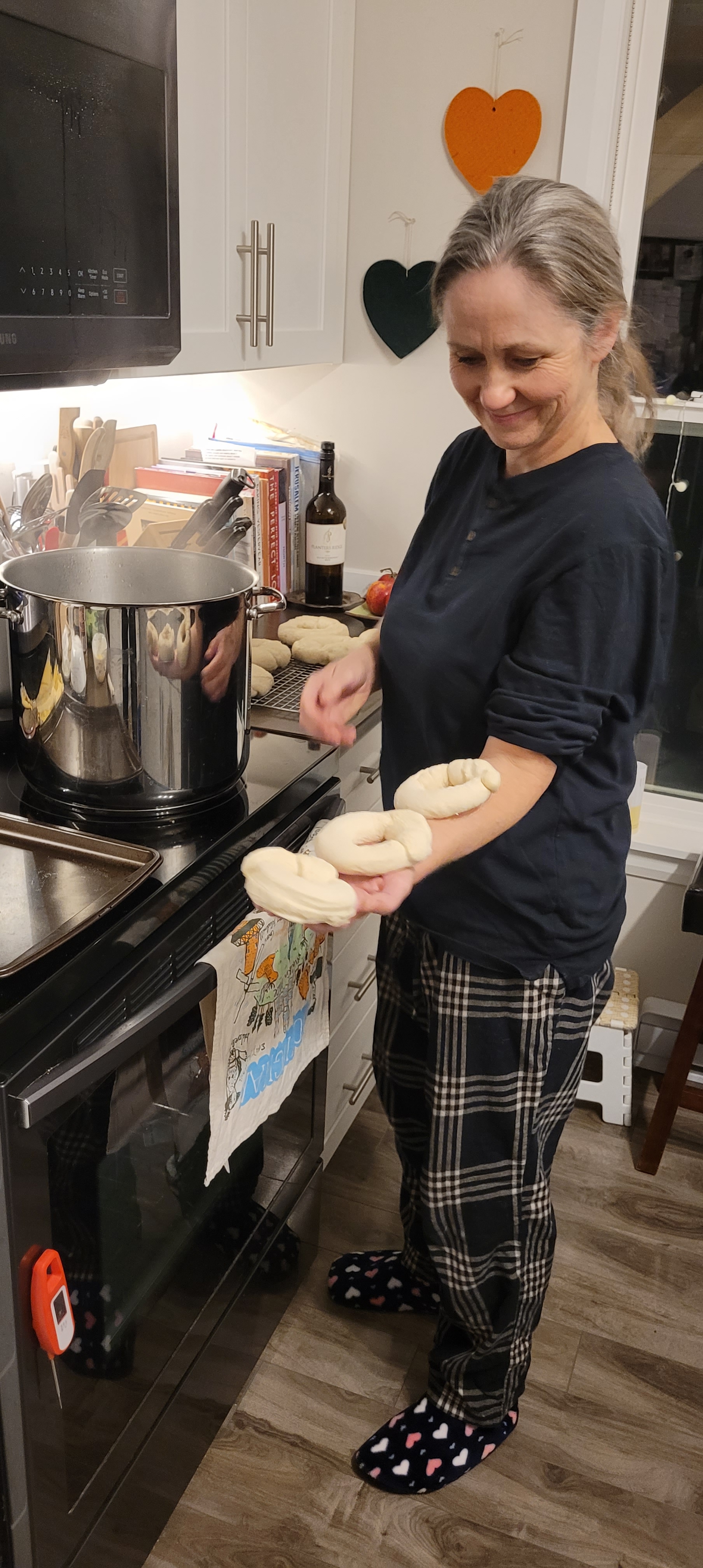
Nor is it that Sara tried her hand at making bagels (Montreal-style, of course!). As I write this I’m enjoying that yeasty, honey-laden smell and taste, and I can’t wait to try them with cream cheese. A rare delight and pleasure, indeed! (Recipe here). But no, not that…
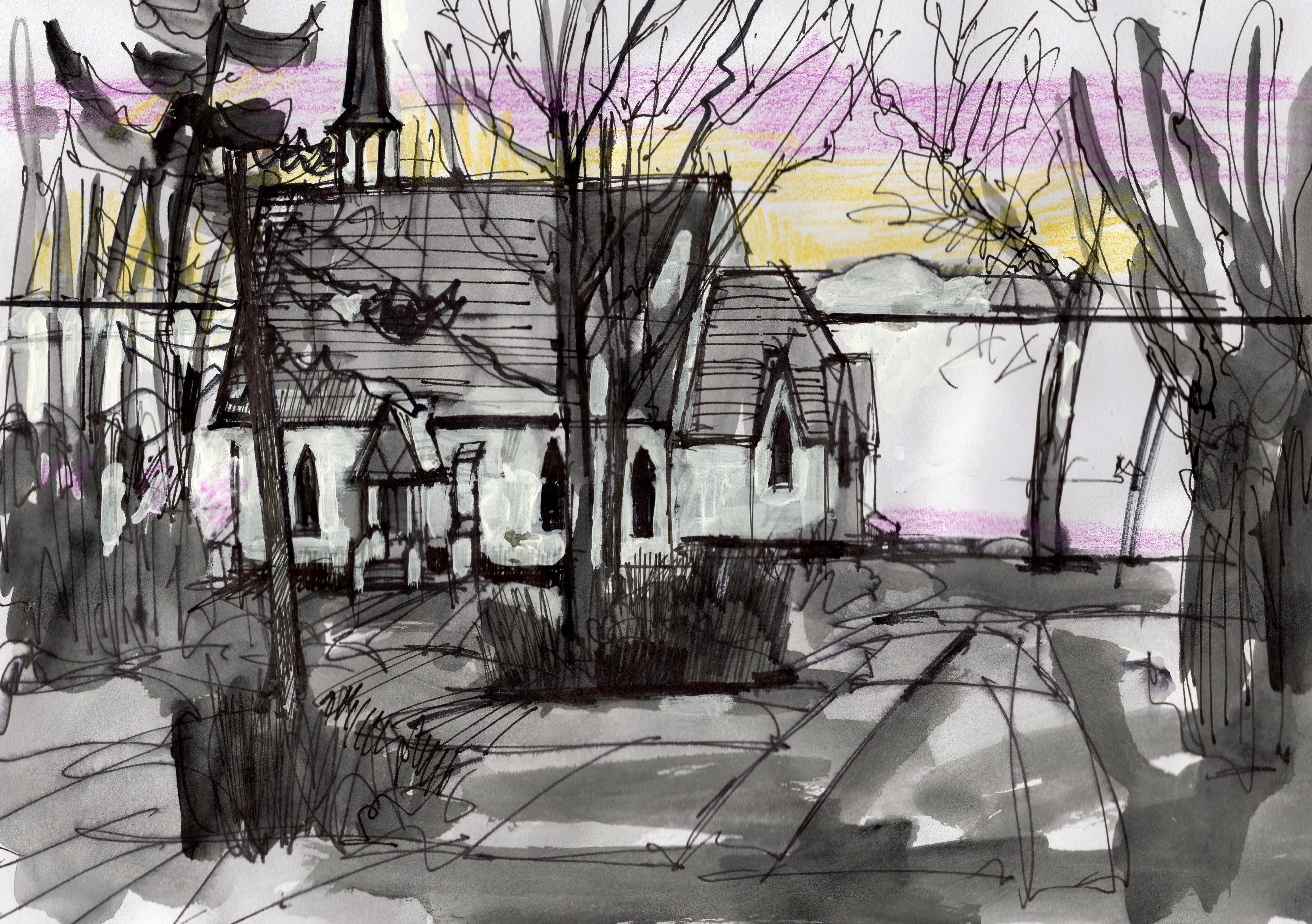
Finally, it’s not that for the first time in months I dusted off my completed novel manuscript and read through it again, and I still think it’s great! I’ve been inspired to start sending it out to publishers again. The drawing below is from my friend Robert Aubé (more at his website). The novel is set in the very real location of St James Anglican Church, Cacouna QC. I’m rejuvenated. But no. Not that either…
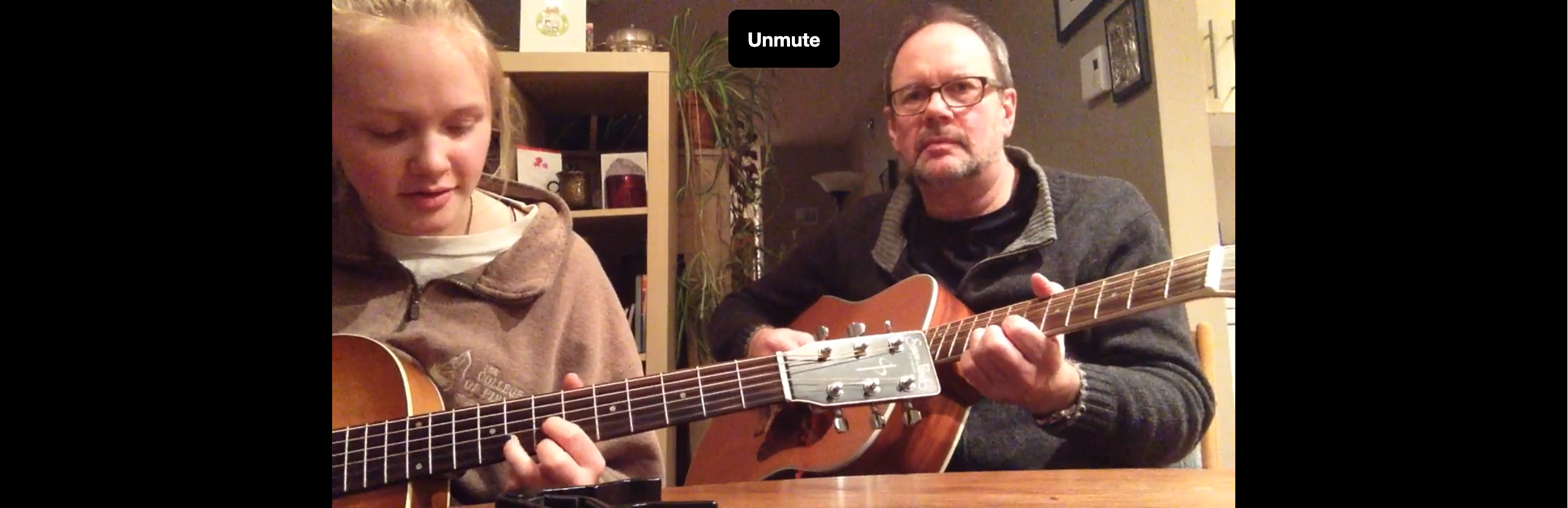
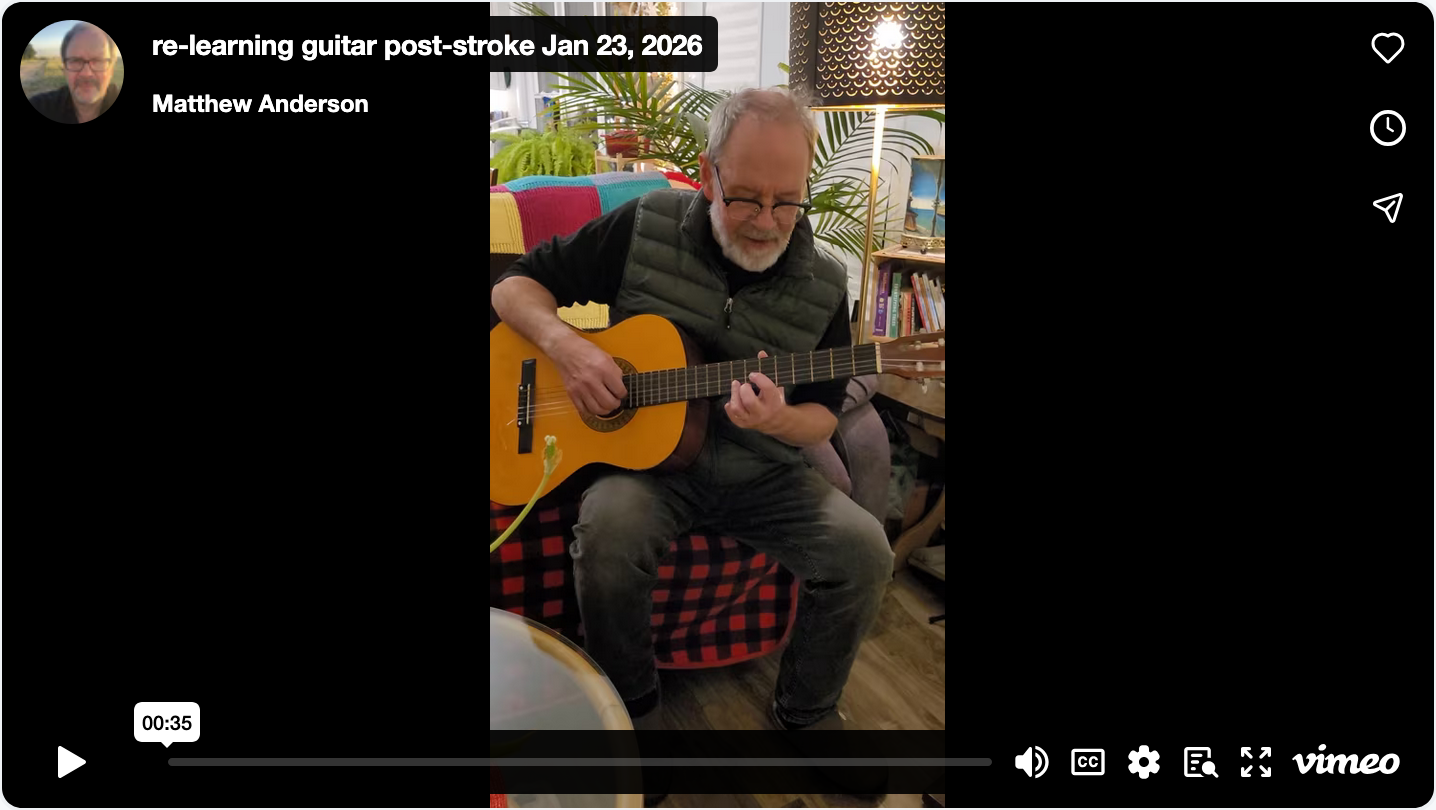
What it IS, is that this last week I had Sara film my daily attempts at guitar. Every day I try to get my left hand fingers to move better by practising my playing. Here’s where I’m at post-stroke as of yesterday: https://vimeo.com/1157626018?share=copy&fl=sv&fe=ci
And here’s where I was pre-stroke, with that same piece (and with help from my youngest). I hope someday to get back to this level: https://vimeo.com/433444043

No. What actually happened this week that was unusual, was that I watched the recording Sara made, then the one from a couple of years ago. Then I broke down and cried.

I don’t weep like that often. It wasn’t from sadness, exactly, although I know I’ve lost much. I had to reflect a while on it. It’s complicated. While some of it was sadness, more of it was happiness – happiness I’m alive. Even though a year ago I could only twitch my thumb (and barely that), and now my hand has dramatically improved and is still getting better. Some of my tears came, I think, from realizing just what an endurance test recovery has been, despite the help and support of so many: the months of struggling with coats, and socks, and shoes, and bags, and silverware, and backpacks, and grocery bags, and everything else. Every day making the decision to use my left hand even though every time, it’s harder. (I just remembered to do it again, while typing this sentence.)

My point is NOT that congratulations are needed. There are lots of folks who’ve had it much worse. And there are certainly others who have to be much much more courageous. It’s that we are, all of us, emotional creatures, whole beings with needs, regrets, hopes, sadnesses, and joys. All. And life can sometimes feel the most beautiful, and the most rewarding, in precisely those times when it’s not the easiest.

I wouldn’t wish my stroke on anyone. But I was glad, this week, to go through such a heart-filling experience as that unexpected cry. Given the state of the world right now, we probably all need one.
Categories
Uncategorized

Uncle Carl’s Requiem Aeternam

Today is All Souls’ Day. It’s a sort-of All Saints, which was actually yesterday, Nov 1. That still might mean little, but in essence says that today is a day for remembering loved ones, and (if one is so-minded) praying for their memory.
I’m not an Anglican. But Anglicans do All Saints so well that days like these make me just slightly envious. The hymn “For All the Saints” is perfect, and perfectly Anglican: all pomp and circumstance, with a feel both global and sentimental, pious and restful and stirring in a sad, masculine, military sort of way, all at the same time. One can just about hear the British Empire and God’s mirrored and more perfect realm echoed in the words”…the golden evening brightens in the west…. while yet there breaks a still more glorious day”.
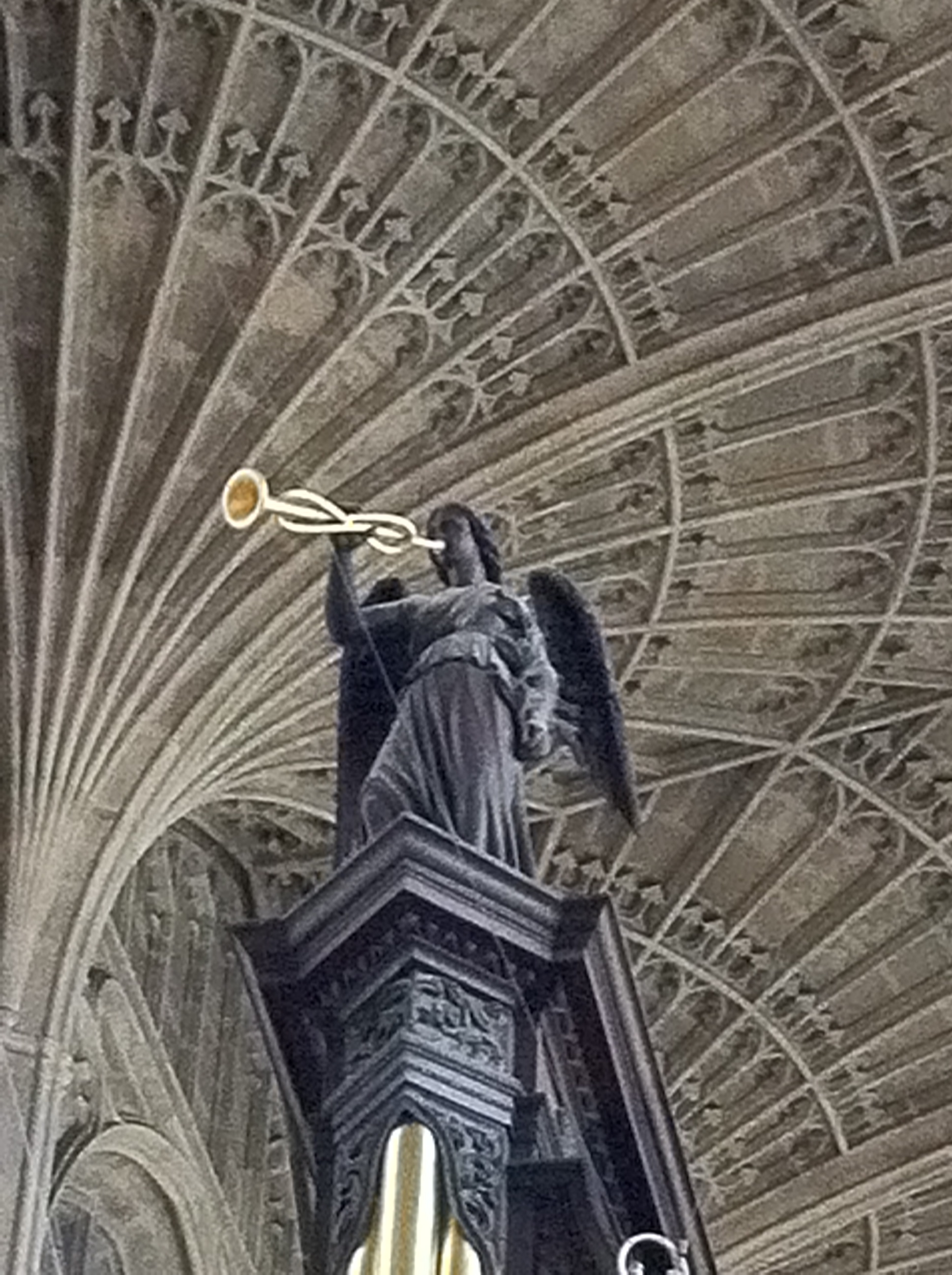
It perhaps takes something as solid as the Anglican church to really mark the permanence we hope that our loved ones enjoy. There is a weight of history, for instance, to the high wooden vaulted ceilings and the Gothic walls of a place like Cambridge’s Kings College. Or even, more locally, the jewel that is St James the Apostle Anglican, Montreal, where I visited with my students on Hallowe’en (All Saints’ Eve). There are so many memories in such places, and such rare beauty.
But this year the person I most remembered was the one person who would have felt most out of place in such a (as he would have called it) “high falootin'” environment. My uncle Carl was a simple man, if anyone can truly be called that. He never had a great education, and left school to take over the farm at the age of 12. His grammar was terrible and his habits, frankly, not the best. But his heart was kind. And he managed to travel the world enough to inspire me, decades later, to follow his tracks. My childhood years are sprinkled with postcards he sent from places like Japan, Morocco, Gibraltar and Germany. The first time I ever rode a camel (in my case, in Palestine), I thought of Uncle Carl, grinning out from beneath a straw hat in a photo he had sent in the 1960s. All I was missing – thankfully – was the big cigar and loud tropical American shirt.
When we honour “our” dead, something mysterious happens. We are changed. Perhaps it’s an act of memory, perhaps of alchemy, but they come alive again, if ever so slightly, by our remembering. And more importantly perhaps, we recognize in what parts of ourselves, our habits, our dreams, even our physicality, they live on.
So here’s to whomever it is that you remember. Requiem Aeternam, Uncle Carl. “What? What’s that? I don’t understand that kind of stuff,” I can see him pushing his cap back, scratching his head, laughing that big laugh that means he doesn’t really understand, and frankly, doesn’t really care.
“That’s fine, Uncle Carl. God doesn’t need us to understand to bless us all the same. Requiem Aeternam.”

Categories
Uncategorized

The Clergy House of Rest

The Clergy House of Rest

My second day at the parsonage attached to the summer parish of Cacouna QC, my friend Eric, who had come down to spend a couple of days with me in Bas St-Laurent, found a small plaque on the mantel of the fireplace. It’s a short text, written in old and uneven typewriter script, and deserves quoting in full. The capitals (interesting in and of themselves) are there in the original:

The Committee desire to draw attention to an established Rule which forbids except on special occasions, and with the approval of the Master of the House – the admission of Ladies and Children to the hospitality of the House.

The Committee believe that it will be recognised that the observance of such a Rule is absolutely necessary to secure the Guests of the House that freedom and liberty of action to which they are entitled.

By order of the Committee

There’s no date, and no easy way to situate the notice, but it seems to be a bit of historical luggage left over from the 1920s or 30s. Whichever modern parishioner of the parsonage found this and dug it out must have had a sense of humour. She’s probably also the one who found a photograph that seems to go with it. The photo shows a group of middle-aged men, all in suits, sitting or standing on the veranda of a house very much like the present day parsonage of St James Cacouna. Some are wearing clerical collars. They are looking at the camera, and a few out toward the St-Lawrence (it’s hard to know whether to call it the St-Lawrence or “the sea” here since it’s a bit of both. It’s a river, but some 20 miles across, with six to eight foot tides and salt water). Some of the men are smiling, but most, as was the fashion of the day in front of cameras, look grim. Presumably, the looks on their faces indicate that they are enjoying “that freedom and liberty of action to which they are entitled”!

It would be easy to moralize over such a plaque. But times have changed, and little is accomplished by such straw-man opinions. Likely the men who were responsible for this directive wanted, more than a release from women and children, a release from themselves and their domestic lives (we still go on “retreats”, and these still involve getting away from responsibilities as far as one is able). The capitalization of the word “Rule” is interesting, however – is it possible, I wonder, that whoever framed this had in mind, consciously or unconsciously, the far more official and effective monastic “Rules” such as the Rule of St-Benedict? If so, perhaps there were some frustrated monastics amongst that surly lot on the steps.

But the phrase that most piques my interest is the last line: “that freedom and liberty of action to which they (that is, the clergy) are entitled.” Leaving aside for a second the word “entitled”, it begs the question: what exactly did they DO in the clergy house of rest? Smoke cigars? Surely, in the 1920s, the men did that at home. Tell dirty jokes? Golf? Fish? Walk around in their slippers all day and read the paper? None of these seem exclusively the province of a “house of rest.”

Maybe the “freedom and liberty of action” meant, for these men, temporarily laying aside the heavy weight of being clergy in a culture and time less libertarian than our own, where clergy had a much higher profile and were under much greater scrutiny. Let’s face it, most people barely know we exist these days, and find us more a curiosity than an object of judgment. But in the 1920s, in a stratified Anglo society, things were different. Maybe this Rule expresses the desire of these men to be free to express unorthodox opinions on certain church issues (to tell sacrilegious jokes rather than dirty ones), to be able to vent about people in their parishes, or to be able to pretend, for a time, that they were not “marked” by their ordination vows to be forever different from the rest of society.

It’s also possible that in these words we find the same somewhat unformed but strong urges for male unity and self-awareness that mark the “masculinity movement” of recent decades. And of course, it’s hard for us moderns not to look at that photograph, read these words, and wonder if there were not, again perhaps unconsciously, some homoerotic urges on the part of at least some of those men, the forbidden feelings for which “mens’ clubs” were once a cover.

That’s probably going too far. Maybe, the framers of this “Rule” didn’t really know themselves what they wanted, and “freedom” and “liberty” were words that expressed a yearning more than any actual plan of action. If so, I hope that they found what they yearned for, without having to resort too often to such petty, clumsy and dictatorial decrees as this “Committee” seemed prone to making.

It’s the end of my week in Cacouna. Eric left on Wednesday and when Cathy decided not to come up with her mother as planned, it occurred to me that as a man alone in the house, I was living by the Rule of the Clergy House of Rest! The Parish of St James has been tremendously welcoming to me, and the House (there, I’m picking up the capitalization habit) has been a God-send. Some days the fog rolled over and through the grand old place, making it eerily moody, and other days, when the sun was shining over the gulf, I’ve sat at my computer and watched, hoping to see the Beluga whales that sometimes pass by out in the sparkling waters. I can hear the foghorns of the freighters on the one side, and the lonely sound of the Gaspe train on the other. Up on highway 132, cars with campers pass by, and tourists stop to look at the signs describing the historic village of Cacouna. We haven’t stopped needing places of rest. But I’m glad that the parish of St James Cacouna is now so much more welcoming than was, once, the “Clergy House of Rest”.