Categories
academic research

A Radically-Reinterpreted New Testament

Last fall my friend Dr Christine Jamieson asked if I might contribute to an upcoming issue she was editing for the Canadian-based journal Critical Theology. I wrote a short piece inviting theologians to consider what implications might arise for their work from recent research in New Testament, early Christian, and early Jewish studies. While academics produce excellent work both in Theological Studies and in Biblical Studies in Canada and around the world, they often don’t talk to each other, as I pointed out. I’m fortunate to be working and teaching as a Gatto Chair of Christian Studies at Saint Francis Xavier University, Nova Scotia. This means I can pursue biblical studies research while attuned (I hope!) to the “engaging church, culture, society” that Critical Theology’s byline promises.
The journal issue came out in November. I was delighted to see my article there, and I wanted to share it. What I didn’t know was that Critical Theology has recently become open access, meaning it’s no longer hidden to everyone except subscribers. Thanks to Novalis Press for making the journal available – coincidentally, Novalis was the publisher for my first book, Pairings: The Bible and Booze.

I also didn’t realize – until I read the issue in full – that this issue of Critical Theology begins with a brilliant, timely, and powerful piece about the importance of theology in the university, written by my Montreal Concordia colleague Richard Bernier at Concordia’s Department of Theological Studies.

You can read Richard’s stirring defense in the open access issue HERE. I’m reproducing my own short article below for your convenience. But I recommend the whole issue to you! And I thank Christine for inviting me to be a part of this worthwhile project.

Good reading!
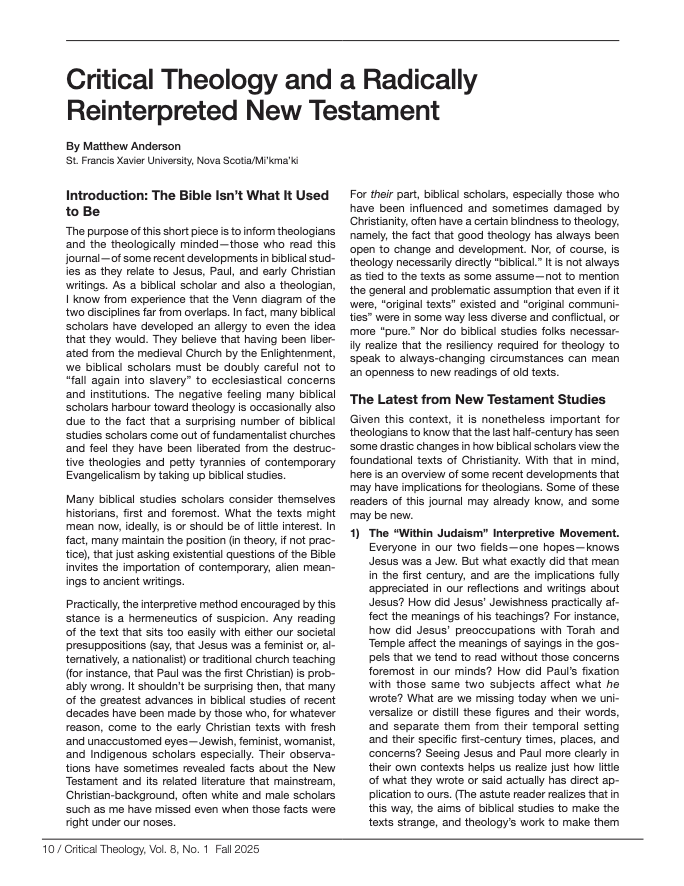
“The aims of biblical studies to make the [New Testament] texts strange, and theology’s work to make them relevant, are opposed”
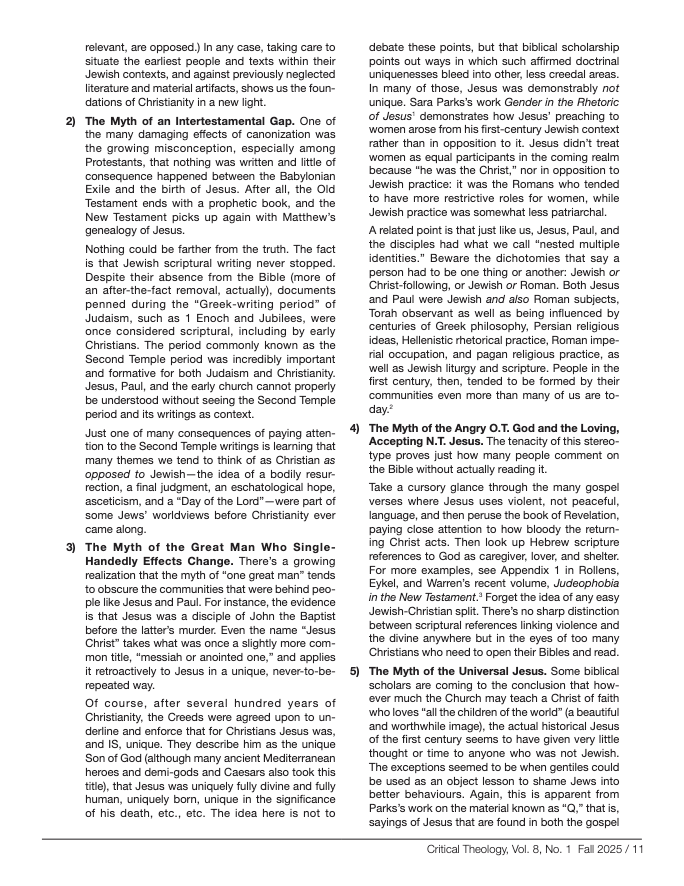
“taking care to situate the earliest people and texts within their Jewish contexts and against previously neglected literary and material artifacts, shows us the foun­dations of Christianity in a new light”
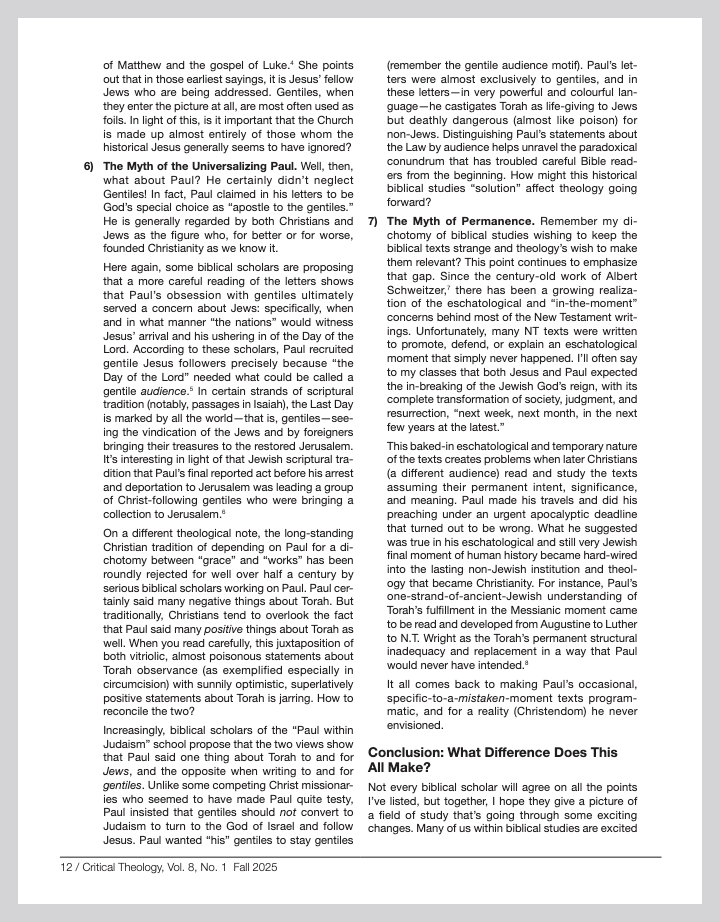
“Paul made his travels and did his preaching under an urgent apocalyptic deadline that turned out to be wrong”
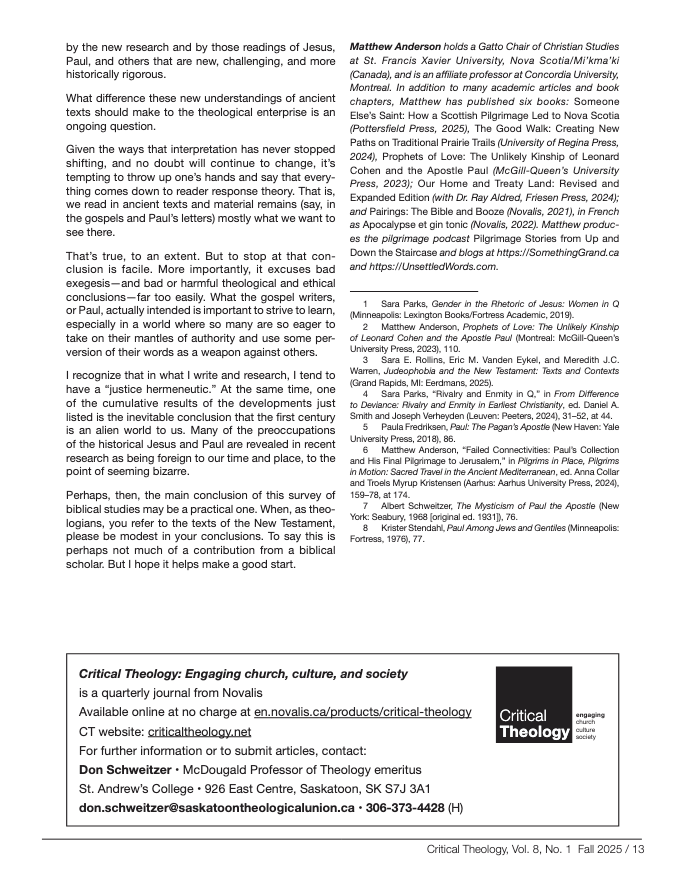
“Many of the preoccupations of the historical Jesus and Paul are revealed in recent research as being foreign to our time and place to the point of seeming bizarre”
Categories
Uncategorized

Pairings: Drinking Cider in the Garden of Eden

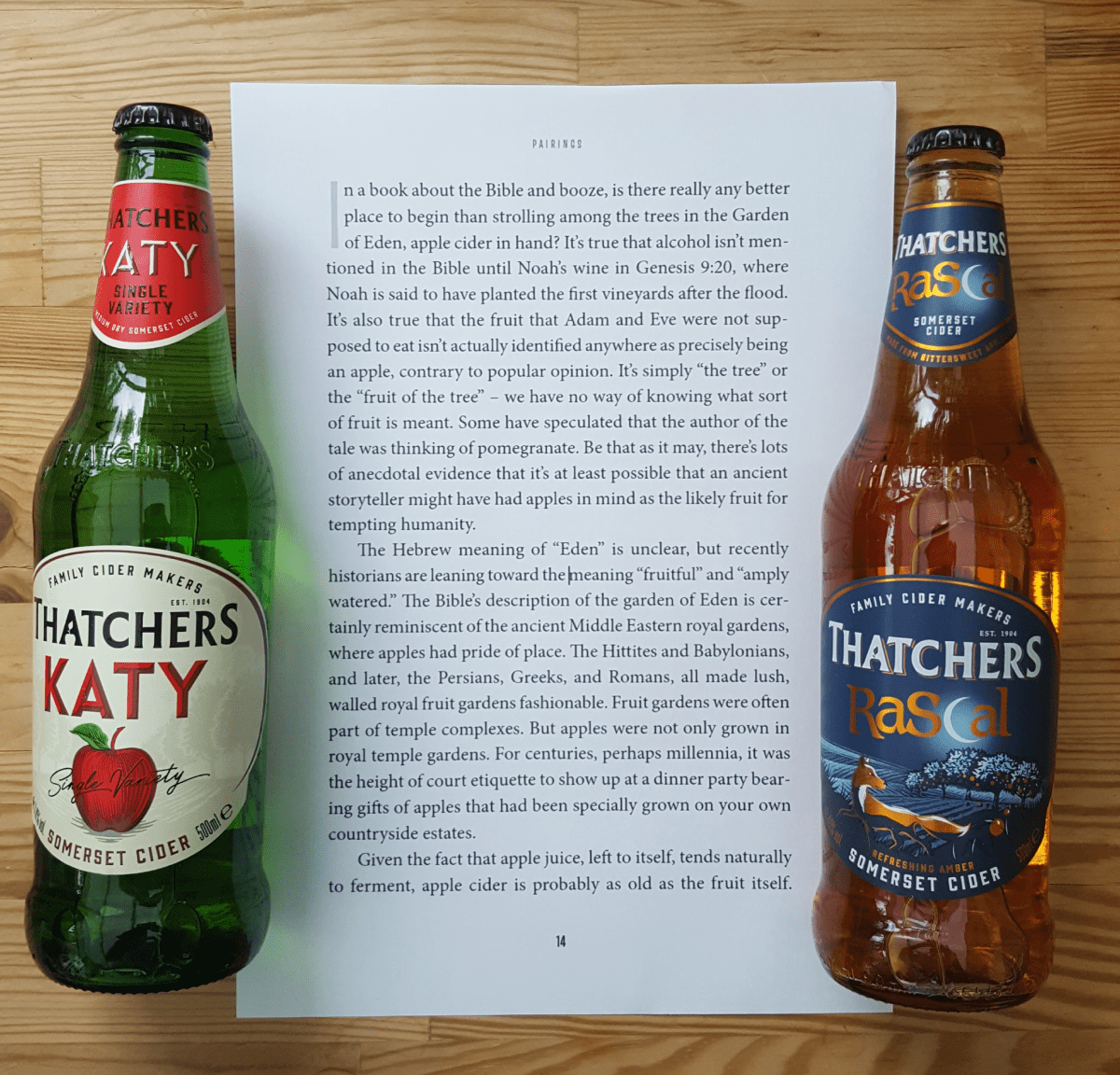
You can find a good cider almost anywhere apples are grown, but England has some of the best. In today’s post, I’m serving up these two Thatchers ciders—Rascal and Katy—with a sampler from chapter one of my book Pairings: The Bible and Booze. Why this pairing? Two simple reasons:

1/ “Rascal” is yet another in a steady stream of apple cider branding that portrays the product as “sinfully good,” “temptingly tasty,” and “devilishly delicious.” Notice a theme here? Without necessarily mentioning the Garden of Eden, many cider companies rely on advertising and logos that “tap into” images of apples and temptresses that we think are from Genesis. But are they really biblical? This brings us to the second cider…

2/ “Katy” is the name of one of the biblical scholars I quote in the chapter – Dr Katie B. Edwards, Hebrew Bible specialist, BBC broadcaster, and author of Admen and Eve: The Bible in Contemporary Advertising. In Admen and Eve, she shows how Eve has been so consistently portrayed in art and in advertising as a “femme fatale” that we forget that that’s NOT how she’s actually portrayed in Genesis! There are many other ways of reading the story of the Garden of Eden without linking an apple (iffy) with Eve as solely responsible for original sin (look to the Church Fathers for that one).

Katie was kind enough to write an endorsement for the back cover of Pairings.

You can read more about Genesis 2-3, Katie, and the secret history of apples, in chapter one of Pairings: the Bible and Booze, “Low-Hanging Fruit: Apple Cider and the Second Creation Account.” Each chapter of the book pairs a specific drink with a specific biblical text. Chapter one pairs the Genesis creation accounts with either a fermented cider, like one of these Thatchers, or an alcohol-free farmer’s market cider, like the ones you can buy from Rougemont Quebec, or in the Okanagan, or the Niagara Peninsula, or the Annapolis Valley.

Order your copy at https://en.novalis.ca/products/pairings !

Categories
Uncategorized

My First Book!

Oh, I like looking at that.

I can hardly believe it. I’ve been writing for decades. I’ve written short stories, academic papers, sermons, presentations, blog posts, a novel, and non-fiction memoirs and travelogues. I’ve been fortunate to have both academic articles and short stories published. But it’s been a waiting game to see whether a publisher would ever pick up one of the book-length manuscripts. Now it’s finally happened — a publisher said YES, and it wasn’t the manuscript I expected! But I’m SO happy that Novalis Press took a chance on Pairings: The Bible and Booze. One of the editors wrote: “I loved it! In fact I couldn’t put it down.”

Pairings will be out soon in Canada and the US, and will be coming out in French a few months later (translated by my friend Sabrina Di Matteo). It’s the first time I’ve signed a book contract. I even received the Press’s standard advance (completely unexpected for someone used to academic publishing). I admit it: it’s a thrill!

Not long ago they sent me some possible book covers. The one I picked (see above) is the choice the Press went with as well. It kind of looks like a Bible, doesn’t it? I love the retro feel, the woodcut approach. And the old-school Bible colour.

So what’s in the book? Here’s what my pitch said: “The manuscript represents the latest biblical studies research. Its commentary on popular biblical texts – arguing tongue-in-cheek for why they should be twinned with certain drinks – is a delicious “taster” for both. Pairings feels like an excellent dinner conversation shot through with a gentle sense of humour.” I added that “Pairings: The Bible and Booze turns our natural curiosity about dissimilar items and our thirst for the old truths into a lively and inspiring book about the Bible.”

See for yourself….here’s the Table of Contents! Each chapter offers up two tasty suggestions – one alcohol and one alcohol-free – to match a passage. Some biblical studies types, friends of mine, have seen the pairings. They often disagree with my choice of drinks…but that’s part of the fun! You may have other pairings to suggest too, once you start to read. I’d love to hear your suggestions.

I hope to hold a physical copy in my hands very soon. I can’t wait. Look for more news in the coming weeks!

Categories
Uncategorized

Aware-Settler Exegesis

Trying to bring one’s worlds together is the work of a lifetime, as fulfilling as it is challenging. I’m a biblical studies scholar interested in earliest Christianity and late Second-Temple Judaism. I research pilgrimage and journey, and try to walk paths and learn about the Land wherever I am. I’m also a Canadian trying to face some of the injustices against Indigenous peoples which created and help sustain my country. I’ve learned a lot, and I’m still learning, from First Nation and Métis friends, and from reading Cree, Métis, Maori, Haudenosaunee, and Anishinaabe authors and scholars.

Out of this mix comes this reflection on reading the Bible through an “Aware-Settler” lens. If you’d like to know more about my own work on this, you can find the full academic paper published by Journal of Interdisciplinary Biblical Studies here: https://hcommons.org/deposits/item/hc:26771/

If you’d like to know more about my sources, a Cree scholar whose methods have been of great help to me is Margaret Kovach Sakewew p’sim iskwew and her book: Indigenous Methodologies: Characteristics, Conversations, and Contexts (Toronto: University of Toronto Press, 2009). I can’t recommend it highly enough.

Here is a film (a powerpoint with voice-over) about “Aware-Settler Biblical Scholarship.” My apologies that the sound for the first slide has somehow been cut off – it was simply me introducing myself as from Concordia University, Montreal, and a research associate at University of Nottingham, UK. If you listen hard enough, there’s also a cat and a train making an appearance in the background.