
Categories
media and publications Uncategorized

The Importance of Second-Place: Times I Was THAT Close

Our cat Theodore is no runner-up to anyone…

There are few moments that offer the “glass half full / half empty” opportunity so effectively as the instant you hear you’ve won second place for something.

For most of my adult life, friends — and even casual acquaintances — have remarked how lucky I am (although I don’t hear that quite so often since my stroke (2024) and cancer surgery (2013)). I do feel lucky, fortunate, and blessed! But behind every win and achievement, there’s a mountain I’ve built of near-misses and almosts.

In high school, I was the “sixth man” for our five-man basketball team. I got lots of silver or bronze medals in track meet. I came second-highest in the province in several Grade 12 provincial exams, only to find out that of all the students in Saskatchewan, it was the same girl who always scored just a percentage point or two higher than me in elementary school, who’d come back to haunt me six years later.

What has me reflecting on this is the WFNS Rita Joe Poetry Prize I was recently a finalist for:
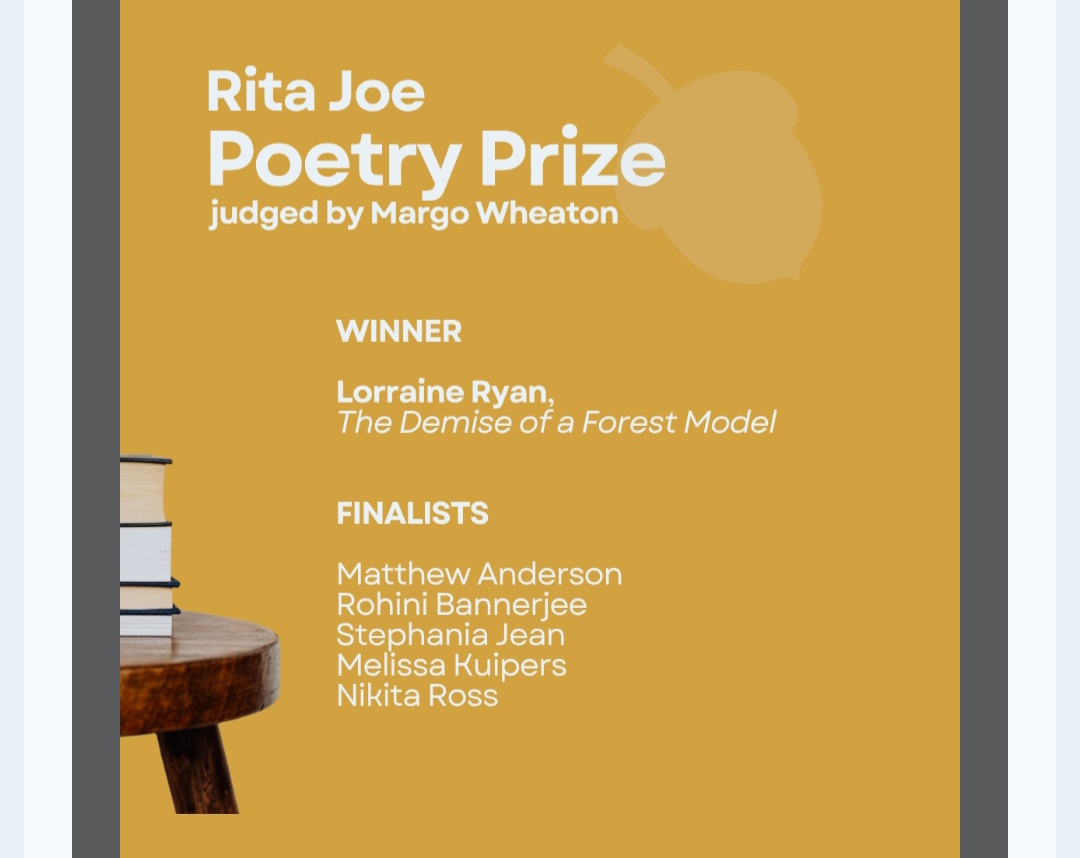
I wonder if I’m the only Rita Joe finalist who was also a runner up for the WFNS Budge Wilson Short Story Prize!?
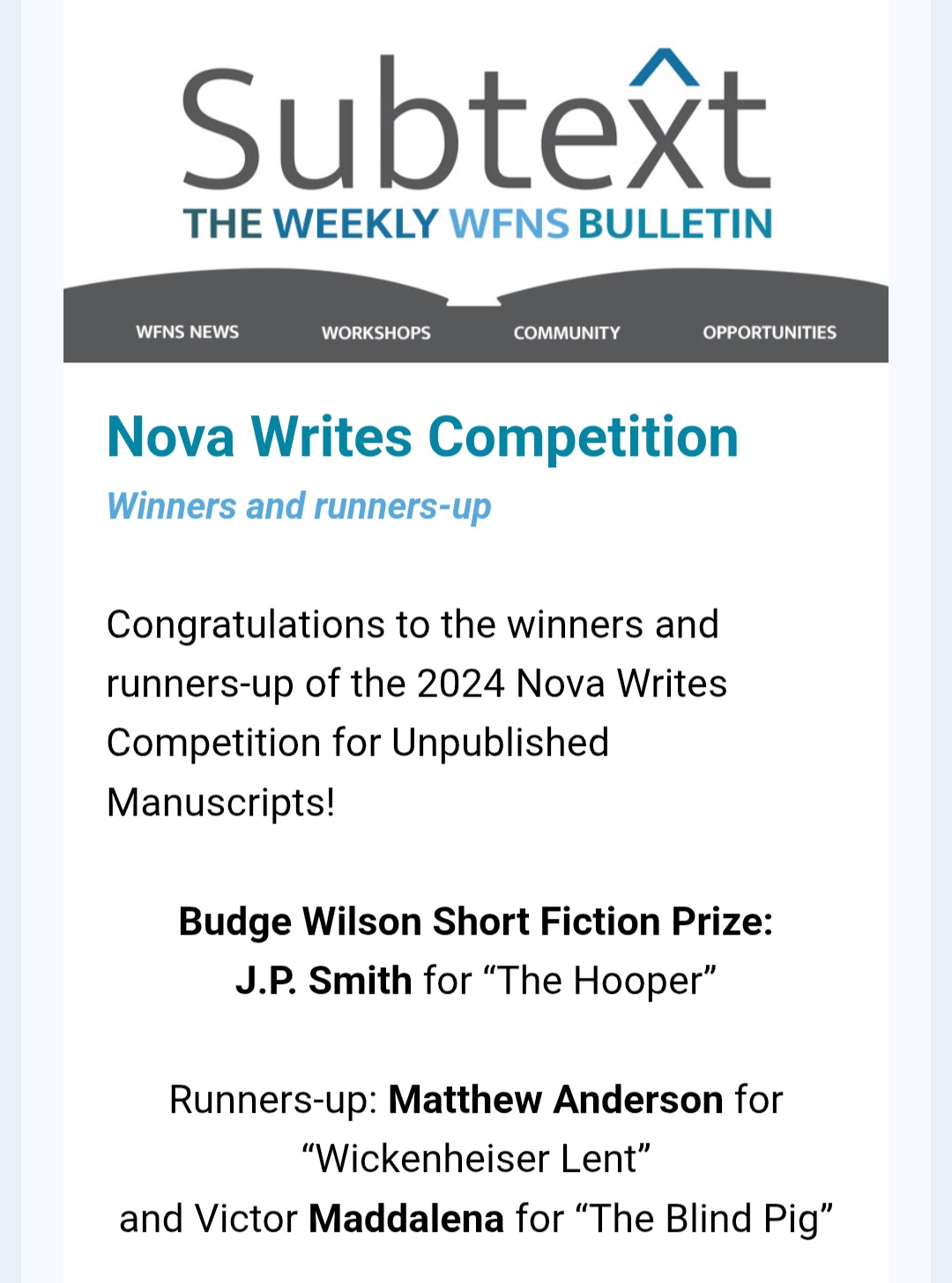
Turns out that I am the glass half full type. You probably knew that.

So, in the spirit of a “CV of Failures,” this post celebrates all my near misses and brags them up. Here’s a list of all the things I’ve NEARLY won….all those times I was “close but no cigar” (by the way, if you’re here for a stroke update, I promise to release one soon!).

2026

I was one of five finalists for the WFNS Rita Joe Poetry Prize for “The First Frost,” a set of poems about my stroke and 4-month hospitalization at St Marthas’ Regional Hospital, Antigonish NS. Lovely judges’ comments.

2025

I was one of ten finalists for a Canada Prize for Prophets of Love: The Unlikely Kinship of Leonard Cohen and the Apostle Paul (McGill-Queen’s). It’s a great book, if I do say so myself.

2024

I was one of two runners up for the WFNS Budge Wilson Short Story Prize for “A Life in its Pieces,” an elegiacal tale of an aging quilter and her great-grandchild. Winner was J.P. Smith.

I was also one of three authors shortlisted for the $10,000. Koffler Vine Canadian Jewish Book Awards for Prophets of Love: The Unlikely Kinship of Leonard Cohen and the Apostle Paul. Winner was Naomi Klein, for Doppelganger. Quite an honour even to be on the same virtual podium as Klein!

2023

I was runner up for the Pottersfield Press Non-Fiction Prize, for the book manuscript Someone Else’s Saint: How A Scottish Pilgrimage Led to Nova Scotia. In this case, second place still included a publisher’s advance and publication of the book – I’m grateful! (No thanks to Premier Tim Houston.)

2022

I was the 11th choice of a Canadian Small Press (that only selects 10 books a year to publish) for my two-time Canada Council Grant winning novel manuscript The Clergy House of Rest. I received a nice email from the publisher (at least I get personal, nice rejections) stating my novel (still unpublished) almost made the final cut – but not quite. That email was tough.

2019

I really could have used the $10,000 that year, but I was runner up for the Dalton Camp Award, for my essay “A Blanket Argument for Empathy.” Instead I got $250 (hey, it’s not nothing).

2014

I was a finalist for the CBC/Quebec Writers Federation Short Story Competition for “The Backhoe,” published in Salut King Kong (Vehicule Press), edited by my friend Elise Moser.

2010

I got Honourable Mention in the Short Fiction Category of the Prairie Fire-McNally Robinson competition for “A Street Called Generous,” which was published in Prairie Fire Magazine.

My CBC Ideas proposal titled “Burying the Master Race,” came extremely close to being chosen. The nice email from a CBC idol of mine, Producer Bernie Lucht, said mine was the “last one that fell off the table.” I still hold on to that email.

2005

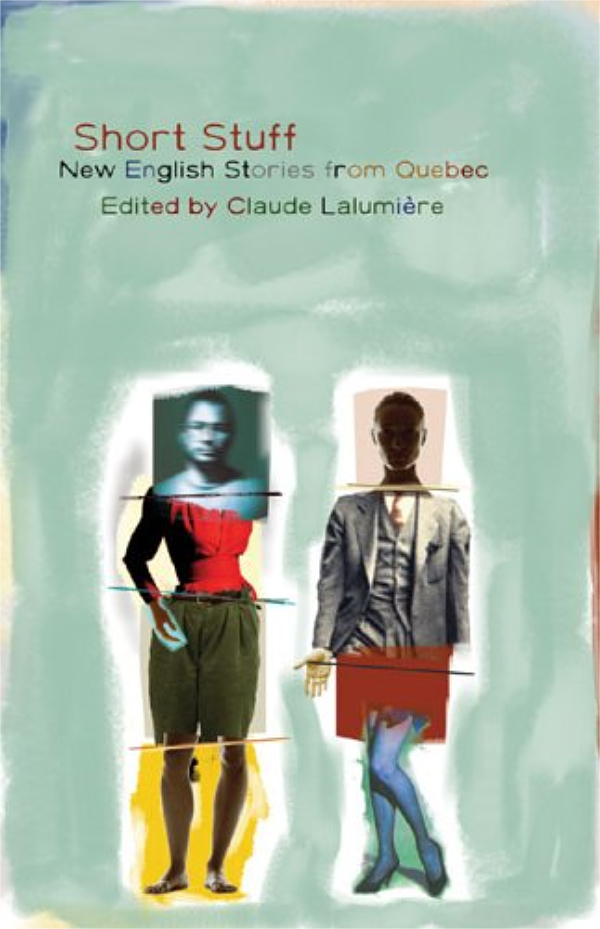
I was a finalist for the CBC/Quebec Writers Federation Short Story Competition for “Marathon of Hope,” published in Short Stuff: New English Stories from Quebec. Lalumière ed. (Véhicule Press).

2004

I was a finalist for the CBC/Quebec Writers Federation Short Story Competition for “Europa,” published in Short Stuff: New English Stories from Quebec. Lalumière , ed. (Véhicule Press).

I came Second Place in a literary competition for short fiction, for my strange little piece “Yard Art Love,” in Maisonneuve Magazine. The funniest part about this one is that the judges sent me an email that said, “why did you get second place instead of first place? Who knows? Luck of the draw!” Ha!
In addition, balancing all these close calls, and the few times I’ve won something, are the many times I haven’t even heard back from a publisher or a contest. Nothing. Nada. Crickets.

You get the picture! If at first you don’t succeed, try, try again! Some folks like to say that “second place is no place” and runners-up are losers. That’s baloney.

The fact is, many of my second-place finishes still allowed me to be published, or to receive some small award money, if not the big prize. And by keeping at it, every now and then I DID manage to win something! So if you’re ever wondering if second-place is worth it, my hot take is that it’s proof you’ve put in the 10,000 hours… and the answer is definitely yes!
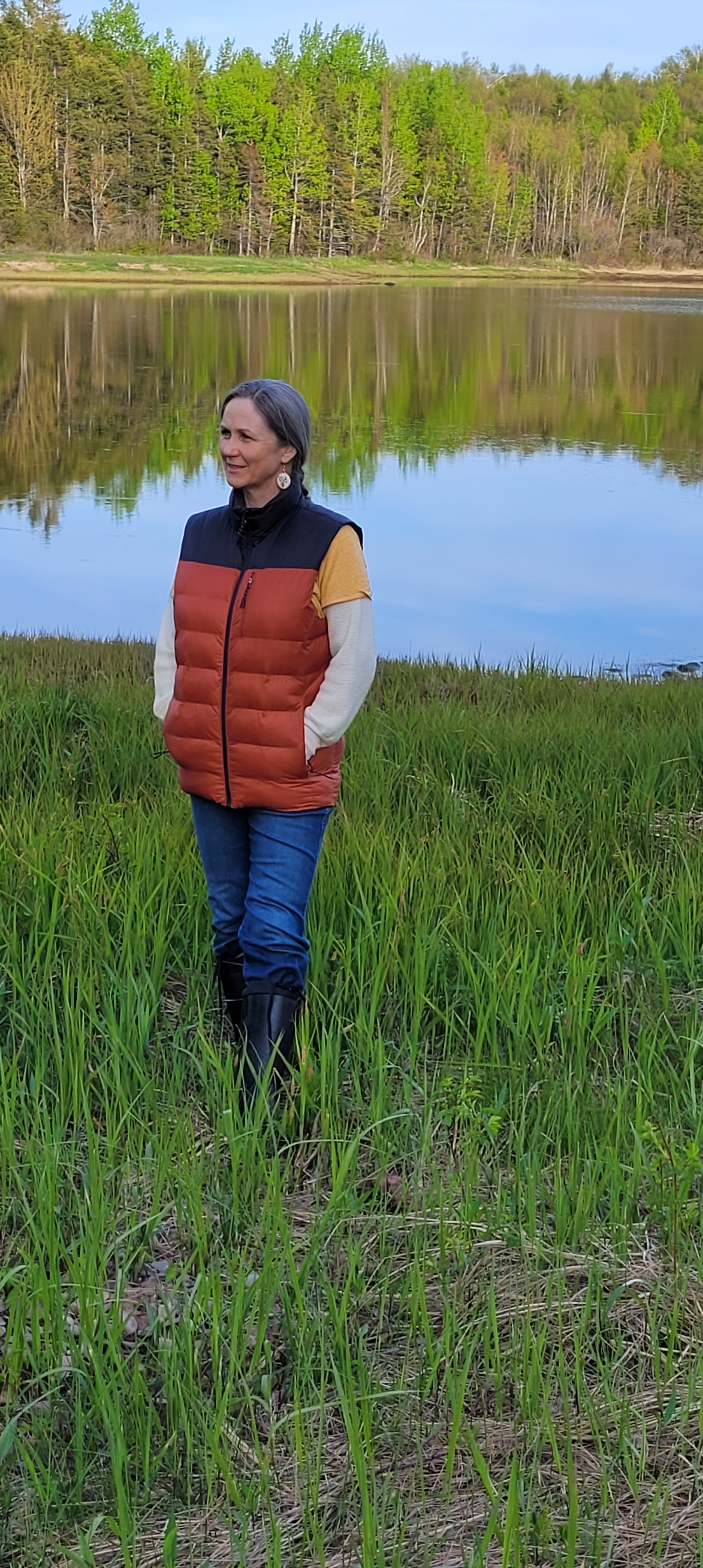
First Prize….definitely. But it took 10,000 hours.
Categories
Uncategorized

Leonard and Paul’s All in a Weekend Interview

Last weekend I had the pleasure of chatting with Sonali Karnick on CBC Radio One about “Prophets of Love: The Unlikely Kinship of Leonard Cohen and the Apostle Paul.” You can find the interview HERE. Sonali is a wonderful interviewer! We’ve chatted so many times that it felt to me a bit like a quick convo with a friend about my latest news. I hope you enjoy our visit as much as I did!

Categories
Uncategorized

The Faceless Messiah

The Faceless Messiah

A half-hour by car, north-west of Siena Italy, sits the lovely little hill-top town of Lornano. Meandering the twisty roads in Tuscany leads to all kinds of treasures, architectural, historical and culinary, and Lornano is no exception. If you escape the late afternoon sun to sit under the trees at the one restaurant in town, you may find that despite their delicious home-made pastas and the Chianti for which this region is famous, eventually you are distracted by the church sitting opposite the intersection.
The little sign outside says it was built in the ninth century, and the Romanesque architecture of the building – renovated in the 1770s – seems to confirm it. It’s a working parish, so there are devotional pamphlets and parish announcements stuck on bulletin boards at the back. The chairs sit haphazardly, perhaps from the last meeting or mass.
At the front, above the altar, is a work honouring John the Baptist. The minimal signage says that the fresco is the work of Giuseppe Nicola Nasini, dating from 1731, although there are other paintings in the small church which originate a hundred years earlier with Siennese artist Bernardino Baroni.
Nasini, lying on his back painting his pigments hurriedly into the wet mortar (the word fresco comes from this process of finishing the painting while the underlying stucco is still “fresh”) might have hoped that his work would survive the centuries, as it has. But presumably, he could not have imagined the oddity that has become his Christ: we see John clearly, sitting on a block of Tuscan marble and under a stand of Tuscan cypress, extending his arm to point to Jesus. Equally clear are the two figures on the other side – Peter and John? – who also observe the scene. The fresco is making reference to the passage from the Gospels where the Baptist is made to say: “Behold the Lamb of God!” To reinforce the point, the artist has placed a lamb to the right of the Baptist.
So far so good. But what Nasini could not have imagined is that, for some reason, the focal point of his fresco – the figure of Christ coming out of the water – is missing. Actually, the figure is not missing. There is a white space in the painting, in the clear outline of a human being, muscular, head turned to the side in an almost Roman pose. But it is only an outline. The details, including any face, are missing.
Whatever mysterious circumstances are responsible for deleting the details of the Christ from Nasini’s painting underline a deeper, theological and historical truth: Jesus, by being the man with no face, has become, over the centuries, the man of a thousand faces. Nasini, despite himself (one imagines) has captured this.
If ever there was an “every-person”, it must be Jesus. He was a Jew, born in what the Romans called Palestine, certainly of Semitic background. This much we know. One could, therefore, expect a certain look of this first-century Jew. Yet Jesus has been portrayed, without apology, as Korean, Nordic, African and North American, and dressed up as a peasant, a worker, a businessperson and a sailor. His eyes, depending on the artist, are blue, or black, or green, and his beard (usually he’s portrayed with a beard) has been just about every usual beard colour but red. Not usually an institution known for its openness and liberality, the church, from the beginning, seemed not only willing to see its messiah portrayed with such flexibility, but was the first to do so. Some of the earliest surviving representations of Jesus show him as a young, beardless male looking every inch a Greco-Roman Dionysus.
In the past century and a half, representations of Jesus have become even more varied, with Jesus showing up artistically as a tattooed gay male, a muscular prize-fighter, a tired soldier, a woman, and a laughing hippy.
The four canonical Gospels seem monumentally uninterested in describing Jesus with any of the kinds of details that now we find so interesting and revelatory. Instead, the Christian writings want to talk about some aspect of Jesus’ significance. What colour were his eyes? One can imagine the author of Mark answering: “what difference does it make? He is the Messiah!”
Paul, the earliest Jesus-follower to leave us much of a written record, is not only disinterested in what Jesus looked like, but comes right out and says that it’s not his concern and he doesn’t much care: “for once we knew Jesus from a human point of view,” he writes to his congregation in Corinth, in a phrase oft-quoted among Biblical scholars, “but we know him this way no longer.” Once you are the Messiah, the little details of your life don’t count. End of the subject.
A Jesus who can be “every man and woman” can appeal to every man and woman, and this surely must be one of the reasons why fact-laden Jesus biography was never big on the church’s list of priorities. The changeability of Jesus’ appearance turned out to be a big part of how to translate the message, not only linguistically, but also culturally, to new locations (note that Nasini’s John the Baptist is sitting on Tuscan marble below what appear to be a stand of Tuscan cypress trees). Every church, in every age, has translated the Bible into its cultural and geographical present….for which, to take Renaissance painting as an example, we are forever grateful. But we should remember that the church’s main reason for this flexibility was to aid the spreading of the Christian message. In Matthew’s Gospel, Jesus is portrayed, at the last judgment, as sending all humanity off to either heaven or hell with the words: “whatsoever you did to one of the least of these – in whom you should have seen me – you have done to me.” Thus both the church’s apologetics and its social concerns are based, in part, in seeing Jesus somehow embodied in others. Add to these practical rationales for ambiguity the mysticism of Paul, who concentrated on the believer being somehow incorporated “in” Christ, and you have every reason for a “Jesus for all time and all peoples.”
The little church in Lornarno holds a minor piece of art that contains a major theological truth: Jesus is most Jesus-like when he looks like our neighbours. Where do we find Jesus? Not in the Holy Land, but perhaps even right there, across the intersection, on a hot summer’s day.