Categories
Uncategorized

Eight-Month Strokeaversary: How’s My Heart?

Several kind folks have messaged me recently asking for a health update, and saying they’ve missed my posts. The fact is: I’ve had a stroke-and-surgery update half-started on my laptop for maybe six weeks! But so much has been happening I couldn’t finish it until now.

In this post, I’ll share some of those events. In a forthcoming post, I’ll focus on more of the details of my actual health update — especially for those who’ve also had (or have loved ones who’ve had) major strokes, or who’ve had PFO Closure surgery, or who may be waiting for news of my hand and leg!

# 1 Heart Surgery in Halifax

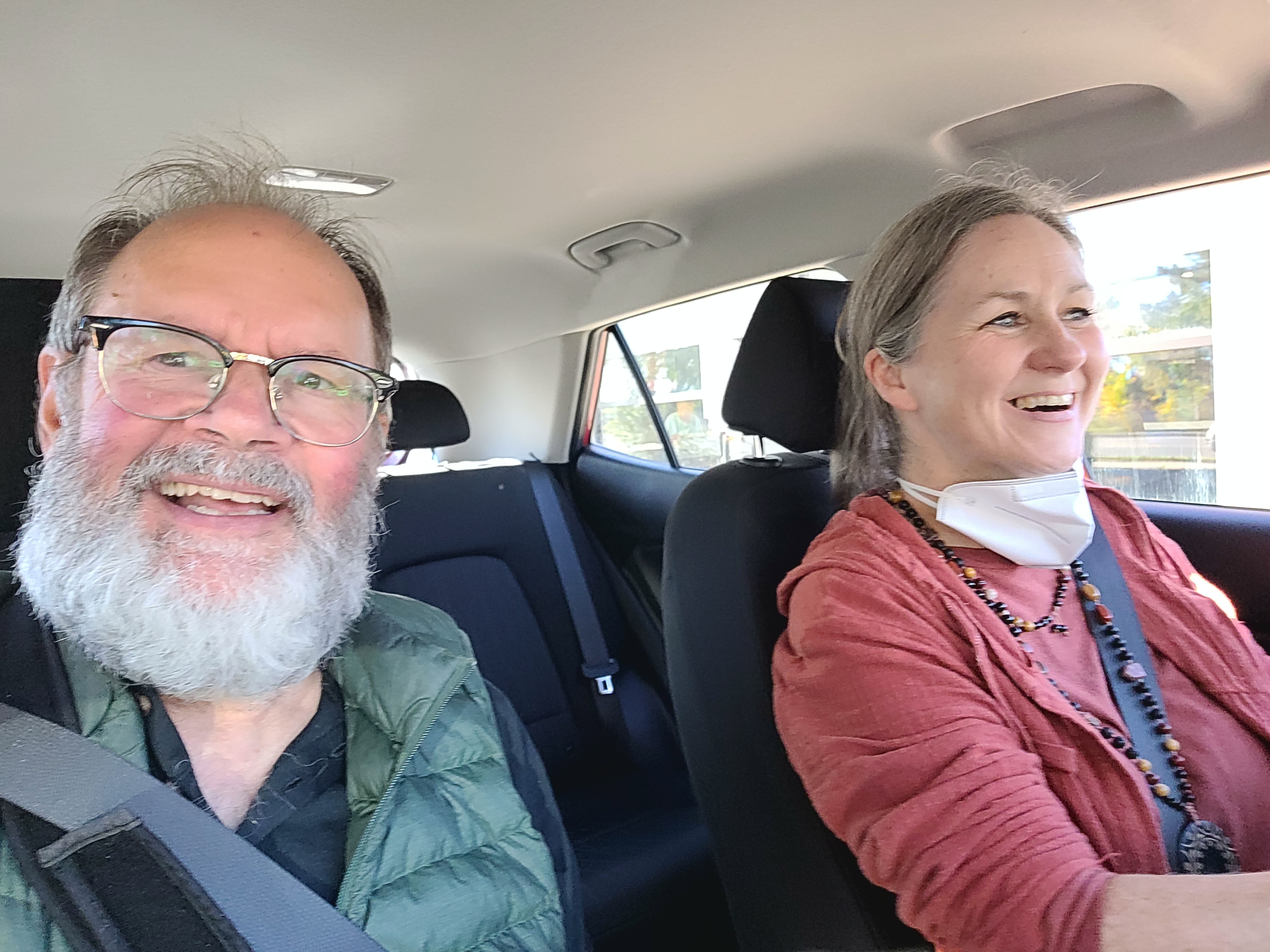
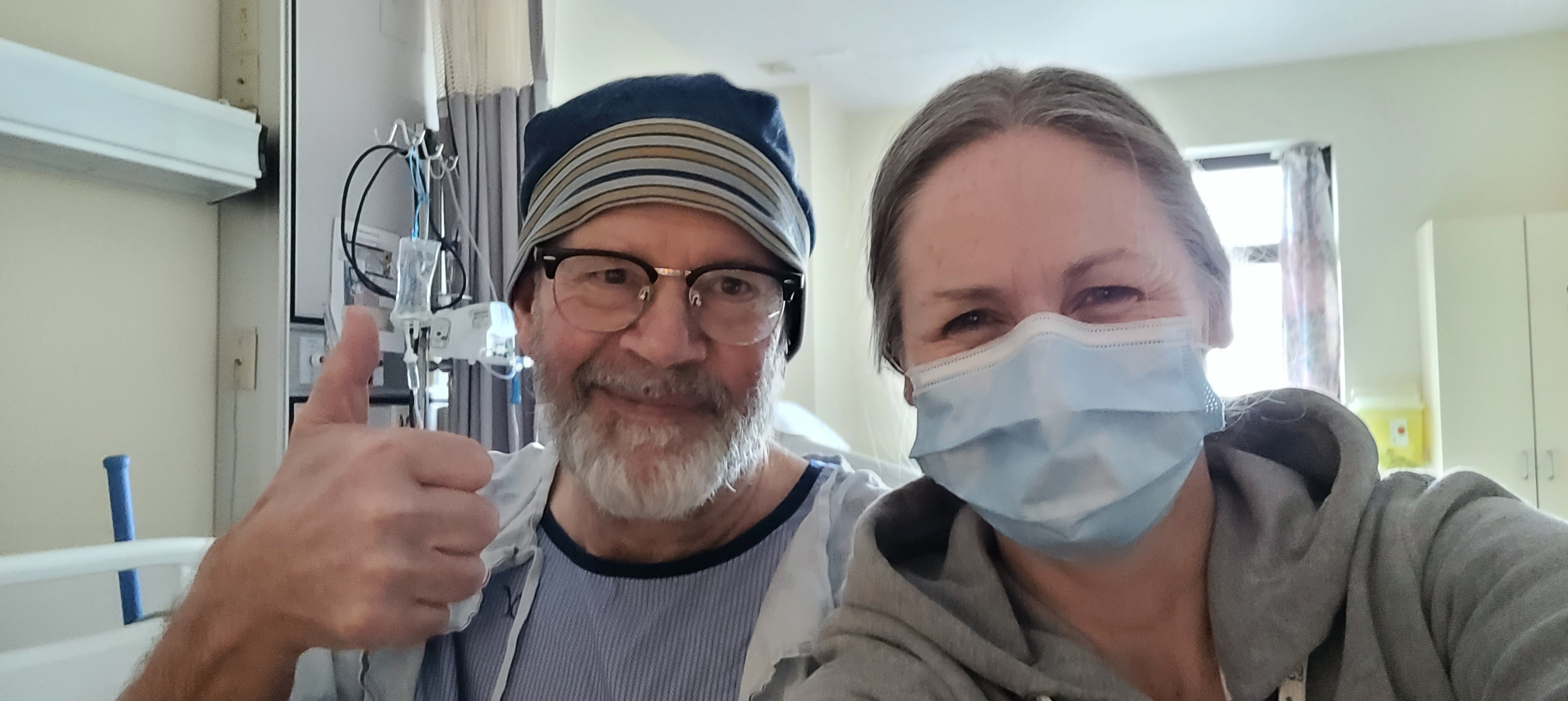
A month ago I had a procedure to close the PFO (hole between the upper chambers) in my heart. I was kept awake for the surgery which went well …. but it meant long hours of final grading to finish beforehand, travelling the 2 1/2 hours to Halifax the night before, with Sara as my chauffeur, nurse, and help-mate, the operation itself (more on that in my next post, but a pivotal moment was hearing the surgeon say “I’ve never done that before”!), then trying to follow doctor’s orders (no lifting for a month) to recuperate.
#2 A Book in The Hand

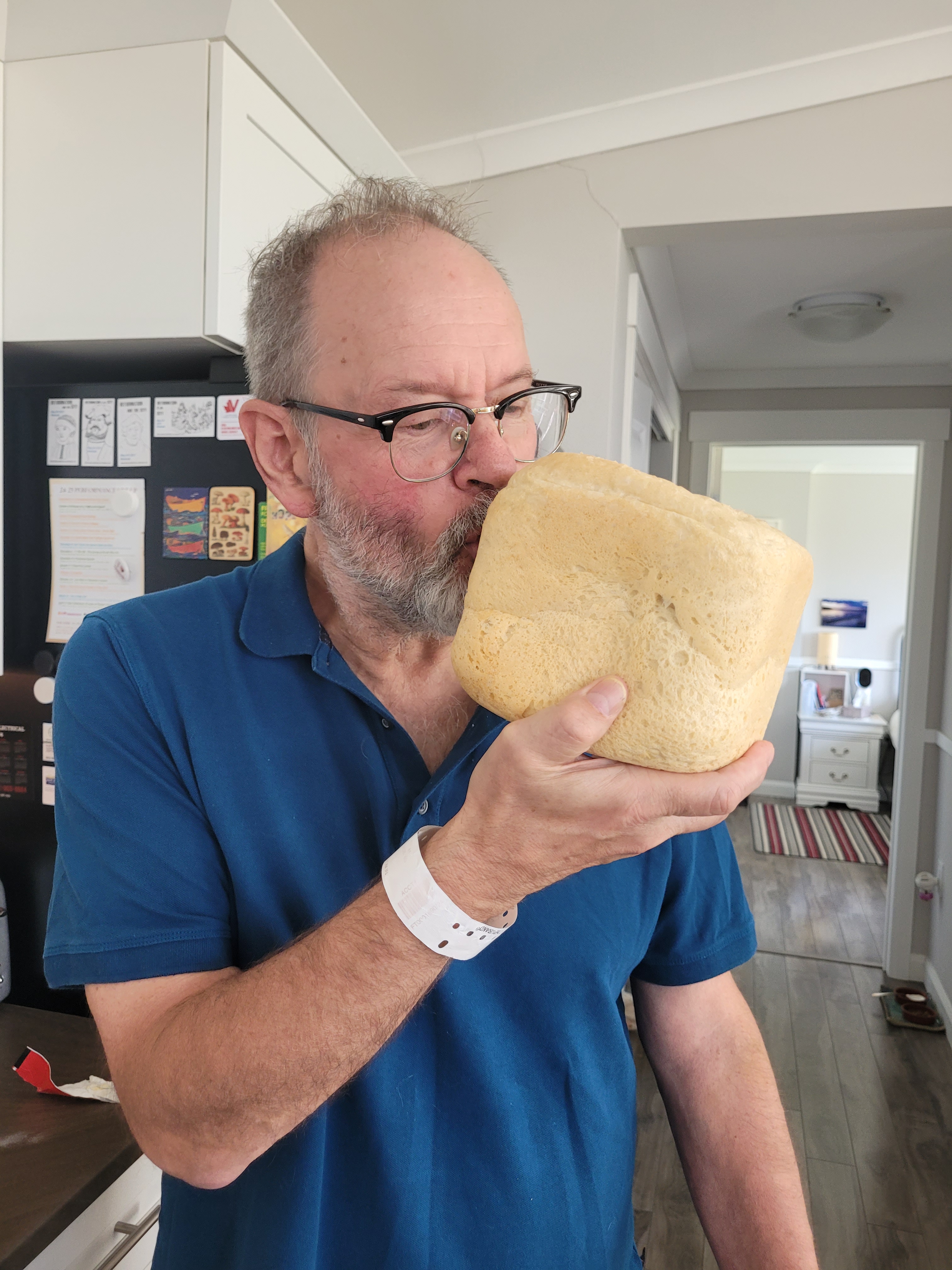
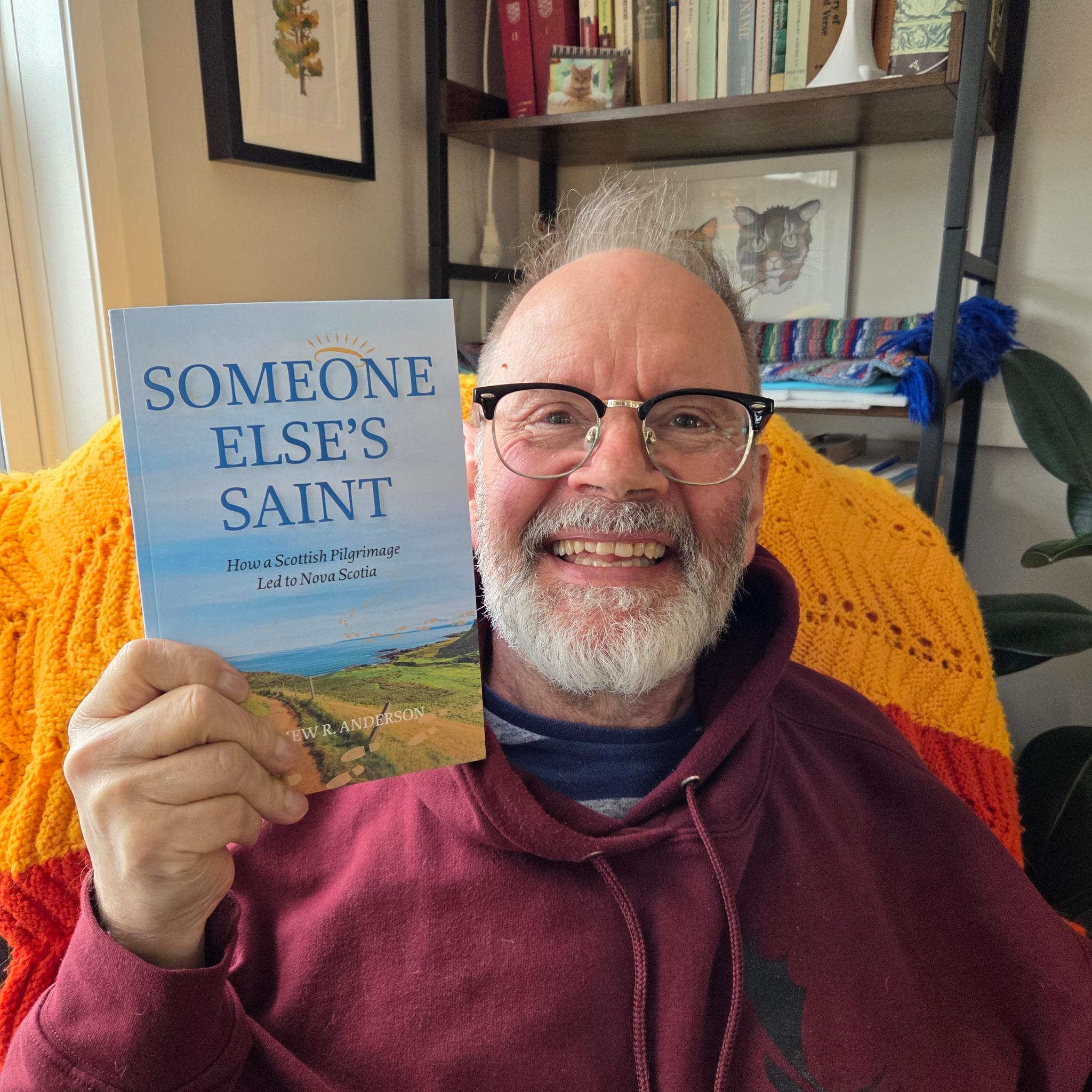
The moment we drove down our driveway on the trip home from the hospital, my – now patched up – heart leaped. Two boxes sitting on the doorstep turned out to contain the first shipment of my latest book, Someone Else’s Saint: How a Scottish Pilgrimage Led to Nova Scotia (Pottersfield Press, an homage to Nova Scotia and to Scotland, and second-place winner of the 2025 Pottersfield Creative Prize for Non-fiction). Sara lugged the boxes in, as ten pounds is my upper limit for lifting while I recuperate. Excitement soon yielded to post-op fatigue…

#3 Throw a Tartan Over It

Just a few days after my return from hospital, I was able to launch Someone Else’s Saint at the wonderful Antigonish Heritage Museum. It was a lovely warm evening, thanks to the talents and scheduling flexibility of friends Barry Mackenzie (colleague from the StFX history department and director of the museum), Lewis MacKinnon (poet and Executive Director of Gaelic Affairs for Nova Scotia), and star musician Mary Beth Carty (Canadian Traditional Singer of the Year 2024). During setup, Barry rapidly produced a variety of tartans, one to cover the cardboard recycling, one for the book table staffed by Sara, and one for the treats baked by museum volunteers. He confided that one of the museum’s life hacks is “just throw a tartan over it.” Even though there were other community events that night, and grade deadlines and convocation to compete with, my (now hole-less) heart melted to see departmental colleagues, community members, and even fellow pilgrims all the way from Halifax come out in support.

pilgrims extraordinaires: Brent King, me, Joann Chapman

#4 Medicine Hat Heartbreak

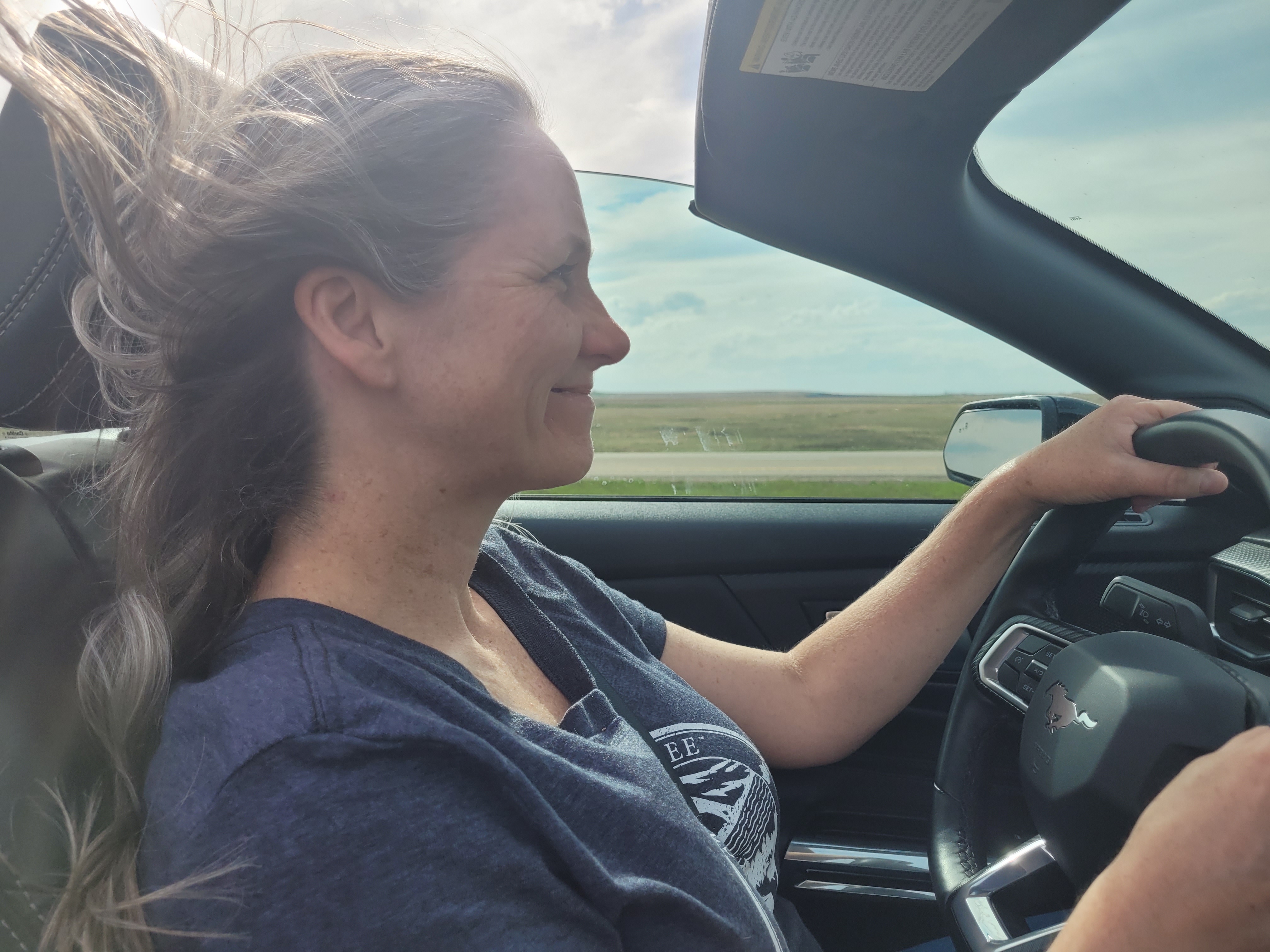
The biggest thing that happened has yet to completely sink in. My always-happy, full-of-life-and-fun, strong as an ox brother in law Vern Enslen had died – a shock to us all, but above all to my sister Kandace in Medicine Hat. As soon as it was confirmed that I could safely fly after surgery, Sara and I booked the next flight to Alberta. There (still somewhat unsteady on my feet) I conducted the largest service the funeral director had seen in years. “By far,” were his words: “It’s a testament to Vern.” Vern, pictured below, was a gregarious and good-hearted extrovert who made friends with everyone – turned out the funeral director was a buddy as well. We spent valuable time with my sister, still in shock, and with other family, including crowds of my cousins Sara had never met. We had booked a “manager’s choice” car rental out of Calgary airport to save money, and were surprised to be handed the keys to a 2024 Mustang convertible. We both had the exact same thought: it would be just like Vern to arrange this from the great beyond, to remind us of the jovial, sport-loving, boisterous tone he would want his friends to take as they celebrated his life well lived. It seemed odd after a funeral, yet somehow fitting, to be cruising back to the airport with the top down. After the accumulated fatigue of grief, unexpected travel, working with my sister to arrange the funeral, and the intense two days of visiting, we returned to Nova Scotia on a red-eye flight that involved no sleep and a LOT of walking–the most I’d done since the stroke. Whewff.

#5 Heart’s Desire

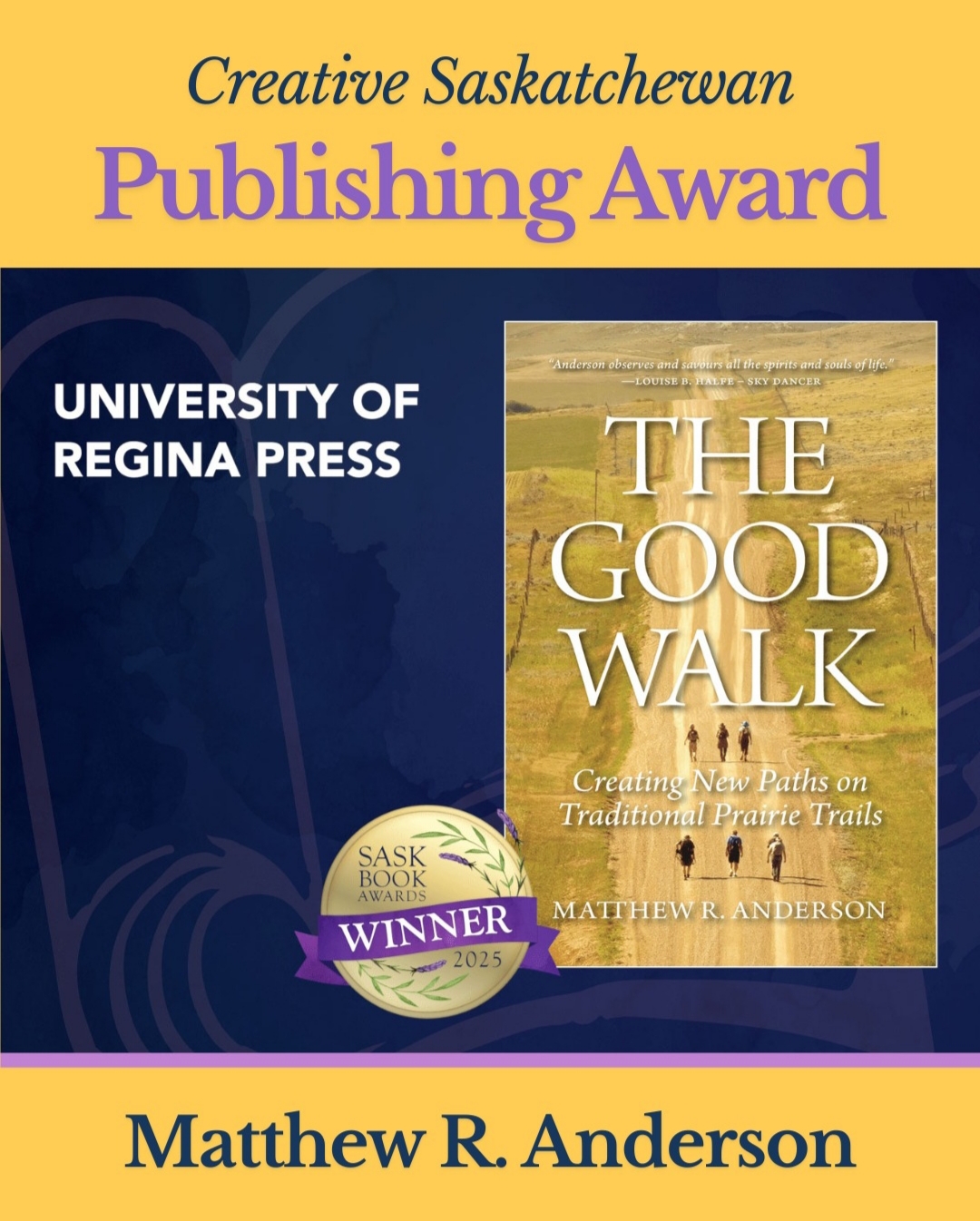
The night of the funeral turned out to also be the night of the Saskatchewan Book Awards gala. Before Vern’s death, I’d been notified that The Good Walk: Creating New Paths on Traditional Prairie Trails was shortlisted. An unimaginable dream come true, for a book so close to my heart — a memoir of my family’s history and our prairie walks, intertwined with the troubled history of Canada’s prairies. But after Vern’s death, the nomination fled to a dusty corner of my mind. Immediately following the funeral, I collapsed into bed at our Medicine Hat hotel, and didn’t even think to check for the winners. Then an email pinged in from my friend and fellow walker Simone Hengen, who was attending the gala in Saskatoon. She sent a photo of what she was seeing on screen at that moment: a Powerpoint showing The Good Walk. At first, I didn’t understand what I was looking at. Then I saw the little gold medallion that said “winner.” University of Regina Press had won the Creative Saskatchewan Publishing Award for my book! It was strange to be jubilant in the midst of loss, but again it felt fitting as I remembered that Kandace and Vern, with his eternal ingenuity and myriad connections, had done so much to outfit me for the long walks across the Prairies recounted in this book.
#6 Faint of Heart

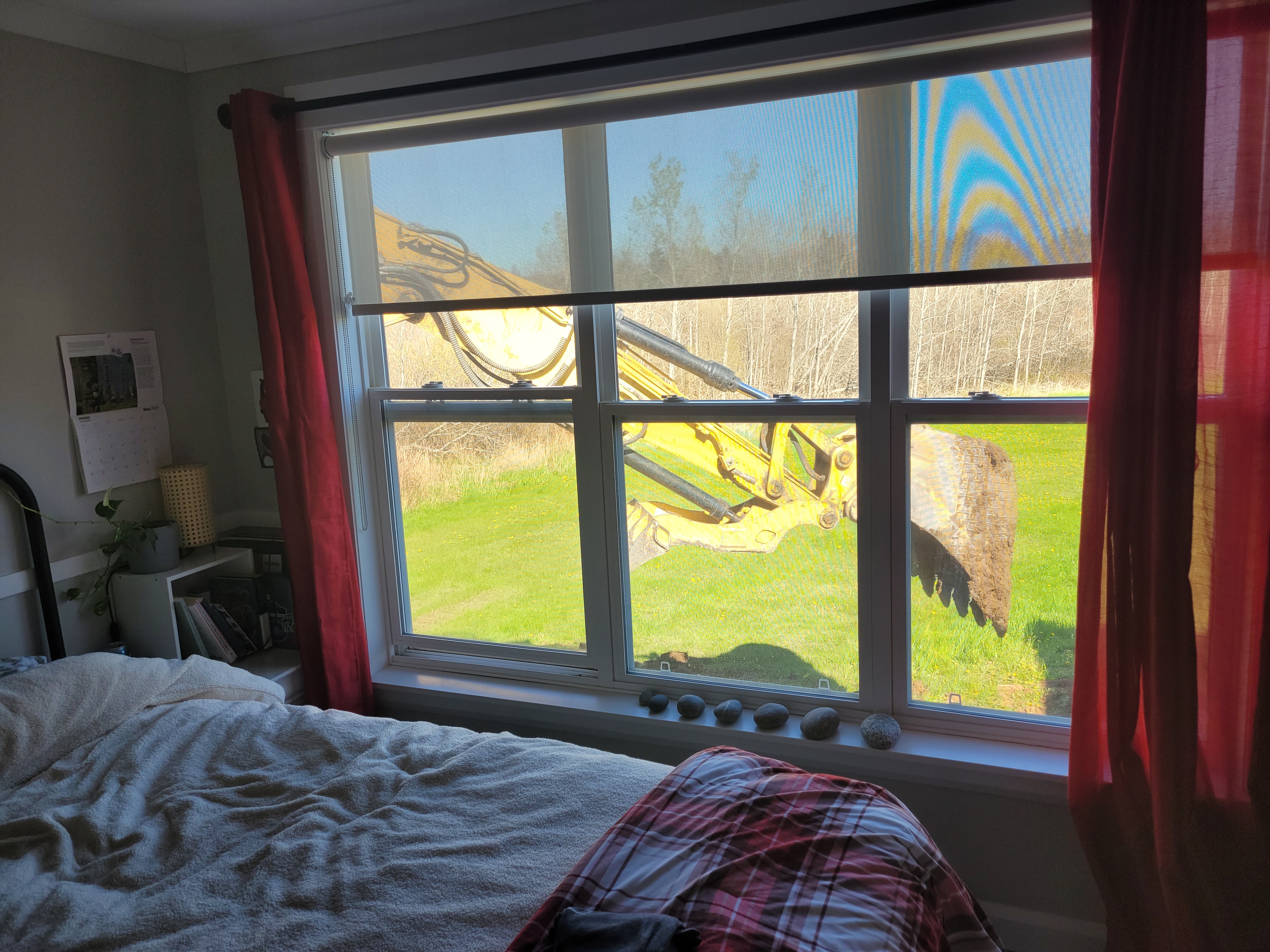
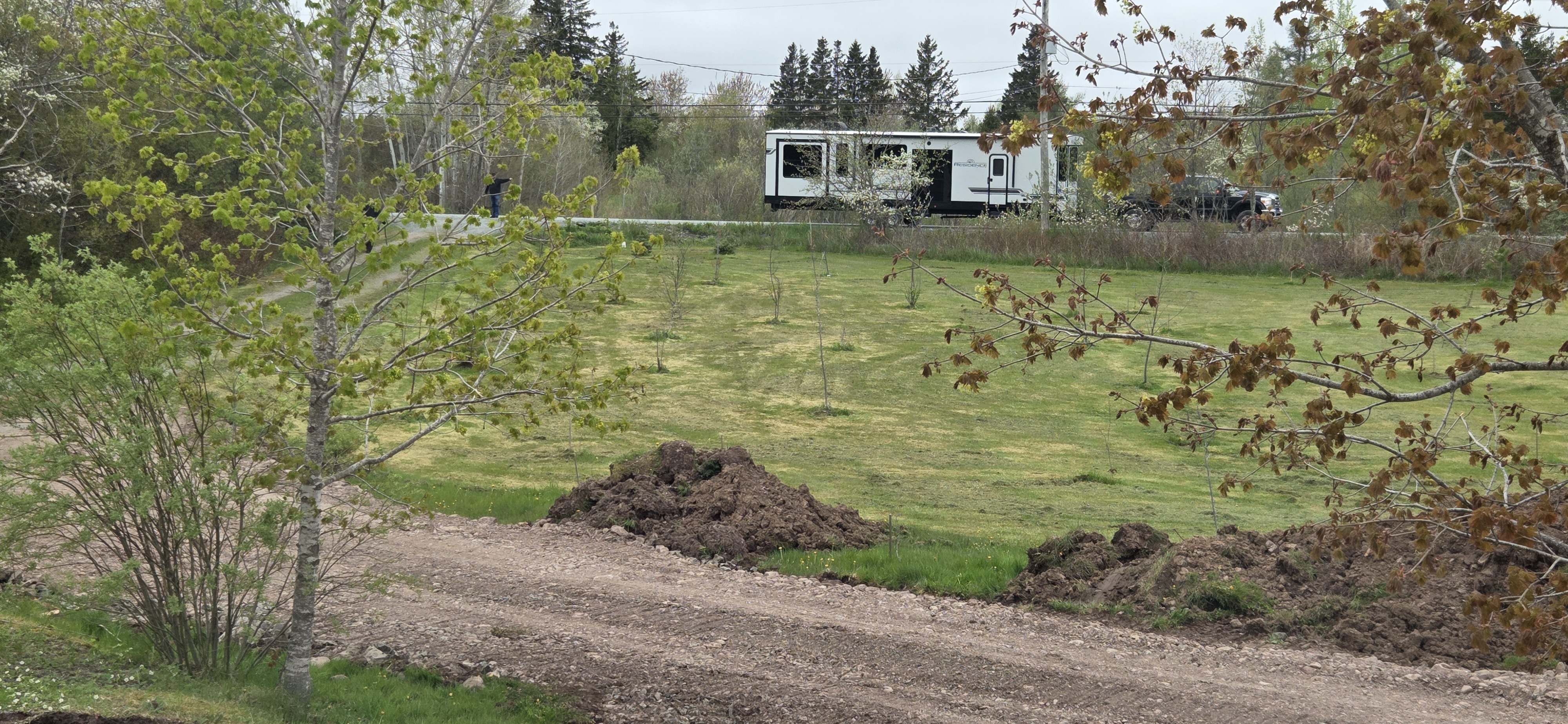
Shortly after we arrived back home, earth-moving equipment showed up to widen our driveway and build a gravel platform for the trailer Sara’s parents Winston and Shirley are going to use as their summer cottage on our property. The platform and driveway were a great success – as an added bonus, they evaded a future problem when they spotted an issue with our septic tank and promptly fixed it. However, the delivery guy from Bouctouche NB didn’t have the gumption to manoeuvre the trailer into place. He was nervous about backing up, and afraid to raise the telephone wires a few inches to clear the air conditioner on top of the unit. In the end he abandoned the huge trailer on the side of the road and went back to New Brunswick, leaving us hoping for the best. Just then, a typical Pomquet neighbour stopped to chat. (No strangers here, only neighbours waiting to happen.) She offered her husband Joe’s tractor and services. The next day, Victoria Day, Joe Rennie showed up and had the unit parked in no time. Sara used our Canadian Tire snow rake duct-taped to a branch clipper to hold up the wires for the trailer to clear. Now, if we can just nab the electrician for hookup, Sara’s parents’ move will be complete…

#7 Heart-Recovery

I want to be sure to mention this: while I’ve posted a lot about my writerly highlights above, life is life. It’s also true that during these last few weeks I got two disheartening manuscript rejections from publishers, and I heard that I’d not received a different book prize for which I’d been shortlisted!

You get the picture. Between surgeries, book prizes, book launches, manuscript rejections, tragic funerals, and major construction we’ve been through quite the roller coaster of events and emotions. Major ups and downs. It feels like a year’s worth of changes have been jammed into a few short weeks.

The surgery and the busy-ness have certainly affected my recovery. More on that very soon in my next post.

Categories
Uncategorized

SOUTH BRANCH SCRIBBLER

This prairie boy remembers feeling on top of the world when he got called a “Montreal Creative” by Nantali Indongo on CBC Radio One Montreal in 2012:

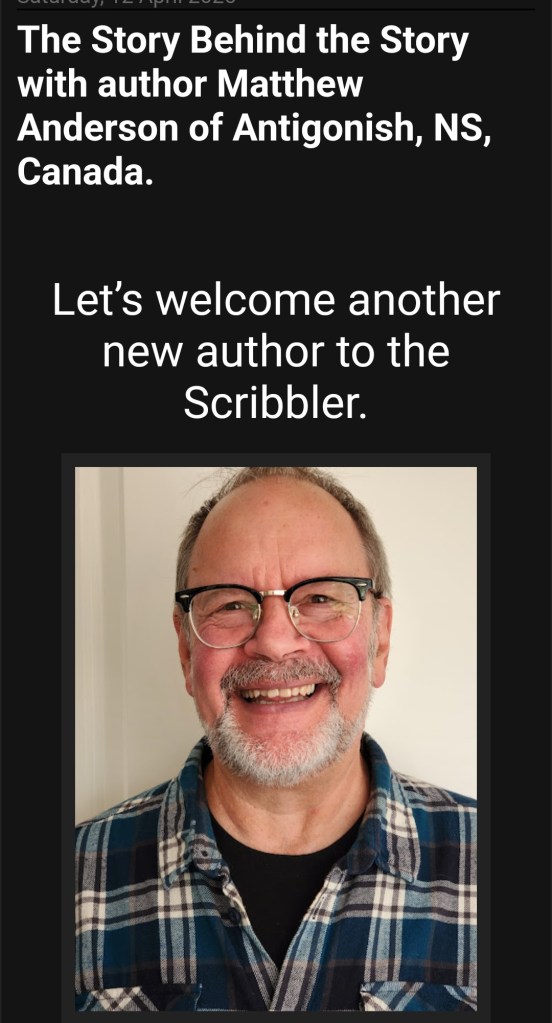
But I have to admit being “author Matthew Anderson of Antigonish, Nova Scotia” feels pretty great in 2025. That’s my moniker in this “Story Behind the Story” interview for the South Branch Scribbler. Interviewer Allan Hudson is a New Brunswick writer and promoter of writing, and The South Branch Scribbler is his blog. He reached out to talk about the backstory of Someone Else’s Saint: How a Scottish Pilgrimage Led to Nova Scotia, published this coming week.

If you live near Moncton NB, I’ll be joining Allan at the 3rd Annual Greater Moncton Riverview Dieppe Book Fair, April 26 2025.
Riverview Lion’s Centre 10am to 3pm.

If you live near Antigonish, the official launch of Someone Else’s Saint will be at the Antigonish Heritage Museum on May 1 2025 at 7pm, where I’ll be upstaged by the glorious Mary Beth Carty and blessed in Gaelic (at least I hope it’s a blessing – my Gaelic isn’t too good yet) by Lewis MacKinnon.

If you live further afield, Someone Else’s Saint is available from Indigo, or by request at those two symbols that the world is still a good and just place: your independent bookseller or your public library.

Categories
Uncategorized

In the Bleak Midwinter of my Stroke

Matthew Anderson, Pomquet NS

excerpt…

“Like many others, I love the hymn In the Bleak Midwinter. I always have. But as someone who walked to school through Saskatchewan’s -40 mornings, shovelled out cars in Montreal’s worst snowstorms, and now checks that the generator is ready when a Nova Scotia blizzard threatens, I’ve always felt that for Canadians, the timing of this favourite hymn is a little off.”

This is how my piece in the most recent Canada Lutheran (Jan/Feb 2025) begins. Since many folks I know and who follow this blog aren’t Lutheran, and won’t receive the wonderful ELCIC (Canadian Lutheran) magazine, I’m showing that piece here. Enjoy!

Categories
Uncategorized

Strokeaversary week 10: Handcamp Antigonish

Here’s a slice of hospital life from Nova Scotia:

Three elderly men, two with walkers, are standing in the hallway outside my room. “I was going to go home,” one says, “but all my neighbours are here.”

The second man, Jack, pulls out a photo developer’s envelope he carries everywhere. “Jack was attacked by a bear,” the third explains, pointing.

“Got photos?”
“Yeah, there’s five of ’em.”
“Five photos?”
“No, five bears!”

Jack hitches his pants before he regales them with the story: “I was working in the yard. Didn’t see him. He knocked me over the woodpile.” The second man takes the photo. Peers at the bear, then at Jack. “Prob’ly lookin’ for work,” he pronounces.

A visitor walks by, muttering to herself: “How many Donald MacDonalds are there in this hospital?”

Another visitor is about to walk into the room opposite when a passing orderly points to the “Contagion Precaution” sign requiring mask and gown. The woman dutifully dons a paper gown, calling out to someone deep in the room: “Donald, you’re on quarantine? You musta’ been a bad boy!”

I’ve been fortunate to hear from some of you who’ve also spent long periods in hospital. Many of your experiences were similar to mine: the frustrations of wheelchairs and bedpans placed out of reach, the fatigue and the ennui of having to strategize everything from blankets to bowel movements in ways the able-bodied don’t have to think about. The way that occasionally, new nurses who don’t know me ignore me, standing there with pen in hand to sign myself out for the weekend, and speak right past me to Sara as if I’m incapable of my own decision-making.

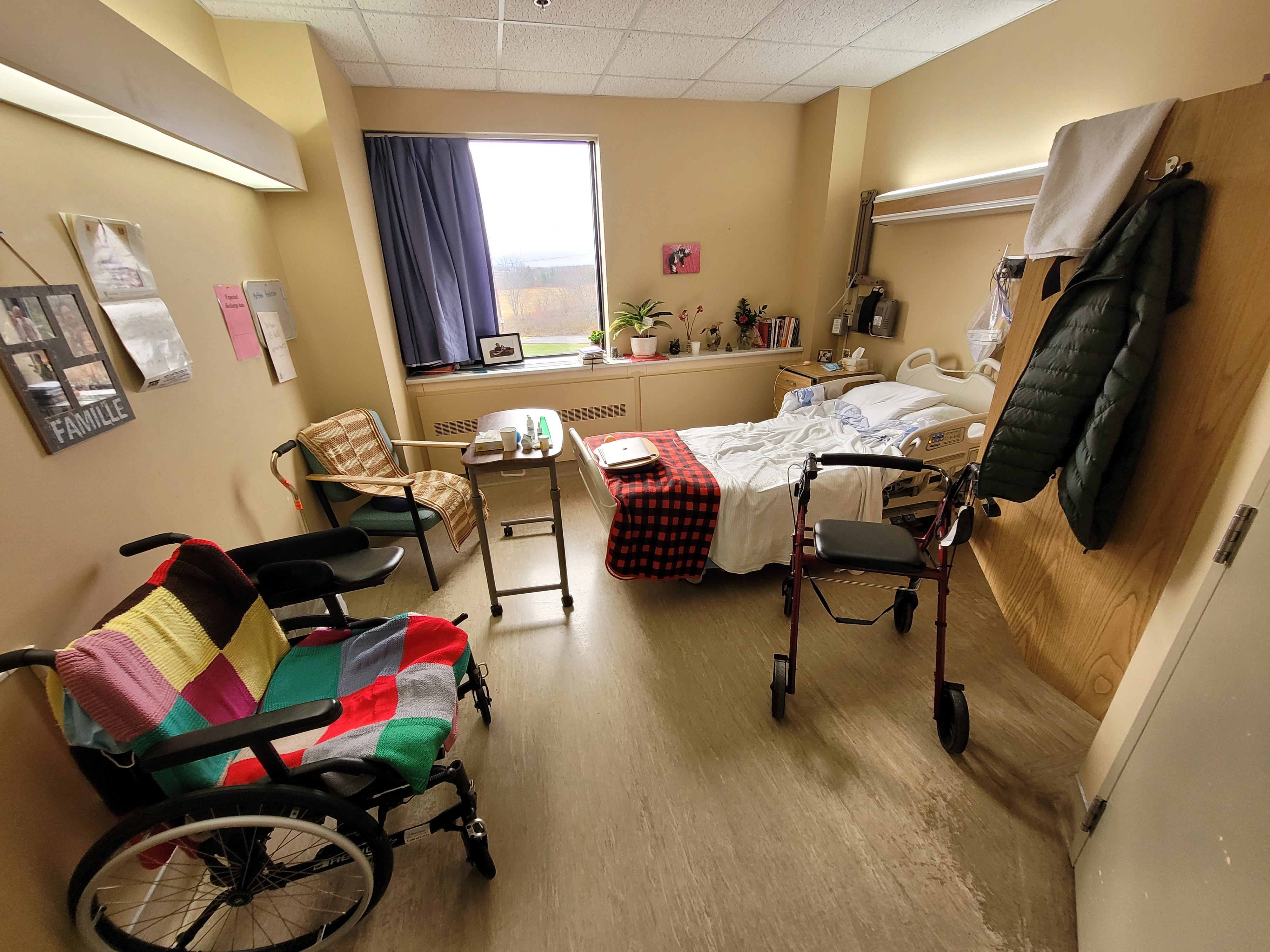
But there are also unique positives to being hospitalized in rural Nova Scotia. Overhearing the bear story, or Sara texting me to say she saw a bobcat at the end of our driveway on her way home one night, after her usual routine of tucking me in. What a gift to have her fussing around my room straightening things, reading to me, or sitting working alongside. (I am back into writing my Jerome project, part of my work as Gatto Chair at StFX. More than once, Sara and I have slipped and called my room, “the office”!) The atmosphere at St. Martha’s Regional Hospital is relaxed and humane; there are no set visiting hours–Sara is free to come whenever she can, stay as long as she likes, and to decorate my room with plants, lights, quilts, and art on the walls. Once last week four nurses came in just to see my room and breathe deeply. “It’s beautiful in here,” one remarked, “it’s the most relaxing room in the hospital!” I said only one word in response:

“Sara.”

Another distinction is delicious local food. I order from a small menu that includes a tasty seafood chowder that would cost quite a bit in a restaurant. You can have fresh poached haddock, or roast turkey with mashed potatoes, gravy, and cranberry sauce on demand. There’s excellent lemon meringue pie in the volunteer-run cafe. If you forget your wallet as I did one evening, they’ll just give you the item and tell you to pay it forward.

The portions do tend to be geriatrically small. Combined with the lack of snacks, butter, or oil (I’m on a cardiac diet), very few breads and pastas, and no glass of wine with dinner, I’ve lost 20 pounds since my hospitalization. All good – the weight loss puts me where I should have been anyway. But I wish it hadn’t taken a stroke!

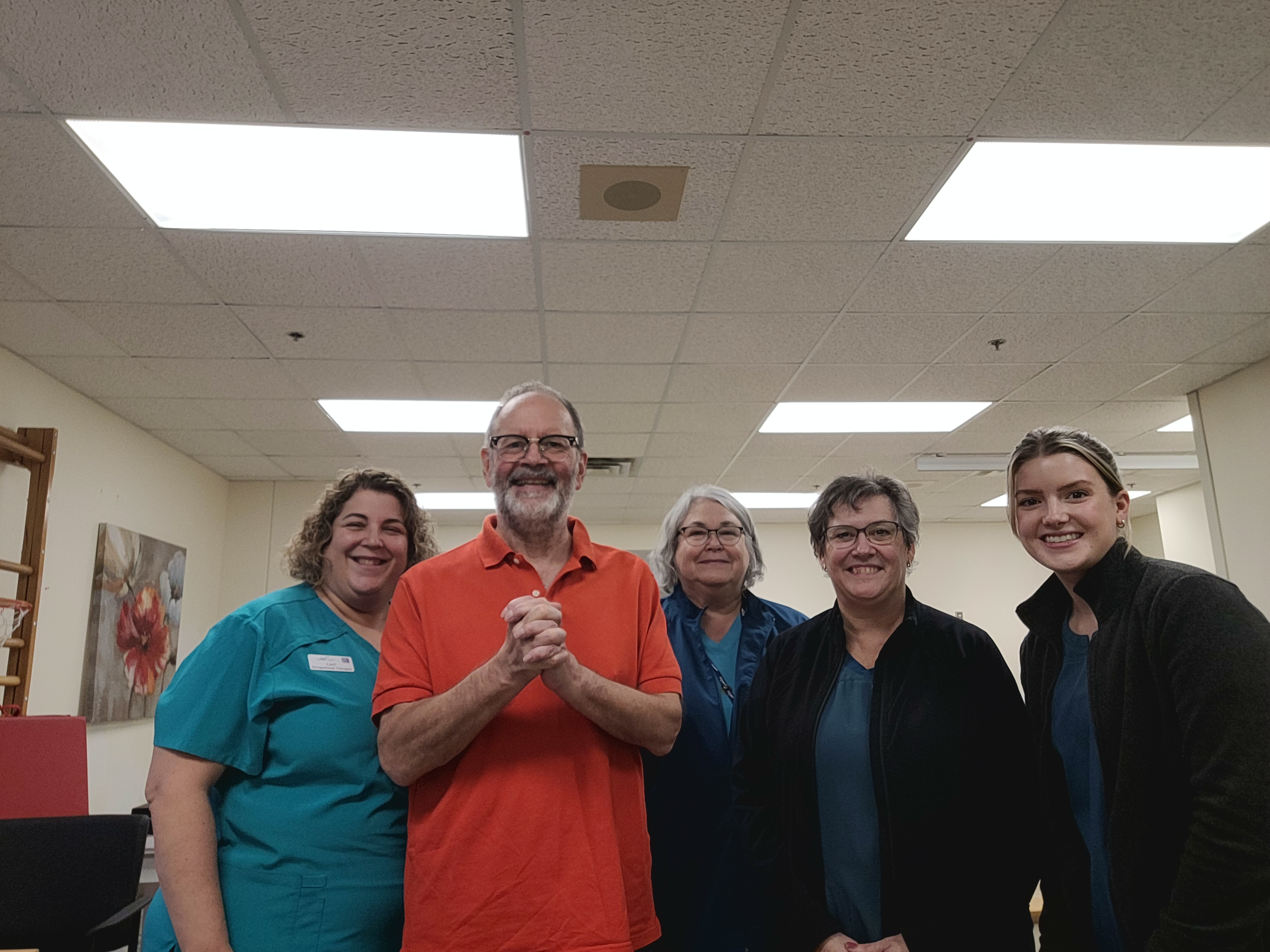
Big news this week: I’m not moving. The Halifax rehab centre only takes Haligonians. When they learned I wasn’t eligible for “Hand Camp,” my incredible team here (Lori, Lina, Lee, and Ria, above) swung into action. Lori produced a binder labelled “Matt’s Handcamp” and teased me, “it’s going to be hard work from here on in.” My binder has daily check-mark columns for the next three weeks, with slots for shoulder, arm, and hand therapy, physio on my leg, “magic mirror” visualization (fooling the brain with a mirror image), and other homework.

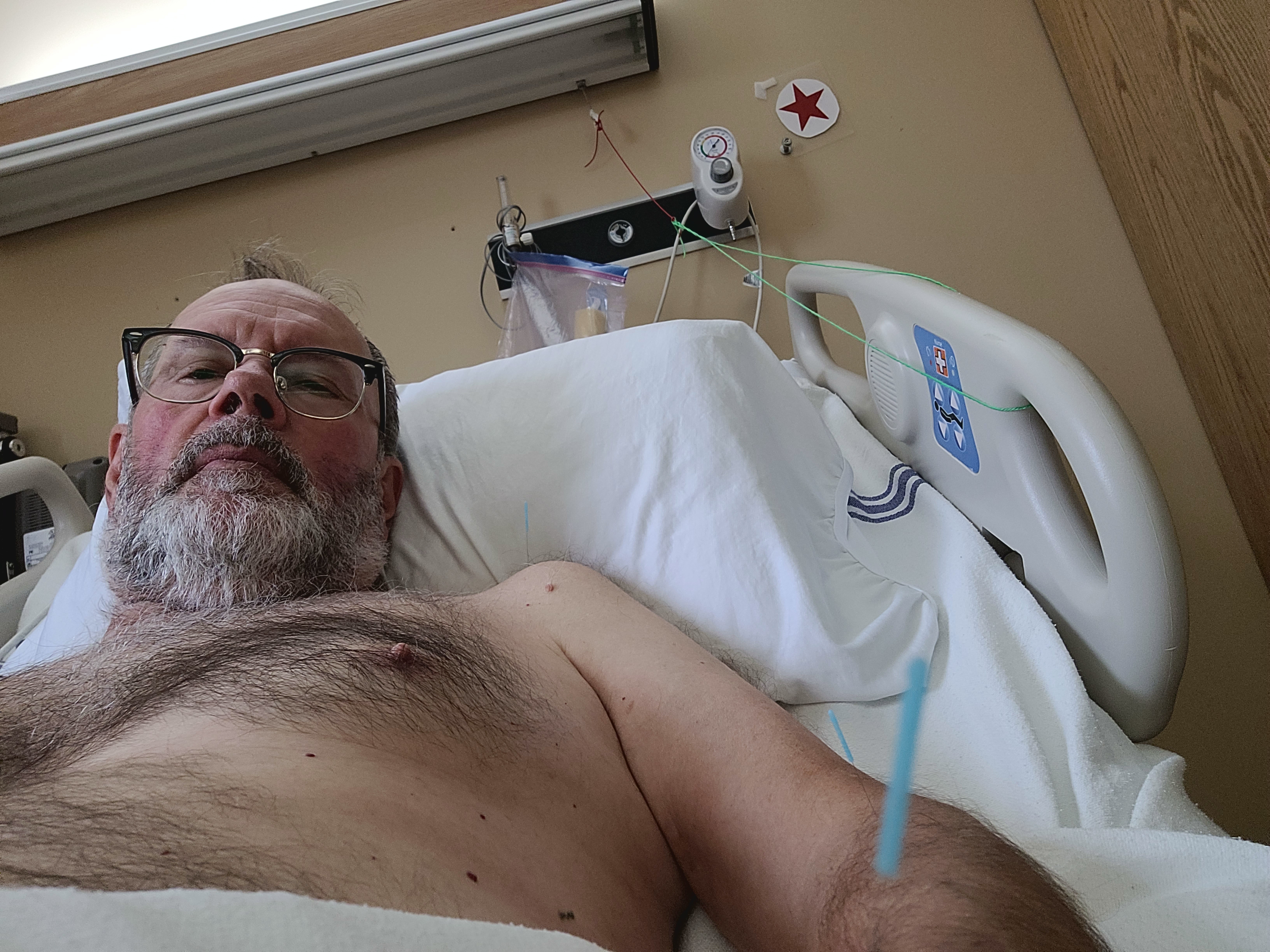
Lee has started me on the “big” exercise bike and treadmill. She’s doing gentle acupuncture on my left arm. I’m supposed to take weekends off, but weekdays until discharge are dedicated to more intensive therapy, whenever they can get me in.

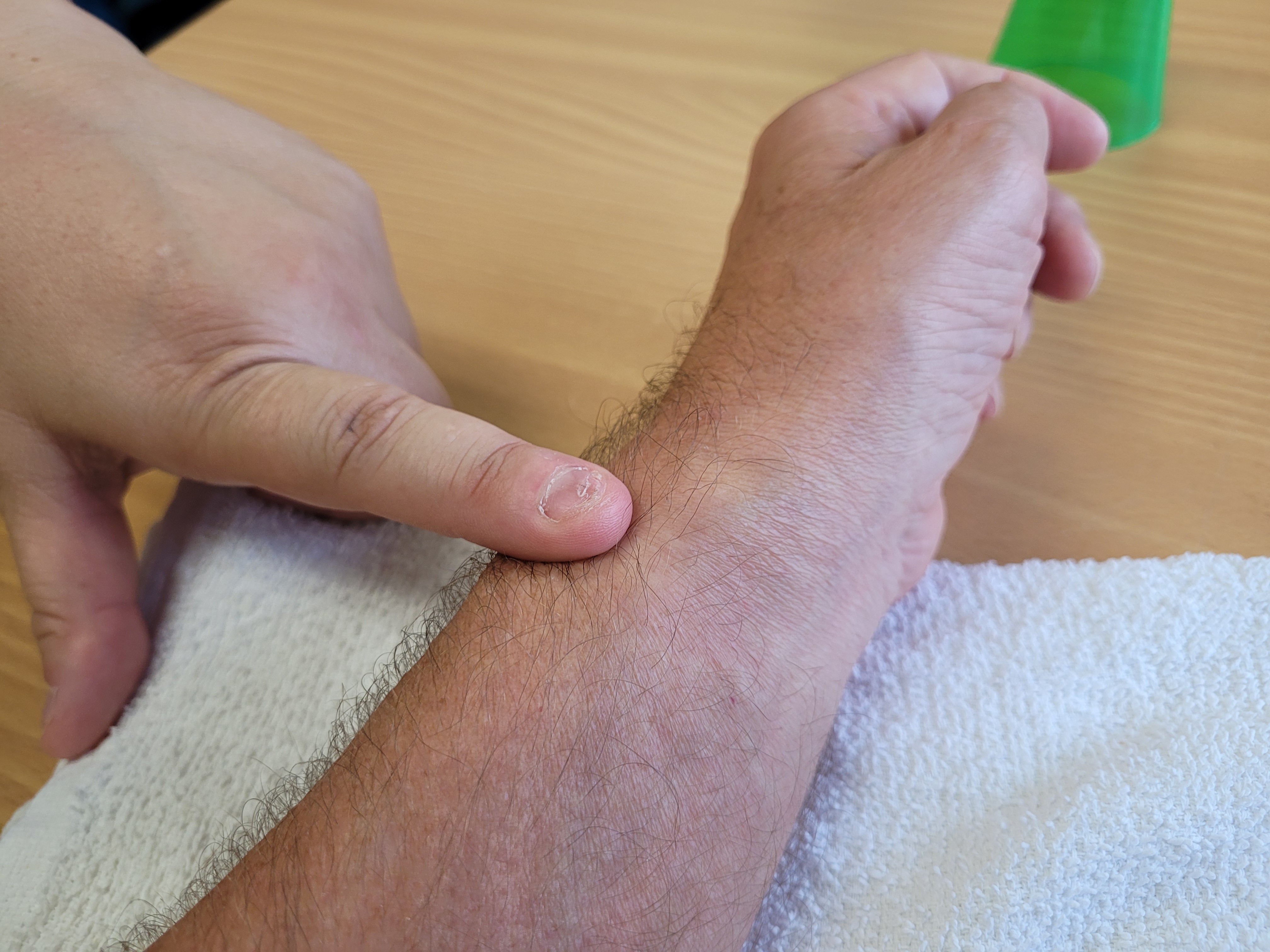
Lori has been researching some new OT techniques out of Japan that involve massaging and “slapping” the hand tendons alternatively to shake them out of cramps. (The hand has been seizing up a lot.) My new music therapist dropped by for the first time, getting me to tap a pen with my affected hand while he played the blues. Thanks to my friend Nadine from Montreal (herself a music therapist), for suggesting ways to use familiar music to improve my walking speed and gait!

Improvements: I can now lift my arm into the air while lying on my back and touch my right hip with my left hand (I should be good at that – it’s a disco move!) I can “curl” a one-pound barbell and raise a washcloth up to my face or under my arm, using my left hand. But I have no strength yet to scrub. I can move a cloth around a counter more freely – wiping cupboards is clearly in my future. I managed to pick up a marker and draw lines with my left hand on a sheet. Sometimes I can pick up and drop wooden blocks, although straightening my fingers afterwards continues to be difficult. Like a baby bird on its first solo flight, I’ve ventured out on my first walks down the hall without cane or walker. Sara and I danced a real two-step, and she’s doing less lifting to keep my left hand in the air. I took my first standing shower at the hospital, holding the support bar for the first time with my left hand.

Last week I had another left-side dream. I was in a large underground garage where an old muscle car, a 1970s Barracuda, had been left behind piles of boxes, old mattresses, and junk. In my dream I was putting oil into the rusted engine and trying to clear a path to drive it out. Speaking of which: not saying anyone did this, but IF a person had tried to drive their automatic transmission car just around their yard last weekend using their unaffected right hand and leg, it may have worked out perfectly! For myself, it looks like I will have to take a drivers’ test before I’ll be allowed on the roads, which makes sense.

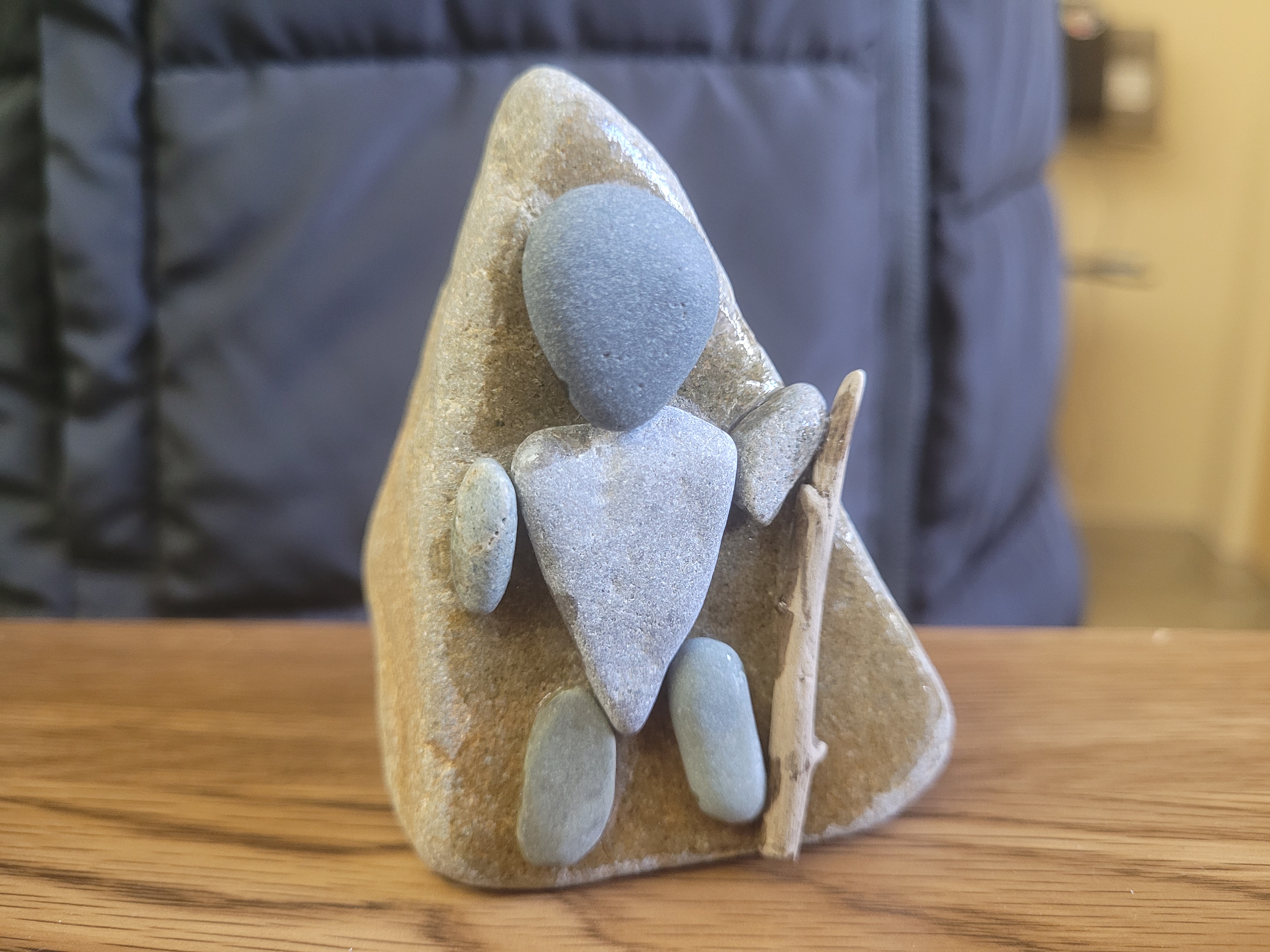
This week is the 9th anniversary of Sara and I meeting, so she picked me up from the “office” after work one night this week and we went out to eat for the first time in months, with a Gabrieau’s gift certificate from our departmental colleagues! I was also blessed with delightful visitors: Phillip Kennedy, a fellow walker along the Annapolis Valley, Tonya Fraser, who gave me some hand-picked Labrador Tea and a stone from the local beach, Leona English, another walker and a professor emeritus at StFX, and Andrea Terry, who in addition to leaving me several blueberry-themed gifts, reminded me that it was exactly one year ago that we had so much fun co-curating Philip Szporer’s and Marlene Millar’s art show “1001 Lights”! Many thanks also this week to my friend Dr Meredith Warren in Sheffield, UK, for providing a lecture for “my” class on “The Ancient Hellenistic Novels.”

Speaking of small-town advantages, those who come to visit have to pay to park at the hospital. The whopping sum for a full day or any part thereof is … a twonie. (The first time we realised this, we laughed out loud, comparing it to big city parking costs.) While I was a little disappointed at first not to be going to Halifax for fancy therapy, I feel incredibly fortunate to be right here in Antigonish, where an entire talented physio team has taken me on as a project, and where I can focus on my recovery (and my StFX research) from such a warm and hospitable room. I am sure that much of this good fortune comes from the prayers, meditations, thoughts, and intentions so many of you are keeping up for me. Thank you!

P.S. I was surprised and very, very thankful to get the news this week that Prophets of Love: the Unlikely Kinship of Leonard Cohen and the Apostle Paul is one of three non-fiction works short-listed for the 2024 Vine Canadian Jewish Book Awards! What a gift to my spirit to receiving an honour for past writing at a time when I’m typing with one hand!

Categories
Uncategorized

A Room of One’s Own: strokeaversary week 9

I remember walking from Melrose Scotland, to Holy Island, England, in 2013. After some extremely hot and tiring days, the path took me up a 300-metre ascent to a rocky outcrop. (There was also the small matter of a pasture with bulls, which can happen when you have the “Right of Responsible Access” to pastureland–but that’s another story.) At the top I stopped to catch my breath. Turning to see the view, I realised that there on the distant horizon two valleys over, I could make out the ruins of the Roman fort where I’d stopped on my first morning of pilgrimage, two days before.

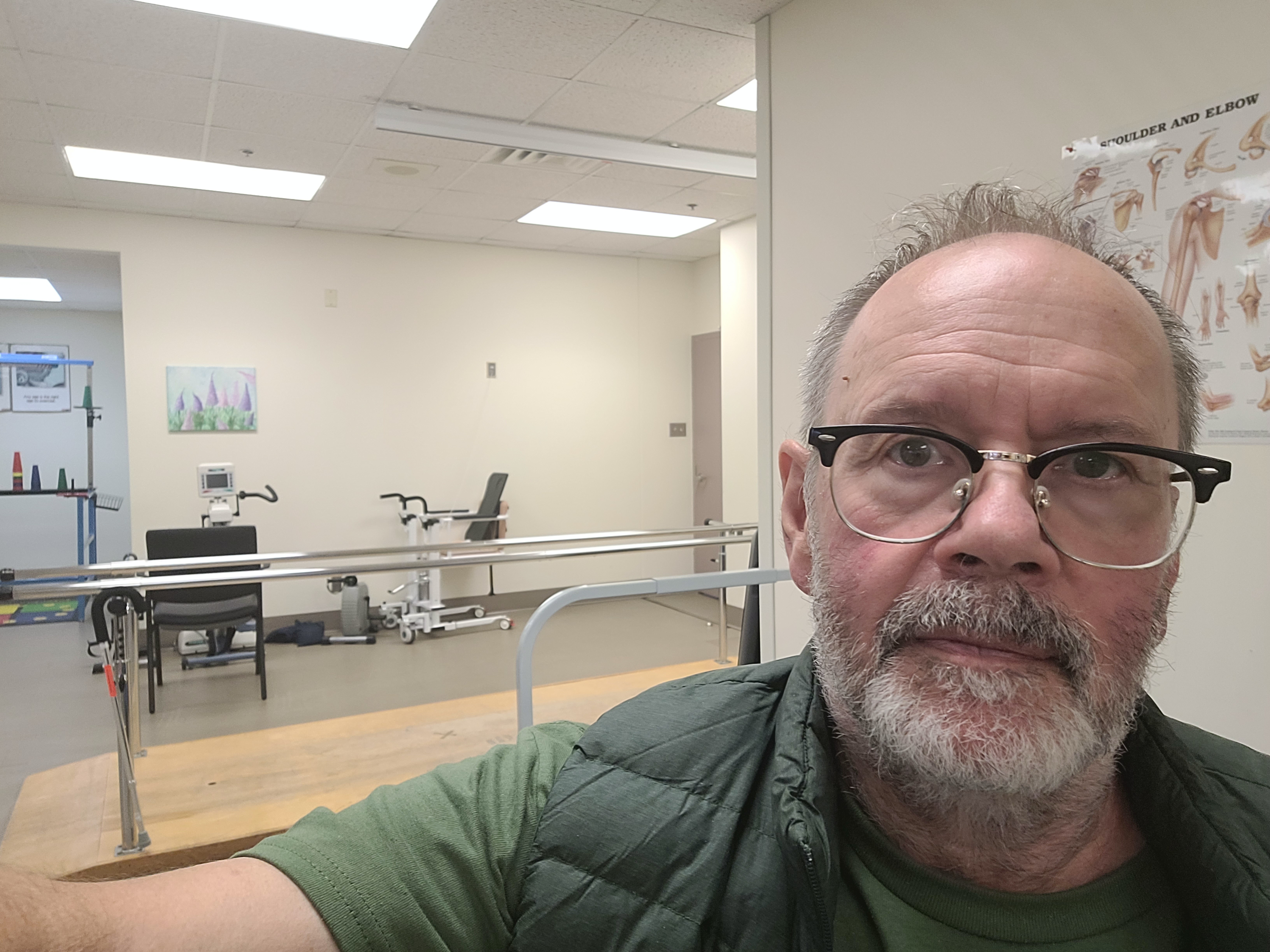
That’s how this week feels. The pilgrimage through my stroke is hardly over. But this week I’m seeing how far I’ve come. The parallel bars (below) that not so long ago represented the greatest distance I could possibly shuffle are now where I try balancing while standing on my left leg without support. I have more strength in that leg every day. Without use of my left hand and arm to steady myself, my balance is off. But the distance? No problem.

Although the physios aren’t recommending I do this at home, Lee is making me practise climbing stairs one per foot, like you probably walk them, instead of like a toddler does. This week she had me kicking a soccer ball back and forth with her (I had to hold on to a railing for support, but my left leg did quite well.) For the first time since my stroke I did up the button on a pair of jeans on my own. And I might only be able to “bench press” a featherweight aluminum cane. But the simple fact my left arm can even hang on is a major win. And for the first time this week, I could sometimes push my arm straight ahead on a table. “Cheers” is getting closer!

I’m thankful that the newly-conscripted neurons in my brain that agreed to take over the management of my arm and hand are beginning to sort out their new roles. But I have to be patient: I was so anxious to force my wrist to flex in my room that my hand swelled up like a balloon. I suffered painful cramps until it recovered. Sara suggested, since I am so eager to use all my time working on recovery, that I do it in other ways than “extreme boot camp” (as she put it) and instead take some time each day to be consciously grateful to my brain and my awakening left side. It’s great advice, so I’ve added that to my routine.

Lee, who works mainly with my legs, says she’s amazed at my progress. She hasn’t seen this video of me bringing my own tea to the couch at home on my “weekend pass” today, without cane or walker. I’m not sure what she’d think!

When I was watching this video and bemoaning the lack of fluidity in my step Sara reminded me that just six weeks ago it required two people to hoist me out of bed and get me to the washroom. Looking back brings perspective.

There’s no news yet about “Handcamp”…. they’re waiting on word of whether I’m eligible. But I’m booked in Halifax at the end of the month for a preliminary cardio assessment, a first step to the procedure to close the hole in my heart that may have let a clot pass to the brain.

Having a room to myself is making a world of difference. The previous week, with little rest day or night, I was looking “increasingly frazzled and worn,” in the words of one nurse. Now I sleep well most nights. During the day there’s peace, so I can read, listen to CBC, write (working on some poetry), or do my physio. I also feel more comfortable video-chatting with the kids, and I attended my own class by Zoom this week when Elizabeth Castelli graciously came to talk to them about early Christian ascetic women patrons. Now Sara can even bring her meal and share the whole evening, as her schedule allows. From a place of stress, my hospital room has become an oasis for healing.

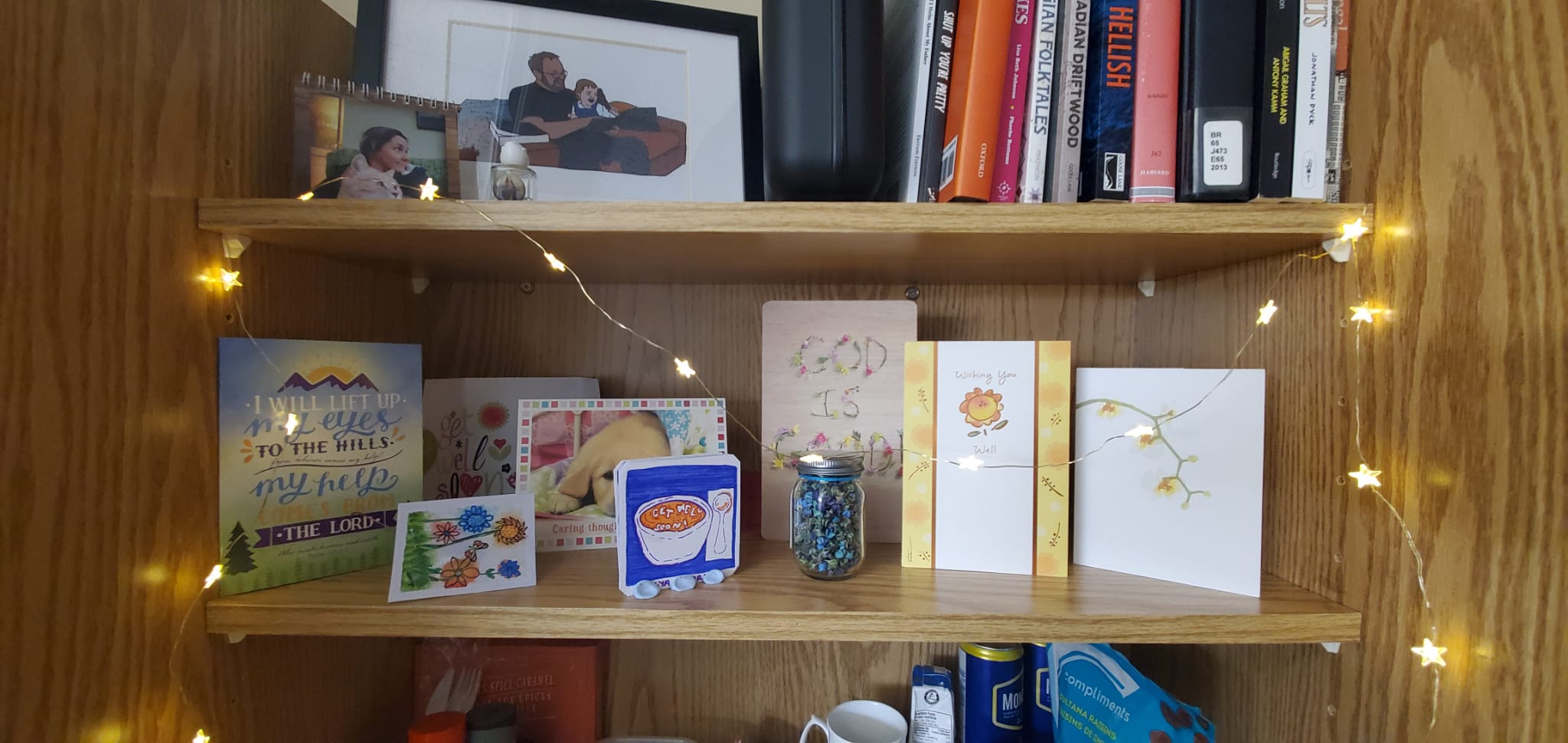
I’m thankful to the physio team – Lori, Lee, Ria, Lina, and Abby – who are so patient with me day after day. They were the ones who pushed for a room where I would get the rest my brain needs to recover. The staff know that my dogged motivation comes from being supported by so many of you. One of the orderlies looked at my shelf of cards and said “well, aren’t YOU well-loved!” That comment gave me a physical rush of warmth and comfort.

Several of you recommended recently that I read Daniel Levitin’s just-published “I Heard There Was a Secret Chord: Music as Medicine.” Coincidentally, Levitin and I had an email exchange last spring, when he asked me something about Prophets of Love: The Unlikely Kinship of Leonard Cohen and the Apostle Paul. We exchanged books by mail. So I’m reading Secret Chord now, and feeling the recuperative power of music every day (see below). I should tell Levitin I’ve had a stroke, and how applicable his research is for me.

That healing power of music is definitely helping release some of the frozenness of my left side. I’ll sign off this week’s update with the clip below, more evidence of how far I’ve travelled with this stroke. I love to dance… and in my own room, now I can. Or better, we can. If you know me, you know this has GOT to be good for my recovery!

[Click here for my podcast about that walk from Melrose, Scotland, to Holy Island.]

Categories
Uncategorized

Left Neglected: week 8 strokeaversary report

I finished a fascinating novel about a brain injury called “Left Neglected” this last week. At one point the main character is afraid she’s being sent home from hospital too soon. She doesn’t feel ready. I’m starting to wonder if this is happening to me. When I’m tired, my speech still slurs, and then I have to be careful eating, or I bite my lip or tongue. My walking has improved greatly. But when I catch or stub my left foot, as I inevitably will at some point, I’m always a split second from falling, especially while using my cane. Still, I’ve graduated to being allowed a cane sometimes. And now, the nurses at St. Martha’s are starting to greet me in the hall with “Why are you still here? You should be home by now.”

However, it’s not the nurses, but the physios and the doctor who make that call. For the sake of my hand they want me around a while longer. Back in September I was predicted to go home mid-December. Now I’m hearing it might be in just a couple weeks! There’s another wrinkle: Dr. Gorman and Lori, the head physio (that’s Lori and me above), are checking whether I could be sent to a specialized occupational therapy facility in Halifax to try to help my left arm improve. Sara immediately dubbed it “hand camp.” “You can still go home weekends,” Dr Gorman assured me. I’ll know more soon.

I’m not young but I’m the youngest patient on our wing. That and my strong recovery mean I don’t need much help from the nursing staff … so they tend to ignore me. This weekend they moved me to a private room. Hallelujah! This means I’ll get a full night’s sleep without 4 am wake-ups, and blaring Jeopardy and nature shows all day.

My walking is still not great, especially when I’m tired. But it’s not bad. As of this last week, I’m officially evaluated as independent with a cane and walker. It’s ironic that the arm motion I most have to practise is the one you make when giving a “cheers” (the little arm wagon you see below helps me rebuild that muscle).

One thing I have trouble with is clipping my fingernails and toenails. Phyllis, an LPN who is the closest to a saint-nurse I’ve ever met, came on her own time at lunch and cut my toenails while we talked about Kenya and Cape Breton. I’ve never had a pedicure and it felt wonderful. There are so MANY people and kindnesses for which to be thankful: delicious Barr’s chocolates from Stratford ON thanks to Susan and Darin Jacques, letters from Rev. Aaron Billard and visits from Rev. Peter Smith, the local United Church minister, & cards from my cousin Raymond Anderson and from George Greenia.

I’m still trying, with limited success, to learn how to supinate my wrist and open my fingers. Opening jars requires almost acrobatic skill and sometimes both knees. But I’m getting better at small tasks that require closing and holding my fingers. In the physio kitchen I peeled a carrot and a potato. This Remembrance Day weekend I got to spend THREE days at home – blessed days! – and the best physio of all was holding cards for a game of Uno with Sara’s parents Shirley and Winston (I had to pry my fingers apart afterward to get the cards out).

Sara and I were given 20 spruce trees which we planted around the property. Or, I should say, which Sara planted while I pointed my cane and gave advice. This was my chance to try walking with a cane over rough and uneven terrain. I didn’t fall!

The pictures and videos perhaps make things look normal…but they’re not. I move at a glacial pace around a room. If you called me and my back was turned I wouldn’t glance over my shoulder for fear of losing balance and tumbling. When I’m tired or cold, especially in the mornings, my hand and sometimes my entire left side can go into a painful cramp. I’ve developed an itchy rash from sleeping on rubberized mattresses for two months, so Sara is putting cortizone cream on my back.

BUT….I’m so far ahead of where I was!! Every day I feel how deeply upheld I am by the prayers, meditations, and thoughts of so many of you. I rely on that support every step. I continue to know how fortunate I was to have suffered a stroke that only affected my motor skills. I get to go home more and more, and spend time with Sara. And I have an appointment at the end of November in Halifax as a first stage to fixing the hole in my heart that perhaps let a clot through to my brain.

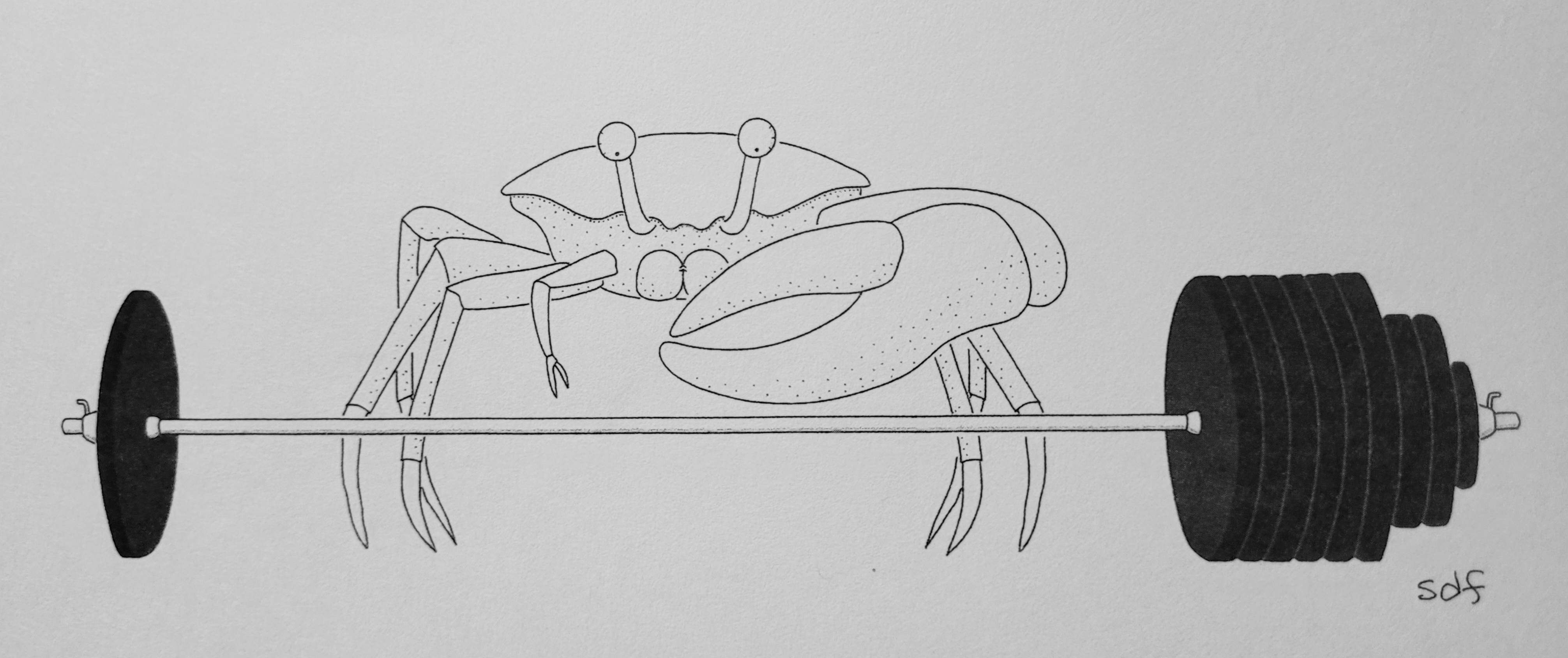
Sometimes I feel like this crab, with one puny arm and hand that just won’t develop. But when I look back I see how far even that hand has come. I’ll learn more this week about whether I’m being transferred to Hand Camp in Halifax. Just today, for the first time since the stroke, I was able to walk – okay, hobble – with Sara down to the water at the end of our property. That has always been a life-giving place for me, and it was so good to stand there again and breathe the cool air.

I’m thankful.

Categories
Uncategorized

Week 6 Strokeaversary: setbacks & slowdowns

;

How prescient and thoughtful George‘s card was this week! One of the dangers of making daily improvements in my post-stroke recovery is expecting that trend to continue without fault. At the outset, the health care team said there would be days of setback and slowdown. “It’s not a uniform progression,” they warned. “Don’t be discouraged when some days you find you can’t do as much, or your condition even seems to regress.”

That’s what happened this last week. “You’re dragging your foot and swinging out with your hip more,” observed Lee as she watched me with the walker Monday. Eventually she said “Just take a break. You must be tired.” My speech slurred perceptibly, especially Sunday through Wednesday, as much as I tried to mindfully keep my “s”s tight. For the first time, there was no progress in my hand – despite Ria’s, Lena’s, and Lori’s best efforts. Between physio sessions I was exhausted. I’d crawl back into bed for naps.

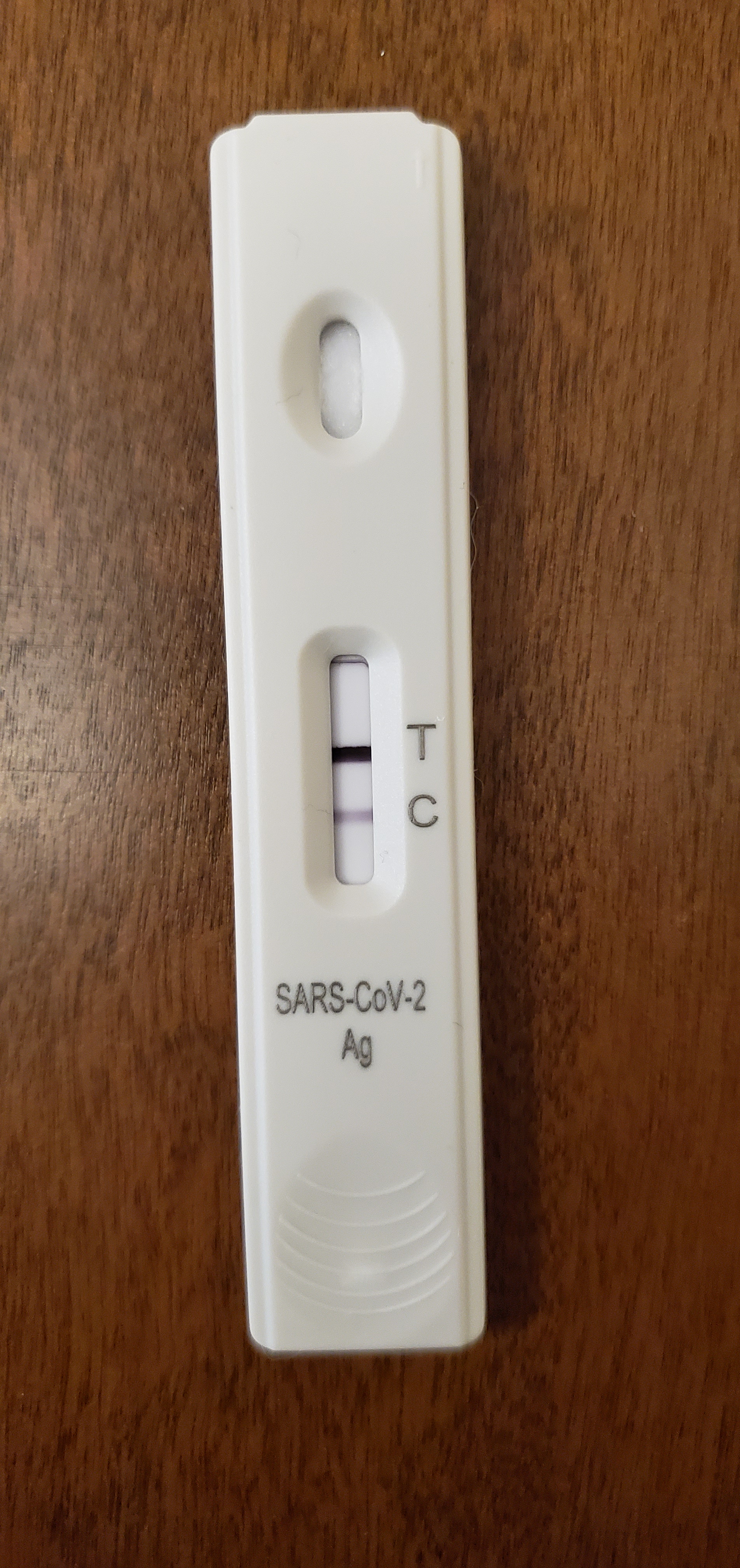
I asked the staff whether a change I was starting to notice in my taste buds could be stroke related. Some said yes, maybe so. But when Sara picked me up for a supper at home, and heard that I hadn’t been able to taste the maple syrup on my french toast and didn’t enjoy a piece of home-made fudge, she left her N95 respirator on for the car ride home, then pulled out the last covid test from the stash we’d built up (when they were plentifully provided), and said: here, take this.

I was positive. Sara said, “I knew it.” She still made the Mexican Bean Stew she’d planned, but we ate in separate rooms. When we got back, I told the ward. For 24 hours they didn’t quite seem to know what to do with me and said to “wait for Infectious to get here in the morning.” They administered a test that had to be sent away for analysis. They didn’t bother to protect my room-mate, explaining “he’s already been exposed at this point.” But ironically, just as I started feeling better, the infectious disease control measures locked in full force. By Wed night I was isolated to my part of the room, and staff added gowns, gloves, and face shields to their usual haphazard masks, when they checked my vitals or brought my pills. For the rest of the week members of the physio team who were not themselves sick faithfully led me through my exercises in the few square feet of room where I could still move. Things like showers and fresh bedding were put on hold. For a few days it was just me, my laptop, my book, and the window.

Sara suggested I take advantage of my isolation to write poetry, a practise I got into in Montreal, England, and Ireland. I was anxious to try this, and a bit anxious about it. The side of my brain damaged by the stroke is the side typically used for imaginative, connective thinking – precisely the kind of conceptualization required to write poetry and fiction. In my isolation room, I worked out a poem about looking out my window and sent it to Sara. “It made me cry,” she wrote back immediately. Knowing I’d been worried, she added, “It’s very much your pre-stroke style. That part of your creativity hasn’t changed.” Encouraged, I wrote the first draft of another poem, about a crow. “Even better,” she responded. “Keep on.”

By week’s end my slurred speech was closer to normal, my energy was good again and I was making progress every day with my exercises. But hospital protocols require 8 days from first confirmed symptoms, and so they have me on isolation until this Tuesday Oct 29. The physios and doctor suggested that if I could, I should go home for the entire weekend. “You’ll get more physio there than here, at the moment,” Lori told me. Sara, who ALWAYS masks in shared spaces out of concern for vulnerable loved ones, had also become briefly unwell – a “surreal fatigue” she said, and a few coughs and sniffles, although she tested negative. I was six days post-first-symptoms. Sara came and picked me up. I was able to shower both days (shower chair on loan from the Red Cross) and fall asleep in my own bed, where I’ve had my best sleeps in weeks.

Sat morning I was able to make bread-machine bread, make coffee and tea, and cook rice (although re-doing the twist tie on the rice with one hand defeated me). Saturday and Sunday I did my leg lifts and toe-points on our deck in the sun, so much better than the thin slice of my room between isolation refuse bins. Tonight (Sun Oct 27) I’ll head back to the hospital and two more days of isolation.

I can now hold myself up on my left elbow, and bend down to pick up items (with my right hand) that have fallen on the floor. My left hand remains barely responsive. But here at home I’ve used it to squeeze toothpaste and hold a jar while I twist off the lid, so that’s something. I had a very vivid dream this week in which I was going into a musty wing of a large building and turning on the lights, trying to find the thermostats, etc. In my dream I knew that I used to live there and had to make it habitable again. I think the dream was about my brain reactivating (re-inhabiting) my left arm and hand.

The more I’m learning about strokes, the more fortunate I feel that mine did not take my speech, hearing, or cognition, or in any other way cut me off from my loved ones. Apparently 4 of 5 strokes affect these faculties in some minor or major way. I’m still recognizably my old self – to my own mind, to Sara and my kids, and through this writing, to you. I’ve joined the Heart and Stroke Foundation. I finished Norman Doidge’s brain plasticity book and I’m half-way through “My Stroke of Insight: a brain scientist’s personal journey” by Jill Bolte Taylor. I’m grateful that apparently only my mobility was affected by whatever deadened the 3-cm sphere on my right brain hemisphere. I feel a responsibility to work hard on my recovery because of that relative good fortune.

This week I’m thankful for the lasagna dropped off for us by the Penners from our Department of Religious Studies at StFX, for the meal coupons given us by our Dean, Erin Morton, for Joanne, our administrator, who thought to send me a ‘grabber’ for those pesky charging cords, for visits from Lewis McKinnon, Robert Kennedy, and Rev. Peter Smith, for the magnificent flowers from my adoptive Finnish family at St Michael’s Church, Montreal, for James McGrath’s gift of a zoom lecture to my class at FX (check out James’ fascinating books here), for tea and a book of poems about walking from our former colleagues at the University of Nottingham, for prayer candles lit at Lutheran Church of the Cross in Victoria, Quebec City, and in so many other places as well, including by the Apostolic Johannite Church (the Gnostics). “Has anyone ever been so love-bombed?” teased my friend and fellow writer Ellie. I don’t know. But I know I feel that support in every part of me every time I try to extend those left-hand fingers. One of these days!

Last Monday, when I was feeling poorly, Sara took me out to St. Martha’s grotto garden to feel the sun and see the leaves. I felt a bit discouraged just then.

I played Gabrielle Papillon’s song “Go into the Night” for Sara in that garden, to tell her how absolutely loved and supported I feel by her, and how thankful I am. We both broke down and had a cry as the cars passed at end of shift. It’s a beautiful song. I’ll leave it here for you, too, in closing, in case it speaks to any challenges you’re facing. Not all weeks are easy, stroke or not.

Categories
Uncategorized

Week Five Stroke Report: Bananas

I’m reading a book that my physiotherapist Lee loaned me: The Brain That Changes Itself by Norman Doidge. The crucial message about brain plasticity seems to be “use it or lose it.” It dawned on me that in some ways, unlike my left leg, I wasn’t even trying to use my left arm outside of physio because, well, it doesn’t work. So this week I determined to use it somehow, however ineffectually. One day, I held a banana in my left hand and gripped it just long enough to peel it. I forced myself to NOT use my right hand, but instead to hoist the banana with my heavy, resistant left arm, bob my head until I could steal a bite, dropping it back into my lap after each effort. I looked like a toddler. Like a toddler, I have only spastic reflexes, and no fine motor control on the left side. Put cheerios in front of me and 99 of 100 will end up on the floor. But I ate three bananas that way this week.

Someone asked how soon I might be back to typing with both hands. I don’t like to think about it much, but the truth is that it’s possible it will take years. It’s possible I’ll never type with my left hand, or be able to hold down the strings on the fret and play guitar, ever again. I don’t believe that. I think I will, and it’ll be sooner. But there are no guarantees. I’m not writing this asking for reassurance: I’ve been overwhelmed by the support I’m getting! And I’m making incredible progress. The head of the physio team told me while she wouldn’t wish a stroke on anyone, she’s delighted to work with me. “We’ve never had a patient like you,” she confided. (Mind you, her business is encouragement.)

My leg improves a little bit each day. By week’s end I actually went up the practise stairs slowly one foot per stair, like I normally would have. They’re trying me out with a cane: I walked from my room to the physio gym and back with just the cane, and around a slalom course. But they (and I) prefer the roller walker. In part this is because it exercises my left hand while I grip the handle. Now when Sara gets me out on a day pass for a few hours, I can walk all the way out of the hospital and to the parking lot with just the walker, no wheelchair needed. Each time I’m home (which was almost daily this week during university Reading Week), Sara puts on a record and we have very careful dance therapy sessions! Lee had me pointing my foot like a dancer, and walking heel-toe as on a tightrope (holding the parallel bar). That was fun.

In the absence of equivalent progress with my hand, I’ve been told to use my imagination. Apparently, the science says that carefully imagining lifting your index finger again and again digs the same new neural pathways as actually moving that finger. Doing reps of carefully imagined hand movements is crucial to neural plasticity and “counts” as restorative exercise (it certainly feels like it). Fortunately, as many of you know, I’m blessed with a strong imagination. So if you come into the hospital and see me with my eyes closed, a strained expression on my face, I might be imagining wringing out a dishcloth. Or eating an ice cream cone in my left hand.

It’s working. Friday, for the first time, I flexed my fingers outward a centimeter or so, trying to push a cylinder. I can push my fingers downward in sequence from thumb to little finger, not just in my imagination. New neural pathways are forming. I’m sure of it.

My pilgrimage friend Shawna Lucas dropped by for a visit. She left me a pilgrim rock she created from local beach stones.

Fellow StFX walker Leona English stopped by with dahlias from her garden.

University of Regina Press, who published The Good Walk, sent a beautiful bouquet with equally lovely words of support.

My friends David and Margaret Hundeby Hunter sent a cozy handmade prayer shawl as a hug over the miles.

Scholar friends Shayna Sheinfeld and Meredith Warren thoughtfully sent Sara a week of delicious meal kits.

This last Thursday Heidi Campbell sent me a photo of her brand-new Master of Education degree from the University of Regina, along with this message: “I’d like to dedicate this to you and your recovery. You were the first person I knew who ever did an advanced degree (you were doing it when I was your babysitter). Thank you for showing me that parents can do anything!”

I deeply appreciate these and the messages of support, prayers, and solidarity from friends across Canada and as far afield as Malta, Brazil, Ireland, Norway, and Virginia. I think of all this when physio Ria tells me for the fifth time to twist my wrist, and all my heaving and grunting barely twitches it.

Sometimes, at 4 in the morning when I wake wondering what will happen to me, and if I’ll ever fully recover, I meditate myself back to sleep with the words “breathe in support, breathe out hope.” So: thank you. Every day, a little more support, a little more hope, a little more progress. All these little days are adding up.

Categories
Uncategorized

4 week stroke report: Thanksgiving

My one-month strokeaversary falls on Thanksgiving! It’s not hard for me to give thanks in this post. I’m on a day pass from the hospital, writing this at our dining room table, looking out at the watermarsh view I’ve been missing for a month. Sara is at my side. I managed the stairs to get into the house. From time to time my largely inert left hand and arm begin to slide slowly slide off the table, dragging the tablecloth part-way along. But Sara just straightens it again, replaces my arm, and we keep talking.
Midweek Dr Gorman told me I could go out of hospital for a day pass with Sara if we wanted. She didn’t need to say that twice. Between giving mid-term exams Sara rushed to the hospital, wheeled me to the car, and took me for a drive to see the peak leaves on one of the nicest fall days we’ve had.

Sara’s parents, Winston and Shirley, drove down to see us. Her 89-year old father and 82-year old mother bustled in carrying a raised toilet seat, a wheelchair, and some other items…. “thought you might need these,” they said. They’re an incredible support. They also brought some food for Sara and me: turkey and dressing, and lemon cheesecake for Sara’s birthday.

Friday Sara took me home for a birthday dinner with them, and Saturday we enjoyed our own Thanksgiving and birthday dinner. Sara also gave me the full haircut and the beard trim I’ve been wanting. She’s added chauffeur, cook, barber, and laundry to everything else she’s been doing for me. My Thanksgiving definitely includes her graceful, cheery, and determined support.

It was another week of small improvements for which I’m so grateful. The physio and OT staff who work with me, Lee, Lori, Ria, Lena, and sometimes Juanita, Jay, and Abbie, are gentle and encouraging. But also taskmasters when needed (this morning Abbie barked out “give me five,” sounding very much like my high school coach). Early in the week Lee said I could try the stairs. The saying is:”good goes to heaven, bad goes to hell” (the unaffected leg leads first going up the stairs, the affected leg goes first going down).

I tried a German-made stationary bike that measures the force of each leg to help me balance better. I took a hand-held squeeze test: let’s see if you can get a pound or two, Ria said encouragingly. I squeezed 20, which made her eyebrows go up. My average with my left hand over three squeezes was 16.3…for comparison, my right hand squeezed over 93 pounds.

There’s still very little fine motor movement in my left hand. The team is sending electrical current into my arm to cause my muscles to spasm and contract, in hope that new neural pathways will form around the 3-cm damaged area deep in my brain. The exercises Lori and Ria have me do would be simple for you – twist your wrist, swing your arm outward from the elbow – but they leave me gasping and sweating after a few reps. Still, I wouldn’t trade that precious therapy time for anything. I’m lucky to have daily access to a physio team who want to see me improve.

I keep getting messages of prayers and support: congregational prayers from the Finns and Estonians, and others, candles lit in Munich, Florence, Montreal, and Portugal, daily Medicine Buddha prayers in the Rinzai-Zen tradition, a Gaelic caim of protection, as well as home candles and dedicated walks. I remember these when my whole body goes rigid trying to slide my arm a few inches forward on the table without using my shoulder. The thoughts and meditations and walks and prayers help me tremendously – thank you!

I’m also thankful for the many incredible scholars around the world who are providing Zoom or recorded lectures for my class, and another incredible scholar, Dr Robert Kennedy from our department, who took over my course after it became clear I wasn’t returning soon to teaching (my students sent me adorable hand-made cards).

I’m especially thankful that there may be a cardiac procedure to fix the “hole in my heart” that potentially allows clots through to my brain. But more on that later, in a future post.

For now, there’s more than enough to be thankful for…especially you who are my community of support. For today, then, I’ll gratefully enjoy the view a bit longer before I have to go back!

Categories
Uncategorized

Week 3 Report: Stroke-A-Versary

Scotland

Before anything else, THANK YOU to all of you who’ve said a prayer, sent up a thought, done a meditation or walk, hoped a hope, or lit a candle for my healing. I’m strengthened and encouraged by you. Thanks. It helps me tremendously. Folks have sent me photos of candles they’ve lit for me in Scotland, in Germany, in Norway, and all over Quebec and Canada.

Norway

Oddly, even though my prestroke agenda has emptied, my days are full. The ingredients of those days are basic, and familiar to anyone who’s been stuck in hospital for an extended period: did I have a bowel movement ? (which sometimes means: was there a staff person around when the urge hit?), am I standing enough to take pressure off my derriere and keep myself healthy? Did I do my hand movement visualization exercises? Did the nurse forget to move my table back after taking my vitals, necessitating a 10-minute-carefully-planned maneuver to recover it, along with the call bell? Can I get a bowl with warm water to wash up, or will breakfast arrive early, which will mean no space for the tray on my table and the impossibility of fetching my food off the chair later? When did I last change socks? When is shift change, which will eliminate help for a half-hour? If I forget to charge my earbuds, how will I be able to sleep when the man with dementia across the hall breaks free from his two security accomplices and roams the hall cursing in the night?

It sounds worse than it is. For every aid who empties the urinal then slouches out of the room leaving it 20 feet from the bed, there is another whose warm greeting is sunshine, and who out of the blue offers to wheel me to the patio for some sun or to change the water in the flowers. Or the nurse who said to us “you mean you haven’t seen your test results? They’re your property…let me fetch them so you can take a photo or scan them!”

Speaking of tests, mid-week I was taken by ambulance the 2 hrs to Halifax for a TEE test of my heart. It turned out to be positive: I have a “communication” (a hole) between the upper chambers. Apparently this is more common than most people know and affects about a fifth of the population. The problem is that it can allow clots to pass from the legs directly to the brain. When I asked the ward doctor what this meant in terms of next steps, he didn’t know.

To this point I’ve been sheltered from many of the ill effects of institutional care by Sara, who has been both cheerful caregiver and steely-eyed advocate for me all along. Unfortunately she was brought low this last week by a terrific cold none of us wants me or other patients to catch.

The good news is that this last week also brought improvements for me that have helped that situation. When I’m not tired, my facial droop almost disappears. Mid-week the physios declared me able to transfer from bed to chair and back again by myself. I don’t really need spotting even to the toilet anymore with my walker, so I expect that requirement will be lifted soon as well. The doctors have written me “passes” that mean, as soon as Sara recovers, that she could take me out of hospital for short periods – although neither of us wants me to miss any physio. Yesterday and today I walked twice the full length of two wings of the ward to the small chapel, where I could look out at the changing leaves. Once I got out myself to the small third floor patio and just enjoyed the sun on my face a long while. I’ve learned to move my body so that I can sit up myself on the edge of the bed and can now give myself a sponge bath. The nurse couldn’t believe I can put my own socks on. Not pretty, but do-able.

(video below of walking)

My left leg has moved from being unresponsive to generally going roughly where I want it to, which is fantastic. It’s draggy, but coming along. Arms and hands recover more slowly, they say, and I’m no exception. But there have been changes: I can now put a bit of limited weight on my elbow and arm, I can make a reasonably tight fist now, curl my bicep and curl my fingers with much less concentration than before. I lifted my index finger once. I can curl my fingers around the margarine and use my other hand to pocket it into my left thumb to help spread it.

My brain seems to have forgotten where to send the “move” messages to my left hand. Lori, my cheerful and steadfast OT, has taken to tapping the muscles which need to work with her finger…this helps my brain know what to focus on and works surprisingly well. My triceps were hardly my strong suite even before the stroke…I search my mind in vain for them now, until the tapping begins.

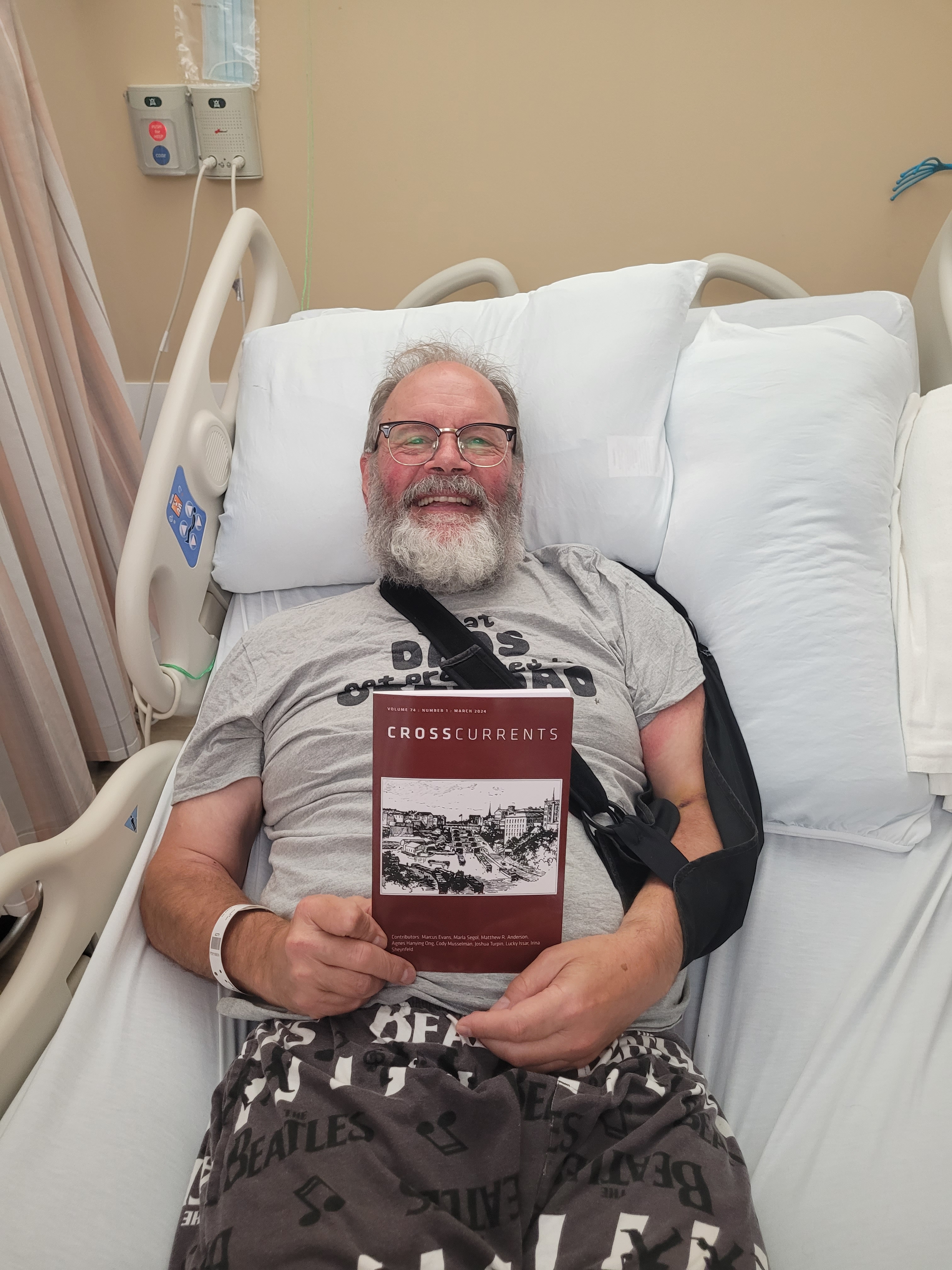
It’s been encouraging that several of my earlier writing projects came out this last week. My piece on Aware-Settler Hermeneutics with the Society of Biblical Literature’s teaching resource Bible Odyssey, the proofs for my article (right beside Sara’s) in the upcoming volume Judeophobia, and my essay in CrossCurrents about walking in north Dublin, Ireland and saying goodbye as we headed back to Canada. I can’t celebrate these with Sara as I would at home. But I’m thankful nonetheless.

So: every day some small improvements. It’s interesting that relationality, so important to our thinking about planetary crises, and about justice, is also so crucial now personally, to the body’s working. The unaffected parts of my brain and my left side are building new relations. As in every new relationship, that takes time, patience, good humour and a willingness to celebrate every new connection, no matter how modest.
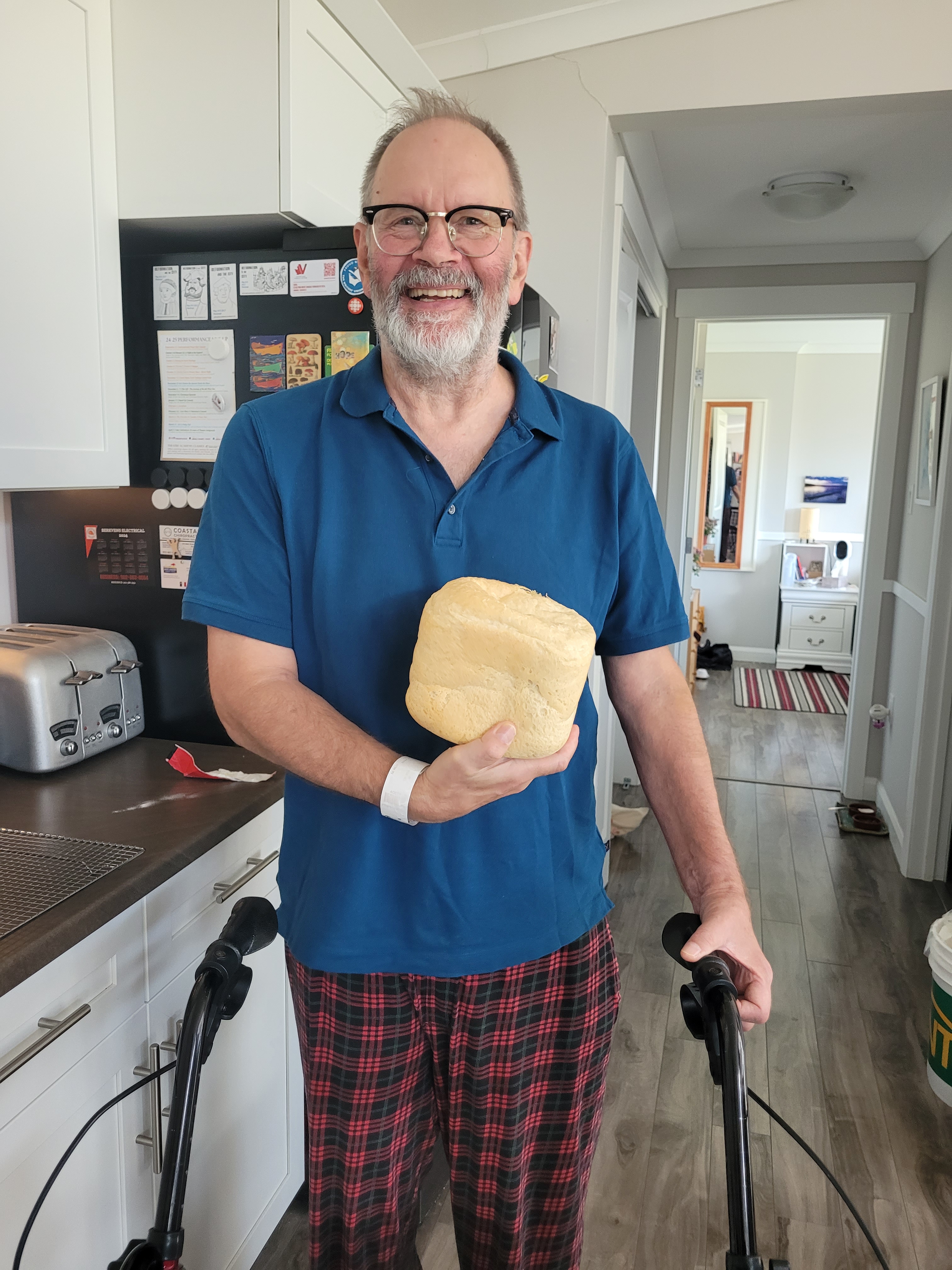
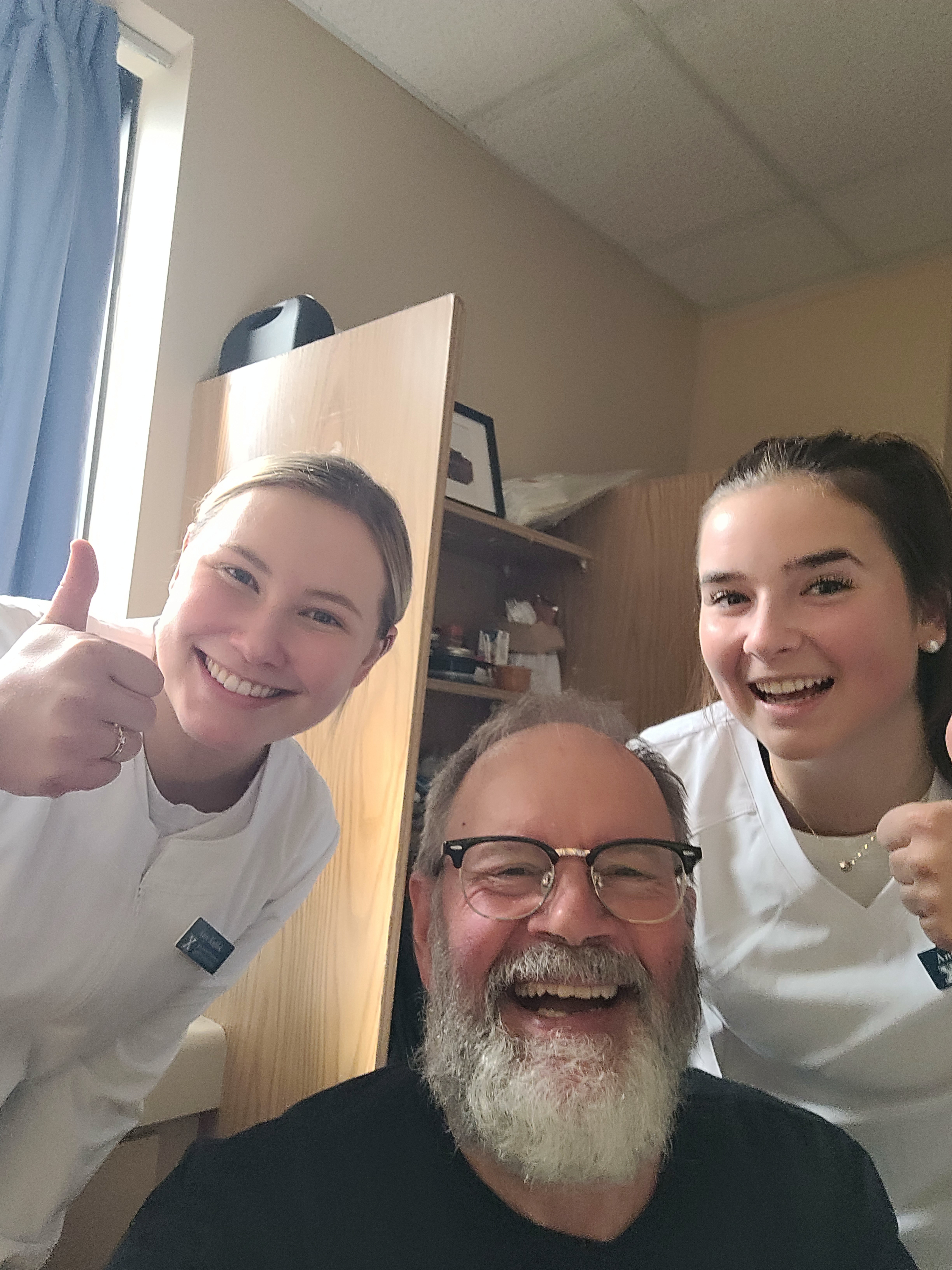
photo of two student nurses who took excellent care of me last week.