Categories
Uncategorized

Impact Statement – the SC-Battleford Trail Walk

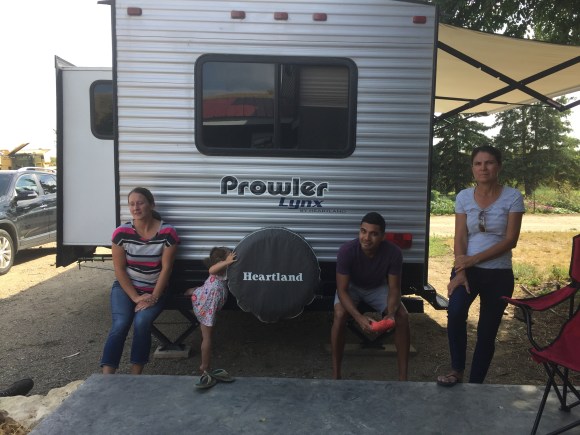
IMG_3164
photo courtesy Connie Sykes

(the following is the impact statement that I wrote for the SK History and Folklore Society, who requested it to forward to their funding agencies. Those of you who have followed the walk in some way may find it worthwhile)


The Swift Current – Battlefords Trail walk certainly affected me personally. In addition I was witness to a number of ways in which it had an impact on communities and individuals we encountered. Firstly, although the historical connection between the Métis community and the Trail is well known, I believe that the linking of our first day’s walk with the Métis celebration in Swift Current solidified that connection. I was touched by the accompanying Red River cart and the members of the Métis community who walked the first steps of the Trail with us. Another community – or set of communities – that now have a greater knowledge of the Trail are the Hutterite colonies that we passed through. Our very positive interactions, especially with the Swift Current Colony meant that the members of the Colony learned something of the history of the Trail that passes through their land. We got the fresh cinnamon buns – they got a history lesson, and some local human geography! Thanks to our Trek organizer and guide Hugh Henry for laying the groundwork here, as he did in every other way.

Hutterite women offering iced tea

When we met individual farmers as we walked, the reaction, almost without fail, was the same: interest in what we were doing, and most often, some positive but nostalgic comment about the Trail, almost as if it was a thing that had belonged to a past (perhaps their parents or grandparents’ generation) that they were surprised might still be considered important, but very quickly agreed should be important. In other cases, farmers who hosted us joined the walk briefly, for a day or part of a day, and told us of their own family histories and how they intersected with the histories of the Trail. In most cases their recollections were of the important early settlement history. In a very natural way, those of us who were walkers were able to include the First Nations and Métis aspects of the Trail’s history without in any way belittling the important personal and family histories they were recounting, bringing (I hope) the first steps toward some kind of integration of those histories. In a few cases local farmers joined us in the daily smudges led by one of our Métis walkers, Richard Kotowich.

An important result of such a marathon effort as this trek – and one of my reasons for walking personally – is to reinforce in the public mind, quietly and with respect for landowners, the idea that there do exist, on private land, trails of public importance, which need to be preserved and to which the public should have some limited rights of access. There is no fear, in Saskatchewan, of hordes of trekkers taking to the Battleford Trail! At the same time, the Trail is part of the commonwealth of history, and importantly, for three very different communities: the First Nations, the Métis, and the Settler. I have great respect for the occasional farmer or rancher who decides not to break some of the land that still bears the marks of the carts, for the public good. Our walk was, in a very small way, a call to such civic-mindedness.

IMG_3247

We did not plan it this way, but our walk through the Biggar and Battlefords regions coincided with some breaking news about the trial process in the manslaughter charge connected to the death of Coulton Boushie. Whether it was in our minds, or in the air, it did feel as if the tensions increased, both when we stayed on the Mosquito First Nation, and when we passed by farms in the area, many of which were plastered with “No Trespassing” signs we had not seen further south. Perhaps our stay on the Mosquito FN helped those who were there realize that there are many Settlers who are trying to reach out and to learn from them; I hope so. Perhaps, at the same time, the fact that a group that was primarily of Euro-Canadian background sought to be guests on the Reserve helped some of the non-Indigenous folks we encountered in that area realize that the two solitudes can perhaps be bridged by folks of good-will on both sides. The matter, of course, is more complex than a single group of walkers might influence, but I hope that we were, if nothing else, a living sign of what the very first steps in seeking reconciliation might look like.

Finally, the Trail walk was important to me personally. When I grew up in the Swift Current and Simmie regions of the south-west corner of Saskatchewan, we learned about the “Indians”, as we called them then. If we thought of them at all, it was as important people who no longer lived anywhere close to us. No one – including me – ever seemed to wonder why the First Nations no longer ranged over those areas. I only learned much later, as an adult, that many, including Big Bear’s Plains Cree, sought Treaty lands exactly where I grew up, but were pushed north, often starving and in poor clothing, during the winter, by the policies of the Dominion government and the railroad. Walking this Battleford Trail, generally in comfort with more than enough food and a good tent or occasionally a hotel room, we were walking the Trail that they once walked, starving, not much more than a century and a quarter ago.

IMG_9926

Thanks to Hugh Henry, Harold Steppuhn, Ken Wilson and local farmers, the trek taught me the geography of the land where I was raised. I learned about the “Eagle Hills”, the “Bear Hills” and the “Bad Hills”, about NWMP outposts and glacial moraines and ancient inland seas, about soil formations and water drainage, about poplar trees and prairie grasses. Such learnings, added to my first visits to communities like Sanctuary, Greenan and Herschel, and made in the company of other pilgrims who became like family, made it a very rich three weeks. I blogged about the Trail and had hundreds of reads of my blog posts, both in Canada and internationally. Thanks to the Saskatchewan Historical and Folklore Society, and especially to my friend and co-walker Hugh Henry, for making this walk possible.

IMG_3181

Categories
Uncategorized

17 Days

This article appeared a week after we set out, but we never saw it until finishing the trail!

Booster Article

Categories
Uncategorized

It Matters to Me

It Matters Metis Flag

This is what Sharon Pasula’s tee-shirt from the Truth & Reconciliation Commission says. It’s the reason we’re walking. Sharon drove from Edmonton to join us in Herschel. She led us in a smudge the day after Rick (who had led us regularly) returned home to Regina. It matters to me. It matters to us, that the trail we walk has been used for hunting, for freighting, and for settling. It matters to us that a trail that now sits on private land be remembered as of public interest. It matters to us that we remember the three groups that used the trail – First Nations, Métis, and Newcomers (including the military) – and recognize and remember the positive contributions and also the failures and mistakes made along this trail. Most of all, the land matters to us. It doesn’t belong to us. We belong to it. As with the Métis flag Sharon carries, it matters.

Categories
Uncategorized

Ten Seconds of the Battleford Trail

Took this short video today, while walking into a very strong wind from the south-east. It may be bringing rain. There were seven or eight white-tailed deer in a nearby field watching us pass. Shortly after we found tracks, in the dirt road, of a cat, probably a bobcat.

Categories
Uncategorized

Carved into Hands and Rock

hands after a week

After 150 km or so, I’m surprised by my hands. They’ve been chipped and cut and scraped and burnt, pricked by mosquitoes and cactus and sharp straw and torn by caraganas and baked in the constant sun. They seem like different hands from the ones I started out with, at the beginning of the Battleford Trail. If a pilgrimage is a journey of transformation, I hope that what’s happening to my hands is also happening to my mind and heart. Today and yesterday we stayed at the Herschel Retreat House, where from the Ancient Echoes Archaeological Centre we walked out (on our first and only day off) to see petroglyphs that have been radio-carbon dated to the first century. The same years as Jesus walked, some ancestor of the Blackfoot carved these symbols into the dolomite rock.

petroglyph Herschel

and this was a potholder at the Herschel Retreat Centre (Herschel SK, population 31). We used the potholder for a day before actually realizing the design, which echoes the petroglyph:

bison potholder


Categories
Uncategorized

Learning to Smell

brown eyed susans and tree

Bit by bit, as you walk slowly across the land, senses you don’t use normally come to life. For me the most surprising is smell. You can smell canola fields from quite far away, if you’re downwind. The smell of fresh hay is a smell of my youth…it makes me happy. Sage is everywhere – that beautiful prairie perfume that fills your nostrils with such a welcome. I have some sprigs of it drying in my hat.

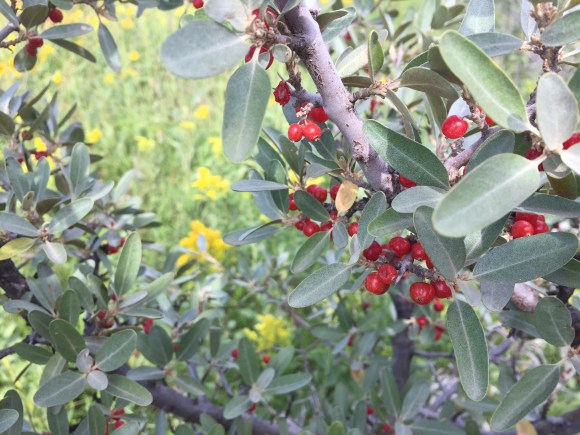
buffalo berries

Buffalo berries (above) don’t smell that much, but the green patch they’re in did. The green, or dry, smell of prairie grasses, as you walk through in the early evening especially, is a treat. Even the smell of cow manure, or bull manure (two days ago they fetched a young bull out of our camping yard just hours before we got there apparently, is a dark spice – just don’t step in it! I’ve learned, in the smudges, to appreciate the good smell of moist, clean and unchemicaled tobacco…so different from the cigarette addictions I grew up witnessing. Caragana bushes smell like shade. Alkali water stinks as you walk by, tickling your nose with the falseness of water that you can’t drink. And here and there, the best: the smell of green things, of dark earth and poplar shadow under an unblinking sun.

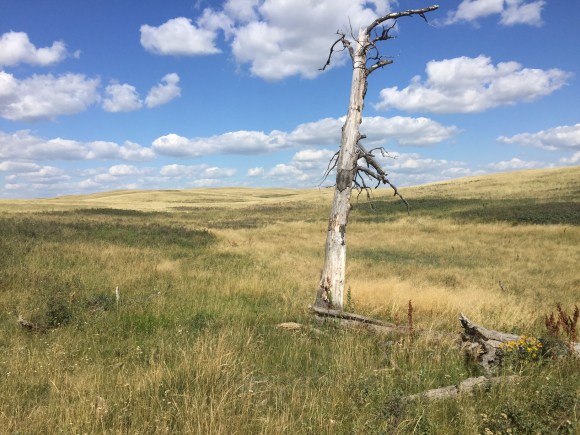
dead tree in prairie
Categories
Uncategorized

Smudging and Walking

smudging or just before

There aren’t any pictures, really. That’s because we don’t want to disturb or disrespect what we’re doing by recording it. Just about every morning, before we start walking, Rick Kotowich, a Métis/First Nation walker, smudges our group and we reflect on what we’re thankful for and what we hope for, give thanks for the land and the people we meet. A few times, local ranchers or farmers happen by to see us just as we’re about to begin, and it’s been interesting: every one has been interested in joining in. The elements of the smudge, sage and sweetgrass, reflect the country we’re walking through (besides buckbrush, there’s been lots of sage growing wild). We remember ourselves and the land we’re walking through with the smudge. And in this dry year, we are fastidious about making sure everything is done safely.

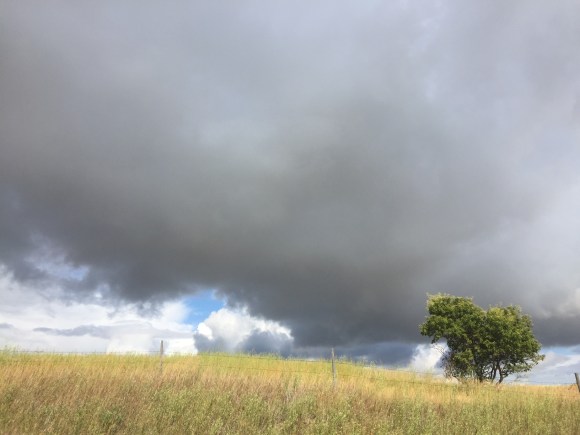
tree against stormcloud

quotes of the day (yesterday) from a local rancher, looking out over the horizon as he talked to us: “awful nice country…until the farmers found it.” Or from Fred, one of the walkers, looking at his tent: “my mess is changing, which I’m taking as a sign of hope”.

Categories
Uncategorized

Saskatchewan Melancholy

abandoned barn on walk.jpg

There’s a certain forlornness to Saskatchewan’s countryside, despite the vitality of so many of its cities, towns, and First Nations. When you’re walking 20-25 km through the countryside, you see a lot of abandoned farmsteads. The rural areas have emptied out. Today we passed a cemetery for a town that no longer exists, and the community centre that sheltered us two nights ago was once a local schoolhouse. Today it’s managed by enthusiastic locals – who fed us supper! Many of the smallest towns no longer exist, others are struggling to find purpose. Three nights ago, we camped in Sanctuary, where only an abandoned elevator remains of what was once a thriving community. As you walk, everywhere you look there are old buildings falling into the earth, rusted implements dark red against the grain.

To walk the Battleford Trail is to remember one very important fact: the economic forces that forced the First Nations north to Battleford (and off the land that would stop being feeding ground for bison and soon become a vast factory landscape for wheat, barley and other grains) is still going on. In the late 1800s, those market forces forced out the Indigenous peoples. In the mid to late 1900s, they forced out the small towns and villages of pioneers who settled the prairies.

yield sign Sanctuary.jpg

So, what happens now? Can the children of those settlers, and the children of those First Nations, now live together, both subject to the market forces that have done so much to change the prairies?

(thanks to Ken Wilson for coming up with the phrase ‘Saskatchewan Melancholy’. The photo below shows one of dozens and dozens of abandoned farmyards we’ve passed or stayed at, sometimes only evident by depressions in the earth. Last night we stayed at an old farmyard and looked at the remains of a very solid house foundation, overlooking a slough, protected by a caragana hedge, no longer inhabited. Life changes, especially on the prairies)

abandoned farmstead near Greenam


Categories
Uncategorized

The Kindness of Strangers

Apple-cinnamon cookies, given by the good folks of Kyle Lutheran as we passed by (too late for the service, but not the snacks!). Iced-tea and cookies from the young women of the Swift Current Hutterite Colony. Cold water, muffins and washroom use (always appreciated!) from the Elliott family, near Otter Springs, who saw us passing and took up the binoculars to have a better look.

Hutterite women offering iced tea

People ask what the difference between pilgrimage and tourism might be. One of the main differences, I’ve discovered, is how the pilgrim relies on the kindness of strangers. Especially on an arid prairie landscape, both feet blistered, under 28 degree Celsius heat and no wind or shade, a refill of water is a blessing, pure and simple.

Elliott family welcome.jpg

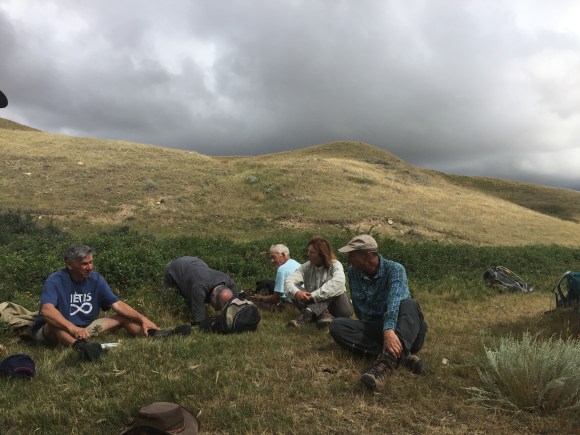
Tonight we’re resting and recharging in rented rooms in Elrose SK. Only 16 or 17 km today, but they were hot ones…I was thankful for the mid-day break, sitting on a tarp in the midst of a rare oasis of cottonwood poplars listening to the red-winged blackbirds complain at our intrusion. White Bear Lake was a surprise. Tomorrow we pass by Otter’s Creek and see the depression in the earth where a home was once built into the earth. This trail seeps history at every step.

IMG_2636

earthen home Matador SK


Categories
Uncategorized

What the Battleford Trail Means

IMG_2444.jpg

On the 150th anniversary of Canada, we just walked today by a traditional Indigenous burial site that has probably existed for 4,000 years. We’re all walking this trail for different reasons. Mine are these: 1/ to draw attention to the fact that there IS a trail of national historical importance, walked by Big Bear and his starving and freezing Plains Cree, right after they signed Treaty 6, the route run by the Métis freighters hauling goods overland from the end of the CPR line at Swift Current to Battleford in 1882, and the route taken by Col, Otter and his troops on their way to fight the North-West Rebellion. And 2/ to show that it’s important to remember that there is a public interest in access even to historic trails on private land. And 3/ to underline the importance of the Indigenous peoples to the history of Canada and Saskatchewan, and the long history they have in this area.