For five days we walked across the prairie. Thirteen miles was our “short day.” We watched for badger holes in the grass, spots where you could drop in to your knee and break a leg. We rolled under and climbed through barbed wire, not always successfully (I have a ‘pic’ in my left palm from grabbing a strand carelessly). Sometimes we walked silently. More often, in spurts, we chatted. During the day we baked in over-thirty temps and at night we shivered in our tents as it dropped to single digits. I was amazed at the wonderfully talented, eclectic group walking south with me. When they found out what I teach, I was challenged: “is this a pilgrimage?” That depends. We ended at a cathedral. We talked a lot about reconciliation, and tried to live it, at least a bit. We sang and laughed and formed a community that blessed each other. It was a holy time. For me, at least, that made it a pilgrimage.
Walking focuses not on the boundary lines of ownership that break the land into pieces but on the paths that function as a kind of circulatory system connecting the whole organism. Walking is, in this way, the antithesis of owning. (Solnit, Wanderlust, 162)
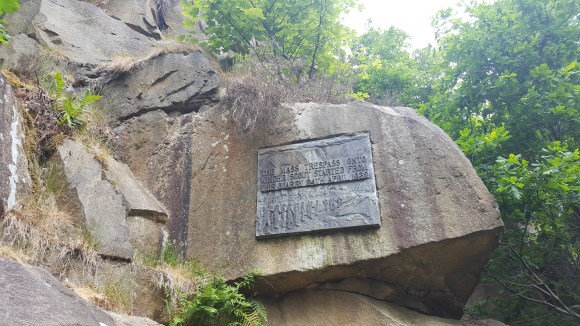
I’d counted on getting my bearings from the Hayfield UK info stop. I had to think again! On April 24 1932, after decades of on-again, off-again confrontations, 400 members of the British Workers Sports Federation started trekking up from their campsites here toward “the forbidden mountain.” The mass trespass of Kinder Scout plateau’s private land became the tipping point in the fight for the right to walking access across private lands. This plaque commemorating the walkers is affixed to the wall of an old stone quarry at the head of the trail. No one is fighting for the right to walk across Saskatchewan. There are no walkers’ groups, no mass rambling movement and no one in Swift Current or Saskatoon is trying to escape the grimy factory life of Sheffield and Manchester in the early 20th century. But there ARE historic, important trails across the prairie. They also deserve public access. And Canada has an important issue that the 1930s British ramblers never faced – the question of Indigenous access.
There is the geography we know and can trace topographically, made up of distance and terrain and movement. For instance, knowing it is about 14 miles (22 km) to the next town, there is a mountain in the way, and a pub and a pint await us there. But there’s another geography as well, one that exists off the maps even though it overlaps them, a geography of uncertainty, of bodily ache, of imagination and story and solitude, and sometimes, if we’re fortunate, of wonder.
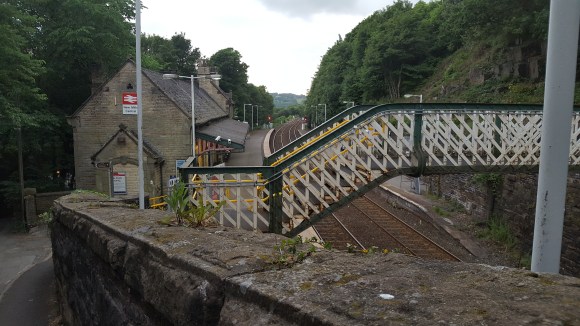
Since the Romantic era at least, wonder is the most gratifying of reactions to a view, natural or human. The walker cannot plan on wonder. But there are ways in which we open ourselves up to it and make ourselves available. In my experience those ways start with being silent, and with not over-planning a walk. That’s the way I felt when I woke up in Hayfield, in England’s Peaks District, the morning of the Kinder Trespass hike. Ready, but not completely prepared.
“The pilgrims of the Spanish-speaking countries pray for you, Holy Father,” intoned an Archbishop (I think that’s what he was?). Below where I sat sweating under the an unseasonably hot Roman sun, perhaps a thousand of the massed faithful erupted into cheers and flag-waving. Pope Francis leaned forward in his plain leather chair, speaking into the mic in Italian. In his address, he reminded us that we are not slaves, but “children, and pilgrims.” I noticed that the metal roof above his head was hinged. I’m guessing that, if there was a danger, the entire roof section could swing down as a shield. This Pope seems uninterested in shielding. A group beside me, from Michigan, fanned themselves. One of the younger women looked up from her smart phone: “I found a lunch spot but it’s at least three-quarters of a mile away. Can you walk that far?” An older man – her father? – lifted his baseball cap and grumbled: “It’s part of being a pilgrim, I guess.” So much pilgrim language. Meanwhile Pope Francis had left his chair. He looked much happier than he had while separated from the crowds. Now he beamed, reaching out to touch people, extending his arms in blessing, shaking hands, smiling broadly. All around me, people were lifting children over their heads, pressing rosaries forward, shouting: “Pappi! Pappi!” Francis leaned over the barrier to a couple in full wedding dress, the young man grinning from ear to ear. The bride, all in white, pressed a photo into the Pope’s hand. As I watched, he blessed it, then, while he blessed the couple as well, a man in a black suit behind him took the photo from his hand, and passed it to another black suit, who handed it to a third man in sunglasses, who walked away from the scrum, idly checking his cell phone. He opened a white plastic bin and placed the photo inside. To my mind, all the elements of pilgrimage came together in that moment: presence, story, a holy terrain, and a material and spiritual transaction. The young couple, via their photo, had reached their pilgrim destination. As had I.
With thanks to my fellow pilgrim, Archbishop Don, for arranging my participation.
Here’s a new, five minute video on journey in Indigenous and Settler spaces! In it, I explore the ways in which Indigenous journey and Settler journey may lead to new ways of seeing the past and the future. It’s meant as an introduction for teaching, but it’s for everyone!
Yesterday was the last day of the Battleford Trail walk. 350 kilometres in total, Hugh Henry tells us. Along the way we read journal excerpts from one of Colonel Otter’s troops as they marched north along the same path in 1885. The writer was a young, green recruit from central Canada who’d probably never seen either a First Nations person or the plains. He wrote: “We saw our first Indian today. He was within rifle distance.” Richard Kotowich, who is Métis, gave a short and powerful talk as he smudged us. “How do we measure the distance? Do we still measure it like that unnamed soldier? Close enough to harm? Close enough to be defensive? Or have we learned to say: ‘the Indian’ we meet is close enough to greet, to get to know, to invite to eat, to sit together and learn from and with?”
This pilgrimage, for me, has been about things old AND things new. The Trail is as old as the Plains Cree that went south to hunt bison, the burial grounds that go back millennia, the Bear Hills that now seem so empty. But the Trail is also as new as the ‘no trespassing’ signs and the farm dogs we met as we approached Battleford, a town which, as a local citizen told us, has “13 reservations around it.” He didn’t add that it was our own government that put them there, often against their will and miles away from their traditional lands, for the convenience of railway and Settler. This trek has been about remembering that Métis, First Nations and Settler all used this trail. It has been about smudging with farm families who in some cases perhaps have never participated before in such a ceremony, and making them welcome. It has been about including First Nations concerns in our conversations naturally, neither preaching nor apologizing, just quietly and consistently recognizing the facts of the Treaties, the expulsions, and the injustices. It has also been about listening to the older farm folks who talk about the coulees and valleys, the rivers and the land and the wildlife with such love and longing that you know the land has taught them, over years. So how DO we measure the distance between Settler and First Nation? We danced with the First Nations dancers in Fort Battleford, but it was just a beginning. For those of us who are non-Indigenous, even after a 350 km Battleford Trek, we have a ways still to travel.
Took this short video today, while walking into a very strong wind from the south-east. It may be bringing rain. There were seven or eight white-tailed deer in a nearby field watching us pass. Shortly after we found tracks, in the dirt road, of a cat, probably a bobcat.
After 150 km or so, I’m surprised by my hands. They’ve been chipped and cut and scraped and burnt, pricked by mosquitoes and cactus and sharp straw and torn by caraganas and baked in the constant sun. They seem like different hands from the ones I started out with, at the beginning of the Battleford Trail. If a pilgrimage is a journey of transformation, I hope that what’s happening to my hands is also happening to my mind and heart. Today and yesterday we stayed at the Herschel Retreat House, where from the Ancient Echoes Archaeological Centre we walked out (on our first and only day off) to see petroglyphs that have been radio-carbon dated to the first century. The same years as Jesus walked, some ancestor of the Blackfoot carved these symbols into the dolomite rock.
and this was a potholder at the Herschel Retreat Centre (Herschel SK, population 31). We used the potholder for a day before actually realizing the design, which echoes the petroglyph:
There’s a certain forlornness to Saskatchewan’s countryside, despite the vitality of so many of its cities, towns, and First Nations. When you’re walking 20-25 km through the countryside, you see a lot of abandoned farmsteads. The rural areas have emptied out. Today we passed a cemetery for a town that no longer exists, and the community centre that sheltered us two nights ago was once a local schoolhouse. Today it’s managed by enthusiastic locals – who fed us supper! Many of the smallest towns no longer exist, others are struggling to find purpose. Three nights ago, we camped in Sanctuary, where only an abandoned elevator remains of what was once a thriving community. As you walk, everywhere you look there are old buildings falling into the earth, rusted implements dark red against the grain.
To walk the Battleford Trail is to remember one very important fact: the economic forces that forced the First Nations north to Battleford (and off the land that would stop being feeding ground for bison and soon become a vast factory landscape for wheat, barley and other grains) is still going on. In the late 1800s, those market forces forced out the Indigenous peoples. In the mid to late 1900s, they forced out the small towns and villages of pioneers who settled the prairies.
So, what happens now? Can the children of those settlers, and the children of those First Nations, now live together, both subject to the market forces that have done so much to change the prairies?
(thanks to Ken Wilson for coming up with the phrase ‘Saskatchewan Melancholy’. The photo below shows one of dozens and dozens of abandoned farmyards we’ve passed or stayed at, sometimes only evident by depressions in the earth. Last night we stayed at an old farmyard and looked at the remains of a very solid house foundation, overlooking a slough, protected by a caragana hedge, no longer inhabited. Life changes, especially on the prairies)


 I’d counted on getting my bearings from the Hayfield UK info stop. I had to think again! On April 24 1932, after decades of on-again, off-again confrontations, 400 members of the British Workers Sports Federation started trekking up from their campsites here toward “the forbidden mountain.” The mass trespass of Kinder Scout plateau’s private land became the tipping point in the fight for the right to walking access across private lands. This plaque commemorating the walkers is affixed to the wall of an old stone quarry at the head of the trail. No one is fighting for the right to walk across Saskatchewan. There are no walkers’ groups, no mass rambling movement and no one in Swift Current or Saskatoon is trying to escape the grimy factory life of Sheffield and Manchester in the early 20th century. But there ARE historic, important trails across the prairie. They also deserve public access. And Canada has an important issue that the 1930s British ramblers never faced – the question of Indigenous access.