Categories
Uncategorized

Walk Past

There’s something about Lindisfarne, Norway and Ireland that connects all three in history, art, and memory. And faith. Cuthbert (634-687) was an Anglo-Saxon shepherd boy trained by Irish monks from Iona, who accepted the decision at Whitby to go with Roman customs, and whose remains were troubled by Viking raiders, whose Danish descendents in the Danelaw, later Northumbria, eventually honoured him as their patron saint. Life is indeed strange. Over thirteen centuries later, a descendent of Norwegians, I arrived by foot at the cave of St. Cuthbert, accompanied by my Northumbrian friends Chris and Clare, after having marveled at the intricacies of Viking art and archaeology in Celtic Dublin and walked through Norway’s St. Olaf Way, to pay my respects at one of the resting places of an Anglo-Saxon saint.

Mostly that morning I’d been worried about keeping up with Chris. His lanky frame and long legs, combined with a love of walking, an interest in history and an excitement for the path ahead, mean that he is a wonderful pilgrimage partner – when he doesn’t mind slowing just a bit. In any case we had to slow to find the place. The signs to Cuddy’s Cave, as it is sometimes known, were not all that clear. The property is managed by UK’s National Trust, but unlike some of the Trust’s other locations there is little infrastructure – just the sandstone rock formation, stairs cut into the rock on either side, some blackened soot on the cave wall from someone attempting a campfire, and the cave itself. Standing in the cave, it’s hard not to feel the weight of the rock overhead. Here, according to which report you believe, was where St Cuthbert actually lived for a short time as a hermit seeking even more isolation than Holy Island could provide, or where centuries after his passing the monks of Lindisfarne hid out from the Vikings with the coffin of the unfortunately mobile saint. Or both.

Both Chris and I are in our 50s. When he was in his early 50s, St. Cuthbert realized that death would soon be on him, and left his post as Bishop and Prior of the active monastery at Lindisfarne/Holy Island to die in his hermit’s cell on Inner Farne Island. He left specific instructions that he did not want to be buried at the monastery because he did not want the monks to be bothered by all of the pilgrims he knew would come to his tomb. But his friends insisted and so that is where he was first laid to rest.

It was almost as if Cuthbert knew what would happen. Centuries later, the vikings raided rich Lindisfarne and laid it to waste. While the sea marauders were not interested in the saint’s spiritual blessings, they were very interested in the kinds of riches that typically adorned saints’ tombs. So the monks fled with the coffin of the saint, and wandered the countryside for seven years before eventually being led by a dun cow to the site of what became Durham cathedral.

Caves are places of shelter, life and death, despair and fear, and hope. The ferns along the path nodded at the lightest touch of a warm wind, and cicadas started up here and there in the trees to accompany our bright and lazy afternoon. As we shared a cup of tea I tried to imagine Cuthbert right there, where our packs were set against the sandstone. An ancient saint, rocks more ancient still.

In his early 50s. The nature of shrines is that we all carry something not only to, but also past such a place. I hadn’t quite finished my tea but Chris was pacing. I got up, brushing the crumbs of cake off my chest. What do you think, I asked him? Can we still make it before sunset?
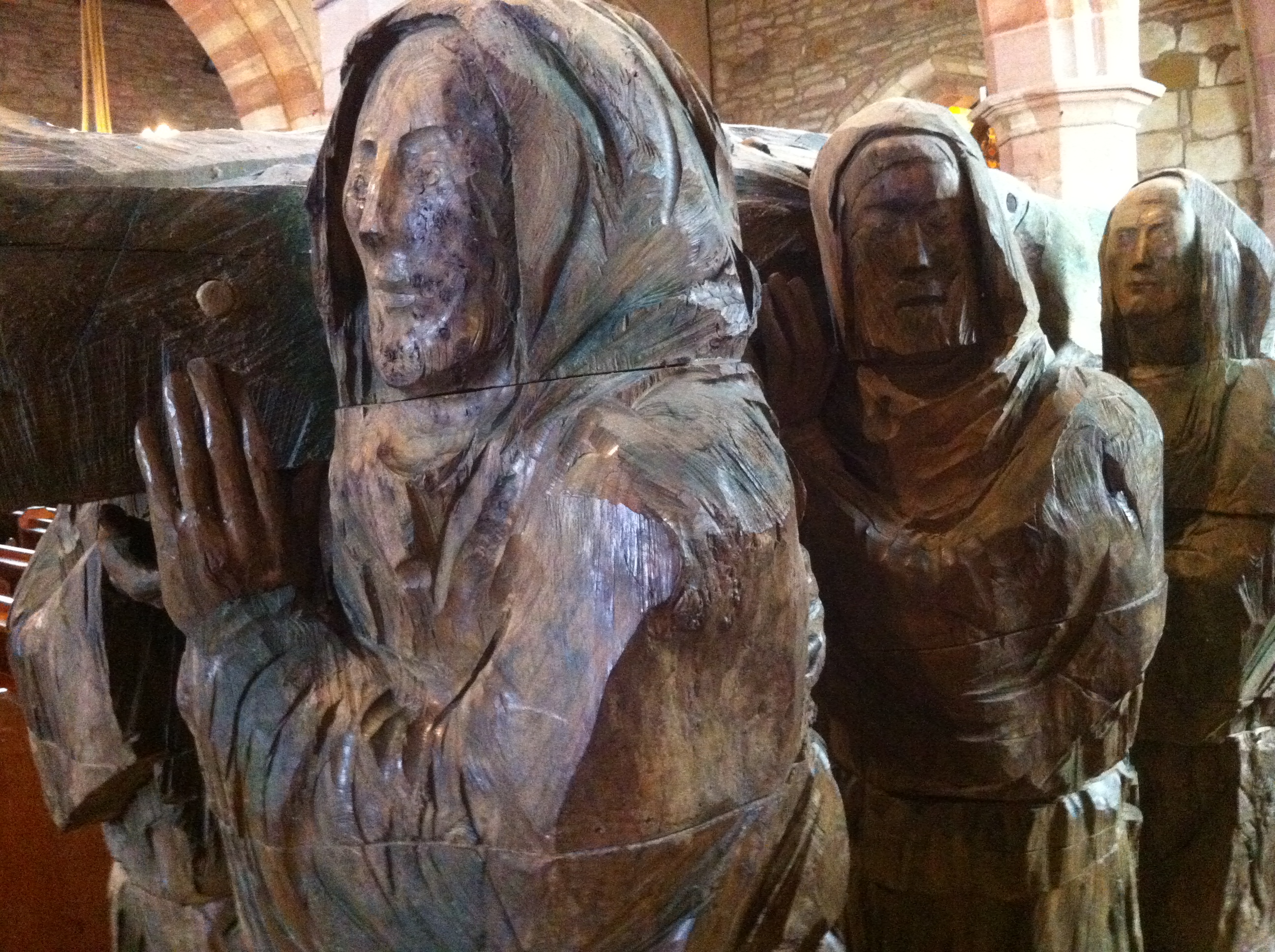
carrying St Cuthbert statue


Categories
Uncategorized

Five clues that you’re already a pilgrim (even if you haven’t yet walked a trail)


Take this simple test. You know you’re a pilgrim when….


1. you find yourself washing our your shirt or underwear by hand even when you’re at home.


2. you think it would be cool to live a very full life out of a very small bag


3. it seems completely normal to you to carry blister bandages and pack water every time you step out the door


4. you’ve come to believe that for the most part, strangers are just friends you haven’t yet met


5. in your mind you dream of new landscapes to walk, and when you walk, you dream of new landscapes for your mind

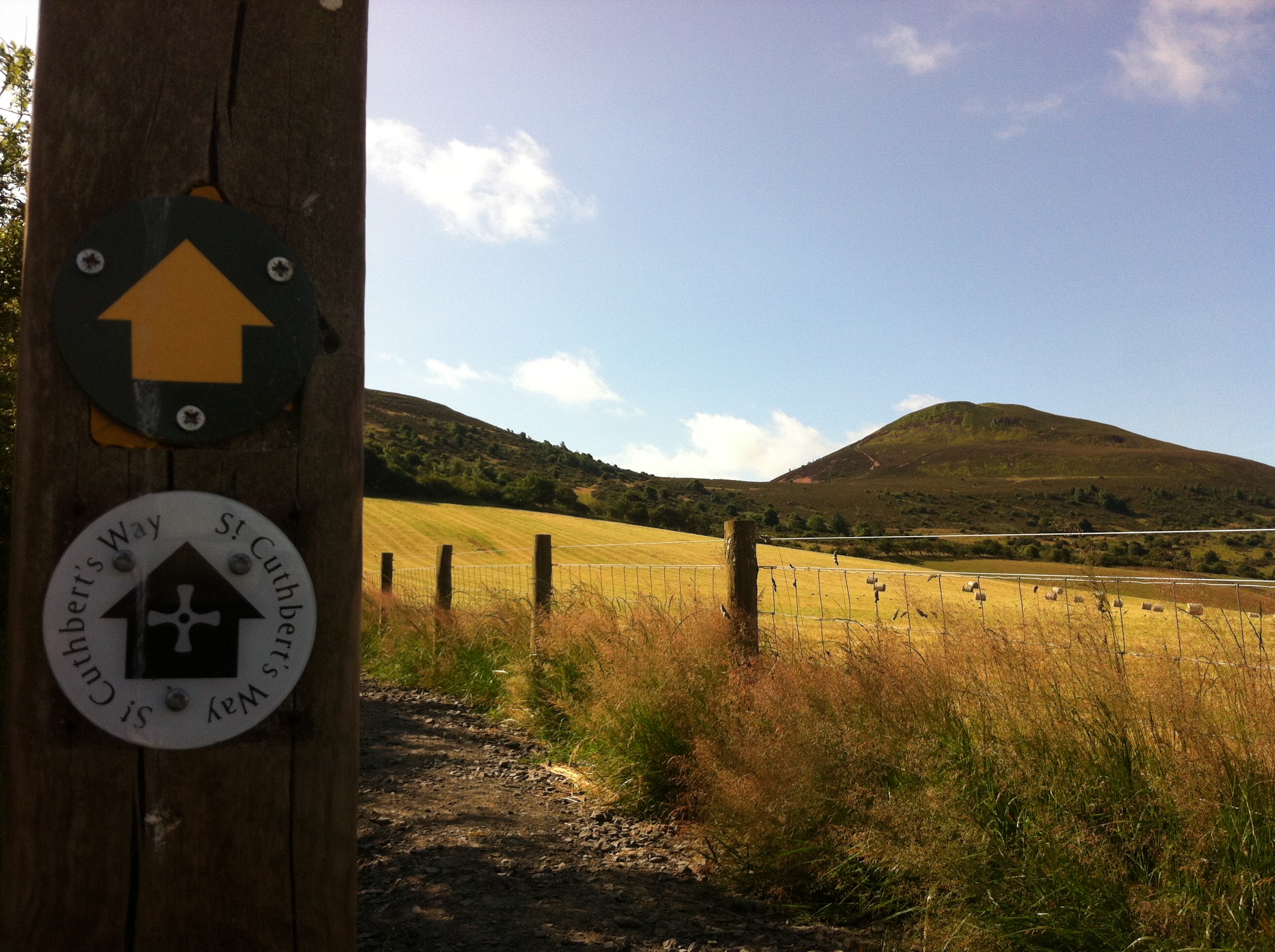
at rest at St Cuthbert's cave

Categories
Uncategorized

From Old Montreal to Kahnawake: a 34-km pilgrimage to combat ignorance

A group of Theological Studies students at Concordia bridge cultural — and physical — divides

Posted on June 18, 2014
|
By: Matthew Anderson
Pilgrimage

Photos by Matthew Anderson


Last weekend Matthew Anderson, an assistant professor in Concordia’s Department of Theological Studies and the Loyola College for Diversity and Sustainability, and Sara Terreault, a lecturer in the Department of Theological Studies, led a group of students on a walking pilgrimage from Old Montreal to the Kahnawake Mohawk Territory.

From Saturday through Monday, they toured churches and First Nations institutions, learning about the people and the cultures they represent. Anderson compiled this account.

Plotting a 34-kilometre walking route between Old Montreal and the Kahnawake Mohawk Territory was difficult. But the hardest part turned out to be the last few kilometres.

Sara Terreault, a lecturer in Theological Studies, and I were temporarily stymied at city hall in Sainte-Catherine, a city near Kahnawake on Montreal’s South Shore.

“Oh, no, you can’t walk to Kahnawake from here unless the police stop traffic and you use the highway,” a clerk said. “I’ve lived here for 30 years, and I can tell you that it’s just not possible.”

Only a couple of minutes later, we discovered a service road footpath connecting the communities along the river. The problem is clearly not impassible terrain, but something else. Maps of the town end at the border and show a blank space to the west, where Kahnawake lies. When there is a blockade or a political crisis, this benign ignorance on the part of many non-Indigenous Montrealers can turn into outright suspicion or hostility, as clearly happened during the so-called Oka Crisis of 1990.

What’s the solution to such a conundrum? Part of it may begin with simply putting one foot in front of the other.

Pilgrimage

Students move between two destinations — and two cultural realities.

In a study I’m presenting in July at the Sacred Journeys conference at Mansfield College, Oxford, I propose that the dynamics of a trek offer a unique way to bridge cultural differences. Our research shows that walking combats ignorance of the cultural “other” not only in the shared experience of the journey, but also by allowing us to feel in our own bodies the distance from — and proximity to — these supposedly foreign places.

This is an experience that travelling by motor vehicle just doesn’t offer.

Taking steps to combat ignorance

This summer, Terreault is teaching a course on pilgrimages in the Department of Theological Studies. Along with me, she organized the 34-kilometre walk from Old Montreal and Kahnawake, which we undertook this past weekend.

To test how walking pilgrimages change the cultural suppositions of those who undertake them, she required her students to critically engage with pilgrimage theories during their trek between the historic destinations.

Notre-Dame-de-Bon-Secours Chapel

Participants tour Old Montreal’s Notre-Dame-de-Bon-Secours Chapel, once a popular site for Christian pilgrims.

The walk began on Saturday morning, with a tour of Old Montreal’s iconic 17th-century Notre-Dame-de-Bon-Secours Chapel, a structure built at the behest of St. Marguerite Bourgeoys that served as a pilgrimage site for the first Christian inhabitants of what was then called Ville-Marie.

From there, we walked the 23 or so kilometres to Sainte-Catherine, where we stayed in the basement of Église Sainte-Catherine d’Alexandrie. Early the next morning, we began the roughly 10-kilometre trek to Kahnawake.

While there, we visited the shrine of Kateri Tekakwitha, who became the first Indigenous North American saint with her canonization in 2012. We learned more about Tekakwitha from Orenda Boucher (BA 09, MA 13), who is working on a PhD thesis on Mohawk spiritual expressions.

Later, we toured the Kahnawake Cultural Centre with Tom Deer, its cultural liaison officer, before we ended our time in the territory with a visit to the Kahnawake Longhouse, a place for traditional religious expression. We also had the privilege of spending some time with Kenneth Deer, a Kahnawake journalist and educator who is involved with the United Nations Permanent Forum on Indigenous Issues.

Our pilgrimage concluded on Monday with our walk back to Montreal. Terreault was moved by the entire weekend.

“It’s humbling as well as instructive to see how warmly we were welcomed throughout our journey,” she said. “Communitas is a technical term used in pilgrimage studies that refers to the spontaneous emergence of fellow-feeling among people journeying together, regardless of social or other differences. There was certainly a sense of that about our entire trip.”

Ultimately, the voyage we undertook was not so much to a destination as between two cultural self-understandings and the physical spaces that exemplify them. It’s important to note that the walk was part of Concordia’s ongoing mandate of public outreach.

On our journey, we crossed densely urban, suburban and industrial zones, as well as parks and recreational areas, rediscovering parts of what was once an important historical Montreal trail. But as much as we were retracing the past, our eyes were definitely on this route’s future. Our political leaders, including those of the First Nations communities, are asking us to learn from each other.

Walking is a singularly powerful way to begin to do exactly that.

article from Concordia NOW, at http://www.concordia.ca/cunews/main/stories/2014/06/18/from-old-montrealtokahnawakea34kmpilgrimagetocombatignorance.html

Categories
Uncategorized

Twenty Minute Liminality


Bridge from SeawaySince it wasn’t rush hour and the span over the St-Lawrence was clear, it took only twenty minutes to drive from my home in Verdun to where the steelwork and concrete delivered the little rent-by-the-hour Toyota containing my friend Sara and me into the Mohawk territory of Kahnawake (Kahnawà:ke). I’ve always found there to be something almost harsh about the Mercier Bridge. Despite being of similar construction it has none of the 19th century charm of the Victoria (a bridge my children used to call the “singing bridge” when they were little, for the hum of the tires on the steel tracks slung along its sides). Nor does the Mercier attempt the modernist concrete vision that first inspired and then doomed the grandly arching Champlain, finished in 1967 and already on life support. Where the Jacques Cartier Bridge meanders genteelly over roller coasters and parks, the Mercier seems more grimly pedestrian, even though actual pedestrians would be risking their lives to walk it.

Maybe it’s the way one is forced to drive the Montreal approach to the Mercier, encased in a graffiti-covered cement chute that twists and turns through barely glimpsed walls of duplexes until the roadway finally shoots you up and onto the steel. It’s really only as you near the bridge’s end that you realize how high you’ve come. And then, just as the Seaway glitters below you, you drop down the exit ramp to the erroneously named “south shore”, the car’s shocks pinging at potholes. Suddenly you’re in a land you didn’t realize was there, a strip of gas stations, restaurants, smoke shops and road-side businesses with signs in a language that seems to have too many consonants, apostrophes and syllables to make sense. This is not your land, you think. And you’re right.

The Mercier Bridge’s greatest shortcoming might be that, on a good day, it delivers you too quickly from one world to the next. From the thick stone walls of the centuries-old Roman Catholic mission among the Iroquois, through the Mohawk steel workers who were first trained on the bridge spans and went to American cities for work, through Indian residential schools and the riots and blockades and soldiers and warriors of the late summer and fall of 1990, there are stories to be told about every foot of the transition between shore-lines. When traffic is light the stories flit by like the shadows between girders, far too quickly even to be heard, much less really heard, which is to say, to be felt and understood.

In June Sara and I will be leading a group of walking pilgrims from Old Montreal to Kahnawake as part of the pilgrimage class we’ve developed at the Department of Theological Studies, Concordia University. Each year the students have had to walk a pilgrimage. While in the past we’ve focused on European routes, this year we’re sticking closer to home. In June we will walk the 30 km or so one-way route together. Although we are starting in the Old Port it won’t be a pilgrimage to Kahnawake (although such a pilgrimage does exist, centred on the shrine of the Mohawk Saint Kateri). Instead we hope our June walk will be an experiencing of the full distance – cultural, temporal, linguistic, historical, and spiritual – between two poles: Old Montreal, one of the hearts of Champlain’s dream of French settlement in this part of North America, now a gentrified example of Quebecois North American culture, and Kahnawake, a territory of the Mohawk, part of the historic Haudenosaunee Confederacy. Each end of this walk has its own understandings of, and traditions around, journey. We hope that by taking our time along the distance between those understandings and experiences of mobility this summer, the stories will unfold at a pace we can hear as well.

This morning when Sara and I arrived by car in Kahnawake, we realized fairly quickly that our maps were not going to be of much use. There were no street signs to be found, anywhere in the village. “Why do you need street signs?” someone said to us when we asked, with a gentle lifting of the shoulders and the trace of a smile. “Everyone who needs to know where they’re going already knows how to get there.”

This summer we hope that we too will learn, together and footfall by footfall, where we are going, and how to get there.

The heart of Kahnawake

Categories
Uncategorized

The Phantom Bomber

starting out

Where the long, hot, dusty path finally drops out of the Cheviot Hills into the town of Wooler, Northumberland , every B&B and hotel room is booked. Eventually I manage to get hold of someone at the Youth Hostel. A voice on the other end of the phone answers my by-then desperate plea: “Sure, we have a place.” As if it were a silly question to ask. My room is spartan but fine, and there’s a shower at the end of the hall.

Being a youth hostel, I expected youth. But in the morning I find myself at table with an English man and a Scottish woman of at least my age. Although separated by the length of the table, they are already deep in conversation when I sit, perhaps not wisely, in the middle.

There is a small map on the table between them. The Pennine Way starts here, declares the man, pointing to it. I know; I’ve walked it. You’ve walked some path, corrects the woman. But it wasn’t the Pennine Way. That starts here. She jabs her finger on another spot. I try to find a place for my tea that is not on the disputed piece of paper. Well, I know what I walked says the Englishman. You’re wrong, answers the Scot, and they both lapse into what to me would be charged, but seems to them to be a comfortable, silence. I wonder if they’re a couple.

Edinburgh is a lovely city I volunteer. I was there in 2006. Loved the old town. The Scot answers back crisply. It’s nice to look at. But I grew up there and I’d never move back. They all ask what schools you’ve been to. As if that’s what’s important. First thing they want to know. It’s not a pretty place. She shakes her head as if to rid her mind of some memory. Dark local sandstone, pipes up the English man from his end of the table. That’s what makes Scottish buildings ugly. Northumberland too, he adds after a pause, with a nod to her.

When the Englishman finds out I’m walking the St. Cuthbert Way to study walking pilgrimages, a discussion ensues on the decline of long-distance trail-walking in England. Foot and mouth disease, he pronounces. That’s what killed it. Ever since then the trails are less busy. And the hostel movement has suffered too. The Scot nods. Yes, foot and mouth. It’s a pity. We need the social movement of hostels more than ever in this world.

This world, the Englishman repeats, with feeling. As if that says it all.

I tell them about the World War II vintage bomber that surprised me in the hills, coming up out of nowhere and then gone again as I struggled to pull out my camera. Was that the ghost bomber, asks the Scot? There’s silence for about 30 seconds while I try to digest the question. Umm. It was real enough, I say finally. Loud and low. Just not what I was expecting, you know, in a long day of walking by myself. Oh yes, those low flying fighters, says the Englishman, looking up from his book. They’re over you before you even hear the sound. Scares the hell out of the wildlife. No, I heard this one, I insist. The fighters – I’ve seen those too, the last couple days. RAF. This was different. Some hobby pilot I guess. It was an old prop plane. It came around the hill and banked right above me. By the time I got my camera it had flown over the next hill. It was beautiful.

The ghost bomber repeats the Scot. I was in the Cheviots, the summer before last, and I saw it then. Passed right over me, low. I never heard a thing. Just saw it. That’s when I knew it was a ghost.

The Englishman looks down at his tea and says nothing. I start thinking about the trail ahead. Can you pass the marmalade, I ask?

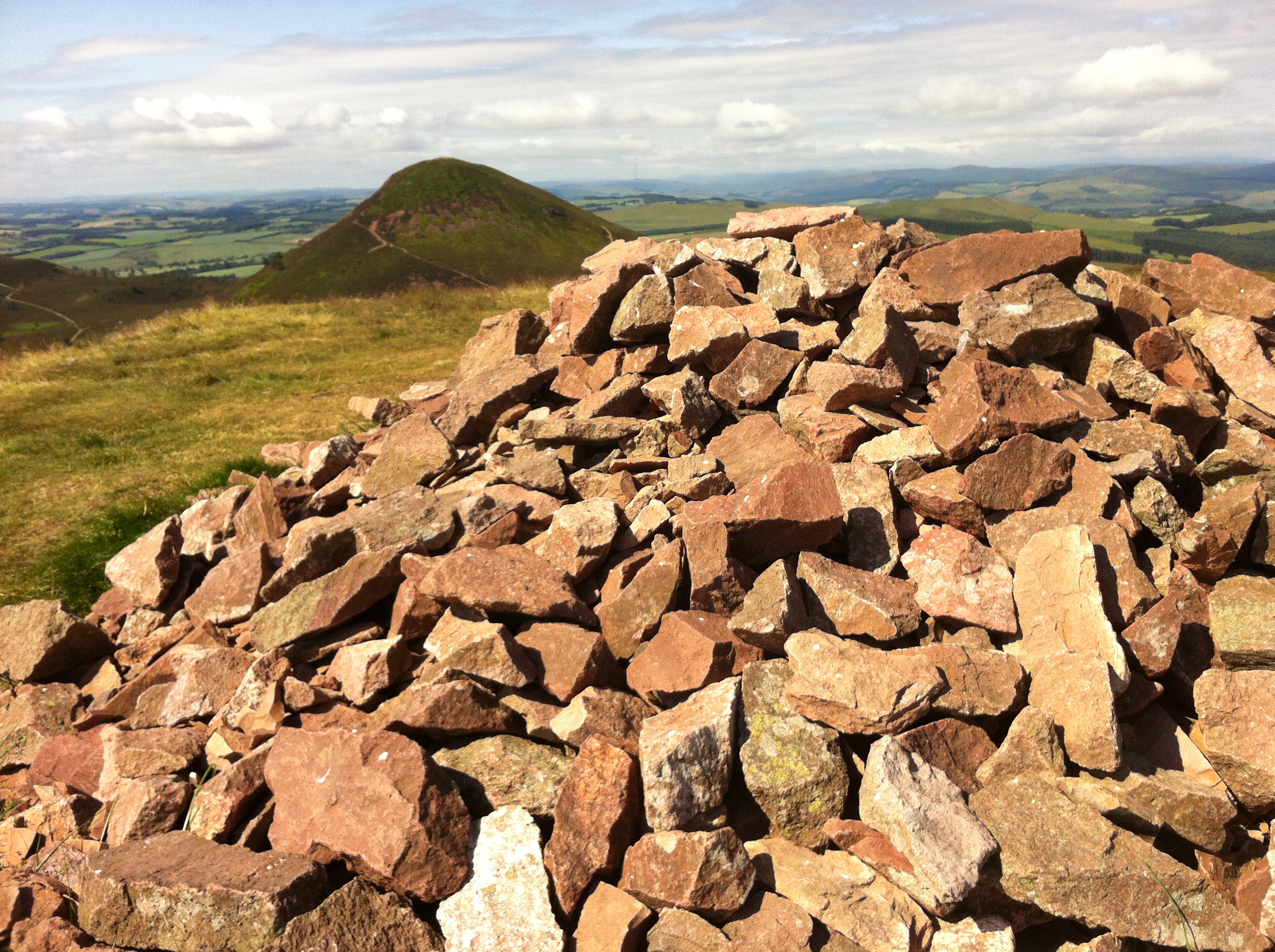
east hill