Categories
Uncategorized

Walk Past

There’s something about Lindisfarne, Norway and Ireland that connects all three in history, art, and memory. And faith. Cuthbert (634-687) was an Anglo-Saxon shepherd boy trained by Irish monks from Iona, who accepted the decision at Whitby to go with Roman customs, and whose remains were troubled by Viking raiders, whose Danish descendents in the Danelaw, later Northumbria, eventually honoured him as their patron saint. Life is indeed strange. Over thirteen centuries later, a descendent of Norwegians, I arrived by foot at the cave of St. Cuthbert, accompanied by my Northumbrian friends Chris and Clare, after having marveled at the intricacies of Viking art and archaeology in Celtic Dublin and walked through Norway’s St. Olaf Way, to pay my respects at one of the resting places of an Anglo-Saxon saint.

Mostly that morning I’d been worried about keeping up with Chris. His lanky frame and long legs, combined with a love of walking, an interest in history and an excitement for the path ahead, mean that he is a wonderful pilgrimage partner – when he doesn’t mind slowing just a bit. In any case we had to slow to find the place. The signs to Cuddy’s Cave, as it is sometimes known, were not all that clear. The property is managed by UK’s National Trust, but unlike some of the Trust’s other locations there is little infrastructure – just the sandstone rock formation, stairs cut into the rock on either side, some blackened soot on the cave wall from someone attempting a campfire, and the cave itself. Standing in the cave, it’s hard not to feel the weight of the rock overhead. Here, according to which report you believe, was where St Cuthbert actually lived for a short time as a hermit seeking even more isolation than Holy Island could provide, or where centuries after his passing the monks of Lindisfarne hid out from the Vikings with the coffin of the unfortunately mobile saint. Or both.

Both Chris and I are in our 50s. When he was in his early 50s, St. Cuthbert realized that death would soon be on him, and left his post as Bishop and Prior of the active monastery at Lindisfarne/Holy Island to die in his hermit’s cell on Inner Farne Island. He left specific instructions that he did not want to be buried at the monastery because he did not want the monks to be bothered by all of the pilgrims he knew would come to his tomb. But his friends insisted and so that is where he was first laid to rest.

It was almost as if Cuthbert knew what would happen. Centuries later, the vikings raided rich Lindisfarne and laid it to waste. While the sea marauders were not interested in the saint’s spiritual blessings, they were very interested in the kinds of riches that typically adorned saints’ tombs. So the monks fled with the coffin of the saint, and wandered the countryside for seven years before eventually being led by a dun cow to the site of what became Durham cathedral.

Caves are places of shelter, life and death, despair and fear, and hope. The ferns along the path nodded at the lightest touch of a warm wind, and cicadas started up here and there in the trees to accompany our bright and lazy afternoon. As we shared a cup of tea I tried to imagine Cuthbert right there, where our packs were set against the sandstone. An ancient saint, rocks more ancient still.

In his early 50s. The nature of shrines is that we all carry something not only to, but also past such a place. I hadn’t quite finished my tea but Chris was pacing. I got up, brushing the crumbs of cake off my chest. What do you think, I asked him? Can we still make it before sunset?
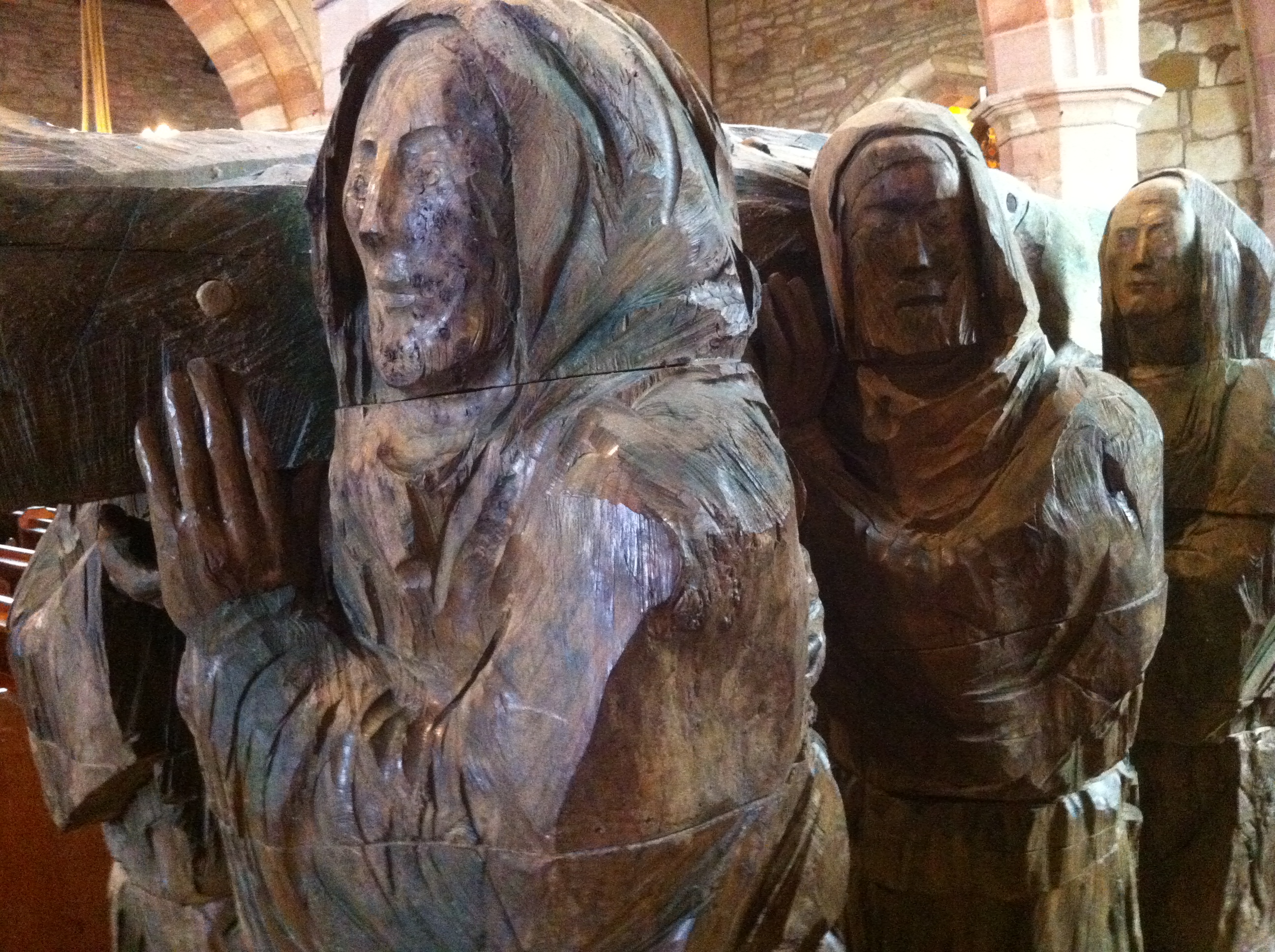
carrying St Cuthbert statue


Categories
Uncategorized

From Old Montreal to Kahnawake: a 34-km pilgrimage to combat ignorance

A group of Theological Studies students at Concordia bridge cultural — and physical — divides

Posted on June 18, 2014
|
By: Matthew Anderson
Pilgrimage

Photos by Matthew Anderson


Last weekend Matthew Anderson, an assistant professor in Concordia’s Department of Theological Studies and the Loyola College for Diversity and Sustainability, and Sara Terreault, a lecturer in the Department of Theological Studies, led a group of students on a walking pilgrimage from Old Montreal to the Kahnawake Mohawk Territory.

From Saturday through Monday, they toured churches and First Nations institutions, learning about the people and the cultures they represent. Anderson compiled this account.

Plotting a 34-kilometre walking route between Old Montreal and the Kahnawake Mohawk Territory was difficult. But the hardest part turned out to be the last few kilometres.

Sara Terreault, a lecturer in Theological Studies, and I were temporarily stymied at city hall in Sainte-Catherine, a city near Kahnawake on Montreal’s South Shore.

“Oh, no, you can’t walk to Kahnawake from here unless the police stop traffic and you use the highway,” a clerk said. “I’ve lived here for 30 years, and I can tell you that it’s just not possible.”

Only a couple of minutes later, we discovered a service road footpath connecting the communities along the river. The problem is clearly not impassible terrain, but something else. Maps of the town end at the border and show a blank space to the west, where Kahnawake lies. When there is a blockade or a political crisis, this benign ignorance on the part of many non-Indigenous Montrealers can turn into outright suspicion or hostility, as clearly happened during the so-called Oka Crisis of 1990.

What’s the solution to such a conundrum? Part of it may begin with simply putting one foot in front of the other.

Pilgrimage

Students move between two destinations — and two cultural realities.

In a study I’m presenting in July at the Sacred Journeys conference at Mansfield College, Oxford, I propose that the dynamics of a trek offer a unique way to bridge cultural differences. Our research shows that walking combats ignorance of the cultural “other” not only in the shared experience of the journey, but also by allowing us to feel in our own bodies the distance from — and proximity to — these supposedly foreign places.

This is an experience that travelling by motor vehicle just doesn’t offer.

Taking steps to combat ignorance

This summer, Terreault is teaching a course on pilgrimages in the Department of Theological Studies. Along with me, she organized the 34-kilometre walk from Old Montreal and Kahnawake, which we undertook this past weekend.

To test how walking pilgrimages change the cultural suppositions of those who undertake them, she required her students to critically engage with pilgrimage theories during their trek between the historic destinations.

Notre-Dame-de-Bon-Secours Chapel

Participants tour Old Montreal’s Notre-Dame-de-Bon-Secours Chapel, once a popular site for Christian pilgrims.

The walk began on Saturday morning, with a tour of Old Montreal’s iconic 17th-century Notre-Dame-de-Bon-Secours Chapel, a structure built at the behest of St. Marguerite Bourgeoys that served as a pilgrimage site for the first Christian inhabitants of what was then called Ville-Marie.

From there, we walked the 23 or so kilometres to Sainte-Catherine, where we stayed in the basement of Église Sainte-Catherine d’Alexandrie. Early the next morning, we began the roughly 10-kilometre trek to Kahnawake.

While there, we visited the shrine of Kateri Tekakwitha, who became the first Indigenous North American saint with her canonization in 2012. We learned more about Tekakwitha from Orenda Boucher (BA 09, MA 13), who is working on a PhD thesis on Mohawk spiritual expressions.

Later, we toured the Kahnawake Cultural Centre with Tom Deer, its cultural liaison officer, before we ended our time in the territory with a visit to the Kahnawake Longhouse, a place for traditional religious expression. We also had the privilege of spending some time with Kenneth Deer, a Kahnawake journalist and educator who is involved with the United Nations Permanent Forum on Indigenous Issues.

Our pilgrimage concluded on Monday with our walk back to Montreal. Terreault was moved by the entire weekend.

“It’s humbling as well as instructive to see how warmly we were welcomed throughout our journey,” she said. “Communitas is a technical term used in pilgrimage studies that refers to the spontaneous emergence of fellow-feeling among people journeying together, regardless of social or other differences. There was certainly a sense of that about our entire trip.”

Ultimately, the voyage we undertook was not so much to a destination as between two cultural self-understandings and the physical spaces that exemplify them. It’s important to note that the walk was part of Concordia’s ongoing mandate of public outreach.

On our journey, we crossed densely urban, suburban and industrial zones, as well as parks and recreational areas, rediscovering parts of what was once an important historical Montreal trail. But as much as we were retracing the past, our eyes were definitely on this route’s future. Our political leaders, including those of the First Nations communities, are asking us to learn from each other.

Walking is a singularly powerful way to begin to do exactly that.

article from Concordia NOW, at http://www.concordia.ca/cunews/main/stories/2014/06/18/from-old-montrealtokahnawakea34kmpilgrimagetocombatignorance.html

Categories
Uncategorized

Twenty Minute Liminality


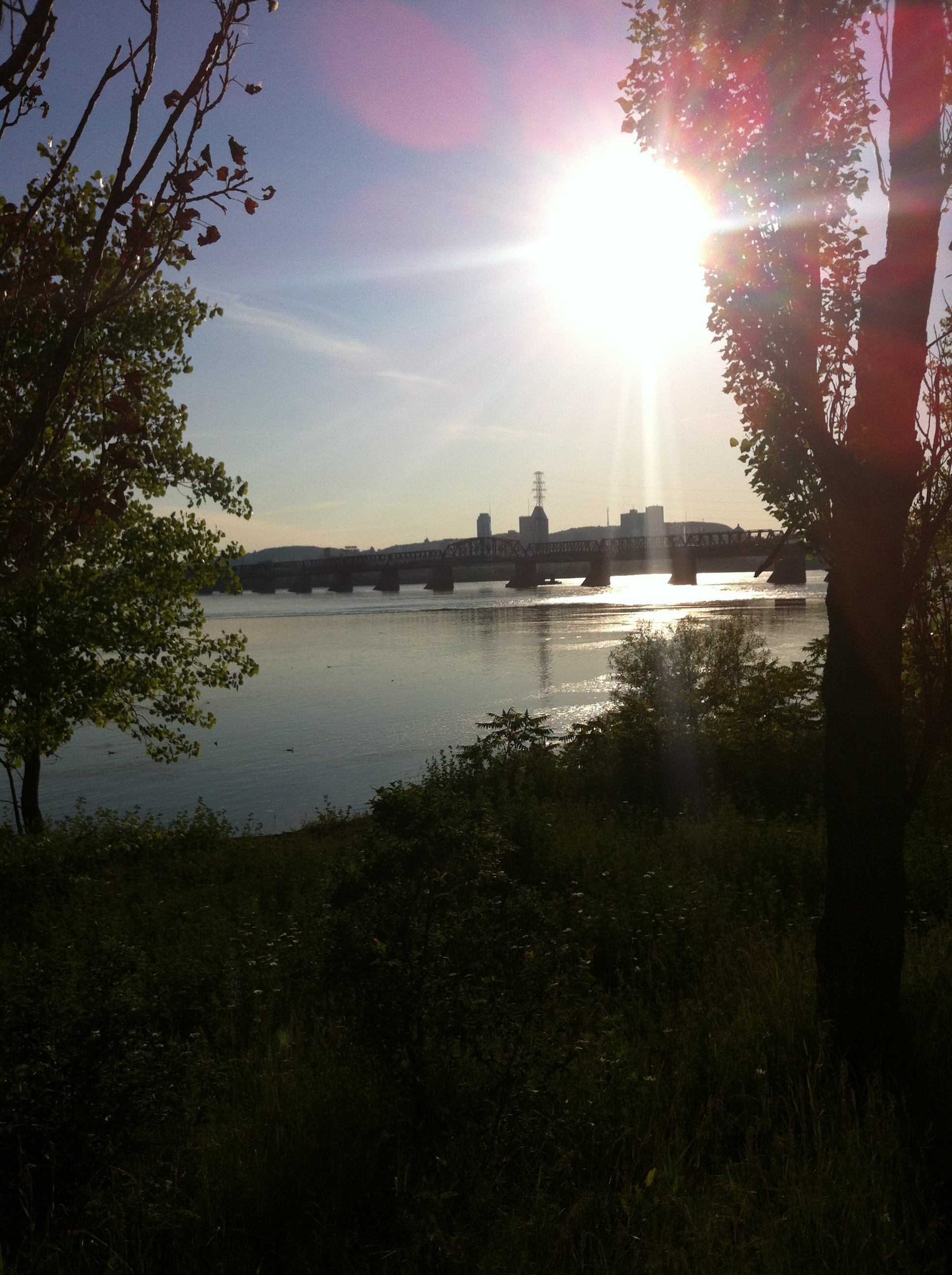
Bridge from SeawaySince it wasn’t rush hour and the span over the St-Lawrence was clear, it took only twenty minutes to drive from my home in Verdun to where the steelwork and concrete delivered the little rent-by-the-hour Toyota containing my friend Sara and me into the Mohawk territory of Kahnawake (Kahnawà:ke). I’ve always found there to be something almost harsh about the Mercier Bridge. Despite being of similar construction it has none of the 19th century charm of the Victoria (a bridge my children used to call the “singing bridge” when they were little, for the hum of the tires on the steel tracks slung along its sides). Nor does the Mercier attempt the modernist concrete vision that first inspired and then doomed the grandly arching Champlain, finished in 1967 and already on life support. Where the Jacques Cartier Bridge meanders genteelly over roller coasters and parks, the Mercier seems more grimly pedestrian, even though actual pedestrians would be risking their lives to walk it.

Maybe it’s the way one is forced to drive the Montreal approach to the Mercier, encased in a graffiti-covered cement chute that twists and turns through barely glimpsed walls of duplexes until the roadway finally shoots you up and onto the steel. It’s really only as you near the bridge’s end that you realize how high you’ve come. And then, just as the Seaway glitters below you, you drop down the exit ramp to the erroneously named “south shore”, the car’s shocks pinging at potholes. Suddenly you’re in a land you didn’t realize was there, a strip of gas stations, restaurants, smoke shops and road-side businesses with signs in a language that seems to have too many consonants, apostrophes and syllables to make sense. This is not your land, you think. And you’re right.

The Mercier Bridge’s greatest shortcoming might be that, on a good day, it delivers you too quickly from one world to the next. From the thick stone walls of the centuries-old Roman Catholic mission among the Iroquois, through the Mohawk steel workers who were first trained on the bridge spans and went to American cities for work, through Indian residential schools and the riots and blockades and soldiers and warriors of the late summer and fall of 1990, there are stories to be told about every foot of the transition between shore-lines. When traffic is light the stories flit by like the shadows between girders, far too quickly even to be heard, much less really heard, which is to say, to be felt and understood.

In June Sara and I will be leading a group of walking pilgrims from Old Montreal to Kahnawake as part of the pilgrimage class we’ve developed at the Department of Theological Studies, Concordia University. Each year the students have had to walk a pilgrimage. While in the past we’ve focused on European routes, this year we’re sticking closer to home. In June we will walk the 30 km or so one-way route together. Although we are starting in the Old Port it won’t be a pilgrimage to Kahnawake (although such a pilgrimage does exist, centred on the shrine of the Mohawk Saint Kateri). Instead we hope our June walk will be an experiencing of the full distance – cultural, temporal, linguistic, historical, and spiritual – between two poles: Old Montreal, one of the hearts of Champlain’s dream of French settlement in this part of North America, now a gentrified example of Quebecois North American culture, and Kahnawake, a territory of the Mohawk, part of the historic Haudenosaunee Confederacy. Each end of this walk has its own understandings of, and traditions around, journey. We hope that by taking our time along the distance between those understandings and experiences of mobility this summer, the stories will unfold at a pace we can hear as well.

This morning when Sara and I arrived by car in Kahnawake, we realized fairly quickly that our maps were not going to be of much use. There were no street signs to be found, anywhere in the village. “Why do you need street signs?” someone said to us when we asked, with a gentle lifting of the shoulders and the trace of a smile. “Everyone who needs to know where they’re going already knows how to get there.”

This summer we hope that we too will learn, together and footfall by footfall, where we are going, and how to get there.

The heart of Kahnawake

Categories
Uncategorized

Winter Walking

img_3002.jpg

I love a public road: few sights there are

That please me more – such object has had power

O’er my imagination since the dawn

Of childhood, when its disappearing line

Seen daily afar off, on one bare steep

Beyond the limits which my feet had trod,

Was like a guide into eternity,

At least to things unknown and without bound.

                                                                                                            Wordsworth


The snow is falling. Ice has formed on the sidewalks and walking is becoming, if not impossible, at least treacherous. My 4 km path from home to office has been transformed into an obstacle course. Not so much harder, I guess, than some of the summer’s more difficult wanderings, but requiring much sturdier dress. And even in its warmth, the city was harsher than Norway and Scotland’s hedgerows and mountain trails. There are no wild flowers along the way, no trout rising in any stream through Verdun, no herons kicking into the air to greet my passing. Now there are gusts of needle-sharp air around the frozen concrete corners of walk-ups. There is the way the wind plays a winter song on the wires, calling the pigeons out to find the bread crumbs someone left on the snow. And there is N-, the homeless man on the bench he stubbornly, nonsensically prefers to a warm bed, his nose dripping even as he speaks to me in the most reasonable, cultured, and educated of tones about his degree in English literature. “I can’t leave,” he tells me, “they asked me to be here in this place when they come, which should be any day now.” He shifts his legs and adjusts the plastic bags around him. I look at his boots. Such is mental illness. But then, it was a kind of rootlessness I aspired to not many months ago. I buy him snow pants and worry about him on nights like last night, when it drops to 28 below. I think of my sons and know he is someone’s. Calling the police is an option.

There is garbage in the gutter, the smell of oil and tomato sauce unexpectedly tinging the vacuum of air behind the pizzeria, the hiss of the plastic Frosty the Snowman who lifts out of his inner tube once every thirty seconds as the air pump builds him again and again to greet a street that is empty except for me. Later a car rolls slowly by, a foreign creature, windows shadowed, the sound of its tires compressing the snow loud in my ears, muffled bass beating like a heart buried deep within.

Peregrination seems far away from this winter world. Against the cold and dark of the city, life has settled into whatever warm niches it can find, leaving little above the surface. But there is life nevertheless. Different eyes are needed for walking this way, different rhythms to keep from falling on this pilgrim route. There is a different loneliness and a different cost.  In my doorway I take off my gloves and the back of my hands is red and raw, the skin threatening to break open from dryness. The only hand cream I can find stings.

 A Verdun Christmas 2012


Categories
Uncategorized

The Likes of You Walking

Singing Donkeys Hostel Kirk Yetholm

As I leave the village of Kirk Yetholm, striding up toward the bare yellow hills of the Scottish Borders, I walk past a sign announcing The Singing Donkeys Hostel and Soup Kitchen for the Soul. It is hand-drawn. I stop despite myself, and think about singing donkeys, trying to remember if I’ve heard anything overnight that might be a braying animal. All I can visualize are the Bremen Town musicians, and I’m pretty sure they didn’t mean that. The sign, and the motley collection of boots underneath, conjure other images between memory and imagination, that I realize are probably not accurate even as they keep floating to mind: a young man in Rasta hat and beard, stirring soup in a communal kitchen, long and lazy afternoons in the sunlight with indistinct plans, someone playing guitar in another room and the sweet-sour tang of pot drifting in an open window, the feel of sex in the air, dream-catchers and crystals and Buddha prayer corners. A part of me wants to knock on the door, tempted by whatever “soup kitchen for the soul” might mean. But it’s too early in the day to begin detours, real or metaphysical. I wasn’t a hippy even when there were hippies. Although my bed at the Borders Hotel was too soft and the beer too tempting, it felt more like home. I take a photo and move on.

Months later, back in Canada, I read in a book about the St. Cuthbert trail that the hostel in Kirk Yetholm was, centuries ago, built as a schoolhouse for gypsy children.

As I’ve discovered on pilgrimage, morning inevitably means climbing. It’s 8 am and the sun is already feeling just a touch too warm for what I had only ten minutes before decided would be perfect wear. Upset with myself, I strip off a layer of merino wool and add it to the weight in my sack. This portion of the trail coincides with the Pennine Way. Probably because I’ve read accounts from those who’ve walked the Pennines, and every story stresses how difficult the path is, I keep expecting to be overtaken by long-legged, weathered, grim-eyed hikers, a different, hardier species, even though I’ve been averaging 25 km a day myself. There is a Pennine Hikers’ Inn, to my surprise looking much more luxurious than my Borders Hotel, and then a corner marked, mysteriously, Halfwayhouse. Half-way to where, I wonder? And where is the house? There are sheep everywhere, unfenced and curious, but no sign of human life. And oddly enough, no walkers, even though this is supposed to be one of the busier parts of the route.

Something happens in the mornings when you’ve been walking day after day: you begin to get eager – almost impatient – for the rhythm that sets itself up in your body after a kilometer or so on the trail. It’s something that stays on, most evenings, even when you’ve dropped your pack for the night and had your solitary meal, when you’re lying in bed trying to remember what day it is and why you were so stressed back home. Maybe it’s a rhythm of breath, or of the feet, or of both. There’s something in it of feeling your lungs tighten under the pressure of taking ever-larger breaths to handle the climb, or noticing the increase in heart-rate, knowing without any doubt that it will drop again as soon as you’ve taken a moment to rest. I’ve read that happiness is doing what you’re designed to do. Humans are designed to walk.

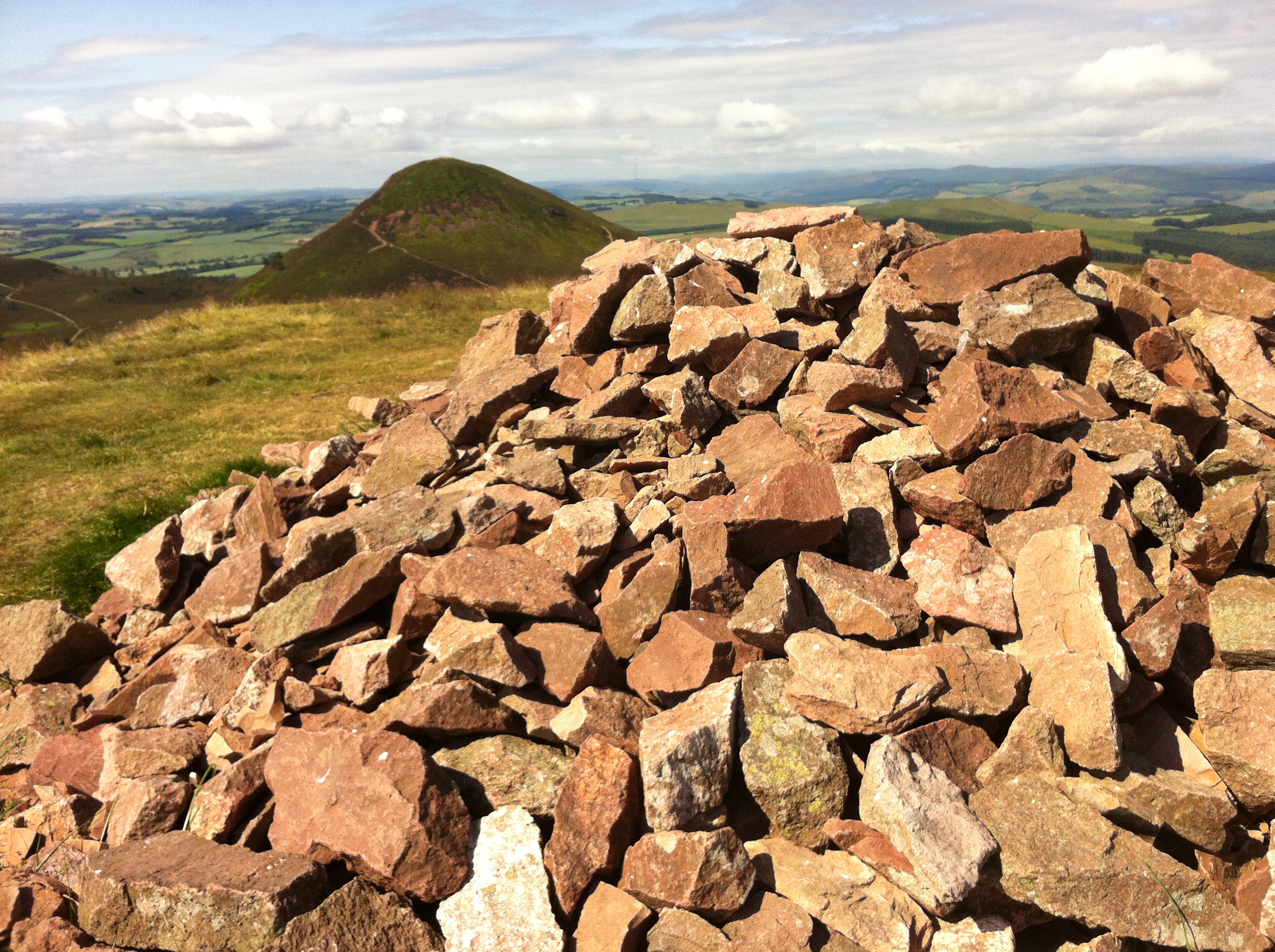
It’s probably that happiness that leads me up the first big hill of the morning, an imposing bare challenge of a knoll planted right in front of the road. The hill is called Green Humbleton on the map, had I been smart enough to look at my map. It’s only 268 meters, but when what I’d thought was the trail becomes indecisive and finally peters out about three-quarters of the way up, I assume that the cairn of stones I can sort-of see is my next marker. The way goes neither left nor right, and so neither do I. The top quarter of the hill is steep, so steep that at times I’m forced to scramble on all fours, burrs and seed spears digging into my soft palms. Bottle flies sit in black swirling columns of air that I pass through, forcing myself to breathe in through my nose so as not to inhale too many insects at one go. Horseflies discover the exposed flesh of my arms and legs, wet with sweat and red with exertion; I swat as best I can, but each swivel, because of the weight on my back, threatens to tip me over. When finally I stand at the summit of the hill, the warm gusts of wind are a blessing.

But there is no trail down. I sit for a second to catch my breath and scan the hills for the trail from which so clearly I’ve strayed, but sitting is just an invitation for more horseflies, and I’m bitten twice. So I stand again, and begin the descent. I’m a bit jittery, the way the weight of the pack jolts with each footfall, and with a mild curse at myself for almost making a mistake even worse, I slow down. This would be the way to lock a knee, or step in a hole. Eventually, I spot a sign to my right. The path has wisely sidestepped the hill. I’m happy to be on it again, even though it rewards my happiness by leading, honestly this time, straight up yet another rise.

In the morning, setting out, I’d asked an older woman where the path out of the village began. She’d looked at me in silence for a second, as if debating whether to answer, and then stretched out one arm, almost like a curse, to point at the hills. “That’ll be for the likes of you, walking,” she’d said. Then she smiled.

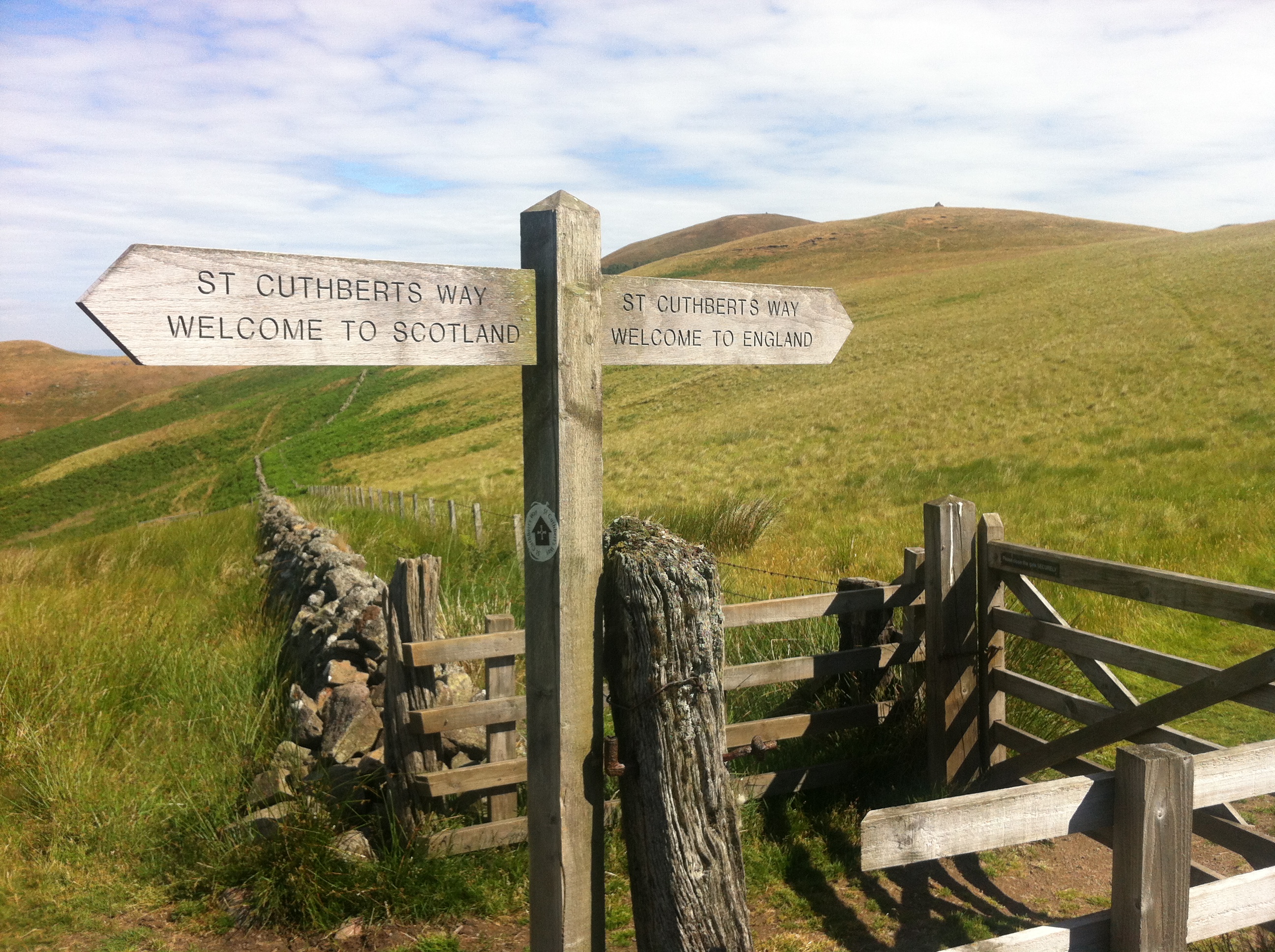
I remembered that when I reached a gate in a stone fence. There’s a sign. It reads, on one side “Welcome to Scotland” and on the other “Welcome to England”. I open the latch, and step through to another country.
heather and wall
the border

Categories
Uncategorized

Kindness

the Tweed day one

“We’re here on this earth to be kind to others. What the others are here for I don’t know” (Auden)

Tuesday turns out much hotter than I’d thought: by midmorning I’m already out of water. The path has been one long riverbank meander, common sandpipers calling and flitting through the low branches, a lone grey heron loosing itself awkwardly from its perch as I passed, and a series of wooden steps with wire mesh tread, forever up and down, up and down over eroding dirt banks and muddy tributary creeks and cuts. Finally the path turns right. It climbs steeply uphill through tall grass and buzzing wildflowers that make me dizzy.

Sweating and out of breath, I follow the way-markings into the village of St. Boswell’s. At first I’m relieved. But no stores are open and the doors are shuttered against the day. There’s a Scottish flag on a pole in the middle of a field of overgrown weeds. My feet immediately dislike the sidewalk. They yearn for a return to the shade and the cushion of the forest floor, but I know this may be my one chance to replenish water. When I dig it out, the guidebook says to be sure to stop and look at the stained glass in the parish kirk. The church door resists a pull; like everything else in this town, it seems permanently locked. For a while I peer at what I think may be the glass through the dark windows, but I can’t tell if the colours I see are real or my imagination. This is my one chance to see the work of Liz Rowley, an artist I cared nothing for nor knew anything about until I’d opened my guide. Traveling is about glimpsing what we have just missed. For a while I sit on the low stone fence outside the church until a tall, slim man with a pack approaches. He must have been behind me on the country trail. He’s walking fast.

I say hello. He seems reluctant to break stride, but does. A walker. He introduces himself as Chris. We talk for a moment and for a few blocks I join him and try unsuccessfully to match the speed of his long legs. We come to a junction where the path turns left and back out of the village. There’s an historic municipal water pump here, with a Bible verse in stone: “Jesus said whosoever drinketh of this water shall thirst again, but whosoever drinketh of the water I give him shall never thirst.” “Alleluia,” I respond, reading it aloud. I give the handle a tentative pump, and when that doesn’t work, a firmer go. Nothing. The well is dry. I’m not quite sure what that does to the verse, but my mouth is parched and I’m disappointed in more than a spiritual way. And, although I don’t admit it to Chris, a little worried.

At that moment there’s a shout from across the street. A young woman, the first person we’ve seen in the village, is waving at us. “Are you thirsty?” she calls. We gratefully accept the two glasses of water she offers, and she takes my plastic backpack bladder into the house to replenish it. I notice that she closes the gate, leaving us on the outside, before going in. In a few seconds she’s back. Chris nods his thanks and bids farewell. Before he leaves he tells me that his wife meets him at points along the trail and perhaps we can all have tea together sometime and I can interview him then. I say sure, thinking it’s the last I will ever see him.

As I hand back the glass, the woman begins an incredibly long and convoluted story of angelic visitation and mystical paralysis in answer to what I thought was a quick question about whether she has ever helped other pilgrims. Eventually, despite her initial kindness, I become edgy. When she appears to be beginning to talk herself into joining me on a spiritual pilgrimage I repeat my thanks, say a hasty goodbye and turn my back to the town.

Hours pass. After the manner of distance walking, all thoughts of St Boswells, the woman, Chris, and the well – all thoughts of everything, in fact – elide into the rhythm of my steps and the vague pains –  left big toe, right heel – where sensations, like blisters, are growing. I traverse golden forests of beech and oak, and rejoin the river, still there, waiting like an old friend who has decided after a lovely morning to take the afternoon off as well.

Eventually the path turns up a country lane-way. It runs along a stone fence bordered by purple strife and daisies. At the top of the gravel way I see two figures outlined against the sky, the first human beings since St Boswells. A woman is talking to a man, gesturing. He shakes his head and walks out of my sight to the right. I wonder if it’s a dispute of some sort. She remains standing at the head of the path, hands on her hips. What happens next is like something out of a dream.

She looks at me as I reach the top of the rise. “Are you Matthew?”

I’m startled to hear my own name. “Yes.” “Oh good,” the woman says. She introduces herself as Clare. “I have tea for you. Follow me.” On a patch of grass between roads are two blankets. There’s a thermos bottle and a padded lunch bag. Two cups are set out.

As I settle, not quite believing, she pours me tea and informs me that her husband told her to expect me, but that I’d taken longer than either of them had imagined. The tea is delicious, the sun is warm, there’s a light breeze. I sit on a blanket, in Scotland, with someone I have never met. After a while I realize that the grass looks cool and inviting. “Would you mind if I took my boots and socks off?” I ask.

“Not at all,” she answers, smiling. “Would you like a scone? I have some of those, too.”

tea and cake first day

Categories
Uncategorized

Leaving Kongsvold

alpine pond near Dovre

For most of the morning, despite the signs saying otherwise, there really is no trail, just the steep side of the mountain. The grass is thick and slippery with overnight rain. The going is difficult: two of our group fall, one badly, somersaulting down the slope and rising painfully with an egg-sized bruise on her shin. We struggle along, unusually quiet. There are two more falls before lunch. No one says anything but I’m sure I’m not the only one worrying there will be an even more serious accident if the trail doesn’t soon improve. We’ve only gone two kilometers out of 25 planned for the day. Later, we find out that many pilgrims just skip this section of marked trail because their German or Norse guidebooks suggest going by the highway. We have no book.

“The best maps are conveyed orally and by gestures, occasionally with a pen and a scrap of paper…just where the road makes that imperceptible fork, that difficult turn” (Tomas Espedal, Tramp). But there was no informal guide to show us the secret, safe path. We are alone, six Canadians under a Norwegian sky. We manage in the only way, the old way, step by step.

When it’s safe to lift our heads, there’s a beautiful pass stretching before us. The trail, such as it is, perches us high above the highway, which is itself above a train track, all three thin parallel lines etched like afterthoughts into a narrow notch between steep granite. On breaks to catch our breath or adjust our boots, we scan the rock-face across from us, and especially the meadows between rockslides. If you want to see muskoxen look for boulders, said one of the Norwegians. Boulders that move.

It’s the end of June and there are still banks of snow on the upper flanks. Every hundred meters or so we meet another rushing mountain stream. Is there a bridge? Someone calls out from behind. There is? Thank God. Pilgrim prayers are increasingly simple. Thank God for goretex boots. Here there’s a larger stream, jumping and frothing and swollen with spring run-off. No bridge, but fortunately there are flat rocks and A moves a few into place to stand on. Two of our group take position, mid-current, to help support the others across, water coursing and spraying around our ankles. Crossing water has become routine. No one thinks much more about it until we round a switchback and come face to face with the fact that the gushing current we just traversed flies out the side of a cliff and drops fifty feet through empty space, only yards after our fording. Later that day a Norwegian pilgrim falls and manages to get out, but loses items from her backpack over the precipice.

There’s animal dung of every variety on the path. At first it’s a game to try to imagine the various creatures who have passed. But at one point just before a steep ascent it’s so thick we have to make a detour. The sheep and reindeer are smart, smiles G grimly, as she pushes up the incline; they know how to drop weight when a hill is coming. Yet climbing is easier than a descent. Your heart hammers and the moisture pools at the base of your back where most of the backpack weight sits. But there is none of the shock to your knees, the chance of slipping. And anyway, climbing is hopeful; it means going somewhere.

Eventually we emerge onto a huge flat table-plateau, where we’re rewarded by the high Norwegian landscape: moss-covered rocks and grey-green lichen stretching out in all directions to a treeless horizon. Without a mid-range, distances are deceiving. We see a cabin in the distance, perched on a giant, solitary rock. It takes forever to walk there. In front of the door is a grey mass that turns out to be a waist-high pile of reindeer antlers. We look around but there is no sign of human life, no one to explain the carnage. A flock of sheep approach and retreat, wheel around us in a spiral and disperse, alternating between curiosity and fear. For a few seconds we are two groups completely still, examining each other across the divide of species, before one of us makes a sound and they bolt away again.

After another hour or so under the huge vault of sky, someone calls for a stop. We find spots in the lee of boulders, sheltering from the increasingly cold wind. K pulls her hood up around her ears and falls back into the pillow of lichen. S, who was busy picking greenery in the lower altitudes now adds garnish from the wilderness to our bare sandwiches: leaves and flowers and herbs, edible evidence of where we’ve been. It’s late and there are still many kilometers to go before we sleep. But we pull our hats over our ears and pass the sandwiches and the tea. How long have we been walking? Four days now? Five? No one seems to remember. We lean back into the lichen, and enjoy a view we cannot name, looking out over this strange world like house-guests who are lost but can’t yet admit it.
Hjerkinn Fjellstue to Kongsvold Inn

Categories
Uncategorized

The Phantom Bomber

starting out

Where the long, hot, dusty path finally drops out of the Cheviot Hills into the town of Wooler, Northumberland , every B&B and hotel room is booked. Eventually I manage to get hold of someone at the Youth Hostel. A voice on the other end of the phone answers my by-then desperate plea: “Sure, we have a place.” As if it were a silly question to ask. My room is spartan but fine, and there’s a shower at the end of the hall.

Being a youth hostel, I expected youth. But in the morning I find myself at table with an English man and a Scottish woman of at least my age. Although separated by the length of the table, they are already deep in conversation when I sit, perhaps not wisely, in the middle.

There is a small map on the table between them. The Pennine Way starts here, declares the man, pointing to it. I know; I’ve walked it. You’ve walked some path, corrects the woman. But it wasn’t the Pennine Way. That starts here. She jabs her finger on another spot. I try to find a place for my tea that is not on the disputed piece of paper. Well, I know what I walked says the Englishman. You’re wrong, answers the Scot, and they both lapse into what to me would be charged, but seems to them to be a comfortable, silence. I wonder if they’re a couple.

Edinburgh is a lovely city I volunteer. I was there in 2006. Loved the old town. The Scot answers back crisply. It’s nice to look at. But I grew up there and I’d never move back. They all ask what schools you’ve been to. As if that’s what’s important. First thing they want to know. It’s not a pretty place. She shakes her head as if to rid her mind of some memory. Dark local sandstone, pipes up the English man from his end of the table. That’s what makes Scottish buildings ugly. Northumberland too, he adds after a pause, with a nod to her.

When the Englishman finds out I’m walking the St. Cuthbert Way to study walking pilgrimages, a discussion ensues on the decline of long-distance trail-walking in England. Foot and mouth disease, he pronounces. That’s what killed it. Ever since then the trails are less busy. And the hostel movement has suffered too. The Scot nods. Yes, foot and mouth. It’s a pity. We need the social movement of hostels more than ever in this world.

This world, the Englishman repeats, with feeling. As if that says it all.

I tell them about the World War II vintage bomber that surprised me in the hills, coming up out of nowhere and then gone again as I struggled to pull out my camera. Was that the ghost bomber, asks the Scot? There’s silence for about 30 seconds while I try to digest the question. Umm. It was real enough, I say finally. Loud and low. Just not what I was expecting, you know, in a long day of walking by myself. Oh yes, those low flying fighters, says the Englishman, looking up from his book. They’re over you before you even hear the sound. Scares the hell out of the wildlife. No, I heard this one, I insist. The fighters – I’ve seen those too, the last couple days. RAF. This was different. Some hobby pilot I guess. It was an old prop plane. It came around the hill and banked right above me. By the time I got my camera it had flown over the next hill. It was beautiful.

The ghost bomber repeats the Scot. I was in the Cheviots, the summer before last, and I saw it then. Passed right over me, low. I never heard a thing. Just saw it. That’s when I knew it was a ghost.

The Englishman looks down at his tea and says nothing. I start thinking about the trail ahead. Can you pass the marmalade, I ask?

east hill

Categories
Uncategorized

Speed Dating Riga

Freedom

monumental monuments
Trying to see a city in four hours feels a bit like speed-dating: you’ll hear a story, you’ll get an impression, but it’s not enough on which to build a relationship. The cheapest ticket north from Frankfurt to Stockholm is an Air Baltic flight that sticks me in Latvia’s capital for a layover too long to sit and do nothing and too short for a real, proper visit. Where some might find that annoying, I’ve never been to Riga. A quick run in seems the least I can do.

Fortunately, the airport is small. The pretty woman in blue at the city information desk is incredibly friendly and helpful. Yes, I can take a taxi, it’s right over there. But why do that when the city bus is almost as fast and costs one-thirtieth the amount? I don’t want to change money for four hours, so I charge the equivalent of one euro for two bus tickets. It leaves over there, from the other side of the parking lot, she points, handing me a card. In two minutes. You’ll have to hurry. I run out the door and into cool straw-yellow Baltic sunshine, me and my backpack bouncing the 100 meters or so to the waiting bus.

I’m in my seat, still breathing heavy, when I hear someone calling me. “Sir? Sir?” Coming down the bus aisle is the same woman in the blue uniform. Sir, she says, smiling, I forgot to give you your second pass. Here it is. She has run the whole distance behind me, in stilettos, to give me a ticket worth 50 cents.

Bus #22 is half-full. Young men in sunglasses, clearly airport workers off-shift, polished leather shoes and pressed shirts, lean against the windows of the bus with their eyes closed and ear buds in. Small old men sit in suits that seemed as grey as their skin, while several elderly women in shapeless but colourful shift dresses peer into each other’s huge paper bags and chortle in a language impossible to understand. Hipster couples, the men in shorts with deck shoes, the women in red pants with v-necked sweaters, hold swaying baby-carriages in place. Beside me sits a pair that look for all the world like some younger, Baltic version of Brangelina. He a rougher Brad Pitt in a white tee-shirt, and behind her sunglasses, high heels and fur-lined vest, hers an adolescent Angelina smile. We pass by gaunt old concrete apartment buildings, interspersed with modern concrete homes. Occasionally there is an old framed cottage, the wood grey with age, fading paint and single-pane glass, old flowerboxes gone to colourful riot.

At the next stop three men who appear to be in their late twenties step on to my section. They move together, a unit of something that seems, from the reactions of the other passengers, foreign. One of them, bare-chested under an open Adidas jacket, turns on music as soon as they sit down. 60s style Russian, or maybe Ukrainian or one of the Republics, the singer’s voice floating over the seats. The old women stop talking and turn to stare. The three men seem oblivious, talking loudly, looking only at each other. When the Brangelina couple leave the bus, the woman gets caught in the doorway a second, her one high-heeled leg stuck for a second on the inside of the bus the occasion for great hilarity from the Russians.

Where the bus drops me it’s only a few steps to the old town. A group of pre-schoolers, all dressed in bright tee-shirts, straggle at the hip level of their monitor as they pass under a giant statue of two officers in greatcoats and caps, back to back, looking out over the river. The squares are full of people. A Mexican ship is in port: small clean-cut men, their skin olive against the bleached white of impeccable uniforms, carry cameras on their belts and examine the wares of the street sellers. The products are typically Baltic: carved wood, bright, intricate knitted goods, and amber in every possible shape and setting. I’m trapped at one of the tables in front of a statue of the Bremen town musicians. The woman managing the stall seems as excited for a chance to practice her English as to show off the wares, which are beautiful, but exactly the same as at the next table. Further down I notice traditional wooden Russian dolls painted with European soccer players. In one of the shops I come across unique and exquisite ceramic houses like some that I saw coming into town. I’d like one, but where would I put it?

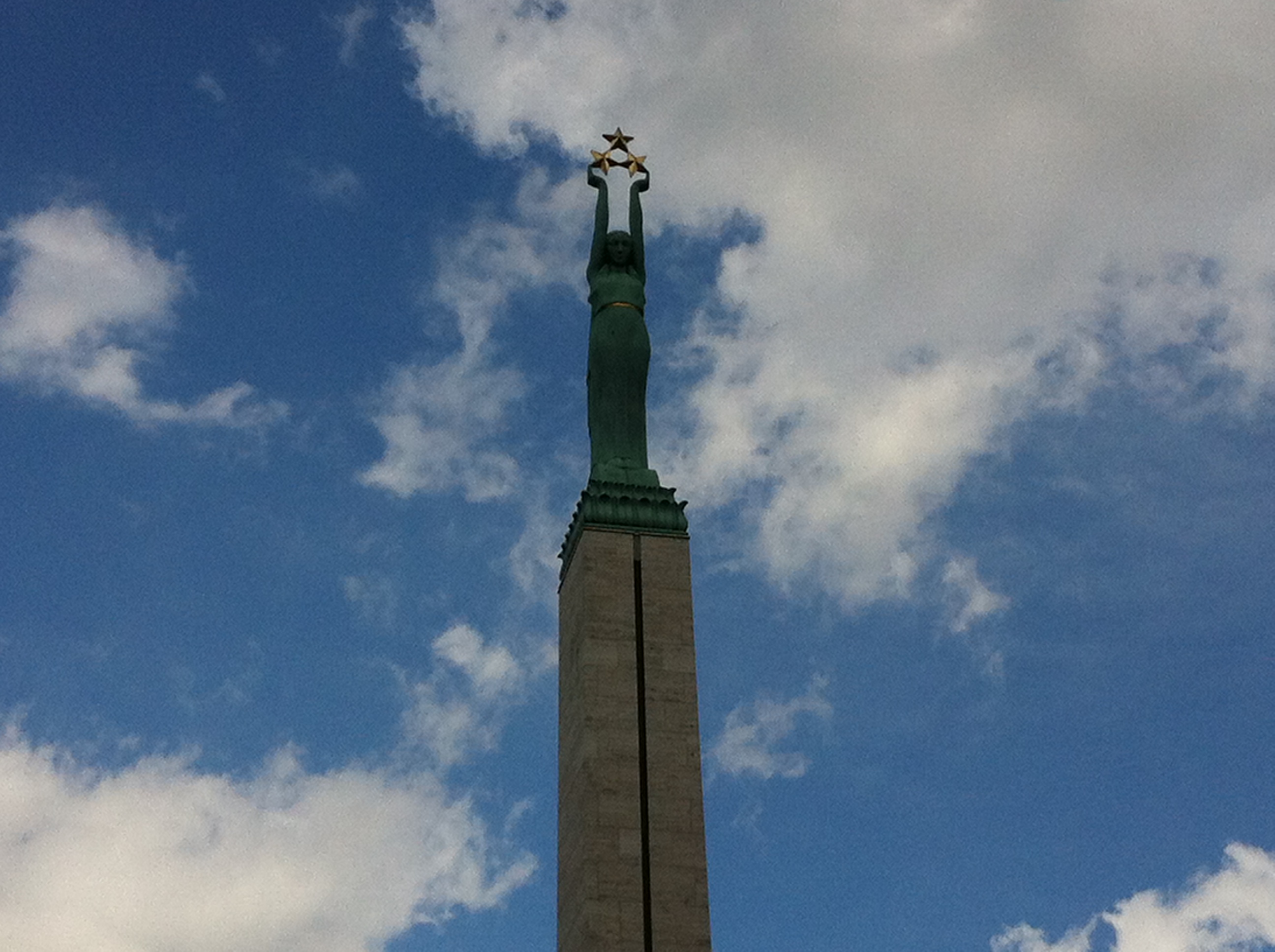
The churches are quiet and simple. I take photos of some of the art deco ornamentation that graces the buildings. The statues and monumental reliefs are…. well, monumental. These are twentieth century work. Big-shouldered men in army uniforms and helmets, carrying rifles. Big shouldered, bare-breasted women, carrying heavy loads. There is another giant statue at the opposite edge of the old city, titled “Freedom”. On top of a granite column high above the street, the two-storey, stylized figure of a woman in a robe thrusts three golden stars up to the heavens. Perhaps it was called “Progress”, I think. Later on I walk by a small triangular shrine, quite different from the monuments, simply titled “1991 Barikades”. There are fresh flowers on it. Here and there I see testimonies of struggle, pocketed between coffee shops and western fast-food franchises. But I’m like a half-deaf man trying to hear a conversation about a subject I don’t recognize.

A tram passes. I think that its compact size, clean lines and wrap-around windows make it look retro, like something from the 1950s, and then realize that it probably is a piece of equipment still in use from then. On the street nearby, a group of women laugh and talk to each other in Latvian as they take turns releasing arrows at an archery range.

I’ve just enough time for something to eat before going back to the airport. There’s an old convent across from the street sellers, converted to a restaurant called “Domini Canes”. I take that as a sign and sit down. The waitress brings me a bowl of ginger-lamb-lentil soup. The presentation looks like something from a flight magazine: trickles of balsamic reduction on the four corners of a large white bowl, traced with herbs and flowers. For a second I could be in Paris or London, Toronto or New York or Hong Kong. Then I take a bite of the bread. It’s thick and brown and heavy, tasting of molasses, spread thick with butter and garlic, and says only one thing: there’s nowhere quite like Riga.

archery

barikades

Categories
Uncategorized

Going Nowhere Fast

Blake's pilgrim sketch

By about 2 pm on the first day of walking through the Scottish Borders it was becoming clear I’d been wrong imagining the dots on my map to be quant Scots villages full of local eccentrics, well-crafted beer and heavy, happy northern food. The two areas of settlement I’d passed were small clusters of squat and shuttered houses, grey sandstone window frames, darkened slate roofs and doorways offering no welcome. They were perhaps bedroom communities for Edinburgh. Whatever they were, they were barely inhabited: there would be no conversation of any sort, quaint or otherwise. Likewise no cafe or store to pick up lunch.

Long-distance walking into unknown or lesser-known territory means reaching a series of decisions without full information. You expect to make some mistakes, and hope they’re neither major nor cumulative. You trust to luck and the kindness of others, if others happen by. Going a bit hungry your first day isn’t the worst that can happen – by far – although in that moment my stomach didn’t necessarily agree.

What was worrying was that it was already the middle of the afternoon, and my guidebook told me I had 15 or so kilometers still to walk before arriving at a closed tourist centre from which I might, if everything worked, be able to contact a ride to come pick me up for my hostel. All of which probably meant a very late meal indeed, should there be anything to be purchased at all by the time I got there. In the bottom of my pack I found the broken remains of a two-day old baguette given to me in London, and some packaged cheese I had forgotten to throw out. The cheese was long past sweating, but my hunger convinced me it might still be okay despite hours in the heat.

Dryburgh Abbey was further off the route than I had expected, a set of foundation stones and half-walls all that remains of an important medieval structure. The detour had already cost me a couple of kilometers and an hour or so and my feet, unhappy with asphalt, needed liberation from the boots. So I took them off, set my socks in the sun and stretched out my toes.

Where we choose to sit and eat can say a lot about us. There was a bench on the grass beside a very low stone wall with a plaque that read “transept side altar”. Barefoot before the altar, feeling the grass between my toes, squinting at where the monks would have filed out from their dormitory to perform the first office of the day, I felt more at home than I had in days. The river Tweed flowing slowly by, the sweat-sweet wetness of my tee-shirt drying on my back in the yellow sun, my stomach happy for, literally, crumbs: part of the joy of walking pilgrimage is the re-sizing of what is needed in life. Even home is re-defined, a sacred flagstone to sit my plastic bag on, in that moment, was enough.

Maybe it has always been so, but it seems to me that the starting point for modern Euro-North American pilgrimage is almost never a sacred destination. The starting point is somewhere and everywhere along the unfamiliar trail, in the awkward freedom of being able to go left or right and not knowing exactly which is best or how long to tarry, in the slowness of footfalls in a motorized world, and in the unfamiliar Google-free uncertainty of a path where the next way-sign might be knocked down or misleading and the next person encountered might forever remain a stranger or perhaps become a dear companion. The world shrinks and expands at the same time: we smell the greenness in whole fields of clover, feel each raindrop in a translucent summer shower, and curse the nail clippers we forgot to put in the Velcro pouch under the flap of our bags, or the single black seed pod that, rolling beneath the sock, turns to a blister on our foot. I ate in a hurry, packed up and walked quickly back over the bridge, striding back onto the path.

One of Blake’s drawings shows a pilgrim striding purposefully forward, walking stick in hand, much as I was walking toward my unknown future. At Blake’s destination awaits a monster, Death, whose maw is the final destination of no escape.

What if he is right?

I was not bereft; anyone who has a Visa card and money in their wallet, a mobile phone and a road nearby is never truly in danger. But I’m more and more convinced from my own experience and from talking to others that there is something in the practice of smallness and absence that is part of the appeal of modern walking pilgrimage. Something very powerful happens in practicing the stripping off of the layers of who we are and what we own. Maybe it simply gives us the chance to see what might be there, in us, at the nub.

In the last pages of Tomas Espedal’s ode to a vagrant life, “Tramp”, after all the poetry and late nights, the alcohol and the sex, the solitude, the philosophy and the history, he writes these words: “the path takes off to the right, through a wood, you cross an electric fence and suddenly find yourself in a clearing, you have to stop; I am brought to a halt by the sudden, soft light and the stillness.”

Maybe, I hope, that is what it might be, at the nub. That would be a nowhere to walk to, fast.

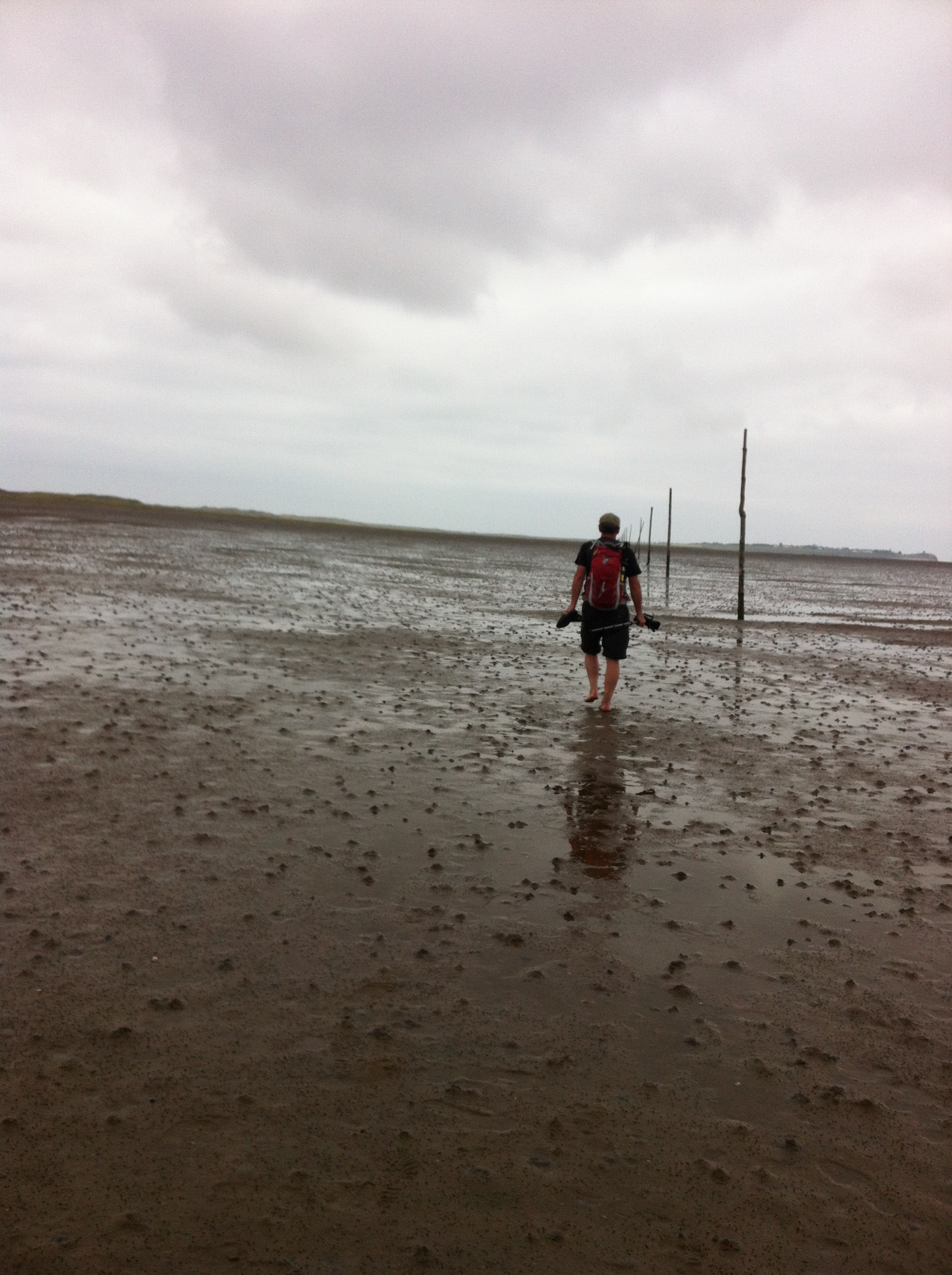
walking to Holy Island