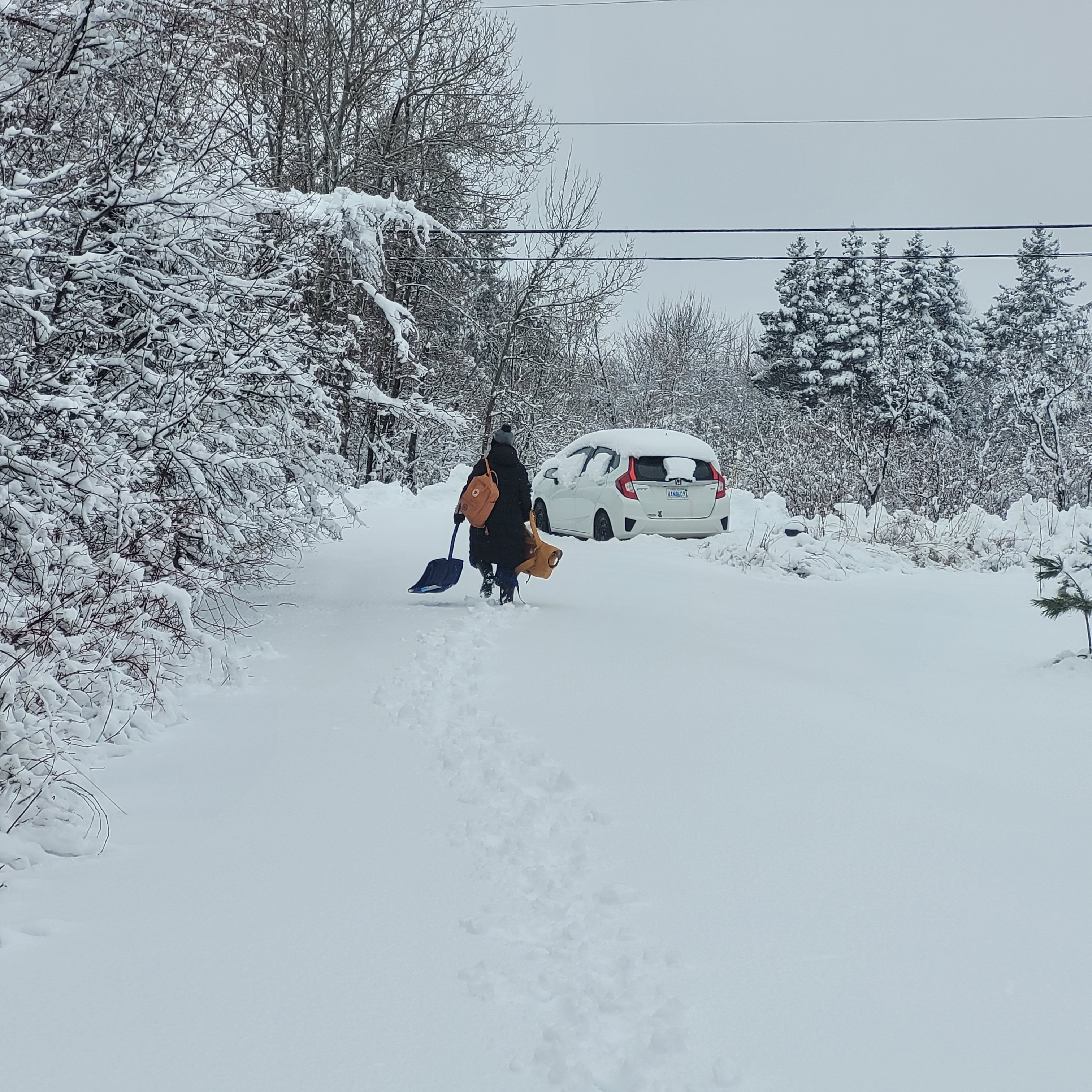
It wasn’t the snowstorm. Having to park the car by the road at the end of our lane to be sure we can get to work in the morning isn’t that strange, even though the snow-laden trees are beautiful. Here in Pomquet, in Antigonish County, a storm day requiring our neighbour to come plow us out is starting to feel like a bi-weekly event. I had some trouble keeping up with Sara on her march to the car. But no, it wasn’t that.
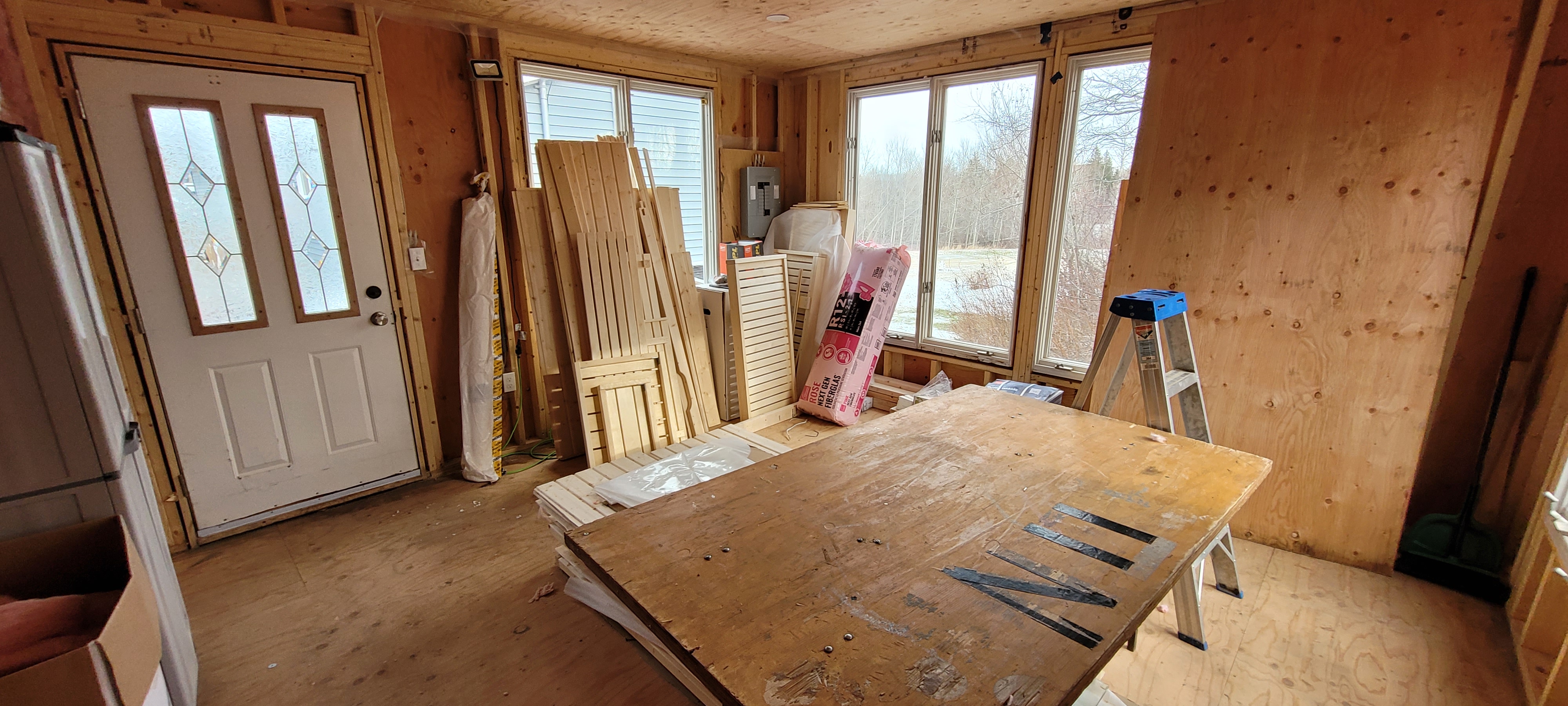
Nor was it the sauna. In December, on receiving unexpectedly good news after a scary cancer test, I decided I’m not getting any younger and I’d buy that sauna kit I’ve dreamt of for years (ever since being pastor to the wonderful Montreal Finns and enjoying the rite with them). With the help of local carpenter extraordinaire Evan Theriault (Theriault Timberworks) I’m hoping we soon have our very own sauna in action for relaxing in this deep-freeze. That will be great. But no, it wasn’t that.
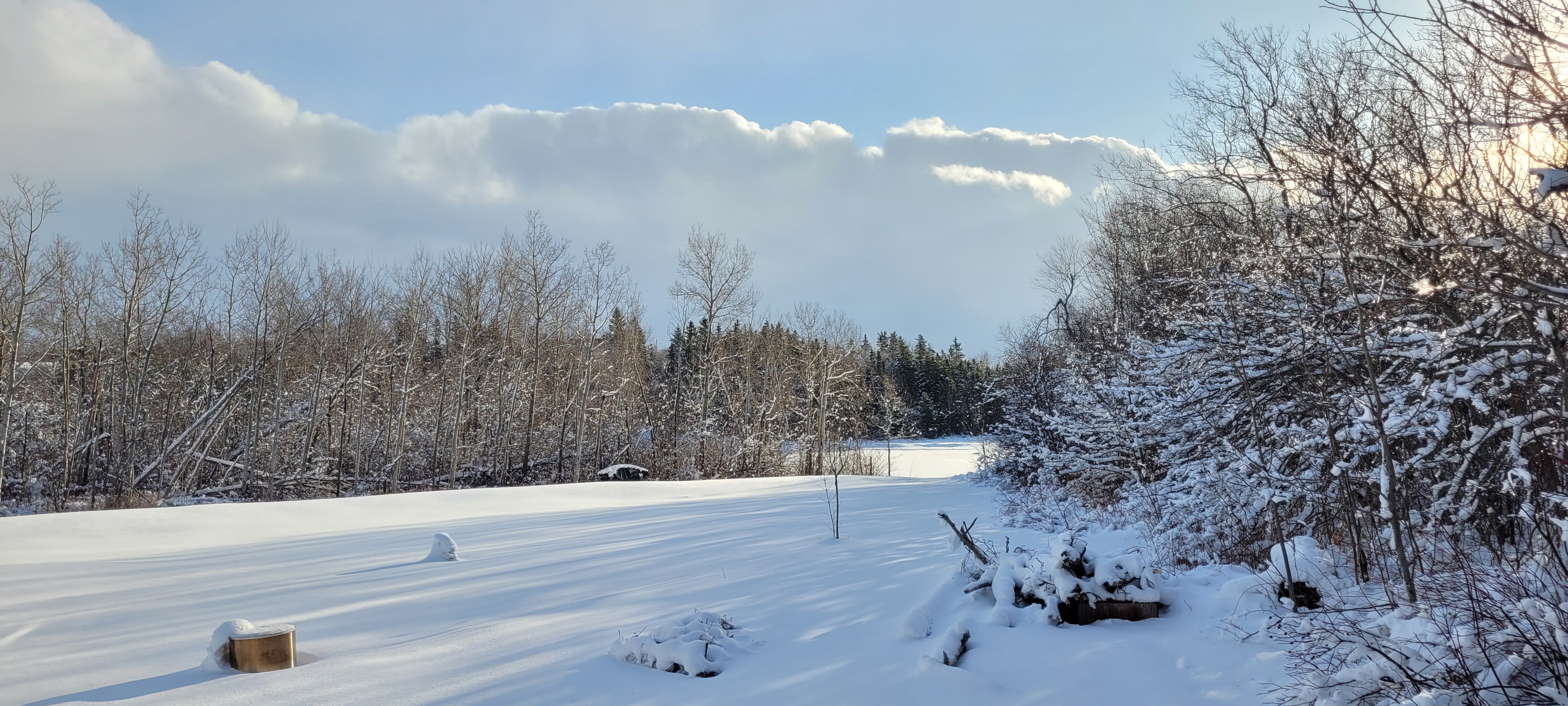
And no, it wasn’t that I’m starting to feel increasingly guilty about my handicapped parking sticker. Yesterday I felt badly using the space at the Farmers’ Market, although in the end I’m glad I did, since my balance on ice still isn’t the greatest. I’ve started to leave spots closest to the door for those who need them more. I guess that says something about my recovery and the general improvement to my walking! It’s easier and easier for me to tramp around the property, even on days like this (see below). But it’s still not that.
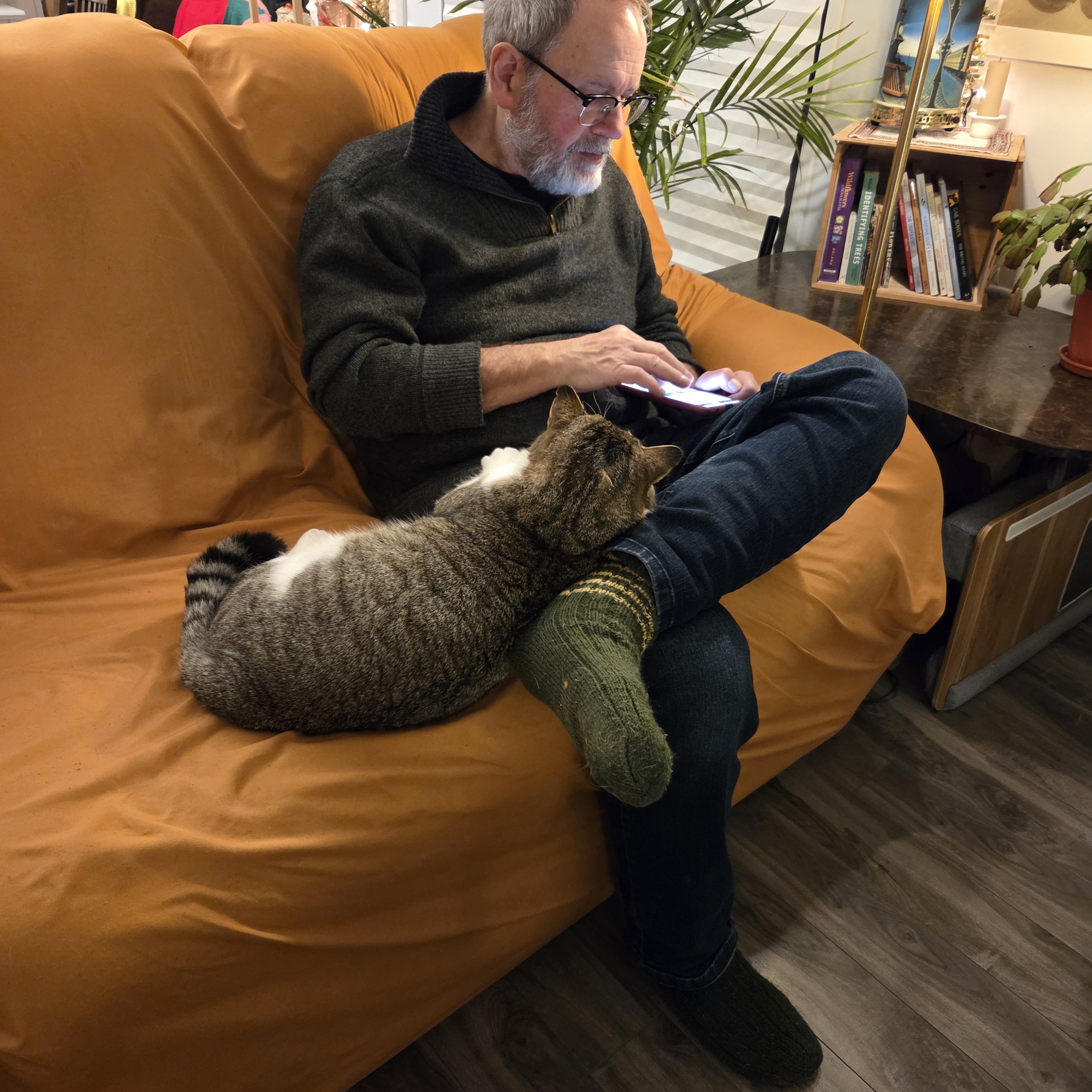
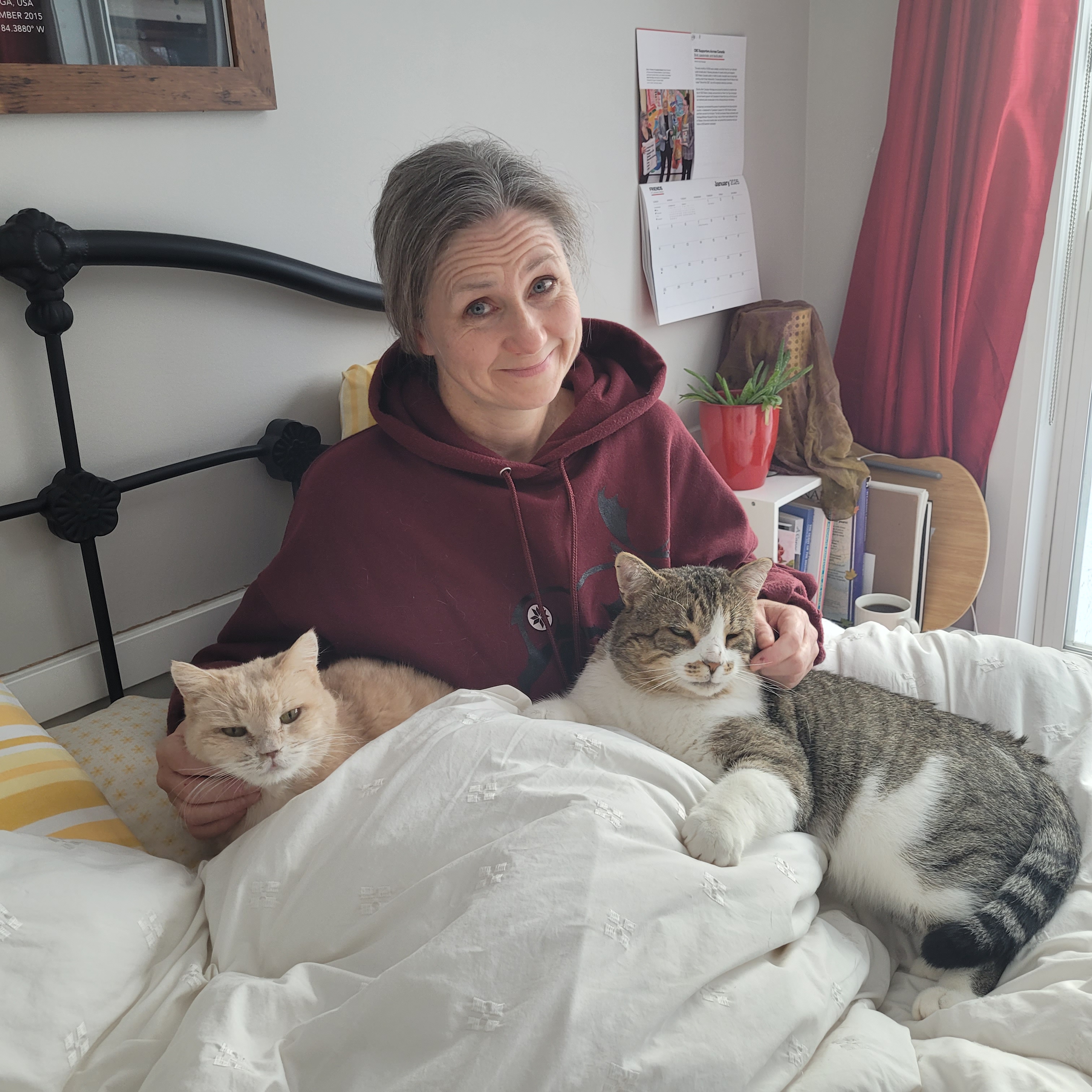
Nor is it that the big, furry feral feline we named Theodore, whom Sara trapped, neutered, and had patched up by the vet for his infected paw injury, didn’t immediately spring back out into the wild on his release. Instead he surprised us by turning into some kind of indoor love-bunny. He has apparently decided to adopt us. He’s incredibly smart and affectionate. As a dog person and someone with mild allergies I don’t encourage Theodore too much, but he seems to think I’m okay. We’re warming up to each other. But it’s not that either.
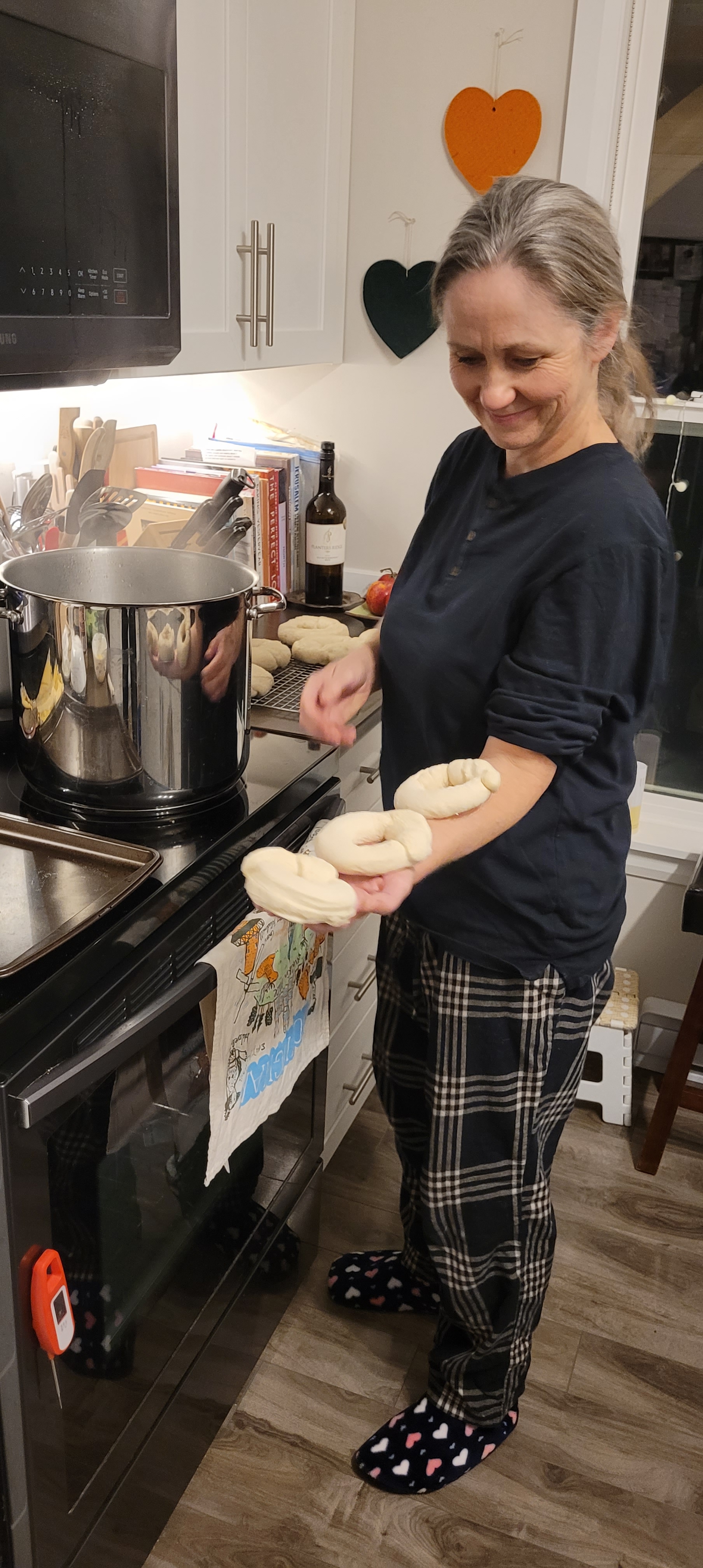
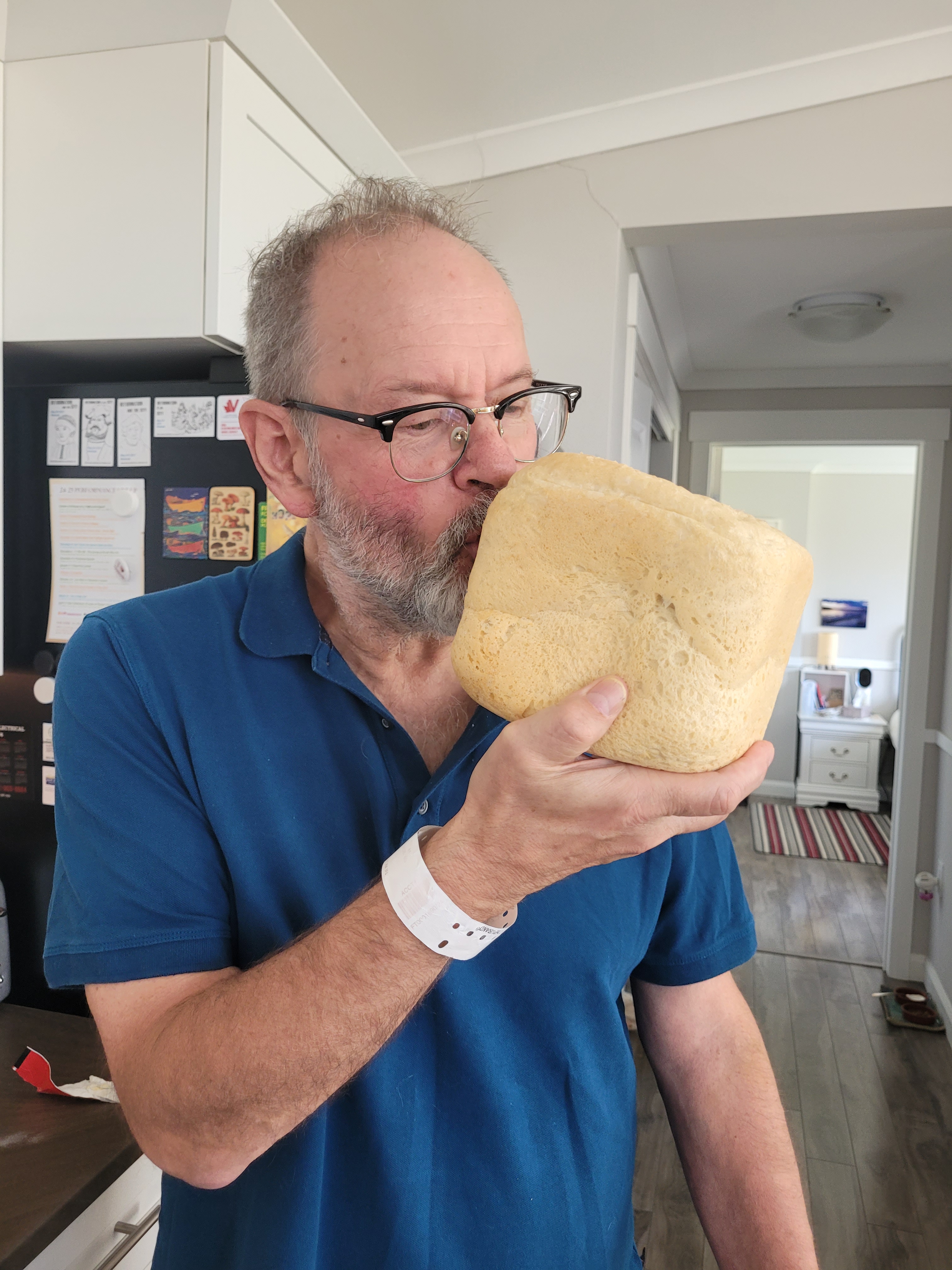
Nor is it that Sara tried her hand at making bagels (Montreal-style, of course!). As I write this I’m enjoying that yeasty, honey-laden smell and taste, and I can’t wait to try them with cream cheese. A rare delight and pleasure, indeed! (Recipe here). But no, not that…
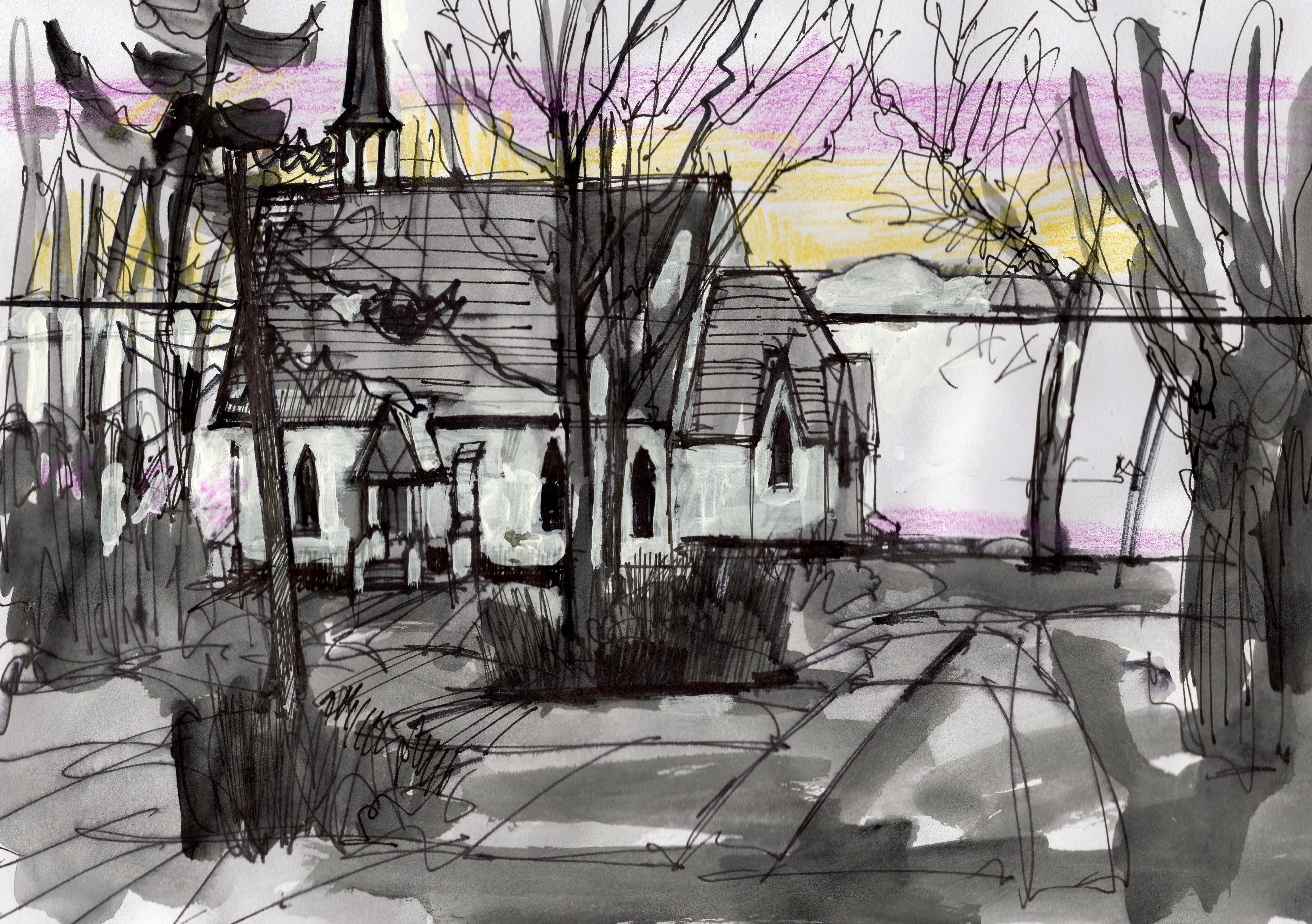
Finally, it’s not that for the first time in months I dusted off my completed novel manuscript and read through it again, and I still think it’s great! I’ve been inspired to start sending it out to publishers again. The drawing below is from my friend Robert Aubé (more at his website). The novel is set in the very real location of St James Anglican Church, Cacouna QC. I’m rejuvenated. But no. Not that either…
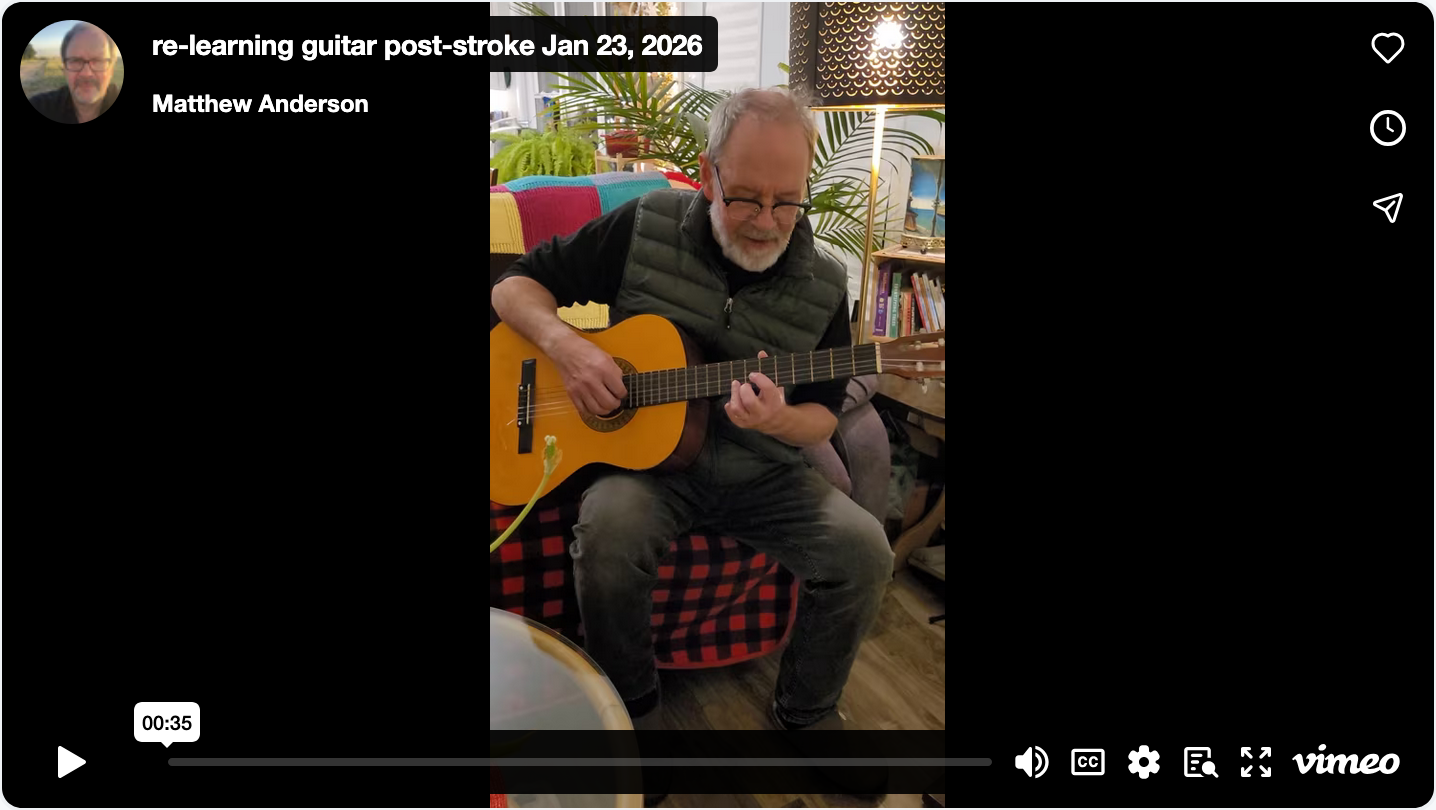
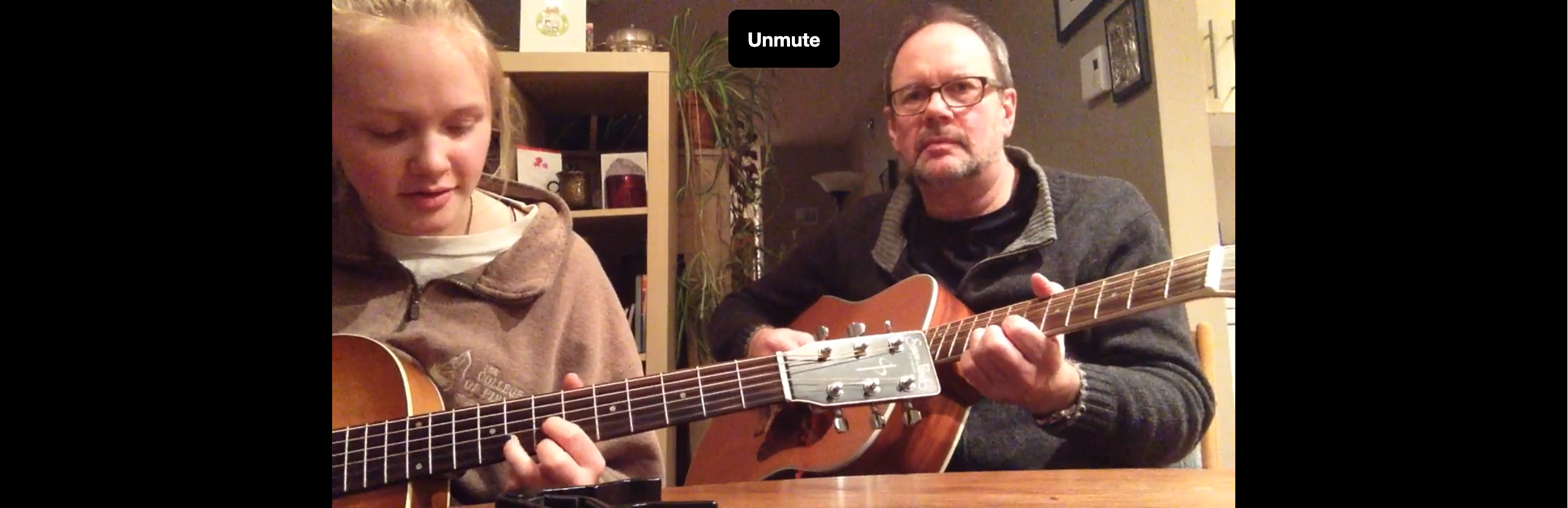
What it IS, is that this last week I had Sara film my daily attempts at guitar. Every day I try to get my left hand fingers to move better by practising my playing. Here’s where I’m at post-stroke as of yesterday: https://vimeo.com/1157626018?share=copy&fl=sv&fe=ci
And here’s where I was pre-stroke, with that same piece (and with help from my youngest). I hope someday to get back to this level: https://vimeo.com/433444043 .
No. What actually happened this week that was unusual, was that I watched the recording Sara made, then the one from a couple of years ago. Then I broke down and cried.
I don’t weep like that often. It wasn’t from sadness, exactly, although I know I’ve lost much. I had to reflect a while on it. It’s complicated. While some of it was sadness, more of it was happiness – happiness I’m alive. Even though a year ago I could only twitch my thumb (and barely that), and now my hand has dramatically improved and is still getting better. Some of my tears came, I think, from realizing just what an endurance test recovery has been, despite the help and support of so many: the months of struggling with coats, and socks, and shoes, and bags, and silverware, and backpacks, and grocery bags, and everything else. Every day making the decision to use my left hand even though every time, it’s harder. (I just remembered to do it again, while typing this sentence.)
My point is NOT that congratulations are needed. There are lots of folks who’ve had it much worse. And there are certainly others who have to be much much more courageous. It’s that we are, all of us, emotional creatures, whole beings with needs, regrets, hopes, sadnesses, and joys.All. And life can sometimes feel the most beautiful, and the most rewarding, in precisely those times when it’s not the easiest.
I wouldn’t wish my stroke on anyone. But I was glad, this week, to go through such a heart-filling experience as that unexpected cry. Given the state of the world right now, we probably all need one.
Somehow my one-year strokeaversary slipped by without a blog post, even though Sara and I marked it privately. Now here we are: way past twelve months. Already to 14 and counting.
I’m not sure why I didn’t push myself to post a one-year column on the actual day.
Well….that won’t be happening anytime soon, although I still hold out hope. While I can walk farther and faster than at any point since my brain damage, my best distance is a couple of kilometres with a limp. It’s hardly 100 km in a week like we did in 2024, striding into a new coastal village every afternoon in the late-afternoon sunshine.
I also dreamt that at one year post-stroke the part of my body the slowest to recover, my left hand, would be fully back in use. I imagined somehow I’d be chording smoothly on guitar, holding my mug of tea, and most importantly, typing. The truth is that yes, I can actually DO all those things, sort of! It’s a miracle. And I recognize that miracle when I’m properly “glass-half-full” thinking. For instance, I’ve typed this blog-post using both hands.
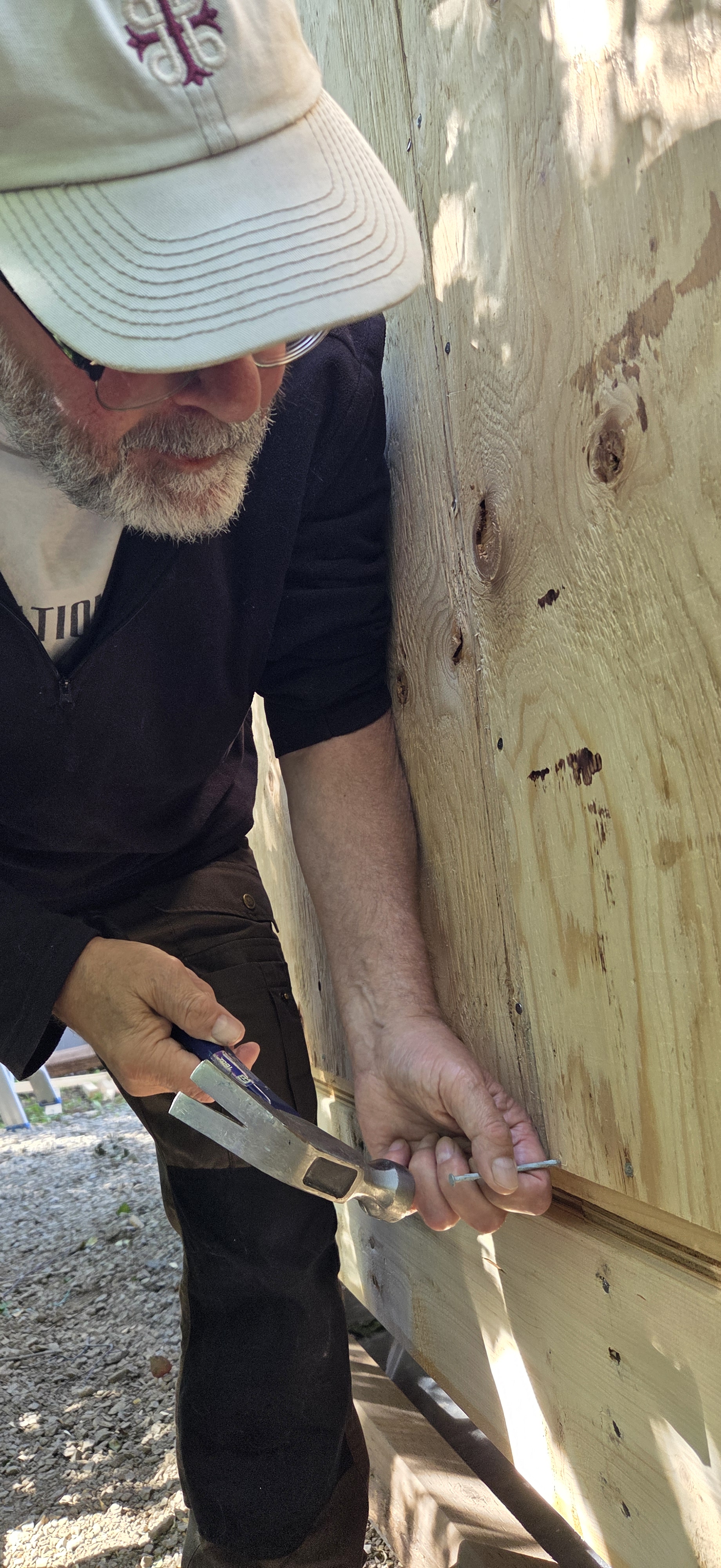
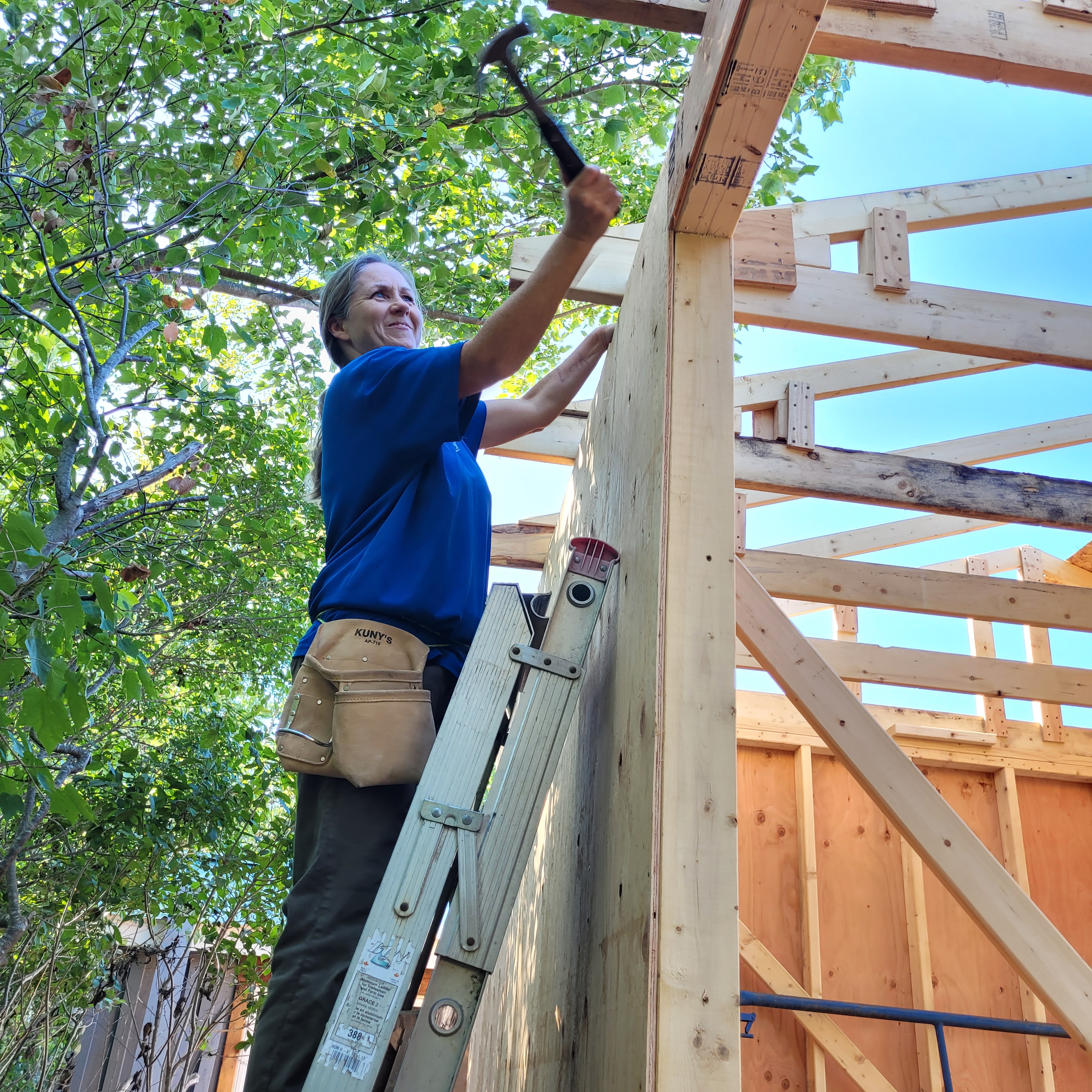
But the deeper truth is more nuanced. Chording is still slow….usually too slow for a song to really feel like a proper song. A full cup of tea is dangerous to hold in my left hand for too long – and a hot cast iron pan more dangerous still! But I’m able to reach, and lift, and manipulate more with that hand every week. I can now screw the milk and toothpaste lids off and on as a leftie. I regularly empty the dishwasher with my left hand as therapy. I can almost snap my fingers and make the Vulcan salute. Holding a nail in September while hammering was sometimes an act of faith. But the nails got in. Eventually.
Typing is not as slow as it was. But it’s still tedious, difficult, and tends toward errors. Sara says that she can tell my typing has improved because in the last month I’ve written a lot more pieces – articles, reviews, and the like. “You must feel more comfortable composing,” she remarked. “You’re getting back to your enthusiasm for new ideas.”
I feel that too. This fall I taught an online course on Leonard Cohen and St Paul, and had a wonderful time with my adult students. My classes about early Christian asceticism at StFX are fun, and recently I took first-year kids on a tour of the Saint Ninian Cathedral, being sure to point out features I write about in my book “Someone Else’s Saint.” Sara and I each gave keynote presentations on subsequent weeks at different institutions in Halifax, which was a chance for trips “to the big city” and mini-holidays.
When she read what I just wrote above, Sara pointed out that maybe it wasn’t disappointment that stopped me after all. Maybe I let the 12-month blogpost slide simply because my fall has been so incredibly busy. True enough. But the anniversary didn’t pass completely unmarked.
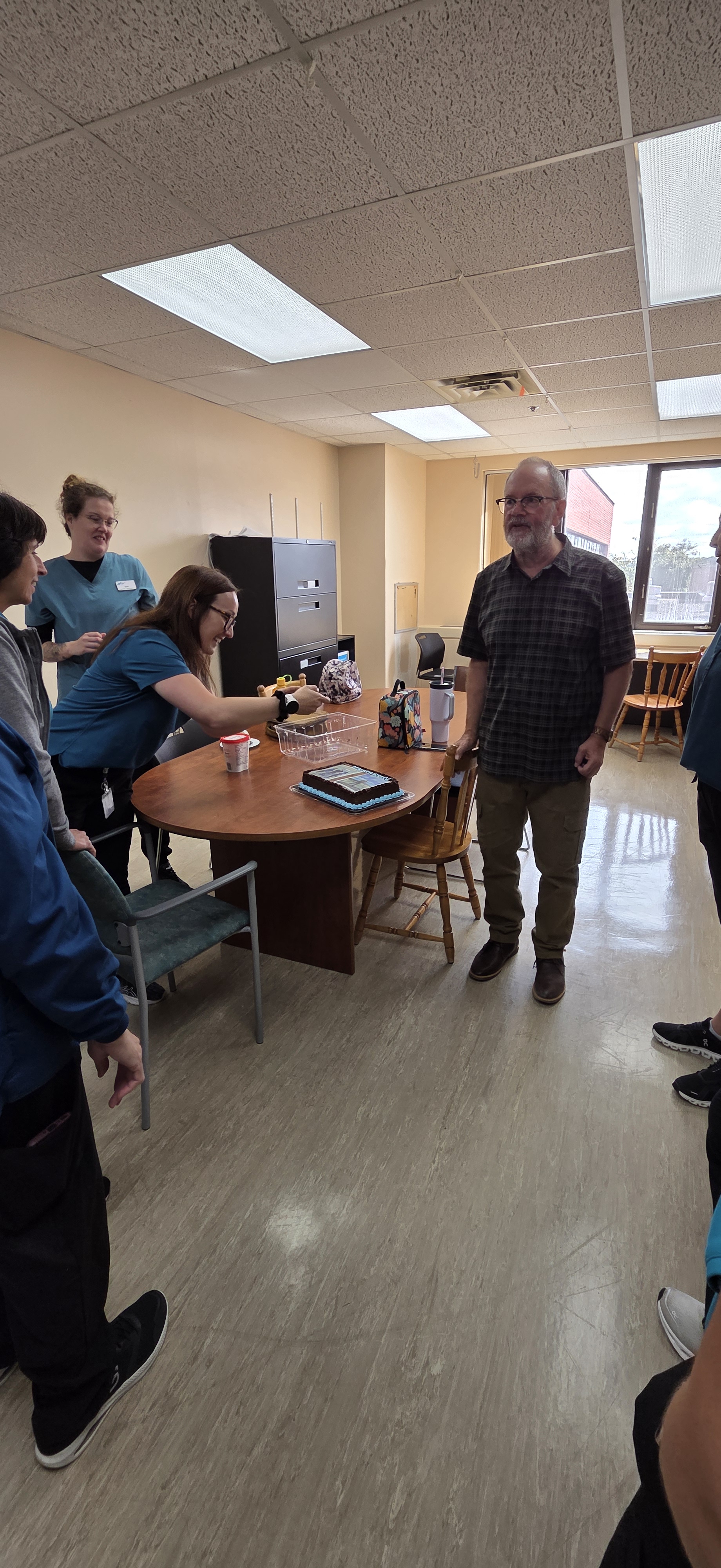
It turned out that I had a follow-up appointment at the hospital one year to the day from my initial TIA – Trans Ischemic Attack, September 16th. So I ordered two cakes from our local Sobeys and Sara and I took them in to mark the day: one for the physio ward, since that’s where I’ve spent so much time post-discharge, and the other for St. Martha Regional Hospital’s third-floor hospital wing, where I lived for almost four months last fall.
Those cakes turned out to be a pretty good metaphor for the hospitalization and recovery process, and for the nature of institutions. On the physio wing, it turned out that almost all of the Occupational Therapists and Physiotherapists who’ve worked with me this past year were there. To a chorus of “oohs” and “aahs” the cake was quickly divvied up. There was lots of laughter and shared memories, and many thanks and congratulations given and received. It was wonderful.
However, when I carried my one-year cake to the nurses’ station, it was a different story. That day, none of the faces looked familiar at all, except my own GP, who was at the desk. Apparently, there’s been quite a bit of turnover recently on the ward. A nurse politely thanked me for the cake, took it, and congratulated me on my recovery. Sara and I stood around a minute or two awkwardly, then left. I’m sure the staff there that day enjoyed the sweets. But through no fault of theirs, they didn’t know me from Adam. There was no one at the desk from “my” past, no one who shared my memories, and no one to mark with me those tumultuous months that were so significant.
That’s life, I guess. In the end, our experiences change us profoundly. Sometimes permanently. But for everyone else, things can sometimes go back to normal pretty quickly.
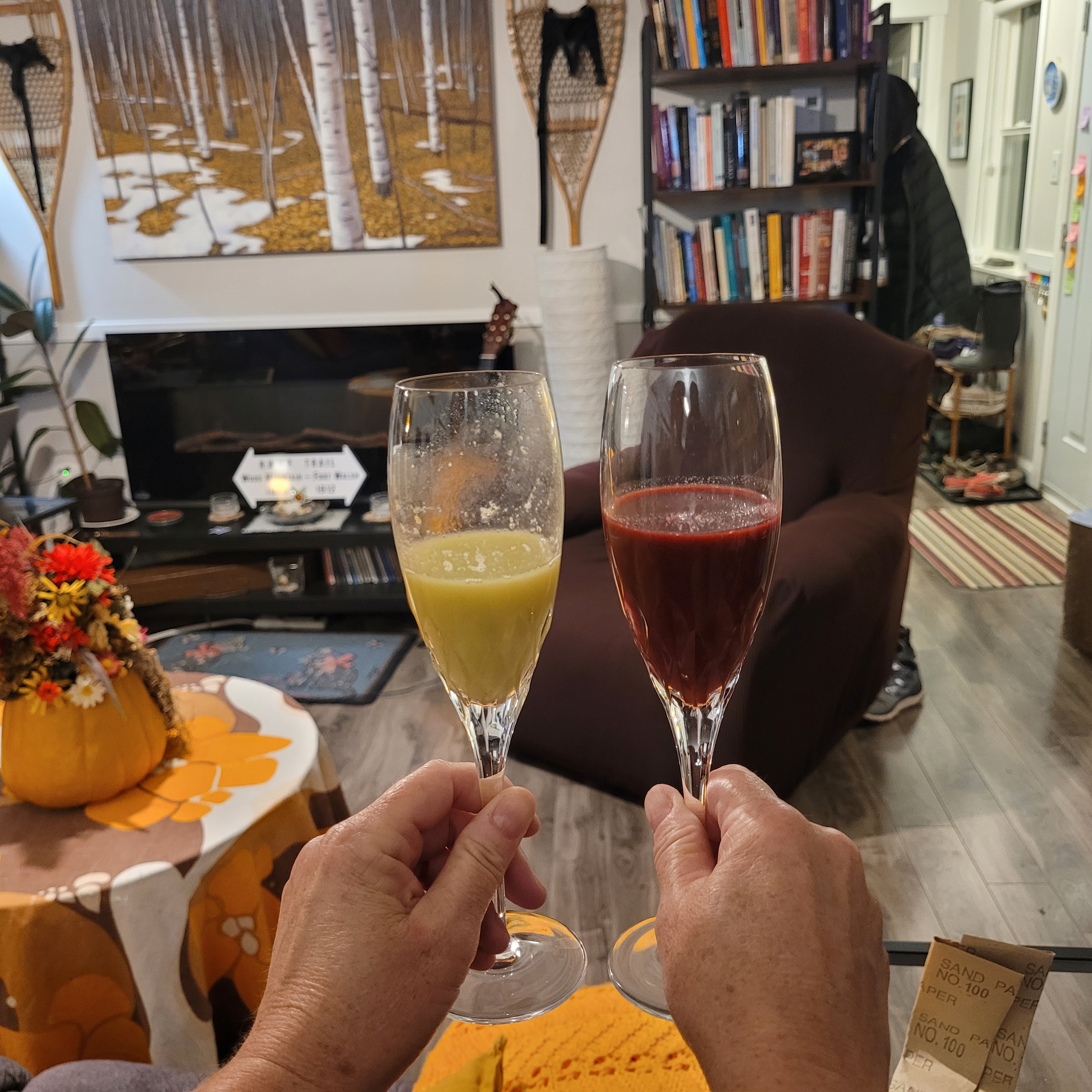
Speaking of major life-changes this fall: in October, Sara’s parents moved back to Moncton for the winter, after a wonderful, but very busy, summer of cooking, canning, and building. I took a very quick, very short trip to Montreal to hug my kids after their own family tragedy: the untimely death of my ex, their mom. Sara and I made our first juice from our first grapes, and filled our pantry with summer’s jellies. Since then my own step-mother, Mary Anderson (Hattum) passed away, along with another good friend in Saskatchewan, John McPhail. Oh yes, and a feral cat we’re calling Theodore seems to have adopted us, on and off….
Things aren’t the same as a year ago in so many ways, some large, some small. I keep having to learn and relearn the lesson that life is beautiful, often fragile, and that the time to tell folks you love and appreciate them is right now.
I feel very fortunate to be alive, and thankful every day for the chance to experience this world in all its confusing glory. Strangely enough, I believe my life has been enriched by my stroke a year ago, and by the struggles that have followed. I appreciate you who have accompanied me through this year (plus a couple of months). As the leaves drop, the Grey Cup finishes (yay SK!) and November tilts toward Advent and Christmas, I hope you find some love and joy in these days as well.
What better therapy than dancing with Gabe? (video below)
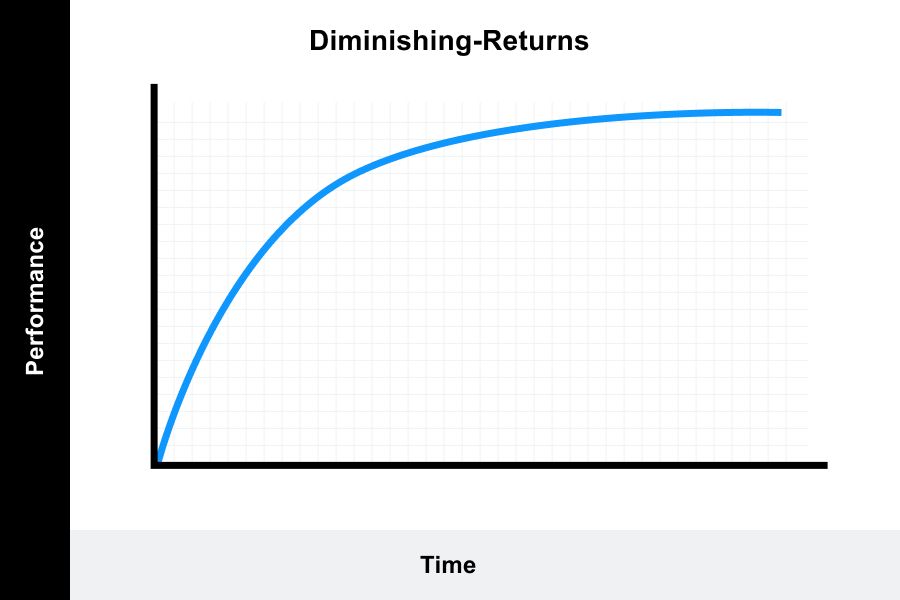
As the ONE-YEAR anniversary of my stroke approaches – wow! – my recovery continues to follow the quick rise and flattening curve (see below) that the medical staff predicted for me, as for other stroke survivors. And it’s true – eleven months in, the changes are more subtle. However, every week there inevitably still turns out to be some marked improvement. My physio supervisor, Jessica, tested me last week and told me I’m much stronger in my leg than just a month ago, and my left arm has also strengthened considerably in recent weeks. The Theraband exercises must be helping.
My recovery has gone far, far beyond what many of my doctors and medical team initially predicted in the dire days of last fall. With Sara’s urging, I continue to believe that the curve will never flatten out completely. As the book Stronger After Stroke maintains, there never needs to be a complete plateau to recovery, for a stroke survivor who is fortunate enough to have good support, a stabilized health condition, and dogged determination to work together with the brain’s natural plasticity.
So on this 11th-month strokeaversary, here’s some of what recovery has looked like!
Theraplaying
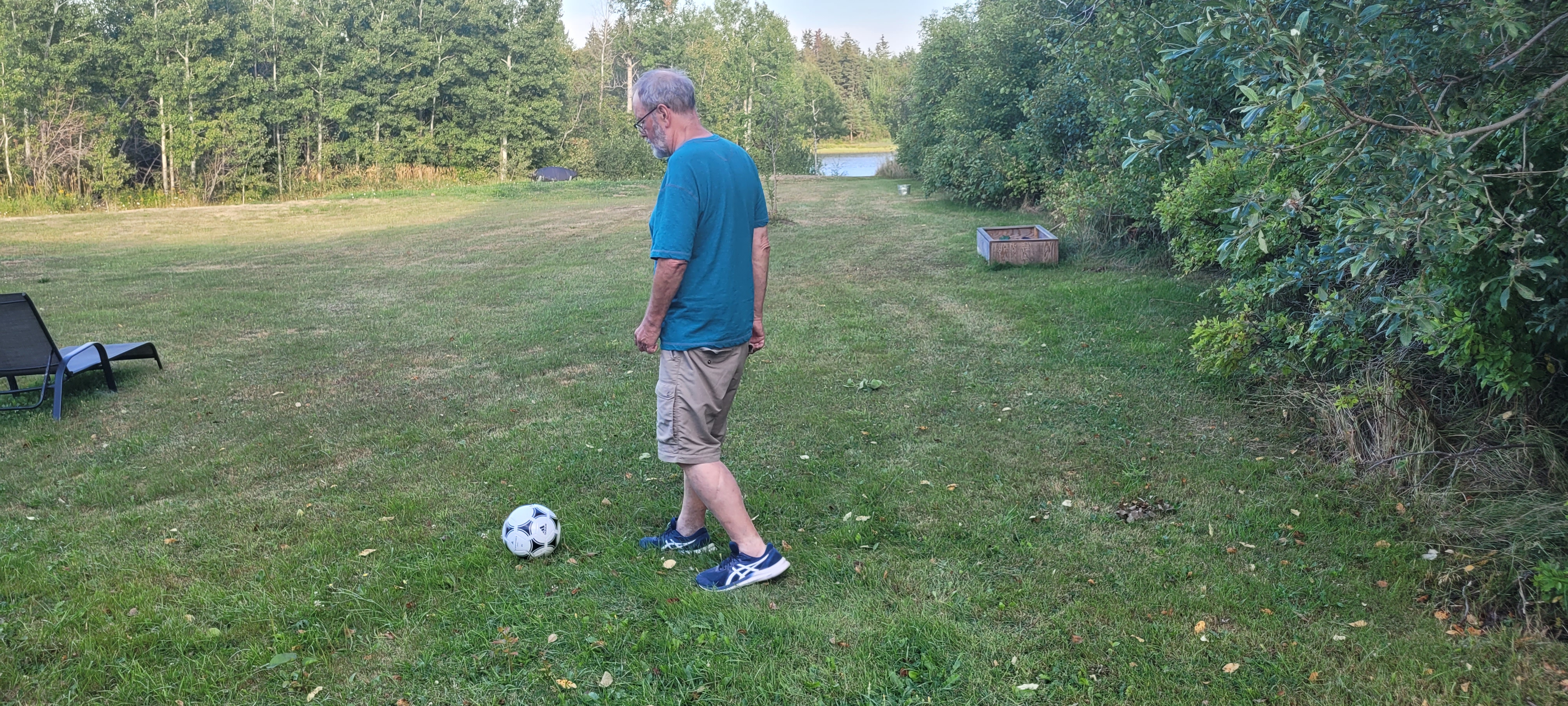
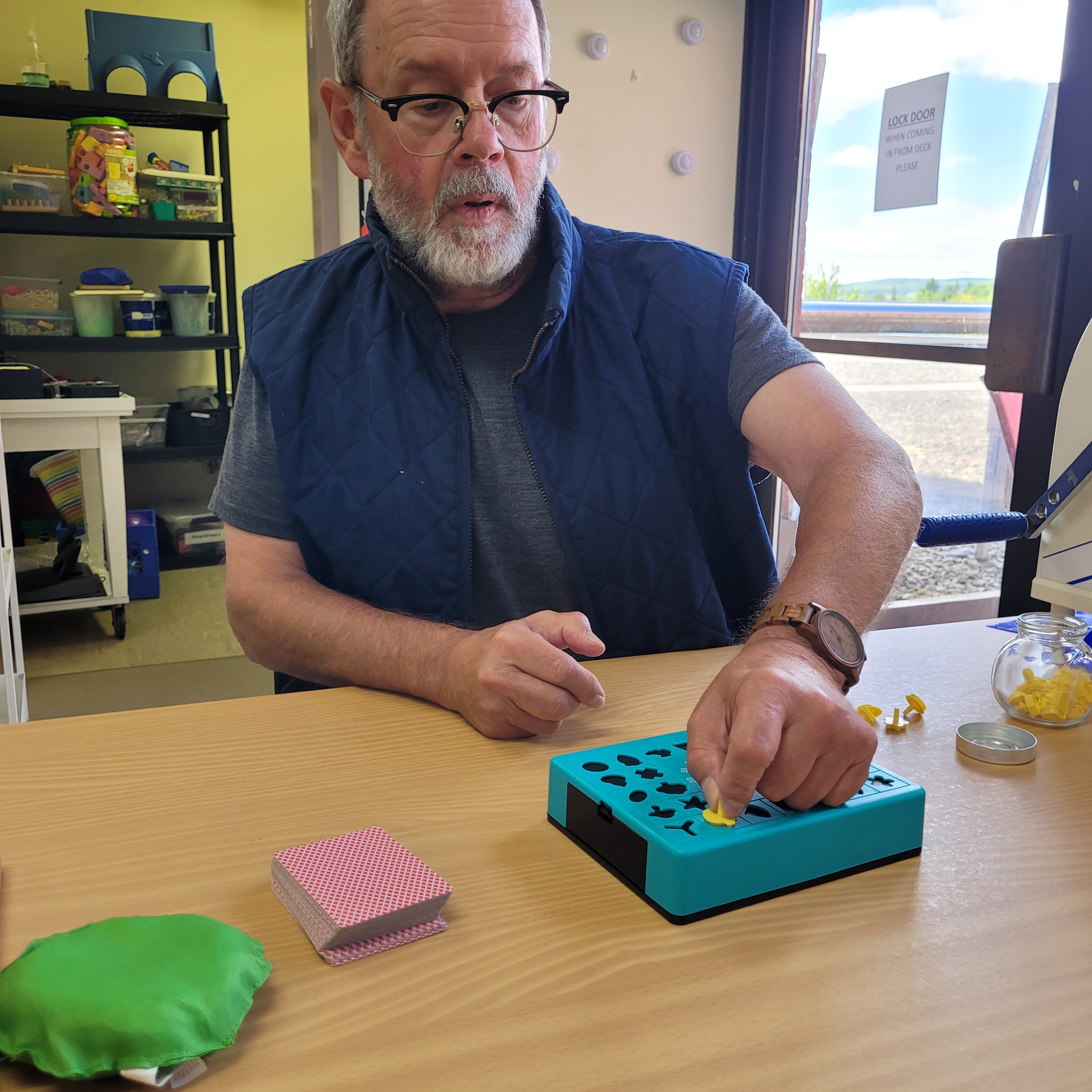
The wonderful physical therapy and occupational therapy folks at St. Martha’s Regional Hospital are starting to hint that I can’t be an outpatient forever. Of course, they’re right. “As much as we like you and look forward to our sessions,” they tell me, “we have to make room in our case load for new patients…” The hospital has been incredibly generous, and I’ve come to really love my outpatient team. I moved from two sessions a week to one only this last month. Colin, the smart and thoughtful tech who took over from the equally helpful physio tech Janna, is now regularly kicking a soccer ball with me. The catch: I have to use only my left foot. I’m finding that soccer and the funny-face bean-bag toss are my favourite therapy activities. Like a toddler, I’m improving my balance, coordination, and hand movements through play, which makes it seem (almost) easy.
Medicating
After my heart surgery in April to close a PFO (the hole between the upper chambers of my heart), the Halifax surgeon put me on precautionary Plavix, to guard against post-operative complications. I just came off of it and I couldn’t be happier. I’ve been bruising after every blood test (one time the blood actually spurted out) and also when I bump or ding myself as so often happens in summer gardening and construction season. I remain on low-dose Aspirin and a suite of blood pressure pills. But my GP and the cardio team at the hospital have dialled back even these a bit, and now I can crouch and stand up without threatening to black out. Sitting on my haunches to look in a cupboard reminds me of my old self.
Straightening
It was Lindsay, the incredibly gifted and helpful Occupational Therapist at the Nova Scotia Rehabilitation Centre in Halifax, who suggested “Oval 8 Finger Splints” for my left hand’s fingers most reluctant to recover – my ring finger and my pinkie. My pinkie has been broken a few times over the years of basketball and tended to go its own way even before the stroke. I find the splints helpful at the end of a busy day when my fingers tend to curl and stiffen. My typing is improving slightly, although when my left hand quickly tires, those two fingers droop and tend to type their own messages.
Hearing
Of the many effects of the stroke, one of the most subtle has been a slight alteration in my hearing, or more accurately perhaps, my brain’s processing of what I hear. I’ve noticed more trouble understanding Sara when she’s in another room, or there’s ambient noise.
At the same time, my need to focus more carefully on whatever I’m doing so as not to lose balance, trip, or drop something, means my ability to multitask, including “listening, while…,” has diminished. And, I’m not young anymore.
So my audiologist appointment finally came through. The audiologist took me into a sealed quiet room, ran tests on both ears, then gave a series of tests I had to respond to.
The results? Apart from the normal post-stroke inability to multitask because of increased need for concentration, my ears are typical old guy’s ears: some age-related hearing loss, and that’s it.
I actually enjoyed the challenge of having four numbers spoken at once into both ears and having to try to correctly identify them!
Canning
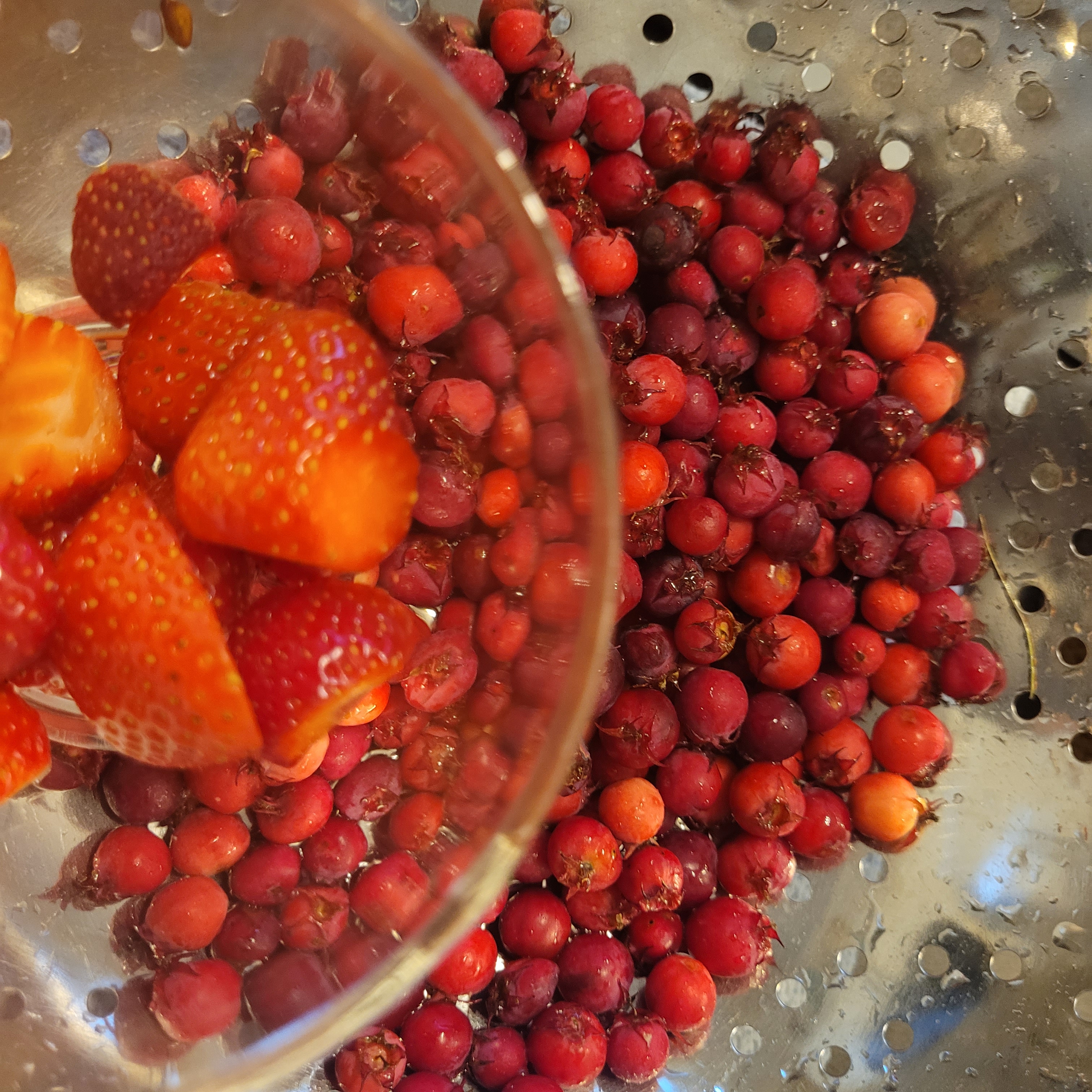
When Gabe, my youngest, came to visit in August with Ray, they said they wanted to do some jelly-making like we did last year. The Saskatoons were done and it was a bit early for the chokecherries, but the jelly turned out well.
Our place is prolific for berries despite the scary and record-breaking drought. I spent hours picking Saskatoons earlier in the season, and our strawberries and grapes are plentiful.
Holding boughs with my left hand while picking berries with my right turns out to be good therapy, too.
Dancing
Gabe’s visit this month also gave me a chance to re-learn and re-try the swing steps we’ve done so many years together, and also to re-learn some of the guitar chords my fingers have forgotten, from all the songs we used to play together. I’m thankful.
If you watch the video (click on the photo below), you’ll see how my face goes mask-like (not direct stroke damage but because I’m concentrating on not falling), my left arms wants to pull in and tighten, and I lose my balance briefly. But overall, what a joy, and what an improvement! Sara has been keeping up my dance therapy since Gabe left…
Reading
My worlds overlapped recently when The Canada Lutheran asked Sara to write a column for their regular Q&A feature. As usual, Dr. Sara Parks, who is a consummate teacher and communicator, produced something interesting, academically solid, and pitched perfect for non-academics. Have a read below.
I recently finished Tanis MacDonald’s wonderful book Straggle. I highly recommend it – it’s full of beautiful writing and profound observation. And Tanis’s thoughts on “ungainly” walking fit my new post-stroke life so well….
Travelling, Walking, & Celebrating
This was also the month that I took my first solo plane trips. I’d been invited west to celebrate the tenth anniversary of our Wood Mountain – Cypress Hills trek in the summer of 2015, featured in my book The Good Walk (URP, 2024). The Saskatchewan History and Folklore Society, which has spearheaded the walks since, was having its board meeting at Wood Mountain in conjunction with the event.
Even though Sara could not accompany me to hoist bags, hold my hand and generally be my security blanket, I was lucky that my brother Mark and sister-in-law Barbara (a recently-retired physio) were there to meet me in Regina. We stayed in their camper at Woodboia Camp near the Wood Mountain Historic Site (the NWMP Fort at Wood Mountain). That’s where Hugh Henry, Richard Kotowich, Hayden Thomassin and I started out 10 years ago to walk the 350-km North-West Mounted Police Patrol Trail (Traders’ Road) across Treaty Four territory.
10 years later, posing with Hugh Henry of the Sask History and Folklore Society
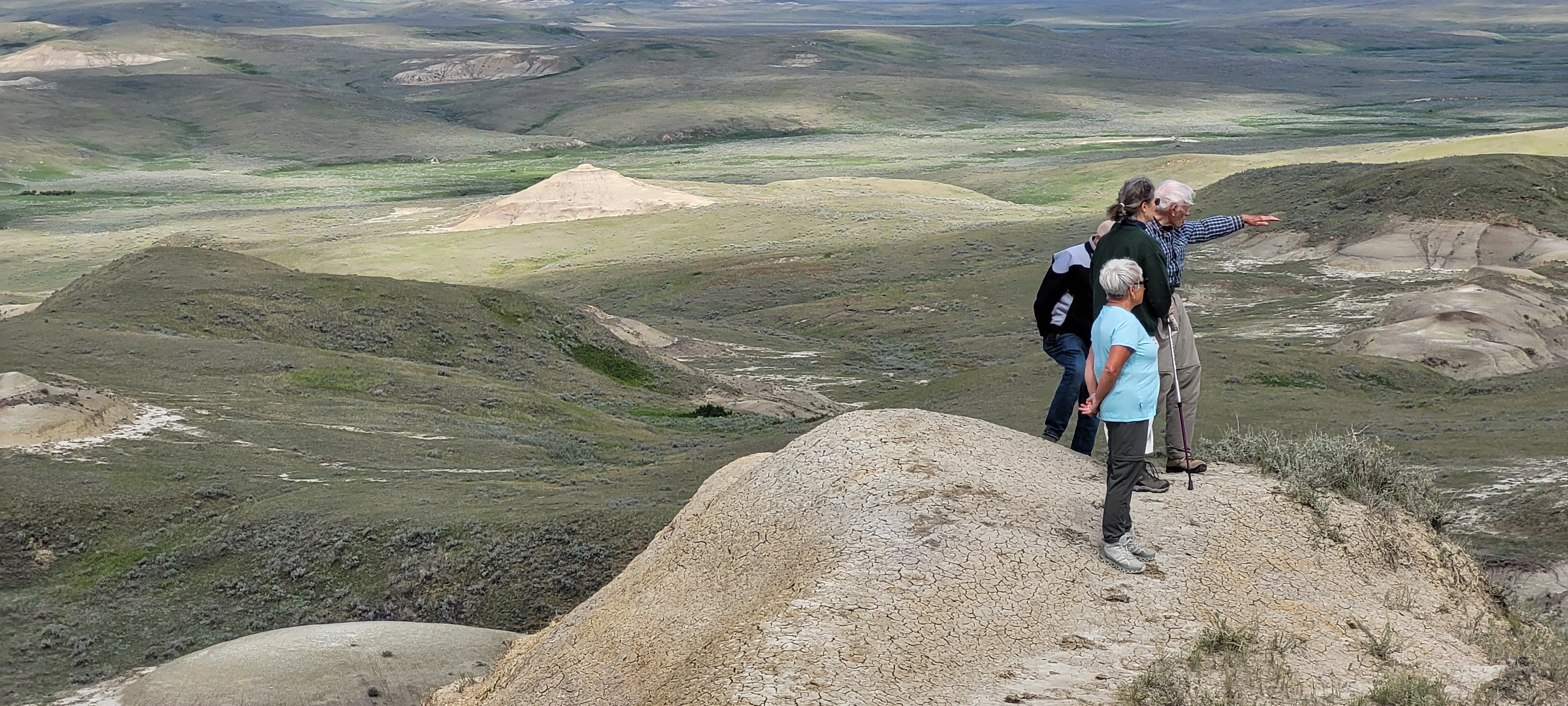
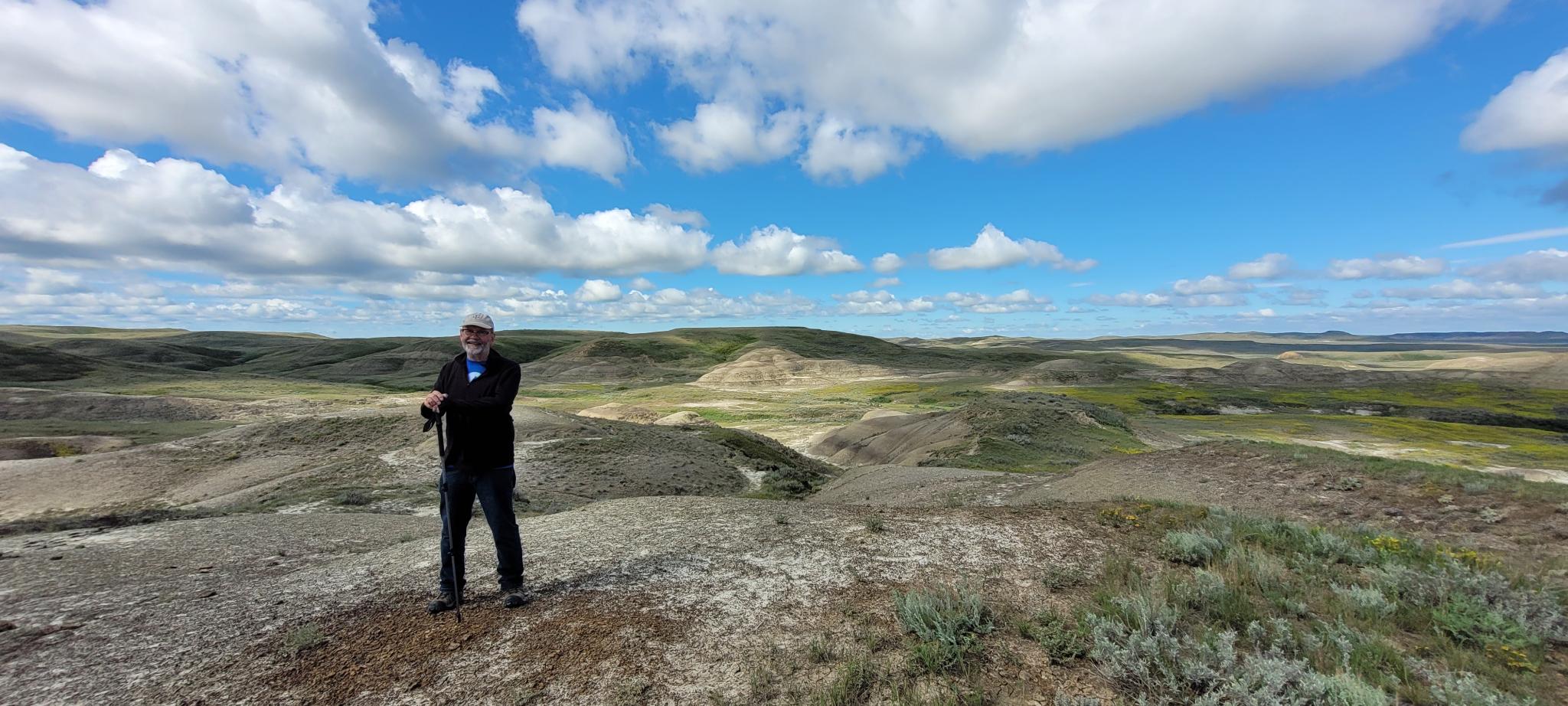
Among the highlights of my trip was visiting the Badlands in the “East Block” at Grasslands National Park. If you ever have the chance, be sure to visit this incredible place.
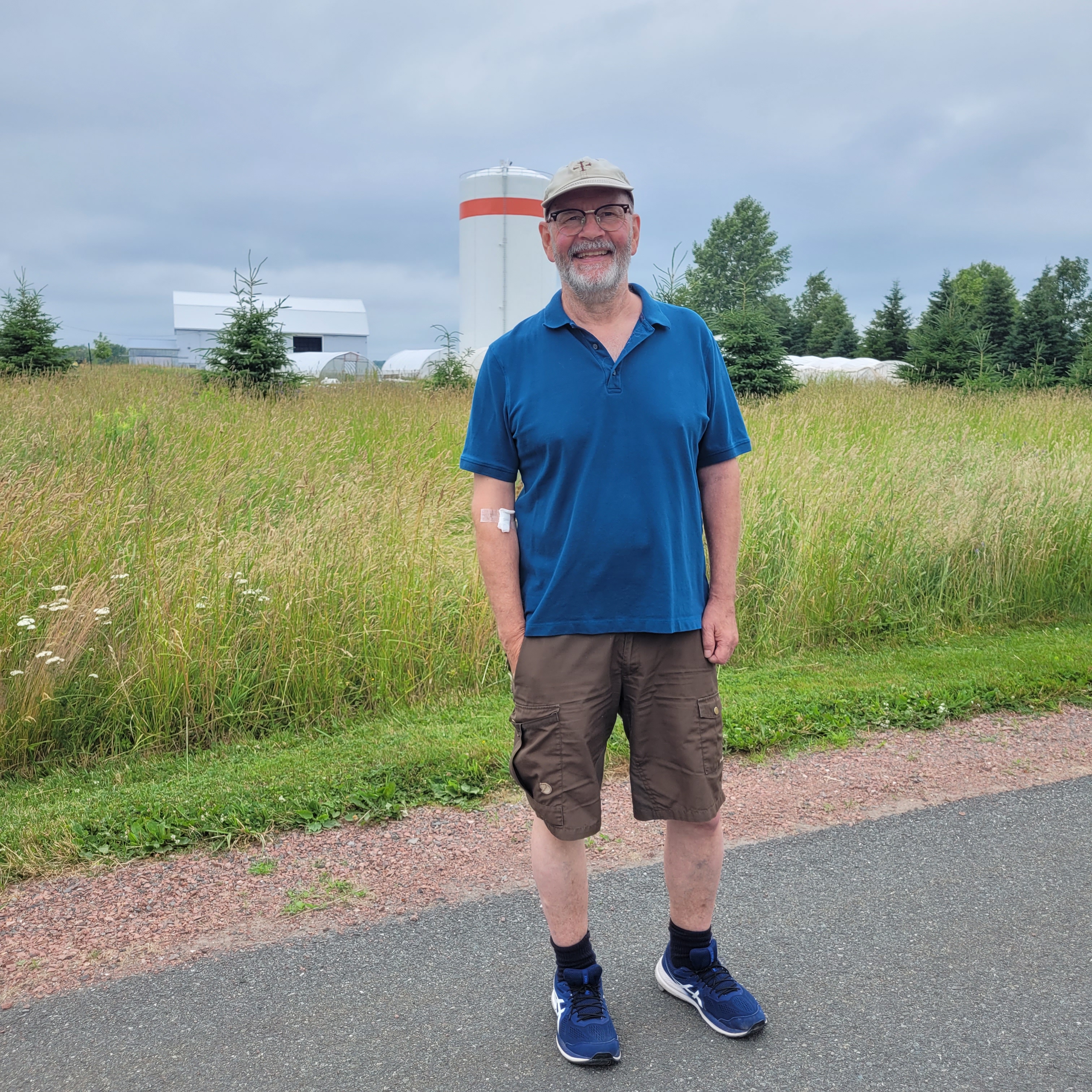
One of the most significant tests of my recovery was putting on my hiking boots (this time, with elastic laces) and re-walking a portion of the trail from Wood Mountain to the Lakota First Nation. Ten years ago, we did the three miles easily in the morning. This time, I cut out when the trail got muddy and hard to walk, and rejoined later. I managed to walk about a mile and a half in total.
Another highlight was meeting Dr. Claire Thomson, who led us around the historic site at Wood Mountain and gave both an academic and a personal history of the area. Dr Thomson is a descendant of one of the early North-West Mounted Police officers, and of his Lakota wife. Her PhD research on the Lakota history of Wood Mountain won the prize for best doctoral thesis in Canadian Studies recently…I quoted her in The Good Walk and was delighted to meet her in person.
My life as an author looks like it will keep me busy into the fall as well. In September the Atlantic School of Theology is hosting me for a series of six online lectures on Leonard Cohen and Saint Paul, following up on my book Prophets of Love (MQUP, 2023). You can find more info on those lectures by clicking the “Almost Like the Blues” link HERE.
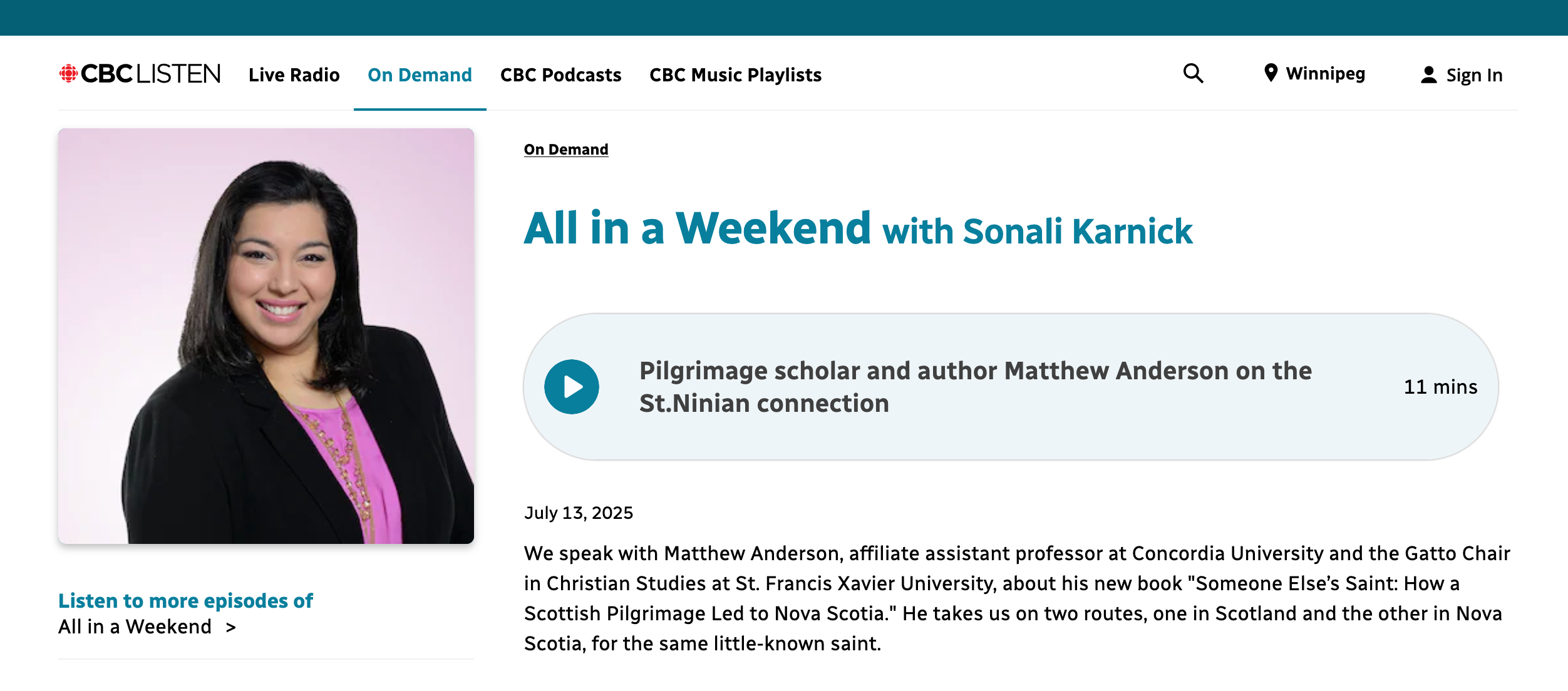
This week my interview with CBC Radio One Cape Breton’s Wendy Bergfeldt came out on the afternoon show “Main Street.” God bless the public broadcaster! I was excited for my first Nova Scotia CBC interview…and our talk went so well it was broadcast over three separate afternoons! It was wonderful meeting Wendy – it turns out we have LOTS in common: growing up from Scandinavian settler grandparents in SK, attending the U of S in Saskatoon during the same years, living in the UK for a while, and then settling in Nova Scotia. Oh, and did I mention? A shared interest in decolonization, history, and pilgrimage! I’ll post the links to the interview soon. (In case you missed it, my earlier CBC Montreal interview with Sonali Karnick can be heard here).
Next Month: One Year
Soon it will be a full year since my stroke. I’ll be marking the occasion, for sure. Will I be celebrating? I’m not sure what to say.
My stroke cost me a lot that I haven’t yet regained: my sense of secure balance, my ability to walk long distances, to run, to dance smoothly, and to play songs smoothly on the guitar. And crucially, I can’t type with both hands like I used to, which is how I’ve written my essays, lectures, and books.
BUT: the stroke helped me realize what a community of support is around me, how good so many people are, what an incredible partner I have, and how precious life and health is. I’m thankful every day for just being able to walk and speak (and pee and shower!), teach, read, think, and do what passes for a “normal” life for me. Much less all that’s listed above.
In the end, it’s all gift. Because of my stroke last fall, I realise that now more than ever.
So, see you next month! I wonder what surprises await?
Sara found a more elegant solution for dripping juice than the complicated ladder-thingy I typically used.
So, something fairly big for me happened recently. Following my stroke ten months ago, I would look out the hospital window from my wheelchair and see people–strolling on their lunch-breaks, walking their dogs, or jogging–up and down the small hill that leads from the hospital to the Bethany Gardens and farm owned by the sisters of St. Martha. At that time, I was a ‘two-person transfer’ and couldn’t walk a meter, let alone a kilometer. “See that hill?” I said to Sara. “I’m going to walk up it with you one day. That’s my goal.” There’s a small tower at the top. My dream was to touch that tower like Rocky finally able to take the steps from the iconic movie. It felt impossible, but I fervently envisioned getting to the top of that hill, giving thanks for my recovery–and being outside, right side up, and on my own two feet.
This week, it finally happened. Sara and I were running separate errands on a busy day and we both wound up in the vicinity of the hospital at the same time. We decided to meet for tea at the volunteer-run BreakAway Cafe that helps pay for new medical equipment. Last fall Sara had been there pretty well every single day to see me, and she still had a free coffee on her hospital coffee card. It had been a while since we’d both been at St. Martha’s together since my stay. After our drink and my medical appointment, Sara said, “is today the day?” and looked meaningfully at the hill. And we set off. It was surreal to make it all the way to the top.
It wasn’t entirely as envisioned. My gait wasn’t as smooth and confident as I’d imagined from my wheelchair in September. I was winded by the slope and had to stop to catch my breath. (That certainly wouldn’t have happened pre-stroke to this long-distance pilgrim!) And when we got to the top it turned out there was no way to actually touch the tower, which turns out to sit behind fences, cattle, and construction.
Even dreams that come true don’t usually do so in the ways we’ve imagined.
But – it felt wonderful to reach the top just the same! And I was thankful every step.
“Telltale Heart“
(apart from the title, what’s below doesn’t actually have much to do with the Edgar Allen Poe short story, which is frighteningly narrated here, if you’re interested)
Today I was at the hospital for another important step in recovery. I’m still doing physio at St. Martha’s at least twice a week…odd to remember how when I was new to Antigonish I used to think I should go see the place because I’d never been inside. But this morning wasn’t physio. After three tries and two different technicians, they got an IV line into my arm for what’s called an “agitated saline contrast,” or echocardiogram bubble test, pumping “bubbles” into my vein, then watching them travel to the heart to see if my surgery in April had really closed the hole between my heart’s upper chambers.
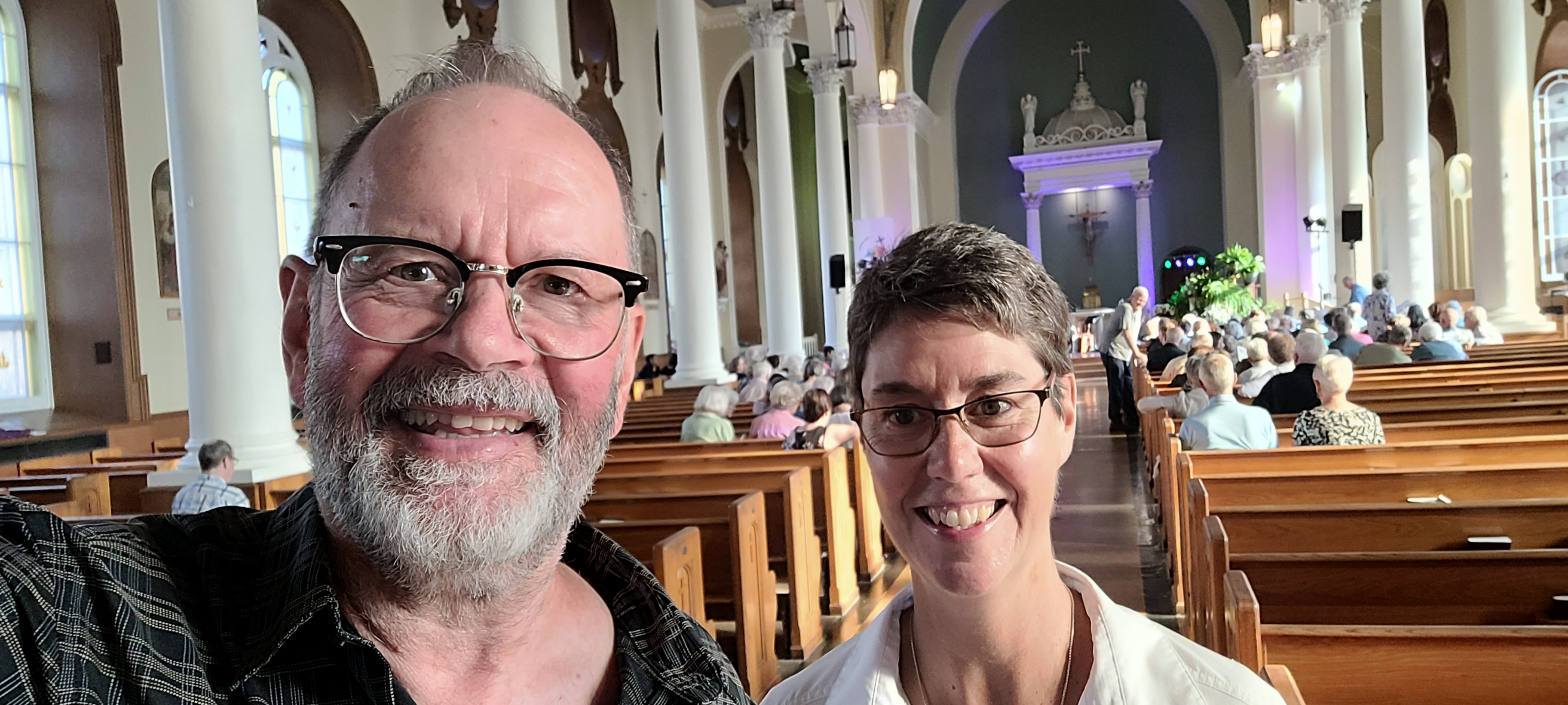
The great news: it had. No bubbles got through. This means that now no future clots can sneak through there, either. I said thank you to Dr Amy Hendricks, and told her she plays a mean piano and violin (I had been surprised to see her perform in a wonderful concert at St Ninian Cathedral). She laughed and said thank you, and that everyone needs to have a few hobbies on the side. That’s life in a small town. (Pictured are my friend and fellow pilgrim Sister RéAnne and I at the concert before it began).
This week I also got my Botox shot for leg spasticity. Or rather six shots, into my left calf, as I lay on my stomach on a clinic bed in Halifax. There was no immediate change, except some mild flu-like symptoms I’m presently experiencing. Apparently it takes 4-6 weeks for the poison to reach full efficacy and (we hope) work its wonders. However, tonight I feel like my leg already swings a bit easier, which might be psychosomatic. In any case, convincing my plastic brain to accept that my leg can be trusted again is apparently part of the point. We’ll see!
I’m starting to be able to do some slow and basic typing with my left hand. Just barely. Soon the hand tires and my xpinxkixe finger (there it is, doing it again), starts drooping and hitting errant keys and I have to go back to one hand. But… it’s a start. The trick is holding my left hand in the air without the fingers curling in (spasticity) or the whole hand dropping, then adding to that the coordination of using fingers to distinguish between the “a” and the “d” keys when they are only beginning to remember their connection to my brain…
“The Gatto Came Back”
Okay, that heading holds a fairly obscure pun, but IYKYK. (If you don’t, click here for “Gatto”; and watch Canadian entertainer Fred Penner sing the song here !)
My two universities have both been incredibly supportive through these months of stroke and stroke recovery. Firstly, Concordia’s Dept of Theological Studies and its chair, Dr. André Gagné, worked to renew for one last time my status as an “affiliate assistant professor” there. I love still being associated this way with Montreal, even though the thought of a trip to the big city and taking public transit in my present condition gives me the heeby-jeebies.
Second, Saint Francis Xavier (StFX) and my colleagues here in the Religious Studies department have been nothing short of wonderful. In addition to taking over my teaching last fall, interim chair Dr Robert Kennedy dropped by with a stunning white orchid from the department after my heart surgery. You may recall that they also sent flowers and cards during my hospital stay, and Sara got gift certificates for take-out and ready-meals from our then Dean of Arts office and the department. Recently, the University also made “a big deal” of my winning a Sask Book Award with a special news release. New colleague Dr Gerjan Altenburg invited me fishing with him and his son. And this last week, Dr. Erin Morton, Associate Vice-President, Research, Graduate and Professional Studies, and head of the Gatto Chair Committee, confirmed that my application for a one-year extension of my chairship was approved. This means that the research travel and meetings for which I had funding will not be lost to my months in hospital. I’m incredibly grateful!
“Running Back to Saskatoons”
I’ve been hanging ’round hospitals” is one of the lines from the 1972 The Guess Who song “Running Back to Saskatoon,” which also mentions libraries, grease monkeys, and Moosomin SK. But it’s actually now that I’m home from the hospital that I’ve really been able to enjoy Saskatoon (or as they say here in Nova Scotia, “serviceberry”) season.
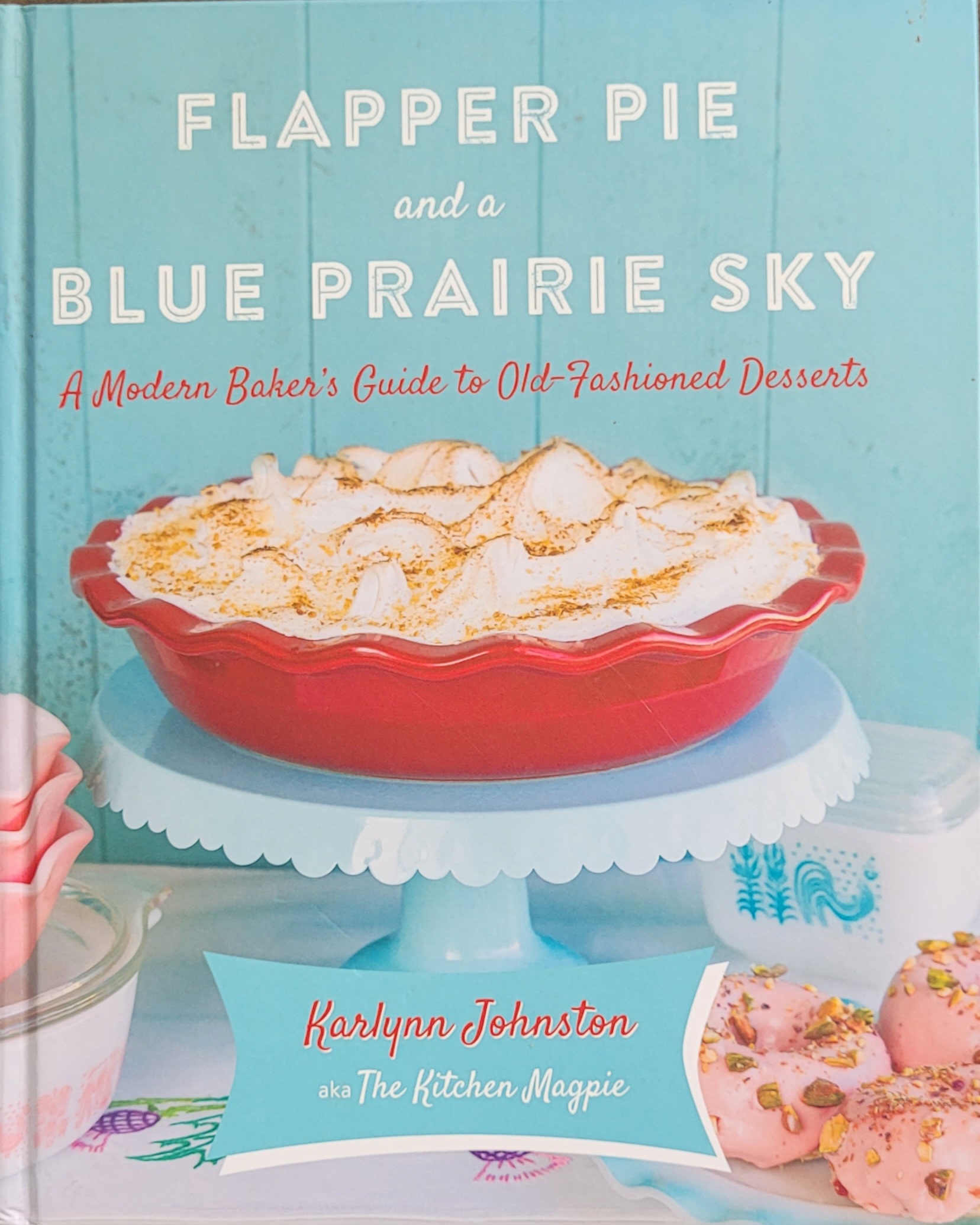
It’s a good year here on our three acres for Saskatoons, even if you’d laugh to watch how slow I am to pick them. My first attempt at a Saskatoon crumble was only okay (not enough berries). But today is Saskatoon pie day. I followed a recipe from the beautiful – and fun – cookbook Flapper Pie and a Blue Prairie Sky, which devotes several pages to Saskatoons and their place in prairie cuisine and culture.
It’s not a beautiful pie…I used a store crust, and my thumb marks disappeared in the baking. But it’s mine. And what I really wanted to say was not so much about Saskatoons (or pies!) as the feelings that arose in me this year as I picked the deep purple berries. The other evening I was out during the “golden hour” with my plastic pail. Somewhere in the near distance I could hear children playing. A rooster crowed from one of the nearby farms, and the songbirds – we have a lot of song sparrows, vireo, yellow warblers and more – were calling to each other.
Despite the mosquitoes, deer flies, and ticks, suddenly there was so much peace and joy welling up inside that I could feel it like a physical presence. Here I was, standing on my feet, reaching with both hands, however awkwardly, for berries, and tasting the sweetness of this land where I live.
I feel incredibly blessed to be living, period, and to be living in the country. Yes, the power goes out sometimes, yes, there are critters, some great, mostly small, to be aware of and learn to live with, yes, there is grass cutting and incessant yard care, and yes, there are no bakeries or restaurants or cool little take-out spots just around the corner like I enjoyed in Montreal. But there are other pleasures, like sitting with tea looking out at the little bit of salt water that fingers in at the foot of our yard, like watching herons rise up into flight or eagles float lazily overhead. Like tossing ripe Saskatoons into your mouth and hearing the soft tap-tap-tap of a downy woodpecker somewhere deeper in the bush. And feeling alive and connected to it all.
The 2009 album “These Are the Moments” by local Cape Breton group The Rankin Family contains the song “Fare Thee Well Love” – which is my wish to you, in your moments, whatever and wherever they are..
That’s a snapshot of what’s been happening. It’s been ten months since the event that overturned my life last fall. That one moment of garbled speech, of a tingle running down my arm, of Sara running for the Aspirin and calling 911, has led to all these moments since.
Isn’t it profound how a single moment can change our lives, and how often that happens, in some form or another?
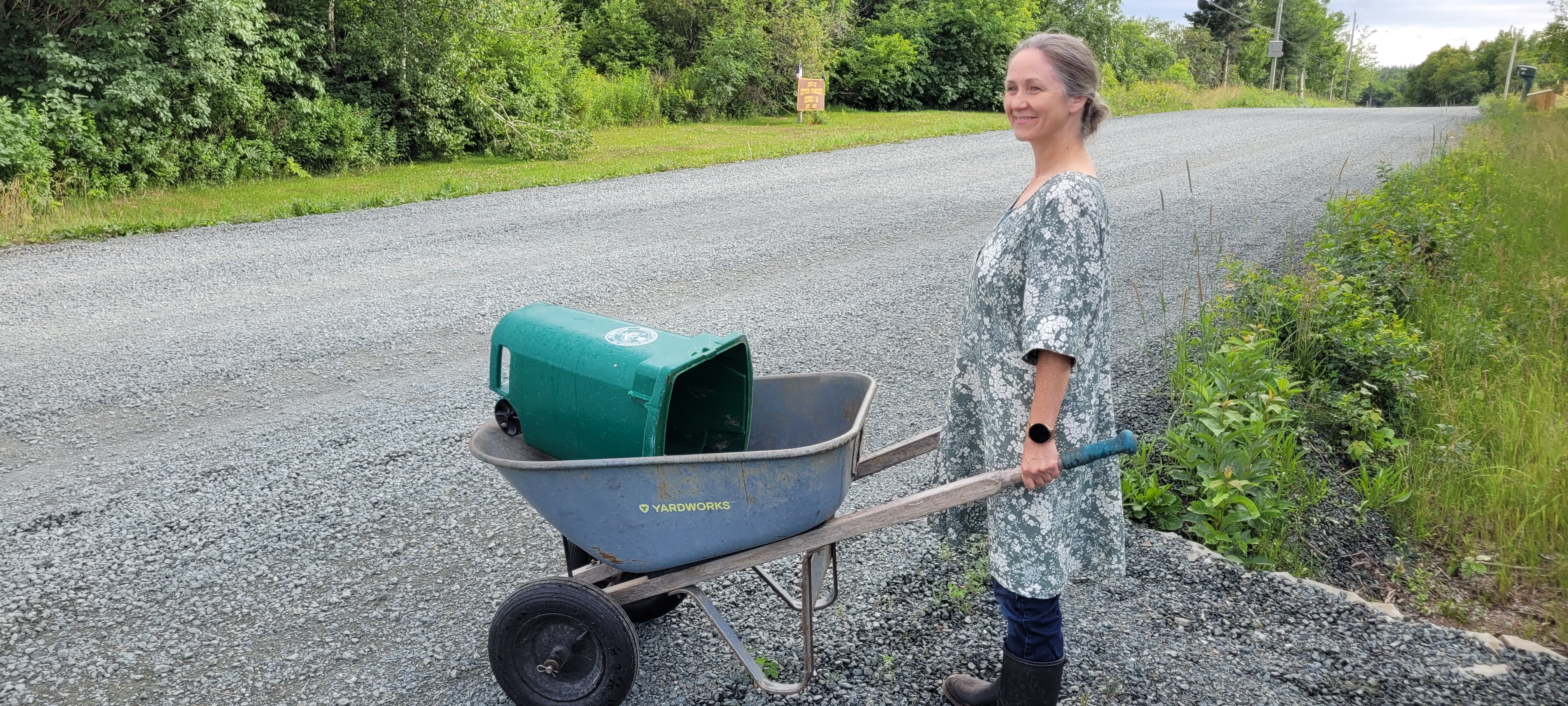
And yet life still goes on, until it doesn’t. And for this moment now, I’m thankful. And thankful to you for taking a moment to read this. Tonight is garbage night. Time to head out with the wheelbarrow, and then maybe try that pie…
[Update: As they say in the Maritimes, it was some good.]
“Dad, can I borrow the car tonight? I promise I’ll fill ‘er up.”
After my stroke, I was required by law to take my driver’s tests (written and practical) again, as a “one-armed driver.” I went in to Access Nova Scotia for an oral exam on road rules and safety, a road signs quiz, and a 45-minute road test. My jovial inquisitor was Teresa. At the end of it all, I officially got to keep my driver’s license.
Yayyy!!! I feel SO thankful.
The Driving Exam
It seems fitting that my 90-min driving exam took place almost five months to the day from my stroke back in September. I was supposed to take it a week ago. But I hurt my unaffected right arm last week overworking it (trying to rake snow off our solar panels, I think, or maybe it was that time I carried in all the groceries at once). It took a week for my “driving arm” to recover enough to turn a corner without grimacing.
Was I nervous? Of course! It will be – unbelievably to me – 50 years this June since I passed my first driver’s test in Regina, Saskatchewan (the above grouchy photo was taken a year or two after that time….I’ve since learned to smile!). The very professional and friendly Teresa here in Antigonish was all smiles when we got back to the provincial office. “Look at that,” she said, holding out her clipboard. “I barely wrote a thing. Sometimes I have to fill these sheets! You got just enough points deducted to prove you’re human.” I know one of the two things I got docked for was not signalling when I left a roundabout, but it was because I couldn’t safely take my right hand off the wheel to get all the way over to the turn signal while making that sharp a turnoff.
Appointments, Appointments, Appointments
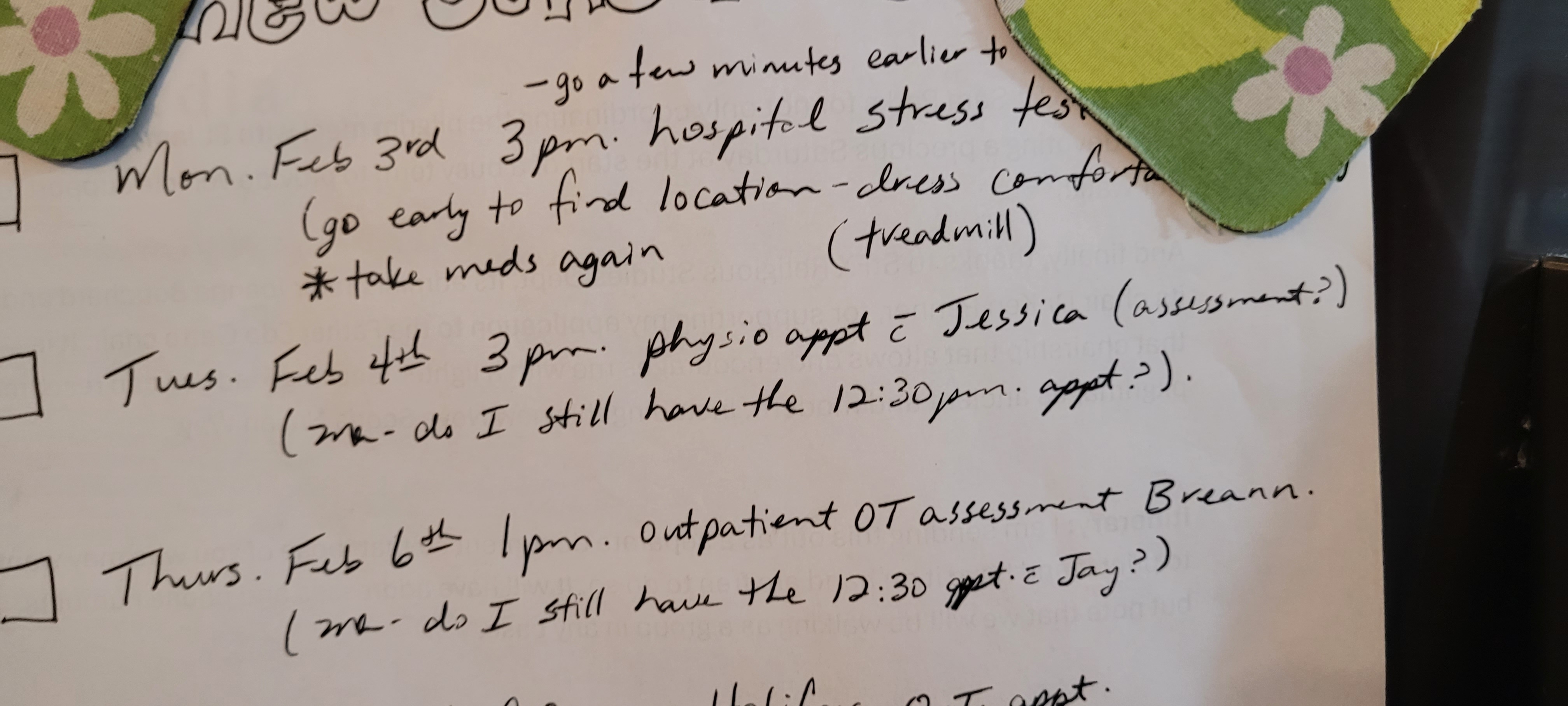
Since Sara and I live in the country, not having a driver’s license would have meant a major life change. These days I’m teaching two days a week at Saint Francis Xavier University, 17 km down the highway. (Last week’s midterm exam for Bible and Film pictured above!) A normal week also means driving in two mornings for the Nova Scotia Cardio rehab program “Hearts in Motion” at the StFX Amelia Saputo Centre gym, where I and a dozen other heart patients get sessions on exercise and diet and 75 minutes on the treadmills, stationary bikes, and (for me) elliptical machines. I usually bump into one or two of my students, which is nice. Twice a week I also head back to the stroke rehab centre at the hospital, now as an outpatient. There I do 30 minutes of physio and 45 minutes of occupational therapy. Then there are all the appointments for blood tests, stress tests, reassessments, and consults, most here, but some coming up in Halifax.
I remember the old folks always complaining about how busy they were with appointments. Preoccupied juggling multiple part-time jobs and kids, I remember thinking: that’s hardly something to keep a body busy. Boy was I was wrong! I’ve needed to post myself a schedule just to keep all my rendezvous’ straight and out of conflict with my teaching times. I’ve also apparently joined that group of people who have to remember to take multiple pills daily, counting them out carefully every evening.
Me and My Big PFO
A big date for me comes up the end of this month in Halifax: my initial cardiac procedure pre-appointment. In case you missed my earlier mention of this: apparently I have a “PFO,” a hole between the upper chambers of the heart. This hole exists in newborns, but in almost all people closes in very early infancy. In a small percentage of us, that hole never closes. A PFO can allow a clot from the leg to pass directly to the brain rather than being shunted safely to the lungs for “processing.”
No one seems to know for sure if this is what happened to me. But it may have been. Something poetic about the fact I have a hole in my heart.
At my pre-appointment they’ll confirm whether I’m a candidate to have that hole closed with an arthroscopic procedure involving magnetized rubber washers. Of course I’d like that procedure asap. I don’t want another stroke (although I’m grateful for the meds that have finally brought my blood pressure down from the mountaintops)! But I know I’m fortunate to be seen so quickly about this. For now, on the doctor’s advice I’m not flying or taking long drives. A trip to Montreal to see the kids, or speaking at Gathering of Pilgrims 2025 in Vancouver as planned, are out.
Refuse the Plateau!
The book “Stronger After Stroke” that was sent to me by Greg and Ingrid Gust says that a good rule for stroke survivors is to refuse to accept the idea of “a plateau” limiting their recovery. So that’s what I’m doing. And amazingly, I have yet to see a plateau. Every single day, I see slight but noticeable improvements. For instance, I typed this sentence using the three fingers of my left hand….not easy, nor graceful, but a start.
I sometimes feel disappointed for still having a pronounced limp when I walk (my arm and leg spasticity, or tightness, becomes much worse when I’m cold). Then Sara reminds me that I’m also walking through snow, and up and down multiple flights of stairs at the gym and the university (holding the railing). So there’s that.
The physios at the hospital filmed me walking. “This isn’t for us,” they said. “This is for you, so you can see how far you’ve come.” Sara came into our living room last week to find me lying on the floor. I’d been trying to squat the way I used to pre-stroke. “Are you okay?” she asked. “I tipped over,” I said, not moving. “Do you need help getting up?” she asked gently. “No.” Sometimes, flat on your back, you just gotta laugh.
My proudest news is that for the first time I can actually make a couple of chords on my guitar… WITHOUT always using my right hand to “arrange” my left fingers. Before Christmas I couldn’t even keep my left hand on the guitar without it sliding off under its own weight. Now, the feeling of very slowly moving my left fingers into an A or D chord (the easiest) is pure joy. A stroke-specialist in Halifax I met with over Zoom said to keep at the guitar daily. That seems to be the key: my daily routines, using my left hand as much as possible, even though it takes so much more time (you’d chuckle to see me spending three minutes trying to fish a spoon out of the cutlery drawer for my tea – do you remember Tim Conway’s SOOOOO-slow routines from the Carol Burnett show?).
Book Launch!
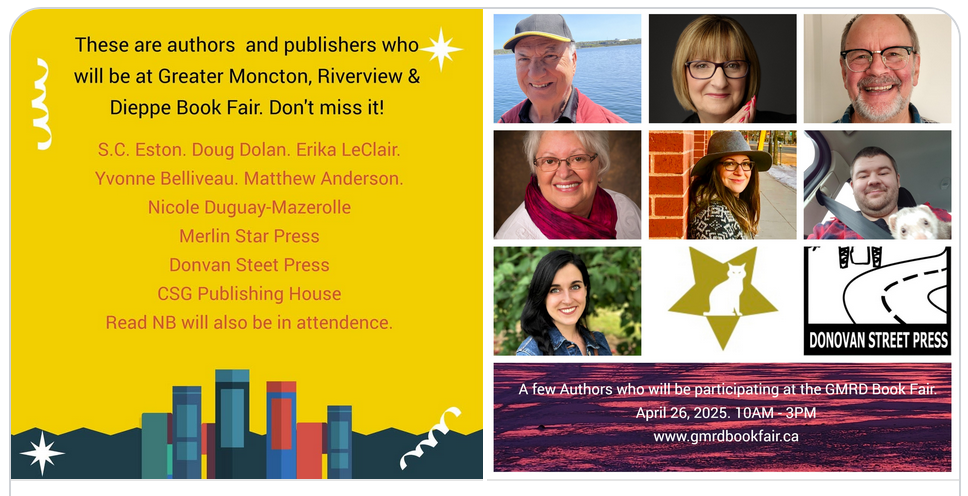
One of the best parts of being at least partly back in the routine is getting back to my writing. With my colleague Barry from the History Department who also happens to run the Antigonish Heritage Museum where I was first invited to give the talk that ended up ballooning into my new book, we’ve set a date for the launch — fittingly at the museum! “Someone Else’s Saint: How a Scottish Pilgrimage Led to Nova Scotia” launches there on Thursday April 24th, at 7 pm. I’ll tell the story of the book and do a reading or two, some of the local walkers will attend (I hope), and fingers are crossed for some fine local music! Two days later, Sat April 26th, I’ll be in New Brunswick for the Greater Moncton Riverview Dieppe Book Fair from 10 am to 3 pm. The book is already getting some nice attention, with a planned CBC Radio (All in a Weekend) interview. It’s only in pre-sales, but it’s already listed as #15 in Amazon Canada’s “hot-sellers” in its category (see below). But please don’t buy it there … pre-order it through your local bookstore instead! 🇨🇦
Taking Time for Warm Stanfields and for Berry Blossoms
Like everyone else, I’m having a hard time not doom-scrolling and feeling anxious these days because of the news. But my stroke recovery books – and my common sense – tell me that what’s best for my condition is to maintain a hopeful and constructive attitude, and allow my self-discipline and anxiety to be tempered by humour and forgiveness (good advice for us all). So I’m going to be lining up some post-stroke, retirement-adjacent therapy. I’ll try to dial down the work and dial up the creative writing a bit more all the time. And even on my lower sodium, fat and sugar regime, there’s some room for the occasional self-indulgence, such as these 100% Quebec-made “Berry Blossoms.”
As you might be able to tell from this photo of the moon rise over our neighbours’ place, it’s been cold here in Pomquet – and the cold affects me more since my stroke. So it’s also been great to discover that the “Stanfields” long johns of my youth is now a full clothing line, made since before Canada was even a country, just down the road in Truro Nova Scotia. I bought myself a sleeping shirt and Sara a tee-shirt for Valentine’s. These days, I think we can all agree with the logo.
If by chance you’re thinking of saying goodbye to Facebook at some point, please consider subscribing to this blog as a way of staying in touch. Thank you for following me along on this pilgrimage through stroke, and may the support you’ve given me return to you in a thousand ways. Courage and health to you, from our home to yours!
How prescient and thoughtful George‘s card was this week! One of the dangers of making daily improvements in my post-stroke recovery is expecting that trend to continue without fault. At the outset, the health care team said there would be days of setback and slowdown. “It’s not a uniform progression,” they warned. “Don’t be discouraged when some days you find you can’t do as much, or your condition even seems to regress.”
That’s what happened this last week. “You’re dragging your foot and swinging out with your hip more,” observed Lee as she watched me with the walker Monday. Eventually she said “Just take a break. You must be tired.” My speech slurred perceptibly, especially Sunday through Wednesday, as much as I tried to mindfully keep my “s”s tight. For the first time, there was no progress in my hand – despite Ria’s, Lena’s, and Lori’s best efforts. Between physio sessions I was exhausted. I’d crawl back into bed for naps.
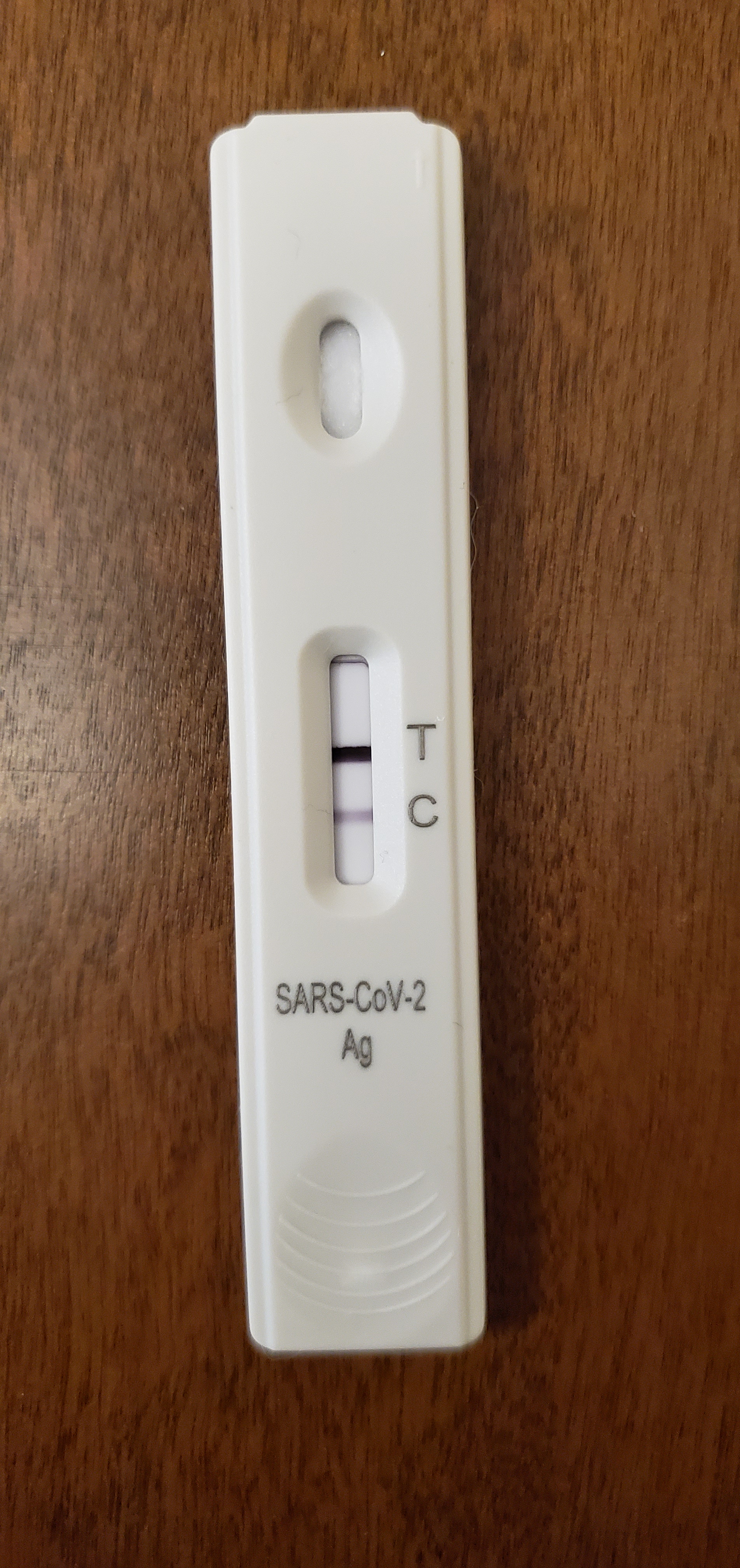
I asked the staff whether a change I was starting to notice in my taste buds could be stroke related. Some said yes, maybe so. But when Sara picked me up for a supper at home, and heard that I hadn’t been able to taste the maple syrup on my french toast and didn’t enjoy a piece of home-made fudge, she left her N95 respirator on for the car ride home, then pulled out the last covid test from the stash we’d built up (when they were plentifully provided), and said: here, take this.
I was positive. Sara said, “I knew it.” She still made the Mexican Bean Stew she’d planned, but we ate in separate rooms. When we got back, I told the ward. For 24 hours they didn’t quite seem to know what to do with me and said to “wait for Infectious to get here in the morning.” They administered a test that had to be sent away for analysis. They didn’t bother to protect my room-mate, explaining “he’s already been exposed at this point.” But ironically, just as I started feeling better, the infectious disease control measures locked in full force. By Wed night I was isolated to my part of the room, and staff added gowns, gloves, and face shields to their usual haphazard masks, when they checked my vitals or brought my pills. For the rest of the week members of the physio team who were not themselves sick faithfully led me through my exercises in the few square feet of room where I could still move. Things like showers and fresh bedding were put on hold. For a few days it was just me, my laptop, my book, and the window.
Sara suggested I take advantage of my isolation to write poetry, a practise I got into in Montreal, England, and Ireland. I was anxious to try this, and a bit anxious about it. The side of my brain damaged by the stroke is the side typically used for imaginative, connective thinking – precisely the kind of conceptualization required to write poetry and fiction. In my isolation room, I worked out a poem about looking out my window and sent it to Sara. “It made me cry,” she wrote back immediately. Knowing I’d been worried, she added, “It’s very much your pre-stroke style. That part of your creativity hasn’t changed.” Encouraged, I wrote the first draft of another poem, about a crow. “Even better,” she responded. “Keep on.”
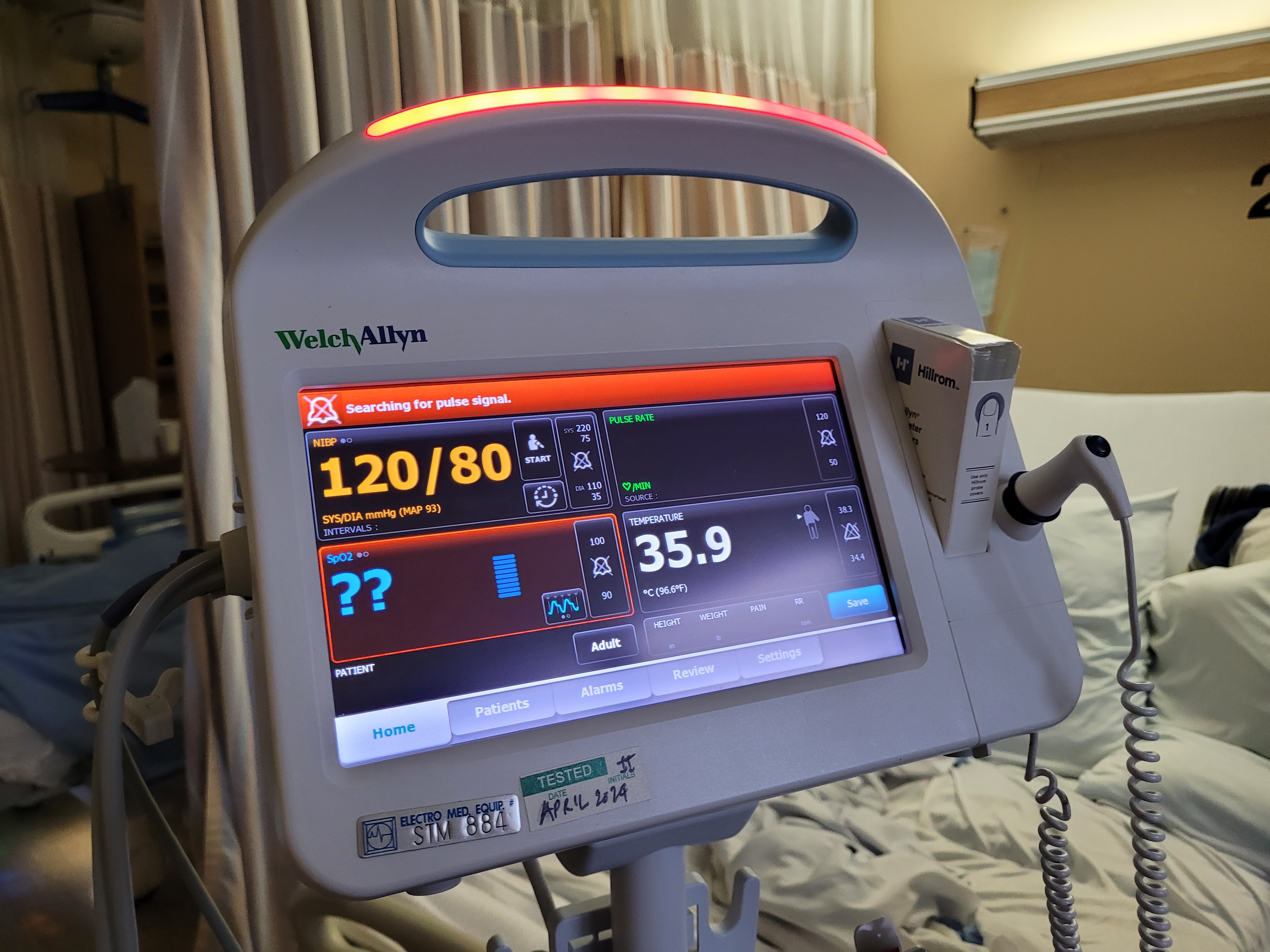
By week’s end my slurred speech was closer to normal, my energy was good again and I was making progress every day with my exercises. But hospital protocols require 8 days from first confirmed symptoms, and so they have me on isolation until this Tuesday Oct 29. The physios and doctor suggested that if I could, I should go home for the entire weekend. “You’ll get more physio there than here, at the moment,” Lori told me. Sara, who ALWAYS masks in shared spaces out of concern for vulnerable loved ones, had also become briefly unwell – a “surreal fatigue” she said, and a few coughs and sniffles, although she tested negative. I was six days post-first-symptoms. Sara came and picked me up. I was able to shower both days (shower chair on loan from the Red Cross) and fall asleep in my own bed, where I’ve had my best sleeps in weeks.
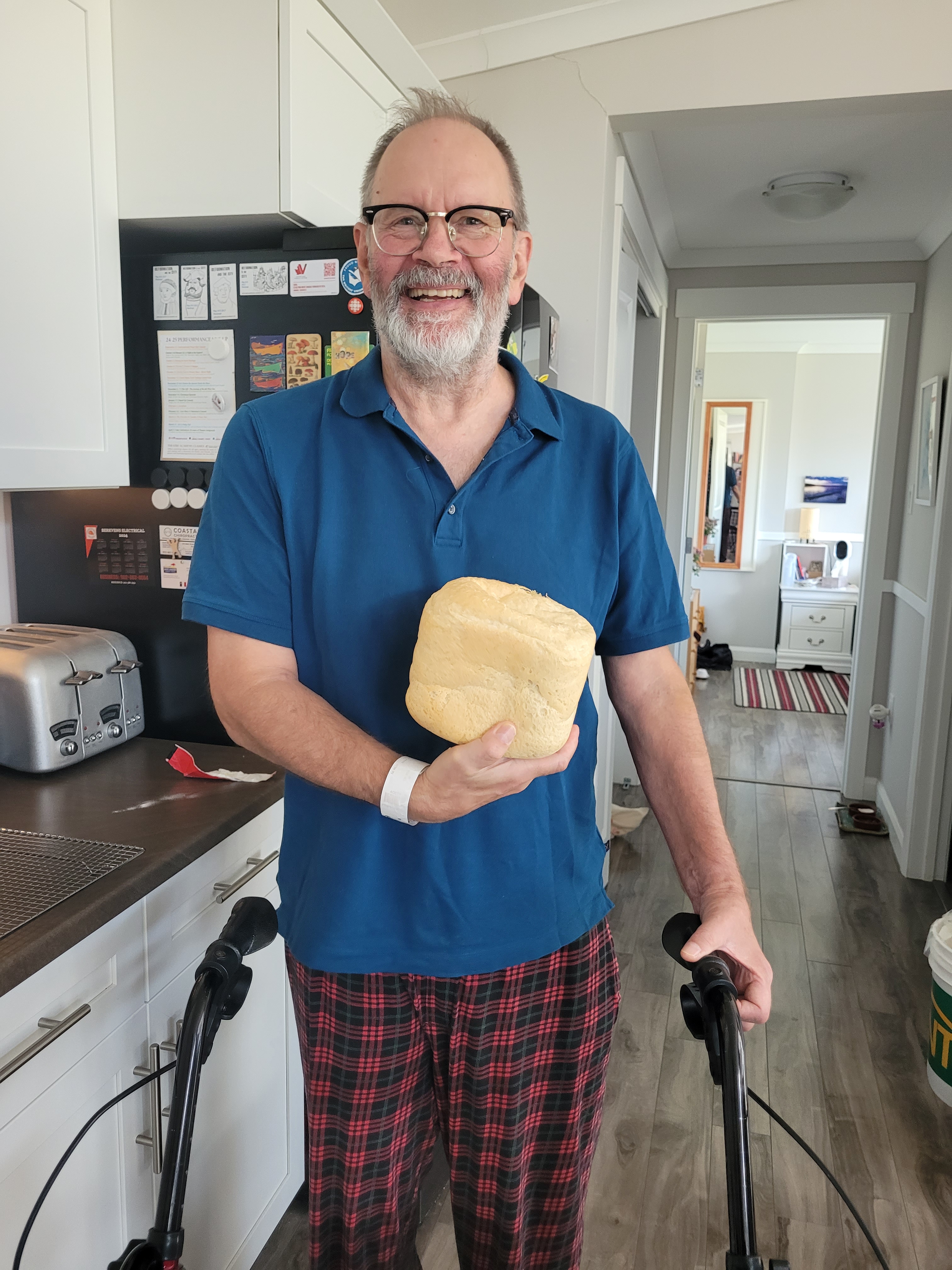
Sat morning I was able to make bread-machine bread, make coffee and tea, and cook rice (although re-doing the twist tie on the rice with one hand defeated me). Saturday and Sunday I did my leg lifts and toe-points on our deck in the sun, so much better than the thin slice of my room between isolation refuse bins. Tonight (Sun Oct 27) I’ll head back to the hospital and two more days of isolation.
I can now hold myself up on my left elbow, and bend down to pick up items (with my right hand) that have fallen on the floor. My left hand remains barely responsive. But here at home I’ve used it to squeeze toothpaste and hold a jar while I twist off the lid, so that’s something. I had a very vivid dream this week in which I was going into a musty wing of a large building and turning on the lights, trying to find the thermostats, etc. In my dream I knew that I used to live there and had to make it habitable again. I think the dream was about my brain reactivating (re-inhabiting) my left arm and hand.
The more I’m learning about strokes, the more fortunate I feel that mine did not take my speech, hearing, or cognition, or in any other way cut me off from my loved ones. Apparently 4 of 5 strokes affect these faculties in some minor or major way. I’m still recognizably my old self – to my own mind, to Sara and my kids, and through this writing, to you. I’ve joined the Heart and Stroke Foundation. I finished Norman Doidge’s brain plasticity book and I’m half-way through “My Stroke of Insight: a brain scientist’s personal journey” by Jill Bolte Taylor. I’m grateful that apparently only my mobility was affected by whatever deadened the 3-cm sphere on my right brain hemisphere. I feel a responsibility to work hard on my recovery because of that relative good fortune.
This week I’m thankful for the lasagna dropped off for us by the Penners from our Department of Religious Studies at StFX, for the meal coupons given us by our Dean, Erin Morton, for Joanne, our administrator, who thought to send me a ‘grabber’ for those pesky charging cords, for visits from Lewis McKinnon, Robert Kennedy, and Rev. Peter Smith, for the magnificent flowers from my adoptive Finnish family at St Michael’s Church, Montreal, for James McGrath’s gift of a zoom lecture to my class at FX (check out James’ fascinating books here), for tea and a book of poems about walking from our former colleagues at the University of Nottingham, for prayer candles lit at Lutheran Church of the Cross in Victoria, Quebec City, and in so many other places as well, including by the Apostolic Johannite Church (the Gnostics). “Has anyone ever been so love-bombed?” teased my friend and fellow writer Ellie. I don’t know. But I know I feel that support in every part of me every time I try to extend those left-hand fingers. One of these days!
Last Monday, when I was feeling poorly, Sara took me out to St. Martha’s grotto garden to feel the sun and see the leaves. I felt a bit discouraged just then.
I played Gabrielle Papillon’s song “Go into the Night” for Sara in that garden, to tell her how absolutely loved and supported I feel by her, and how thankful I am. We both broke down and had a cry as the cars passed at end of shift. It’s a beautiful song. I’ll leave it here for you, too, in closing, in case it speaks to any challenges you’re facing. Not all weeks are easy, stroke or not.






























 somethinggrand