Categories
Uncategorized

“Der Pilger (The Pilgrim)” reviews The Good Walk

Gotta love those Germans…
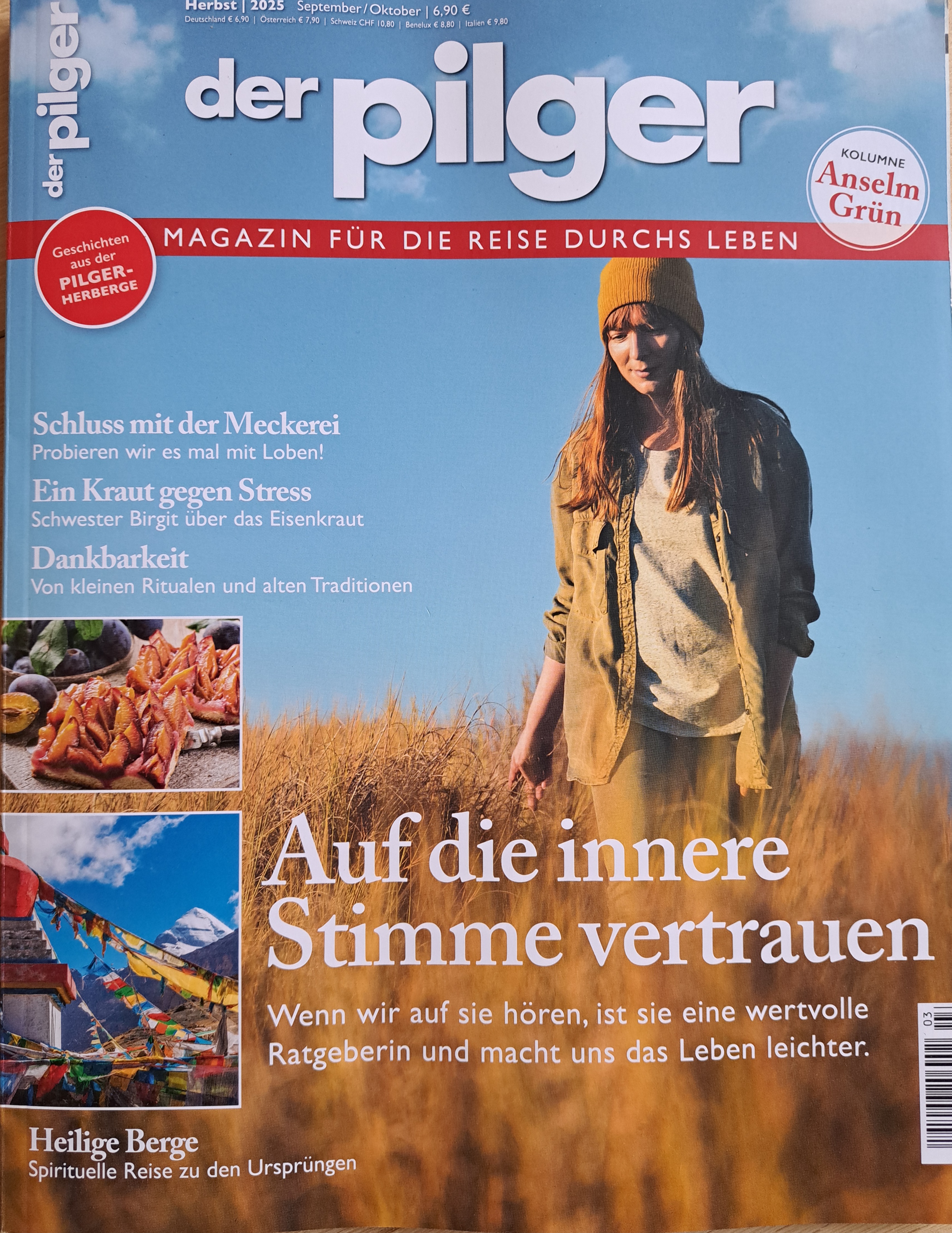
When my friend Traugott Roser contacted me to let me know he’d written a review of The Good Walk, for the magazine Der Pilger (The Pilgrim), I was overjoyed!

My hopelessly naive generalizations about Germans include that…

All Germans are fit and athletic and they LOVE walking and pilgrimages. So they’ll eat up The Good Walk. The book that really ignited the contemporary rise of the Camino was Hape Kerkeling’s fun and incredibly popular I’m Off Then: Losing and Finding Myself on the Camino de Santiago, first published in German and a sensation there.,

All Germans idealize the North American “West” and North American landscapes. Germany is a crowded country that has lost so much of its own “wildness” but still maintains a strong national mythology of origins around it. And yet …

All Germans are aware of and sensitive to Indigenous sovereignty and concerns, and …

All Germans love to read, and as a bonus, as truly civilized people are multilingual and can often read English books like mine, unlike most anglophones and folks like me, who struggle with anything more than simple tourist directions auf deutsch

SO. After all these expectations, how did the review turn out?

Thanks to Google translate, you can read on for yourself….

The Review

p. 43 New Pilgrim Perspectives:

A devout Muslim embarks on the Way of St. James, and a Canadian professor and long-time pilgrim follows the trail of spiritual wandering in the vastness of the Midwest. Two inspiring book recommendations from Protestant pastor and passionate pilgrim Traugott Roser.

The Search for a Lost Home (Die Suche nach einem verlorenen Zuhause)

“Matthew Anderson, Professor of New Testament at Concordia University in Montreal, is an experienced pilgrim who has also led his Canadian students through Spain, France, England, and Norway and has made a name for himself as a documentary filmmaker on pilgrimage. After many trips to Europe, he wonders whether pilgrimage is also possible in North America and what pilgrimage might mean there. In his new book, “The Good Walk – Creating New Paths on Traditional Prairie Trails,” he tells a compelling story of humanity’s age-old paths through the prairie of the Middle West. It is an account of a painful yet healing search for home: “Pilgrimage together with others—in the broadest sense understood as spiritually motivated hiking—is a way of searching for a lost home.” Anderson is a descendant of settlers who farmed…

(P. 45) and built small towns on the supposedly deserted plains of Saskatchewan (see photo above), and [the region once called] the Northwest Territories. Since 2015, Anderson and his wife Sara have been traveling the trails once used by traders, settler treks, and the Northwest Mounted Police, a paramilitary force commissioned by the Canadian government. But Anderson not only gets close to the story of his own family, descendants of white European immigrants, but also of the people who lived there before and were deprived of their land through sham treaties, displacement, and targeted extermination.

Pilgrimage: intercultural and interfaith

Anderson is accompanied on his journey by various companions, including Don Bolen, the Catholic Archbishop of the Diocese of Regina. Descendants of the First Nations, the Lakota, the Nakota, and the Nehyawak (Cree) accompany them or host them, as do descendants of settlers and the Métis, descendants of European-Indigenous marriages, who historically mediated between cultures as fur traders and are now considered an independent nation.

Anderson sees his hikes through the vast landscapes as pilgrimages to places whose history has been partly forgotten, partly erased. This also changes the landscape and its perception itself: through narratives and archaeological evidence, places of living memory emerge.

The places create new relationships and deepen old ones. In this way, the pilgrims come into contact with the spiritual world, [sometimes] with the elders and wise men of the Indigenous peoples, [sometimes] with their own family history, and [always] with nature. Through Christian and Indigenous rituals, the pilgrimage becomes an intercultural and religiously unifying experience. At the same time, it is a painful journey that ties in with the tradition of penitential pilgrimage: The extermination of the North American bison took place in the vastness of the prairie. This deprived the Indigenous people of their livelihood, and thousands starved to death while faced with the government’s deliberate inaction. It is equally painful when the pilgrims encounter survivors from the church-run boarding schools (of both Catholics and Protestants):

On behalf of state authorities, children were taken from their families and  Nations and placed in Christian schools. Only in recent years did the public learn of the graves of thousands of nameless children who did not survive the ordeal.

Reward for Physical and Mental Effort

The paths across the prairie demand physical and mental effort from the pilgrims, but they also reward them: through community, forgiveness, and understanding. Matthew Anderson ultimately even succeeds in finding peace for his deceased parents and for his sister, who died very young. The pilgrim’s path is a good path, and with the project Anderson describes, a new, very unique pilgrimage tradition begins in Canada.

I couldn’t put either book down; it was precisely the different perspectives of both authors that inspired me to consider my own pilgrimage

I couldn’t put either book down; it was precisely the different perspectives of both authors that inspired me to consider my own pilgrimage on the Way of St. James in a new and more profound way: as a consciously religious experience, as a path to encounter God, and as a path to reconciliation.”

Dr. Roser’s Own Pilgrim Book

I wouldn’t be much of a friend, if at this point I didn’t mention that Traugott has published his own pilgrim book. It’s in German, titled Hola! bei Kilometer 410: Mit Allen Sinnen auf dem Jakobsweg (Hola! At kilometre 410 with all senses on the Camino de Santiago).

I wonder if a rather free, but still good, translation might be: “Hola! Fully aware and alive at kilometre 410 of the Camino de Santiago.” It’d be great to see this valuable book out for the English-language reader as well! (By the way, the other book he reviewed with mine in the above article sounds fascinating).

Traugott does all kinds of interesting teaching and research, including (like me) teaching Bible and Film classes. He is also an ethicist who teaches about ethics in healthcare and palliative care.

Thanks, Traugott, for the great review. Buen Camino! Looking forward to walking with you some day soon!

Categories
Uncategorized

11-Month Strokeaversary: an update in 9 gerunds

What better therapy than dancing with Gabe? (video below)

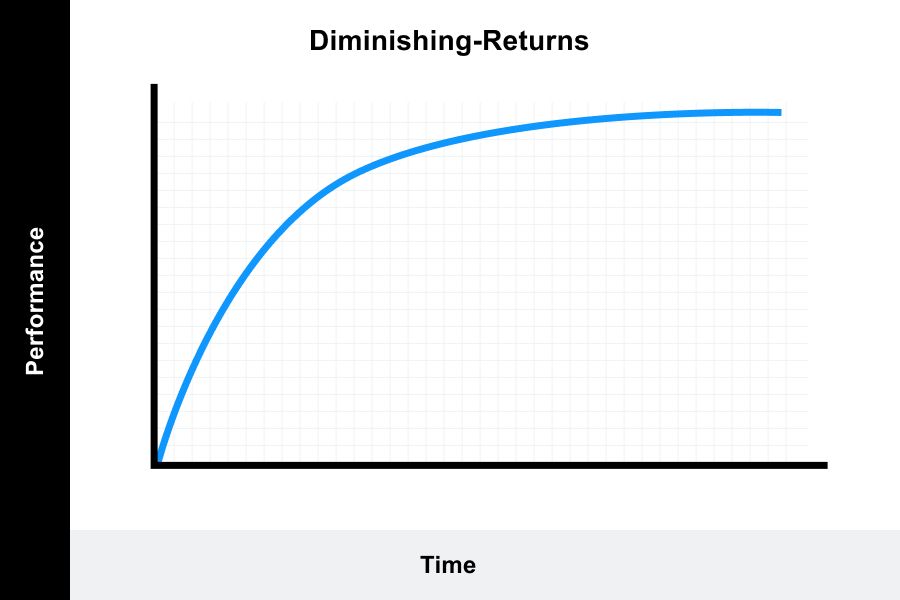
As the ONE-YEAR anniversary of my stroke approaches – wow! – my recovery continues to follow the quick rise and flattening curve (see below) that the medical staff predicted for me, as for other stroke survivors. And it’s true – eleven months in, the changes are more subtle. However, every week there inevitably still turns out to be some marked improvement. My physio supervisor, Jessica, tested me last week and told me I’m much stronger in my leg than just a month ago, and my left arm has also strengthened considerably in recent weeks. The Theraband exercises must be helping.

My recovery has gone far, far beyond what many of my doctors and medical team initially predicted in the dire days of last fall. With Sara’s urging, I continue to believe that the curve will never flatten out completely. As the book Stronger After Stroke maintains, there never needs to be a complete plateau to recovery, for a stroke survivor who is fortunate enough to have good support, a stabilized health condition, and dogged determination to work together with the brain’s natural plasticity.

So on this 11th-month strokeaversary, here’s some of what recovery has looked like!

Theraplaying

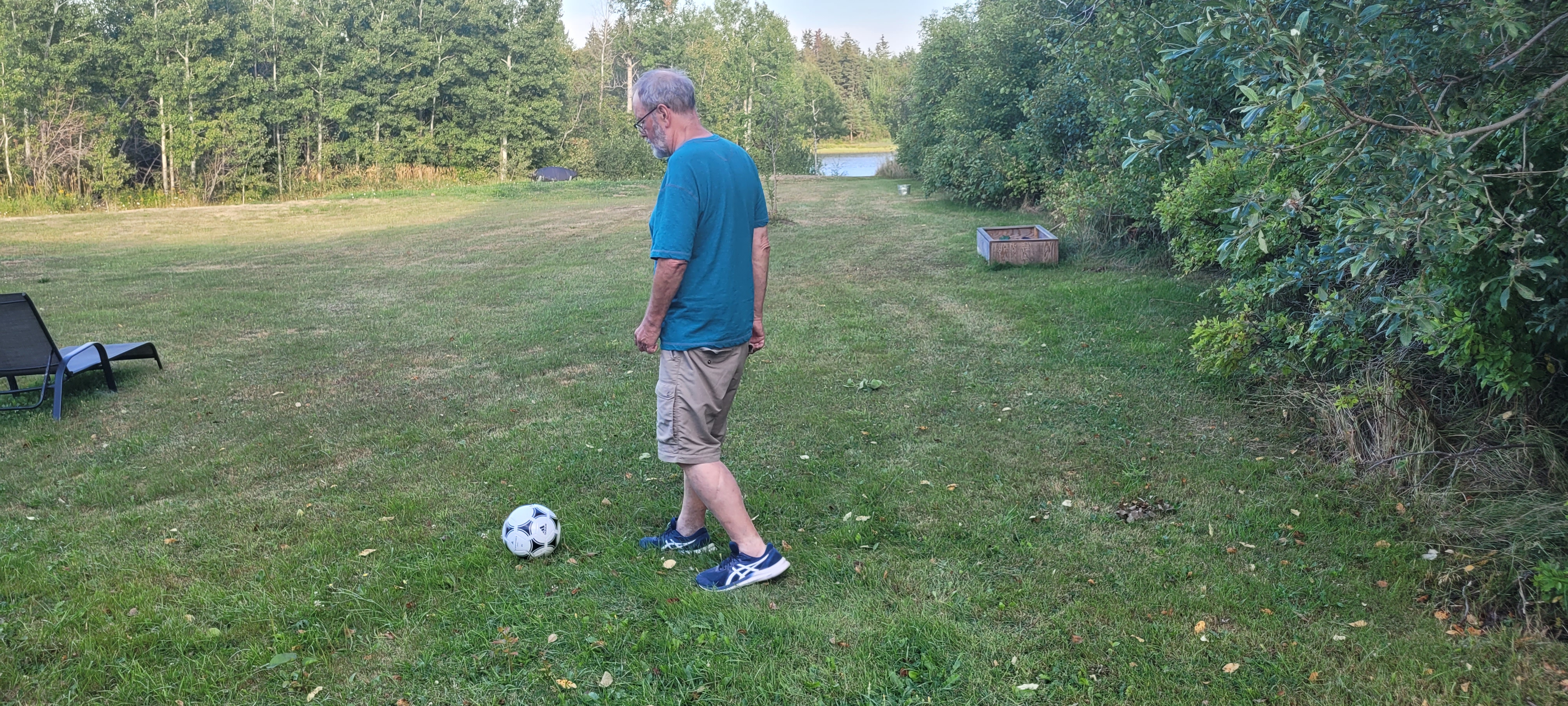
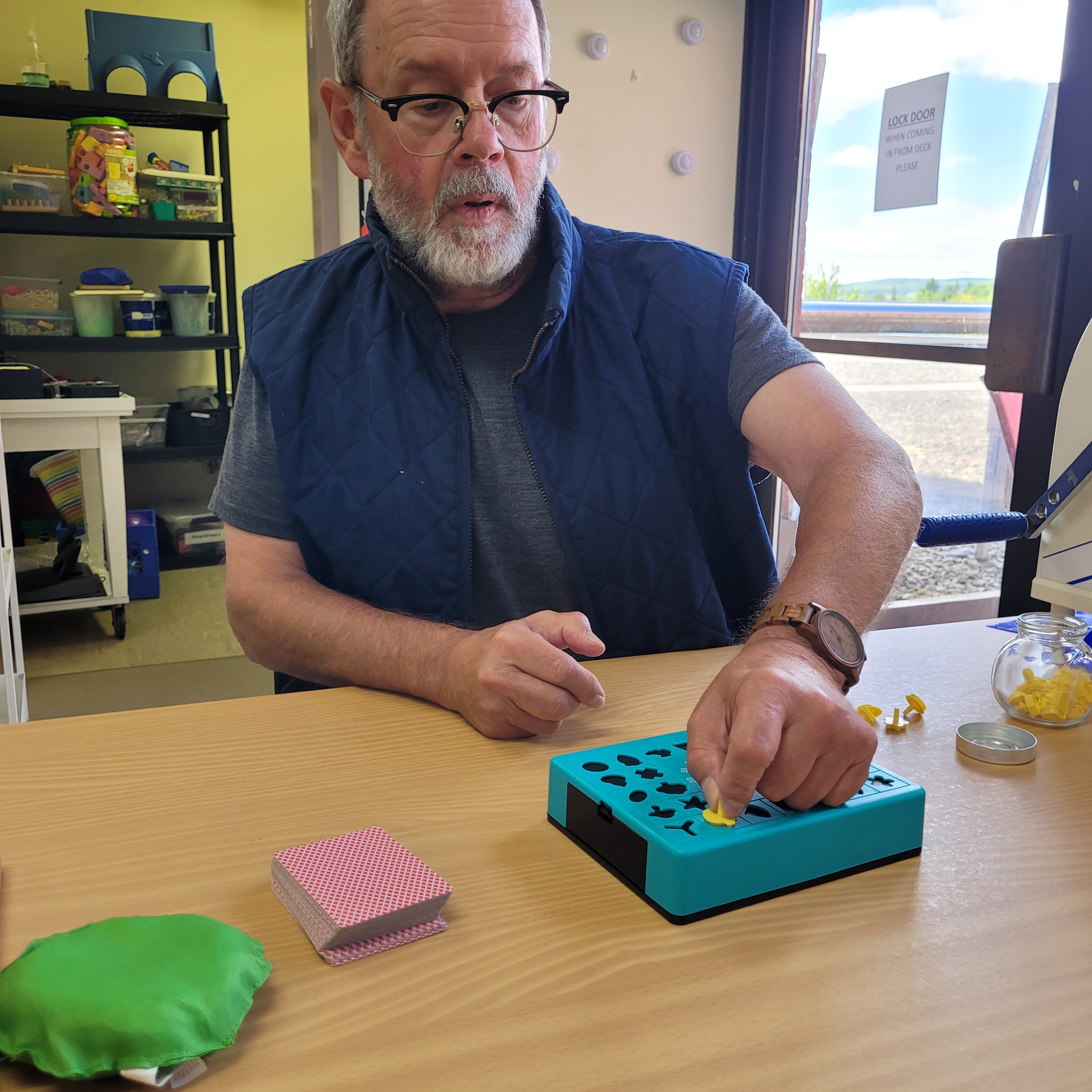
The wonderful physical therapy and occupational therapy folks at St. Martha’s Regional Hospital are starting to hint that I can’t be an outpatient forever. Of course, they’re right. “As much as we like you and look forward to our sessions,” they tell me, “we have to make room in our case load for new patients…” The hospital has been incredibly generous, and I’ve come to really love my outpatient team. I moved from two sessions a week to one only this last month. Colin, the smart and thoughtful tech who took over from the equally helpful physio tech Janna, is now regularly kicking a soccer ball with me. The catch: I have to use only my left foot. I’m finding that soccer and the funny-face bean-bag toss are my favourite therapy activities. Like a toddler, I’m improving my balance, coordination, and hand movements through play, which makes it seem (almost) easy.

Medicating

After my heart surgery in April to close a PFO (the hole between the upper chambers of my heart), the Halifax surgeon put me on precautionary Plavix, to guard against post-operative complications. I just came off of it and I couldn’t be happier. I’ve been bruising after every blood test (one time the blood actually spurted out) and also when I bump or ding myself as so often happens in summer gardening and construction season. I remain on low-dose Aspirin and a suite of blood pressure pills. But my GP and the cardio team at the hospital have dialled back even these a bit, and now I can crouch and stand up without threatening to black out. Sitting on my haunches to look in a cupboard reminds me of my old self.

Straightening

It was Lindsay, the incredibly gifted and helpful Occupational Therapist at the Nova Scotia Rehabilitation Centre in Halifax, who suggested “Oval 8 Finger Splints” for my left hand’s fingers most reluctant to recover – my ring finger and my pinkie. My pinkie has been broken a few times over the years of basketball and tended to go its own way even before the stroke. I find the splints helpful at the end of a busy day when my fingers tend to curl and stiffen. My typing is improving slightly, although when my left hand quickly tires, those two fingers droop and tend to type their own messages.

Hearing

Of the many effects of the stroke, one of the most subtle has been a slight alteration in my hearing, or more accurately perhaps, my brain’s processing of what I hear. I’ve noticed more trouble understanding Sara when she’s in another room, or there’s ambient noise.

At the same time, my need to focus more carefully on whatever I’m doing so as not to lose balance, trip, or drop something, means my ability to multitask, including “listening, while…,” has diminished. And, I’m not young anymore.

So my audiologist appointment finally came through. The audiologist took me into a sealed quiet room, ran tests on both ears, then gave a series of tests I had to respond to.

The results? Apart from the normal post-stroke inability to multitask because of increased need for concentration, my ears are typical old guy’s ears: some age-related hearing loss, and that’s it.

I actually enjoyed the challenge of having four numbers spoken at once into both ears and having to try to correctly identify them!

Canning

When Gabe, my youngest, came to visit in August with Ray, they said they wanted to do some jelly-making like we did last year. The Saskatoons were done and it was a bit early for the chokecherries, but the jelly turned out well.

Our place is prolific for berries despite the scary and record-breaking drought. I spent hours picking Saskatoons earlier in the season, and our strawberries and grapes are plentiful.

Holding boughs with my left hand while picking berries with my right turns out to be good therapy, too.

Dancing

Gabe’s visit this month also gave me a chance to re-learn and re-try the swing steps we’ve done so many years together, and also to re-learn some of the guitar chords my fingers have forgotten, from all the songs we used to play together. I’m thankful.

If you watch the video (click on the photo below), you’ll see how my face goes mask-like (not direct stroke damage but because I’m concentrating on not falling), my left arms wants to pull in and tighten, and I lose my balance briefly. But overall, what a joy, and what an improvement! Sara has been keeping up my dance therapy since Gabe left…

Reading

My worlds overlapped recently when The Canada Lutheran asked Sara to write a column for their regular Q&A feature. As usual, Dr. Sara Parks, who is a consummate teacher and communicator, produced something interesting, academically solid, and pitched perfect for non-academics. Have a read below.

I recently finished Tanis MacDonald’s wonderful book Straggle. I highly recommend it – it’s full of beautiful writing and profound observation. And Tanis’s thoughts on “ungainly” walking fit my new post-stroke life so well….

Travelling, Walking, & Celebrating

This was also the month that I took my first solo plane trips. I’d been invited west to celebrate the tenth anniversary of our Wood Mountain – Cypress Hills trek in the summer of 2015, featured in my book The Good Walk (URP, 2024). The Saskatchewan History and Folklore Society, which has spearheaded the walks since, was having its board meeting at Wood Mountain in conjunction with the event.

Even though Sara could not accompany me to hoist bags, hold my hand and generally be my security blanket, I was lucky that my brother Mark and sister-in-law Barbara (a recently-retired physio) were there to meet me in Regina. We stayed in their camper at Woodboia Camp near the Wood Mountain Historic Site (the NWMP Fort at Wood Mountain). That’s where Hugh Henry, Richard Kotowich, Hayden Thomassin and I started out 10 years ago to walk the 350-km North-West Mounted Police Patrol Trail (Traders’ Road) across Treaty Four territory.

10 years later, posing with Hugh Henry of the Sask History and Folklore Society

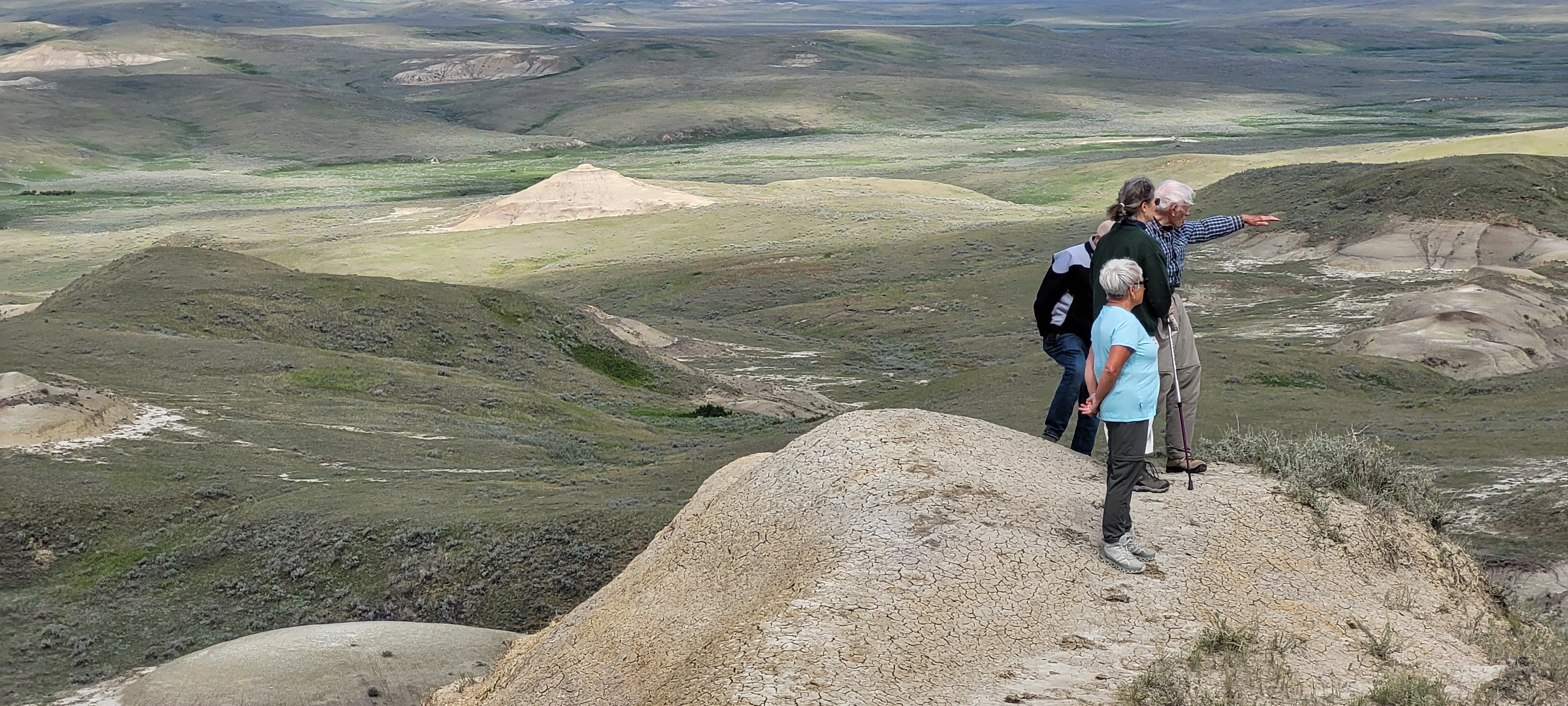
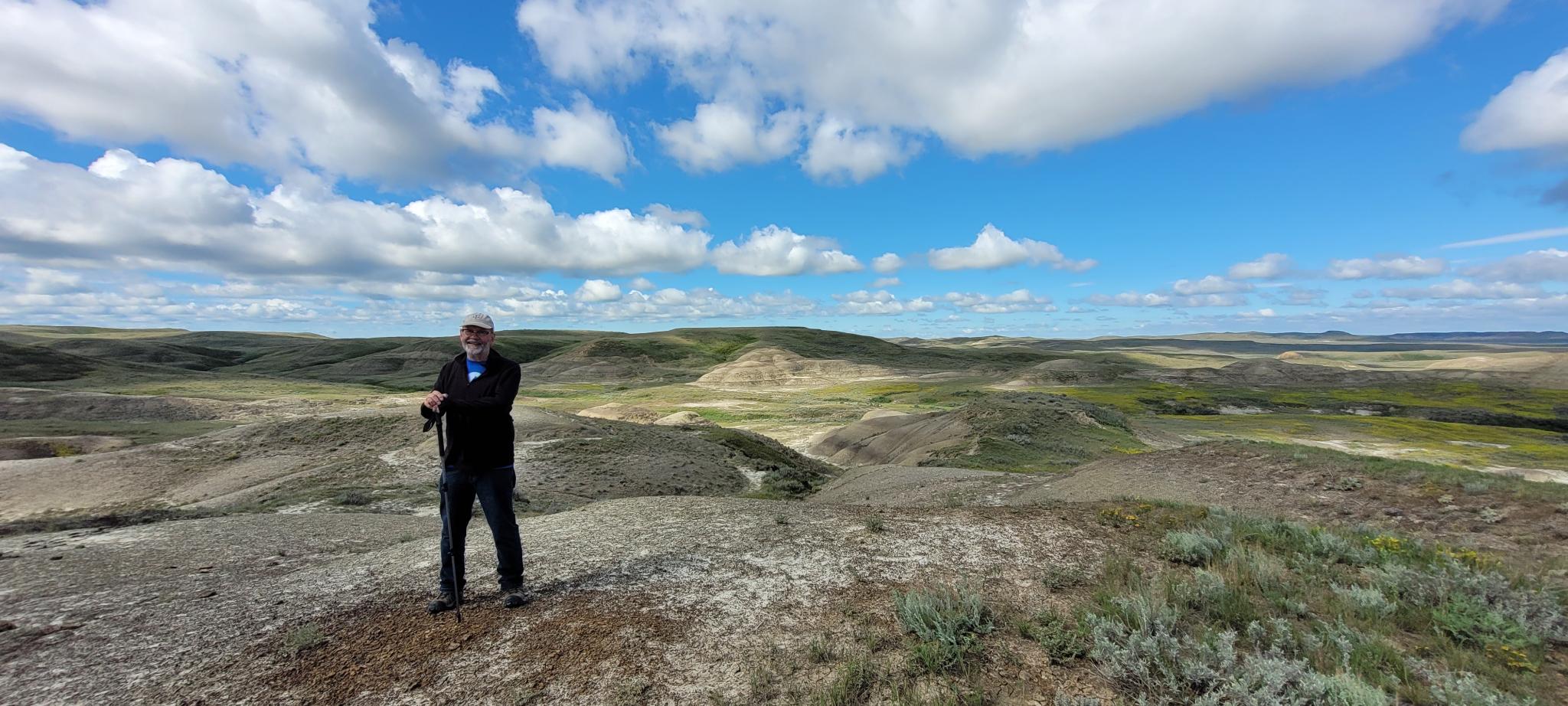
Among the highlights of my trip was visiting the Badlands in the “East Block” at Grasslands National Park. If you ever have the chance, be sure to visit this incredible place.

One of the most significant tests of my recovery was putting on my hiking boots (this time, with elastic laces) and re-walking a portion of the trail from Wood Mountain to the Lakota First Nation. Ten years ago, we did the three miles easily in the morning. This time, I cut out when the trail got muddy and hard to walk, and rejoined later. I managed to walk about a mile and a half in total.

Another highlight was meeting Dr. Claire Thomson, who led us around the historic site at Wood Mountain and gave both an academic and a personal history of the area. Dr Thomson is a descendant of one of the early North-West Mounted Police officers, and of his Lakota wife. Her PhD research on the Lakota history of Wood Mountain won the prize for best doctoral thesis in Canadian Studies recently…I quoted her in The Good Walk and was delighted to meet her in person.

Authoring

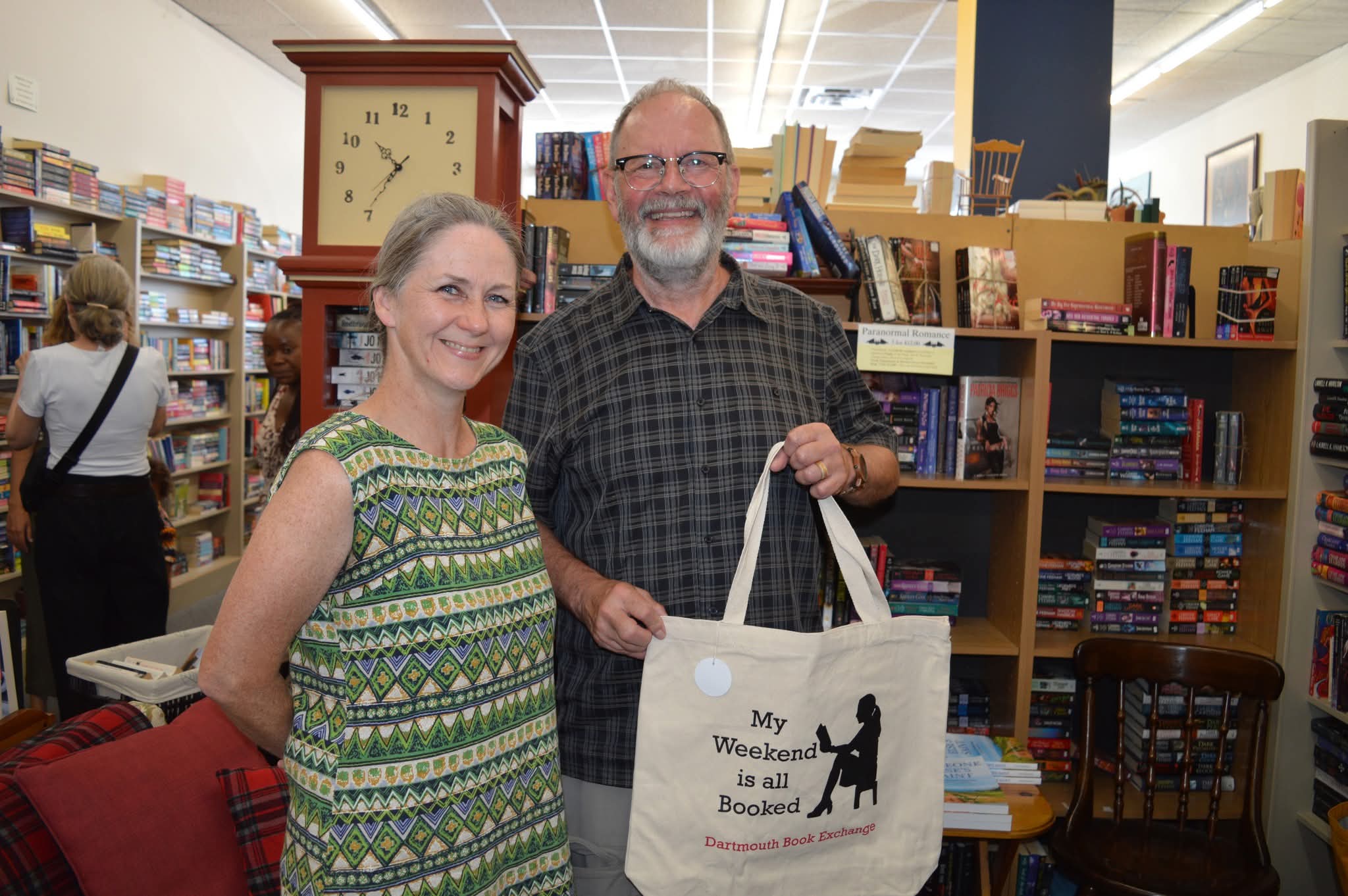
At the Regina Chapters-Indigo store I spent an afternoon meeting old friends and new, and signing books. It was great that my western trip gave me that chance. Also this month I had a chance to sign books and present Someone Else’s Saint: How a Scottish Pilgrimage Led to Nova Scotia (Pottersfield, 2025) at the wonderfully-full and fascinating Dartmouth Book Exchange. It’s an incredible place, well-worth a visit!

My life as an author looks like it will keep me busy into the fall as well. In September the Atlantic School of Theology is hosting me for a series of six online lectures on Leonard Cohen and Saint Paul, following up on my book Prophets of Love (MQUP, 2023). You can find more info on those lectures by clicking the “Almost Like the Blues” link HERE.

This week my interview with CBC Radio One Cape Breton’s Wendy Bergfeldt came out on the afternoon show “Main Street.” God bless the public broadcaster! I was excited for my first Nova Scotia CBC interview…and our talk went so well it was broadcast over three separate afternoons! It was wonderful meeting Wendy – it turns out we have LOTS in common: growing up from Scandinavian settler grandparents in SK, attending the U of S in Saskatoon during the same years, living in the UK for a while, and then settling in Nova Scotia. Oh, and did I mention? A shared interest in decolonization, history, and pilgrimage! I’ll post the links to the interview soon. (In case you missed it, my earlier CBC Montreal interview with Sonali Karnick can be heard here).

Next Month: One Year

Soon it will be a full year since my stroke. I’ll be marking the occasion, for sure. Will I be celebrating? I’m not sure what to say.

My stroke cost me a lot that I haven’t yet regained: my sense of secure balance, my ability to walk long distances, to run, to dance smoothly, and to play songs smoothly on the guitar. And crucially, I can’t type with both hands like I used to, which is how I’ve written my essays, lectures, and books.

BUT: the stroke helped me realize what a community of support is around me, how good so many people are, what an incredible partner I have, and how precious life and health is. I’m thankful every day for just being able to walk and speak (and pee and shower!), teach, read, think, and do what passes for a “normal” life for me. Much less all that’s listed above.

In the end, it’s all gift. Because of my stroke last fall, I realise that now more than ever.

So, see you next month! I wonder what surprises await?

Sara found a more elegant solution for dripping juice than the complicated ladder-thingy I typically used.