Categories
Uncategorized

Those Surprising Vikings

At the Anderson family reunion I attended years ago, when the heavy-set, ruddy blonde prairie farmers I’m from passed me a 24 of beer and told me I have Viking blood coursing through my veins, I don’t think they realised how confusing that could be. Now, having fought my way through several books and a couple of BBC documentaries on the subject, I’m less sure than ever.


What’s a descendent of those who were the scourge of Europe through the not-so-dark Dark Ages to do? We’re having a full-blown identity crisis. The wonderful, recently released History channel series “Vikings” takes some of the usual turns (rough and ready adventurers with lots of facial hair – at least, the men. Blood and gore. Plenty of sex). And yet, despite some caricatures, the greater truth the series portrays is this: it turns out that being a Viking meant above all being, believe it or not, complex.


If only we’d thought about it, we’d have suspected the former “pillage and plunder” paradigm too simple to be true. How could a small band of tattooed berserkers really be responsible not only for the sack of monasteries and cities all over northern Europe (and as far as Byzantium), but also for positive changes: the design of beautiful and advanced sea- and river-craft, the exploration of waters as far as North America, a fashion craze in costume jewelry – then, not now – the minting of coinage, and a process of urbanization that led to the establishment of quite a number of NEW cities? And why should small farmers who only wanted gold and slaves have become quite so good at setting out grid-lines and building churches? It may be a surprise to the neo-pagan “revivalists” to find out – should they ever care to – that the various hyphenated Scandinavians of the British Isles and Normandy were in part responsible for the 11th century re-flowering of Christianity.


My Norse relatives will hear more about this as I travel through Ireland and Norway on pilgrimage this summer. But the first to be surprised is me: I thought I had my ancestors pegged. It turns out they were more than just a hardy lot. They were often violent warriors of fortune, yes. But just as often, many of them were travelers and settlers, artists and urban planners, the pious and the pilgrims of their days. Learning as they traveled. That latter part doesn’t just sound like a heritage. That sounds like a plan.

Image

Categories
Uncategorized

Lost in the Movement

IMG_0601

Java Jive Kathryn 2013 (click to listen)

How do you describe the colour blue to someone who’s colourblind? You can’t, of course; or at least not very easily. But once you’ve actually seen the colour blue with your own eyes, well then….
Then (and only then) the “cobalt blue” of the sea, the “blue-green” of her eyes, the “navy blue” of the flag snapping in the breeze, the pale-washed blue of arctic ice, all make sense.

That’s the way harmony singing is for me. When I was young I was harmony-blind. I listened to Neil Young and Queen and April Wine and America on the radio growing up. I enjoyed the music, and even had a fairly easy sense of rhythm. But the notes? To me they were just one big wall of sound. Then on a bus when I was fifteen, a very patient musician taught me a simple, one-line harmony to “You are My Sunshine”, and despite my adolescent laziness forced me to repeat and repeat that harmony until I could sing it on my own against the melody.

And all of a sudden I started to see. I mean hear. It was like opening up that wall and realising for the first time in your life that there are studs and beams and gyproc and insulation and wiring and a whole world you’ve never suspected, behind the smooth paint.

Probably because I came fairly late to hearing and singing harmony, I’ve never been more than an amateur at it. But even so, what a gift it’s been. And what a simple and yet profound pleasure it is to DO it, to sing in harmony with someone else. For me, singing harmony is something like dancing. Really, it IS dancing: a kind of vocal dancing where sometimes you come in close for a swing or two, then you move further away, then you mimic each other until someone laughs, or maybe – in a choir or group – you together build such a complex, shifting pattern of sound that it’s a thing of aching beauty, all the more so for its ephemeral temporary existence.

So here’s my thanks to those who taught me to sing in harmony, and to hear it in others. To that first mentor, thank-you with all my voice. To Gerry Langner and the choirs he led, thank-you. To Mark Christensen and his lovely deep bass, Alan Solheim’s baritone, to the singers of the ’76 tour, to Wanda for the duets and the Clarence Ave girls for their quartets, to the Unconventionals and to Marginal Notes for years of madrigals and magic, and to all the rest since…. to my daughter for seeming to perfect the art of harmony, and to Kathryn for singing with me recently and reminding me of all this, thank-you.

You opened my ears to a tapestry of such complexity and beauty I cannot imagine having never heard it before. And you encouraged my earth-heavy voice in its own faltering attempts to lift off. I’m a late-flyer, but I’m still in the air, and celebrating the weaving and dancing of these harmonies as they flit around each other for the sheer pleasure of being lost in the movement.

Categories
Uncategorized

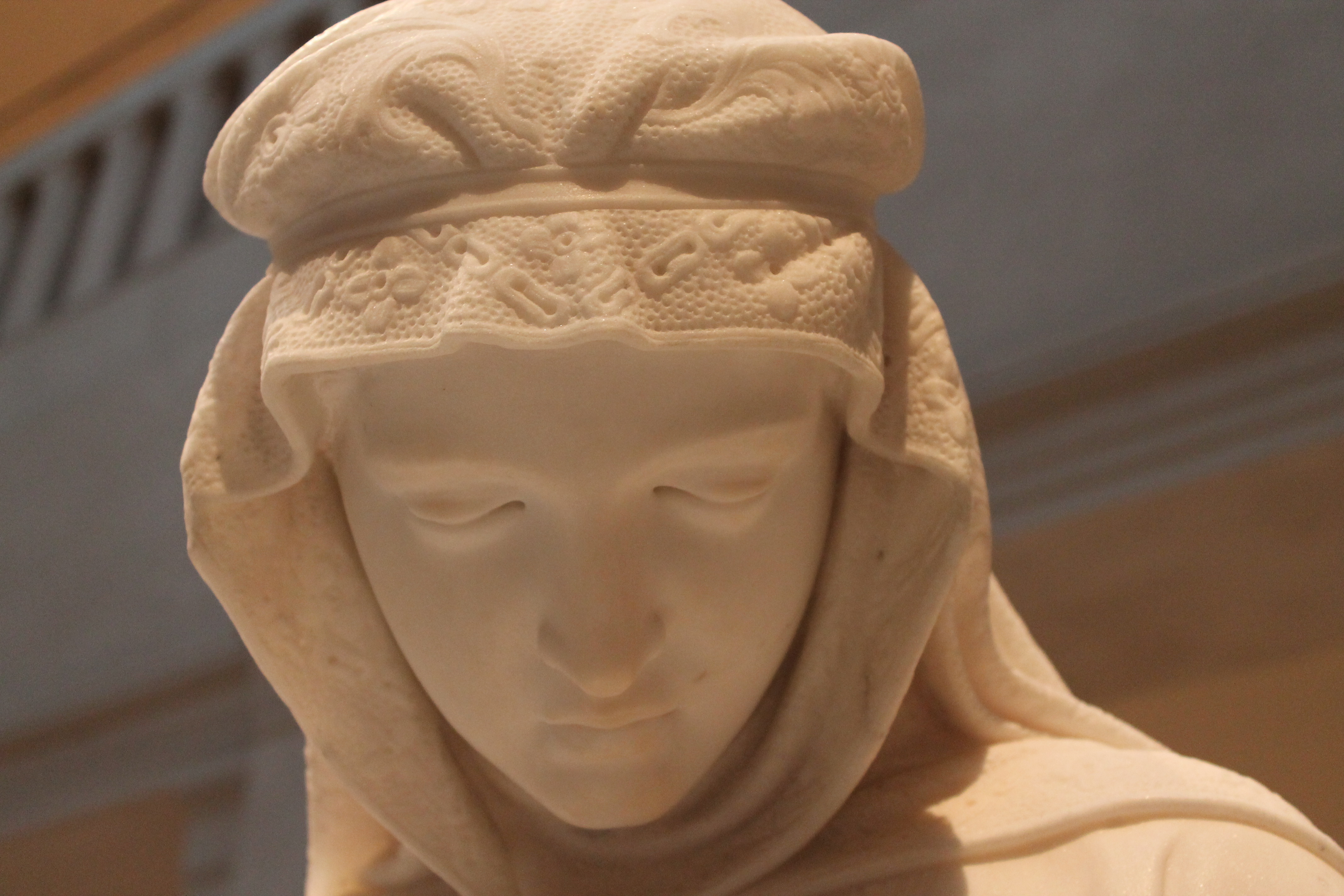
What’s in a Veil?

Jepthah's daughter Chicago Inst of Art
(a spoken word performed Feb 10, 2013 Waterloo ON)

When you were born,
you came out of the womb (well, let’s be honest)
you came out a prune,
All wrinkly, squinty-eyed and pointy-headed.

Your parents held you
in trembling, coltish new-parent arms and
they said:
How beautiful
when what they really meant was:
how terrifying.
Then they glanced sideways at each other, with that innocent , easy,
never-to-be-repeated conspiracy of those
who have just, together, somehow stumbled into creating life,
and they knew
they just KNEW, that they would have to:
bundle you up,
and put you in the car,
and actually take you home,
And that was frightening.
But there was something even more frightening to do first.
The hospital came with the forms to fill out.
The nurse stood, hands on hips, and said: you can’t leave until you’ve done this.
And your parents then turned to each other and said:
have we decided, finally?

How shall we veil him?

It was a big responsibility, when they veiled you, their new baby,
their pride, their joy.
After all, it was all about YOU.
You were the one who had to live with this decision your whole life.
Was it a veil the other kids would tease you for?
Was it a veil that stood out, or a veil that blended in?
And back then, who was to know?
Imagine back, as if you were looking at one of those old Polaroid shots.
You know the ones. Of camping in the tent trailer.
The photos where someone’s wearing those denim shorts that were too tight, and that tee-shirt, and with that hair-do, can you believe it?
And those veils….so psychedelic. So sixties.
Imagine that.
And imagine, then,
what they must have been thinking, when they gave you your veil.
They must have asked themselves:
Is it a veil that , if they chose just right, might get you ahead, might get you noticed?
Was it a veil to push you past all those others fighting for jobs, for recognition, for security?
For love?
You see? You see how important it was?
Veiling shouldn’t just be left to chance.
But almost always, it is.

Or was the veil they chose for you a veil that’s too historical, too old-fashioned?
A sepia-tinted fabric that looked better on your grandparents, maybe, in the old country?
Maybe it was a veil for different times, another world, a different tongue,
a foreign soil and syllable and sun.
A rough, peasant fabric that worked then, not now.
Was yours a veil like that?

Oh, it must have been hard for them.
Because on the other hand, if parents aren’t careful, the veil can be too trendy.
A good idea at the time. But now?
Passé, like tomorrow’s stale croissants.
The kind of veil one sees on the front cover
of some glossy magazine at the supermarket,
and without thinking, gasps: oh, that’s a good one!
But! Hah. But:
ten years from today? It’ll look like the kerchief worn by some forgotten movie star,
the Jessicas and Justins and Jonnys and Brittainys and Ashleys,
Fabric abandoned to the bin of “cute, but didn’t last.”
Too flimsy, too changeable, too vapid and faddish.
Nothing dire.
Just, not enough there to protect, or inspire.
Or to add uniqueness
to the warp and weave that is life.

You’d think choosing how to veil a child a decision too big for most parents,
Which is maybe why we don’t think. Don’t decide. Aren’t conscious about it.
And then we live with the consequences.

Some people don’t, of course.
Live with the consequences, I mean.
The young woman I saw the other day who held out her arms to me for a book?
She’d forgotten.
But I saw.
Old scars, thankfully,
there, on her forearms.
She made those scars, I imagine, cutting off that first veil,
the veil her parents chose for her,
the veil drawn tighter and tighter around her by school,
and family, and relatives, and parties and trying to be someone else, and….
And maybe most of all, by herself,
A veil she couldn’t, what’s the word?
Suffer.
Until, suffocating,
in her rush to lose that first veil, it was – it must have been –
like shedding skin.

Oh, but men don’t wear veils, says the fellow sitting at the corner table,
in sunglasses, when there’s no sun,
Inside.
“Men don’t wear veils because we don’t have to,” he says – from behind his shades.
But I can barely hear him.
His voice is muffled, his veil so thick.
It’s the masculine veil, made of old superhero costumes, and football jerseys,
and beer ads carefully cut out, and hockey tape, and boasting, and NOT saying anything. It’s a patchwork made of hot cocoa and the camouflage pajamas he wore in grade two,
a veil of toughness. Even though he might secretly like to try vulnerable, he can’t.
Any tell-tale feminine colours acarefully covered over, or scribbled out.

“I don’t wear a veil either” pipes in the young woman at the other table,
“that’s those other people. You know, the religious ones.”
But I can barely see her, either,
through the shimmer of the lip gloss she had to have, like all her friends,
in grade six, the curtain of some celebrity’s perfume,
Her veil is colourful, made up of names and brands, tops by GAP,
cigarettes she smoked to fit in,
creams, conditioners, colours, her veil threaded through, incredibly, with her own skin.
Spelling the word sexy. Even though she mostly just looks afraid.
No.
No veil there.

That first veil? The one that comes home with us from the hospital?
It seems so natural we hardly know it’s there. Some folks never realise.
But it is.
Indulge me. Take a second, now,
and feel it. Maybe you’ve forgotten even that you’re wearing it.
But I’m here today to remind you.
It’s okay: reach up, and put your hands on your cheek.
Can you feel it?
Take a moment. It’s safe. Try it. Remember.
Place some of the gauzy material between your thumb and forefinger.
And give it a gentle rub.
What threads do you feel there? Are they smooth? Rough? A mixture?
All those half-hidden threads showing which aunt had a drinking problem,
which overly-religious uncle scared us half-to-death with stories of hell,
which father wasn’t there, or maybe was too-much there. The mother who bandaged you up when you fell.
Or didn’t.
The babysitters and books and recesses and graduations.
All those platitudes are there too, sewn in:
when the going gets tough, the tough get going. Always wear a smile.
Make a success of yourself. We’re proud of you.
All those threads, and more:
The bed-times with your siblings,
the preachers, the teachers, your first love, the first death, the first job, the time you didn’t think you’d make it through,
but you did.
Your last kiss.
What you were taught and what you just learned, period.
All those people who contributed one thread, even just one,
Or another.
I hope you can feel that cloth, and what’s in it.

That’s the thing about veils.
Although the basic fabric’s usually what we’ve been given,
they rarely stay the same.
We improvise,
or better: we are the cloth upon which improvisation happens.
Our experiences change us, catching textures like burrs on a cross-country walk,
We find ourselves shimmering just a moment with the colours
of someone we just met,
and maybe, knowing them long enough,
we take on some of that hue
permanently.

Did you know that even Emperor Augustus veiled himself
when offering sacrifice to the gods?
Moses covered up his glory.
Veils imply a limit, a protection,
a recognition that what’s within is not the same as what’s without.
A boundary, of sorts.
A story.

And even to my friend who once confided to me
“clothes are an improvement on the body”
I would answer this:
until truly, we are transformed from one degree of glory to another, I know:
Our veils will rise from sleep with us,
And go down to our dreams covering our heads.
But, at least, let us make them as nearly US, the outside reflecting the in, as we possibly can.
So that, when what is hidden is revealed,
and the dainty lace and cowboy flannel and urban black and country brown all removed,
unveiled and naked,
we stand before each other, and our God.
It will not so much be a surprise as a place to hear what is unbelievably, happily, graciously, true:
You are still a prune.
“And before you were named,
before you were veiled,
I knew you thus, all along.”

Categories
Uncategorized

Life is Beautiful

IMG_3263

Life and Death Pilgrims

One of the dilemmas – or opportunities, depending on how you look at it – of sitting in a lounge in a large hotel is overhearing the conversations of other guests. As much as I was trying to focus on my own work, the conversation of a family several tables over kept intruding on my mental space. Both father and grown son were doctors – the father retired, the son in the middle of his practice. While I struggled to think about pilgrimage and the concept of liminality, they got onto the topic of “end of life practice” in hospitals.
“My tendency is to be up front,” said the son. “That’s the best. My colleagues act all coy, but when I walk into a room I want patients and their families to know when the quality of life is just no longer there.”
“Better to be honest,” the mother agreed. “You’re not helping the family if you hide them from the truth.”
“We all gotta go sometime.”
There was silence a second.
“Except that we’re not always right,” the father spoke into the pause. “That’s one thing I’ve learned.”
“Really?” answered the son (I wasn’t sure if he meant: really, we’re not always right? Or: dad, really, you’ve learned that?)
That was when I realised they were talking about the same thing I was thinking about: liminality.
Pilgrimage, among other things, is a chance to practice at life and death. It’s “heightened” time, time intentionally taken away from the stultifying but often necessary routines that make our days such a blur of appointments and distractions. In that heightened (some would say “liminal” or “threshold”) time, we have the chance to re-order our priorities, forgive ourselves or others, and – perhaps – set some new directions in the face of our own mortality.
Embarking on a modern-day pilgrimage is an intentional act of flirting with edges – the edge of one’s quotidian experience, the edge of comfort and sometimes the edge of one’s physical capabilities. And, in one sense, the edge of life. After all, as much as we hide it from ourselves, we all know, down deep, that, as the young doctor said “we gotta go sometime.”
Funny then, that the very next thing the son did was to pull out his smart phone: “look at this,” he told his parents, “I took it just before I left.” And what I heard over the oohs and ahs of the grandparents was the sounds of a young child – a two or three year old – playing.
“Isn’t that beautiful?” they said.
Indeed, life is. Pilgrimage is a way of reminding ourselves where we’re headed. And that we’re not there yet. Both. Life IS beautiful. Which is why we should make the most of it.

Categories
Uncategorized

Memory Files

Pre-K in Swift Current

Memory Files

Early in the New Year, for almost 25 years running, I’ve created what I call “memory files” for my family. Setting them up long ago became one of those January traditions, along with packing up Christmas decorations, transferring appointments to the new agenda, and throwing out the December eggnog that seemed like such a good idea to buy at the time. Memory files are hardly a new idea. Maybe you do the same thing. They’re nothing special – just those plain, cream-coloured manila file folders we all use. But with these particular folders, I sit down every January and carefully print someone’s name and the year. Then, throughout the twelve months, if there’s a concert my daughter performs in, a card from a special aunt or uncle, some doodling, a to-do list that really says what’s happening in our lives (pay violin lessons, call re: job offer) or maybe even a little hand-written note – “gone to the store; I’ll be back in twenty minutes”, I might keep it and, at some point, toss it in the file.
I keep one for myself, too. Looking back, it’s interesting how the width of the folders changes, depending on the year. Which means, I guess, depending on where I and my kids are in our lives. From the halcyon years when the kids were young, the file folders are like horns of plenty: spilling with colourful bits and pieces. In those years, scrapbook pages and school drawings and construction paper in bright oranges and blues and reds and greens bulge out of the files, all fighting for attention.
These days, not so much. The files are neater, more organized, and much, much slimmer. There might be a strip photograph of teenagers taken in one of those photo booths at the mall, or a ticket stub from a “One Direction” concert, or a ribbon from a sports event, and not much else. Actually, these days my file is looking thicker than my kids, which doesn’t mean that less is happening in their lives, only that I’m less a part of it. With my grown sons I’ve gone through, already, that awkward stage of not quite knowing why I’m even keeping a file, and then, finally, realising that our daily lives just don’t overlap enough for me to “file” much.
The word “keep-sake” is interesting for what it doesn’t say. Keep for the sake of what? Or whom? For a couple of decades I have been keeping, I suspect, for my own sake more than anyone else’s. At some point soon, I will have to divest myself of at least some of these memories, and it will be up to my children to claim which memories they want to treasure, and which are ready to be let go.
Only a few years ago I found a little box in the storage unit where my father keeps his things. In it were dumped all kinds of detritrus having to do with my young life: the ribbon that I won at a Science Fair in grade six, a photo of a clean-cut little blond boy with a bow-tie that I struggle to see myself in, and more school graduation bulletins than a person can ever reasonably expect a parent to suffer through. But suffer they did, and they kept the papers to prove it.
It was such a pleasure to open that box and sift through its treasures. Some of the memories were painful, but many brought a smile to my eyes. And some of the items brought tears. Our memories of our families are so short. For all the stuff that we accumulate, precious little of it has meaning beyond a generation or two.
But, at least for now, I will keep collecting. It may be that, years from now, some little item that I scrounged from recycling will be picked up by hands younger than mine, turned over once or twice, and with a “well, will you look at this?”, will be shared. And then the circle will be complete, and the memories not just filed, but fulfilled.

Categories
Uncategorized

Snow Angels (a poem)

The Gates of Heaven Jan 1 2012

Snow Angels

High banks, cast up by wind and plow,
heavy as crowd barriers against my thighs.
I lift one leg, then another, an exaggeration of walking,
cheeks red-raw into a westerly, boots somewhere below.
I cannot see my feet.

All I wanted was a photo.

I manage, with clumsy fingers, to put one mitt more or less back on,
then another.
The stone angels are motionless, arms frozen.
As I would be too, were I – just a little lower than them – to linger here,
in the company of January.

Categories
Uncategorized

The Most Beautiful Thing

South SK River Nov 2012

This is a radio drama I wrote some years ago, that was produced and broadcast by CBC Radio One in the 1990s. It was one of the winners of a “radio drama” script competition….back in the days when there was much more radio drama! My thanks to the actors and the director who made the script come alive. I’m glad to find a home for this piece here on Something Grand. The radio play is 14 minutes long, and you listen by clicking on the title below. I hope you enjoy it!

The Most Beautiful Thing Radio Drama

Categories
Uncategorized

Yard Art Love – a sort of Advent Story (Maisonneuve Magazine 2005)

Christmas in Verdun

There I was, butt-up, head-down, outside at midnight in my dressing gown. Smack-dab in the middle of lining up my plastic snails, someone at Hydro threw the city’s breaker. The darkness was just so – you know – total, with no big fat moon sitting like a pumpkin just over the neighbor’s clothes-line, that I lost the snails for a moment. It kind of makes you think you could be anywhere. Or anyone. It’s like when we were St-Henri girls pulling down the shade pretending to be camping dans les bois even though we could still hear the humming of the fridge downstairs and the adults talking, voices rising and falling with the rye and coke, the shuffling of cards, the arguments, the calling through the screen door for fresh packs of du Mauriers.
It wasn’t easy making it all the way back to the porch in that kind of blackness. Every footstep’s a decision. I closed my eyes – for concentration – and figured my place in relation to the big cement angel fountain in the centre of the yard. Saint-Gabriel help me see my hand in front of my face, I said, and then I just went. Stepped right around the flock of pink flamingoes, each with their one foot up, waiting. Inched my feet around the frog, knowing the little rascal was there, even without the sound of water shooting out of his mouth. Pictured the glass fairy globes on their poles so clearly I could touch them, passing. Waited till I could hear the lazy clack-clack-clack of the windvane duck, so I wouldn’t bump it off its tethered flight.
I heard geese that night. I swear I did. It was a remarkable Passover. Their calling out in the high darkness to each other made me look up. Oh my God yes. If it’s true what they say, that in this world there are ghosts wanting bodies, then they could have had mine. Perhaps they did.
The night drifted, with the streetlights out. I don’t know, I really don’t – what happened, exactly. Stars trespassed the city, came up my street, crossed my eyes. I fell right over the yard butts (a family of four in descending girth, thick white legs like sausages from their slacks), still looking up. Don’t know how long I sat there. Like eating candy at the drive-in. A good long while, I guess.
What we long for, we live in fear of finding, open and waiting, wanting nothing more than to fall into our laps like fruit off the trees, forever luscious. I’m not saying it was the stars, exactly. But two things happened that night: my troll disappeared, the one sent to me by my mother’s cousin’s sister (somewhere in Norway, I’ve forgotten where). That nasty short fellow with his long nose never did fit with the leprechaun. Better he’s gone now.
And best: I sit on the porch, growing fatter and closer to term with my precious little baby each passing week. A real-estate agent came by today, a nice man in a fancy car, sweating in his spring suit as he hung over the fence trying not to look at either my big belly or the manger scene (I decided to leave it up at Christmas). He said “Ms. Elizabeth, I could sell your house for a lot of money.” I told him about the ultrasound the doctor ordered, about the bulb in the streetlight over my yard that keeps burning out now, the city crews that come back every few weeks to repair it. I showed him how my ankles have swollen with the edema. I asked him about my collection – what would happen to it if I sold? But he didn’t really answer. Eventually he left, my leprechaun making rude faces after him.

Categories
Uncategorized

Vulnerability

They say we’re our own worst critics. I suppose in one sense that’s true. But it’s also a strange and not very comfortable feeling to stand in the semi-darkness at the back of a crowd of people while they’re watching a documentary you’ve been putting your heart into for months, waiting for what they think.

Monday last, on November 19, I had the Concordia University premiere of “Something Grand”. Tons of people showed up; estimates were just shy of 200. We filled the place. Those of us who’d organized the evening – thanks Adan! – kept pinching ourselves as more and more came through the doors. To our amazement the floor chairs were soon full and we were putting viewers into the balconies. Many of the faces were familiar, but not all. Certainly I’d pulled in all the friends and family I could. But there were many, many more as well – students, professors, Camino walkers who’d heard about the film on the radio, others who knew of it through contacts or posters. Three of the pilgrims I’d interviewed in Spain came to Montreal for the premiere. M, from Georgian Bay ON, came with her husband. And the delightful (and fabulous) S and J put on their premiere outfits and diamonds and looked like they could have been walking down a Hollywood runway. They’d come all the way from Florida just to be there with us and acted every inch the “celebrities”.

Luke, the musician we’d hired to play spanish guitar, was excellent. The speeches were….well, they were speeches…but some managed to point quite well to what pilgrimage really is, and the importance of studying this exceptional social and spiritual revival. When the lights finally dimmed, there was a buzz of excitement in the room. Or maybe that was the butterflies in my stomach.

We spend so much of our lives learning to avoid being vulnerable. In elevators and on the street we keep our eyes to ourselves. If we allow ourselves to cry at funerals or films it’s discreetly; we hide our tears. The word “sensitive” isn’t a compliment. But then we try our hand at something “creative” or “artistic”. And surprise, surprise: we then discover that in order to make something good, or true or beautiful we HAVE to open ourselves up to others. We have to FEEL with them. And we have to make ourselves vulnerable too – and show our dreams, ambitions and flaws. Which is to say: we have to risk.

The premiere was a smashing success. Now I want more people to see the documentary. Its strength is clearly not its technical aspects (despite some miracles of editing by M, Z and P). It’s in the relationship I had with the people I interviewed. The author Jonathan Lear, in his book Radical Hope, says that we human beings are “born into the world longingly”. One of the things we long for is real, genuine contact. Both the documentary and the premiere offered a glimpse of that. And that is worth all the vulnerable risk in the world.

Categories
Uncategorized

Uncle Carl’s Requiem Aeternam

Today is All Souls’ Day. It’s a sort-of All Saints, which was actually yesterday, Nov 1. That still might mean little, but in essence says that today is a day for remembering loved ones, and (if one is so-minded) praying for their memory.
I’m not an Anglican. But Anglicans do All Saints so well that days like these make me just slightly envious. The hymn “For All the Saints” is perfect, and perfectly Anglican: all pomp and circumstance, with a feel both global and sentimental, pious and restful and stirring in a sad, masculine, military sort of way, all at the same time. One can just about hear the British Empire and God’s mirrored and more perfect realm echoed in the words”…the golden evening brightens in the west…. while yet there breaks a still more glorious day”.
It perhaps takes something as solid as the Anglican church to really mark the permanence we hope that our loved ones enjoy. There is a weight of history, for instance, to the high wooden vaulted ceilings and the Gothic walls of a place like Cambridge’s Kings College. Or even, more locally, the jewel that is St James the Apostle Anglican, Montreal, where I visited with my students on Hallowe’en (All Saints’ Eve). There are so many memories in such places, and such rare beauty.
But this year the person I most remembered was the one person who would have felt most out of place in such a (as he would have called it) “high falootin'” environment. My uncle Carl was a simple man, if anyone can truly be called that. He never had a great education, and left school to take over the farm at the age of 12. His grammar was terrible and his habits, frankly, not the best. But his heart was kind. And he managed to travel the world enough to inspire me, decades later, to follow his tracks. My childhood years are sprinkled with postcards he sent from places like Japan, Morocco, Gibraltar and Germany. The first time I ever rode a camel (in my case, in Palestine), I thought of Uncle Carl, grinning out from beneath a straw hat in a photo he had sent in the 1960s. All I was missing – thankfully – was the big cigar and loud tropical American shirt.
When we honour “our” dead, something mysterious happens. We are changed. Perhaps it’s an act of memory, perhaps of alchemy, but they come alive again, if ever so slightly, by our remembering. And more importantly perhaps, we recognize in what parts of ourselves, our habits, our dreams, even our physicality, they live on.
So here’s to whomever it is that you remember. Requiem Aeternam, Uncle Carl. “What? What’s that? I don’t understand that kind of stuff,” I can see him pushing his cap back, scratching his head, laughing that big laugh that means he doesn’t really understand, and frankly, doesn’t really care.
“That’s fine, Uncle Carl. God doesn’t need us to understand to bless us all the same. Requiem Aeternam.”