Categories
Uncategorized

Going Nowhere Fast

Blake's pilgrim sketch

By about 2 pm on the first day of walking through the Scottish Borders it was becoming clear I’d been wrong imagining the dots on my map to be quant Scots villages full of local eccentrics, well-crafted beer and heavy, happy northern food. The two areas of settlement I’d passed were small clusters of squat and shuttered houses, grey sandstone window frames, darkened slate roofs and doorways offering no welcome. They were perhaps bedroom communities for Edinburgh. Whatever they were, they were barely inhabited: there would be no conversation of any sort, quaint or otherwise. Likewise no cafe or store to pick up lunch.

Long-distance walking into unknown or lesser-known territory means reaching a series of decisions without full information. You expect to make some mistakes, and hope they’re neither major nor cumulative. You trust to luck and the kindness of others, if others happen by. Going a bit hungry your first day isn’t the worst that can happen – by far – although in that moment my stomach didn’t necessarily agree.

What was worrying was that it was already the middle of the afternoon, and my guidebook told me I had 15 or so kilometers still to walk before arriving at a closed tourist centre from which I might, if everything worked, be able to contact a ride to come pick me up for my hostel. All of which probably meant a very late meal indeed, should there be anything to be purchased at all by the time I got there. In the bottom of my pack I found the broken remains of a two-day old baguette given to me in London, and some packaged cheese I had forgotten to throw out. The cheese was long past sweating, but my hunger convinced me it might still be okay despite hours in the heat.

Dryburgh Abbey was further off the route than I had expected, a set of foundation stones and half-walls all that remains of an important medieval structure. The detour had already cost me a couple of kilometers and an hour or so and my feet, unhappy with asphalt, needed liberation from the boots. So I took them off, set my socks in the sun and stretched out my toes.

Where we choose to sit and eat can say a lot about us. There was a bench on the grass beside a very low stone wall with a plaque that read “transept side altar”. Barefoot before the altar, feeling the grass between my toes, squinting at where the monks would have filed out from their dormitory to perform the first office of the day, I felt more at home than I had in days. The river Tweed flowing slowly by, the sweat-sweet wetness of my tee-shirt drying on my back in the yellow sun, my stomach happy for, literally, crumbs: part of the joy of walking pilgrimage is the re-sizing of what is needed in life. Even home is re-defined, a sacred flagstone to sit my plastic bag on, in that moment, was enough.

Maybe it has always been so, but it seems to me that the starting point for modern Euro-North American pilgrimage is almost never a sacred destination. The starting point is somewhere and everywhere along the unfamiliar trail, in the awkward freedom of being able to go left or right and not knowing exactly which is best or how long to tarry, in the slowness of footfalls in a motorized world, and in the unfamiliar Google-free uncertainty of a path where the next way-sign might be knocked down or misleading and the next person encountered might forever remain a stranger or perhaps become a dear companion. The world shrinks and expands at the same time: we smell the greenness in whole fields of clover, feel each raindrop in a translucent summer shower, and curse the nail clippers we forgot to put in the Velcro pouch under the flap of our bags, or the single black seed pod that, rolling beneath the sock, turns to a blister on our foot. I ate in a hurry, packed up and walked quickly back over the bridge, striding back onto the path.

One of Blake’s drawings shows a pilgrim striding purposefully forward, walking stick in hand, much as I was walking toward my unknown future. At Blake’s destination awaits a monster, Death, whose maw is the final destination of no escape.

What if he is right?

I was not bereft; anyone who has a Visa card and money in their wallet, a mobile phone and a road nearby is never truly in danger. But I’m more and more convinced from my own experience and from talking to others that there is something in the practice of smallness and absence that is part of the appeal of modern walking pilgrimage. Something very powerful happens in practicing the stripping off of the layers of who we are and what we own. Maybe it simply gives us the chance to see what might be there, in us, at the nub.

In the last pages of Tomas Espedal’s ode to a vagrant life, “Tramp”, after all the poetry and late nights, the alcohol and the sex, the solitude, the philosophy and the history, he writes these words: “the path takes off to the right, through a wood, you cross an electric fence and suddenly find yourself in a clearing, you have to stop; I am brought to a halt by the sudden, soft light and the stillness.”

Maybe, I hope, that is what it might be, at the nub. That would be a nowhere to walk to, fast.

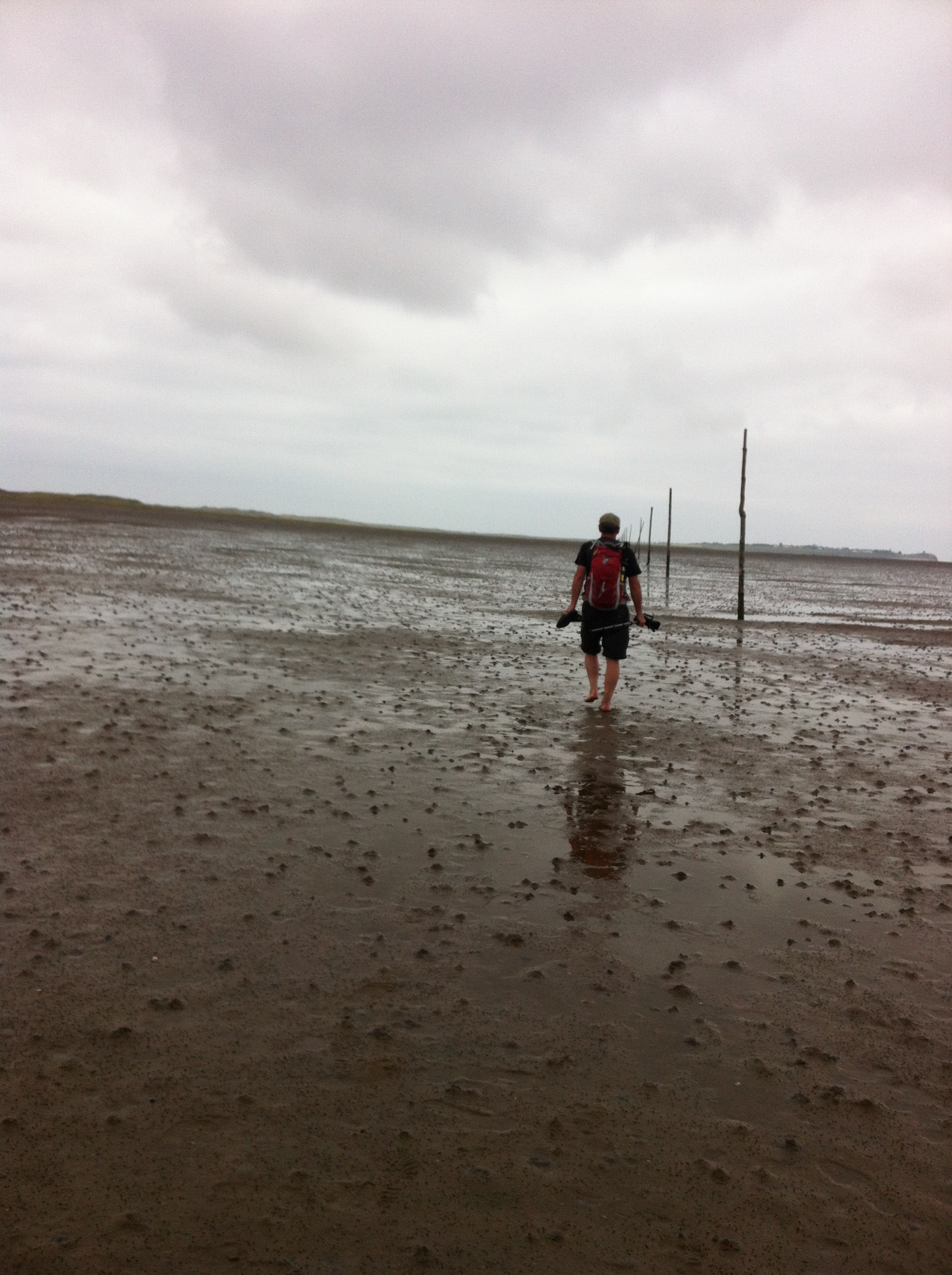
walking to Holy Island

Categories
Uncategorized

The birthing of a pilgrimage

Allen ponderingThis hostel is accredited, begins the promotional blurb for Meso Gård , and recommended by the National Pilgrim Centre. It has met the same requirements, and holds the same standard, as the pilgrim accommodation along Camino de Santiago. But a Spanish pilgrim who comes to Norway will find themselves, not in a bunk room in barren and dusty Castrojeriz, but in a typical sod-roofed, log-cabin style Norwegian hostel in the Rennesbund district along the St-Olaf’s Way, where a river rushes by, birds are singing, mountain flowers bloom around you and everything is green. Meso is a world away from a Spanish albergue. And the differences aren’t just in the lack of Rioja and dust (the first to better deal with the second).

Those who planned the St-Olav Weg have tried to make it familiar. The elements are as standardized as the boarding procedure at airports. There is a passport, obtained from an official pilgrim centre and sized appropriately for tucking into a backpack, local business stamps validating one’s walk along the trail, trail markers along paths and roads and paint slashes on rocks to guide the way, ‘pilgrim meals’ offered at some local restaurants, and several revitalized ancient routes (traceable on a smart-phone app) toward a cathedral city celebrating a medieval saint.

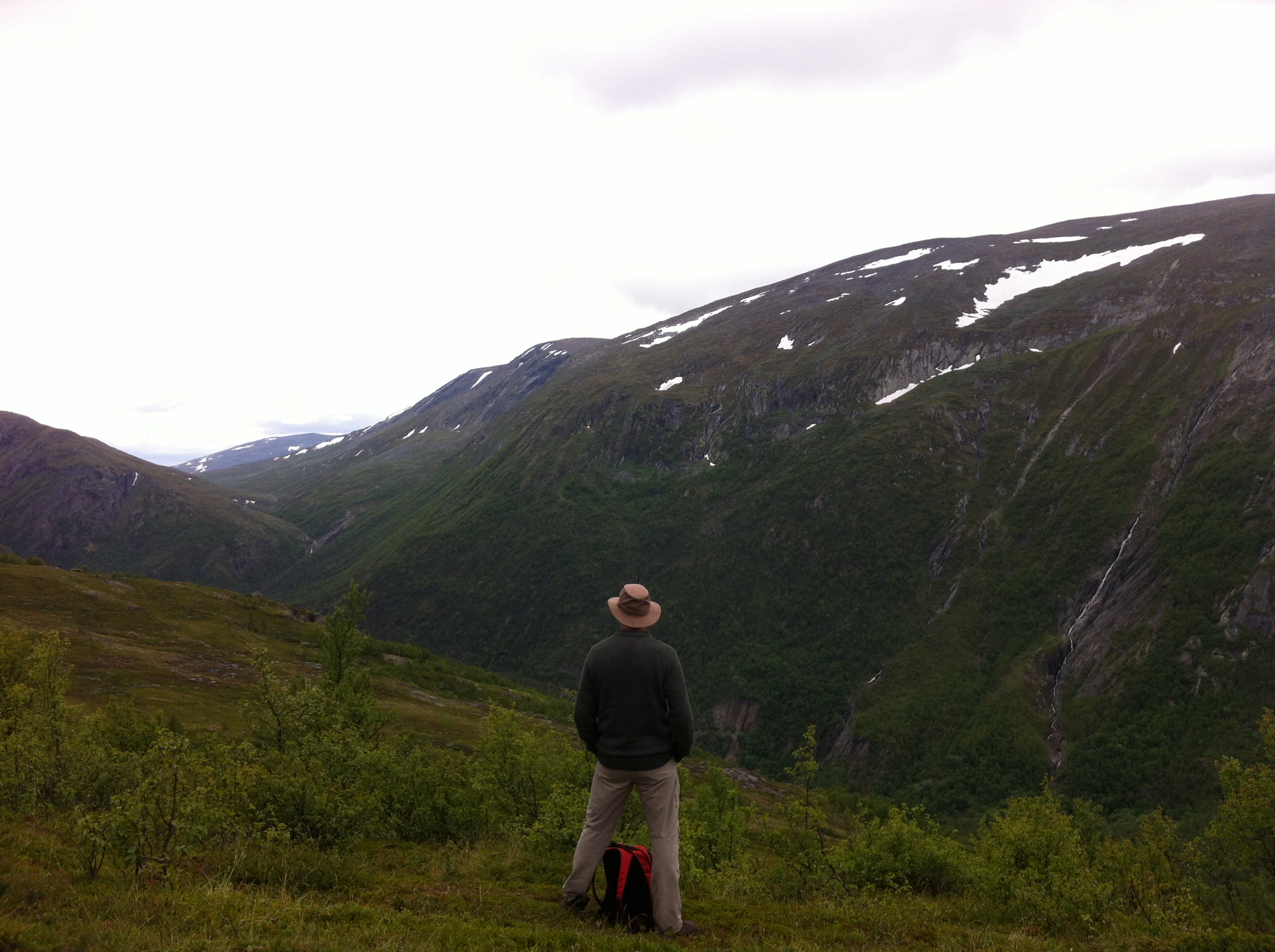
Yet the similarities between the two pilgrimage routes are overshadowed by differences as high as Norway’s mountains. The mountains, in fact, may be the most obvious initial difference, at least from the Camino Frances part of the Spanish trail. It’s been less than two weeks since I walked with five other Canadians from Dovre, in the Dovrefjell district of Norway, 250 or so kilometres to Trondheim. As far as I know, we were the first group of Canadians ever to walk this way as pilgrims. Unlike my experiences on the crowded Camino Frances, there were very few others we met. Those we did echoed our experience of a satisfying but extremely tough walk through conditions more like the high Rockies than the Meseta. In part because of an unusually late, cold and wet spring, we forded swollen mountain streams, jumped from hillock to hillock through kilometres of bog, and in sections of the trail found ourselves going days without seeing other human beings, much less a store to purchase supplies. We fell down, we froze, we saw incredible beauty, one of our group broke her ankle among the endless tree roots. It may be ancient, but it was not an urban walk. Café con leche? Forget it, unless you have a thermos, some farm experience and can catch one of the abundant sheep or goats.

Because it is still early in the redevelopment of the St-Olaf Way, one of the most fascinating parts of the walk, for me, was how we met those still trying to put their mark on how the trail will develop. I felt like we were there at the beginnings of something important. We met chapel builders who want to make sure there will be a spiritual component to the walk, officials who seek the ‘new spirituality’, walkers interested primarily in ecology and environment, and others who are developing their businesses in hopes of increasing numbers of high-tech backpackers showing up at their doorsteps.

All of which raises some interesting questions. What gives a particular pilgrimage its unique character? Is there such a thing as a more or less authentic pilgrimage? It seems to me that the inevitable conflict of values in this birthing of a European pilgrimage route is useful, because it helps bring about something that, however it borrows from the past, is new. As my friend Allen Jorgenson noted, the role of land, and of landscape, is more important than some of us have realized. Maybe we should be talking about pilgrimscapes, and how the outer journey influences the shape of the inner one.

Whatever the medieval St-Olaf route once was, there is now a struggle for its modern identity. It is definitely not the Camino. What it will be remains to be seen.
Alpine shelter