Heritage Saskatchewan sponsored film-maker Kristin Catherwood, who made this short film for the Canada 150 year. It features me and Hugh Henry, talking about the importance of the Swift Current – Battleford Trail, the 350 km trek we finished in August 2017. Thanks Kristin!
Tag: pilgrim
Here’s a new, five minute video on journey in Indigenous and Settler spaces! In it, I explore the ways in which Indigenous journey and Settler journey may lead to new ways of seeing the past and the future. It’s meant as an introduction for teaching, but it’s for everyone!
17 Days
This article appeared a week after we set out, but we never saw it until finishing the trail!

The Distance Between Me and You

Yesterday was the last day of the Battleford Trail walk. 350 kilometres in total, Hugh Henry tells us. Along the way we read journal excerpts from one of Colonel Otter’s troops as they marched north along the same path in 1885. The writer was a young, green recruit from central Canada who’d probably never seen either a First Nations person or the plains. He wrote: “We saw our first Indian today. He was within rifle distance.” Richard Kotowich, who is Métis, gave a short and powerful talk as he smudged us. “How do we measure the distance? Do we still measure it like that unnamed soldier? Close enough to harm? Close enough to be defensive? Or have we learned to say: ‘the Indian’ we meet is close enough to greet, to get to know, to invite to eat, to sit together and learn from and with?”
This pilgrimage, for me, has been about things old AND things new. The Trail is as old as the Plains Cree that went south to hunt bison, the burial grounds that go back millennia, the Bear Hills that now seem so empty. But the Trail is also as new as the ‘no trespassing’ signs and the farm dogs we met as we approached Battleford, a town which, as a local citizen told us, has “13 reservations around it.” He didn’t add that it was our own government that put them there, often against their will and miles away from their traditional lands, for the convenience of railway and Settler. This trek has been about remembering that Métis, First Nations and Settler all used this trail. It has been about smudging with farm families who in some cases perhaps have never participated before in such a ceremony, and making them welcome. It has been about including First Nations concerns in our conversations naturally, neither preaching nor apologizing, just quietly and consistently recognizing the facts of the Treaties, the expulsions, and the injustices. It has also been about listening to the older farm folks who talk about the coulees and valleys, the rivers and the land and the wildlife with such love and longing that you know the land has taught them, over years. So how DO we measure the distance between Settler and First Nation? We danced with the First Nations dancers in Fort Battleford, but it was just a beginning. For those of us who are non-Indigenous, even after a 350 km Battleford Trek, we have a ways still to travel.


It Matters to Me

This is what Sharon Pasula’s tee-shirt from the Truth & Reconciliation Commission says. It’s the reason we’re walking. Sharon drove from Edmonton to join us in Herschel. She led us in a smudge the day after Rick (who had led us regularly) returned home to Regina. It matters to me. It matters to us, that the trail we walk has been used for hunting, for freighting, and for settling. It matters to us that a trail that now sits on private land be remembered as of public interest. It matters to us that we remember the three groups that used the trail – First Nations, Métis, and Newcomers (including the military) – and recognize and remember the positive contributions and also the failures and mistakes made along this trail. Most of all, the land matters to us. It doesn’t belong to us. We belong to it. As with the Métis flag Sharon carries, it matters.
Carved into Hands and Rock

After 150 km or so, I’m surprised by my hands. They’ve been chipped and cut and scraped and burnt, pricked by mosquitoes and cactus and sharp straw and torn by caraganas and baked in the constant sun. They seem like different hands from the ones I started out with, at the beginning of the Battleford Trail. If a pilgrimage is a journey of transformation, I hope that what’s happening to my hands is also happening to my mind and heart. Today and yesterday we stayed at the Herschel Retreat House, where from the Ancient Echoes Archaeological Centre we walked out (on our first and only day off) to see petroglyphs that have been radio-carbon dated to the first century. The same years as Jesus walked, some ancestor of the Blackfoot carved these symbols into the dolomite rock.

and this was a potholder at the Herschel Retreat Centre (Herschel SK, population 31). We used the potholder for a day before actually realizing the design, which echoes the petroglyph:

Learning to Smell

Bit by bit, as you walk slowly across the land, senses you don’t use normally come to life. For me the most surprising is smell. You can smell canola fields from quite far away, if you’re downwind. The smell of fresh hay is a smell of my youth…it makes me happy. Sage is everywhere – that beautiful prairie perfume that fills your nostrils with such a welcome. I have some sprigs of it drying in my hat.

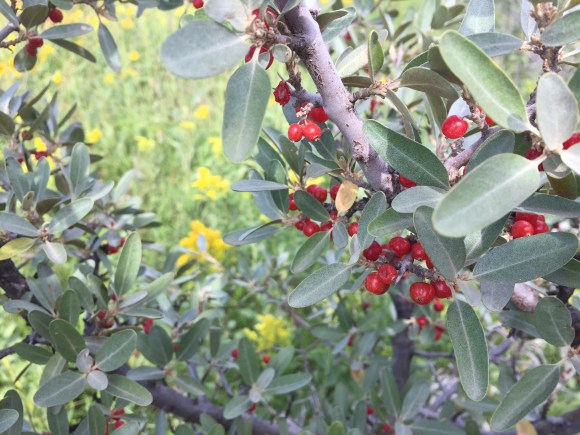
Buffalo berries (above) don’t smell that much, but the green patch they’re in did. The green, or dry, smell of prairie grasses, as you walk through in the early evening especially, is a treat. Even the smell of cow manure, or bull manure (two days ago they fetched a young bull out of our camping yard just hours before we got there apparently, is a dark spice – just don’t step in it! I’ve learned, in the smudges, to appreciate the good smell of moist, clean and unchemicaled tobacco…so different from the cigarette addictions I grew up witnessing. Caragana bushes smell like shade. Alkali water stinks as you walk by, tickling your nose with the falseness of water that you can’t drink. And here and there, the best: the smell of green things, of dark earth and poplar shadow under an unblinking sun.

Saskatchewan Melancholy

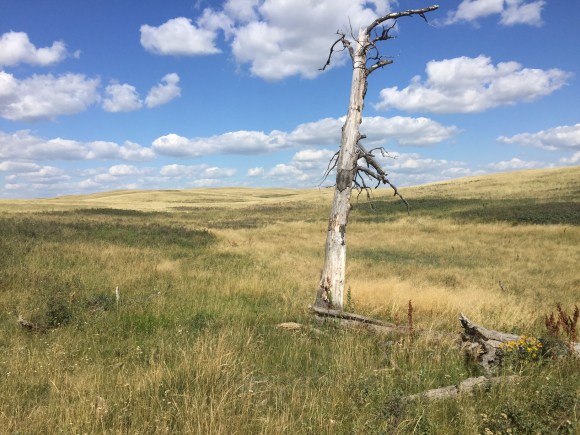
There’s a certain forlornness to Saskatchewan’s countryside, despite the vitality of so many of its cities, towns, and First Nations. When you’re walking 20-25 km through the countryside, you see a lot of abandoned farmsteads. The rural areas have emptied out. Today we passed a cemetery for a town that no longer exists, and the community centre that sheltered us two nights ago was once a local schoolhouse. Today it’s managed by enthusiastic locals – who fed us supper! Many of the smallest towns no longer exist, others are struggling to find purpose. Three nights ago, we camped in Sanctuary, where only an abandoned elevator remains of what was once a thriving community. As you walk, everywhere you look there are old buildings falling into the earth, rusted implements dark red against the grain.
To walk the Battleford Trail is to remember one very important fact: the economic forces that forced the First Nations north to Battleford (and off the land that would stop being feeding ground for bison and soon become a vast factory landscape for wheat, barley and other grains) is still going on. In the late 1800s, those market forces forced out the Indigenous peoples. In the mid to late 1900s, they forced out the small towns and villages of pioneers who settled the prairies.

So, what happens now? Can the children of those settlers, and the children of those First Nations, now live together, both subject to the market forces that have done so much to change the prairies?
(thanks to Ken Wilson for coming up with the phrase ‘Saskatchewan Melancholy’. The photo below shows one of dozens and dozens of abandoned farmyards we’ve passed or stayed at, sometimes only evident by depressions in the earth. Last night we stayed at an old farmyard and looked at the remains of a very solid house foundation, overlooking a slough, protected by a caragana hedge, no longer inhabited. Life changes, especially on the prairies)

Coming up in August!
In August we’re walking an incredibly important trail from Swift Current to Fort Battleford – a trail used by First Nations, Métis overland freighters, and Colonel Otter’s Canadian militia. Big Bear, after signing Treaty Four, came overland near here. We need to remember our important historical paths, and in the spirit of the TRC, to point out to non-Indigenous peoples how Canadian history has been shaped and formed by the removal of the First Peoples from the land. Are you interested in walking or helping sponsor a walker? You can!
Why Walk?

‘Pilgrimage’ is such a tired metaphor it’s hard to remember sometimes that it’s based on actually doing something. “Let’s go on a pilgrimage to my favourite restaurant”. “Life is a pilgrimage from birth to death.” Yes, sure. But…But what keeps me interested in not just studying journeys, but also walking them, is the way the brain unhooks at 5 km/hr. Without even trying to, you begin to notice geography, and your own body, and the relationship between the two (as you walk up a long prairie hill, for instance, or start to sweat in the sun). You pay attention in a different way to nature. Or better, nature presents itself to you, when you are available: coyotes sleeping in a burrow, badgers running ahead along the fallow-line, the meadowlark calling from a grey fence-post, a family of otters playing as they cross your path from the river, some old abandoned buildings, the soil at your feet. This is almost impossible at highway speeds. When you walk, you begin to think emotional and philosophical and spiritual thoughts – not because you plan to, but just because of the leisure and the rhythm, maybe even the slight boredom. For those fortunate enough to be able-bodied, the fact is that walking is one of those conscious activities closest to being unconscious, freeing the mind up for contemplation and surprise intuitions. Walking journey connects landscape, body, story and movement in a unique way. For those of us who try to allow space for the spiritual, walking pilgrimage is a gift. It’s meditation for anyone, like me, too undisciplined or lazy to meditate in other ways. Rebecca Solnit puts it this way: Pilgrimage is premised on the idea that the sacred is not entirely immaterial but that there is a geography of spiritual power…. it reconciles the spiritual and the material, for to go on pilgrimage is to make the body and its actions express the desires and beliefs of the soul (“Wanderlust” Penguin Books, 2000. Page 50).