How do you walk a pilgrimage during these months of restricted travel? I’ve been walking up and down my staircase in Nottingham England, and dreaming of pilgrimages past! To share those stories I’m releasing my first-ever podcast, “Pilgrimage Stories from Up and Down the Staircase.” Each episode features a different trail, or a different character I’ve met.  I’ll introduce you to enthralling paths in Norway, Scotland, England, Iceland, Canada and Indigenous territories, and provide some of the resources you’ll need to walk them. All the while I’ll be telling the stories of the fascinating individuals I’ve walked with and met along the way, and sharing snatches of our conversations, songs, and experiences.
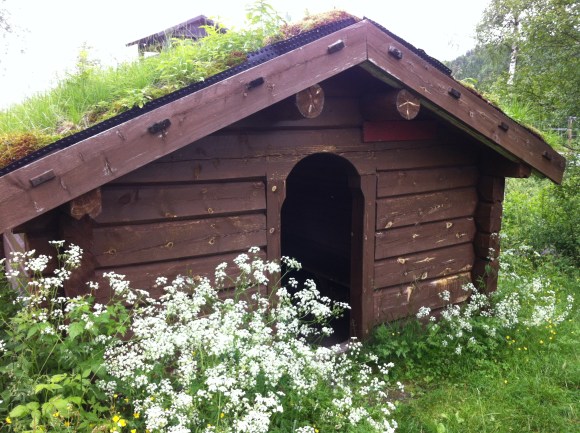
Thursday, July 30, 2020, at 5 pm Montreal time, I’m releasing the first episode: “Walking the St Olav Way.” In the 17-minute episode you’ll hear snatches of our struggle up and down mountains and jumping late-spring run-off streams and boggy marshes. You’ll meet a friendly Norwegian border agent and a marathon German pilgrim struggling to understand his life. You’ll sit with us in rustic Budsjord Gård and hear fellow pilgrim Kathryn singing as we walked. I hope you’ll listen in to this first episode, and to the others as they come out every Thursday! The series “Pilgrimage Stories from Up and Down the Staircase” will be available wherever you find your podcasts.
To find out more about St Olav before listening to the episode, why not check out some of these resources?
- The official St Olav website, which you can find here, is a wealth of beautiful images and practical info (look for the English-language option)
- In 2011, Alison Raju wrote The Pilgrim Guide to Trondheim, available at this website.
- For my article about the history of the Trail and its modern-day recovery as well as some photos of our 2013 trek, see the International Journal of Religious Tourism and Pilgrimage, here.
- For an article about the health benefits of walking the St Olav Way, written by a Norwegian scholar of pilgrimage in the same journal, see this link.
I’m looking forward to sharing my experiences with you on the “Pilgrimage Stories From Up and Down the Staircase” podcast!





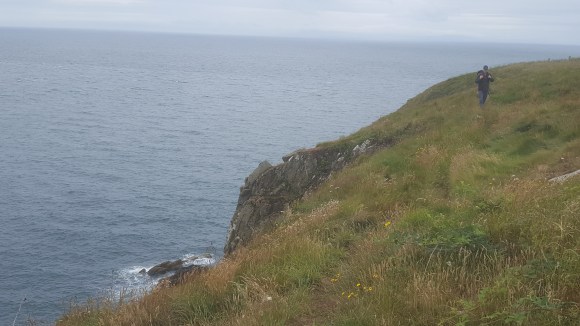
 Today was a vertiginous day. It’s the perfect word, although I had to look it up. Vertiginous has two meanings, both true today: extremely high and steep, and suffering from vertigo. I don’t know how the Scots do it. We had just passed through a short section – the worst – where the path was within two metres of the edge and a stumble could easily topple you down 200-feet onto the rocks. A couple ambled toward us with a dog tied to the woman’s waist. When we said hi, she cheerily told us “he has to be tied up. He’s a naughty dog and we had to call the coast guard to fetch him a couple weeks ago.” Hmm.


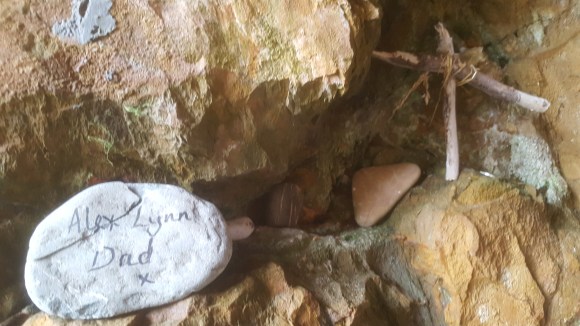
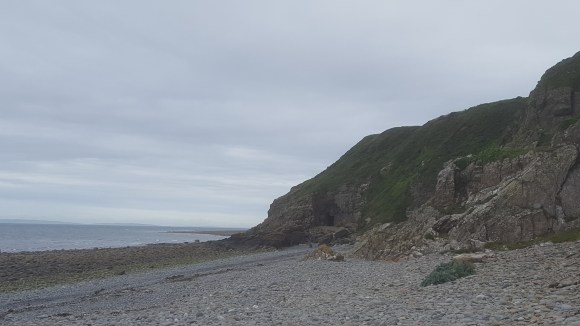


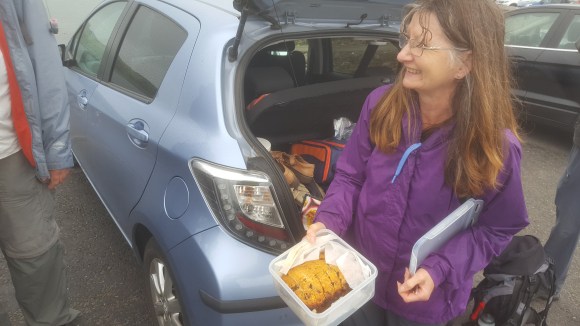


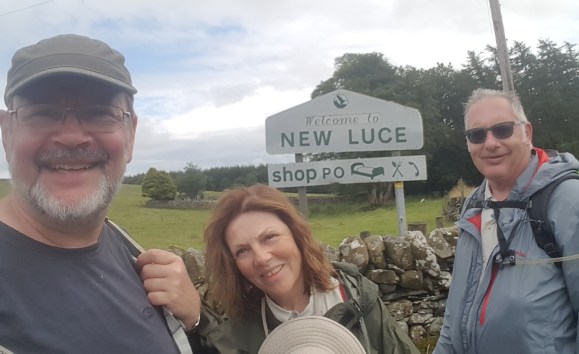
 Secondly, we arrived at our “hikers’ shed” only to find that the lovely & picturesque village of New Luce has no pub, no restaurant, and no store – although all are planned – and that the owners of our accommodation hadn’t been warned we were wanting supper. They very kindly found a can of soup. We were planning to make do with that and some crackers until local walker and walking activist Peter Ross showed up at our door, asking if we needed anything and offering a ride for groceries. Finally, owing to the fact that a local rented cottage won’t receive its guest for a couple days, we got a place to shower! New Luce has got to be the most lovely little village we’ve come across – it’s vying for the flower award for the UK this year.


 By the way, Peter told us that all the garbage we’d seen on the coast was NOT Scottish: “a lot of that’s drifted in from Dublin and Liverpool and Belfast with the prevailing currents,” he told us, “But we Scots have to clean it up.” On the walk today we came across a poignant reminder, in rural Scotland, of Canada’s international garbage. We could hardly believe what we were seeing!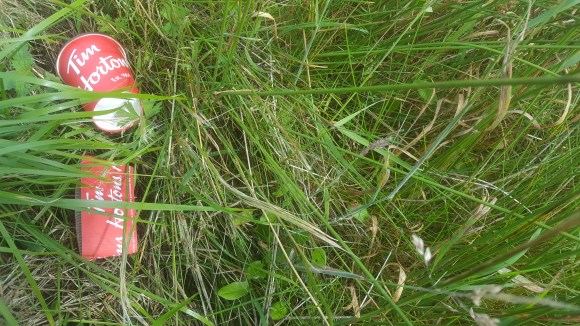



 I’d counted on getting my bearings from the Hayfield UK info stop. I had to think again! On April 24 1932, after decades of on-again, off-again confrontations, 400 members of the British Workers Sports Federation started trekking up from their campsites here toward “the forbidden mountain.” The mass trespass of Kinder Scout plateau’s private land became the tipping point in the fight for the right to walking access across private lands. This plaque commemorating the walkers is affixed to the wall of an old stone quarry at the head of the trail. No one is fighting for the right to walk across Saskatchewan. There are no walkers’ groups, no mass rambling movement and no one in Swift Current or Saskatoon is trying to escape the grimy factory life of Sheffield and Manchester in the early 20th century. But there ARE historic, important trails across the prairie. They also deserve public access. And Canada has an important issue that the 1930s British ramblers never faced – the question of Indigenous access.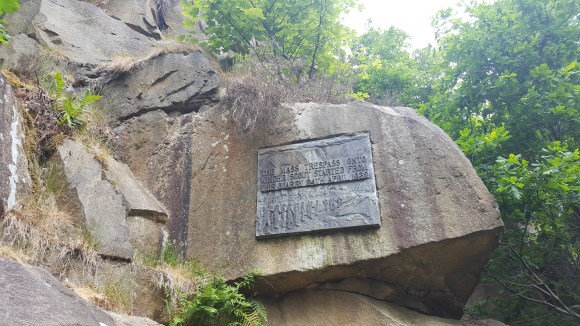
 somethinggrand