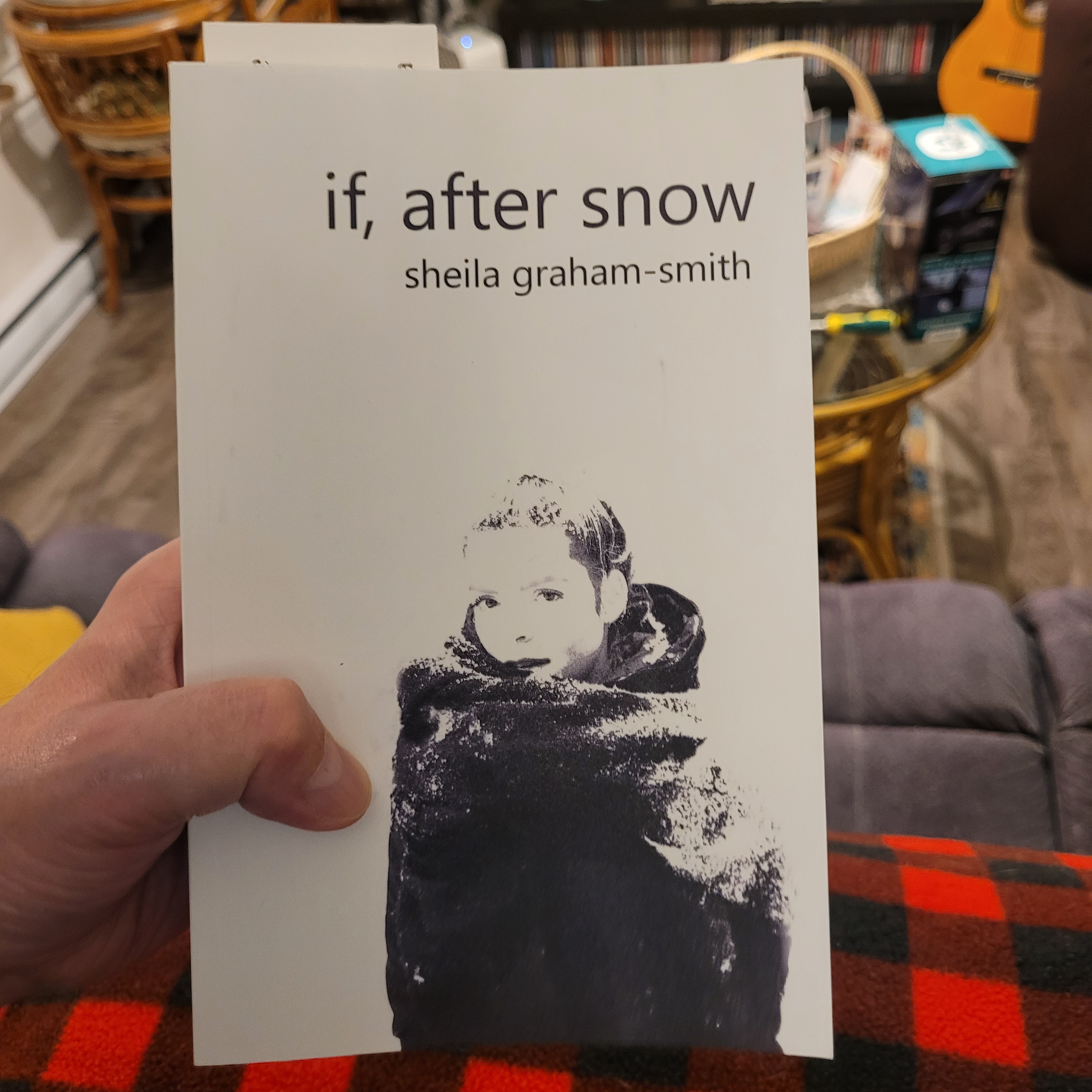
She had never heard of my book, nor I of hers (although apparently I was the first to recognize the Sappho reference in her title). We exchanged our books accompanied by firm promises to read and report back.
All Germans idealize the North American “West”and North American landscapes. Germany is a crowded country that has lost so much of its own “wildness” but still maintains a strong national mythology of origins around it. And yet …
All Germans love to read, and as a bonus, as truly civilized people are multilingual and can often read English books like mine, unlike most anglophones and folks like me, who struggle with anything more than simple tourist directions auf deutsch…
SO. After all these expectations, how did the review turn out?
Thanks to Google translate, you can read on for yourself….
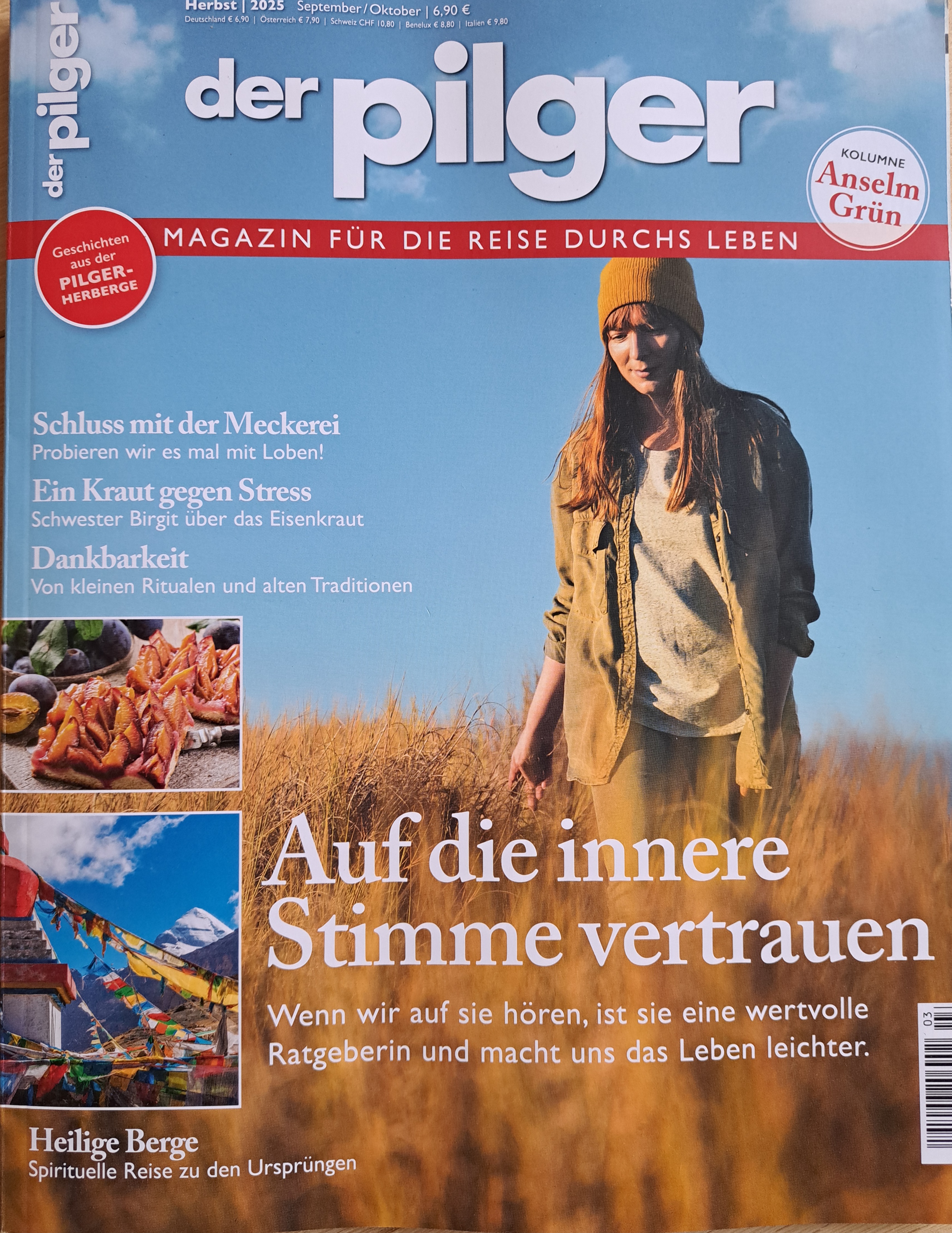
The Review
p. 43 New Pilgrim Perspectives:
“A devout Muslim embarks on the Way of St. James, and a Canadian professor and long-time pilgrim follows the trail of spiritual wandering in the vastness of the Midwest. Two inspiring book recommendations from Protestant pastor and passionate pilgrim Traugott Roser.“
“The Search for a Lost Home (Die Suche nach einem verlorenen Zuhause)“
“Matthew Anderson, Professor of New Testament at Concordia University in Montreal, is an experienced pilgrim who has also led his Canadian students through Spain, France, England, and Norway and has made a name for himself as a documentary filmmaker on pilgrimage. After many trips to Europe, he wonders whether pilgrimage is also possible in North America and what pilgrimage might mean there. In his new book, “The Good Walk – Creating New Paths on Traditional Prairie Trails,” he tells a compelling story of humanity’s age-old paths through the prairie of the Middle West. It is an account of a painful yet healing search for home: “Pilgrimage together with others—in the broadest sense understood as spiritually motivated hiking—is a way of searching for a lost home.” Anderson is a descendant of settlers who farmed…
(P. 45) and built small towns on the supposedly deserted plains of Saskatchewan (see photo above), and [the region once called] the Northwest Territories. Since 2015, Anderson and his wife Sara have been traveling the trails once used by traders, settler treks, and the Northwest Mounted Police, a paramilitary force commissioned by the Canadian government. But Anderson not only gets close to the story of his own family, descendants of white European immigrants, but also of the people who lived there before and were deprived of their land through sham treaties, displacement, and targeted extermination.
Pilgrimage: intercultural and interfaith
Anderson is accompanied on his journey by various companions, including Don Bolen, the Catholic Archbishop of the Diocese of Regina. Descendants of the First Nations, the Lakota, the Nakota, and the Nehyawak (Cree) accompany them or host them, as do descendants of settlers and the Métis, descendants of European-Indigenous marriages, who historically mediated between cultures as fur traders and are now considered an independent nation.
Anderson sees his hikes through the vast landscapes as pilgrimages to places whose history has been partly forgotten, partly erased. This also changes the landscape and its perception itself: through narratives and archaeological evidence, places of living memory emerge.
The places create new relationships and deepen old ones. In this way, the pilgrims come into contact with the spiritual world, [sometimes] with the elders and wise men of the Indigenous peoples, [sometimes] with their own family history, and [always] with nature. Through Christian and Indigenous rituals, the pilgrimage becomes an intercultural and religiously unifying experience. At the same time, it is a painful journey that ties in with the tradition of penitential pilgrimage: The extermination of the North American bison took place in the vastness of the prairie. This deprived the Indigenous people of their livelihood, and thousands starved to death while faced with the government’s deliberate inaction. It is equally painful when the pilgrims encounter survivors from the church-run boarding schools (of both Catholics and Protestants):
On behalf of state authorities, children were taken from their families and Nations and placed in Christian schools. Only in recent years did the public learn of the graves of thousands of nameless children who did not survive the ordeal.
Reward for Physical and Mental Effort
The paths across the prairie demand physical and mental effort from the pilgrims, but they also reward them: through community, forgiveness, and understanding. Matthew Anderson ultimately even succeeds in finding peace for his deceased parents and for his sister, who died very young. The pilgrim’s path is a good path, and with the project Anderson describes, a new, very unique pilgrimage tradition begins in Canada.
I couldn’t put either book down; it was precisely the different perspectives of both authors that inspired me to consider my own pilgrimage
I couldn’t put either book down; it was precisely the different perspectives of both authors that inspired me to consider my own pilgrimage on the Way of St. James in a new and more profound way: as a consciously religious experience, as a path to encounter God, and as a path to reconciliation.”
Dr. Roser’s Own Pilgrim Book
I wouldn’t be much of a friend, if at this point I didn’t mention that Traugott has published his own pilgrim book. It’s in German, titled Hola! bei Kilometer 410: Mit Allen Sinnen auf dem Jakobsweg (Hola! At kilometre 410 with all senses on the Camino de Santiago).
I wonder if a rather free, but still good, translation might be: “Hola! Fully aware and alive at kilometre 410 of the Camino de Santiago.” It’d be great to see this valuable book out for the English-language reader as well! (By the way, the other book he reviewed with mine in the above article sounds fascinating).
Traugott does all kinds of interesting teaching and research, including (like me) teaching Bible and Film classes. He is also an ethicist who teaches about ethics in healthcare and palliative care.
Thanks, Traugott, for the great review. Buen Camino! Looking forward to walking with you some day soon!
So, something fairly big for me happened recently. Following my stroke ten months ago, I would look out the hospital window from my wheelchair and see people–strolling on their lunch-breaks, walking their dogs, or jogging–up and down the small hill that leads from the hospital to the Bethany Gardens and farm owned by the sisters of St. Martha. At that time, I was a ‘two-person transfer’ and couldn’t walk a meter, let alone a kilometer. “See that hill?” I said to Sara. “I’m going to walk up it with you one day. That’s my goal.” There’s a small tower at the top. My dream was to touch that tower like Rocky finally able to take the steps from the iconic movie. It felt impossible, but I fervently envisioned getting to the top of that hill, giving thanks for my recovery–and being outside, right side up, and on my own two feet.
This week, it finally happened. Sara and I were running separate errands on a busy day and we both wound up in the vicinity of the hospital at the same time. We decided to meet for tea at the volunteer-run BreakAway Cafe that helps pay for new medical equipment. Last fall Sara had been there pretty well every single day to see me, and she still had a free coffee on her hospital coffee card. It had been a while since we’d both been at St. Martha’s together since my stay. After our drink and my medical appointment, Sara said, “is today the day?” and looked meaningfully at the hill. And we set off. It was surreal to make it all the way to the top.
It wasn’t entirely as envisioned. My gait wasn’t as smooth and confident as I’d imagined from my wheelchair in September. I was winded by the slope and had to stop to catch my breath. (That certainly wouldn’t have happened pre-stroke to this long-distance pilgrim!) And when we got to the top it turned out there was no way to actually touch the tower, which turns out to sit behind fences, cattle, and construction.
Even dreams that come true don’t usually do so in the ways we’ve imagined.
But – it felt wonderful to reach the top just the same! And I was thankful every step.
“Telltale Heart“
(apart from the title, what’s below doesn’t actually have much to do with the Edgar Allen Poe short story, which is frighteningly narrated here, if you’re interested)
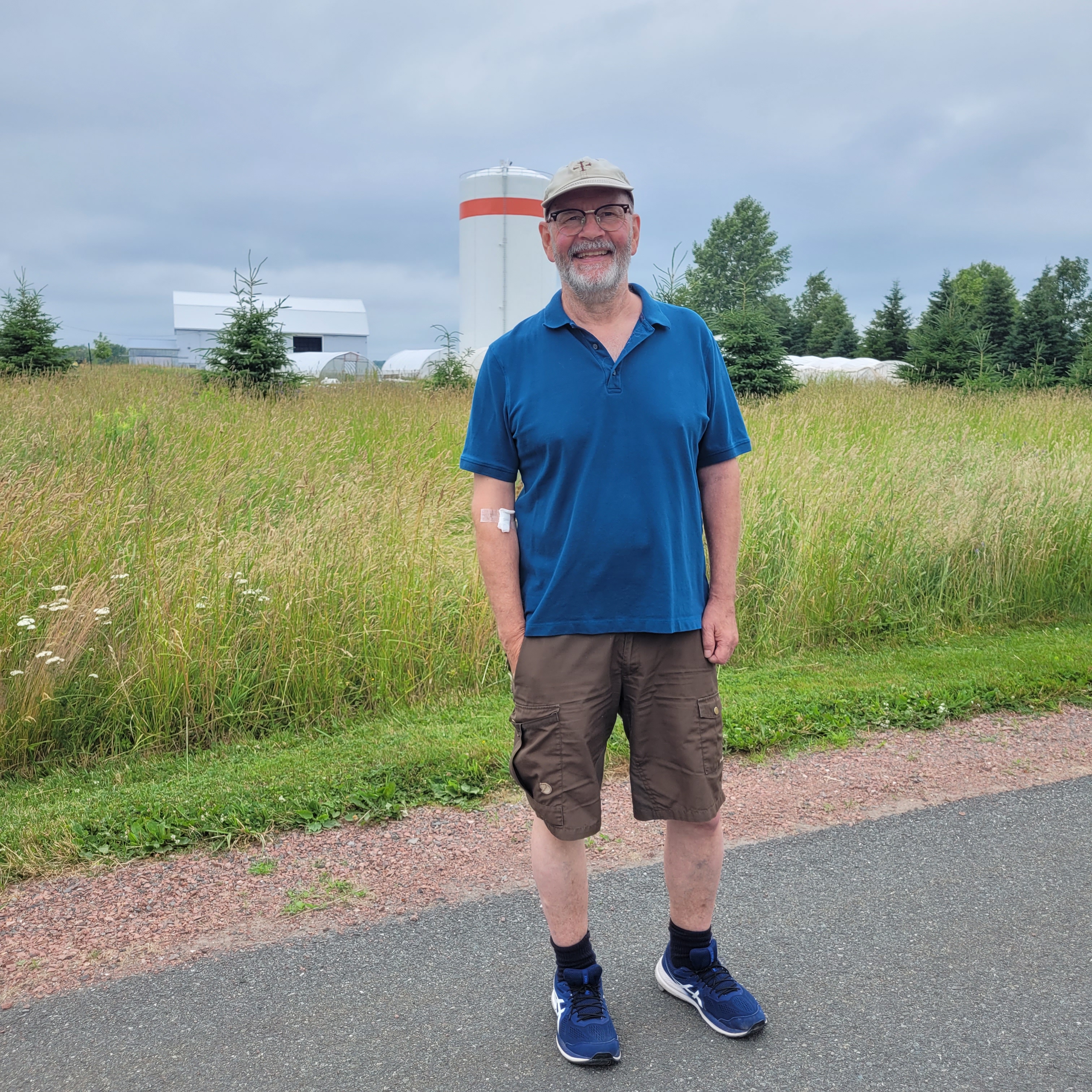
Today I was at the hospital for another important step in recovery. I’m still doing physio at St. Martha’s at least twice a week…odd to remember how when I was new to Antigonish I used to think I should go see the place because I’d never been inside. But this morning wasn’t physio. After three tries and two different technicians, they got an IV line into my arm for what’s called an “agitated saline contrast,” or echocardiogram bubble test, pumping “bubbles” into my vein, then watching them travel to the heart to see if my surgery in April had really closed the hole between my heart’s upper chambers.
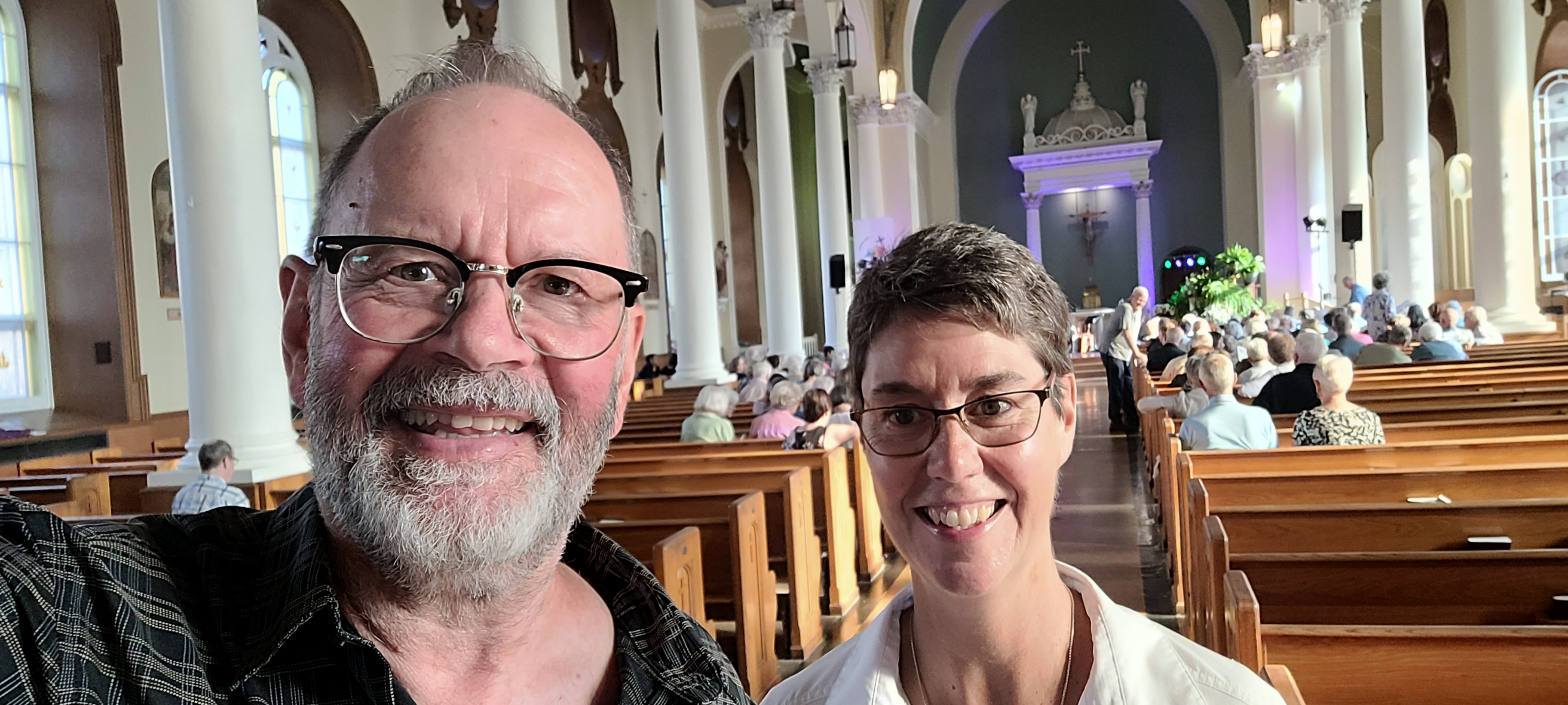
The great news: it had. No bubbles got through. This means that now no future clots can sneak through there, either. I said thank you to Dr Amy Hendricks, and told her she plays a mean piano and violin (I had been surprised to see her perform in a wonderful concert at St Ninian Cathedral). She laughed and said thank you, and that everyone needs to have a few hobbies on the side. That’s life in a small town. (Pictured are my friend and fellow pilgrim Sister RéAnne and I at the concert before it began).
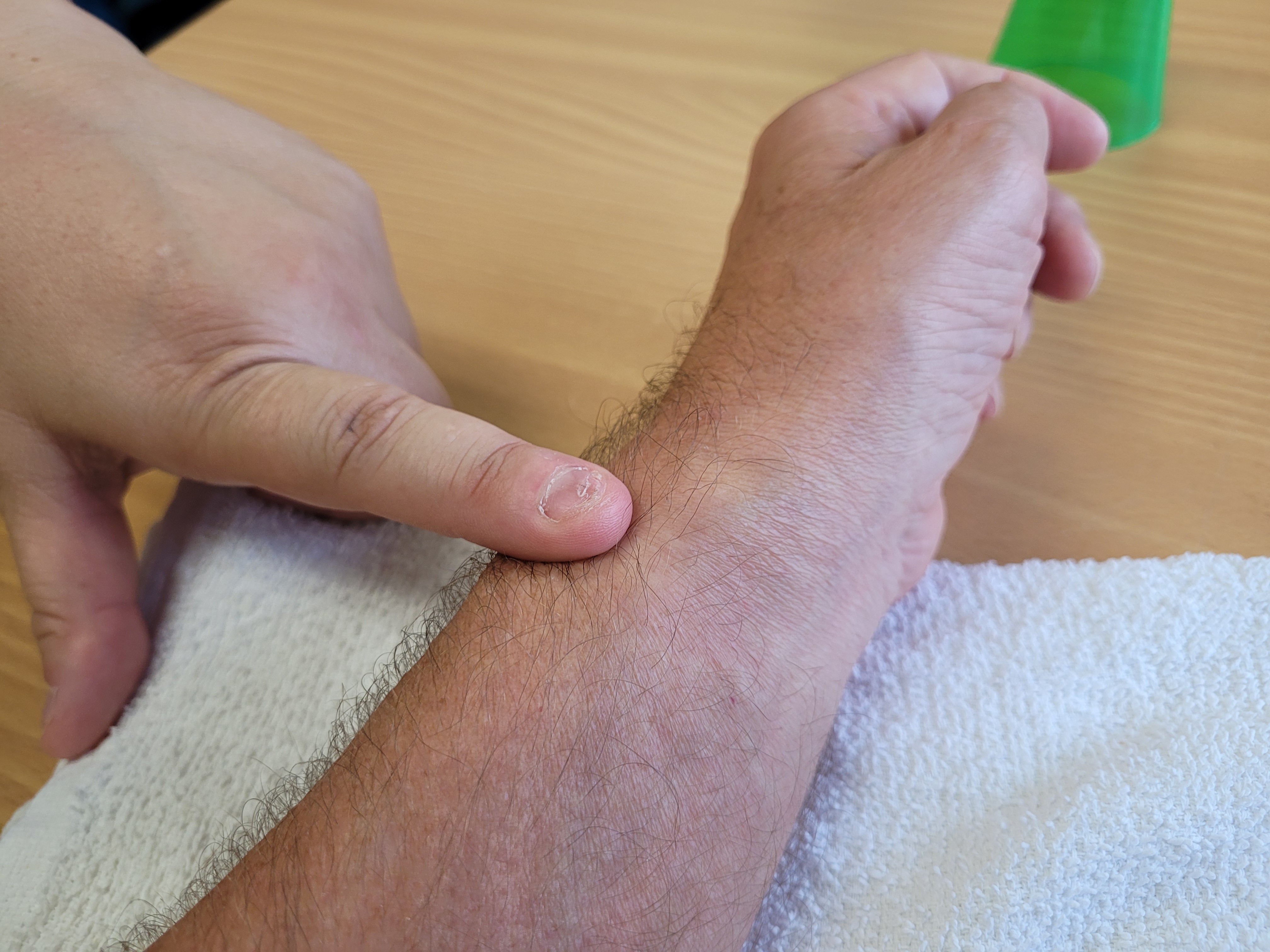
This week I also got my Botox shot for leg spasticity. Or rather six shots, into my left calf, as I lay on my stomach on a clinic bed in Halifax. There was no immediate change, except some mild flu-like symptoms I’m presently experiencing. Apparently it takes 4-6 weeks for the poison to reach full efficacy and (we hope) work its wonders. However, tonight I feel like my leg already swings a bit easier, which might be psychosomatic. In any case, convincing my plastic brain to accept that my leg can be trusted again is apparently part of the point. We’ll see!
I’m starting to be able to do some slow and basic typing with my left hand. Just barely. Soon the hand tires and my xpinxkixe finger (there it is, doing it again), starts drooping and hitting errant keys and I have to go back to one hand. But… it’s a start. The trick is holding my left hand in the air without the fingers curling in (spasticity) or the whole hand dropping, then adding to that the coordination of using fingers to distinguish between the “a” and the “d” keys when they are only beginning to remember their connection to my brain…
“The Gatto Came Back”
Okay, that heading holds a fairly obscure pun, but IYKYK. (If you don’t, click here for “Gatto”; and watch Canadian entertainer Fred Penner sing the song here !)
My two universities have both been incredibly supportive through these months of stroke and stroke recovery. Firstly, Concordia’s Dept of Theological Studies and its chair, Dr. André Gagné, worked to renew for one last time my status as an “affiliate assistant professor” there. I love still being associated this way with Montreal, even though the thought of a trip to the big city and taking public transit in my present condition gives me the heeby-jeebies.
Second, Saint Francis Xavier (StFX) and my colleagues here in the Religious Studies department have been nothing short of wonderful. In addition to taking over my teaching last fall, interim chair Dr Robert Kennedy dropped by with a stunning white orchid from the department after my heart surgery. You may recall that they also sent flowers and cards during my hospital stay, and Sara got gift certificates for take-out and ready-meals from our then Dean of Arts office and the department. Recently, the University also made “a big deal” of my winning a Sask Book Award with a special news release. New colleague Dr Gerjan Altenburg invited me fishing with him and his son. And this last week, Dr. Erin Morton, Associate Vice-President, Research, Graduate and Professional Studies, and head of the Gatto Chair Committee, confirmed that my application for a one-year extension of my chairship was approved. This means that the research travel and meetings for which I had funding will not be lost to my months in hospital. I’m incredibly grateful!
“Running Back to Saskatoons”
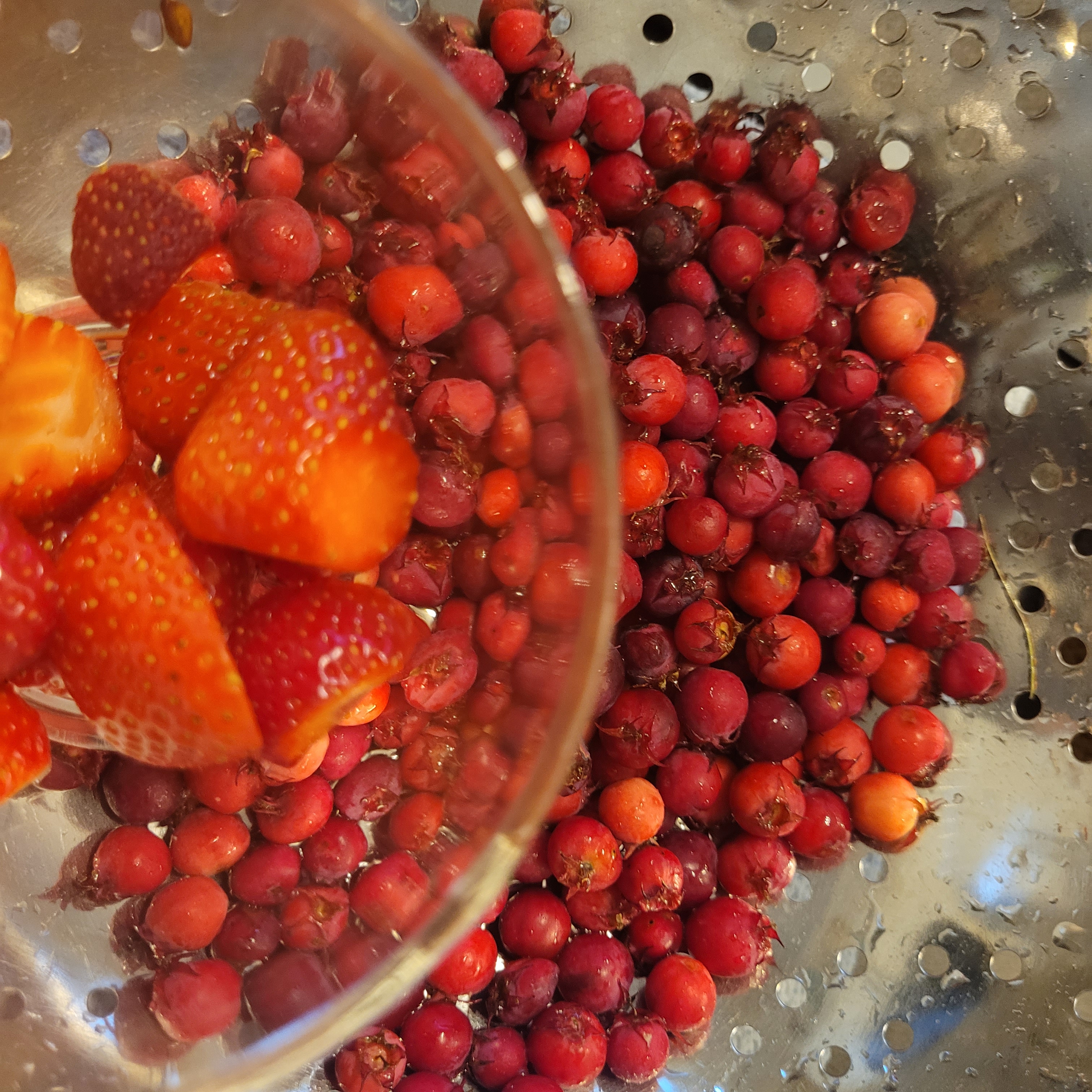
I’ve been hanging ’round hospitals” is one of the lines from the 1972 The Guess Who song “Running Back to Saskatoon,” which also mentions libraries, grease monkeys, and Moosomin SK. But it’s actually now that I’m home from the hospital that I’ve really been able to enjoy Saskatoon (or as they say here in Nova Scotia, “serviceberry”) season.
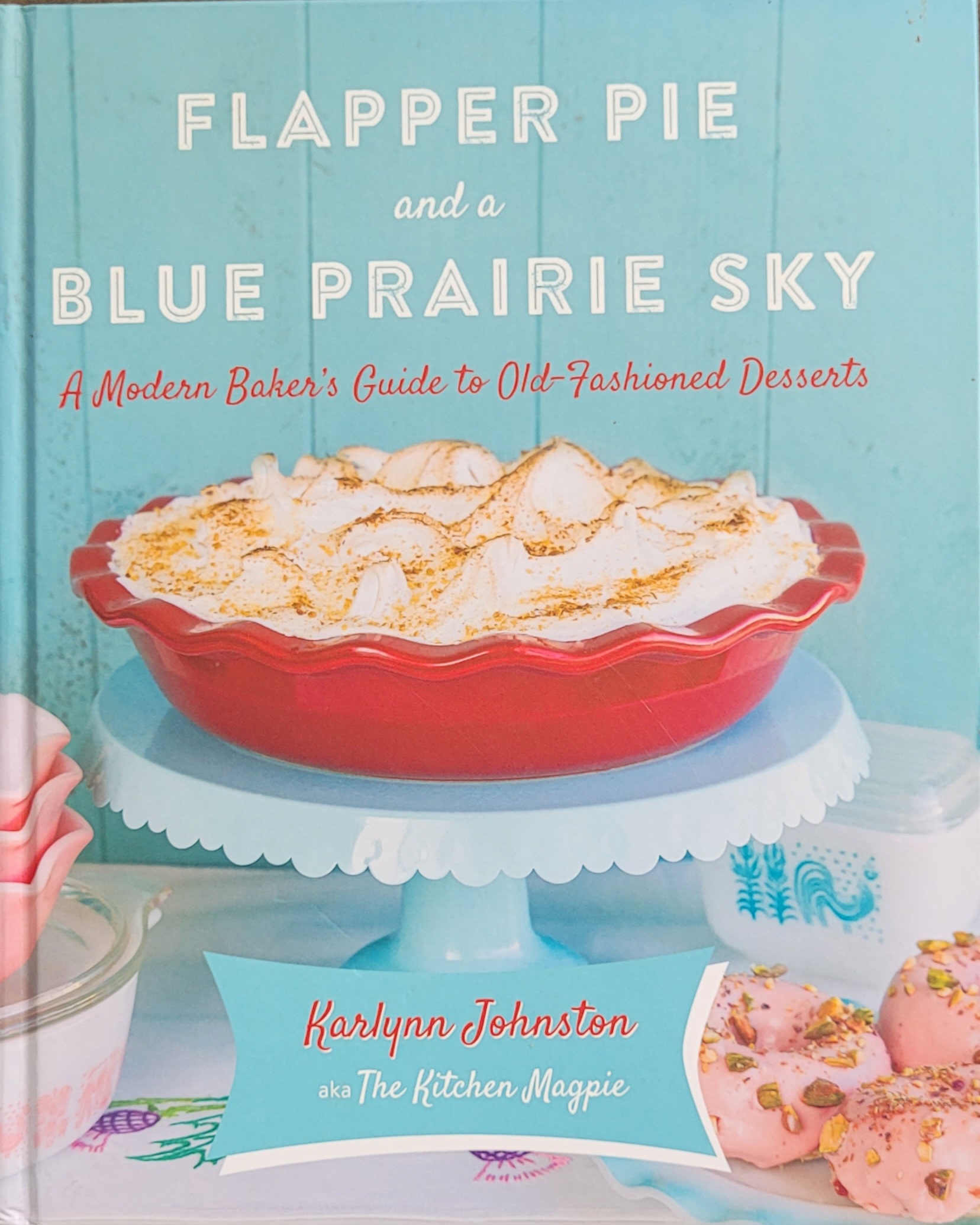
It’s a good year here on our three acres for Saskatoons, even if you’d laugh to watch how slow I am to pick them. My first attempt at a Saskatoon crumble was only okay (not enough berries). But today is Saskatoon pie day. I followed a recipe from the beautiful – and fun – cookbook Flapper Pie and a Blue Prairie Sky, which devotes several pages to Saskatoons and their place in prairie cuisine and culture.
It’s not a beautiful pie…I used a store crust, and my thumb marks disappeared in the baking. But it’s mine. And what I really wanted to say was not so much about Saskatoons (or pies!) as the feelings that arose in me this year as I picked the deep purple berries. The other evening I was out during the “golden hour” with my plastic pail. Somewhere in the near distance I could hear children playing. A rooster crowed from one of the nearby farms, and the songbirds – we have a lot of song sparrows, vireo, yellow warblers and more – were calling to each other.
Despite the mosquitoes, deer flies, and ticks, suddenly there was so much peace and joy welling up inside that I could feel it like a physical presence. Here I was, standing on my feet, reaching with both hands, however awkwardly, for berries, and tasting the sweetness of this land where I live.
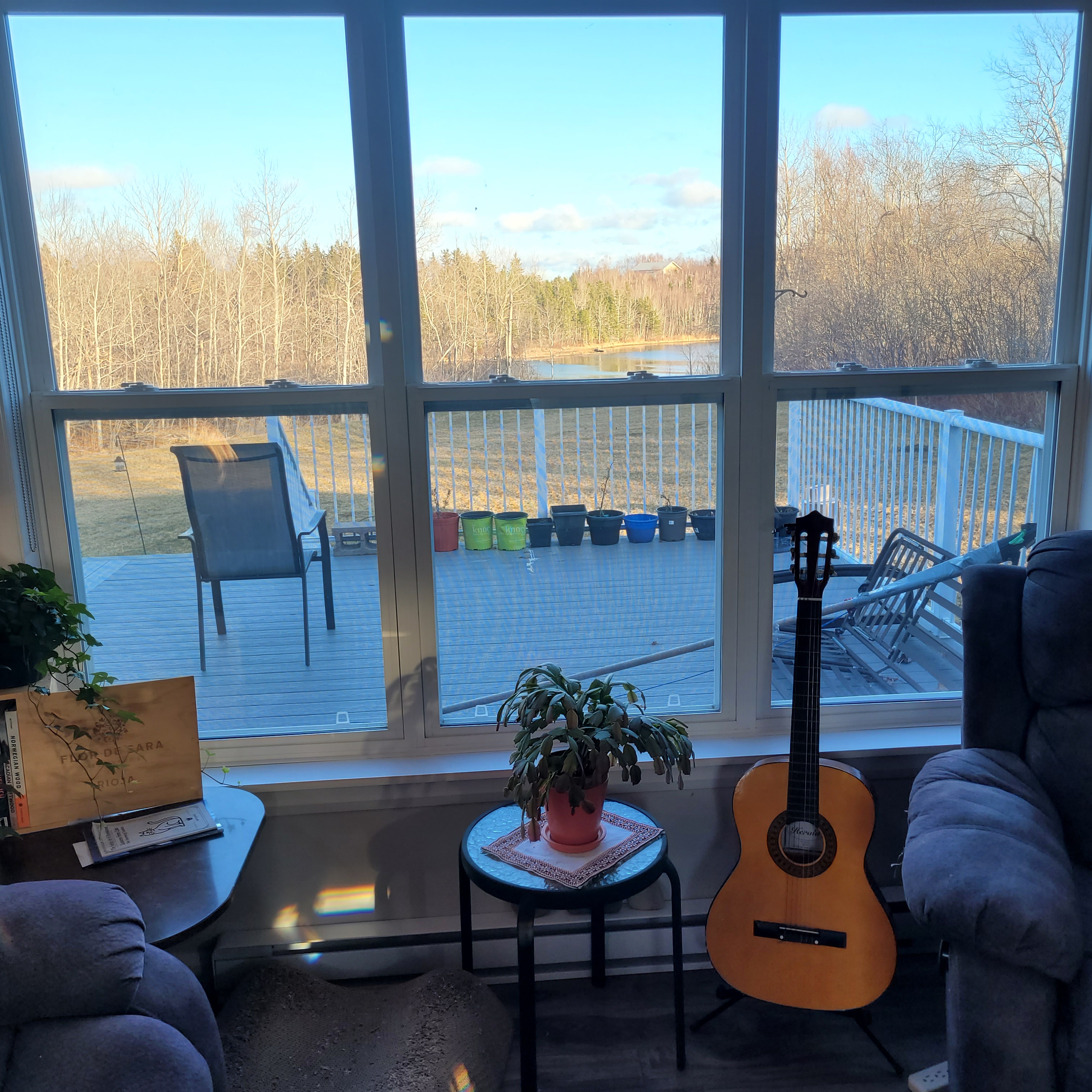
I feel incredibly blessed to be living, period, and to be living in the country. Yes, the power goes out sometimes, yes, there are critters, some great, mostly small, to be aware of and learn to live with, yes, there is grass cutting and incessant yard care, and yes, there are no bakeries or restaurants or cool little take-out spots just around the corner like I enjoyed in Montreal. But there are other pleasures, like sitting with tea looking out at the little bit of salt water that fingers in at the foot of our yard, like watching herons rise up into flight or eagles float lazily overhead. Like tossing ripe Saskatoons into your mouth and hearing the soft tap-tap-tap of a downy woodpecker somewhere deeper in the bush. And feeling alive and connected to it all.
The 2009 album “These Are the Moments” by local Cape Breton group The Rankin Family contains the song “Fare Thee Well Love” – which is my wish to you, in your moments, whatever and wherever they are..
That’s a snapshot of what’s been happening. It’s been ten months since the event that overturned my life last fall. That one moment of garbled speech, of a tingle running down my arm, of Sara running for the Aspirin and calling 911, has led to all these moments since.
Isn’t it profound how a single moment can change our lives, and how often that happens, in some form or another?
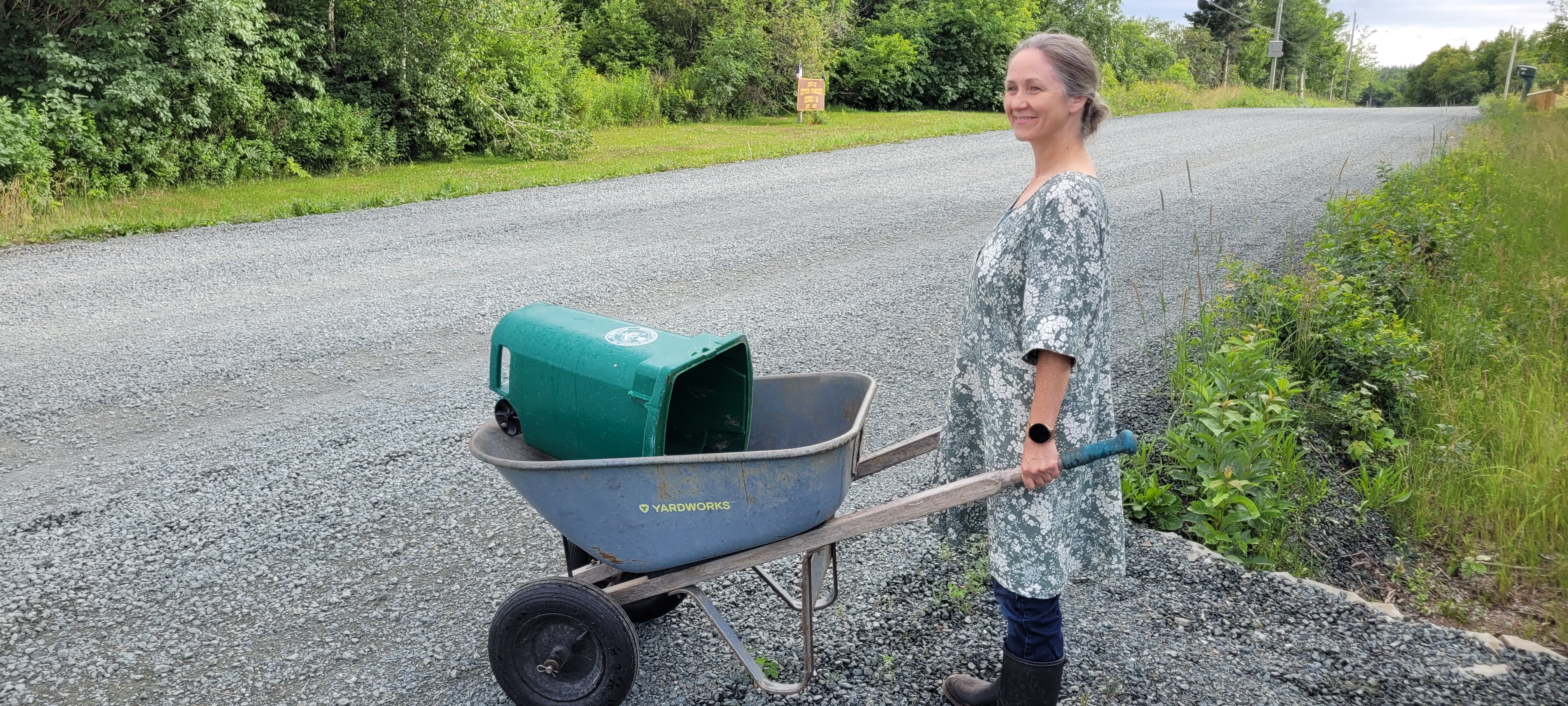
And yet life still goes on, until it doesn’t. And for this moment now, I’m thankful. And thankful to you for taking a moment to read this. Tonight is garbage night. Time to head out with the wheelbarrow, and then maybe try that pie…
[Update: As they say in the Maritimes, it was some good.]
When Sara and I first arrived in Nova Scotia for her new job at St. Francis Xavier University, I was bemused to find all kinds of connections to Saint Ninian. In Montreal, I’d endlessly debated Ninian’s existence with Prof. Sara Terreault when we taught pilgrimage together at Concordia. When we moved to England and I was taking advantage of pilgrimages there, I’d enticed friends Ken and Christine to come over and join me as the first group of Canadians to walk Scotland’s nascently revamped Ninian walk, The Whithorn Way. Almost as soon as I arrived in Antigonish I admit I started concocting a fanciful pilgrimage here called “The Nova Scotia Ninian Way,” that would explain the strange choice of Ninian as the patron Saint of the cathedral here while weaving in the often suppressed histories of Gael and Acadian settlers, and original Mi’kmaw peoples on this Land.
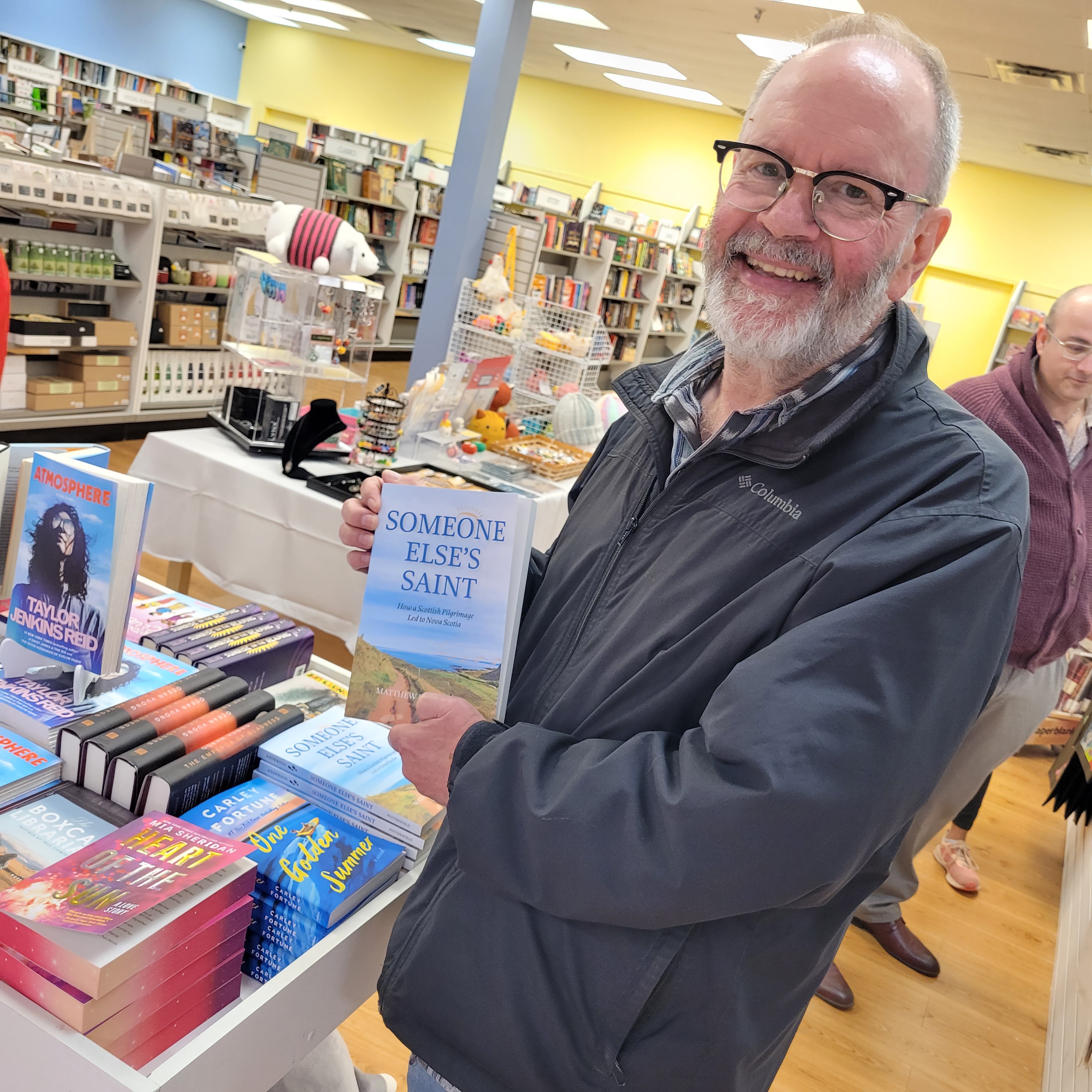
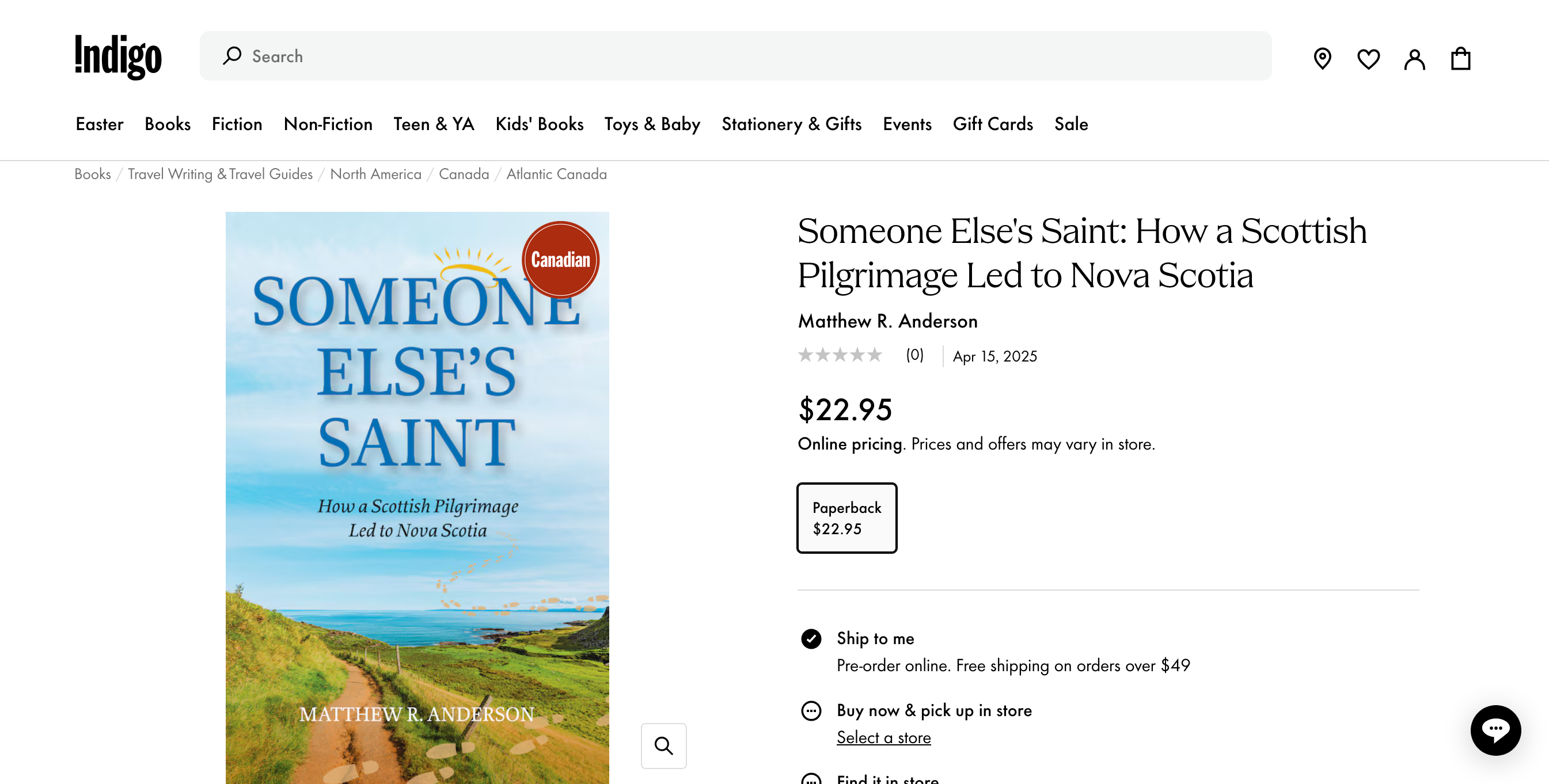
Sara found it a bit weird that I was pulling all-nighters for a talk that wasn’t any longer than a lecture for class. Finally I revealed to her that the talk was spiralling out of control! The deadline for the annual Pottersfield Prize for (unpublished) Creative Non-fiction was approaching …. one thing had led to another and I had myself a manuscript. It was a braiding together of two walks to Ninian–one in Scotland and one in Antigonish–and the stories of impossible underdog successes amid terrible colonial destruction on both sides of the Atlantic. To my amazement, the book, Someone Else’s Saint, won second prize!
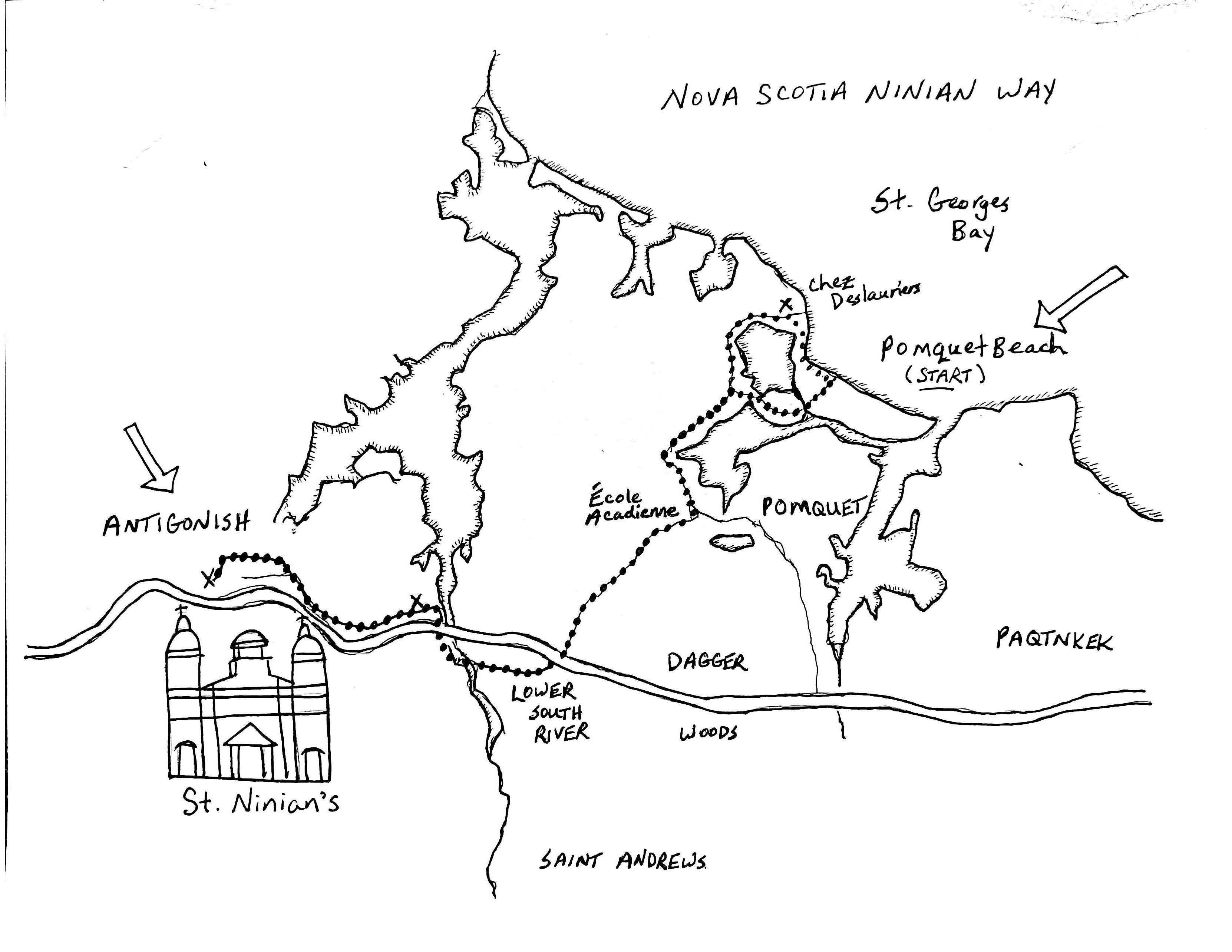
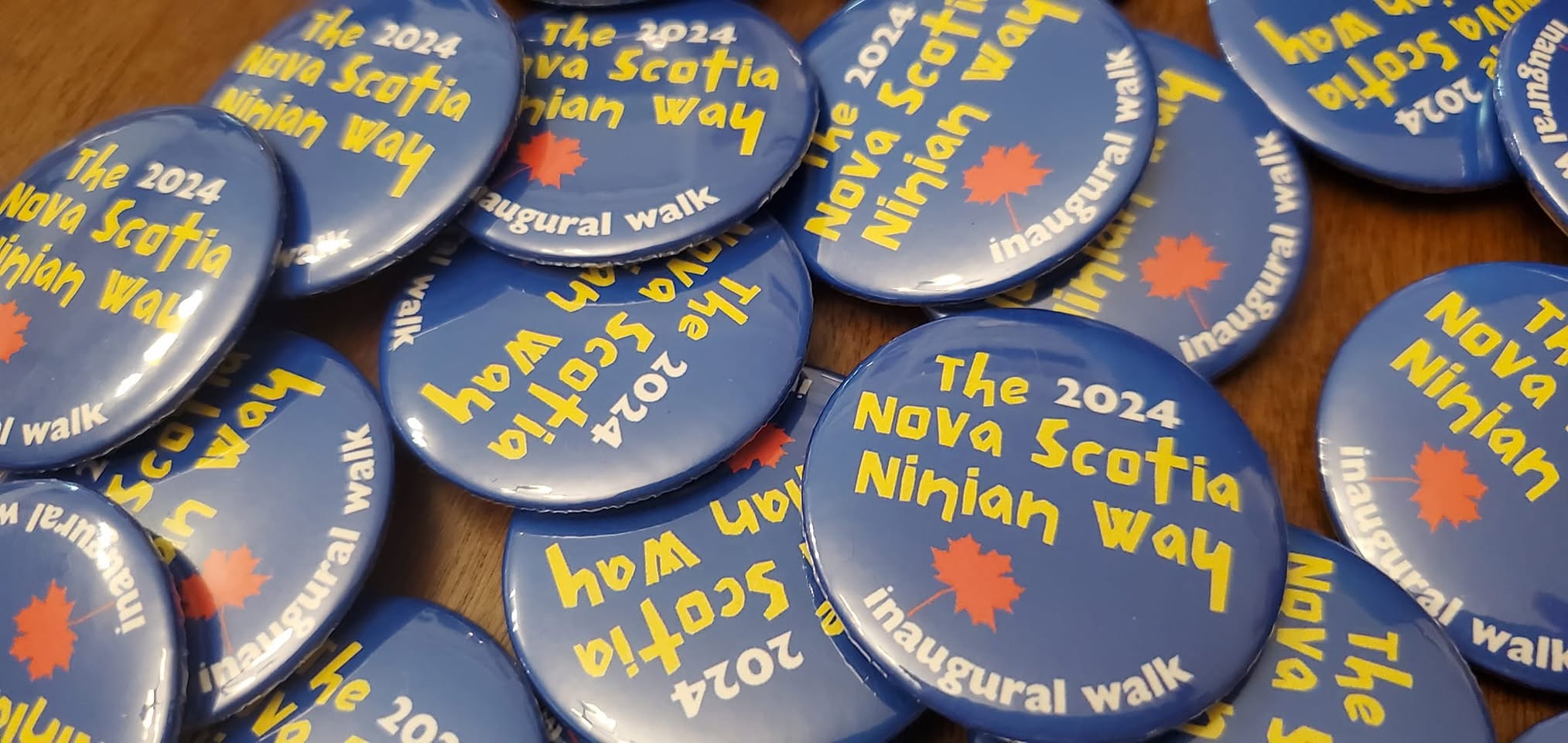
Since there was going to be a Real Life book, I knew then and there that there had to be a Real Life pilgrimage to match. What kind of a fraud would I feel like at book talks if I hadn’t even walked the trajectory I was describing? So the “word became flesh.” Soon, a map was drawn, rest stops were arranged, and a dozen or so adventuresome pilgrims (you know who you are…and thank you!) signed on to walk the inaugural Nova Scotia Ninian Way. We timed the pilgrimage to end at Saint Ninian Cathedral just in time for their 125th Anniversary Mass.
Talk about a bucket list moment.
I sure didn’t think it was likely the Nova Scotia Ninian Way would be walked again.
I shouldn’t be surprised. Ken essentially has a PhD in meaningful walking, he’s the author of Walking the Bypass, out soon with University of Regina Press, and he’s all through the Scottish portions of Someone Else’s Saint (although he wasn’t 100% enamoured of his depiction in the infamous STINGING NETTLE scene and the WET SOCKS FIASCO) as he let me know via his blogged review.)
But what an honour to have the likes of Ken check out this Antigonish Pilgrim Path AKA The Nova Scotia Ninian Way!
Recently, a near-miracle happened. For the last couple of months, one stroke recovery strategy for my left arm has been playing catch with my wonderful therapy assistant Jaana. She throws a tennis ball aimed vaguely towards my torso, and I try to catch it without using my right hand. Typically, I’m not completely catching it — more catching/cupping it between hand and torso. (Throwing it back to her is also a challenge because my spastic fingers won’t let go.) But last week, Jaana accidentally tossed the ball too high and suddenly, to her immense surprise and mine, my left hand shot up and I caught it in mid-air! Neither of us could believe it. I hugged her and we immediately ended my session for the day on that high note. No way was I was going to top that (in fact, I haven’t been able to do it again since, although I’m able to consistently catch underhand, sometimes just with my hand, more often against my body).
A few days ago I managed to tie my work shoes without help. That felt like a major win. Afterward I sat awhile, pleased with myself but so winded from bending over, I had to wait to recover before heading outside. On my new meds my blood pressure actually gets low sometimes! The herons have returned to our little inlet, along with scads of songbirds, so I can sit on our deck during such recovery times and just …. recover.
My Left Leg
The physiotherapist regularly tests my left leg strength and flexibility. Although I’m still limping, and have to be ever-mindful not to trip over my dragging left toe, this month she discovered it is now back to full strength! Why the limp, then? “It’s strong enough to walk without a limp,” she explains. “The problem isn’t your leg. It’s your brain.” I don’t know how to convince my brain to relax that left calf and to pick up my left foot and bend my left knee automatically. Sometimes I’m pretty smooth, but as soon as I’m tired or cold, I’m prone to a kind of geriatric side-to-side waddle that means a sore hip. With absolutely every step I have to remember to lift my foot. It’s frustrating (until I remember how recently were the days I couldn’t walk at all!)
Lately my twice-a-week physio dates have me walking on different paths near the hospital while the therapist assesses my gait. I even found a labyrinth. Sometimes I walk to music, which seems to make my gait smoother. I guess my brain responds to The Stones better than the stones.
Botox? Why not?
You may not have pegged me as a Botox kind of guy, but I’ll soon be a new man. The doctors arranged for a shot of Botox in my left calf in the hope that — just like Botox deadens face muscles to prevent people from getting wrinkles — it will temporarily deaden my calf enough to keep my leg from “hitching” with every step, training my brain to trust that a smoother, more natural gait is safe again. (When one is initially paralyzed by stroke, the brain sometimes learns to “freeze” an area to protect it from flailing and hurting itself, much like when you’re dreaming about running but your legs aren’t actually moving.) My initial Botox appointment was cancelled because I had to fly out west for my brother-in-law Vern’s funeral. I was told the next opening would likely not be until September. I admit I’d been looking forward to a possible breakthrough for my leg. In the middle of my little funk, Sara, who has often had moments of clarity that have helped my recovery, said: “well, if shocking your arm worked so well for your hand, why wouldn’t it help your leg? Hook those wires up to that calf and give it a try!” (I’ve since found an article that confirmed her insight.) After only a couple of days of shocking my calf, I’m already noticing small improvements in my gait. (And my Botox is now bumped forward to mid-July!) At so many stages, I don’t know what I’d do without Sara’s help, advocacy, advice, watchful eye, optimism, wisdom, and sense of humour.
Longest Walk so Far!
Last week I had a visit from fellow writers-about-walking, Ariel Gordon and Tanis MacDonald. They were in Nova Scotia at a writers’ retreat at the Elizabeth Bishop House. We traded books. I took them to Pomquet Beach, and they convinced me to try walking the beach with them. (Both have written about walking slowly, and Tanis about walking and disability.) We went slow, checking out beach stones and shells. By the time we reached Chez Deslauriers road, about a kilometre later, I think my left foot was dragging more sand than I was leaving behind! But it IS getting better, even pre-Botox! I later realised it was my longest walk since the stroke.
My Speech and Hearing
I’m very, very thankful for all the things I can do. AND, it seems I can accomplish more and more each week. But when I forget to focus on how far I’ve come, and think too much of everything I want to accomplish, I can get frustrated.
Something that’s not as obvious to outsiders is that my stroke seems to have caused a kind of aphasia. During a social event recently, people had to ask me several times to repeat myself. Sara tells me that she finds I’m speaking more quietly. This may be a sign of hearing loss (of course, there is an age factor as well). But since the stroke, I find I can’t distinguish between a “v”, “d” or “p” when someone is speaking, making me misunderstand whatever they’re saying. And because of the stroke’s effects, I “hear” people slurring “s”s, even when they’re not. Almost every physio I spoke with about this said the same thing, “Matt, I think you’re noticing this because you’re you. Most stroke patients wouldn’t be this observant.” I guess it’s a blessing that that’s pretty much the stage of stroke recovery I’m at: the fine-tuning stage! (They did put me on a list for a stroke-related hearing specialist.)
On the plus side, I have recently become eligible for a beer that one of the hospital LPNs, Dionne, promised me last fall when I couldn’t move my hand. She said when I left the hospital that we’d go out for a pint of beer if and when I was able to raise the glass and “cheers” with my left hand. As of this week, I can now raise my left hand completely above my head, and I successfully cheers-ed Sara with a wobbly left handed glass of sparkling. (Ironically, my right arm now has a frozen shoulder from overuse!)
Another first: I was delighted this last week to pull the cord on our hand mower, start it up and actually cut grass. Both hands on the handle!
My Heart
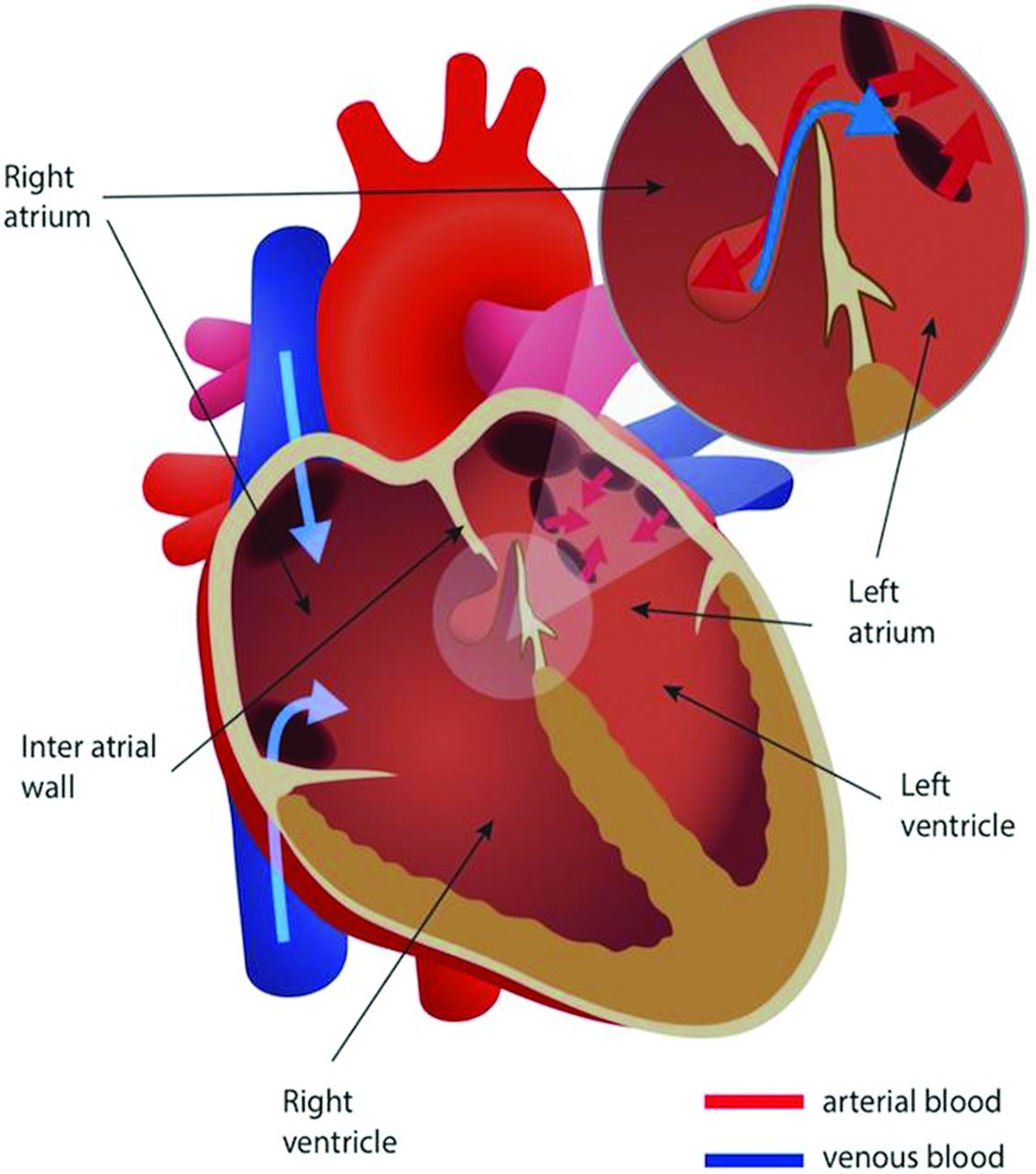
A bit more on my heart surgery for those who may be interested: on April 23 in Halifax, the very professional, very personable – and very skilled – surgeon, Dr Sumaya, made an incision in my groin. He pushed a catheter tube through the incision and up into my heart’s upper chambers. Once it was in place he inserted a wire through it to explore the unusual gap that has existed, undetected, between my heart’s upper chambers since I was born. That hole allows blood (and potentially, clots) to slip through where they shouldn’t, taking a dangerous short-cut to the brain.
I was awake watching the screens. To me, what Dr Sumaya was doing looked like a plumber or electrician trying to thread a “fish line” through a tiny hole. He couldn’t do it, and told me that the gap was smaller than expected and perhaps they wouldn’t need to plug it after all. However, a quick “bubble test” determined there really was flow between the chambers (meaning: possible future brain clots).
“I’ve Never Done This Before”
A surgical huddle followed. I was on so many relaxation meds I didn’t catch most of it, until I heard the surgeon say: “Well, I’ve never done that before.”
THAT woke me up! I may have some of this garbled, but he explained that they proposed to push/drill a second hole between my heart’s chambers, large enough to pass the soft metal umbrella washers through, then bring them together to close both gaps.
He asked if I agreed. I did. Within a few minutes I could see something against the beating flesh of my heart that looked for all the world like a child’s drawing of a flower. “That’s the device,” said someone. Within minutes, all the surgical staff seemed happy. So I was too. “If that was the first time,” I said to Dr Sumaya, “you should write this up.” “Oh, it’s been done elsewhere in the world,” he answered, “just never here in Nova Scotia!”
My Energy and Weight
Did I mention fatigue? A side-effect of my taking on new things constantly is that some days I find myself taking naps. Lots of naps.
Partly because I don’t eat as quickly (too much chance of biting my cheek or tongue), I’m always the last to finish my plate. I tend to eat smaller portions than pre-stroke, and weirdly for anyone who knows my predilection for peanut buster parfaits, my appetite for sugar has diminished. The weight I lost last fall seems to be staying off. I have more of a taste for salt now, and enjoy making home-made pizza!
My Prospects
Now that it’s been nine months since my stroke, I’m realizing (yet again, for the umpteenth time) that recovery is a marathon, not a dash. In fact, recovery is a pilgrimage – one which has changed me more than any of my other walks, and one that I’m still on.
Thank you for your many good wishes, and for the support I still feel, and that still keeps me going. Just the other day, I heard voices at the door as I took a rest. It was the greenhouse crew that a year and a half ago, put in “Sara’s Forest,” the 50+ trees planted for her big birthday. They’d come to check on the trees…and to check on me!
My Birthday!
It was my birthday on May 30th – the BBQ was an unexpected present from Sara’s folks. Sara got me a lovely (made in BC) teak shower chair. Now I can take the old plastic one back to the Red Cross!
My birthday made me realize yet again how grateful I am to still be here. And grateful, too, that so many of you care enough to accompany me on this ongoing journey through stroke.
Wow. Hard to believe it’s been six months since a shudder ran down my left arm and I found myself unable to speak for a couple seconds and Sara called an ambulance and ran for the aspirin.
And…the TIA and major stroke and everything that followed.
When I was wheeled into St Martha’s Regional hospital on a stretcher last September I had no idea it would be home for three months. Autumn was just beginning.
Now here we are at the spring equinox, six months later. The day before spring, the ice came off our little inlet, and those annoying fake ladybugs are waking up all around the house.
The solar panels we had installed last fall are finally free of snow and making power (I check them compulsively).
The seedlings we planted last year have survived.
All signs of spring. Another sign: I’ll have to learn how to tie my shoes again, since pull-on winter boot season is nearly over.
Here’s what else is happening…
My Heart Procedure
I had a pre-op appointment in Halifax last month, and Sara and I used our rare visit to the big city to have a date at IKEA (how romantic!). We then bought a car-load of groceries we can’t get in Antigonish at the surprisingly-well-stocked hole-in-the-wall that is Big Ray Convenience and Asian Store in Dartmouth.
During the appointment the surgeon teased us about being professors and grading him – but we said he already got an A+ just for taking me on. The procedure to close my PFO (Patent Foramen Ovale) will take place in a few weeks, in April. It involves inserting a soft metal “umbrella” into my heart through a tube inserted in my groin. (Really looking forward.) Once in place, it expands to close the hole in between the upper chambers of my heart (for explanation see here). Of course I’m nervous. But I’m thankful it’s considered a low-risk procedure, with recovery times of only a couple of days in most cases, and well worth it for the significant reduction in future stroke risk.
This last month I caught the flu. It really knocked back my energy … and my stroke progress. Fortunately, Sara quarantined in the other end of the house and sanitized like a surgeon and didn’t catch it, and nursed me back to health over the week or so when I was most affected. I recovered in time to lead our team-taught StFX Religious Studies class “Intro to World Religions” on a field trip to Saint Ninian Cathedral, where Father Danny MacLennan seemed delighted to welcome a gaggle of young people, and even took some brave souls down to the crypt “where the bishops are buried.”
Hearts in Motion
Twice a week I drive to town, park at a handicapped spot on campus, and spend an hour at the gym with about ten others, as part of a public health program called “Hearts in Motion.”. The others are there post heart attack or heart surgery, mostly: as far as I can tell, I’m the only stroke survivor (I’m the only participant with partial paralysis…trying to do the “windmill” warm ups with my left arm). I didn’t know what to expect starting out, but going to the gym has been great for me. The first weeks I couldn’t even get on the elliptical machine, much less use it. Now it’s my favourite. I can actually hold the moving hand grips, and release the left one and grasp it again mid-step (sometimes). The program’s physio suggested I try the rowing machine. I was doubtful – I’ve never liked that device. But he was right: the pairing of my left and right arms that’s necessary for “pulling back” the rope and handle seems to be very good for training my affected left arm to stretch and reach. There are only four more sessions, so I may have to get a membership for spring and summer just to keep up on the machines. I’m still incapable of running, even very slowly, on a treadmill. I’d trip and fall. But I’m more and more tempted to try, just briefly…
Left Legand Foot
I’m fortunate that the Physio and Occupational Therapist outpatient departments at St Martha’s hospital are still keeping me on. They say they keep seeing progress, and tell me I’m unusual (I think in a good way?). At my most recent strength and flexibility test, the physio told me that I’ve recovered close to normal strength in my left leg. “But I still have quite a limp,” I told her. “You can see that.” “That’s your brain,” she replied. “At some point it may get back to automatically lifting your foot and adjusting your gait. But there’s no way of knowing when that might happen…” I’m hoping this is like a pilgrimage path in Scotland that I was on with Ken Wilson and Christine Ramsay. Our guide at the time told us: “Use is the cure.” The other evening some great music came on and Sara and I had a quick dance. At the end of it she was laughing: “that felt like before your stroke,” she said. “You were leading like the old Matthew!” Ahhh….that’s what I’m aiming at.
Left Armand Hand
My use of my left hand continues to improve….but very, very slowly, from my perspective. My guitar chording continues to get better: now I can play E,D,A, and G with minimal help from my right hand. But it’s slow, and my strength in pressing down the strings sometimes lacks. I gave up entirely on trying to type with it. I’ll have to get back to that.
Janna, my wonderful therapy aid at St. Martha’s, makes me attempt to move clothespins from a steel wire as a strength exercise for my left hand. But what I enjoy most is playing catch with her! I’ve gotten to the point where on a good day I can catch a gently tossed tennis ball with my left hand, against my stomach, several times, and often succeed in tossing it back, although sometimes my hand won’t let the ball go.
The issue with my hand is what is called “tension” or “spasticity.” My fingers will be loose until I squeeze something (say, toothpaste). Then, instead of loosening again, my fingers stay curled – locked! Sometimes the best technique is to ignore the hand briefly, until the fingers relax again on their own. It’s a bit like trying to fool your own brain. The spasticity seems to be diminishing. But it’s a slow process.
My first submission of my “stroke poetry collection” went nowhere, so I’ll be editing the poetry and trying again. But yesterday I got great news that really lifted my spirits! My memoir The Good Walk: Creating New Paths on Traditional Prairie Trails is shortlisted in the “Publishing” category for the 2025 Saskatchewan Book Awards! On May 9 there will be a fancy awards ceremony in Regina, with the lieutenant governor in attendance. For now my cardiac doctor is telling me no travel. But I can’t wait for May! I’m trying to get my brother Mark, who lives there, to go in my place JUUUUUUUUUUUUUUST in case there is an award to accept.
The End of Term Approaches
All of the hospital staff seemed shocked that I planned to go back to work upon discharge. I don’t regret going back to teaching so soon. But now that the term is winding down I’m realising just how much energy it’s taking for me to go to town four days a week for teaching and physio (and, of course, I’ll stop by the grocery store or Canadian Tire often as well). The OT consultant from Halifax couldn’t believe my weekly schedule. “Of course you’re not getting through all your home exercises,” she said. “When would you do them?” Her main advice to me was to take it easier, especially after I developed frozen shoulder in my right arm last month. Sara declared the dishwasher (reaching down to load and reaching up to put dishes away) off limits and slapped a hefty 100-dollar fine on any disobedience!!! (I only made that mistake once.)
So taking it easy is part of my plan for spring. I’ll take inspiration from the Christmas cactus Sara bought me last fall for the hospital. It budded at Christmas. But in the end, no flowers materialised. Only now, after the equinox, at home, are the blooms coming.
I pray that in your life and mine, there will be delicate beauty developing in its own time this spring. In a world where small, powerful men seem so determined to distract us from their greed and incompetence by emphasizing division, brutality, and ugliness, may we be like this Christmas cactus: blooming boldly, especially where and when it is least expected, and most appreciated.
I remember walking from Melrose Scotland, to Holy Island, England, in 2013. After some extremely hot and tiring days, the path took me up a 300-metre ascent to a rocky outcrop. (There was also the small matter of a pasture with bulls, which can happen when you have the “Right of Responsible Access” to pastureland–but that’s another story.) At the top I stopped to catch my breath. Turning to see the view, I realised that there on the distant horizon two valleys over, I could make out the ruins of the Roman fort where I’d stopped on my first morning of pilgrimage, two days before.
That’s how this week feels. The pilgrimage through my stroke is hardly over. But this week I’m seeing how far I’ve come. The parallel bars (below) that not so long ago represented the greatest distance I could possibly shuffle are now where I try balancing while standing on my left leg without support. I have more strength in that leg every day. Without use of my left hand and arm to steady myself, my balance is off. But the distance? No problem.
Although the physios aren’t recommending I do this at home, Lee is making me practise climbing stairs one per foot, like you probably walk them, instead of like a toddler does. This week she had me kicking a soccer ball back and forth with her (I had to hold on to a railing for support, but my left leg did quite well.) For the first time since my stroke I did up the button on a pair of jeans on my own. And I might only be able to “bench press” a featherweight aluminum cane. But the simple fact my left arm can even hang on is a major win. And for the first time this week, I could sometimes push my arm straight ahead on a table. “Cheers” is getting closer!
I’m thankful that the newly-conscripted neurons in my brain that agreed to take over the management of my arm and hand are beginning to sort out their new roles. But I have to be patient: I was so anxious to force my wrist to flex in my room that my hand swelled up like a balloon. I suffered painful cramps until it recovered. Sara suggested, since I am so eager to use all my time working on recovery, that I do it in other ways than “extreme boot camp” (as she put it) and instead take some time each day to be consciously grateful to my brain and my awakening left side. It’s great advice, so I’ve added that to my routine.
Lee, who works mainly with my legs, says she’s amazed at my progress. She hasn’t seen this video of me bringing my own tea to the couch at home on my “weekend pass” today, without cane or walker. I’m not sure what she’d think!
When I was watching this video and bemoaning the lack of fluidity in my step Sara reminded me that just six weeks ago it required two people to hoist me out of bed and get me to the washroom. Looking back brings perspective.
There’s no news yet about “Handcamp”…. they’re waiting on word of whether I’m eligible. But I’m booked in Halifax at the end of the month for a preliminary cardio assessment, a first step to the procedure to close the hole in my heart that may have let a clot pass to the brain.
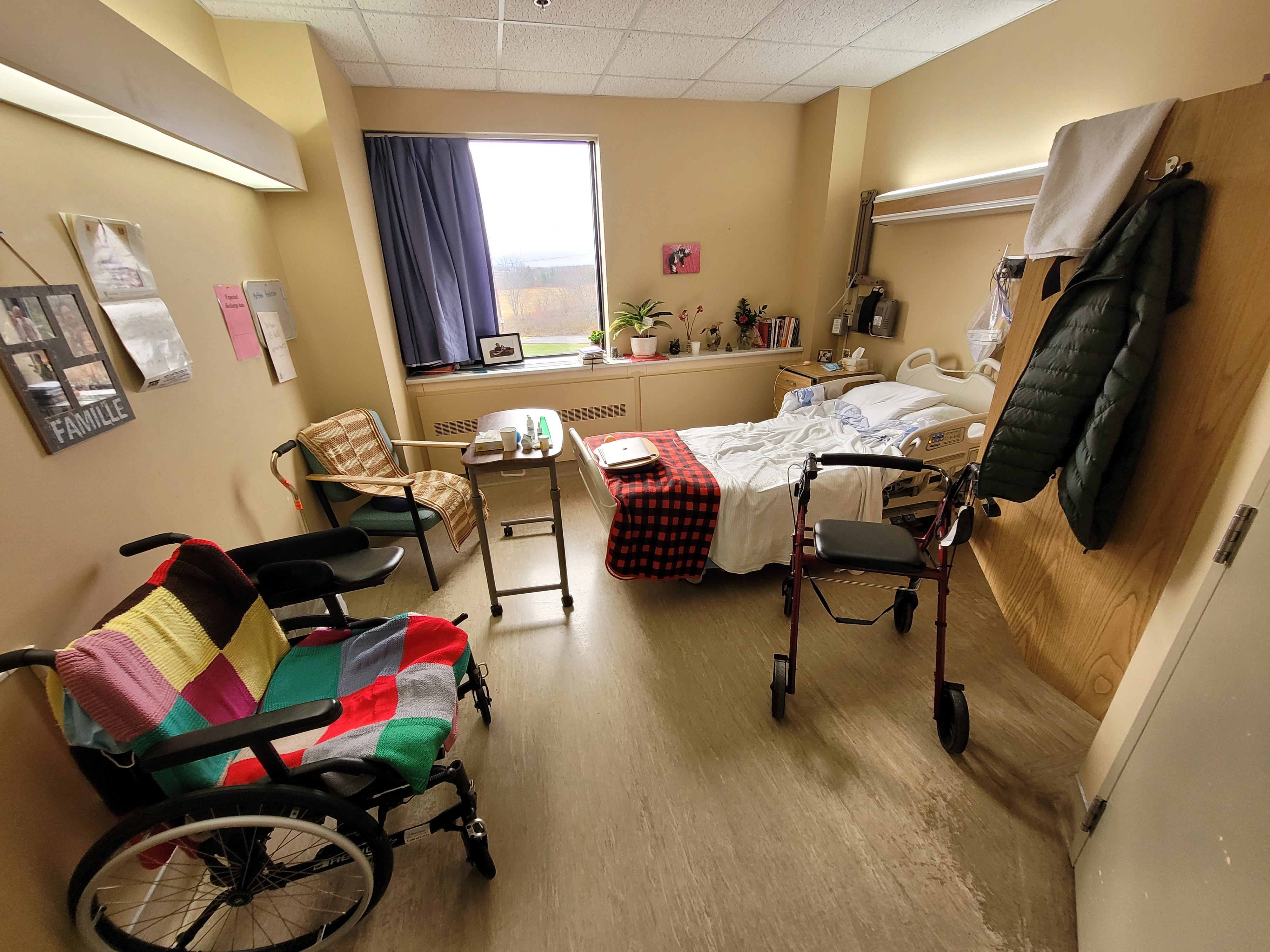
Having a room to myself is making a world of difference. The previous week, with little rest day or night, I was looking “increasingly frazzled and worn,” in the words of one nurse. Now I sleep well most nights. During the day there’s peace, so I can read, listen to CBC, write (working on some poetry), or do my physio. I also feel more comfortable video-chatting with the kids, and I attended my own class by Zoom this week when Elizabeth Castelli graciously came to talk to them about early Christian ascetic women patrons. Now Sara can even bring her meal and share the whole evening, as her schedule allows. From a place of stress, my hospital room has become an oasis for healing.
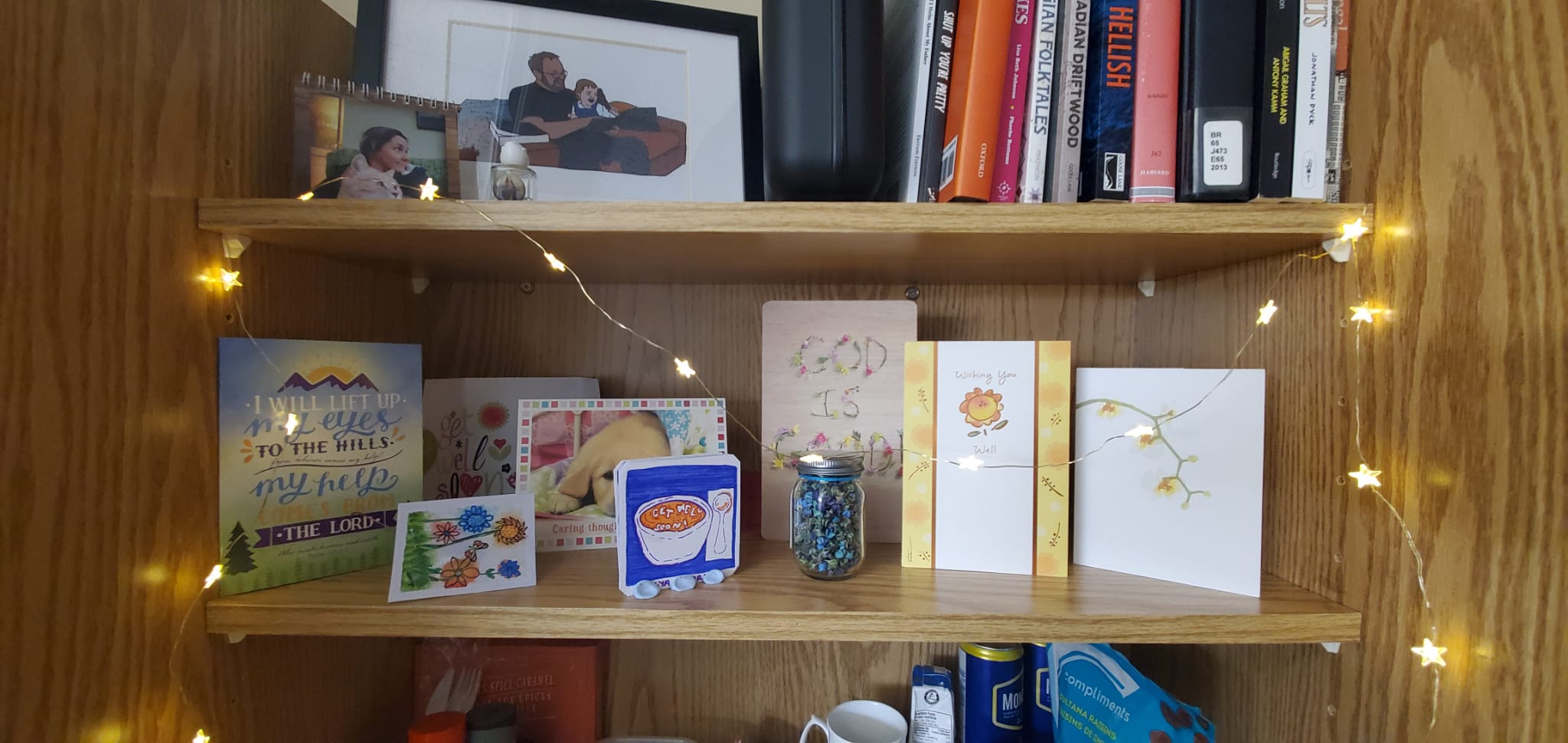
I’m thankful to the physio team – Lori, Lee, Ria, Lina, and Abby – who are so patient with me day after day. They were the ones who pushed for a room where I would get the rest my brain needs to recover. The staff know that my dogged motivation comes from being supported by so many of you. One of the orderlies looked at my shelf of cards and said “well, aren’t YOU well-loved!” That comment gave me a physical rush of warmth and comfort.
Several of you recommended recently that I read Daniel Levitin’s just-published “I Heard There Was a Secret Chord: Music as Medicine.” Coincidentally, Levitin and I had an email exchange last spring, when he asked me something about Prophets of Love: The Unlikely Kinship of Leonard Cohen and the Apostle Paul. We exchanged books by mail. So I’m reading Secret Chord now, and feeling the recuperative power of music every day (see below). I should tell Levitin I’ve had a stroke, and how applicable his research is for me.
That healing power of music is definitely helping release some of the frozenness of my left side. I’ll sign off this week’s update with the clip below, more evidence of how far I’ve travelled with this stroke. I love to dance… and in my own room, now I can. Or better, we can. If you know me, you know this has GOT to be good for my recovery!
[Click here for my podcast about that walk from Melrose, Scotland, to Holy Island.]
Would you like to join a group walking from Pomquet Beach to St Ninian’s Cathedral, Antigonish, linking South-West Scotland to Nova Scotia and remembering an ancient Celtic saint on his feast day? If so, contact Dr Matthew Anderson of Saint Francis Xavier University, Antigonish.
Saturday Sept 14, 2024 we’ll start from Pomquet Beach and head to Lower South River. On Sun Sept 15 we leave from Lower South River to St Ninian’s Cathedral to arrive in time for the 150th anniversary celebration. (This is an ecumenical pilgrimage, open for everyone, not just Catholics). On Saturday we will stop by Ste-Croix Church in Pomquet and have lunch at the Musée de Pomquet as we pass.
The walk is 23 km in total (17 Sat, 5 Sun). For more info see the FAQ sheet below. To sign up, contact Dr Matthew Anderson, Gatto Chair of Christian Studies at Saint Francis Xavier University, at manderso (at) stfx (dot) ca. Please also check out the three videos giving background information on Ninian, the Walks, and Antigonish’s Ninian connections!
Dr Anderson walked the Whithorn Way, the Scottish pilgrimage to St Ninian, in 2019. His book about that walk and this Nova Scotian trek will come out with Pottersfield Press in 2025.
“Take a picture of your father,” I said. “Something nice,” I said.
One of the frustrations I had while being the part-time director of Camino Nova Scotia was leading pilgrimages I couldn’t actually walk! I schlepped bags, drove, unlocked and cleaned halls, and cooked for the pilgrims who had signed up. All the while wishing I could walk the trails in Nova Scotia myself.
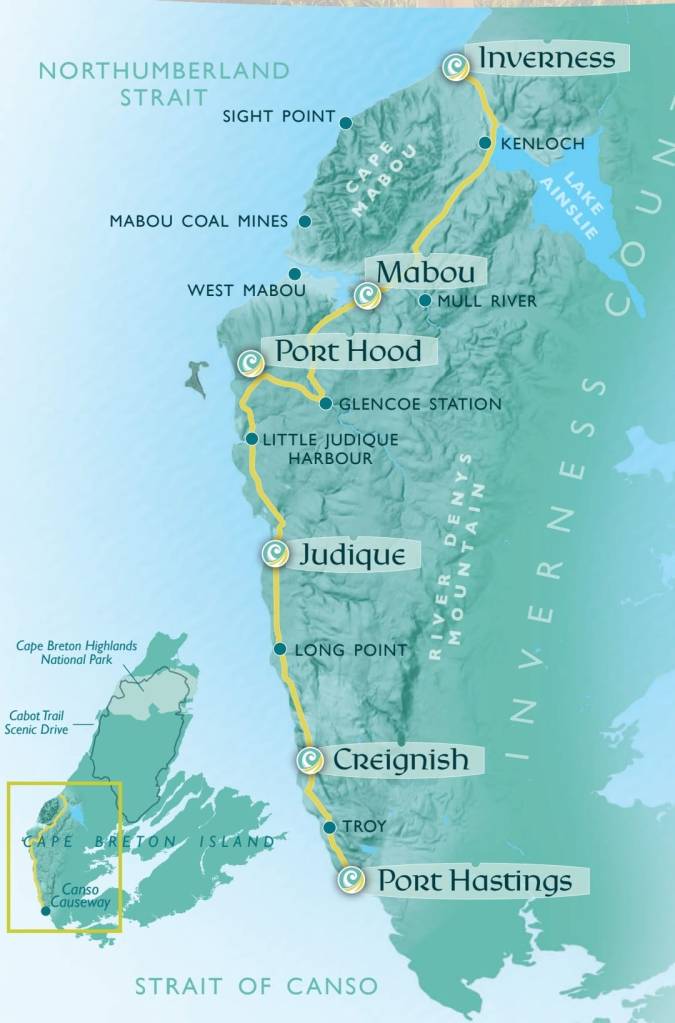
So this spring, when my youngest from Montreal suggested a “long walk with papa” I jumped at the chance. We finally settled on the Celtic Shores Trail in south-west Cape Breton. It was close to home, and because of the SATbus (Strait Area Transit) I was able to plan a way we could leave a car at the end of each day’s walk and still get back to the start point. (Although it meant some VERY early mornings by the end).
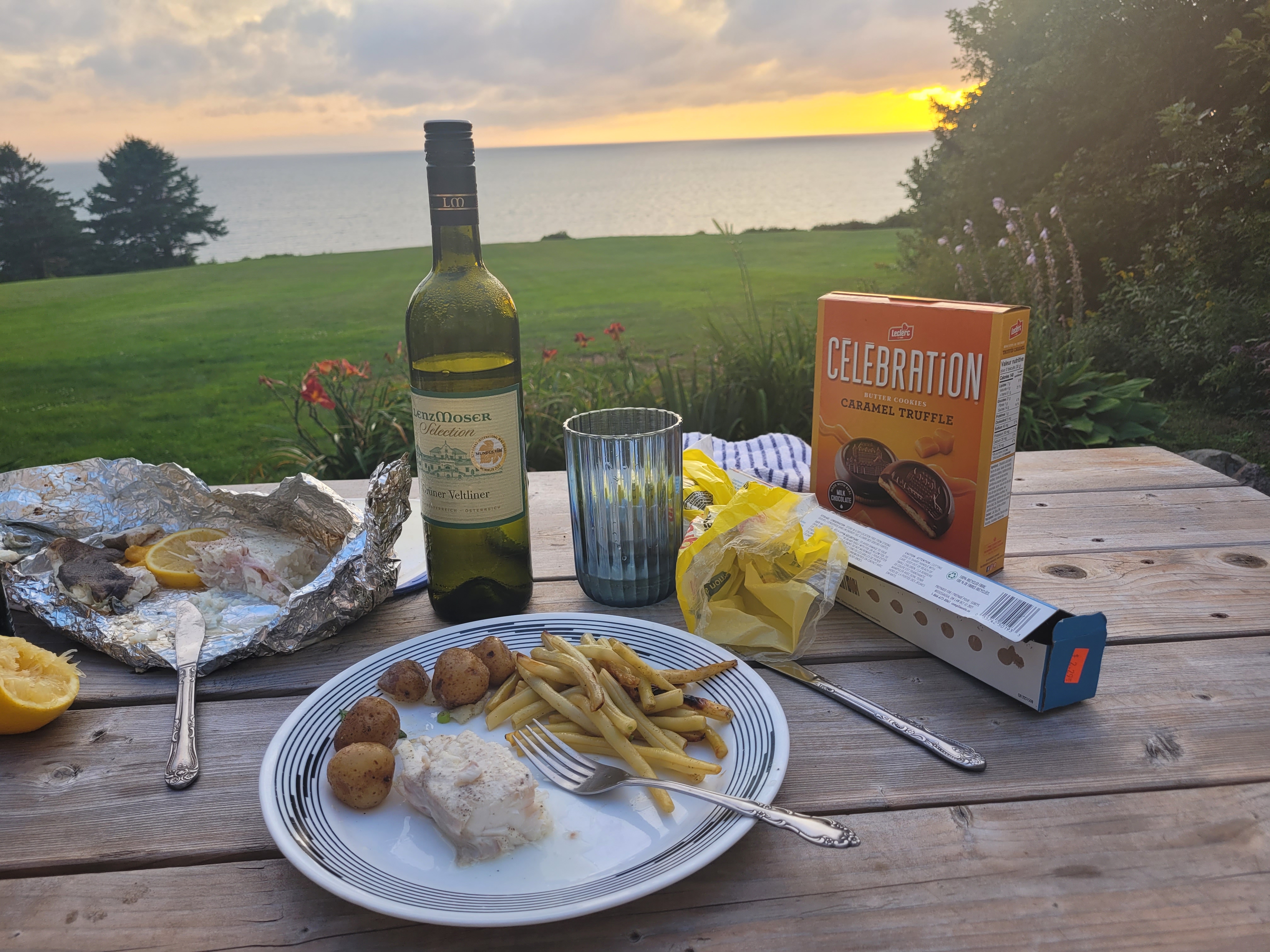
All told, we walked from Troy to Inverness. We had a WONDERFUL time, met lots of folks (although only one other distance walker on the trail), ate tons of sea-food, listened to Cape Breton fiddle music, chatted all day as we walked, and swam in the ocean.
I highly recommend this trail, and the use of the SATbus to coordinate getting back to a car at the end of each day.
Some tips: check the “take a break” walkers’ benches for wasps’ nests…before sitting down! Note that the SATbus doesn’t run weekends, and must be booked in advance. Check out the Ceilidh Fishers’ Coop in Port Hood for fresh seafood and to report your progress to a local trail volunteer. Bring bug spray (although they weren’t bad for us this time around), sunscreen, and rain-gear. We had bear-spray. Thankfully we didn’t encounter any, but we saw some fresh scat. Especially if walking on a weekend, keep your eyes open for four-wheelers, which are a far greater concern. And have fun!
What a wonderful surprise to have Paul Gehrs send me a short note to say: “I imagine you’ve already seen this, but excitement [for your book] is building here in Winnipeg.”
I hadn’t seen it. Thanks to Gail Perry of The Winnipeg Free Press for this gorgeous review!




























 somethinggrand