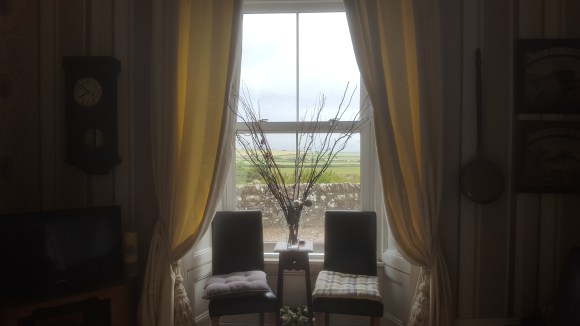
Pilgrimage has two directions. At least, usually it does: Sara Terreault can explain better than me how the ancient Irish (Insular) monks went on peregrinations or wanderings with no intention of returning home. But for the rest of us, to every “there,” there is usually a “back again.” Thank goodness! Whithorn said goodbye with a noisy overnight storm that made me get up to close my window against the sideways rain, then clearing and becoming coyly sunny and warm just as we left. Above is our view from breakfast in the Mansefield Inn. It was once the parsonage to the church converted into a Gulf gas station and garage (below). Fortunately, the conversion of the parsonage was a better job.

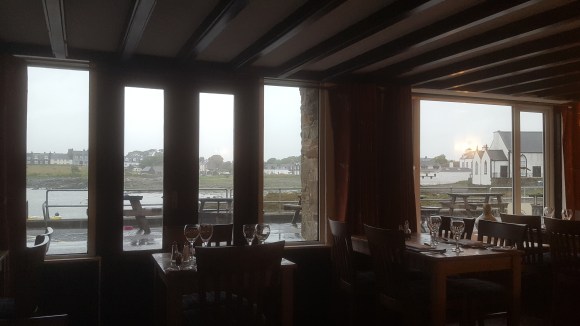
The folks here are rightly proud of where they live. In our 45 minute taxi to the closest train, the driver told story after story, some of which I can repeat, then briefly turned off the taxi’s meter to take us a few hundred yards off-route to see Kennedy Castle. Once on the train, Ken, Christine, and I headed north to Glasgow. My son Daniel once told me how strange it felt to see a pilgrimage “undone” by being in a motorized vehicle heading back to the starting point. I liked seeing some of the sights again from our Scottish Railway car, including these children at one junction waving at the train.

There were unmarked grassy places along the coast where courageous Scots were drying out tents, and I wondered if these were examples of the “Right of Responsible Access.”

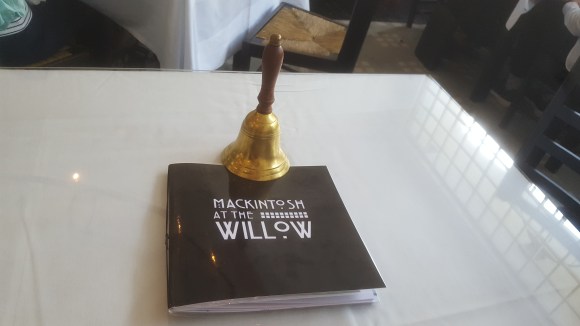
Glasgow Central Station is one of those beautiful, soaring Victorian train stations. We dropped off Ken and Christine’s things, then they accompanied me to the bus station to catch my bus to the airport. On the way we stopped for tea at a replica tearoom done up in the style of Charles Rennie Mackintosh, Glasgow’s famous early 20th century architect. Now I’m waiting to board a prop plane back to East Midlands.

Can one really say that they get to know a place in a short week, even while walking? We covered 120 km, more or less. We saw a lot of mud and stones, beached jellyfish and sheep and cattle and dark woods, barley fields and brambles. Walking is different from seeing land from a train. But both, as Ken reminded me, are different from actually spending time, which is how you make an “anywhere” a “somewhere.” It’s partly by telling stories, and remembering, that we create a sense of place. So that’s the next task for me, as a pilgrim returning from the Whithorn Way. I was happy to share Christine and Ken’s company throughout this long walk. PS: It’s interesting that, after a week researching the Right of Responsible Access in Scotland, on my return to Nottingham Google Maps led me right through a new car parking lot that SHOULD also be a footpath. I wound up exercising my right and hopping the barrier to walk through.


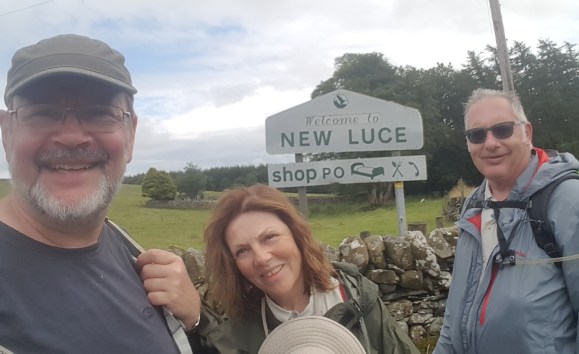
 Secondly, we arrived at our “hikers’ shed” only to find that the lovely & picturesque village of New Luce has no pub, no restaurant, and no store – although all are planned – and that the owners of our accommodation hadn’t been warned we were wanting supper. They very kindly found a can of soup. We were planning to make do with that and some crackers until local walker and walking activist Peter Ross showed up at our door, asking if we needed anything and offering a ride for groceries. Finally, owing to the fact that a local rented cottage won’t receive its guest for a couple days, we got a place to shower! New Luce has got to be the most lovely little village we’ve come across – it’s vying for the flower award for the UK this year.


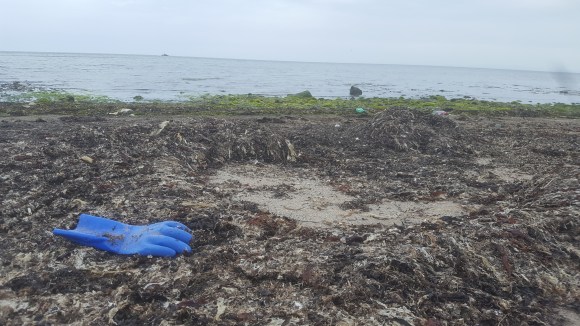
 By the way, Peter told us that all the garbage we’d seen on the coast was NOT Scottish: “a lot of that’s drifted in from Dublin and Liverpool and Belfast with the prevailing currents,” he told us, “But we Scots have to clean it up.” On the walk today we came across a poignant reminder, in rural Scotland, of Canada’s international garbage. We could hardly believe what we were seeing!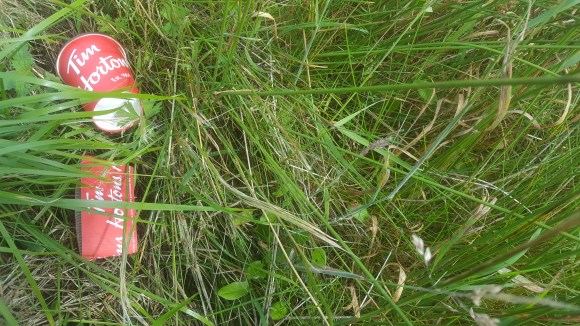







 somethinggrand