Categories
Uncategorized

Miss Lily’s Cafe

2015-11-26 16.44.41

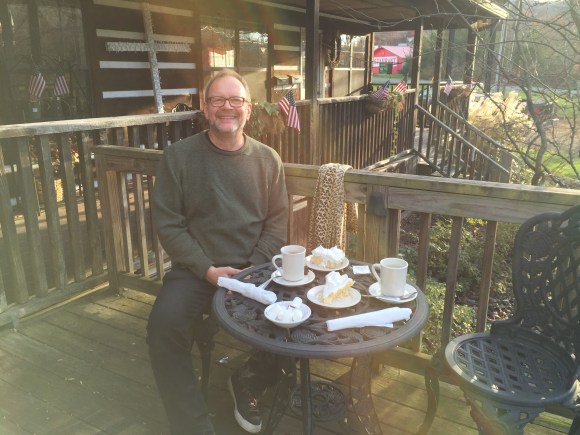
The man who met us at the screendoor to Miss Lily’s Cafe was in his late 40s perhaps, wearing a tee-shirt, with a greying beard and ponytail, and smile lines around his eyes. He looked tired. He held the screen open, but only partly, blocking entrance with his body. “I’m sorry,” he said, not unkindly, “we’re closed. We’ve had a big day already. It’s Thanksgiving.”

“Oh. Okay. We saw the sign saying open,” I told him. “We know a lot of places are shut down early today but thought maybe we were finally in luck.”

“I guess I forgot to change that,” the man shrugged. “Sorry. We’re cleaning up now.”

“We were really hoping for a cup of tea,” my friend added.

Miss Lily’s Café had looked so inviting from the highway. It’s a rambling, log-cabin bungalow of a building, dark logs with white calking, a big front veranda and a red roof. We’d driven off the highway on a long curve that took us by a chapel – no cross but a big red heart on the steeple – and a few other cottages and outbuildings. Given the fact that when we pulled in we were the only car at Miss Lily’s, the truth was that we’d suspected it was already closed. But there were still iron patio tables out on the wooden deck, and streamers of American flags shared space around the windows with various Christmas nick-knacks. A stuffed snowman in an elf-costume stood sentry by the door, alongside a Christmas tree decorated in sparkling balls and straw ribbons. The place was too Smoky Mountain, and too enchanting, not to at least knock on the door.

“Oh for God’s sakes,” came a woman’s voice from inside. “Let’s just give them some tea.” The man turned his head around and said something to the woman, and then held open the door.

The woman –  Miss Lily? – was sitting with her feet up at a little table inside. She had a glass of beer in front of her and a huge piece of some kind of pie, smothered in meringue. “Y’all just relax,” she said to us, although she didn’t move herself. “He’ll get something going for you.” She was going over some figures on a sheet of paper when she noticed me eying her pie. “Do you like coconut cream?” she asked.

“Love it,” I responded.

“And get them some pie while you’re in there!” she yelled to the man.

Within a few minutes we were set up with a pot of tea and two very large pieces of pie out on the deck. The afternoon Tennessee sun, and the tea, warmed us in spite of the cool mountain air.

When we finished we carried our cups and plates in to the café. Lily was still going over her figures, feet up.

“Did you like the pie?” she asked. I didn’t dare tell her that there had almost been too much. I told her the truth – it was delicious. There were probably still flakes of the tasty crust in my beard. “What do we owe you?” I asked. She waved her hand at us.

The holiday, clearly so important to everyone around us, had to that point in the day meant almost nothing to the two of us – a Canadian and a European, both foreigners. But hospitality is universal. “Happy Thanksgiving” Miss Lily smiled.

2015-11-26 16.22.41

Categories
Uncategorized

Pilgrimage and Tourism

sunset at Round Lake Aug 2015

this is the second part in Sara and my discussion of pilgrimage, where we focus on the differences – and similarities – between pilgrimage and tourism, and Sara introduces the ‘Grand Tour’

Categories
Uncategorized

Far from One’s Earthly Home

(this is a guest blog posting on postmodernism and pilgrimage, by Sara Terreault, my friend and pilgrimage studies colleague. Her thoughts were inspired by the questions and comments posed by another of our friends and colleagues, E. Moore Quinn. Their back-and-forth conversation was too good, and too detailed, to leave in the comments section!  MA)

Hi Eileen,

Fancy meeting you here: do you come here often? 🙂

Great questions.  I should be grading papers but cannot resist jumping in.  Here goes, a few note-form thoughts in response to your thoughts:

1) “postmodernism (cultural orientation)/postmodernity (historical time period)”: well, literally “after modernism/modernity”.  So applies to cultures that have been shaped by modernism (or in short, the so-called “Enlightenment Project”), but have grown suspicious of modernist assumptions and values, so

1a) Enlightenment Project, a meta-culture (birthing the so-called universalist  “metanarrative”) consisting of : i) anthropology: human person as primarily (or ideally) interior, individual, rational, and, once freed from the tutelage of superstition (incl “religion”) capable of solving all human issues by exercise of rationality); ii) epistemology: rational, objectivist empiricism, privileges scientific method;  iii) ontology: materialist, immanentist.  Implications: the eclipse of the transcendent, the spiritual/religious, the affective.
1b) Romanticism (late 18/early 19th c.) a reaction/response to the hyper-rationalism of the Enlightenment, but which nonetheless retains the individualist interiority of Enlightenment anthropology … however privileges affectivity, intuition, arts and artists, rather than empiricist rationality and science.  Romanticism has an ambiguous relationship to “religion” and I think we can see there the roots of the contemporary postmodern “spiritual but not religious” (re-opens the door to the re-entry of transcendent reality, but not through traditional “religion”).
1c) Finally: postmodernism: disparate cultural movements that have challenged the assumptions and values of the Enlightenment  and  to some degree Romanticism.  It is paradoxically both hyper-modern and anti-modern.
1d) postmodernity: When is this? This will be endlessly debated, but it makes sense to me to place this post WW2, when all the certainties of modern hopefulness in humans and their “brave new world” lay in ruins after the horrors of two world wars, genocide, totalitarianism, atomic weaponry: our lovely individualist, scientific rationalism has *not* saved us after all. Now what?  Western (modernist) culture fragments into many small cultures (mini narratives) privileging the local, the plural, the diverse, the contingent, the social
2) Shrines, relics, pilgrimage and postmodernity: I’ll suggest that the “shrine” is the in-dwelling place of the divine, “relics” are the meaning-imbued and empowered material memory of the holy one (saint) and the holy experience (in this case, pilgrimage); and “pilgrimage” is physical (or in some cases only spiritual) journey for and to self-transcendence.
2a)  i. The shrine may indeed be spatially located, architecturally realised.  But it is also (at least in Christian tradition) interior, spiritual and personal: “You are the temple of the Holy Spirit” (1 Corinthians).  For postmodern people, the secularity of modernity means that attachment to and experience of traditional religion is often thin or very thin.  Yet the desire for and valuing of the transcendent is nonetheless strong, but is expressed largely privately (religion having been banished from the public square).  So the interior understanding of shrine is “natural” to us postmoderns (we are perhaps just a little bit gnostic in our tendencies …).  We may structure our spirituality on aspects (and in the case of pilgrimage), on locations of traditional religions) but we do this largely individually, partially, and with great focus on interiority. ii. peregrini:  I totally agree that postmodern pilgrimage’s “interior shrine” is in many ways like that of the Celtic peregrini pro Christo whose pilgrim journeys were not toward any wrldly centre, that is toward any spatially/materially located shrine, but rather away from the “centre” of the earthly home, familiarity, comfort etc. Their “destination” is not spatial/material/earthly but rather eschatological, and their only earthly material shrine is their own pilgrim bodies. iii) Relics: the material and sacramental traces of holy people, places, memories.  Not a long way from a strand of hair in a locket, or a pilgrim badge or tattoo, or a burden stone to be left on the road, or a postcard or souvenir …
Your further thoughts?
 

Categories
Uncategorized

When the Shrine becomes the Self

Allen pondering

a ten minute conversation with Sara Terreault, at Concordia, Montreal, about what makes post-modern pilgrimage post-modern!

Categories
Uncategorized

Interview with Cristina

A wide range of thoughts on pilgrimage, from the way space creates thought, to an Australian nun’s summons to a new field.

https://vimeo.com/145929829

Categories
Uncategorized

How I was Saved by a Sense of Belonging

through the trees onto prairie

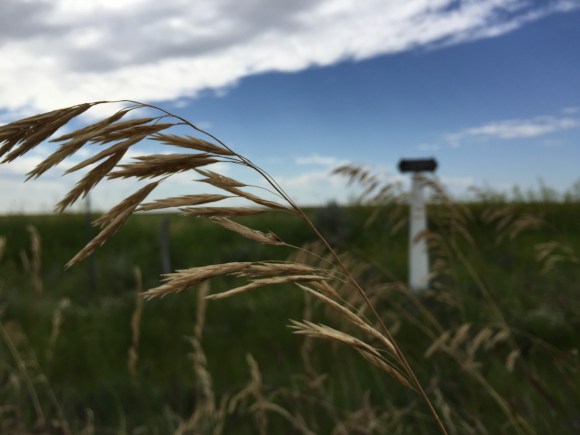
My dilemma: I know from my own experience that being a pilgrim on a certain bit of the planet helps a person identify better with that bit of the planet. I’m not Norwegian. But I feel more of a connection to Norway having walked several hundred kilometres of the mountains and streams my ancestors knew. I AM a prairie person – sort of, still – even after thirty years in Quebec. Remembering my appartenance (belonging) to the prairie was hard-won with every gust of wind, every blade of speargrass burrowing into my foot, every sunburn, every call of the coyotes at night and every Pils beer consumed in a prairie tavern. If you haven’t tried it, do. It’s great. Not just the Pils. The whole pilgrim experience.

So my thesis for the conference to be held at the College of William and Mary, in Virginia, is simple: walking pilgrimage helps ‘ground’ people like me as Canadians, in our land, so long as we are mindful of the land’s history and of its First Peoples (in other words, so long as we walk honestly).

Then I remembered that “pilgrim” actually comes from the word ‘foreigner’ or ‘alien’. How can a foreigner gain more of a sense of belonging by practicing their pilgrimage (ie foreignness)? I thought my paper was ruined. I stewed on this for several days before it occurred to me. For Newcomers like me, being a pilgrim describes my status EXACTLY. The foreigner (pilgrim) doesn’t own land. Pilgrims only go on by humbly accepting generosity from the land and its inhabitants. The pilgrim needs to be in relationship with others, or they perish. Belongingness (if there is such a word) is reversed. Not the land to me, but me to the land. For a non-First Nations person like me, it means seeing that my belonging to this land in Canada has always been by hospitality. It ONLY comes through recognizing my foreign-ness and the ways in which I have been invited to share in belonging TO the land, by those – ie First Nations – who have belonged to it for so long already.

That makes a whole lot more sense. I think I can present that at the conference.

Lyndon walking with paint

Categories
Uncategorized

The Problem of the Definition of Pilgrimage – one half of a dialogue

Craig Baird boom shot Cypress L walkers (photo courtesy of Craig Baird)

(please click on the link)     https://vimeo.com/140200976

A conversation over morning tea at Concordia’s Dept of Theological Studies between Matthew R. Anderson (on camera) and Sara Terreault (staying off camera).

Categories
Uncategorized

Reconnecting with Land article

buffalo wallow rock

Clink on the link below for the article that will appear tomorrow (Aug 28 2015) in the Prairie Post. Thanks to Matthew Liebenberg for his questions and writing!

Prairie Post Aug 28 2015

Hugh magnified by valley

Categories
Uncategorized

Un pèlerin des temps modernes retrace les pas de ses ancêtres

IMG_0215

You can find here the radio broadcast of my interview with Radio-Canada, in French, as well as a photo essay by William Burr, also in French, about the trail and our pilgrimage.

http://ici.radio-canada.ca/emissions/pour_faire_un_monde/2014-2015/chronique.asp?idChronique=380260

Categories
Uncategorized

A Musical Moment

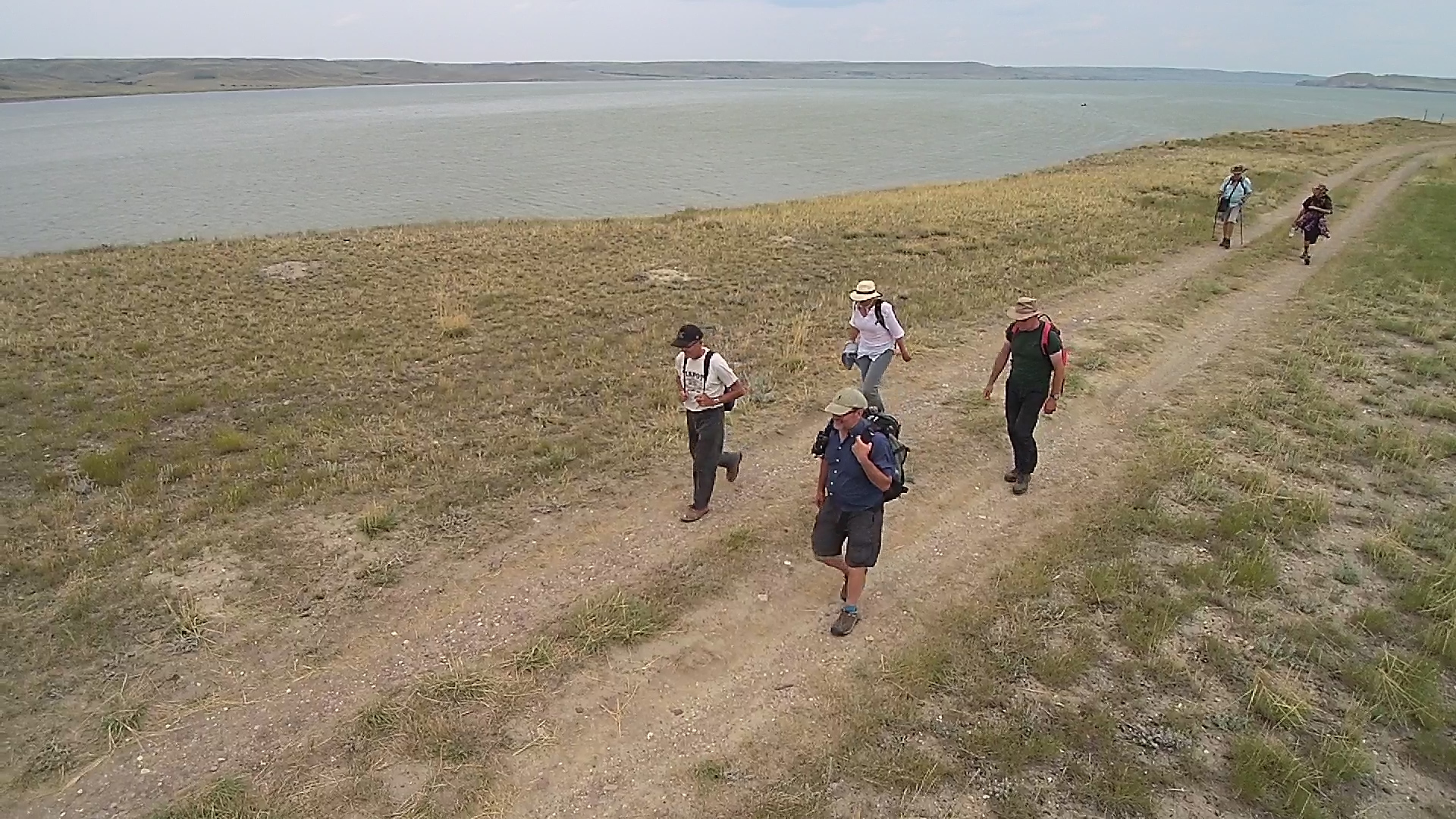
Kathryn Scott, Madonna Hamel and Matthew Anderson try to remember the words and harmonies to Java Jive. We were camping overnight at Chimney Coulee, near Eastend SK, and half-way through our group’s 350 km trek along the North West Mounted Police Patrol trail. This is a moment from a summer 2015 pilgrimage organized by Hugh Henry and Matthew Anderson. The video was shot by James Page, photographer, from Val Marie SK. on the NWMP Patrol Trail pilgrimage July 30, 2015