Author: somethinggrand
writing and walking
“Have you read the Guy Delisle graphic novel Jerusalem?” wrote my friend C, who sometimes pops into my inbox with interesting ideas and comments on life. “Since you were recently there,” she went on, “you might find it relevant, or maybe even entertaining and heart wrenching. There is even an important character at the Lutheran church.”
This was my first ever recommendation to a graphic novel. Had it been about vampires or medieval Spain I might have balked. But Jerusalem is….well, it’s Jerusalem. As you’ll know if you’ve been there, there’s no spot on earth quite like it. I was interested in seeing what a cartoonist would do with the place, that hasn’t already been done by Jews, Arabs, Crusaders, religious zealots, Zionists, Muslims, Christians and the million other types of people who seem to have a deadly interest in these few acres of the not-so-holy Holy Land. Besides, where else does a best-seller feature a Lutheran pastor, even in a small cameo appearance?
I got the novel at the library, and started reading. And C was absolutely right: I did find the novel relevant. And entertaining. AND more than a little heart-wrenching. And because, with the Waterloo Lutheran Seminary group I visited the Lutheran chapel and hospital at Augusta Victoria in East Jerusalem, right above the Mount of Olives, I wanted to see it again, through an outsider’s eyes. It turns out that, unlike the omnipresent dividing Wall (which features again and again in the book), Augusta Victoria became a place of rest and reflection for the author (Delisle became friends with the Lutheran pastor, who is a comics fan, and had his studio there).
I’m not a follower of comics and despite his success, I didn’t know Delisle’s work. He’s a Quebecois who has lived many years in France. This book (originally published in French, English translation by Helge Dascher, published in 2012 by Quill & Quire of Montreal) is the result of his family’s one-year stay in Jerusalem. During that year Delisle took care of the kids and sketched while his wife worked for Medecins sans Frontières in the West Bank and the Gaza Strip.
Get this novel and read it. It’s worth it. Firstly, Delisle is honest but hilariously understated in his portrayals of life in the so-called Holy Land. There’s no shouted polemic. Instead Delisle’s slightly dopey, typically nice Quebec/Canadian alter-ego meanders through, and chronicles, the absurdities that seemingly pop up everyday in and around Jerusalem: an Israeli soldier with a massive machine gun slung in front of him and an equally large guitar slung over his bag, Palestinian women shopping in the settlement grocery store the expatriate workers from overseas, in solidarity with Palestine, have been so studiously trying to avoid, Christian priests coming to blows over which part of the Church of the Holy Sepulchre is theirs, Palestinian children afraid to go to school in the West Bank because of the settlers and Israeli taxi drivers afraid to go into East Jerusalem because of the Palestinians. One of Delisle’s funniest lines is “thanks God for making me an atheist”.
The most touching, and yet still understated, part of the book is at its end, as the family prepare to leave after their year-long stint. But I won’t spoil the ending for you. Read it yourself. Jerusalem: Chronicles from the Holy City is the kind of book that, like a seemingly harmless “nice guy”, sometimes surprises you. Delisle’s everyman is a sharp-eyed observer, and this novel has a punchline, even if you have to look for it.
The Cowichan Sweater
Over a quarter-century ago, before they came back into fashion, my father was throwing out some of his clothes. One of the items was a Siwash sweater he’d worn in the late 1950s and early 1960s. If you’re unfamiliar with the term Siwash, they are also called “Cowichan” sweaters, after a style developed by the indigenous peoples of south-east Vancouver island (see Wikipedia: http://en.wikipedia.org/wiki/Cowichan_knitting).
Truth be told, back then I wasn’t sure what I thought about the sweater. I’d only ever seen “old people” wear them – and most of those old folks were curlers at that. But the sweater was hand-made, and hand-made for my father with images of his 1950s construction vehicles on it, which to me made all the difference. So I saved the piece, and had it resized for my smaller frame by a kind elderly neighbour. Then I put it in a box for almost thirty years, only taking it out occasionally.
This last week I put the sweater on. My father has been wheelchair-bound for a long time. He’s lost weight – a lot of weight, and the sweater that I had made smaller would now be much too big for him in turn. I wear it, not in Saskatchewan where it came from, but in Montreal, where, for at least the moment, and for certain groups of students such sweaters are all the rage (not being the pinnacle of style, I may have missed ‘the moment’ even as I report it!).
But this was more an act of memory and legacy. When I put on the Cowichan this last week, I felt connected across the decades to the man my father was. Don’t ask me exactly how this works. But to feel the wool across my shoulders makes me realize how he and I are connected. We are very different men, in very different times and places. But as he passes 80, and suffers so badly from crippling Parkinson’s, I wear the sweater and wonder: “what was he thinking when he wore this?” “How did he look at the world?” “Did he have any idea what lay ahead?” He would have been a younger man than I am now. But the wearing connects me to him, and to that wild, open country from which both he and I come.
We can talk all we want about memory being a mental process, but in families as in religion there’s something important about the totem, the symbol, the revered object. There’s something special in taking an object into our hands and letting the memories enter us through our skin.
This last week my daughter, who has been eying one of my own sweaters, came out of her room one morning before school. “I’ve got nothing to wear,” said the young woman who has drawer after drawer of clothing spilling over. “Could I wear that sweater of yours?” She had a sparkle in her eye.
It’s all about connection. I just might ask my grown sons if they have anything I can borrow.
Parents’ First Day of School
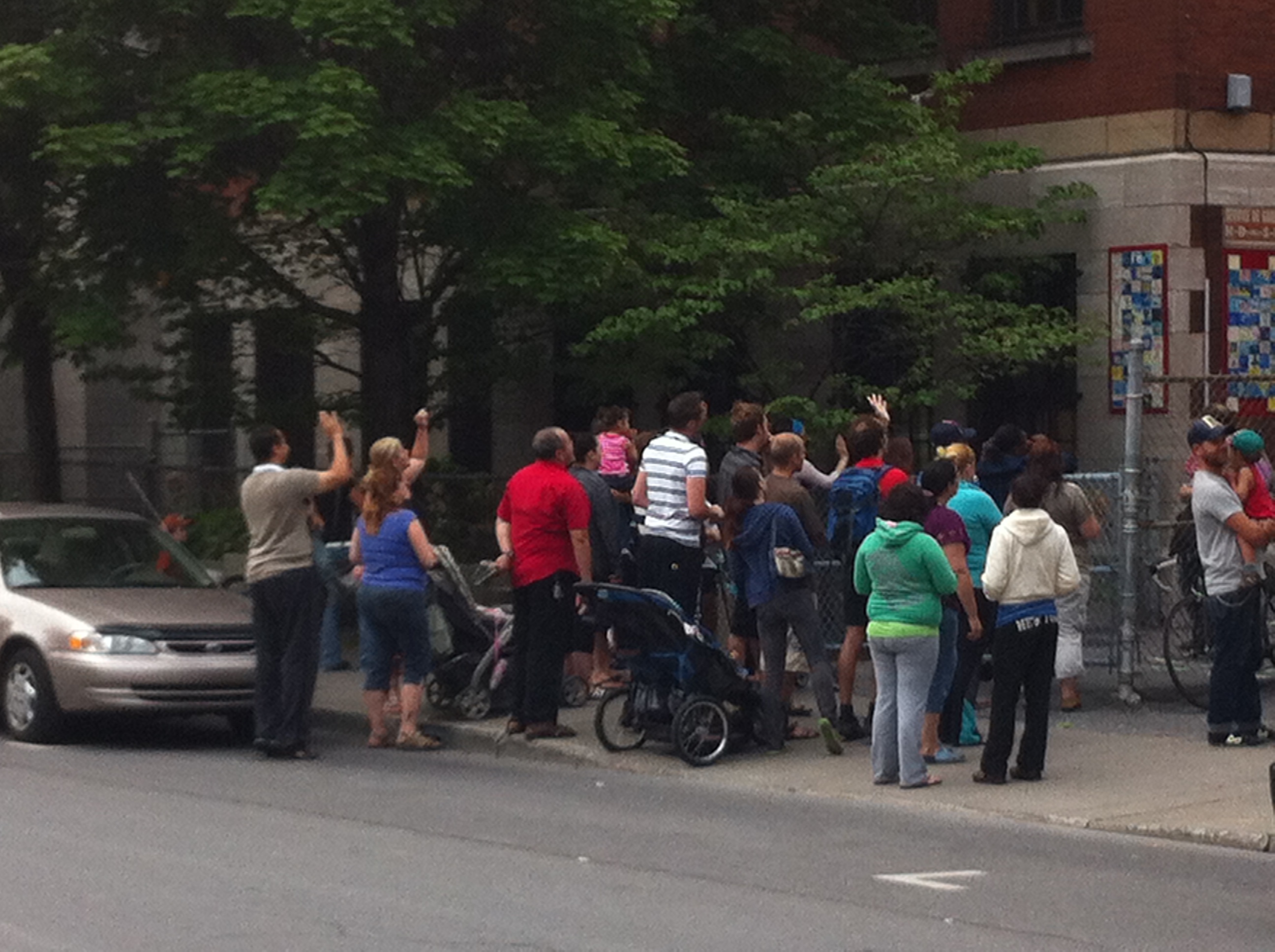
I snapped this photo just down the street from my house, on my way to my first day of university classes this fall. It’s one half of a traditional but heart-wrenching scene: parents waving good bye to their young ones as they go to kindergarten for the first time. It’s that day when we hand our children over to an institution that we know will sometimes be brilliant, often benignly negligent, and occasionally incompetent in the care of our little ones. But even more importantly, this moment marks a new stage of development for the children themselves. From here on they will begin to understand themselves as more autonomous, beginning a process that, parents hope, will lead to responsible and mature adulthood.
I remember the first day I took my daughter, G to kindergarten at a very large downtown Montreal school. She looked so brave with the little piece of paper I had written her name on safety-pinned to her shirt, and her lunch-box in her hand. She had no idea what to expect. Neither did I.
At the end of that day I anxiously arrived at the day-care only to find myself living out a parent’s worst fear: they didn’t know who my daughter was, and had no idea where she might be. This in a school of a thousand students, all of them at that moment moving up and down staircases, running around me, and moving in and out of the school yard in huge crowds that could easily hide a lost child, on a very very busy downtown Montreal street, in the middle of the urban jungle. They didn’t seem all that worried, but I was frantic. As I stood there on the sidewalk, traffic whizzing by, trucks and sirens and delivery vehicles and people of all descriptions crowding by, I was remembering the little child with the note pinned to her shirt who trusted me so completely.
A heart-stopping half-hour later, I found G, sitting calmly in one of the vice-president’s offices, eating her granola bar. The systems that were supposed to be in place to identify and move her had clearly gone wrong, but the safety measures in place to protect any child – even an anonymous one – were still in place.
It was hard, after that first day, to take her back for a second try the next morning. Now she’s a teenager, but I still remember that first day, and how hard it was. There are many types of “first days” of course. Sometimes it’s a child leaving to move to another country, or to take a job, or to become a parent themselves. Part of our task as parents – at any age – is to nurture our children, and then let go. But it’s only human nature – we can’t help waving as we do, and standing on tiptoes, just to see if maybe they’ll wave back.
The Clergy House of Rest
My second day at the parsonage attached to the summer parish of Cacouna QC, my friend Eric, who had come down to spend a couple of days with me in Bas St-Laurent, found a small plaque on the mantel of the fireplace. It’s a short text, written in old and uneven typewriter script, and deserves quoting in full. The capitals (interesting in and of themselves) are there in the original:
The Committee desire to draw attention to an established Rule which forbids except on special occasions, and with the approval of the Master of the House – the admission of Ladies and Children to the hospitality of the House.
The Committee believe that it will be recognised that the observance of such a Rule is absolutely necessary to secure the Guests of the House that freedom and liberty of action to which they are entitled.
By order of the Committee
There’s no date, and no easy way to situate the notice, but it seems to be a bit of historical luggage left over from the 1920s or 30s. Whichever modern parishioner of the parsonage found this and dug it out must have had a sense of humour. She’s probably also the one who found a photograph that seems to go with it. The photo shows a group of middle-aged men, all in suits, sitting or standing on the veranda of a house very much like the present day parsonage of St James Cacouna. Some are wearing clerical collars. They are looking at the camera, and a few out toward the St-Lawrence (it’s hard to know whether to call it the St-Lawrence or “the sea” here since it’s a bit of both. It’s a river, but some 20 miles across, with six to eight foot tides and salt water). Some of the men are smiling, but most, as was the fashion of the day in front of cameras, look grim. Presumably, the looks on their faces indicate that they are enjoying “that freedom and liberty of action to which they are entitled”!
It would be easy to moralize over such a plaque. But times have changed, and little is accomplished by such straw-man opinions. Likely the men who were responsible for this directive wanted, more than a release from women and children, a release from themselves and their domestic lives (we still go on “retreats”, and these still involve getting away from responsibilities as far as one is able). The capitalization of the word “Rule” is interesting, however – is it possible, I wonder, that whoever framed this had in mind, consciously or unconsciously, the far more official and effective monastic “Rules” such as the Rule of St-Benedict? If so, perhaps there were some frustrated monastics amongst that surly lot on the steps.
But the phrase that most piques my interest is the last line: “that freedom and liberty of action to which they (that is, the clergy) are entitled.” Leaving aside for a second the word “entitled”, it begs the question: what exactly did they DO in the clergy house of rest? Smoke cigars? Surely, in the 1920s, the men did that at home. Tell dirty jokes? Golf? Fish? Walk around in their slippers all day and read the paper? None of these seem exclusively the province of a “house of rest.”
Maybe the “freedom and liberty of action” meant, for these men, temporarily laying aside the heavy weight of being clergy in a culture and time less libertarian than our own, where clergy had a much higher profile and were under much greater scrutiny. Let’s face it, most people barely know we exist these days, and find us more a curiosity than an object of judgment. But in the 1920s, in a stratified Anglo society, things were different. Maybe this Rule expresses the desire of these men to be free to express unorthodox opinions on certain church issues (to tell sacrilegious jokes rather than dirty ones), to be able to vent about people in their parishes, or to be able to pretend, for a time, that they were not “marked” by their ordination vows to be forever different from the rest of society.
It’s also possible that in these words we find the same somewhat unformed but strong urges for male unity and self-awareness that mark the “masculinity movement” of recent decades. And of course, it’s hard for us moderns not to look at that photograph, read these words, and wonder if there were not, again perhaps unconsciously, some homoerotic urges on the part of at least some of those men, the forbidden feelings for which “mens’ clubs” were once a cover.
That’s probably going too far. Maybe, the framers of this “Rule” didn’t really know themselves what they wanted, and “freedom” and “liberty” were words that expressed a yearning more than any actual plan of action. If so, I hope that they found what they yearned for, without having to resort too often to such petty, clumsy and dictatorial decrees as this “Committee” seemed prone to making.
It’s the end of my week in Cacouna. Eric left on Wednesday and when Cathy decided not to come up with her mother as planned, it occurred to me that as a man alone in the house, I was living by the Rule of the Clergy House of Rest! The Parish of St James has been tremendously welcoming to me, and the House (there, I’m picking up the capitalization habit) has been a God-send. Some days the fog rolled over and through the grand old place, making it eerily moody, and other days, when the sun was shining over the gulf, I’ve sat at my computer and watched, hoping to see the Beluga whales that sometimes pass by out in the sparkling waters. I can hear the foghorns of the freighters on the one side, and the lonely sound of the Gaspe train on the other. Up on highway 132, cars with campers pass by, and tourists stop to look at the signs describing the historic village of Cacouna. We haven’t stopped needing places of rest. But I’m glad that the parish of St James Cacouna is now so much more welcoming than was, once, the “Clergy House of Rest”.
Angels and Monsters
Angels and Monsters
It’s kind of a joke, but only sort of: I’ll tell my students that if they are ever visited by an angel, they already know exactly what the angel will say, and what they should do. The script is all there in the Bible.
The angel will say two words, I tell them. Guaranteed. And those two words are always the same:
“Fear not.”
And then, I tell the students, their job is to fall flat on the floor in wonder, awe, and holy terror.
The students always laugh. Our generations not being terribly familiar with wonder, awe, and especially holy terror, I suppose they’re laughing at the idea that such an encounter could be so scripted. Or more likely – with the world-wisdom of undergraduates bent on the deconstruction of all myths except the presently-important ones of the market – they are snickering at the idea that such a spiritual and otherworldly encounter could happen at all.
And it is funny, in a way, that the Bible’s angels all seem to have taken the same class in public speaking. They really do say more or less the same thing. In fact, the phrase “fear not” is firmly attached not just to angels in the New Testament, but also to most of the events where what is “normal” in our world is portrayed as breaking down.
The disciples see Jesus doing what no human being should be able to do: walking to the boat across the storm-tossed water. “Fear not,” he tells them, as the laws of nature are tossed out. The confused women enter the tomb on Easter morning to anoint the dead body of Jesus with oil and perfume and instead of the stink meet a young man who says to them “Fear not.”
Perhaps with all that warning against being afraid, a question that could be asked is “what is there to be afraid OF?” And on that subject, we have plenty to learn.
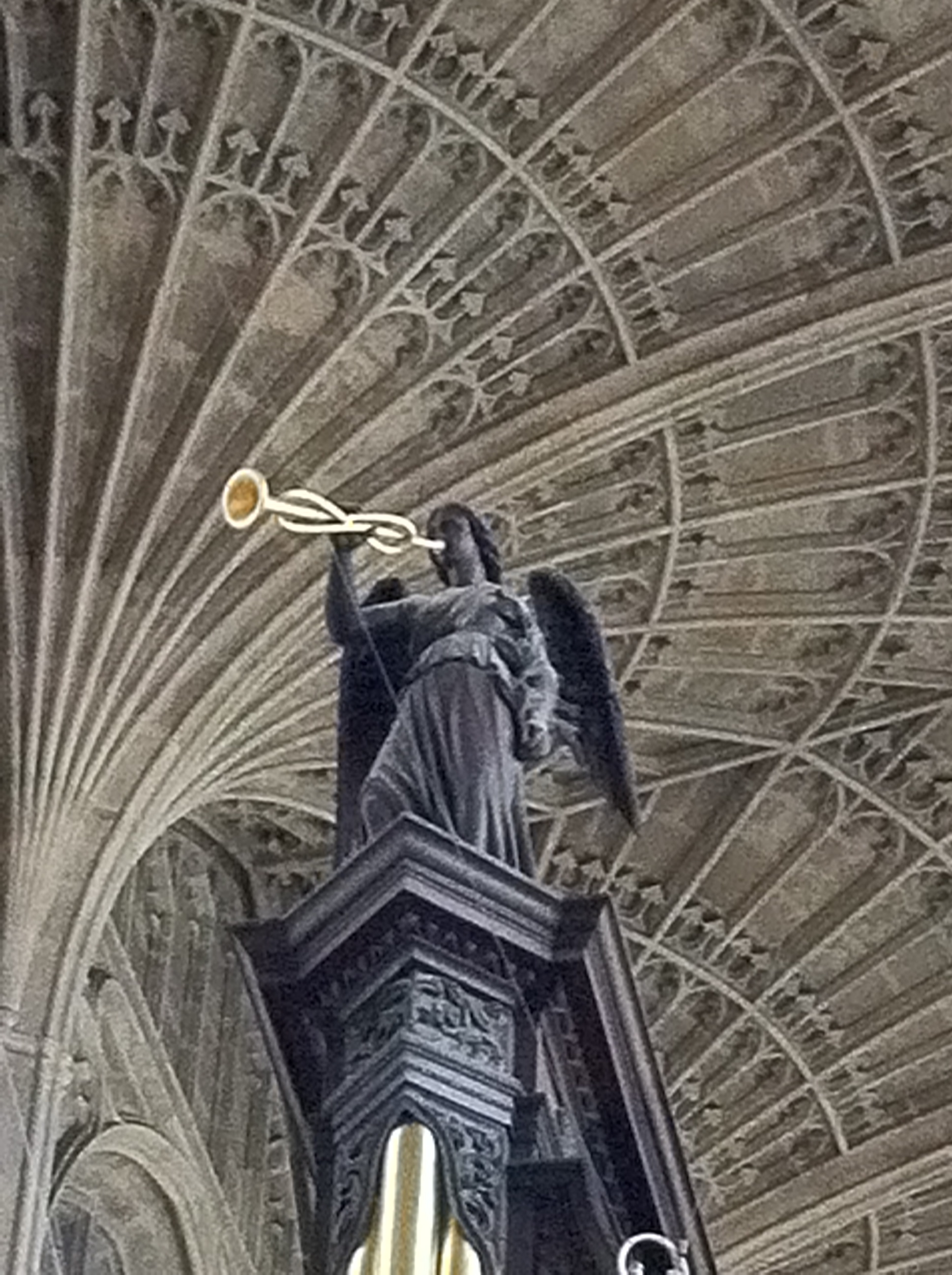
The Bible uses the phrase “fear not” when there is some kind of theophany….some kind of “appearance of the supernatural”. We have forgotten that the Bible is an alien book, from a foreign, strange and sometimes horrific world. It is full – absolutely full – of a kind of monstrous depiction more reminiscent of a Transformers movie than of an English country garden. There are sea creatures that can swallow a man whole, witches that call up dead prophets, armies of skeletons standing at the ready, hell-rain to destroy cities, plagues, pestilences, and a pillar of cloud and fire scalding the ozone in the wilderness. There are angels and seraphim, magical windstorms and signs in the stars.
The understanding of what constitutes holiness, in the ancient Biblical world, was what was “set apart”. And what was set apart was, almost by definition, considered dangerous. When God is a lifestyle option and Jesus a bobble-headed doll, the idea of a terrible presence is something we have moved off to movies about space invaders and genetic mutations. But for the ancients who wrote the Bible, holiness was not just sacred. It was also scary.
And those who think Christianity is all sweetness and light haven’t looked closely at the two defining moments of their faith: the incarnation and the resurrection.
What could be more bizarre and repugnant than the idea of a holy God taking on flesh? The very term – incarnation – shares its root with something like “chili con carne” (chili with “flesh” or meat), which tells us something about Jesus. He was real (all the Gospels agree on this). He was human, which means he had headaches and ear wax and gas problems. If you cut him he bled. And yet he was, according to Christian teaching, the infinite God, somehow collapsed into a puking, mewling, baby with blood pumping furiously through fragile veins.
Holy miracle, freakish myth or monstrosity: a lot depends on your perspective. Given the unnaturalness of the initial story, it’s no surprise that eventually, there were legends about talking animals (run screaming from the barn) and strange foreign astrologers. In our own day, we have seen a whole slate of movies around Christmas that celebrate the monstrous: The Grinch (a monster), Scrooge (who might as well be), It’s a Wonderful Life, Nightmare before Christmas, One Magic Christmas, and the surreal and very spooky “The Polar Express”, just to name a few.
It’s interesting that the same Tuscany that produced the sweet Botticelli cherubs of the Renaissance also is home to the Etruscan urn reliefs. Many of them carry terrible images of the deceased meeting angels who look suspiciously like the modern conception of angels…except that the Etruscans lived centuries before Christ. The ancients weren’t always happy to meet such angels, and so the reliefs often show them carrying goods on their donkey, or sometimes accompanied by a slave carrying gifts, designed to placate the otherworldy powers.
The Bible unflinchingly looks at the “other” and the unusual, and – here’s the point – names it, quite often, as holy. The Biblical God is no stranger to what is different….God welcomes it. In our world, where there are fewer and fewer babies born with genetic abnormalities, and where the rich and stressed can undertake surgery to “correct” the slightest blemish to nose or ear, breast or chin, where is our reverence for what is strange, and our understanding of the holy “other”?
The Faceless Messiah
A half-hour by car, north-west of Siena Italy, sits the lovely little hill-top town of Lornano. Meandering the twisty roads in Tuscany leads to all kinds of treasures, architectural, historical and culinary, and Lornano is no exception. If you escape the late afternoon sun to sit under the trees at the one restaurant in town, you may find that despite their delicious home-made pastas and the Chianti for which this region is famous, eventually you are distracted by the church sitting opposite the intersection.
The little sign outside says it was built in the ninth century, and the Romanesque architecture of the building – renovated in the 1770s – seems to confirm it. It’s a working parish, so there are devotional pamphlets and parish announcements stuck on bulletin boards at the back. The chairs sit haphazardly, perhaps from the last meeting or mass.
At the front, above the altar, is a work honouring John the Baptist. The minimal signage says that the fresco is the work of Giuseppe Nicola Nasini, dating from 1731, although there are other paintings in the small church which originate a hundred years earlier with Siennese artist Bernardino Baroni.
Nasini, lying on his back painting his pigments hurriedly into the wet mortar (the word fresco comes from this process of finishing the painting while the underlying stucco is still “fresh”) might have hoped that his work would survive the centuries, as it has. But presumably, he could not have imagined the oddity that has become his Christ: we see John clearly, sitting on a block of Tuscan marble and under a stand of Tuscan cypress, extending his arm to point to Jesus. Equally clear are the two figures on the other side – Peter and John? – who also observe the scene. The fresco is making reference to the passage from the Gospels where the Baptist is made to say: “Behold the Lamb of God!” To reinforce the point, the artist has placed a lamb to the right of the Baptist.
So far so good. But what Nasini could not have imagined is that, for some reason, the focal point of his fresco – the figure of Christ coming out of the water – is missing. Actually, the figure is not missing. There is a white space in the painting, in the clear outline of a human being, muscular, head turned to the side in an almost Roman pose. But it is only an outline. The details, including any face, are missing.
Whatever mysterious circumstances are responsible for deleting the details of the Christ from Nasini’s painting underline a deeper, theological and historical truth: Jesus, by being the man with no face, has become, over the centuries, the man of a thousand faces. Nasini, despite himself (one imagines) has captured this.
If ever there was an “every-person”, it must be Jesus. He was a Jew, born in what the Romans called Palestine, certainly of Semitic background. This much we know. One could, therefore, expect a certain look of this first-century Jew. Yet Jesus has been portrayed, without apology, as Korean, Nordic, African and North American, and dressed up as a peasant, a worker, a businessperson and a sailor. His eyes, depending on the artist, are blue, or black, or green, and his beard (usually he’s portrayed with a beard) has been just about every usual beard colour but red. Not usually an institution known for its openness and liberality, the church, from the beginning, seemed not only willing to see its messiah portrayed with such flexibility, but was the first to do so. Some of the earliest surviving representations of Jesus show him as a young, beardless male looking every inch a Greco-Roman Dionysus.
In the past century and a half, representations of Jesus have become even more varied, with Jesus showing up artistically as a tattooed gay male, a muscular prize-fighter, a tired soldier, a woman, and a laughing hippy.
The four canonical Gospels seem monumentally uninterested in describing Jesus with any of the kinds of details that now we find so interesting and revelatory. Instead, the Christian writings want to talk about some aspect of Jesus’ significance. What colour were his eyes? One can imagine the author of Mark answering: “what difference does it make? He is the Messiah!”
Paul, the earliest Jesus-follower to leave us much of a written record, is not only disinterested in what Jesus looked like, but comes right out and says that it’s not his concern and he doesn’t much care: “for once we knew Jesus from a human point of view,” he writes to his congregation in Corinth, in a phrase oft-quoted among Biblical scholars, “but we know him this way no longer.” Once you are the Messiah, the little details of your life don’t count. End of the subject.
A Jesus who can be “every man and woman” can appeal to every man and woman, and this surely must be one of the reasons why fact-laden Jesus biography was never big on the church’s list of priorities. The changeability of Jesus’ appearance turned out to be a big part of how to translate the message, not only linguistically, but also culturally, to new locations (note that Nasini’s John the Baptist is sitting on Tuscan marble below what appear to be a stand of Tuscan cypress trees). Every church, in every age, has translated the Bible into its cultural and geographical present….for which, to take Renaissance painting as an example, we are forever grateful. But we should remember that the church’s main reason for this flexibility was to aid the spreading of the Christian message. In Matthew’s Gospel, Jesus is portrayed, at the last judgment, as sending all humanity off to either heaven or hell with the words: “whatsoever you did to one of the least of these – in whom you should have seen me – you have done to me.” Thus both the church’s apologetics and its social concerns are based, in part, in seeing Jesus somehow embodied in others. Add to these practical rationales for ambiguity the mysticism of Paul, who concentrated on the believer being somehow incorporated “in” Christ, and you have every reason for a “Jesus for all time and all peoples.”
The little church in Lornarno holds a minor piece of art that contains a major theological truth: Jesus is most Jesus-like when he looks like our neighbours. Where do we find Jesus? Not in the Holy Land, but perhaps even right there, across the intersection, on a hot summer’s day.
The Life of Riley
The Life of Riley
This last week I told two people that at 53 years old I am “living the life of Riley.” Neither of them knew the expression, which made me wonder if it’s one of those fragments of my growing up in the west, or, more likely, of my age AND of growing up on the Canadian prairies.
No one has ever defined “living the life of Riley” for me, but I’ve always thought it meant doing what one pleases, and being completely pleased with what one is doing. An example might be Tom Sawyer, floating down the river with Huck Finn on an adventure, or the main character of the movie “Into the Wild,” just enjoying the view as he criss-crosses the United States on his epic adventure: canoeing, reading, working only as needed, and meeting new people all along the way.
Whether the expression originates with an American TV show from the 1950s or from the Irish O’Reilly clan much earlier, the problem with the “life of Riley” as the expression is used now, can be that it means one is doing everything except what one should. In other words, the suspicion is that a person who lives the life of Riley is avoiding responsibilities.
But does it have to mean that? It might never be possible to line up one’s pleasures and one’s responsibilities entirely (some tasks are just chores, no matter how you dress them up), but when you are lucky enough to find jobs to do that you enjoy anyway, it seems to me that you can avoid the kind of drudgery we often associate with what we do.
I’ve been reading a book called “The Happiness Hypothesis” by Jonathan Haidt. Among the many, many things he says, the author discusses how most jobs – even those we usually consider dead-end or lacking value – can take on meaning when those who do them are allowed a say in setting the parameters and goals of the job, and in working with a team of others in doing it. Haidt calls it “self-direction”. The hospital orderly who does what most consider the menial tasks of cleaning bedpans and lifting patients, he says, if she is made to feel part of the overall team of healers and care-givers (which in fact, she is) and if others in the team are encouraged to see her this way, can have tremendous job satisfaction in knowing and being affirmed that she is doing a noble thing.
Somehow, at this point in my life, I have found myself in this situation. Being a part-time, contract lecturer at the university, I am forced into the position, often, where “my” classes are taken away, and in order to work I am obligated to design new ones. What seems a tremendous and annoying chore to others I’ve described this to, is for me, really a blessing in disguise. By having to design new classes I not only set my own parameters for teaching and for student success (within the overall expectations of the university). I also get a chance to exercise one of the qualities in myself that I value most: creativity. And the department, in turn, values these creative new offerings, so as part of the teaching team my work is then validated.
Likewise in the parish: as a part-time minister I have a flexibility that is simply not there in most positions. If there is a death in the parish or an emergency of some sort, of course I have to respond. But much of my time is open-ended: I can call a family to visit, I can write an article about the parish for a church or Finnish publication, or I can go and clean the office…..it’s entirely up to me.
Of course this kind of life and lifestyle is privileged. Most of the world does not have this chance to choose how they earn a living. The Bangladeshi worker in bare feet on a factory floor or breaking down old ships in inhumane and poisonous conditions, or the many many unfortunates in the world (even, to our shame, in Canada) who live and work in real enslavement dream of the basics of safety and freedom. Fulfillment is an extra. We owe them justice.
But even so I don’t believe that the “life of Reilly” requires a lot of money. And in my case, it only comes in exchange for a certain insecurity (contract-work) as well.
Anyway, I feel very, very fortunate. My time is flexible, I earn much more than enough for the basics, I have traveled the world over giving papers and presentations for the university and the church, and those natural characteristics I value in myself, the things at which I am best – coming up with new ideas, expressing myself, communicating with others, affirming and celebrating social groups, finding wonder in the world – I get to do not only at work, but FOR work! How very blessed it is.
I’m thankful for this ‘life of Riley.’
July 16, 2012
Peopled by the Book
Peopled by the Book
When I was at Wilfred Laurier University for our church’s 2012 Synod Assembly my friend Tim Hegedus handed me an article and said “you have to read this.” I’m so glad he did. It was by our mutual friend, Allen Jorgenson, who is assistant dean of Waterloo Lutheran Seminary, and a professor of systematic theology there. It turned out to be one of those pieces that are wonderful to spend time with….interesting, provocative, and thoughtful. Like a really good conversation that leaves you thinking and maybe even changed.
Allen believes that scripture is not just something that we can take or leave, assent to or feel guided by, but that the relationship is much more dynamic and – more to the point – much more guided from THAT side (the side of the scriptures) than by THIS side (the side of us readers). Thus his title: “peopled by the book.” As he says “Scripture…cannot be construed as a bill of goods that we accept – or not – rather, it is the communal means by which we are spoken into being by the God of life.”
He also speaks in the article about how we are all “predisposed to relate with those who think like we do”, so perhaps I should admit that some of the reason I liked the article so much is that many of these thoughts are similar (if better expressed) to thoughts I have been turning over and over for years. One of the chapters in my doctoral dissertation was on Ricoeur’s ideas about rhetoric “creating worlds”(based in turn on Gadamer, at least, as well as I understand him) and I tried to bring this view of the creative power of words to bear on Paul’s use of rhetoric in 1 Corinthians. As well, I’ve been especially aware of the specifically creative power of scripture since reading Hans Frei’s “The Eclipse of Biblical Theology,” which makes a similar point to Jorgenson’s article, again however, with much less elegance. Especially Frei-like (in thought, at least) was the phrase in his conclusion: “Not only is this a book that we read, but it is a book that writes us into the book of life by including us in its very plot. Scripture scripts us.” I will be reflecting on that quote for a long time.
There are tons of memorable, well-turned and descriptive phrases here. I love the idea that scripture equals “the visitation in the present of the church catholic” and that “empowerment is at the heart of the redemption that is reading scripture.” And the image of scripture being “rather like a lung” is a jarring and original idea that really helps explain the back and forth of the process he describes.
I was glad that Tim Hegedus (himself a professor of New Testament at Waterloo Lutheran Seminary) passed on this article, and very happy to have spent some time with its thoughts. There’s been some talk at Concordia’s Dept of Theological Studies where I lecture recently about how we have Biblical Studies and we have Theology, but we don’t talk much anymore about Biblical Theology. It seems to me that such an article is really very important for our understanding of Biblical Theology, which is after all, at least in my opinion, what Luther was all about. Perhaps that’s one of the gifts we Lutherans can offer the wider church and academic community both.
Allen G. Jorgenson. “Peopled by the Book,” Word & World. Vol 29, no 4, fall 2009: 325-333.