Categories
Uncategorized

Fresh Trout after the Prestergatta


Day two of our pilgrimage through Iceland: We’re sitting, eight Canadians and ten Icelanders, at one long table. Our host, Hulda Gudmundsdottír, who has put us in her renovated barn (barn being a word that hardly describes the luxury of the place) comes around as we finish our meal of lake trout, potato salad and greens. Did you like the fish? She asked. I went out and caught it with my son in nets, three days ago.

The fish is only one of the wonders of this place. Elínborg Sturludottr led us along the prestergatta today, the priests’ path from the small church where we had our matins (morning devotions) to the even tinier church where we had our vespers (evening devotions). Our other priest guide, Floki Kristinsson tells us that the morning church was built on the site where Rudolf, the English monk who had accompanied St Olaf up to his death in 1030, came that same year to Iceland and started the first monastery. The Icelanders are a fun group, their humour in contrast to the starkness of this land. For the first time today, we came across what we Canadians call real trees. The Icelanders told us: what do you do if you’re lost in a forest in Iceland? Stand up. At which they laughed uproariously. We climbed up and out of the fjord this morning, 1000 feet, and came down the valley to this beautiful lake setting. In passing we were offered an unexpected afternoon coffee and some sort of sweet flatbread, by an Icelander who is interested in our pilgrimage. This place, including the people, is truly a place of wonders.

An extra treat on this blogpost: fellow pilgrim, Ásta Camilla Gylfadóttir, reads a short Icelandic folktale titled: The church builder at Reyn. Click on this link for her lovely diction and accent!

July 20 afternoon coffee
July 20 afternoon coffee traditional Icelandic cottage
Categories
Uncategorized

CBC Interview on Icelandic pilgrimage

turning at the crater

July 2016 interview with CBC Radio One Montreal show ‘All in a Weekend’ hosted by the gracious and thoughtful Nantali Ndongo, about my pilgrimage to Iceland: http://www.cbc.ca/news/canada/montreal/programs/allinaweekend/pilgrimage-to-iceland-1.3692347

Categories
Uncategorized

Jihad and I on Pilgrimage

2016-06-04 13.55.39

It’s been over a month now since I joined Prof Sara Terreault and her class for the third annual pilgrimage between Montreal and Kahnawake Mohawk Territory. The students were fantastic – interesting and interested, willing to learn and to dive into anything (even, sometimes, the water). Jihad T was a student in the class and was gracious enough to join me for two interviews, one in French on Radio-Canada (see the “interviews” link above) and the other in English, on CBC One’s ‘Home Run’ program. Thanks to M, who made the interview available to us! Have a listen! 

Categories
Uncategorized

Crossing the Line

clouds and direction sign over SC SK

“Well, you know, it’s just across the Line,” my aunt said to me, about a town in North Dakota that my cousins were visiting. I haven’t heard that word for a while. In Montreal they don’t use it. But I grew up in Saskatchewan hearing it. “The Line”. Do you know where that word for the US border comes from, I asked my aunt? “No idea,” she answered.

Today is national aboriginal day. The 20th such day, and the first since the Truth and Reconciliation Commission issued its recommendations. Though it’s a small thing, one of the things we who are Settlers can do to mark this day is to remember where some of our words come from. They’re signs of a history willfully forgotten.

I grew up in Treaty Four land – except there were no “Indians”. The First Nations were, for me, like the ancient Egyptians: important people no longer around. What I DIDN’T know, because it wasn’t in my schoolbooks or taught in my classes, or talked about by my parents or grandparents, was that the original inhabitants had only been gone 85 years or so when I was born. The big secret I learned only years later was that they had been pushed off the land they had just signed title to, to make way for people like my grandparents and me.

Using the word “The Line” for the border is a relic of the days not so long ago when the 49th parallel was called “The Medicine Line” by the First Nations, especially the Lakota. They could cross it and the American Army, who were fighting a vicious battle with them south of the border, would not follow. This was good medicine, and at the time, the Canadian government was generally respected for such protection. Soon enough, our government starved the Lakota back south, and pushed the so-called ‘Canadian Indians’ north by starvation, an intentional policy to make an “Indian-free” land-belt for the railroad and its Settlers.

When we say “the Line” for the border, we echo those days. Even better, then: let us actually remember them – with honesty, apology, and intent to make good what was wrongly done.

Categories
Uncategorized

Mirror-Pilgrimage Day

Paroisse St-Lambert angels
photo: M. Anderson, Paroisse St-Lambert, 2016

Today is mirror-pilgrimage day. There are many forms of pilgrimage. But what most people think of is fairly straightforward: 1. travel to some holy place, 2. receive a benefit, and  3. return home, changed, usually with 4. tokens of the visit.

Not today. This is a strange day, at least in Christian tradition. Yesterday was Good Friday, the remembrance of Jesus’ crucifixion. Tonight’s Vigil and tomorrow morning’s Easter Sunday are all about resurrection. But there are some missing hours there. What did Jesus do in between?

The Jesus Testament (I stole this term from my friend Allen Jorgenson) is strangely quiet about this dark, in-between, un-day. Jesus-believers eventually came up with the doctrine of katábasis, the so-called descensus ad inferna – the descent to hell. To me it’s the perfect mirror-pilgrimage: 1. Jesus, the ultimate pilgrim, travels not to the place of holiness but to the place of ultimate UNholiness. There, instead of receiving a benefit from some saint’s surplus of merit, the tradition is that 2. Jesus shared the benefit of his own, breaking the walls of hell and liberating all the captives of Satan. And instead of bringing back a compostela in 3. the resurrection, 4. Jesus’ pilgrim badge, his keepsake, was the long train of ‘souls’ he brings back with him on Easter morning.

Mirror-pilgrimage day. Don’t go out and buy a card. As a new holiday I don’t think it has a lot of traction. But it’s an interesting thought.


Categories
Uncategorized

my daily walk

IMG_4357

Sebastien Caquard, a professor of geography at Concordia University, introduced me and Sara T. to two new mapping applications one can use to chronicle journeys. We’re thinking of using it for the pilgrimage class we co-teach, but in the meantime I tried it out on my 5 km route home from the office.

http://www.tripline.net/trip/Flaneur_Montreal-Verdun-462717565221101183CAC5DFFF2CD21A?n=81#photo

Categories
Uncategorized

And I Have Felt a Presence

2015-07-26 10.57.57

For I have learned

To look on nature, not as in the hour

Of thoughtless youth; but hearing oftentimes

The still, sad music of humanity,

Nor harsh nor grating, though of ample power

To chasten and subdue. And I have felt

A presence that disturbs me with the joy

Of elevated thoughts; a sense sublime

Of something far more deeply interfused,

Whose dwelling is the light of setting suns,

And the round ocean and the living air,

And the blue sky, and in the mind of man


(William Wordsworth, Tintern Abbey, July 13, 1798)

Categories
Uncategorized

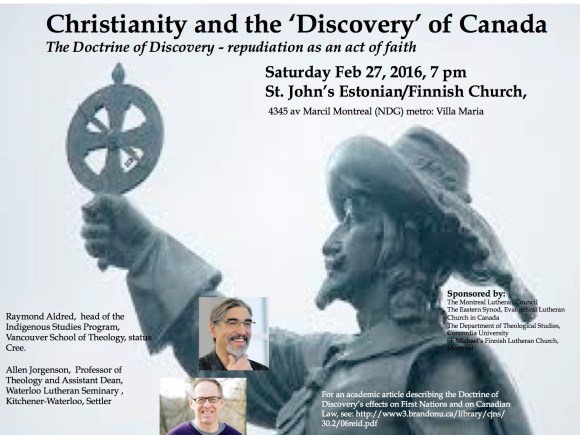
Repudiating the ‘Doctrine of Discovery’

Coming in February 2016. Watch for more details!

poster one JPEG version

Categories
Uncategorized

Pilgrimage and Tourism

sunset at Round Lake Aug 2015

this is the second part in Sara and my discussion of pilgrimage, where we focus on the differences – and similarities – between pilgrimage and tourism, and Sara introduces the ‘Grand Tour’

Categories
Uncategorized

Far from One’s Earthly Home

(this is a guest blog posting on postmodernism and pilgrimage, by Sara Terreault, my friend and pilgrimage studies colleague. Her thoughts were inspired by the questions and comments posed by another of our friends and colleagues, E. Moore Quinn. Their back-and-forth conversation was too good, and too detailed, to leave in the comments section!  MA)

Hi Eileen,

Fancy meeting you here: do you come here often? 🙂

Great questions.  I should be grading papers but cannot resist jumping in.  Here goes, a few note-form thoughts in response to your thoughts:

1) “postmodernism (cultural orientation)/postmodernity (historical time period)”: well, literally “after modernism/modernity”.  So applies to cultures that have been shaped by modernism (or in short, the so-called “Enlightenment Project”), but have grown suspicious of modernist assumptions and values, so

1a) Enlightenment Project, a meta-culture (birthing the so-called universalist  “metanarrative”) consisting of : i) anthropology: human person as primarily (or ideally) interior, individual, rational, and, once freed from the tutelage of superstition (incl “religion”) capable of solving all human issues by exercise of rationality); ii) epistemology: rational, objectivist empiricism, privileges scientific method;  iii) ontology: materialist, immanentist.  Implications: the eclipse of the transcendent, the spiritual/religious, the affective.
1b) Romanticism (late 18/early 19th c.) a reaction/response to the hyper-rationalism of the Enlightenment, but which nonetheless retains the individualist interiority of Enlightenment anthropology … however privileges affectivity, intuition, arts and artists, rather than empiricist rationality and science.  Romanticism has an ambiguous relationship to “religion” and I think we can see there the roots of the contemporary postmodern “spiritual but not religious” (re-opens the door to the re-entry of transcendent reality, but not through traditional “religion”).
1c) Finally: postmodernism: disparate cultural movements that have challenged the assumptions and values of the Enlightenment  and  to some degree Romanticism.  It is paradoxically both hyper-modern and anti-modern.
1d) postmodernity: When is this? This will be endlessly debated, but it makes sense to me to place this post WW2, when all the certainties of modern hopefulness in humans and their “brave new world” lay in ruins after the horrors of two world wars, genocide, totalitarianism, atomic weaponry: our lovely individualist, scientific rationalism has *not* saved us after all. Now what?  Western (modernist) culture fragments into many small cultures (mini narratives) privileging the local, the plural, the diverse, the contingent, the social
2) Shrines, relics, pilgrimage and postmodernity: I’ll suggest that the “shrine” is the in-dwelling place of the divine, “relics” are the meaning-imbued and empowered material memory of the holy one (saint) and the holy experience (in this case, pilgrimage); and “pilgrimage” is physical (or in some cases only spiritual) journey for and to self-transcendence.
2a)  i. The shrine may indeed be spatially located, architecturally realised.  But it is also (at least in Christian tradition) interior, spiritual and personal: “You are the temple of the Holy Spirit” (1 Corinthians).  For postmodern people, the secularity of modernity means that attachment to and experience of traditional religion is often thin or very thin.  Yet the desire for and valuing of the transcendent is nonetheless strong, but is expressed largely privately (religion having been banished from the public square).  So the interior understanding of shrine is “natural” to us postmoderns (we are perhaps just a little bit gnostic in our tendencies …).  We may structure our spirituality on aspects (and in the case of pilgrimage), on locations of traditional religions) but we do this largely individually, partially, and with great focus on interiority. ii. peregrini:  I totally agree that postmodern pilgrimage’s “interior shrine” is in many ways like that of the Celtic peregrini pro Christo whose pilgrim journeys were not toward any wrldly centre, that is toward any spatially/materially located shrine, but rather away from the “centre” of the earthly home, familiarity, comfort etc. Their “destination” is not spatial/material/earthly but rather eschatological, and their only earthly material shrine is their own pilgrim bodies. iii) Relics: the material and sacramental traces of holy people, places, memories.  Not a long way from a strand of hair in a locket, or a pilgrim badge or tattoo, or a burden stone to be left on the road, or a postcard or souvenir …
Your further thoughts?