Categories
Uncategorized

Life is Beautiful

IMG_3263

Life and Death Pilgrims

One of the dilemmas – or opportunities, depending on how you look at it – of sitting in a lounge in a large hotel is overhearing the conversations of other guests. As much as I was trying to focus on my own work, the conversation of a family several tables over kept intruding on my mental space. Both father and grown son were doctors – the father retired, the son in the middle of his practice. While I struggled to think about pilgrimage and the concept of liminality, they got onto the topic of “end of life practice” in hospitals.
“My tendency is to be up front,” said the son. “That’s the best. My colleagues act all coy, but when I walk into a room I want patients and their families to know when the quality of life is just no longer there.”
“Better to be honest,” the mother agreed. “You’re not helping the family if you hide them from the truth.”
“We all gotta go sometime.”
There was silence a second.
“Except that we’re not always right,” the father spoke into the pause. “That’s one thing I’ve learned.”
“Really?” answered the son (I wasn’t sure if he meant: really, we’re not always right? Or: dad, really, you’ve learned that?)
That was when I realised they were talking about the same thing I was thinking about: liminality.
Pilgrimage, among other things, is a chance to practice at life and death. It’s “heightened” time, time intentionally taken away from the stultifying but often necessary routines that make our days such a blur of appointments and distractions. In that heightened (some would say “liminal” or “threshold”) time, we have the chance to re-order our priorities, forgive ourselves or others, and – perhaps – set some new directions in the face of our own mortality.
Embarking on a modern-day pilgrimage is an intentional act of flirting with edges – the edge of one’s quotidian experience, the edge of comfort and sometimes the edge of one’s physical capabilities. And, in one sense, the edge of life. After all, as much as we hide it from ourselves, we all know, down deep, that, as the young doctor said “we gotta go sometime.”
Funny then, that the very next thing the son did was to pull out his smart phone: “look at this,” he told his parents, “I took it just before I left.” And what I heard over the oohs and ahs of the grandparents was the sounds of a young child – a two or three year old – playing.
“Isn’t that beautiful?” they said.
Indeed, life is. Pilgrimage is a way of reminding ourselves where we’re headed. And that we’re not there yet. Both. Life IS beautiful. Which is why we should make the most of it.

Categories
Uncategorized

Memory Files

Pre-K in Swift Current

Memory Files

Early in the New Year, for almost 25 years running, I’ve created what I call “memory files” for my family. Setting them up long ago became one of those January traditions, along with packing up Christmas decorations, transferring appointments to the new agenda, and throwing out the December eggnog that seemed like such a good idea to buy at the time. Memory files are hardly a new idea. Maybe you do the same thing. They’re nothing special – just those plain, cream-coloured manila file folders we all use. But with these particular folders, I sit down every January and carefully print someone’s name and the year. Then, throughout the twelve months, if there’s a concert my daughter performs in, a card from a special aunt or uncle, some doodling, a to-do list that really says what’s happening in our lives (pay violin lessons, call re: job offer) or maybe even a little hand-written note – “gone to the store; I’ll be back in twenty minutes”, I might keep it and, at some point, toss it in the file.
I keep one for myself, too. Looking back, it’s interesting how the width of the folders changes, depending on the year. Which means, I guess, depending on where I and my kids are in our lives. From the halcyon years when the kids were young, the file folders are like horns of plenty: spilling with colourful bits and pieces. In those years, scrapbook pages and school drawings and construction paper in bright oranges and blues and reds and greens bulge out of the files, all fighting for attention.
These days, not so much. The files are neater, more organized, and much, much slimmer. There might be a strip photograph of teenagers taken in one of those photo booths at the mall, or a ticket stub from a “One Direction” concert, or a ribbon from a sports event, and not much else. Actually, these days my file is looking thicker than my kids, which doesn’t mean that less is happening in their lives, only that I’m less a part of it. With my grown sons I’ve gone through, already, that awkward stage of not quite knowing why I’m even keeping a file, and then, finally, realising that our daily lives just don’t overlap enough for me to “file” much.
The word “keep-sake” is interesting for what it doesn’t say. Keep for the sake of what? Or whom? For a couple of decades I have been keeping, I suspect, for my own sake more than anyone else’s. At some point soon, I will have to divest myself of at least some of these memories, and it will be up to my children to claim which memories they want to treasure, and which are ready to be let go.
Only a few years ago I found a little box in the storage unit where my father keeps his things. In it were dumped all kinds of detritrus having to do with my young life: the ribbon that I won at a Science Fair in grade six, a photo of a clean-cut little blond boy with a bow-tie that I struggle to see myself in, and more school graduation bulletins than a person can ever reasonably expect a parent to suffer through. But suffer they did, and they kept the papers to prove it.
It was such a pleasure to open that box and sift through its treasures. Some of the memories were painful, but many brought a smile to my eyes. And some of the items brought tears. Our memories of our families are so short. For all the stuff that we accumulate, precious little of it has meaning beyond a generation or two.
But, at least for now, I will keep collecting. It may be that, years from now, some little item that I scrounged from recycling will be picked up by hands younger than mine, turned over once or twice, and with a “well, will you look at this?”, will be shared. And then the circle will be complete, and the memories not just filed, but fulfilled.

Categories
Uncategorized

Snow Angels (a poem)

The Gates of Heaven Jan 1 2012

Snow Angels

High banks, cast up by wind and plow,
heavy as crowd barriers against my thighs.
I lift one leg, then another, an exaggeration of walking,
cheeks red-raw into a westerly, boots somewhere below.
I cannot see my feet.

All I wanted was a photo.

I manage, with clumsy fingers, to put one mitt more or less back on,
then another.
The stone angels are motionless, arms frozen.
As I would be too, were I – just a little lower than them – to linger here,
in the company of January.

Categories
Uncategorized

The Most Beautiful Thing

South SK River Nov 2012

This is a radio drama I wrote some years ago, that was produced and broadcast by CBC Radio One in the 1990s. It was one of the winners of a “radio drama” script competition….back in the days when there was much more radio drama! My thanks to the actors and the director who made the script come alive. I’m glad to find a home for this piece here on Something Grand. The radio play is 14 minutes long, and you listen by clicking on the title below. I hope you enjoy it!

The Most Beautiful Thing Radio Drama

Categories
Uncategorized

Yard Art Love – a sort of Advent Story (Maisonneuve Magazine 2005)

Christmas in Verdun

There I was, butt-up, head-down, outside at midnight in my dressing gown. Smack-dab in the middle of lining up my plastic snails, someone at Hydro threw the city’s breaker. The darkness was just so – you know – total, with no big fat moon sitting like a pumpkin just over the neighbor’s clothes-line, that I lost the snails for a moment. It kind of makes you think you could be anywhere. Or anyone. It’s like when we were St-Henri girls pulling down the shade pretending to be camping dans les bois even though we could still hear the humming of the fridge downstairs and the adults talking, voices rising and falling with the rye and coke, the shuffling of cards, the arguments, the calling through the screen door for fresh packs of du Mauriers.
It wasn’t easy making it all the way back to the porch in that kind of blackness. Every footstep’s a decision. I closed my eyes – for concentration – and figured my place in relation to the big cement angel fountain in the centre of the yard. Saint-Gabriel help me see my hand in front of my face, I said, and then I just went. Stepped right around the flock of pink flamingoes, each with their one foot up, waiting. Inched my feet around the frog, knowing the little rascal was there, even without the sound of water shooting out of his mouth. Pictured the glass fairy globes on their poles so clearly I could touch them, passing. Waited till I could hear the lazy clack-clack-clack of the windvane duck, so I wouldn’t bump it off its tethered flight.
I heard geese that night. I swear I did. It was a remarkable Passover. Their calling out in the high darkness to each other made me look up. Oh my God yes. If it’s true what they say, that in this world there are ghosts wanting bodies, then they could have had mine. Perhaps they did.
The night drifted, with the streetlights out. I don’t know, I really don’t – what happened, exactly. Stars trespassed the city, came up my street, crossed my eyes. I fell right over the yard butts (a family of four in descending girth, thick white legs like sausages from their slacks), still looking up. Don’t know how long I sat there. Like eating candy at the drive-in. A good long while, I guess.
What we long for, we live in fear of finding, open and waiting, wanting nothing more than to fall into our laps like fruit off the trees, forever luscious. I’m not saying it was the stars, exactly. But two things happened that night: my troll disappeared, the one sent to me by my mother’s cousin’s sister (somewhere in Norway, I’ve forgotten where). That nasty short fellow with his long nose never did fit with the leprechaun. Better he’s gone now.
And best: I sit on the porch, growing fatter and closer to term with my precious little baby each passing week. A real-estate agent came by today, a nice man in a fancy car, sweating in his spring suit as he hung over the fence trying not to look at either my big belly or the manger scene (I decided to leave it up at Christmas). He said “Ms. Elizabeth, I could sell your house for a lot of money.” I told him about the ultrasound the doctor ordered, about the bulb in the streetlight over my yard that keeps burning out now, the city crews that come back every few weeks to repair it. I showed him how my ankles have swollen with the edema. I asked him about my collection – what would happen to it if I sold? But he didn’t really answer. Eventually he left, my leprechaun making rude faces after him.

Categories
Uncategorized

Vulnerability

They say we’re our own worst critics. I suppose in one sense that’s true. But it’s also a strange and not very comfortable feeling to stand in the semi-darkness at the back of a crowd of people while they’re watching a documentary you’ve been putting your heart into for months, waiting for what they think.

Monday last, on November 19, I had the Concordia University premiere of “Something Grand”. Tons of people showed up; estimates were just shy of 200. We filled the place. Those of us who’d organized the evening – thanks Adan! – kept pinching ourselves as more and more came through the doors. To our amazement the floor chairs were soon full and we were putting viewers into the balconies. Many of the faces were familiar, but not all. Certainly I’d pulled in all the friends and family I could. But there were many, many more as well – students, professors, Camino walkers who’d heard about the film on the radio, others who knew of it through contacts or posters. Three of the pilgrims I’d interviewed in Spain came to Montreal for the premiere. M, from Georgian Bay ON, came with her husband. And the delightful (and fabulous) S and J put on their premiere outfits and diamonds and looked like they could have been walking down a Hollywood runway. They’d come all the way from Florida just to be there with us and acted every inch the “celebrities”.

Luke, the musician we’d hired to play spanish guitar, was excellent. The speeches were….well, they were speeches…but some managed to point quite well to what pilgrimage really is, and the importance of studying this exceptional social and spiritual revival. When the lights finally dimmed, there was a buzz of excitement in the room. Or maybe that was the butterflies in my stomach.

We spend so much of our lives learning to avoid being vulnerable. In elevators and on the street we keep our eyes to ourselves. If we allow ourselves to cry at funerals or films it’s discreetly; we hide our tears. The word “sensitive” isn’t a compliment. But then we try our hand at something “creative” or “artistic”. And surprise, surprise: we then discover that in order to make something good, or true or beautiful we HAVE to open ourselves up to others. We have to FEEL with them. And we have to make ourselves vulnerable too – and show our dreams, ambitions and flaws. Which is to say: we have to risk.

The premiere was a smashing success. Now I want more people to see the documentary. Its strength is clearly not its technical aspects (despite some miracles of editing by M, Z and P). It’s in the relationship I had with the people I interviewed. The author Jonathan Lear, in his book Radical Hope, says that we human beings are “born into the world longingly”. One of the things we long for is real, genuine contact. Both the documentary and the premiere offered a glimpse of that. And that is worth all the vulnerable risk in the world.

Categories
Uncategorized

Uncle Carl’s Requiem Aeternam

Today is All Souls’ Day. It’s a sort-of All Saints, which was actually yesterday, Nov 1. That still might mean little, but in essence says that today is a day for remembering loved ones, and (if one is so-minded) praying for their memory.
I’m not an Anglican. But Anglicans do All Saints so well that days like these make me just slightly envious. The hymn “For All the Saints” is perfect, and perfectly Anglican: all pomp and circumstance, with a feel both global and sentimental, pious and restful and stirring in a sad, masculine, military sort of way, all at the same time. One can just about hear the British Empire and God’s mirrored and more perfect realm echoed in the words”…the golden evening brightens in the west…. while yet there breaks a still more glorious day”.
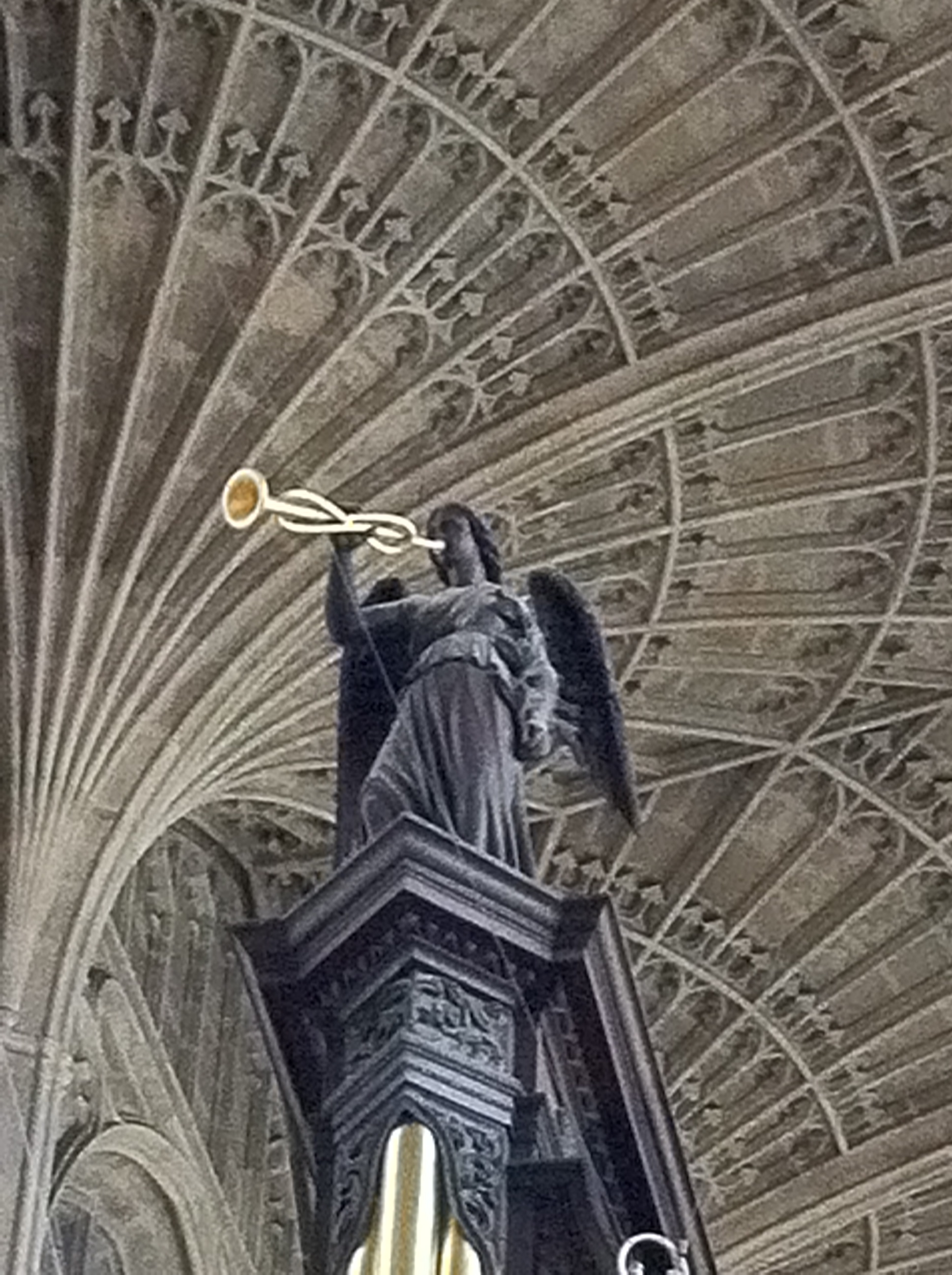
It perhaps takes something as solid as the Anglican church to really mark the permanence we hope that our loved ones enjoy. There is a weight of history, for instance, to the high wooden vaulted ceilings and the Gothic walls of a place like Cambridge’s Kings College. Or even, more locally, the jewel that is St James the Apostle Anglican, Montreal, where I visited with my students on Hallowe’en (All Saints’ Eve). There are so many memories in such places, and such rare beauty.
But this year the person I most remembered was the one person who would have felt most out of place in such a (as he would have called it) “high falootin'” environment. My uncle Carl was a simple man, if anyone can truly be called that. He never had a great education, and left school to take over the farm at the age of 12. His grammar was terrible and his habits, frankly, not the best. But his heart was kind. And he managed to travel the world enough to inspire me, decades later, to follow his tracks. My childhood years are sprinkled with postcards he sent from places like Japan, Morocco, Gibraltar and Germany. The first time I ever rode a camel (in my case, in Palestine), I thought of Uncle Carl, grinning out from beneath a straw hat in a photo he had sent in the 1960s. All I was missing – thankfully – was the big cigar and loud tropical American shirt.
When we honour “our” dead, something mysterious happens. We are changed. Perhaps it’s an act of memory, perhaps of alchemy, but they come alive again, if ever so slightly, by our remembering. And more importantly perhaps, we recognize in what parts of ourselves, our habits, our dreams, even our physicality, they live on.
So here’s to whomever it is that you remember. Requiem Aeternam, Uncle Carl. “What? What’s that? I don’t understand that kind of stuff,” I can see him pushing his cap back, scratching his head, laughing that big laugh that means he doesn’t really understand, and frankly, doesn’t really care.
“That’s fine, Uncle Carl. God doesn’t need us to understand to bless us all the same. Requiem Aeternam.”

Categories
Uncategorized

Premiere of “Something Grand”

final poster Oct 2012

Categories
Uncategorized

Guy Delisle’s “Jerusalem: Chronicles from the Holy City”

“Have you read the Guy Delisle graphic novel Jerusalem?” wrote my friend C, who sometimes pops into my inbox with interesting ideas and comments on life. “Since you were recently there,” she went on, “you might find it relevant, or maybe even entertaining and heart wrenching. There is even an important character at the Lutheran church.”
This was my first ever recommendation to a graphic novel. Had it been about vampires or medieval Spain I might have balked. But Jerusalem is….well, it’s Jerusalem. As you’ll know if you’ve been there, there’s no spot on earth quite like it. I was interested in seeing what a cartoonist would do with the place, that hasn’t already been done by Jews, Arabs, Crusaders, religious zealots, Zionists, Muslims, Christians and the million other types of people who seem to have a deadly interest in these few acres of the not-so-holy Holy Land. Besides, where else does a best-seller feature a Lutheran pastor, even in a small cameo appearance?
I got the novel at the library, and started reading. And C was absolutely right: I did find the novel relevant. And entertaining. AND more than a little heart-wrenching. And because, with the Waterloo Lutheran Seminary group I visited the Lutheran chapel and hospital at Augusta Victoria in East Jerusalem, right above the Mount of Olives, I wanted to see it again, through an outsider’s eyes. It turns out that, unlike the omnipresent dividing Wall (which features again and again in the book), Augusta Victoria became a place of rest and reflection for the author (Delisle became friends with the Lutheran pastor, who is a comics fan, and had his studio there).
I’m not a follower of comics and despite his success, I didn’t know Delisle’s work. He’s a Quebecois who has lived many years in France. This book (originally published in French, English translation by Helge Dascher, published in 2012 by Quill & Quire of Montreal) is the result of his family’s one-year stay in Jerusalem. During that year Delisle took care of the kids and sketched while his wife worked for Medecins sans Frontières in the West Bank and the Gaza Strip.
Get this novel and read it. It’s worth it. Firstly, Delisle is honest but hilariously understated in his portrayals of life in the so-called Holy Land. There’s no shouted polemic. Instead Delisle’s slightly dopey, typically nice Quebec/Canadian alter-ego meanders through, and chronicles, the absurdities that seemingly pop up everyday in and around Jerusalem: an Israeli soldier with a massive machine gun slung in front of him and an equally large guitar slung over his bag, Palestinian women shopping in the settlement grocery store the expatriate workers from overseas, in solidarity with Palestine, have been so studiously trying to avoid, Christian priests coming to blows over which part of the Church of the Holy Sepulchre is theirs, Palestinian children afraid to go to school in the West Bank because of the settlers and Israeli taxi drivers afraid to go into East Jerusalem because of the Palestinians. One of Delisle’s funniest lines is “thanks God for making me an atheist”.
The most touching, and yet still understated, part of the book is at its end, as the family prepare to leave after their year-long stint. But I won’t spoil the ending for you. Read it yourself. Jerusalem: Chronicles from the Holy City is the kind of book that, like a seemingly harmless “nice guy”, sometimes surprises you. Delisle’s everyman is a sharp-eyed observer, and this novel has a punchline, even if you have to look for it.

Categories
Uncategorized

The Cowichan Sweater

The Cowichan Sweater

Over a quarter-century ago, before they came back into fashion, my father was throwing out some of his clothes. One of the items was a Siwash sweater he’d worn in the late 1950s and early 1960s. If you’re unfamiliar with the term Siwash, they are also called “Cowichan” sweaters, after a style developed by the indigenous peoples of south-east Vancouver island (see Wikipedia: http://en.wikipedia.org/wiki/Cowichan_knitting).

Truth be told, back then I wasn’t sure what I thought about the sweater. I’d only ever seen “old people” wear them – and most of those old folks were curlers at that. But the sweater was hand-made, and hand-made for my father with images of his 1950s construction vehicles on it, which to me made all the difference. So I saved the piece, and had it resized for my smaller frame by a kind elderly neighbour. Then I put it in a box for almost thirty years, only taking it out occasionally.

This last week I put the sweater on. My father has been wheelchair-bound for a long time. He’s lost weight – a lot of weight, and the sweater that I had made smaller would now be much too big for him in turn. I wear it, not in Saskatchewan where it came from, but in Montreal, where, for at least the moment, and for certain groups of students such sweaters are all the rage (not being the pinnacle of style, I may have missed ‘the moment’ even as I report it!).

But this was more an act of memory and legacy. When I put on the Cowichan this last week, I felt connected across the decades to the man my father was. Don’t ask me exactly how this works. But to feel the wool across my shoulders makes me realize how he and I are connected. We are very different men, in very different times and places. But as he passes 80, and suffers so badly from crippling Parkinson’s, I wear the sweater and wonder: “what was he thinking when he wore this?” “How did he look at the world?” “Did he have any idea what lay ahead?” He would have been a younger man than I am now. But the wearing connects me to him, and to that wild, open country from which both he and I come.

We can talk all we want about memory being a mental process, but in families as in religion there’s something important about the totem, the symbol, the revered object. There’s something special in taking an object into our hands and letting the memories enter us through our skin.

This last week my daughter, who has been eying one of my own sweaters, came out of her room one morning before school. “I’ve got nothing to wear,” said the young woman who has drawer after drawer of clothing spilling over. “Could I wear that sweater of yours?” She had a sparkle in her eye.

It’s all about connection. I just might ask my grown sons if they have anything I can borrow.