“Take a picture of your father,” I said. “Something nice,” I said.
One of the frustrations I had while being the part-time director of Camino Nova Scotia was leading pilgrimages I couldn’t actually walk! I schlepped bags, drove, unlocked and cleaned halls, and cooked for the pilgrims who had signed up. All the while wishing I could walk the trails in Nova Scotia myself.
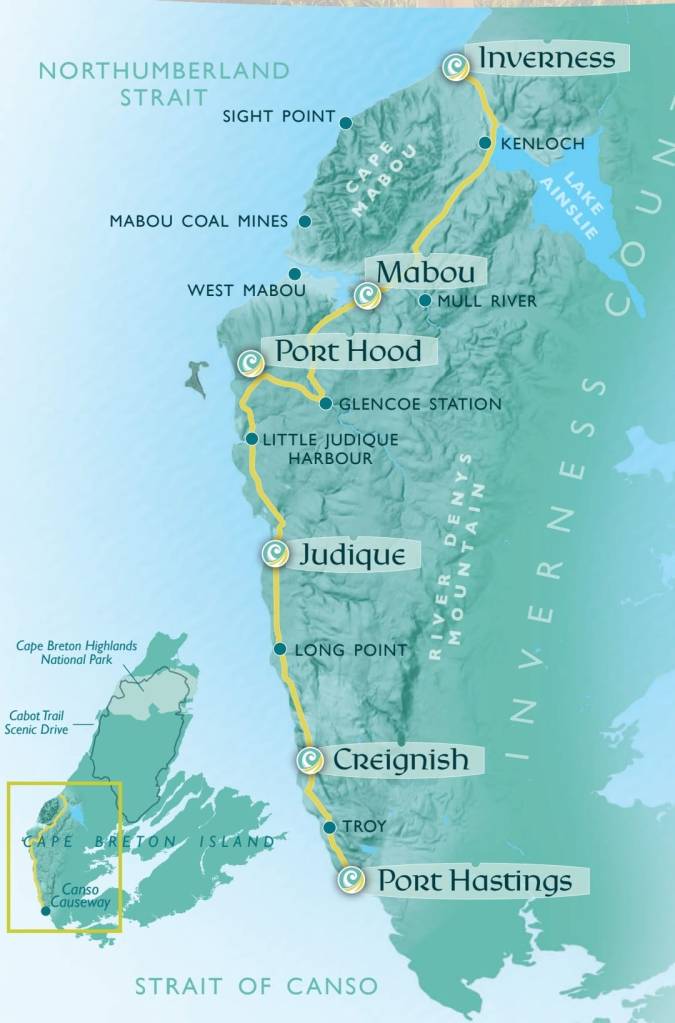
So this spring, when my youngest from Montreal suggested a “long walk with papa” I jumped at the chance. We finally settled on the Celtic Shores Trail in south-west Cape Breton. It was close to home, and because of the SATbus (Strait Area Transit) I was able to plan a way we could leave a car at the end of each day’s walk and still get back to the start point. (Although it meant some VERY early mornings by the end).
All told, we walked from Troy to Inverness. We had a WONDERFUL time, met lots of folks (although only one other distance walker on the trail), ate tons of sea-food, listened to Cape Breton fiddle music, chatted all day as we walked, and swam in the ocean.
I highly recommend this trail, and the use of the SATbus to coordinate getting back to a car at the end of each day.
Some tips: check the “take a break” walkers’ benches for wasps’ nests…before sitting down! Note that the SATbus doesn’t run weekends, and must be booked in advance. Check out the Ceilidh Fishers’ Coop in Port Hood for fresh seafood and to report your progress to a local trail volunteer. Bring bug spray (although they weren’t bad for us this time around), sunscreen, and rain-gear. We had bear-spray. Thankfully we didn’t encounter any, but we saw some fresh scat. Especially if walking on a weekend, keep your eyes open for four-wheelers, which are a far greater concern. And have fun!
What a wonderful surprise to have Paul Gehrs send me a short note to say: “I imagine you’ve already seen this, but excitement [for your book] is building here in Winnipeg.”
I hadn’t seen it. Thanks to Gail Perry of The Winnipeg Free Press for this gorgeous review!
So many years in the writing, and finally – here it is, world!
Today is the official launch of The Good Walk (University of Regina Press, 2024). It’s no longer listed on all the websites as “pre-order.” It’s out in the wild. And here’s a photo from McNally-Robinson Bookstore in Winnipeg to prove it!!
“Equal parts memoir, travelogue, and manifesto, The Good Walk recounts the adventures of settler and Indigenous ramblers who together retrace the earliest historical trails and pathways of the prairies” (from the back cover)
“Unsettles all our precious notions of a peaceable history with wisdom, erudition, and such good grace” (Trevor Herriot, author of The Economy of Sparrows and Towards a Prairie Atonement)
Events this last week proved how unintentionally fitting a name can sometimes be. The Peregrine Lunar Lander, a joint NASA-Astrobotic mission launched January 8th, is no longer expected to reach its goal. It was set to be the first commercial space probe, and the first American vehicle since the last Apollo mission in 1972, to land on the moon’s surface. However, several hours after launch, Astrobotic issued a photograph showing damage to the outer insulation of the craft. The statement noted that because of a propellant leak and difficulties in orienting the ship, a landing is now considered impossible. On social media, Astrobotic went on to state: “At this time, the goal is to get Peregrine as close to lunar distance as we can before it loses the ability to maintain its sun-pointing position and subsequently loses power.”
As a scholar of pilgrimage and pilgrimage studies, the name Peregrine (“pilgrim”) strikes me as uniquely suited to the Lunar Lander, which will now wander through space.
“Peregrinus” originally meant “foreigner” or “resident non-citizen [of the Roman Empire].” But already in ancient times it became the term for a pilgrim. For instance, a Roman pilgrim who travelled from Trier, in modern-day Germany carved his name “Peregrinus” as a thanksgiving on a votive offering stone at the Sulis-Minerva springs in Bath, UK, perhaps two millennia ago, and you can still see the stone there.
Eventually, the word “Peregrine” came to describe a special type of pilgrim, perhaps more related to the fate of the spacecraft that will now drift through the cosmos. My colleague and friend Sara Terreault at Concordia University, Montreal, describes (in this article: https://arrow.tudublin.ie/ijrtp/vol7/iss1/4/) how in the early Middle Ages, “peregrination” became a new type of pilgrimage that proceeded not toward a sacred destination, but away from a beloved homeland. The pain of this permanent separation from home was seen as a kind of “white” or living martyrdom, as opposed to the “red” or bloody martyrdoms of so many early Christian saints. Especially in Ireland and England, and amongst “Insular” monastics, this type of pilgrimage became a movement which sought holiness in exile and wandering. Bernice Lamb-Senechal has also written about this special type of ancient pilgrimage, here: https://arrow.tudublin.ie/ijrtp/vol8/iss1/9/. John Schultz and Ian Reader have identified a similar contemporary phenomenon among serial pilgrims on the Japanese Shikoku pilgrimage, in Pilgrims Until We Die: Unending Pilgrimage in Shikoku (Oxford University Press, 2021).
In the wake of the lunar let-down, scientists are scrambling to recast definitions of “success” for their mission. “Every challenge presents an opportunity to learn and refine our approach,” stated Dr Minkwan Kim of Southampton University in The Guardian. However, the failure of the Peregrine Lander can’t but be a blow to those who placed remains on the ship, hoping for them to have a permanent resting place on the moon. The human remains included DNA or ashes from George Washington, John F. Kennedy, and Dwight Eisenhower, science fiction writer Arthur C. Clarke, Star Trek founder Gene Rodenberry, and several cast-members of the original Star Trek series … Scotty (James Doohan), Bones (DeForest Kelly), and Uhura (Nichelle Nichols). It’s noteworthy that the plans to deposit human remains on the moon went ahead over the formal protests of the Navajo Nation, for whom the moon is sacred, as it is to many Indigenous peoples (https://www.npr.org/2024/01/08/1223377817/navajo-moon-human-remains ).
Now, because of a propellant or valve failure, the Peregrine will become a true space wanderer. For better or worse, it will live up to its name. Like the ninth-century Irish pilgrims who set out in a boat with no sail or oars, trusting themselves to where the seas and winds might take them, Peregrine is truly on a course for the stars, boldly going where no one has gone before.
Last weekend I had the pleasure of chatting with Sonali Karnick on CBC Radio One about “Prophets of Love: The Unlikely Kinship of Leonard Cohen and the Apostle Paul.” You can find the interview HERE. Sonali is a wonderful interviewer! We’ve chatted so many times that it felt to me a bit like a quick convo with a friend about my latest news. I hope you enjoy our visit as much as I did!
The lovely folks at McGill Queen’s Press have given me a discount code for 30% off my new book, “Prophets of Love,” to share with friends and family.
If you are reading this, I consider you friend or family (and the chances are pretty good you actually are!). So the code is MQF2
If you’re in Canada, order online and use the code HERE.
If you are in the UK or Europe, email direct.orders@marston.co.uk and use the code with them.
If you’re in the US or the rest of this big world that both Cohen and Paul loved (however differently), email orders@press.uchicago.edu and use the code with them!
Have you heard of the 1960s TV comedy series “Green Acres”? It starred Eddie Albert as Oliver Wendell Douglas and Eva Gabor as Lisa Douglas. Oliver and Lisa were a socialite New York City couple who moved from their urban penthouse apartment in Manhattan to a run-down place in the country to fulfill Oliver’s dreams of being a farmer. Oliver would drive the tractor wearing a suit and tie, and Lisa did chores in lace nighties or designer dresses while wearing her pearls. The locals were anything but yokels, and a lot of the plotlines revolved around Eddie getting himself into some pickle and having to be bailed out by bemused neighbours and their advice. (For those interested in such things, there was an interesting subplot with the locals and Lisa being able to hear the theme music and credits, while Eddie was blissfully unaware).
I barely remember the show. But it must have stuck somewhere. More than once this last year, while out trimming bushes or picking up wood or fixing a mower I’ve found myself humming “Goodbye city life, Green Acres we are there.”
Our two acres in Pomquet Nova Scotia (Mi’kma’ki territory) has no run-down century farmhouse, but a Kent mini-home. But after decades of living in Montreal, Nottingham, and Dublin, what I see when I look up is as different from the storefronts and sidewalks and constant traffic I’d grown used to as Green Acres was from the Big Apple. Here, the nights are quiet and dark – so still you can sometimes hear the blood in your ears. Two packs of coyotes often sing across the river to each other at dusk. On afternoon “golden hours” the light suffuses our marshy inlet, turning trees and water into some kind of Flemish Renaissance painting. The big excitement now is not a new café or a street festival, but five blue herons at once, a bald eagle low overhead, or the day we spied a pair of puffins in the salt marsh. Or eggs left on our doorstep by the neighbour, so fresh they’re still warm.
“Next year we’ll harvest some of those.”
From not owning a car for over twenty years, we now have two. Our bikes, once our main mode of commuting, sit idle, but we spend more time than we’d like on the ride-on mower. I’ve had to re-remember habits I’d forgotten: how to brace a gas can so it doesn’t tip over in the trunk, how to file the points and clean up a spark plug, changing oil, raking and shovelling and planting. How to safely burn brush, and the best way to cook sausages over the embers. I haven’t consulted a bus schedule in months – but we check the wind speeds and rainfall every day.
A year ago this month, when we moved back to Canada and first saw this land, there were ripe chokecherries filling the bushes along the driveway. We had five suitcases, our cat Sweet Pea, and each other, but nothing else. “Next year,” I told myself, “Next year we’ll harvest some of those.”
Things always happen more slowly than one would like. In just one year we haven’t even scratched the surface of our dreams and “druthers”. But this week I made chokecherry jelly. Plenty of mosquito bites went into getting those berries. But that first bite of a fresh roll with chokecherry jelly was just about perfect. These really are “green acres.” And we really are there.
Atlantic School of Theologyis pleased to announce the appointment of Rev. Dr. Matthew Anderson as the new Director of Camino Nova Scotia!
Matthew is a professor, podcaster, filmmaker, the author of three books, a Lutheran minister, and a pilgrim with thousands of miles on his boots. In 2015, he helped inaugurate annual treks across Treaty territories on the prairies with Indigenous guidance, and from 2014 the first Old Montreal to Kahnawà:ke Mohawk Territory pilgrimage for students. His podcast “Pilgrimage Stories from Up and Down the Staircase” is on all your podcast platforms.
This summer, Wood Lake Publishing releases Matthew’s newest book, Our Home and Treaty Land: Walking Our Creation Story (co-written with Dr Ray Aldred). Matthew’s pilgrimage blog is at https://somethinggrand.ca. There you can also find his documentary on the Camino de Santiago.
The appointment begins immediately
Matthew is excited to be moving with his wife Dr Sara Parksto the North Shore of Nova Scotia, and can’t wait to explore the land and meet other pilgrims with Camino Nova Scotia! His appointment begins on June 27, 2022.
Atlantic School of Theology and Camino Nova Scotia are grateful to the Province of Nova Scotia’s Department of Communities, Culture, Tourism and Heritage for funding that has made possible Matthew Anderson’s appointment and the expansion of Camino Nova Scotia, for the benefit of all Nova Scotians and visitors to Nova Scotia. We are also grateful to the Office of Gaelic Affairs for its ongoing support of Camino Nova Scotia: Slighe nan Gàidheal | Gaels’ Trail.
Sometimes a book comes along at just the right time. For me, this was Matthew Anderson’s Pairings: The Bible and Booze (Novalis, 2022). As pandemic restrictions were loosening and the possibility of gathering with other people was restored, I yearned for a good discussion group. Pairings provided just the right text for a post-pandemic bible study! The concept is clever. Anderson has chosen ten scripture stories and “paired” them with an appropriate drink. He begins with “Low-Hanging Fruit: Apple Cider and the Second Creation Account,” and ends with “Bringing Down the Curtain: Bloody Caesars and the Book of Revelation.”
Though the book seems light and fun – and it is – it is by no means superficial.
The book is small – only 111 pages – but Anderson packs a wealth of material in each short chapter. Readers will be presented with insights into both Scripture and the history of various libations. Though the book seems light and fun – and it is – it is by no means superficial. Anderson provides rich, thought-provoking points for discussion on important and meaningful topics. Each time, our group has met, folks have arrived with points underlined that they wanted to discuss. And discuss we did! So far, the topics have included the portrayal of women in the Bible, the church’s role in colonialism, the comfort that faith brings to our lives, and the admixture of bitterness and sweetness in human life.
I have recently become fond of ordering a beer flight in our local restaurant/brewery where I can sample a variety of beers in small sizes. This always leads me to think, “I’d really like to try more of that beer.” Pairings reminds me of such beer flights. Every chapter left me intrigued to learn more. So, I very much appreciated the excellent suggestions for further reading that Anderson provides at the chapter’s end. I also appreciated that he provides non-alcoholic drink pairing for those who prefer this. Sharing a drink among friends can be wonderful, but alcohol can also be problematic. Thus, I found this to be an ethical, sensitive, and compassionate addition.
The small group we formed around the book has met only four times. I look forward to our six more meetings by which time, (hint, hint), we might have a Volume II!
Christine Way Skinner is a lay minister and author. She received a Bachelor of Arts in Theology degree from St. Francis Xavier University and a Master of Divinity from Harvard Divinity School. She is currently working on a Doctorate in Theology at St. Michael’s College in Toronto. Christine loves trying to find inclusive, compelling, and creative ways to pass on the church’s 2000-year-old traditions. She enjoys exploring the arts, gardening, and engaging conversations. Christine’s numerous publications can be found and purchased here.
I’m delighted with the wonderful translation into French of Pairings: The Bible and Booze, done by biblical scholar, podcaster, journalist, Catholic activist, and PhD student Sabrina di Matteo (phew, it’s tiring just to list all those occupations!). So it’s a real pleasure to announce the upcoming French-language book launch where we present this book to the world together!
Il faut le boire pour le croire
(from the translation – only one of many improvements to the original!)
Funny that les éditions Novalis and éditeur Jonathan Guilbault are partnering with Librairie Paulines on rue Masson in the Rosemont area of Montreal for the launch. I used to live just up the street from this bookstore, on 7e avenue, so I know this chic and interesting neighbourhood (and this cool bookstore) well!
On the agenda: quiz, conversation, swag, cocktails! Because of the pandemic, it’s been a while since I’ve been in Montreal, so my homecoming will be dans la langue francaise, as it should be!!
You can check out an “Apocalypse et gin tonic” quiz, and a short intro video here!
If you can’t make the launch, you can order Apocalypse et gin-tonichere (and of course, the English version, Pairings, is still available, and at a sale price, here!)