Categories
Uncategorized

Far from One’s Earthly Home

(this is a guest blog posting on postmodernism and pilgrimage, by Sara Terreault, my friend and pilgrimage studies colleague. Her thoughts were inspired by the questions and comments posed by another of our friends and colleagues, E. Moore Quinn. Their back-and-forth conversation was too good, and too detailed, to leave in the comments section!  MA)

Hi Eileen,

Fancy meeting you here: do you come here often? 🙂

Great questions.  I should be grading papers but cannot resist jumping in.  Here goes, a few note-form thoughts in response to your thoughts:

1) “postmodernism (cultural orientation)/postmodernity (historical time period)”: well, literally “after modernism/modernity”.  So applies to cultures that have been shaped by modernism (or in short, the so-called “Enlightenment Project”), but have grown suspicious of modernist assumptions and values, so

1a) Enlightenment Project, a meta-culture (birthing the so-called universalist  “metanarrative”) consisting of : i) anthropology: human person as primarily (or ideally) interior, individual, rational, and, once freed from the tutelage of superstition (incl “religion”) capable of solving all human issues by exercise of rationality); ii) epistemology: rational, objectivist empiricism, privileges scientific method;  iii) ontology: materialist, immanentist.  Implications: the eclipse of the transcendent, the spiritual/religious, the affective.
1b) Romanticism (late 18/early 19th c.) a reaction/response to the hyper-rationalism of the Enlightenment, but which nonetheless retains the individualist interiority of Enlightenment anthropology … however privileges affectivity, intuition, arts and artists, rather than empiricist rationality and science.  Romanticism has an ambiguous relationship to “religion” and I think we can see there the roots of the contemporary postmodern “spiritual but not religious” (re-opens the door to the re-entry of transcendent reality, but not through traditional “religion”).
1c) Finally: postmodernism: disparate cultural movements that have challenged the assumptions and values of the Enlightenment  and  to some degree Romanticism.  It is paradoxically both hyper-modern and anti-modern.
1d) postmodernity: When is this? This will be endlessly debated, but it makes sense to me to place this post WW2, when all the certainties of modern hopefulness in humans and their “brave new world” lay in ruins after the horrors of two world wars, genocide, totalitarianism, atomic weaponry: our lovely individualist, scientific rationalism has *not* saved us after all. Now what?  Western (modernist) culture fragments into many small cultures (mini narratives) privileging the local, the plural, the diverse, the contingent, the social
2) Shrines, relics, pilgrimage and postmodernity: I’ll suggest that the “shrine” is the in-dwelling place of the divine, “relics” are the meaning-imbued and empowered material memory of the holy one (saint) and the holy experience (in this case, pilgrimage); and “pilgrimage” is physical (or in some cases only spiritual) journey for and to self-transcendence.
2a)  i. The shrine may indeed be spatially located, architecturally realised.  But it is also (at least in Christian tradition) interior, spiritual and personal: “You are the temple of the Holy Spirit” (1 Corinthians).  For postmodern people, the secularity of modernity means that attachment to and experience of traditional religion is often thin or very thin.  Yet the desire for and valuing of the transcendent is nonetheless strong, but is expressed largely privately (religion having been banished from the public square).  So the interior understanding of shrine is “natural” to us postmoderns (we are perhaps just a little bit gnostic in our tendencies …).  We may structure our spirituality on aspects (and in the case of pilgrimage), on locations of traditional religions) but we do this largely individually, partially, and with great focus on interiority. ii. peregrini:  I totally agree that postmodern pilgrimage’s “interior shrine” is in many ways like that of the Celtic peregrini pro Christo whose pilgrim journeys were not toward any wrldly centre, that is toward any spatially/materially located shrine, but rather away from the “centre” of the earthly home, familiarity, comfort etc. Their “destination” is not spatial/material/earthly but rather eschatological, and their only earthly material shrine is their own pilgrim bodies. iii) Relics: the material and sacramental traces of holy people, places, memories.  Not a long way from a strand of hair in a locket, or a pilgrim badge or tattoo, or a burden stone to be left on the road, or a postcard or souvenir …
Your further thoughts?


Categories
Uncategorized

When the Shrine becomes the Self

Allen pondering

a ten minute conversation with Sara Terreault, at Concordia, Montreal, about what makes post-modern pilgrimage post-modern!

Categories
Uncategorized

The Problem of the Definition of Pilgrimage – one half of a dialogue

Craig Baird boom shot Cypress L walkers (photo courtesy of Craig Baird)

(please click on the link)     https://vimeo.com/140200976

A conversation over morning tea at Concordia’s Dept of Theological Studies between Matthew R. Anderson (on camera) and Sara Terreault (staying off camera).

Categories
Uncategorized

A Musical Moment

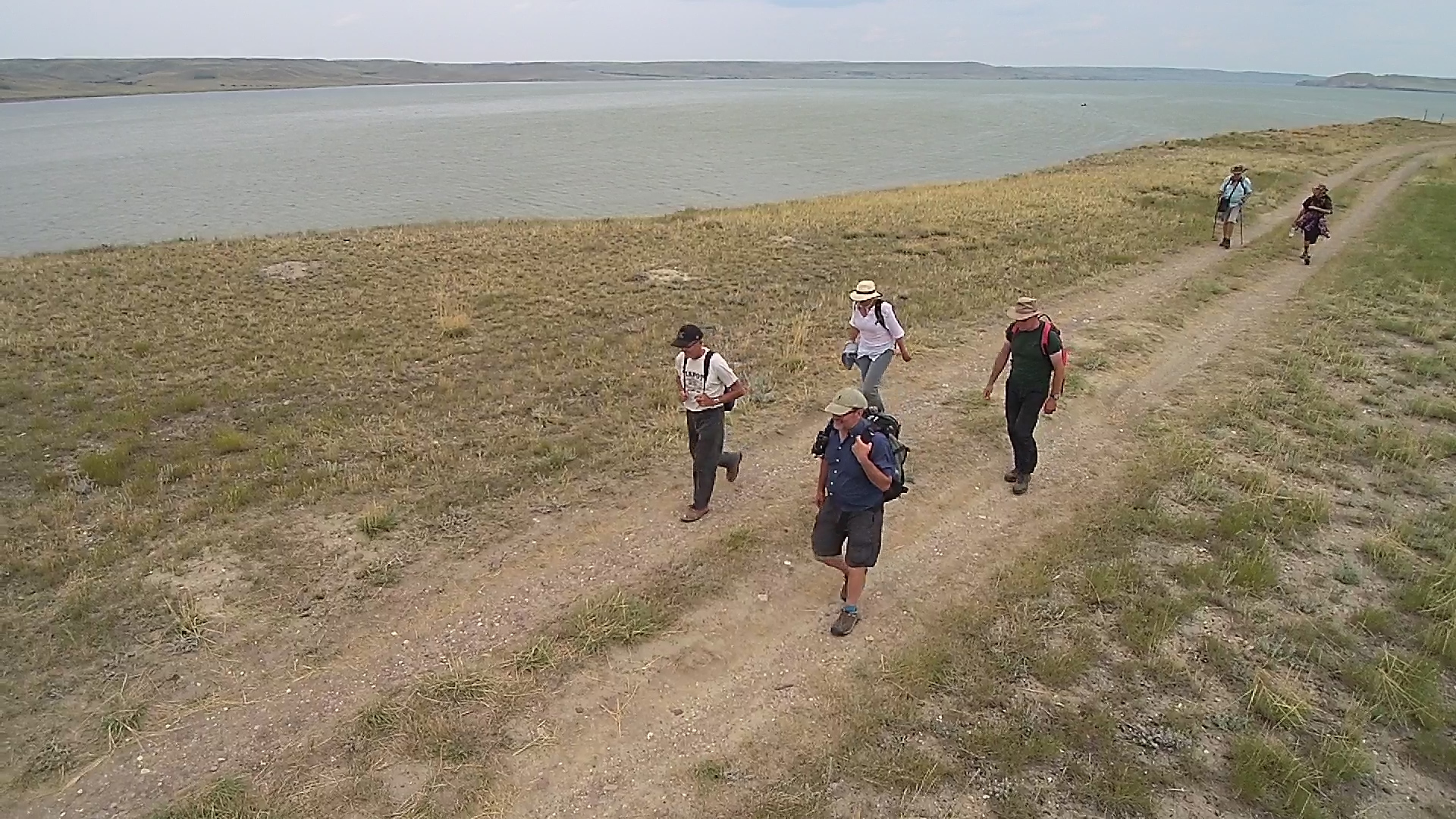
Kathryn Scott, Madonna Hamel and Matthew Anderson try to remember the words and harmonies to Java Jive. We were camping overnight at Chimney Coulee, near Eastend SK, and half-way through our group’s 350 km trek along the North West Mounted Police Patrol trail. This is a moment from a summer 2015 pilgrimage organized by Hugh Henry and Matthew Anderson. The video was shot by James Page, photographer, from Val Marie SK. on the NWMP Patrol Trail pilgrimage July 30, 2015

Categories
Uncategorized

Alive and Well

IMG_0215

There’s something exciting and exhilarating about taking shelter in the back of a van, the back gate up providing a temporary roof, watching the driving rain come down so hard you don’t dare step out into it. It feels just a bit precarious when the lightning is so loud and close you take your feet off the ground just in case there’s a nearby strike. Wondering if the tent you’ve set up under the caraganas will hold up and stay dry (especially since your sleeping bag is already in the tent. You can see the fabric of the fly bouncing from the weight of the downpour, the heavy rain spraying from the roof). But it’s also, somehow, comforting. You are – mostly – dry, the threatened wetness in your boots and the moisture seeping down your back balanced by the carrot and coriander soup mixed with long grain rice (British Army rations) that you’ve saved from the fire and are now eating, steaming hot, straight from the pot.

I’m alive and well. Both. I’m learning once again that the two are not always the same thing.

After the rain, a rainbow comes out over the Frenchman River valley, also known as Whitemud. The valley is so wide you can see both sides of the arc touching down. Golden light floods the river plain from the west. There are horses – perhaps a dozen – charging around the field beside us, kicking up their back legs, perhaps in relief at the temporary respite from the storm. It’s one of the most beautiful sights I’ve ever seen, their manes and tails flying against the dark sky.

The clouds close again and the rain settles in – 7/10ths by morning. I’m awakened several times by flashes of light and loud booms, and sometimes by the horses in the Green’s trailer, whose movements also sound like thunder. At 6:45 am Hugh and I meet in our rain ponchos in the drizzle, trying to decide what to do. Bishop Don’s tent has flooded. The horse folks are calling it a day before starting and starting to pack up. It will be impossible to get through the riverbank grass and lower bogs in any case, so we decide to postpone the half-day river section of the walk. We confer with the rancher, Terry Jensen, a cowboy so stoic he looks as though he would be unperturbed if a spaceship landed on his property. He owns as it might be good to wait. We drive up and out of the valley before the road becomes impassable. It’s the first day we’ve had to change plans. Flexibility, I tell myself, is one of the marks of a pilgrim.

IMG_0203

Categories
Uncategorized

Jellied Salads and Howling Coyotes

jellied salad McCord

I’m writing this from a tent behind the museum in McCord SK, listening to the howling of what sounds like a hundred coyotes. They’re making quite a joyous racket to the south and east of town. Our tents are pitched just behind the old railroad station which is the museum….I had a sponge bath in what must once have been the platform for departing passengers, since this is day three with no running water or electricity close for us. Wondered if someone on that platform could travel in time, what they would think of what they saw, and of this town.

McCord may not have a cafe or more than one main street, but it has palpable community spirit. They took us in and gave us a wonderful potluck supper, and then came out in numbers (50 people) for our presentation on the North West Mounted Police Patrol trail walk. Thelma Poirier, a poet from neighboring Glentworth, talked about how lovely it was to think of this as pilgrimage. Many others loved the slides Hugh showed from the 50s and 60s, people from this area, even one sitting in the audience.

After another day of walking (today only having to cross 4 barbed wire fences and not over 20 like yesterday), we actually got here early today. There was much less walking through waist high hay fields or over bog. Today much of our path was on a lovely dirt road and we had lunch in the lee of an old farmyard’s trees, while the grasshoppers blew around in biblical proportions.

People here, when I ask them on camera, are far too polite to say that they think we’re crazy to be walking. They even brought out the best: jellied salads, potato salad, sweet and sour meatballs, and Saskatoon pie for dessert! And sent us home with our lunch for tomorrow….

Categories
Uncategorized

Making Medicine Pouches

I love my aunt. She’s always been like a second mother to me. Especially these last years, when my own mother failed, my aunt, as so often, was forced to be the safe harbour in which our family finds shelter.

My aunt is surprising. She stays up late and at 88 years old, still likes to travel. If there are potatoes to dig, she just might go dig them. She’s tough – and still, in the ways that count, old fashioned.

But not old fashioned in many other ways. We did something together tonight that I never thought we would do. We made and tied medicine pouches, with elk leather and sweetgrass from Kahnawake Mohawk Territory. The pouches are destined to be used as gifts here in Saskatchewan.

A big part of pilgrimage is learning how to receive the kindness of others. We haven’t even really begun our local Camino – this North West Mounted Police Patrol Trail pilgrimage – and so far there have already been meals, a donated vehicle, and beds to keep us sheltered until we put up our tents.

But part of pilgrimage is also recognizing what gifts we strangers bring with us to these lands we cross, and bringing physical evidence of such gifts with us. That is why I have the sweetgrass and the red string from the Mohawk, for some of the First Nations and Metis people we will meet here. I read recently that even though the Mohawk almost never came this far west, there was a group of them that overwintered, in the 19th century, in the Cypress Hills, where so many other First Nations gathered in the final, collapsing days of the bison hunting economy.

I wonder what those Mohawk saw, and thought. My aunt and I cut the leather and together wrapped up the sweetgrass. It felt like something blessed to be doing this with her, my aunt with whom so often I’ve gone to church and sung hymns as well. Someone with whom I hold this land, this prairie, in common. I held the pouch up to her nose: that smells so good, I said. Doesn’t it. That smell of leather.

She smiled. Or maybe what smells so good, she answered, is the sweetgrass.

Isabelle and the pouches

Categories
Uncategorized

the relationship between pilgrimage and tourism, in one sentence

t at the Mona Lisa Paris 2013

(photo: at the Mona Lisa in Paris, 2013)

I’m a pleased professor, for (yet again) one of my students has outdone me. Andrew Plamondon, wrote the following in his final exam of Theo 234 Pilgrim Bodies/Sacred Journeys:

“Rather than saying that tourism developed out of pilgrimage, perhaps it is more accurate to say that pilgrimage sheltered tourism for a long while.”

In terms of the difference between the two, Andrew pointed to the inevitable overlap, but highlighted subtle and sometimes briefly maintained differences in motivation and ritual. Well said, well thought.

Categories
Uncategorized

Kahnawake Morning

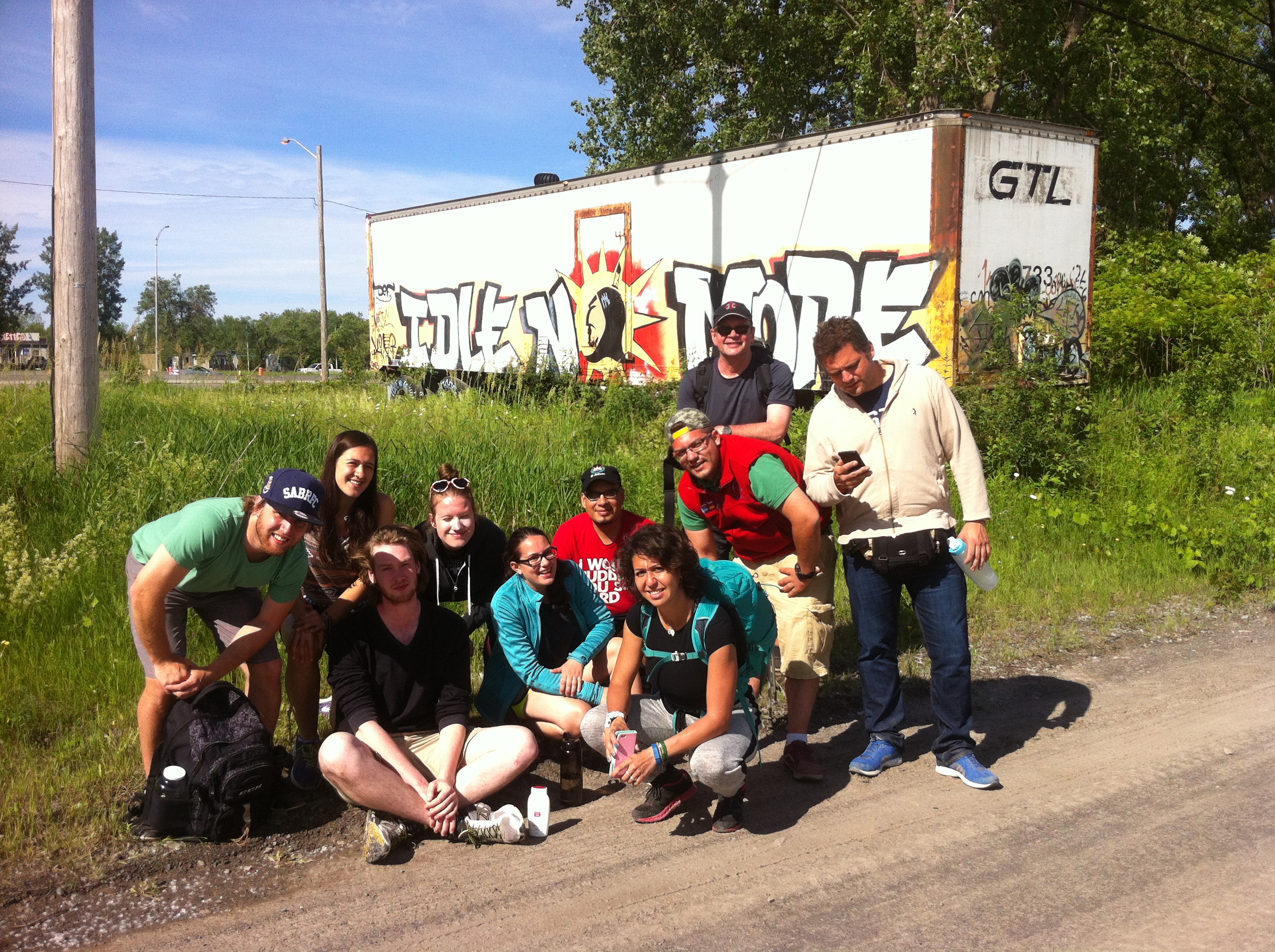
Idle No More trailer shot

The long boom of a lake freighter’s horn woke me up this morning, and within a minute, even from my bed I could feel its massive bulk sliding past just a few metres away on the Seaway. There is something in the air, a vibration that shakes you, when something that big is in motion, so close.

Apart from the freighter, however, it’s quiet here this morning in Kahnawake Mohawk Territory. Sparrows and red-winged blackbirds flit back and forth in the grass along the seaway, calling out to each other. Garter snakes and frogs fight their battle for survival under the cover of leaf and deadfall. After 35 kilometres of walking in the heat and seeing new sights the last two days, my sunburned students are just waking up.

Our group of pilgrims exemplify urban Montreal, and especially Concordia: the students speak Arabic and Spanish, Ukrainian and Armenian in addition to English and French. Some have complicated family backgrounds spanning several continents. One carries a First Nations identity card. A few have shared family histories of oppression and displacement. As ‘hyphenated Canadians’, the questions they ask of the Mohawk are particularly insightful: how is it possible to share land and not lose identity? How will a Mohawk policy of not allowing mixed marriages to remain in Kahnawake work? Do you have your own passports? Why don’t you call yourselves Canadian?

This is a pilgrimage in so many ways. A journey of discovery of ourselves and of others, born on the feet, felt in the heart and mind.

Categories
Uncategorized

Scouting the Trail

Today we scouted the beginning of the North-West Mounted Police Trail. It meant piling five of us into a big Dodge Ram and pounding over the Wood Mountain hills. Thelma, a renowned poet and historian from the area, called it the “Boundary Commission Trail” several times, since the original NWMP trek was further north. Or it might be the “Metis Trail”, or the “Major Walsh” trail (although she doesn’t have kind words for him).

Anyway, we scouted it. Today we pulled out maps. Come summer we will walk.

Between then and now dreams and visions.