A wide range of thoughts on pilgrimage, from the way space creates thought, to an Australian nun’s summons to a new field.
Categories
A wide range of thoughts on pilgrimage, from the way space creates thought, to an Australian nun’s summons to a new field.

My dilemma: I know from my own experience that being a pilgrim on a certain bit of the planet helps a person identify better with that bit of the planet. I’m not Norwegian. But I feel more of a connection to Norway having walked several hundred kilometres of the mountains and streams my ancestors knew. I AM a prairie person – sort of, still – even after thirty years in Quebec. Remembering my appartenance (belonging) to the prairie was hard-won with every gust of wind, every blade of speargrass burrowing into my foot, every sunburn, every call of the coyotes at night and every Pils beer consumed in a prairie tavern. If you haven’t tried it, do. It’s great. Not just the Pils. The whole pilgrim experience.
So my thesis for the conference to be held at the College of William and Mary, in Virginia, is simple: walking pilgrimage helps ‘ground’ people like me as Canadians, in our land, so long as we are mindful of the land’s history and of its First Peoples (in other words, so long as we walk honestly).
Then I remembered that “pilgrim” actually comes from the word ‘foreigner’ or ‘alien’. How can a foreigner gain more of a sense of belonging by practicing their pilgrimage (ie foreignness)? I thought my paper was ruined. I stewed on this for several days before it occurred to me. For Newcomers like me, being a pilgrim describes my status EXACTLY. The foreigner (pilgrim) doesn’t own land. Pilgrims only go on by humbly accepting generosity from the land and its inhabitants. The pilgrim needs to be in relationship with others, or they perish. Belongingness (if there is such a word) is reversed. Not the land to me, but me to the land. For a non-First Nations person like me, it means seeing that my belonging to this land in Canada has always been by hospitality. It ONLY comes through recognizing my foreign-ness and the ways in which I have been invited to share in belonging TO the land, by those – ie First Nations – who have belonged to it for so long already.
That makes a whole lot more sense. I think I can present that at the conference.


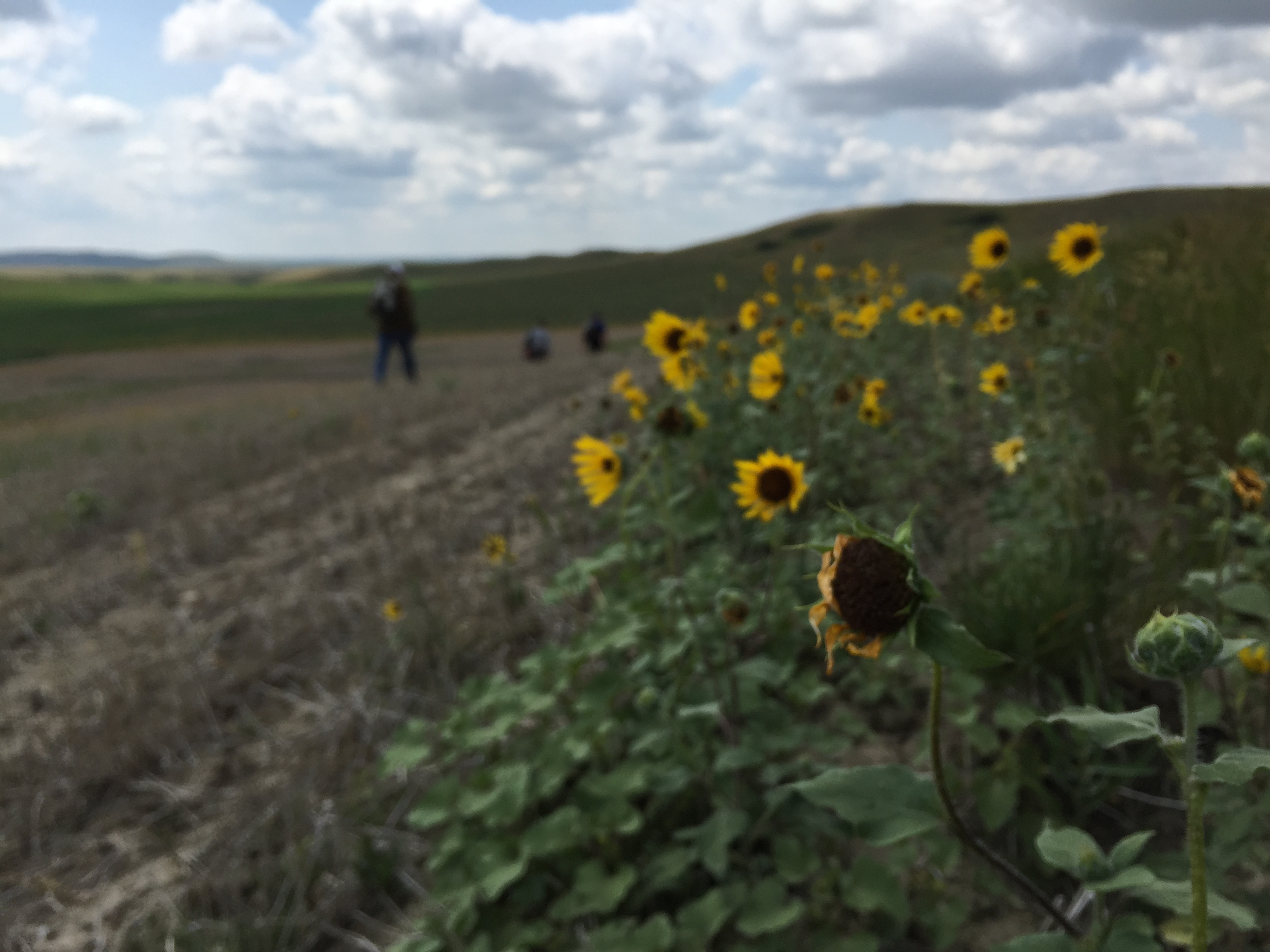
It would be presumptuous to say that we’ve learned how to listen to the land on this prairie pilgrimage. Some – Hugh for instance – already know the flora and fauna very well, and Rick from his Metis and First Nations background has a sense for how the ever-changing terrain contains messages and directions, and listens intently for them. Hayden has the stamina and openness of youth, and the local people gravitate naturally to his enthusiasm. Me? I’m not sure. I’m listening, but not yet sure what I’m listening for, exactly.
The barmaid/waitress/innkeeper at our first hotel stop last night is from Australia, near Brisbane. In talking with her we spoke about walkabouts, and it came up again this morning as Rick talked about his trip to central Australia some years ago and his contacts there. I guess in some ways this is a prairie walkabout. Or if not a walkabout, then perhaps what the Lakota elder who smudged us the first day called it in Lakota. I cannot remember the term, but he described us as taking a voyage as they once did, where a group of people simply pack up and leave the safety of the camp to go out and explore. He said it was a good thing to do, and smiled at us.
And so we walk, and listen. Yesterday, as the wind abated, we heard so many different bird calls – the eagle, the killdeer, the lark bunting, the meadowlark. The cattle were speaking to us at times, not always happily. And the wind, as it changed, and moved over the terrain, was always new.
A pilgrimage, among other things, is a journey of transformation. Yesterday as we started out Rick started humming some old classic rock tune. Then another came up. Then Hayden sang the first few lines of “Take a Walk on the Wild Side”. I guess this is a bit of a prairie wild-side walk, but the transformations in our case are quite different from the classic song! They say there might be some rough weather today. Should be an interesting time of listening.

This is day two without electricity so I will keep it short. We’re camped right now beside a graveyard, at a small Greek Orthodox church on the NWMP trail. When he could see us far off, struggling through the heat on the final stretch of our 15 miles or so today, a man at the church rang the bell to call us home. Now it’s dark. The graveyard beside our tents overlooks the vast open prairie. There are little solar lights beside the graves, which is perhaps nice, but a touch freaky for us in the tents.
Today was also the day that we were sent off by two RCMP officers, one in serge, and then smudged at the Lakota First Nation as we walked through. Not only that, but we happened to arrive at lunch and were given a wonderful hot meal by them.
So much to say, but not now. After all those miles, many of them through thigh-high grasses and rough pasture (fell into a badger hole once), it’s time for sleep.
I love my aunt. She’s always been like a second mother to me. Especially these last years, when my own mother failed, my aunt, as so often, was forced to be the safe harbour in which our family finds shelter.
My aunt is surprising. She stays up late and at 88 years old, still likes to travel. If there are potatoes to dig, she just might go dig them. She’s tough – and still, in the ways that count, old fashioned.
But not old fashioned in many other ways. We did something together tonight that I never thought we would do. We made and tied medicine pouches, with elk leather and sweetgrass from Kahnawake Mohawk Territory. The pouches are destined to be used as gifts here in Saskatchewan.
A big part of pilgrimage is learning how to receive the kindness of others. We haven’t even really begun our local Camino – this North West Mounted Police Patrol Trail pilgrimage – and so far there have already been meals, a donated vehicle, and beds to keep us sheltered until we put up our tents.
But part of pilgrimage is also recognizing what gifts we strangers bring with us to these lands we cross, and bringing physical evidence of such gifts with us. That is why I have the sweetgrass and the red string from the Mohawk, for some of the First Nations and Metis people we will meet here. I read recently that even though the Mohawk almost never came this far west, there was a group of them that overwintered, in the 19th century, in the Cypress Hills, where so many other First Nations gathered in the final, collapsing days of the bison hunting economy.
I wonder what those Mohawk saw, and thought. My aunt and I cut the leather and together wrapped up the sweetgrass. It felt like something blessed to be doing this with her, my aunt with whom so often I’ve gone to church and sung hymns as well. Someone with whom I hold this land, this prairie, in common. I held the pouch up to her nose: that smells so good, I said. Doesn’t it. That smell of leather.
She smiled. Or maybe what smells so good, she answered, is the sweetgrass.


My North West Mounted Police Trail walk (AKA Sitting Bull Trail Walk, Lakota Trail pilgrimage, Metis Trail pilgrimage) begins very shortly, on July 17th! Our small group of pilgrims will be greeted at Wood Mountain (Lakota) First Nation with a smudging ceremony and a blessing to send us off. As well, there will be a Royal Canadian Mounted Police ceremony to send us off, as we begin our three week walk. If you would like to donate to help create the documentary of the walk, please see https://www.indiegogo.com/projects/walking-the-medicine-line#/story. We have already met our initial goal, but additional funds raised will go toward hiring a sound person and camera-person to make the documentary even better. Thank-you!

What is this about this big statue your government is building….what’s it called? Mother Canada? From the pictures I’ve seen, looks ghastly.
I try to tell people here that I couldn’t agree more. Mother and Canada are two good words in their own right. To my mind, however, they just don’t go together. What’s more, the Mother Canada statue will apparently be reaching out eastward, toward Europe. Straining toward Europe by the looks of it. I wonder what the First Nations would think about that. And why Mother Canada’s planners don’t seem to make any reference at all to the earth that has been our real mother since we who are European background arrived on these shores.
My son and I took a 5-mile walk along the Cam river today, Canada Day. It feels a bit odd to be here, in England. Of the string of houseboats moored along the river, one of them was flying a Canadian flag. I took a picture. And I wore my Haudenosaunee tee-shirt. For me, at least now, being Canadian, which I am, has to include also some recognition of those other nations.

(see the 3-minute video clip here) https://www.indiegogo.com/projects/walking-the-medicine-line#/story
With news of a recent tornado in south-west Manitoba, it seems even more important to ensure that we have an emergency vehicle along for our pilgrimage (most nights we’ll be tenting). It will also serve as our cookshack and toilet. We’ve raised $595 on Indiegogo….one third of the way there!
The long boom of a lake freighter’s horn woke me up this morning, and within a minute, even from my bed I could feel its massive bulk sliding past just a few metres away on the Seaway. There is something in the air, a vibration that shakes you, when something that big is in motion, so close.
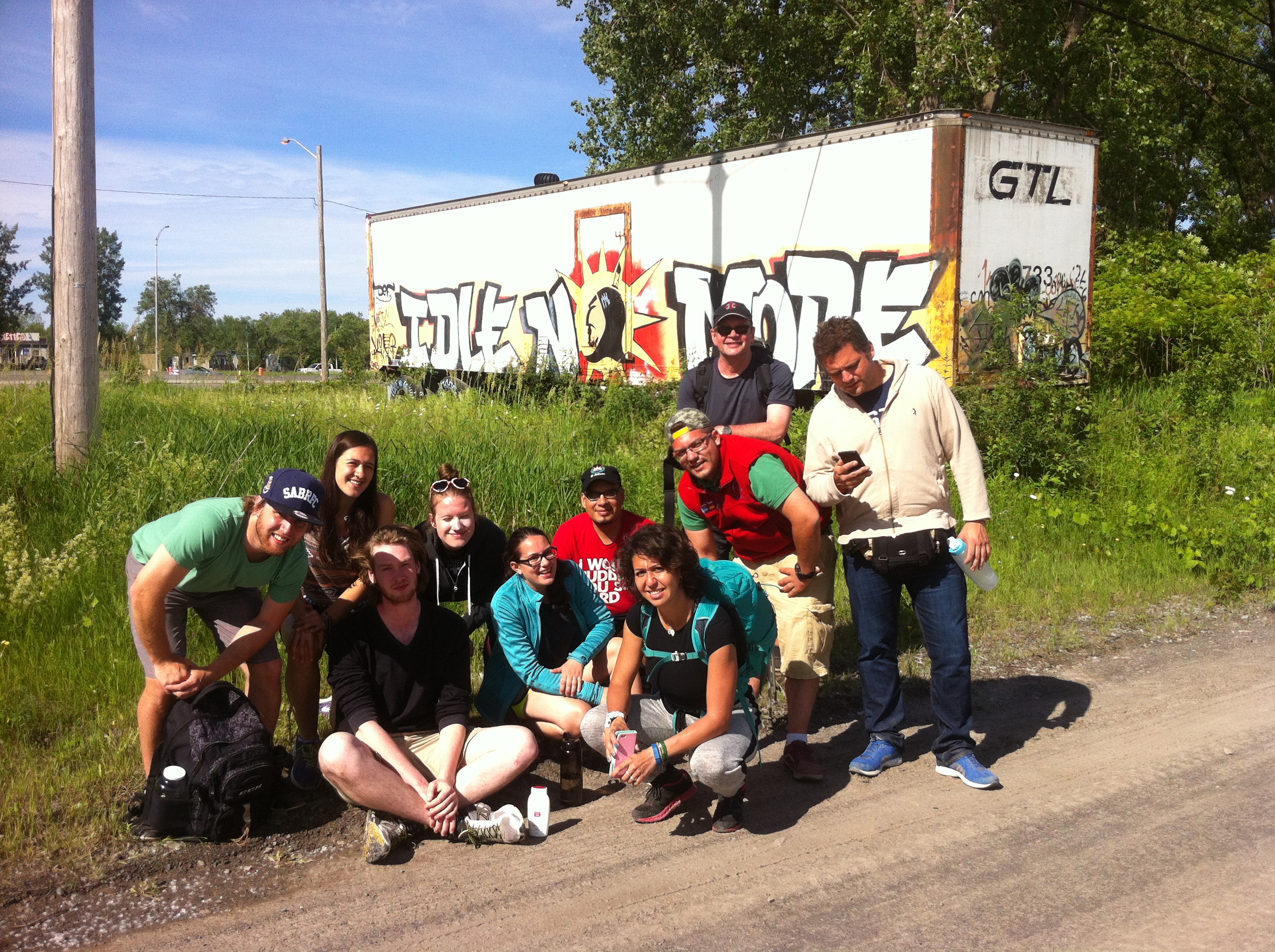
Apart from the freighter, however, it’s quiet here this morning in Kahnawake Mohawk Territory. Sparrows and red-winged blackbirds flit back and forth in the grass along the seaway, calling out to each other. Garter snakes and frogs fight their battle for survival under the cover of leaf and deadfall. After 35 kilometres of walking in the heat and seeing new sights the last two days, my sunburned students are just waking up.
Our group of pilgrims exemplify urban Montreal, and especially Concordia: the students speak Arabic and Spanish, Ukrainian and Armenian in addition to English and French. Some have complicated family backgrounds spanning several continents. One carries a First Nations identity card. A few have shared family histories of oppression and displacement. As ‘hyphenated Canadians’, the questions they ask of the Mohawk are particularly insightful: how is it possible to share land and not lose identity? How will a Mohawk policy of not allowing mixed marriages to remain in Kahnawake work? Do you have your own passports? Why don’t you call yourselves Canadian?
This is a pilgrimage in so many ways. A journey of discovery of ourselves and of others, born on the feet, felt in the heart and mind.

So.
Sir John A. Macdonald – he of the vest, the big nose, the whiskey bottle, and the reins of government – is 200 today. This afternoon in Kingston Ontario’s city hall, Prime Minister Stephen Harper gave a speech to kick off the year-long 200th anniversary celebrations of the birth of Canada’s first prime minister.
Such anniversaries are always political, especially in an election year. But with luck, this anniversary will also be a learning opportunity. Especially for those, like me, who are “settler”, or “newcomer” Canadians, there’s a chance this year to find out just how wrong is our founding myth of the kinder, gentler, Canada. In retrospect, Sir John A. fits right in with some who are pushing to remember Canada as a military, conquering nation. Because, against the First Nations, under Macdonald and others, we were all that, and worse.
To mark the 200th anniversary, you might want to get a copy of “Clearing the Plains”, by James Daschuk. It’s a riveting and disorienting re-telling of Canadian history. From Chapter Six onward, Macdonald figures prominently. For example: “On 24 March 1882, the prime minister announced to Parliament that all Indians in the territory of Assiniboia would be removed, by force if necessary, from the land south of the proposed railway.” Growing up in southern Saskatchewan, I came to wonder why there were no aboriginal people around. Now I know. Reading Daschuk’s book, you realize that they were systematically lied to, starved, beaten, cheated, and forcefully relocated. The treaties, once signed, were ignored, since the true goal was to clear the land for European settlement, for the railway, and for the (often Montreal) investors who were looking for a profit.
Macdonald was the architect behind much of this terrible attack. But he was not the only one. The Liberals, when they were in power during that period, were even harsher in their treatment of First Nations. Some have even argued that, judged in the light of the time, Macdonald was better than most. Disturbingly, both Liberals and Conservatives hid their power and money-grabbing behind ideals of so-called “Christian statesmanship”.
Daschuk concludes his book with this telling statement: “The effects of the state-sponsored attack on indigenous communities that began in the 1880s haunt us as a nation still.” This summer, I’m hoping, with a group of others, to walk the North West Mounted Police Trail, a 275 km half-forgotten path that was crucial to that 1875-85 clearing of the plains. That will be our small way to mark this ambiguous anniversary.
 somethinggrand