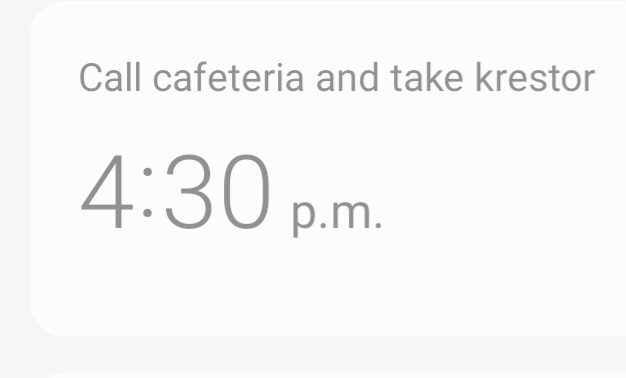
This week I found this old alarm notice on my phone. It brought me back with a jolt to my four months in hospital from September to December 2024. As I deleted it I said a prayer of thanks that, as much as I appreciated their care, I’m no longer at St Martha’s Regional.
In a minor coincidence, this week I also heard that the unpublished collection of “stroke poems” I wrote in the hospital was shortlisted for the Writers Federation of Nova Scotia‘s “Rita Joe Poetry Prize”! Rita Joe was a famous Mi’kmaq poet. It’s an honour just to be shortlisted. I have the privilege of being friends with several extremely talented poets, but have never published poetry myself. I’d love to share these poems with other stroke survivors and carers, so fingers crossed!
Eighteen months since my stroke, already! The reminders that popped up spurred me to write an update. Only, what to report?
#NoPlateau
Quite early on in my recovery, local physios warned me not to be disappointed when I hit the “plateau” at six months or so. But at the same time, they kept being pleasantly surprised at my determined progress. Sara developed the pep-phrase “HASHTAG NO PLATEAU”! I still haven’t hit one and don’t plan to.
I thought of calling this post “and then, one day, you’re putting on your belt using your left hand.” Or: “and then one day, you walk down the stairs and realize you didn’t hold the handrail.” Both statements are true in just the last two weeks. The idea that I could now be twisting my left arm around my body to dress, or to towel myself off after a shower, is an answer to prayer. For the first time since my stroke I can convincingly squeeze shut my grip exerciser. I can now actually “walk” a short base line on the guitar with my recalcitrant left pinkie. My hard-working Halifax Occupational therapist Lindsay is giving me more complicated wrist exercises on my phone’s Tenzr physio app, like tracing the entire alphabet in the air with my left fist. Miracles never cease. (Sara encouraged me to do it in Greek. Okay, not all miracles materialize.)
But the truth is, I also could write: “and then one day you’re stopped by a colleague to talk in the parking lot, and after just an extra 60 seconds in the cold, you suddenly need help to the car.” Or: “when you’re tired you still slur words, and once after climbing a bunch of stairs you lost your balance in front of a group of students and almost fell sideways into the wall.” Those statements are true also.
In a nutshell, THAT’S how it’s going. I’m grateful beyond words that my recovery continues even now, a year and a half after my stroke. Every day I have just an incremental bit more strength and flexibility and control in my left hand and arm. Every week my balance and my ability to crouch down and stand and walk improves very slightly. I mostly know this from others like Lindsay, who only see me every month or so and are amazed at my progress. Every week there are several new #StrokeFirsts I can celebrate when Sara and I read through all the slips we put into the weekly gratitude cup. Every week I’m surprised by what I can do. And less and less by what I still can’t.
Like the saplings
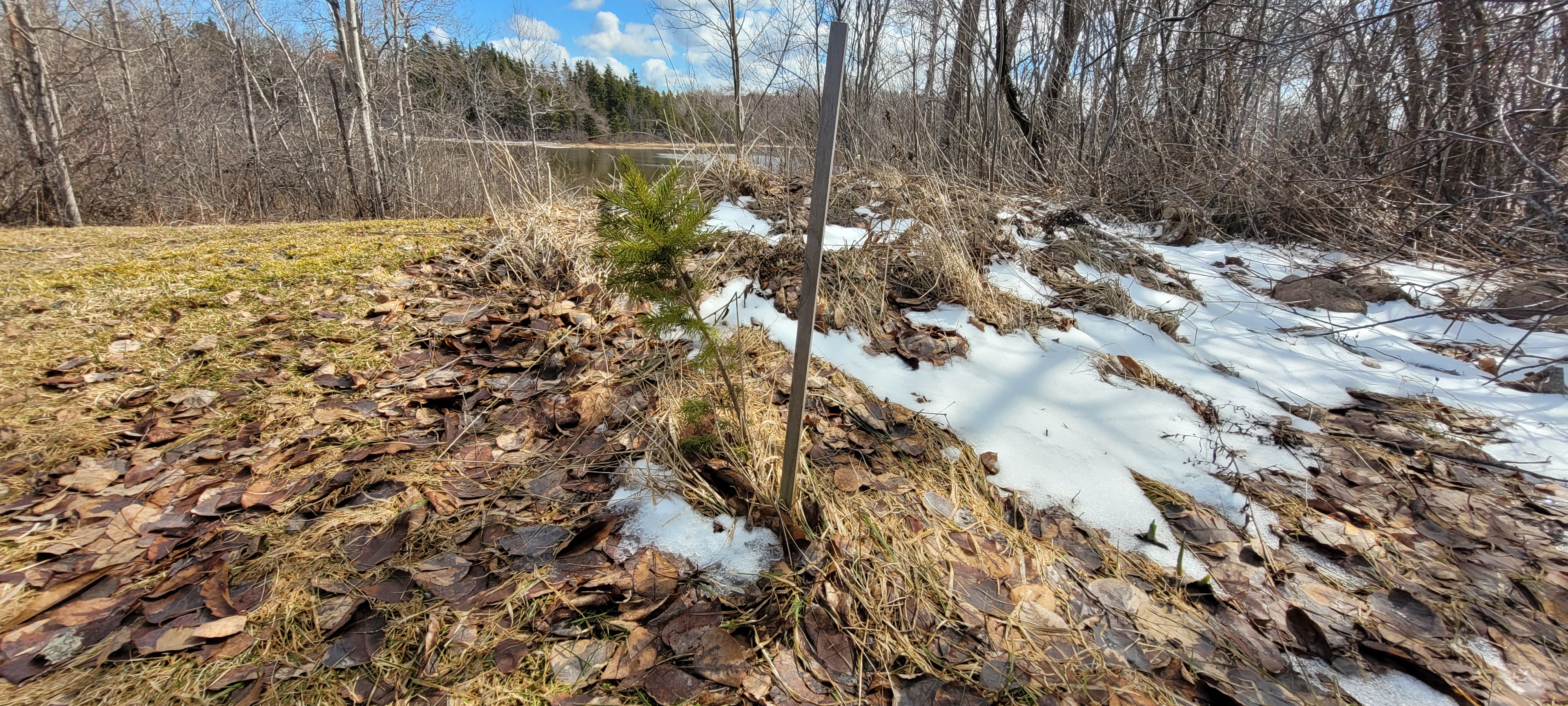
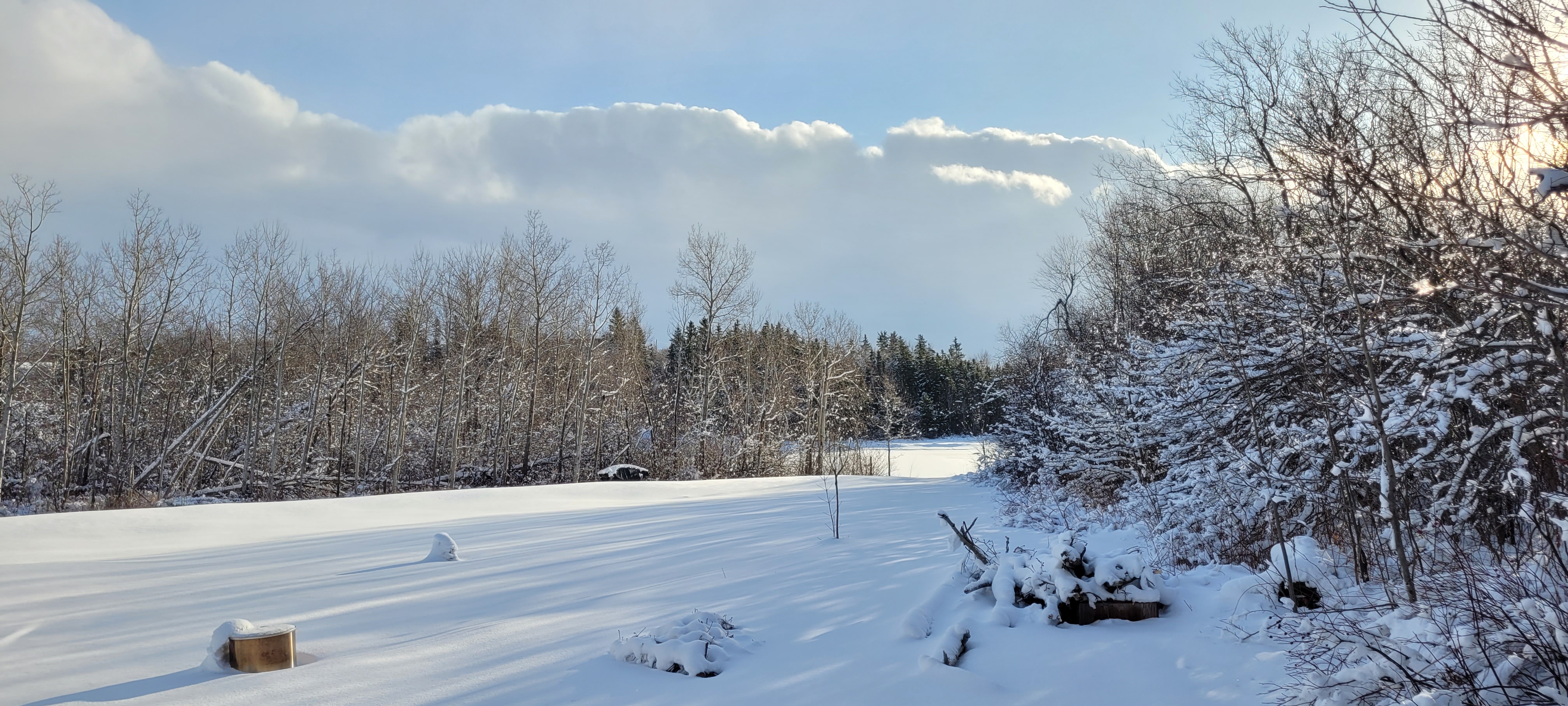
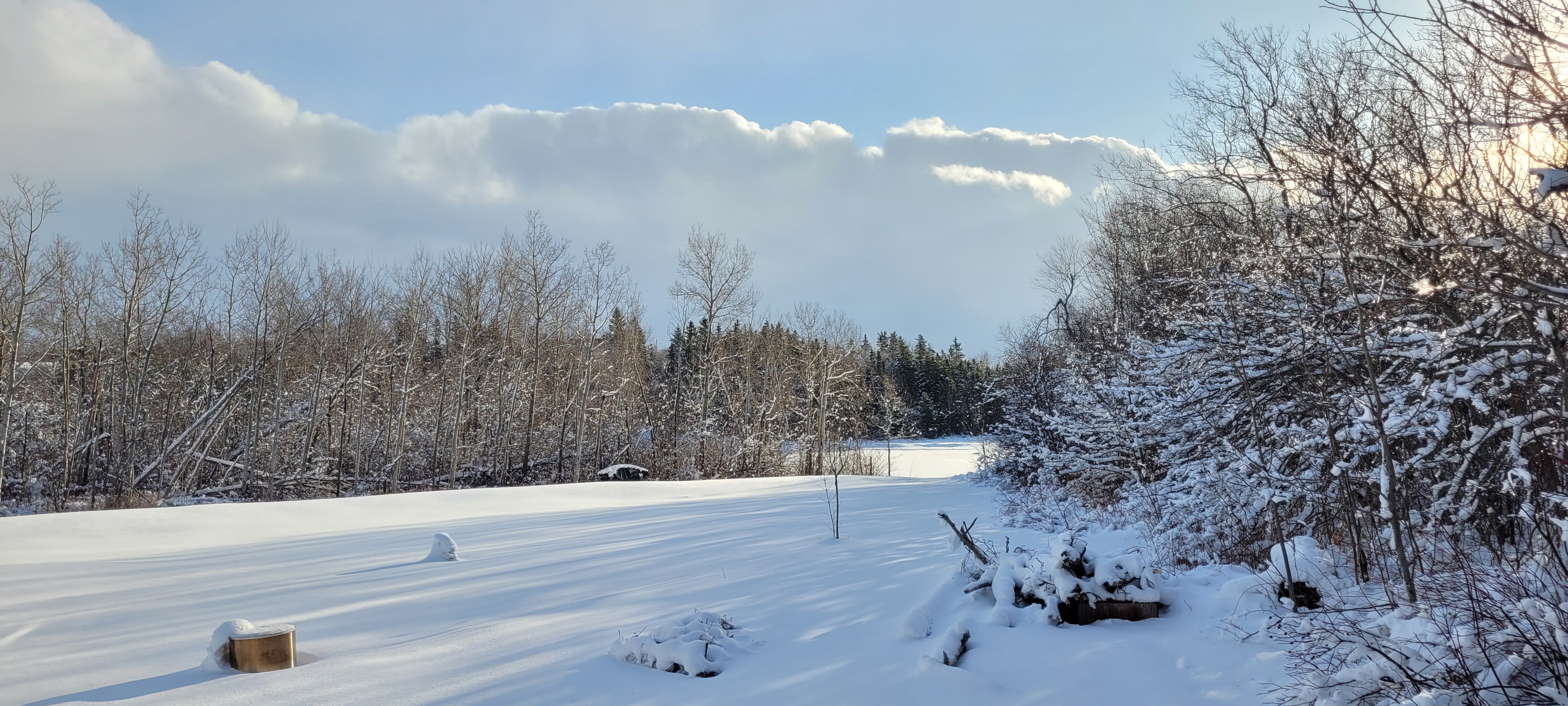
Sort of like Spring, my recovery is happening in bits and pieces. I almost felt like my old self again – and certainly felt a kinship with the earth – when I took a walk around the property this week. Like me, the saplings Sara planted while I looked on seem to have cheerily survived.
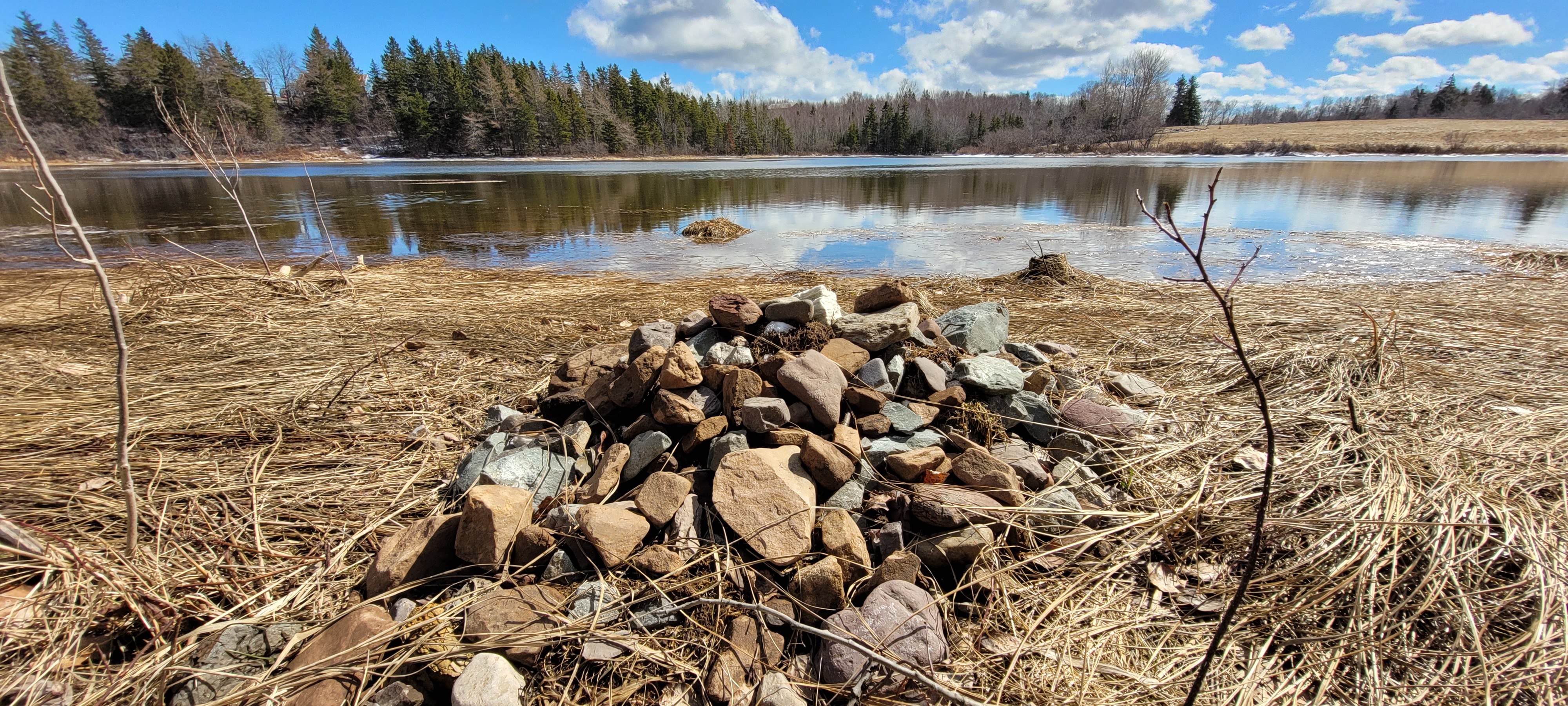
The stones I dumped by the inlet last summer need spreading, but it’s not yet the time.
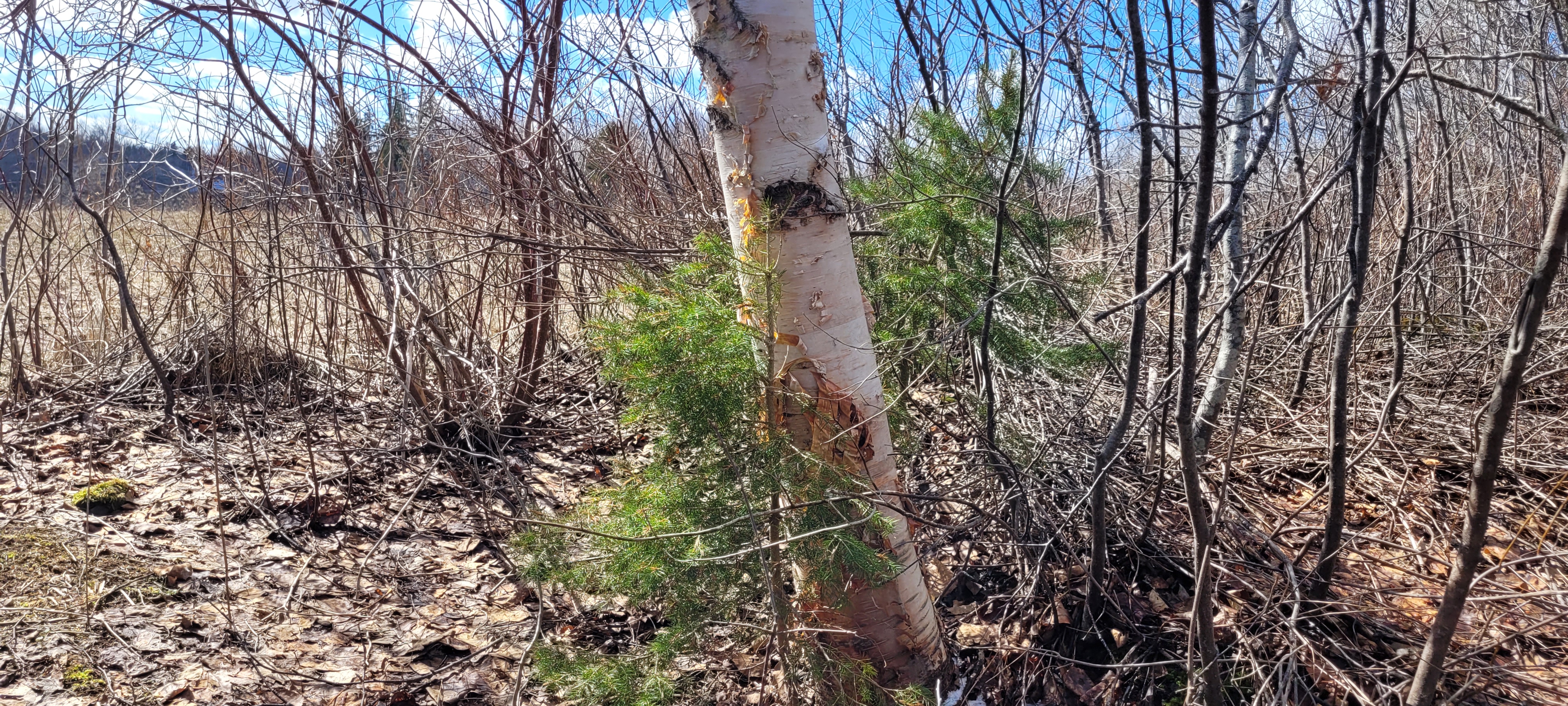
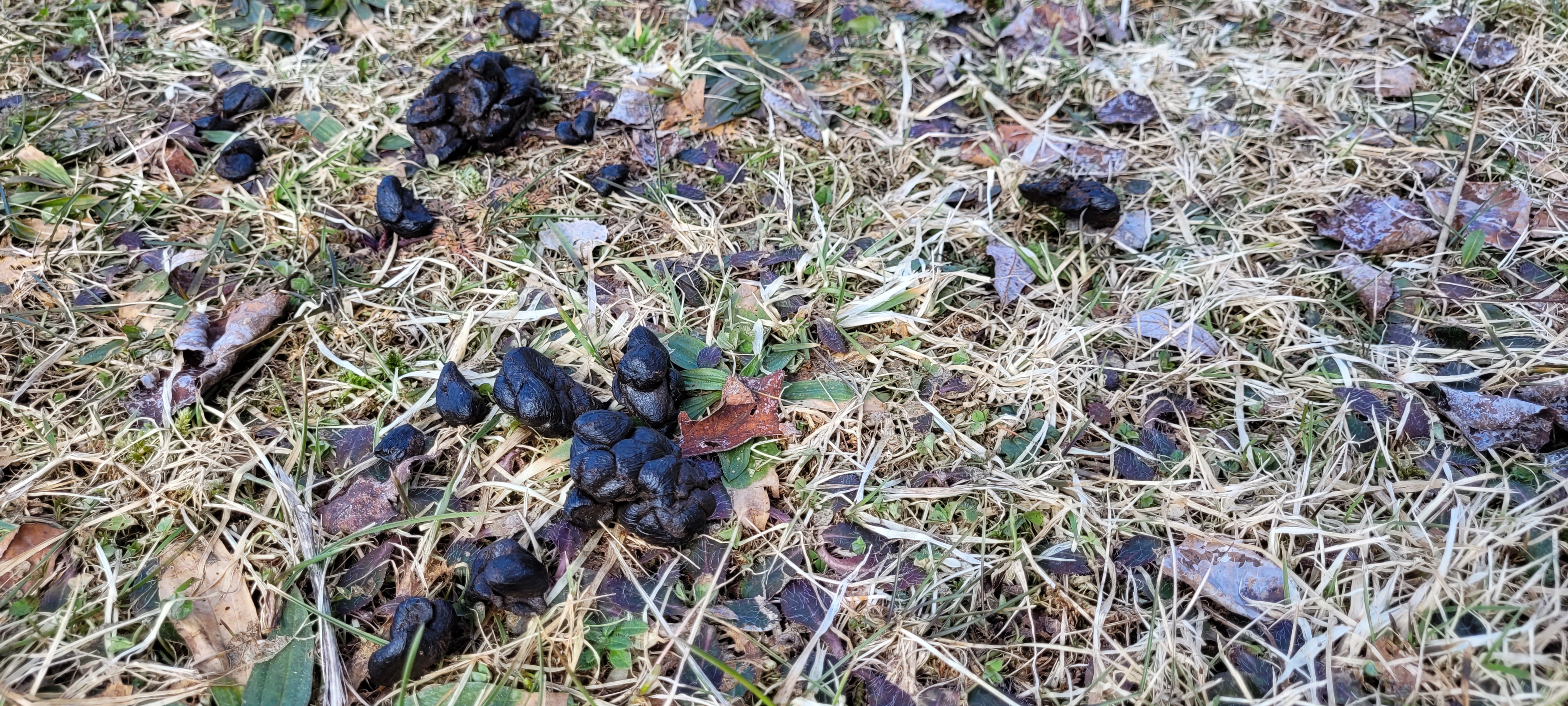
A wild-seeded pine will almost only pop up where there is already a birch, so perhaps the birches are “parenting” the saplings? Some creature left its scat nearby but I’m not sure what kind it is, and I don’t have an app for THAT yet…
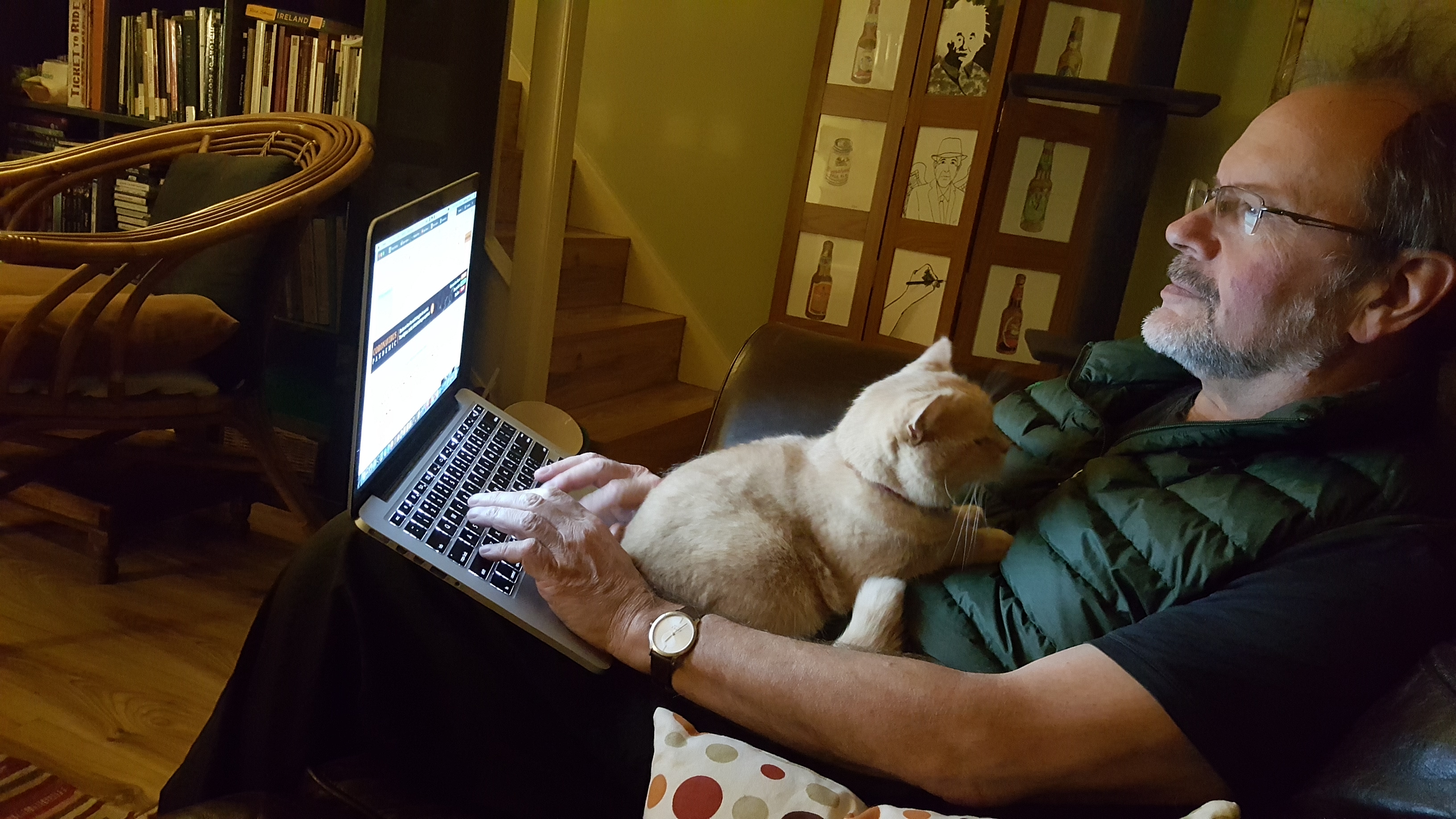
The brook on one side of our property is doing well, and this week the robins reappeared. Their singing is a joy, and might be the reason Theodore the reformed barn cat is crying so sadly to go outside for the first time since he so gleefully adopted us and moved in.
The sunset of my fellowship
There’s only a year left in my renewed Father Edo Gatto Fellowship at StFX, so I’m busily checking off my Gatto Chair goals. A big one happens this week. As soon as I knew I would be translating my historical research on the fourth century Saint Paula to fiction, I wanted to talk to other academics who do this. It’s finally happening this week! Sara will be moderating the webinar conversation, “Novel Research: Meet Four Historians of Religion Who Write Fiction.” I’m excited to talk about writing with these scholars I admire. You’re welcome to join us: register here!
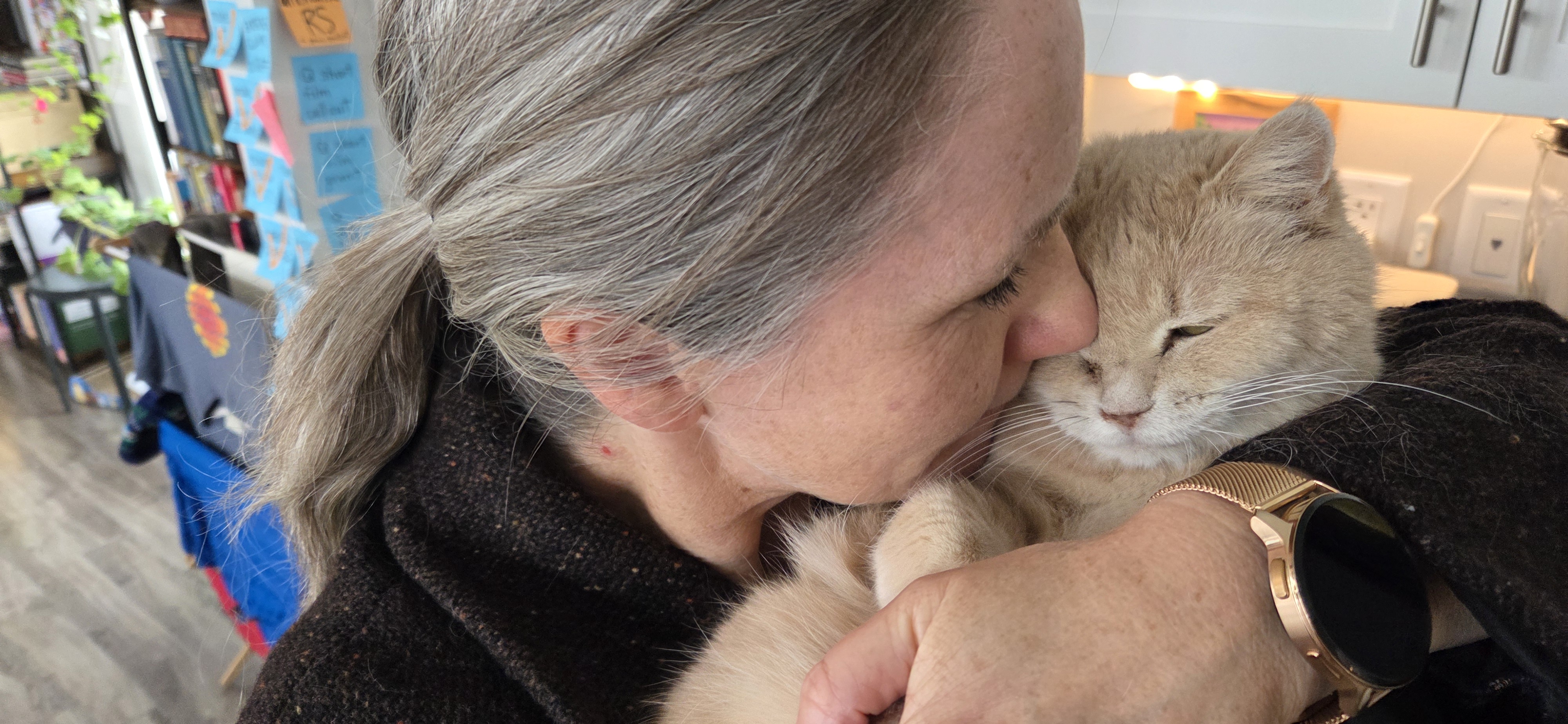
Our beloved 14 year old Sweet Pea just died. I’d had my most recent Botox shots to my left calf and arrived from the long back and forth drive to Halifax to find our elderly lady sprawled awkwardly on the bedroom floor by her food dish. When she saw me she stood to walk but kept falling sideways. I picked her up. Her head jerked in spasms every time I tried to get her to eat or drink, even her favourite tuna snack. She seemed to be experiencing terrible dizziness. Sara rushed home.We arranged an emergency vet, spent hours holding her, and only late that evening, after blood tests and consults, accepted the fact there was nothing we could do to help her. The vet believed Sweet Pea, who has been noticeably frailer recently, may have had a brain tumour (many from her semi-feral colony in Montreal had died from cancerous tumours) and that it had reached her optic nerves.
There’ve been lots of tears since. The day after she died, a letter arrived for Sara from a Montreal cat adopter who just lost her own kitty. She had sent some left-over anti-nausea meds to Sara (they’re expensive and were needed for every long car trip).
When Sara opened the letter, it simply said “Hope these help Sweet Pea in her travels.” “I hope so too,” Sara sobbed, and a fresh round of tears for us both followed.
Sweet Pea
Grief is natural. It’s not to be rushed. Sweet Pea was Sara’s first adoptee. Somehow, despite being the runt, she was the last of the brood to survive and to still be with us. She travelled with Sara back and forth across the Atlantic. When we moved to Dublin we crossed the Irish Sea by ferry – just for her. She was such a trooper. She was annoyingly anal about her schedule, perfectly indignant when food was late, completely trusting of strangers, very patient under duress, a true companion, and very, very smart. She loved being lightly vacuumed.
Also in the mail the day after her passing was an author’s copy of “Touchstone,” the United Church of Canada’s theological journal. The issue title? “Death.” I’d forgotten that I’d written an article on “Death and Mortality From a Biblical Perspective” for them. And here it was.
Given that Sweet Pea’s condition at first looked to me a bit like a stroke, and that journal article, I’ve been thinking about death, aging, frailty, grief, relationships, and all of our shared weaknesses these last few days.
Snow
During our winter break, Sara and I were at the Atlantic Lutheran Leader’s Retreat. Bishop Carla Blakley and the Eastern Synod staff asked how my recovery is going. I told them what I’m telling you: I can’t believe how supported I’ve been. I’m still so appreciative of the support of Sara, of the medical teams in Antigonish and Halifax, and of many of you, as I fight my way back from my stroke. It’s a communion of all kinds of “saints,” and I’ve been blessed by it.
I continue to measure my progress by small victories. For the first time since the stroke I can now straighten my fingers enough to put on just about any gloves (you’d be surprised how hard that’s been). After one of our seemingly endless snowstorms I backed up the car and realised I wasn’t using the camera but doing it the old-fashioned way: steering with my left hand, and looking over my shoulder with my (good) right hand behind the passenger seat. Like everyone else in Nova Scotia I’ve done a LOT of shovelling lately, using both hands. On one sunny day last week last week Sara and I had a hot chocolate date in the snow. I’m able to sit down and get back up from those more difficult places much more easily. My typing is faster and my guitar playing just slightly smoother every week.
Although I walked 1.5 km recently, my left foot was dragging by the end – a hard thing for someone who identified as a “walker” for so many years. But I’m able to dress myself, put on a belt, and dry off after a shower with both hands now. I can even tie a knot again, if there’s no rush and it doesn’t have to be too tight. In so many ways I feel like a toddler who’s had to learn how to move through the world.
Sauna
As I mentioned in a recent blog-post, when I had a brief but serious cancer scare not long ago, I decided life is short, and I’d buy a Finnish sauna kit. Ever since my wonderful years with the Finns of Montreal’s St Michael’s church, saunas have been in my blood – and my dreams. I know it’s an incredible privilege to have retirement savings, and to spend some of them on such a luxury. But when I get cold my entire left side seizes up, making walking difficult. And the sauna sure makes my left side – AND the rest of me – feel good!
Serendipity
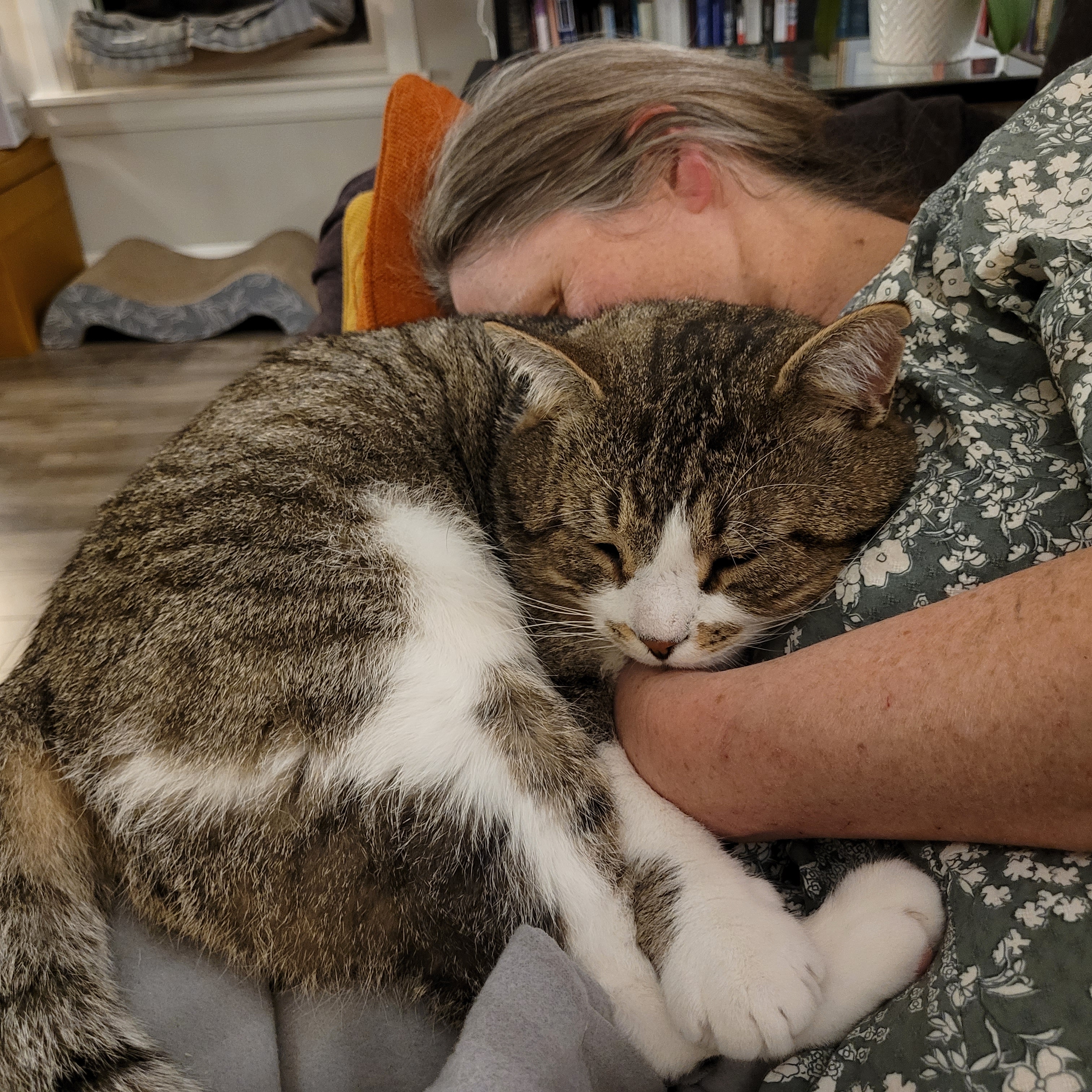
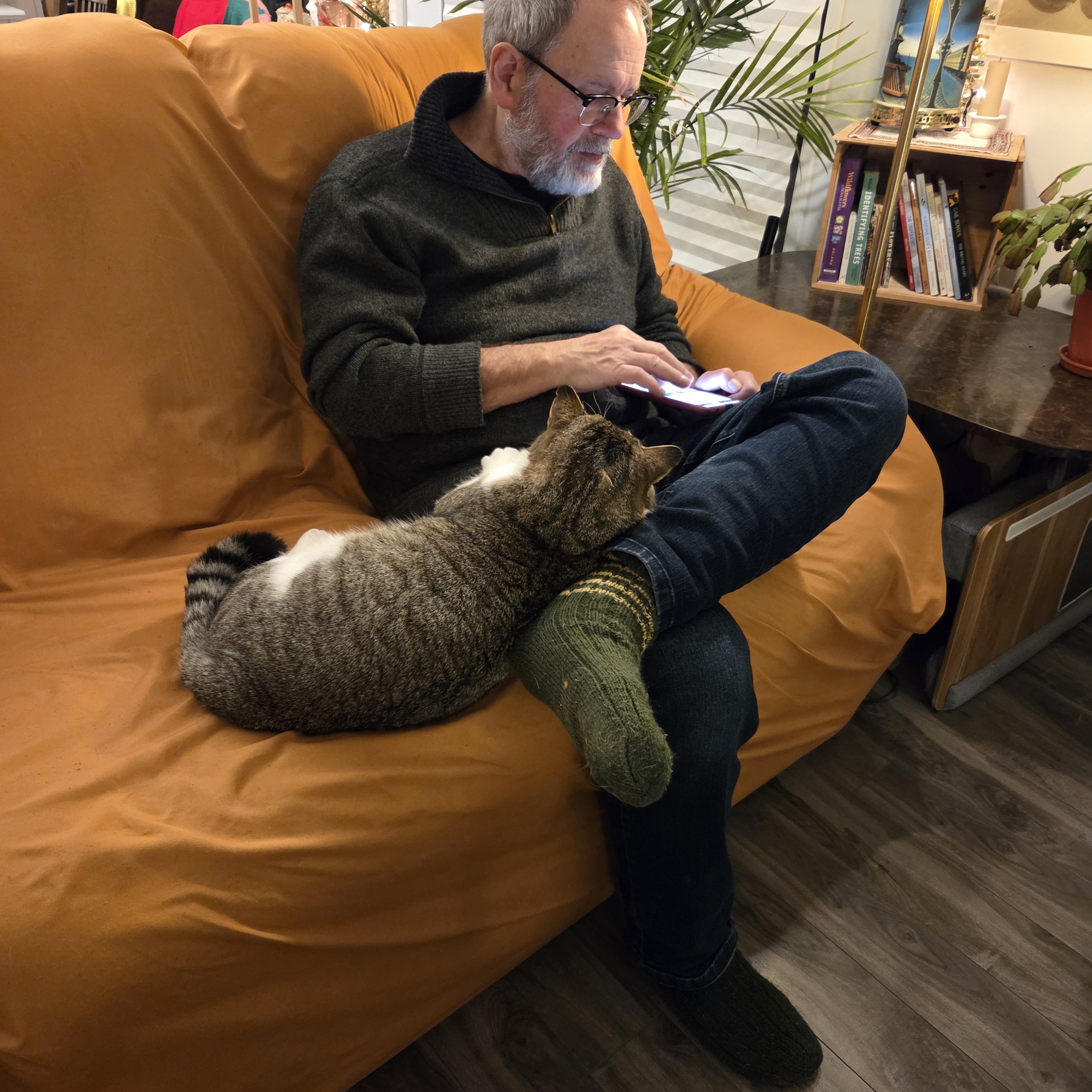
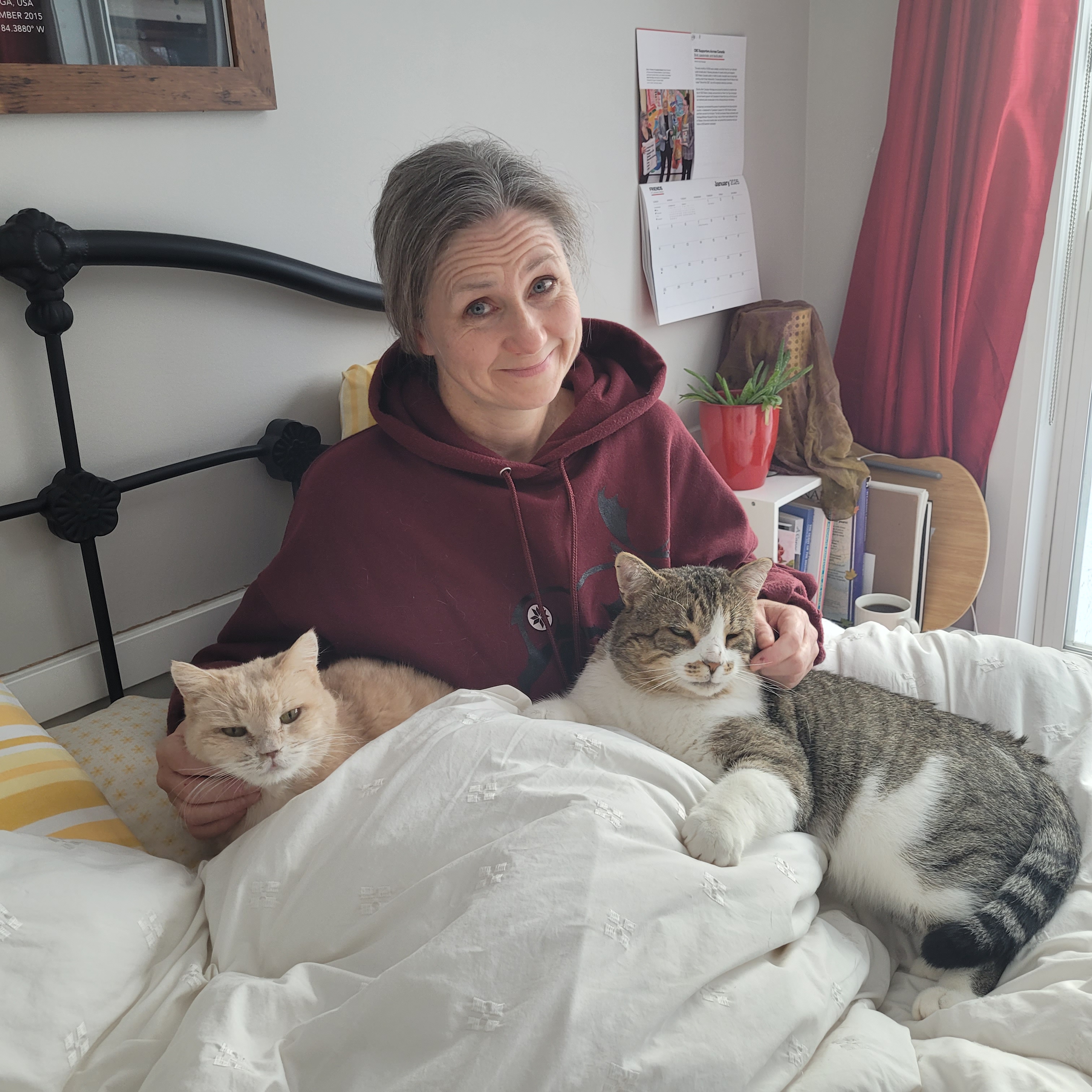
We were thinking Sweet Pea would be our last cat. But then, as I’ve mentioned on this blog, a big feral male showed up near our door in the coldest and snowiest of days last winter. He wouldn’t go near humans, but we’d wake up sometimes after VERY cold nights to find him on a chair on our deck, in the snow. He’d been terribly injured in one front paw somehow, and was un-neutered. Eventually, Sara managed to trap him. But when she opened the cage on his return from the vet, instead of springing away as expected, he turned and came into the house! Theodore is an 18-pound tabby. He’s incredibly affectionate and intelligent, even though (unlike Sweet Pea), he’s scared of any humans but us so far.
Back in his wild days, Sara named him Theodore. Both Sara and I have taught Greek. But until Sweet Pea’s passing just now, somehow we didn’t remember that Theodore also means “gift of God.”
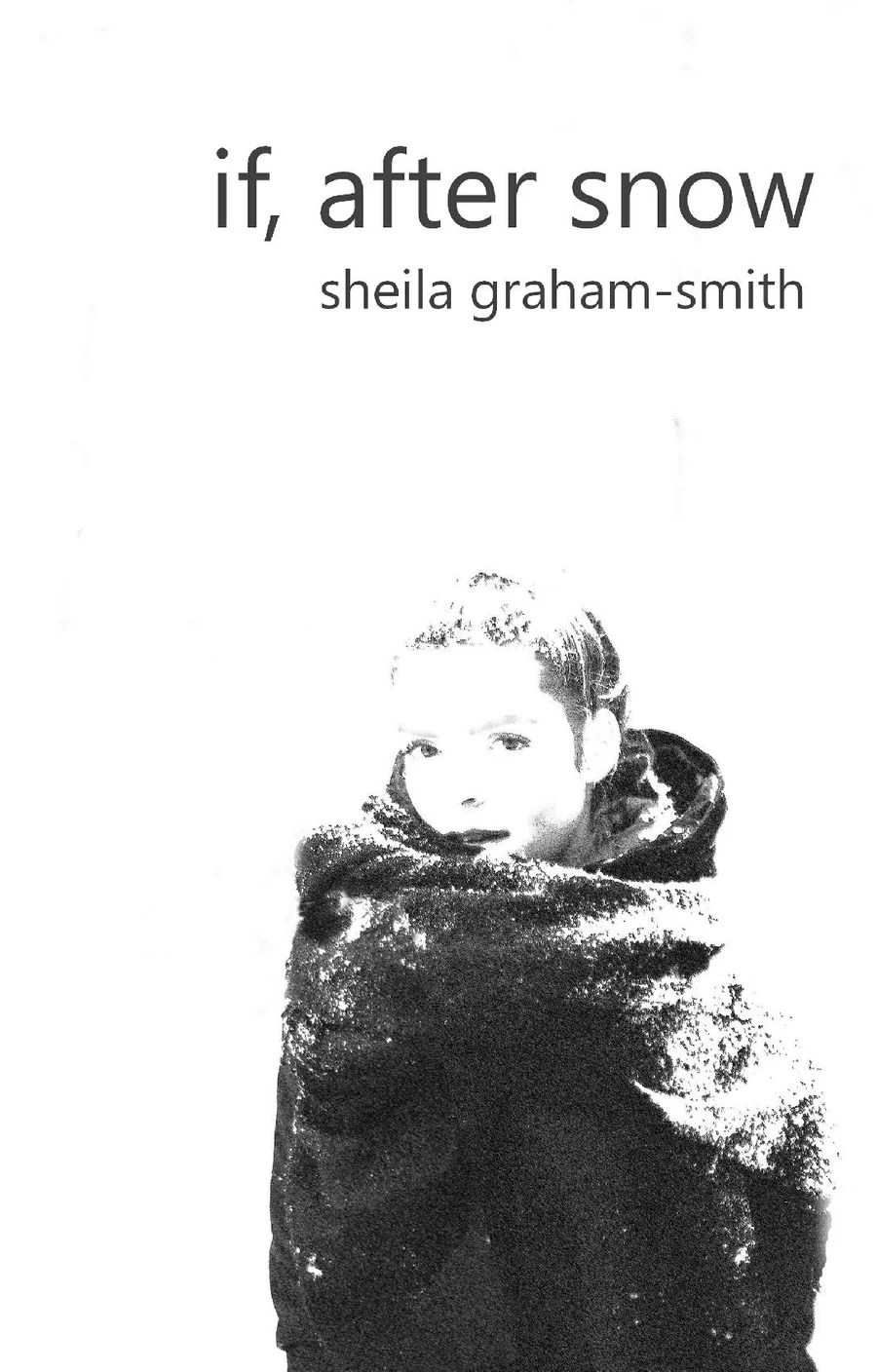
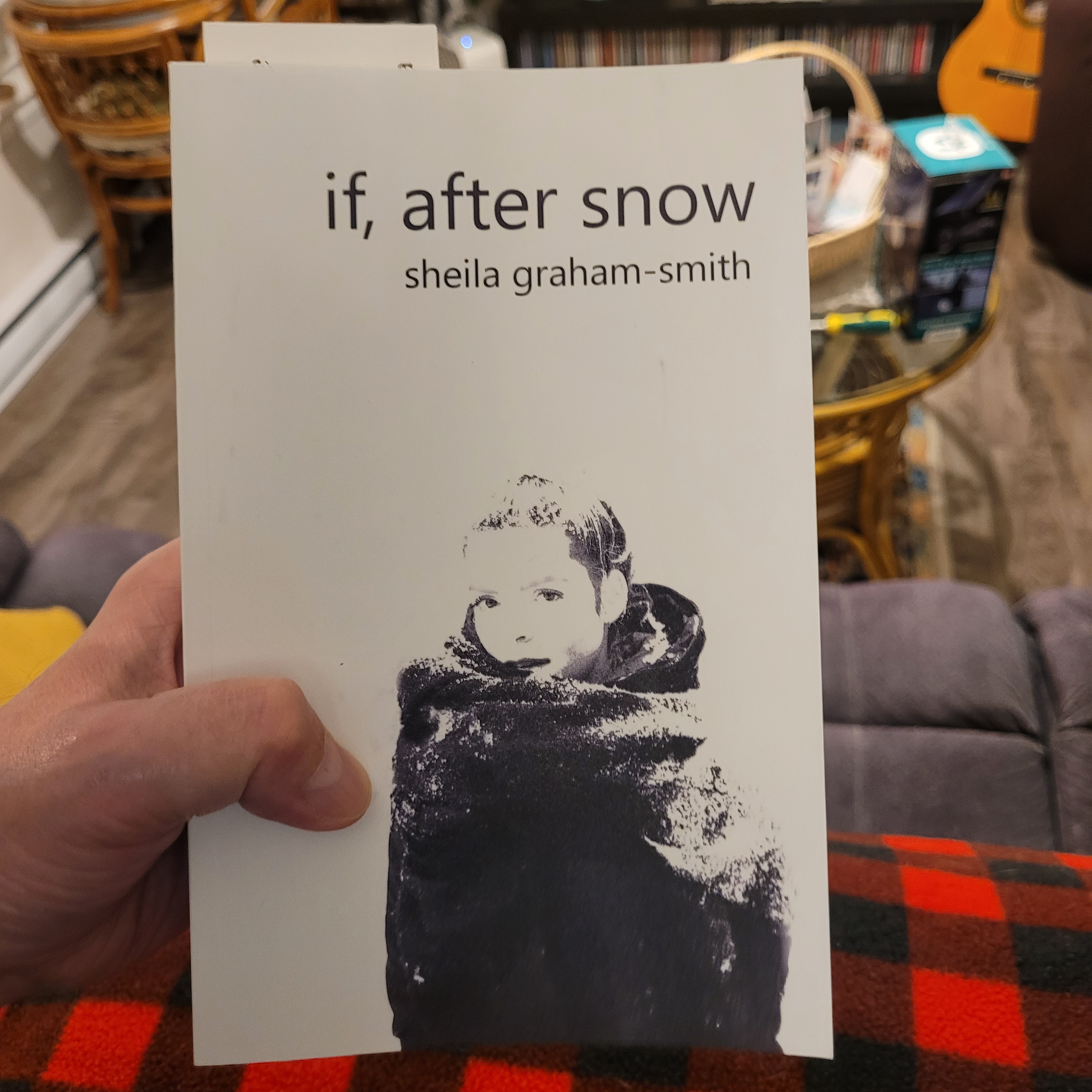
There’s a bleakly beautiful quality to many stories set in northern climes in winter, a dark, dreamlike state that can settle over the entire narrative. I first felt it in the novel Smilla’s Sense of Snow, and it’s palpable in most Scandi Noir TV crime series. You also feel it from the first page to the last in Sheila Graham-Smith’s translucent novel, If, After Snow, set in the Annapolis Valley and published by Askance in 2025.
As I write this, the temperature in Northern Nova Scotia sits in the double digits below zero. Winter’s darkness falls early and completely. The shore ice is cracking, sometimes with sharp, breaking-glass splinters, and sometimes in low thrumming woofs that hit deep in the chest. Among many Indigenous peoples, storytelling is reserved for winter.[1] The reasons are partly practical. But they’re also an age-old recognition of relationality: wind, ice, dark, and cold are not merely “environmental.” They’re agentic. They’re characters, as Graham-Smith makes clear. And the relationships formed or broken between people huddled together for warmth and mutual support during this season develop in interaction with those hibernal characters.
“No breath of wind, No gleam of sun – Still the white snow whirls softly down… Twig and bough and blade and thorn all in an icy quiet, forlorn” (283).
For all our exposure to wind-chill factors and our jokes about shovelling driveways, we Canadians have not always cultivated the intimacy with winter’s vicissitudes and possibilities that characterises other northern cultures. Graham-Smith quietly but firmly redresses that possible omission in “If, After Snow.” The book’s enigmatic cover could be an overexposed photograph taken during a whiteout. The plot unfolds like gently falling snow gathering momentum until arriving at the inevitable storm and its morning-after digging out.
The novel is set in late winter along a snow-bound stretch of the Fundy Coast. Carl Zoëga, facing a terminal illness in his 90th winter, has fled the seniors’ complex in Montreal where his well-meaning son Coby placed him to live out his final weeks with his daughter Miriam, a world-class cellist and experimental composer, at his summer home in the Annapolis Valley. In the neighbouring farm, Kip, a writer who has also taken winter refuge, is struggling to understand his life in light of a collapsed marriage, the death of his own father, and his consequent writers’ block.
Of course, the protagonists meet. With her preternaturally pale skin, her snowy hair, and her half-wild attention to the natural world and comfort in silence, Miriam physically embodies winter. Carl is a native Icelandic speaker, and stranger neither to winter, nor to a certain type of stoic Scandinavian philosophy. He represents the wisdom not only of his years, but also of the way that fate chose him, decades earlier, to be the father of Miriam and Coby.
“Not much can prepare a person for death but love is most effective. Only in those two instances do we give ourselves so completely to the unknown. To the other. And in the case of love, we do it willingly, so it’s like a practice run” (Carl, 155).
Carl had been a 60s-something single man placing groceries into his car when a desperate-looking young woman got her grocery cart stuck in the snow beside him. She asked him to watch the cart and a baby and older sister while she ran back to the store for her purse. She never returned, and Carl became the parent of two children “in none of the usual ways.”
Although the novel’s point of view shifts between protagonists, and the reader is privy to the thoughts of all the characters, it is Kip with his stumbling questions and his fears of mortality who most stands in for the reader. Carl’s – and sometimes Miriam’s – words to Kip are intended for us. The conversations between the three turn out to be as beautiful and delicately fragile as winter hoarfrost.
“the world continues to offer itself as solace for what can’t be cured” (Miriam, 254).
My only moments of readerly disengagement with this extraordinary novel happened during its penultimate pages, during those conversations I was most enjoying. The ability of nearly all the characters at that point to recall complex philosophical arguments in their entirety and never to stoop to banality or small talk (or to ribald humour, a well-loved Maritime trait) at times broke the spell Graham-Smith had otherwise so successfully cast for most of the book.
The author leaves us with both a quiet life wisdom and a profound learning reminiscent of Marilynne Robinson in Gilead. Kip’s writerly realization – and his breakthrough in his fear of death – is perhaps Graham-Smith’s nod to the writers’ craft:
“he had been looking, he realised, not for language to acknowledge life, but language to contain it” (Kip, 319).
If, After Snow successfully acknowledges life, and hope, and love – and even spring – while never trying to control or contain any of them. The novel ends with a funeral, and yet it is not (as Byron would have had it) therefore a tragedy. Perhaps this is because of a quiet glimmer of relational warmth in the final pages. But for me the theme is found more in the Icelandic phrase from Carl that Miriam repeats as an epithet at the funeral, and which brings us back to the gift of how this is a properly Canadian winter novel. Halda fyrir veðri: “stand before the wind.” “We used to stand on what we called the seaward ramparts of Fort Anne,’ Miriam says, “holding hands, in blustery weather. For exercise, Carl said. For practise (335).”
“Stand before the wind…for practise.”
In all those dark, Nordic narratives, winter is not really an enemy. Its hardships are real, but they’re ultimately generative. Winter, the season, is a chance to listen, to gather together, to tell stories, and to hold on. The title If, After… (an allusion to the Sappho fragment and Anne Carson book If not, Winter) says it all. Sheila Graham-Smith’s novel is a bleakly beautiful reminder to hold fast to one another in whatever winters we experience, and to always practise love, but especially in the face of death.
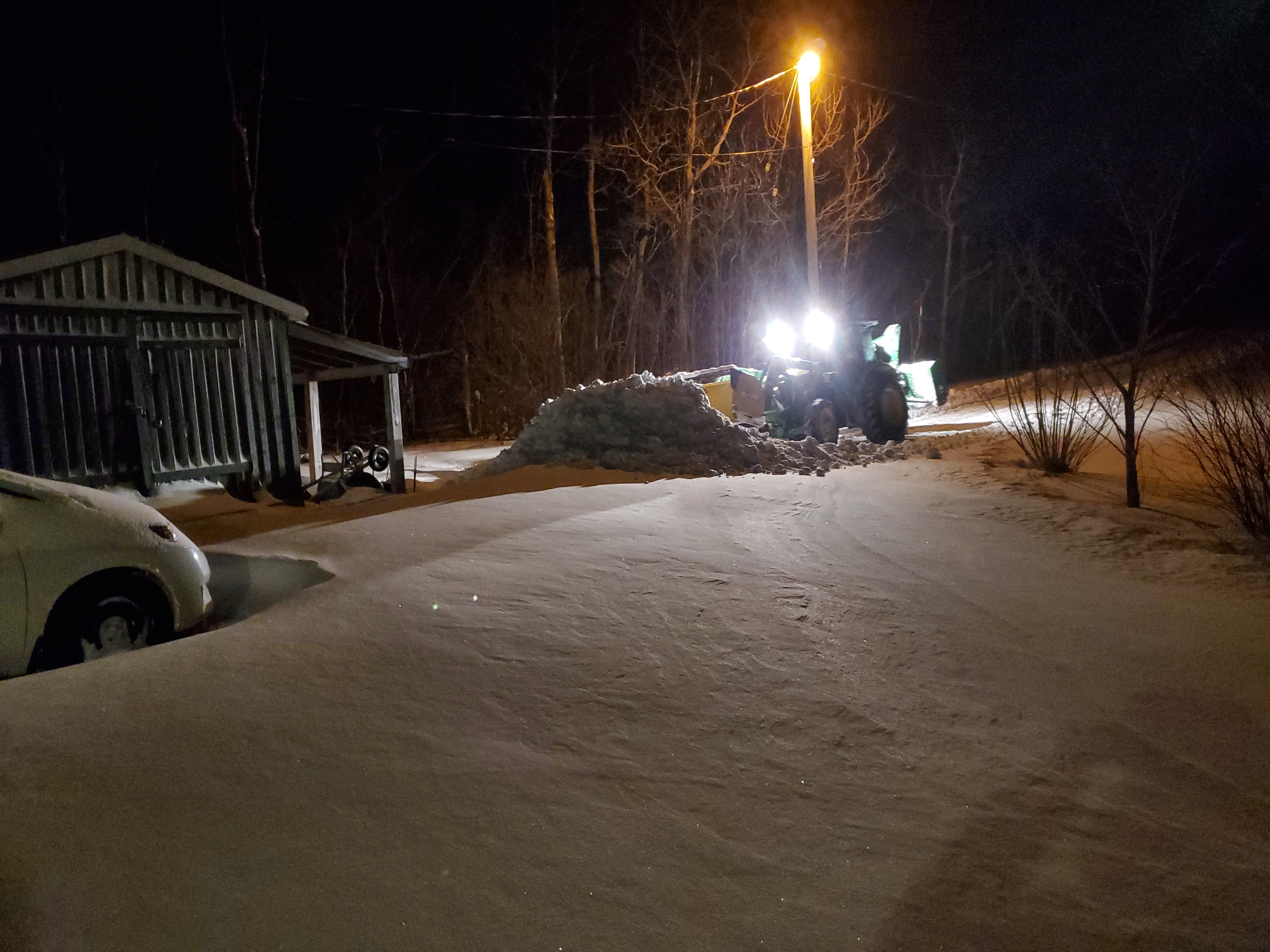
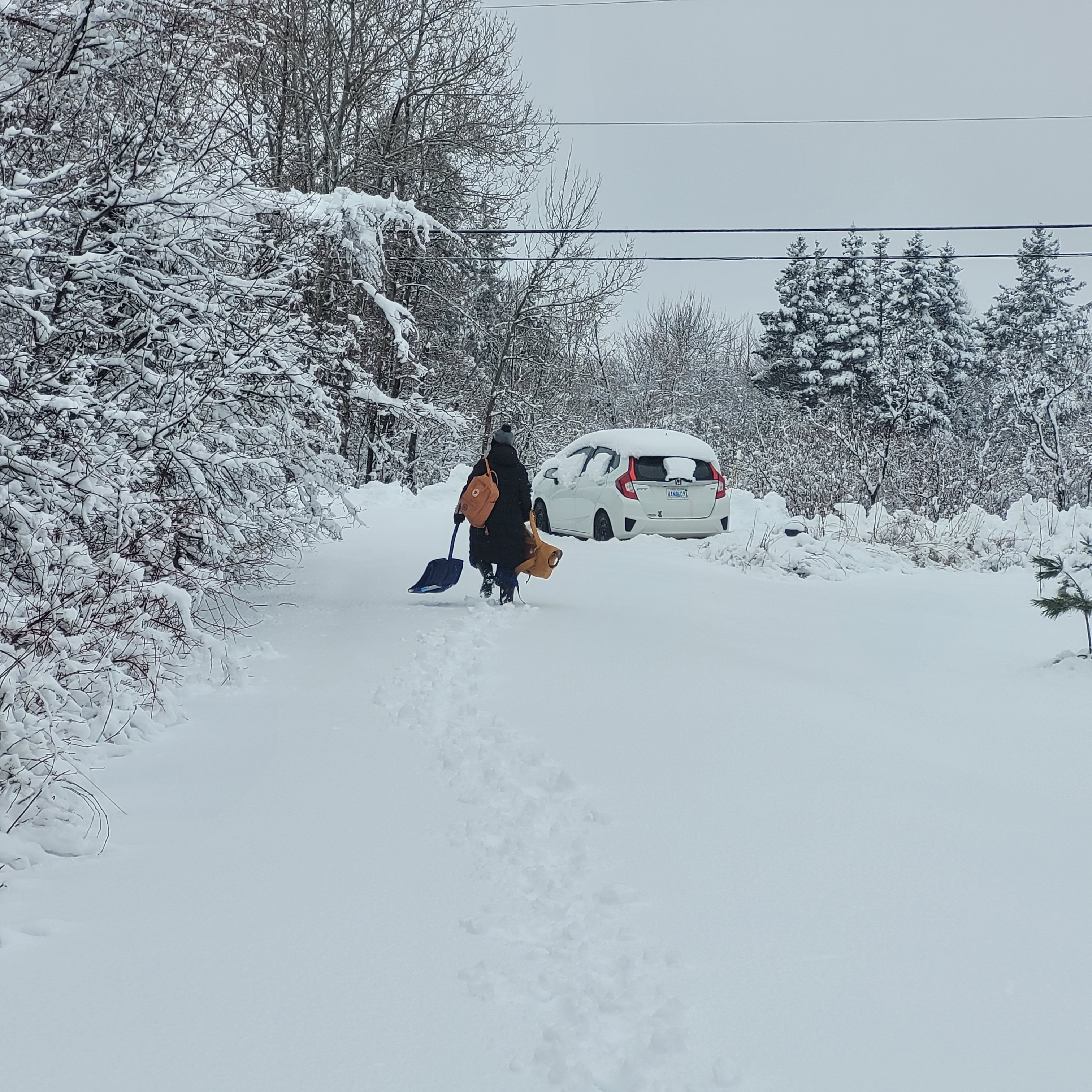
It wasn’t the snowstorm. Having to park the car by the road at the end of our lane to be sure we can get to work in the morning isn’t that strange, even though the snow-laden trees are beautiful. Here in Pomquet, in Antigonish County, a storm day requiring our neighbour to come plow us out is starting to feel like a bi-weekly event. I had some trouble keeping up with Sara on her march to the car. But no, it wasn’t that.
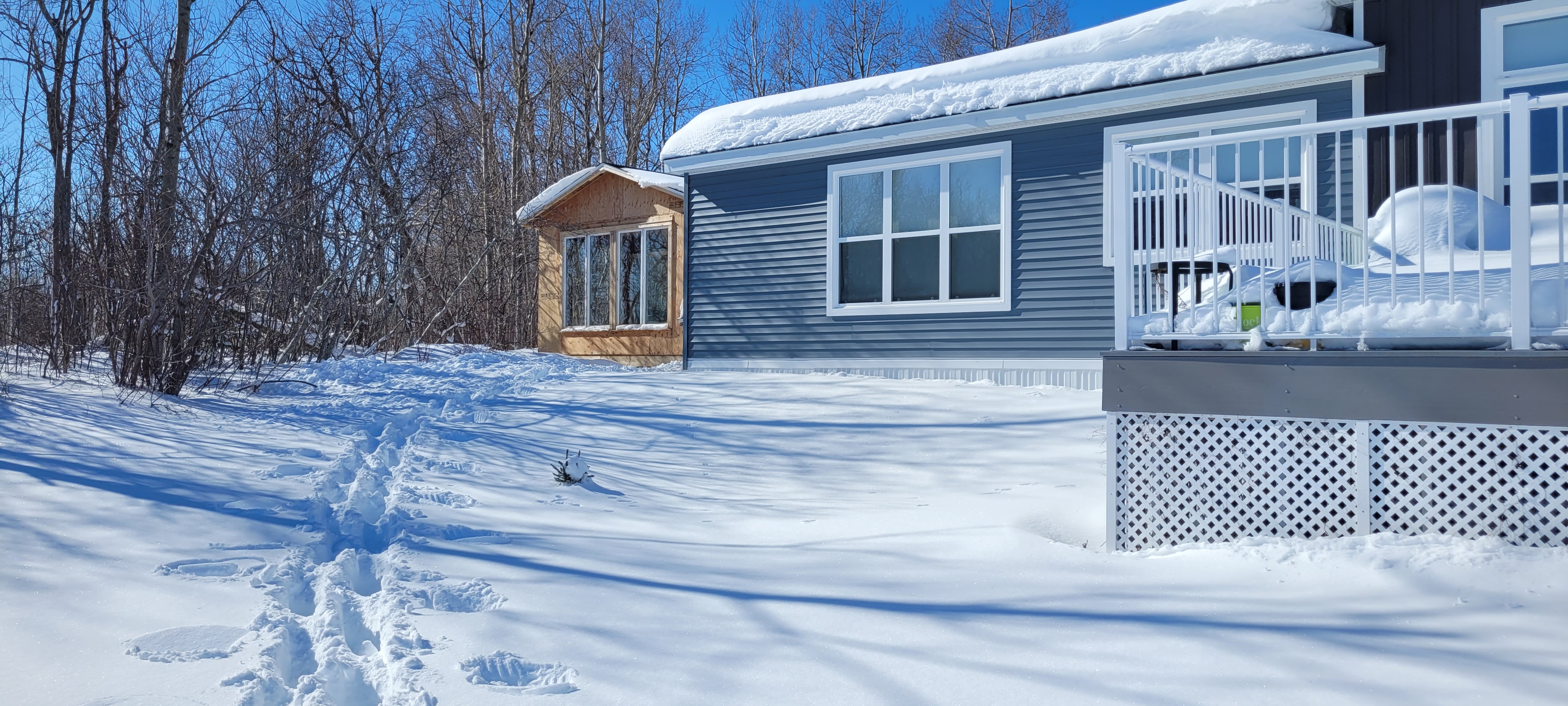
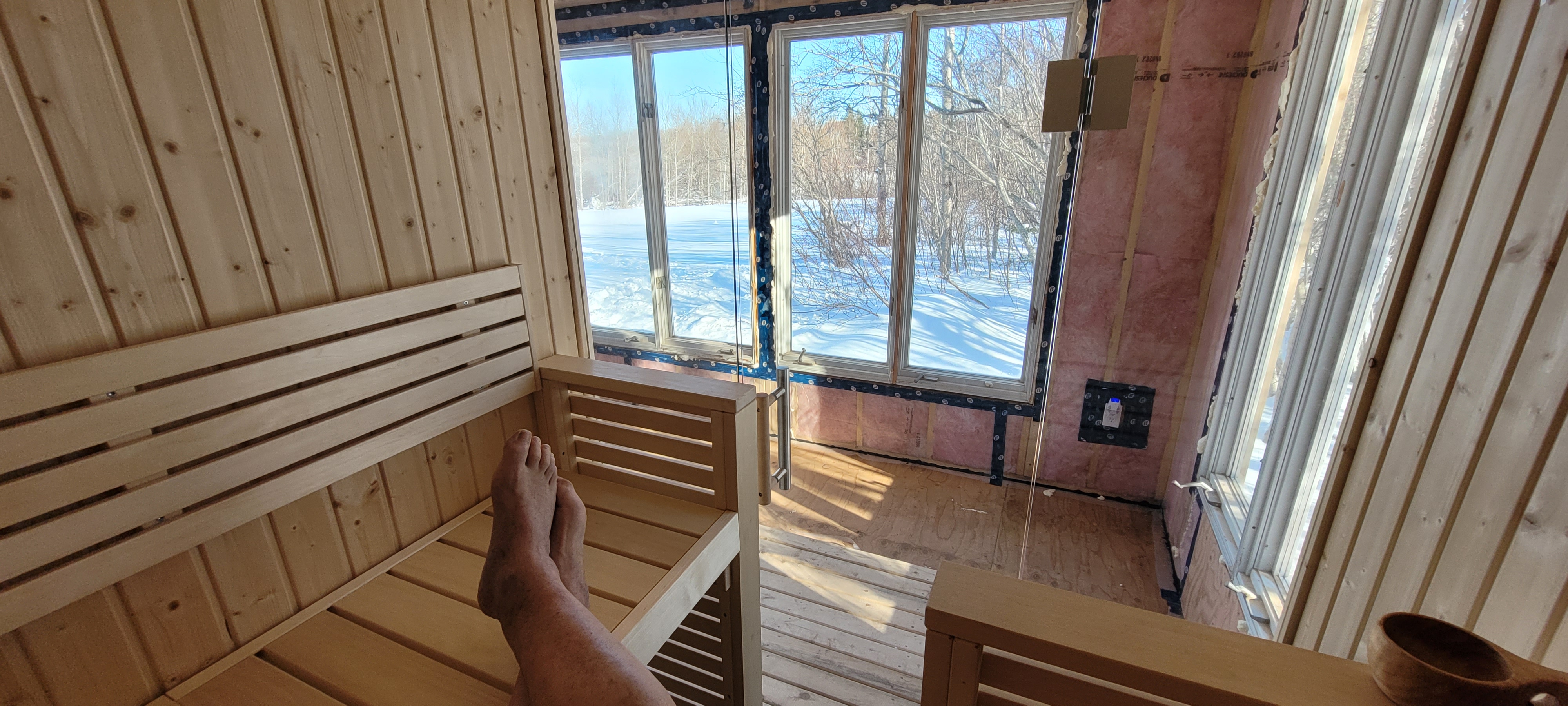
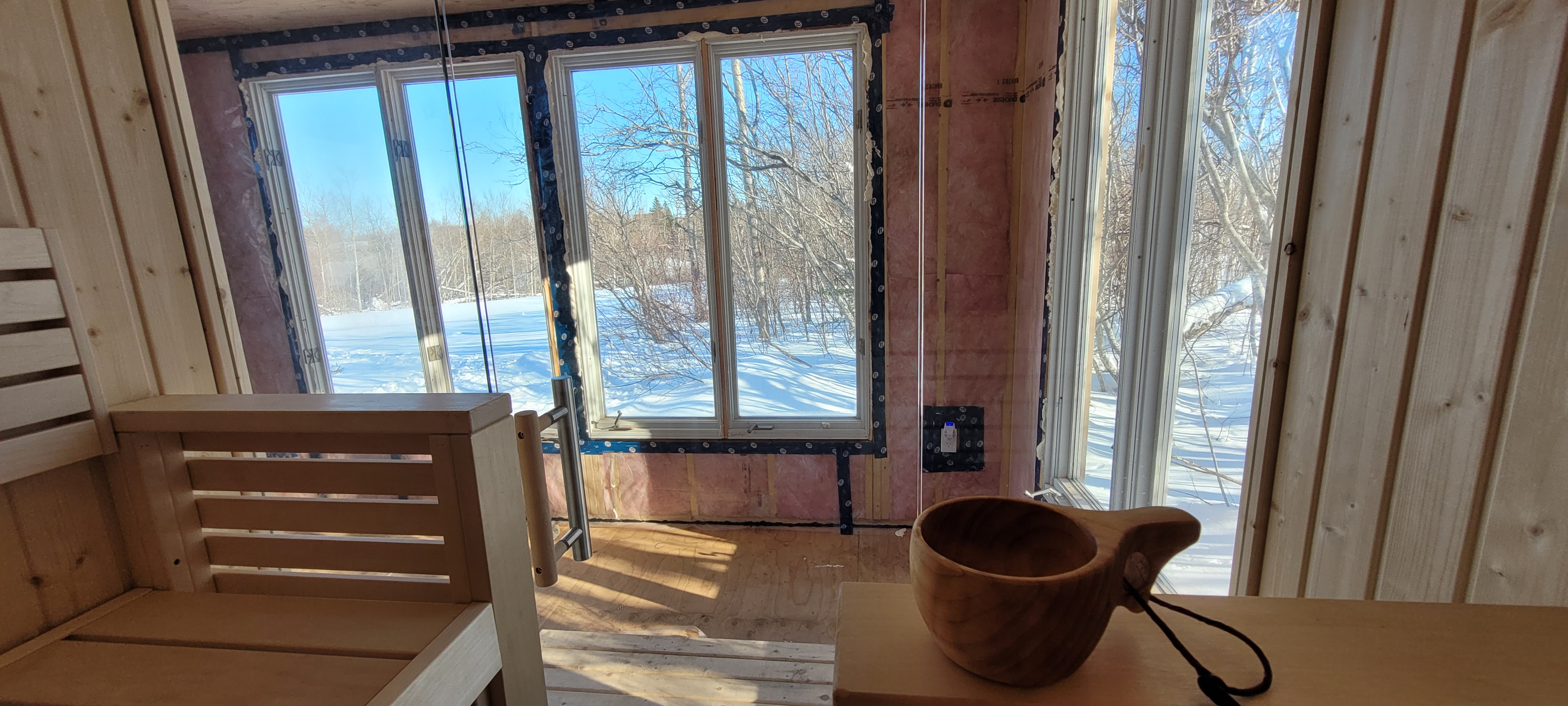
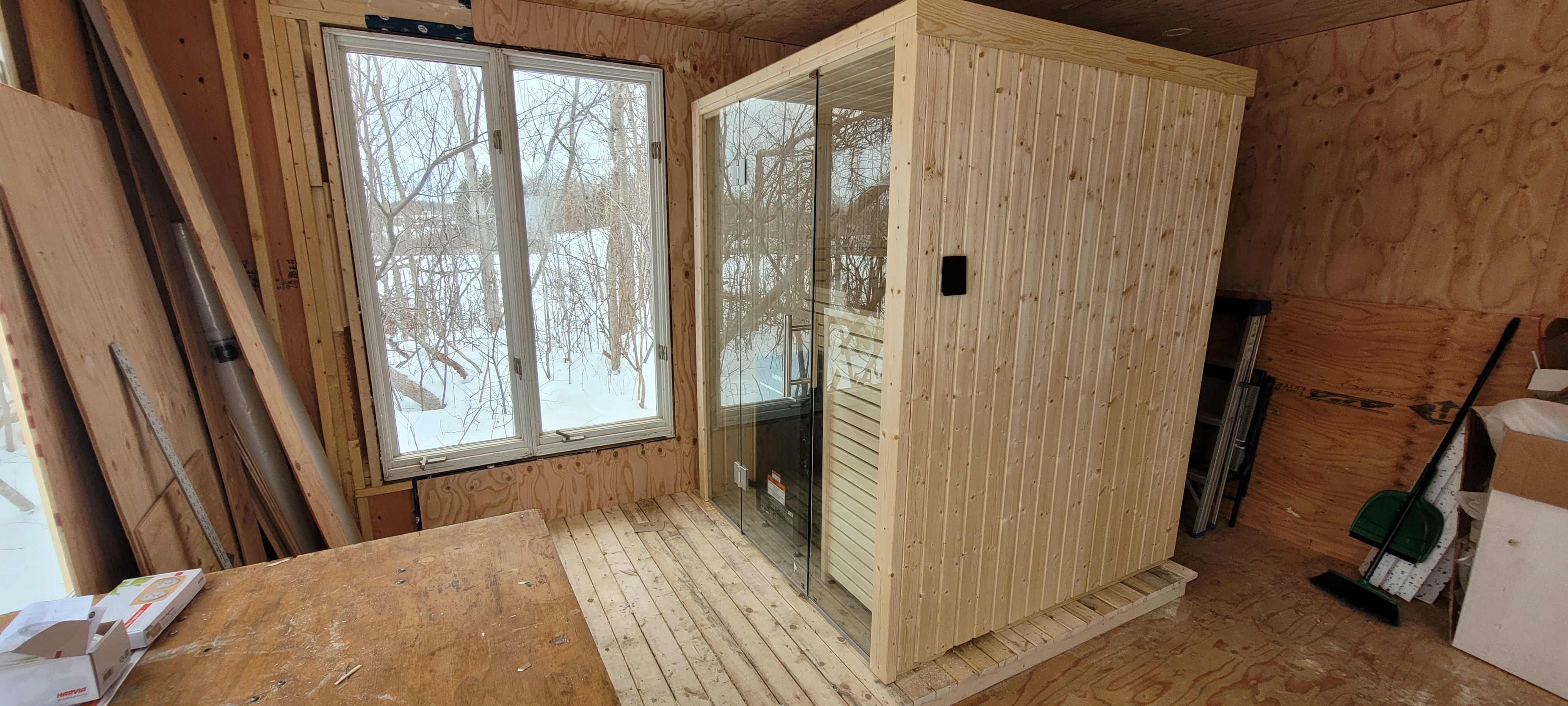
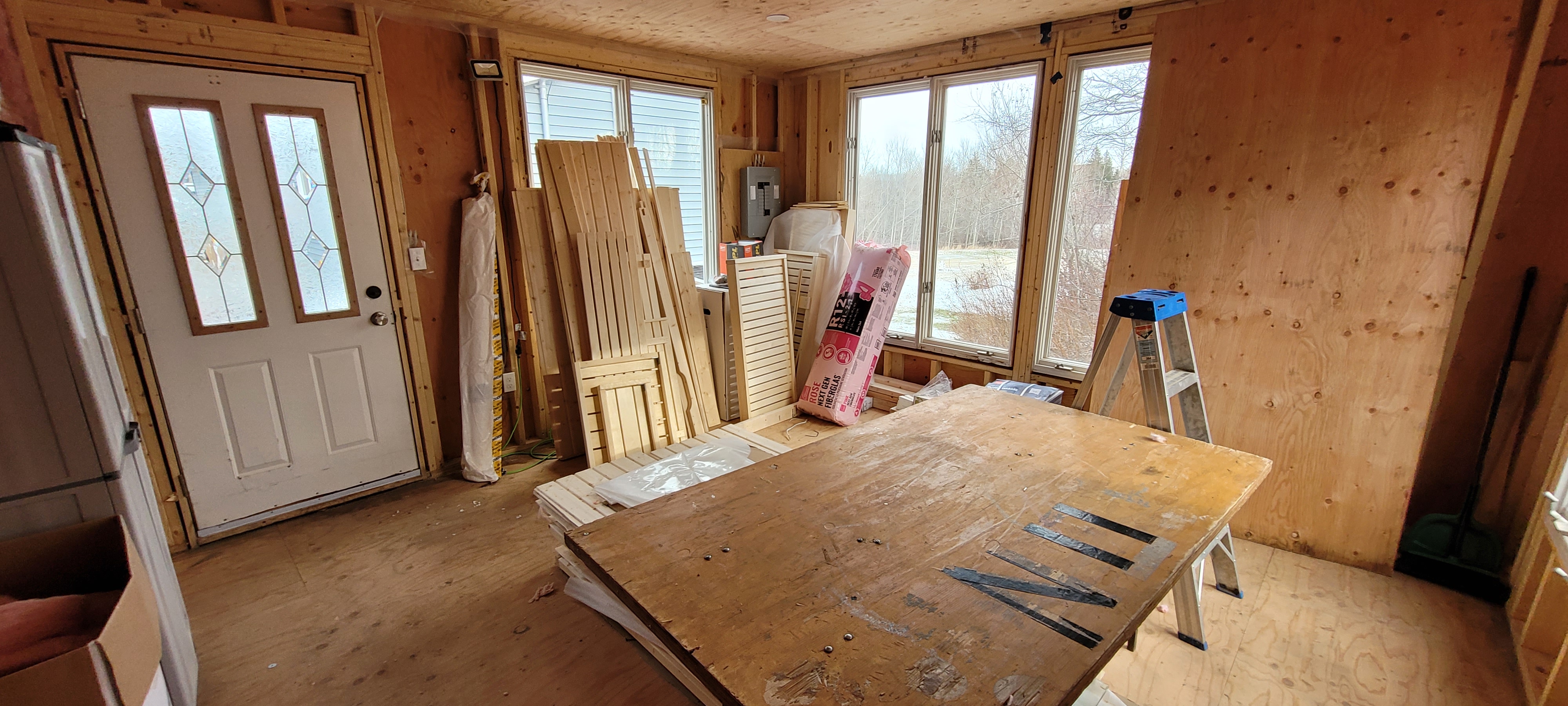
Nor was it the sauna. In December, on receiving unexpectedly good news after a scary cancer test, I decided I’m not getting any younger and I’d buy that sauna kit I’ve dreamt of for years (ever since being pastor to the wonderful Montreal Finns and enjoying the rite with them). With the help of local carpenter extraordinaire Evan Theriault (Theriault Timberworks) I’m hoping we soon have our very own sauna in action for relaxing in this deep-freeze. That will be great. But no, it wasn’t that.
And no, it wasn’t that I’m starting to feel increasingly guilty about my handicapped parking sticker. Yesterday I felt badly using the space at the Farmers’ Market, although in the end I’m glad I did, since my balance on ice still isn’t the greatest. I’ve started to leave spots closest to the door for those who need them more. I guess that says something about my recovery and the general improvement to my walking! It’s easier and easier for me to tramp around the property, even on days like this (see below). But it’s still not that.
Nor is it that the big, furry feral feline we named Theodore, whom Sara trapped, neutered, and had patched up by the vet for his infected paw injury, didn’t immediately spring back out into the wild on his release. Instead he surprised us by turning into some kind of indoor love-bunny. He has apparently decided to adopt us. He’s incredibly smart and affectionate. As a dog person and someone with mild allergies I don’t encourage Theodore too much, but he seems to think I’m okay. We’re warming up to each other. But it’s not that either.
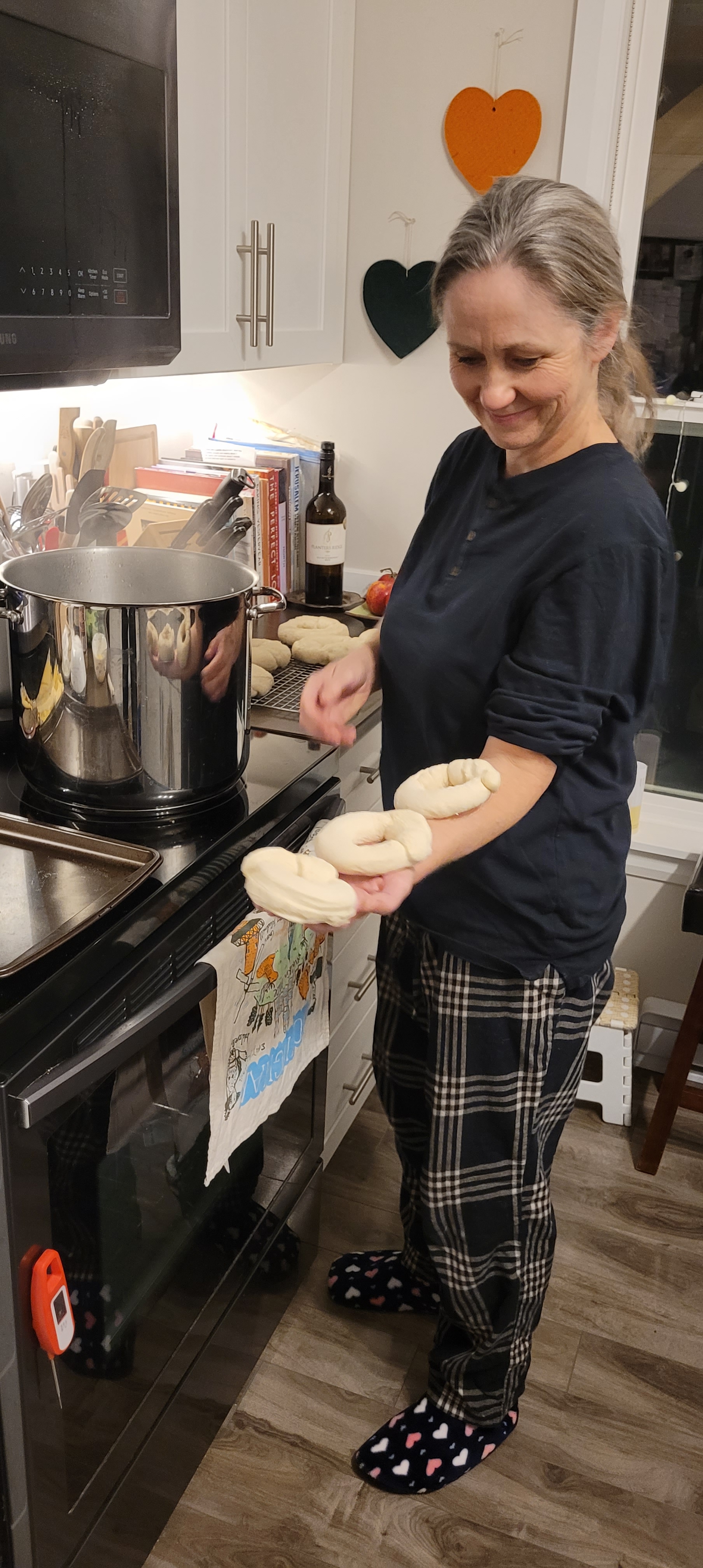
Nor is it that Sara tried her hand at making bagels (Montreal-style, of course!). As I write this I’m enjoying that yeasty, honey-laden smell and taste, and I can’t wait to try them with cream cheese. A rare delight and pleasure, indeed! (Recipe here). But no, not that…
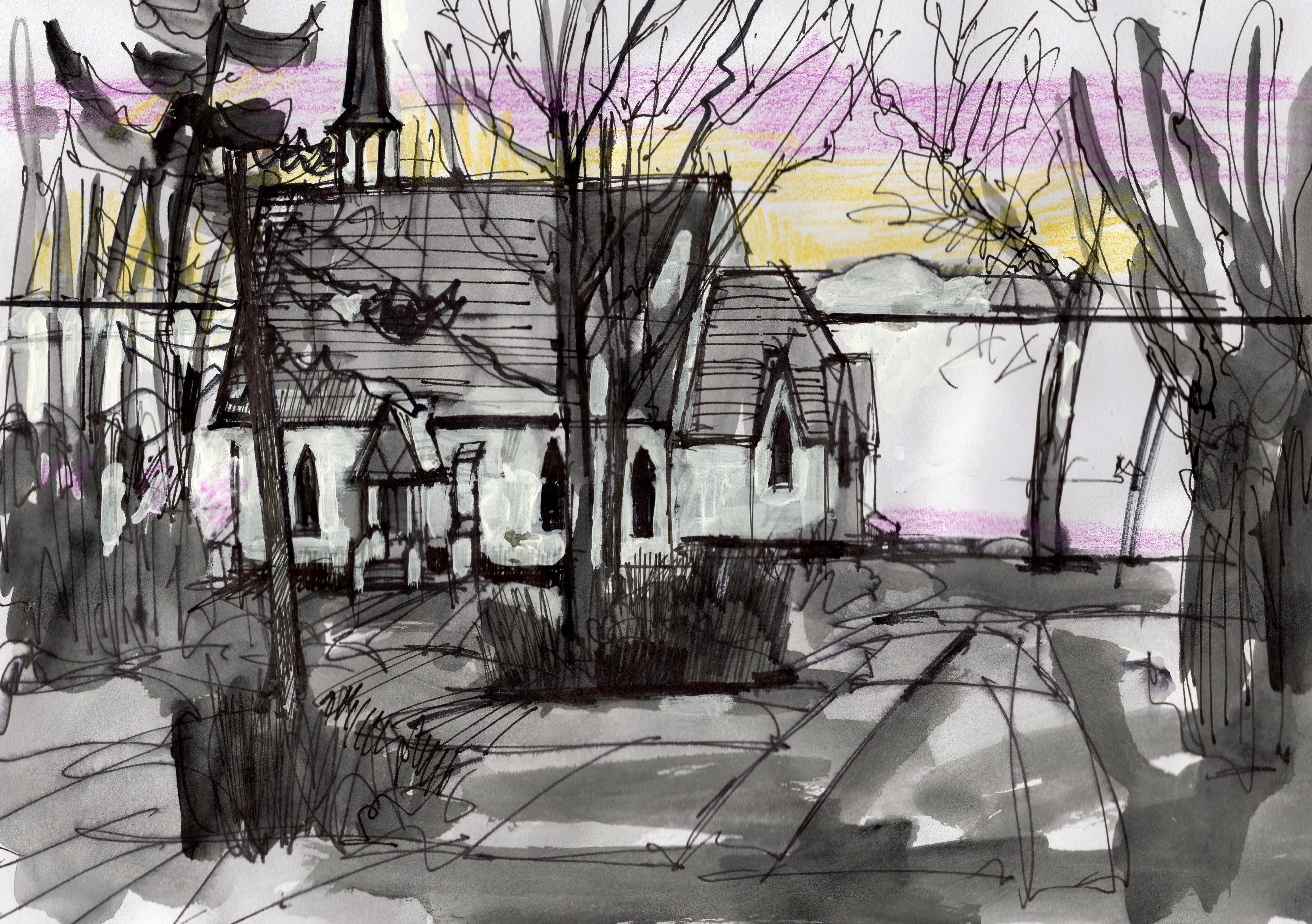
Finally, it’s not that for the first time in months I dusted off my completed novel manuscript and read through it again, and I still think it’s great! I’ve been inspired to start sending it out to publishers again. The drawing below is from my friend Robert Aubé (more at his website). The novel is set in the very real location of St James Anglican Church, Cacouna QC. I’m rejuvenated. But no. Not that either…
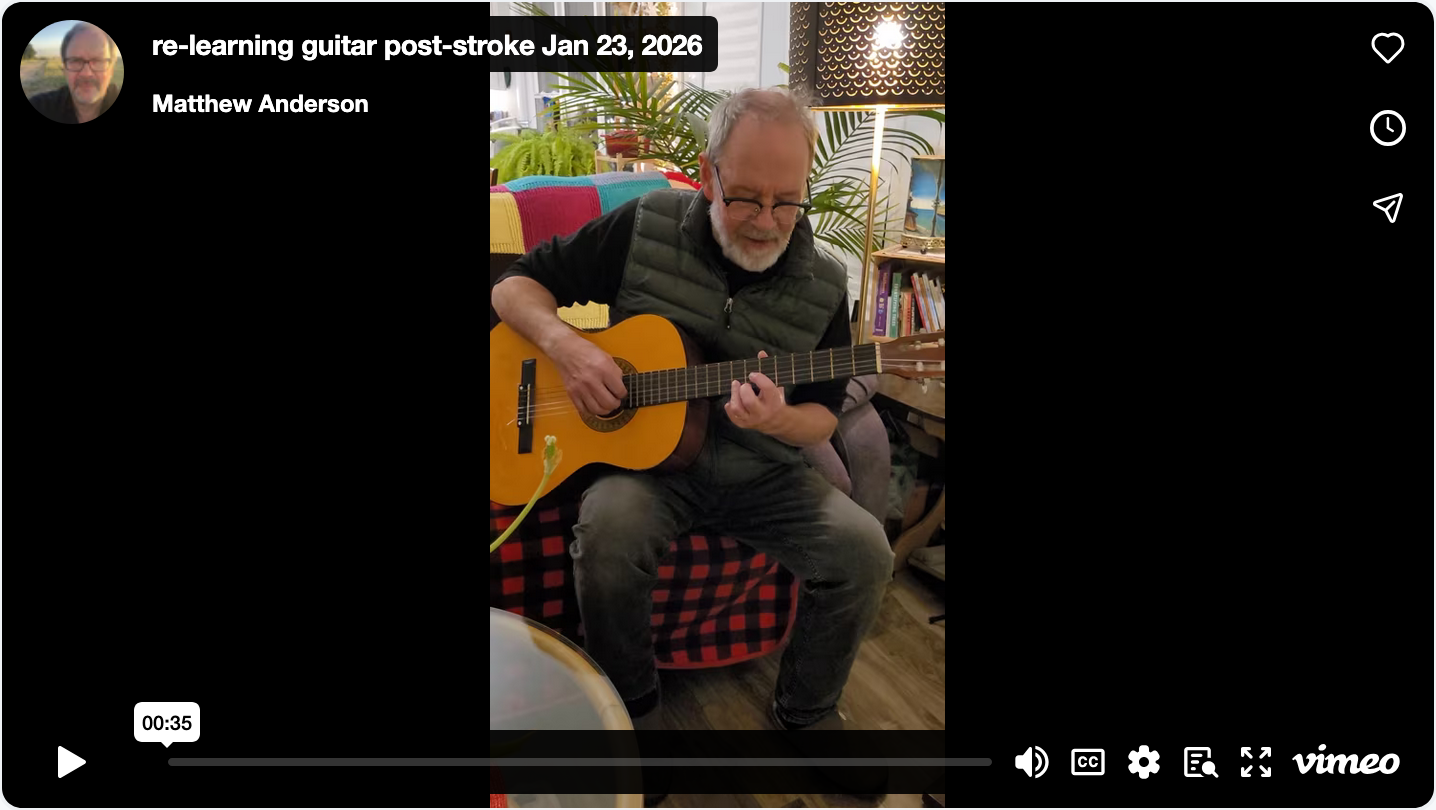
What it IS, is that this last week I had Sara film my daily attempts at guitar. Every day I try to get my left hand fingers to move better by practising my playing. Here’s where I’m at post-stroke as of yesterday: https://vimeo.com/1157626018?share=copy&fl=sv&fe=ci
And here’s where I was pre-stroke, with that same piece (and with help from my youngest). I hope someday to get back to this level: https://vimeo.com/433444043 .
No. What actually happened this week that was unusual, was that I watched the recording Sara made, then the one from a couple of years ago. Then I broke down and cried.
I don’t weep like that often. It wasn’t from sadness, exactly, although I know I’ve lost much. I had to reflect a while on it. It’s complicated. While some of it was sadness, more of it was happiness – happiness I’m alive. Even though a year ago I could only twitch my thumb (and barely that), and now my hand has dramatically improved and is still getting better. Some of my tears came, I think, from realizing just what an endurance test recovery has been, despite the help and support of so many: the months of struggling with coats, and socks, and shoes, and bags, and silverware, and backpacks, and grocery bags, and everything else. Every day making the decision to use my left hand even though every time, it’s harder. (I just remembered to do it again, while typing this sentence.)
My point is NOT that congratulations are needed. There are lots of folks who’ve had it much worse. And there are certainly others who have to be much much more courageous. It’s that we are, all of us, emotional creatures, whole beings with needs, regrets, hopes, sadnesses, and joys.All. And life can sometimes feel the most beautiful, and the most rewarding, in precisely those times when it’s not the easiest.
I wouldn’t wish my stroke on anyone. But I was glad, this week, to go through such a heart-filling experience as that unexpected cry. Given the state of the world right now, we probably all need one.
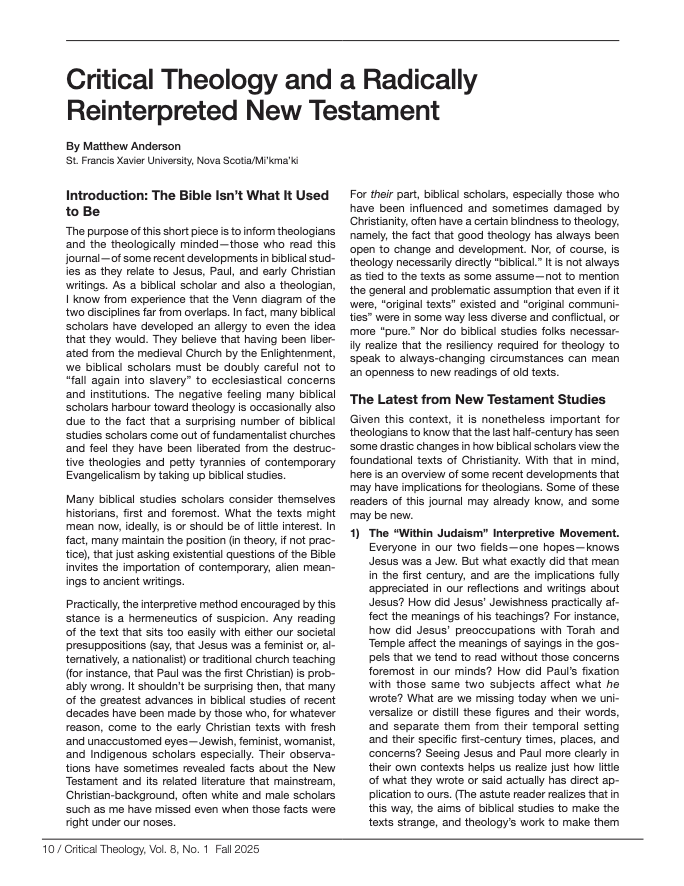
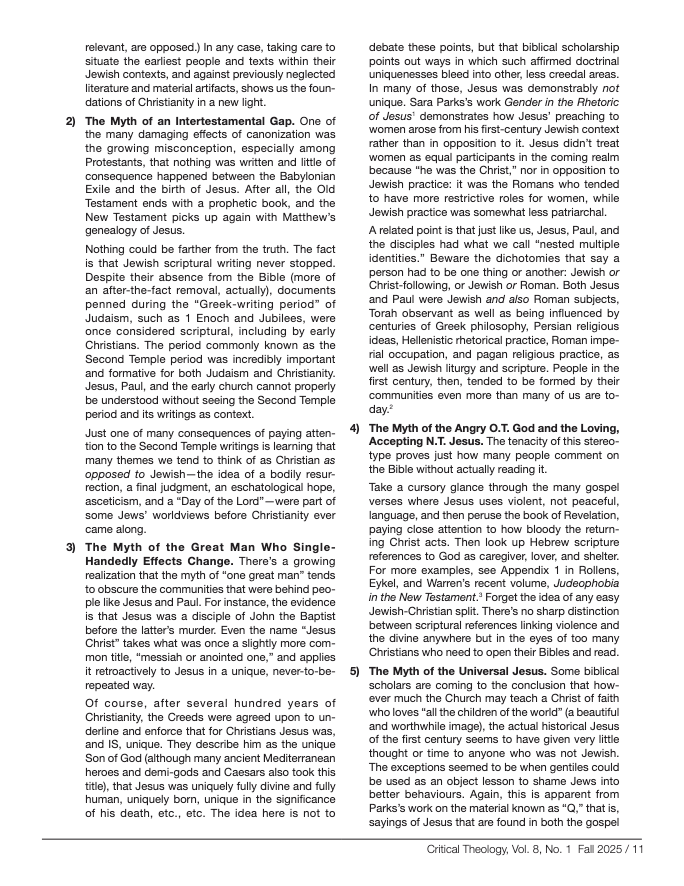
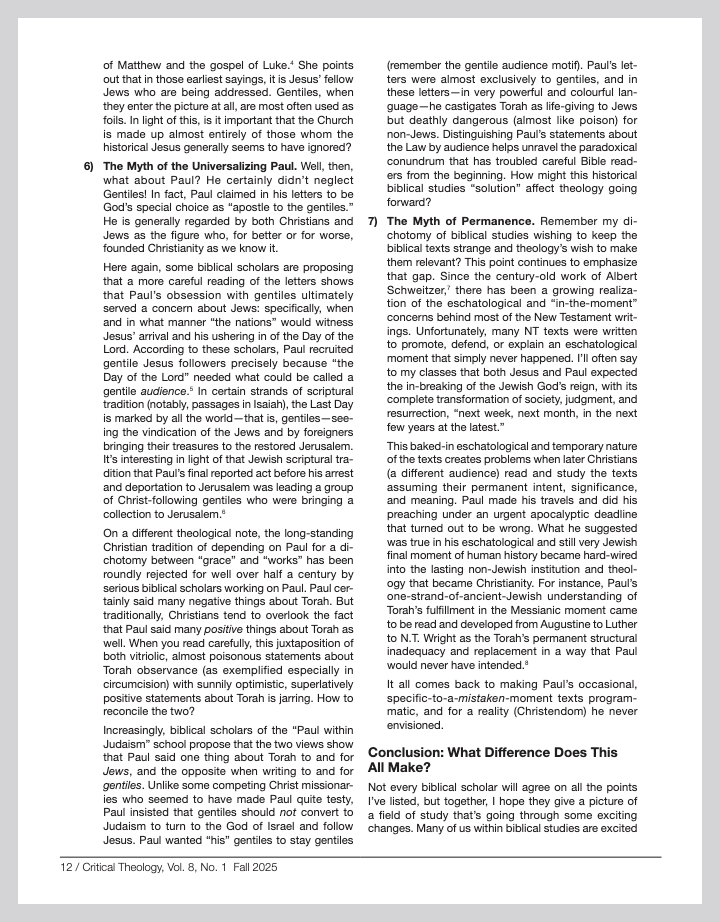
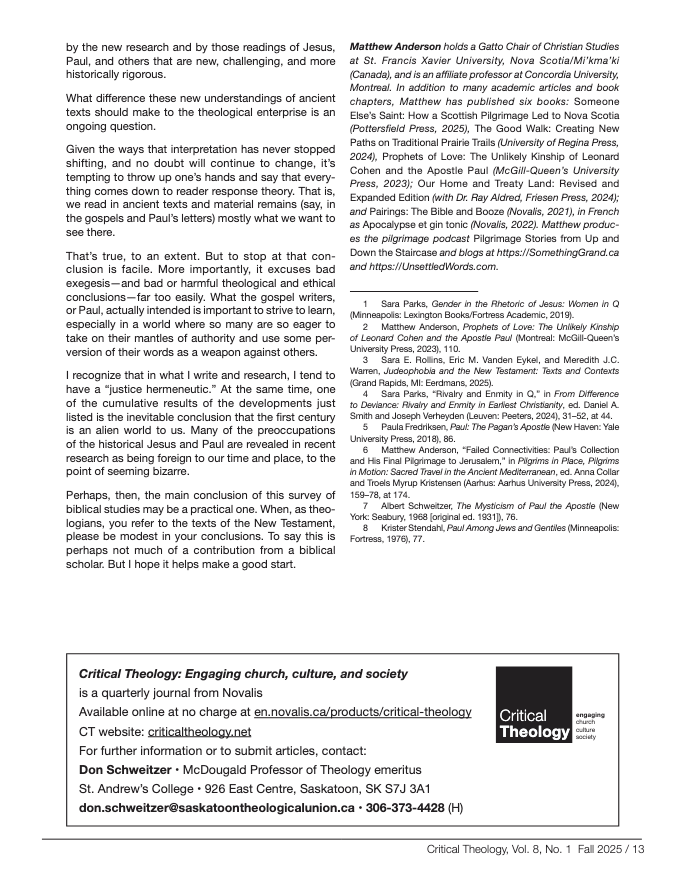
Last fall my friend Dr Christine Jamieson asked if I might contribute to an upcoming issue she was editing for the Canadian-based journal Critical Theology. I wrote a short piece inviting theologians to consider what implications might arise for their work from recent research in New Testament, early Christian, and early Jewish studies. While academics produce excellent work both in Theological Studies and in Biblical Studies in Canada and around the world, they often don’t talk to each other, as I pointed out. I’m fortunate to be working and teaching as a Gatto Chair of Christian Studies at Saint Francis Xavier University, Nova Scotia. This means I can pursue biblical studies research while attuned (I hope!) to the “engaging church, culture, society” that Critical Theology’s byline promises.
The journal issue came out in November. I was delighted to see my article there, and I wanted to share it. What I didn’t know was that Critical Theology has recently become open access, meaning it’s no longer hidden to everyone except subscribers. Thanks to Novalis Press for making the journal available – coincidentally, Novalis was the publisher for my first book, Pairings: The Bible and Booze.
You can read Richard’s stirring defense in the open access issue HERE. I’m reproducing my own short article below for your convenience. But I recommend the whole issue to you! And I thank Christine for inviting me to be a part of this worthwhile project.
Good reading!
“The aims of biblical studies to make the [New Testament] texts strange, and theology’s work to make them relevant, are opposed”
“taking care to situate the earliest people and texts within their Jewish contexts and against previously neglected literary and material artifacts, shows us the foundations of Christianity in a new light”
“Paul made his travels and did his preaching under an urgent apocalyptic deadline that turned out to be wrong”
“Many of the preoccupations of the historical Jesus and Paul are revealed in recent research as being foreign to our time and place to the point of seeming bizarre”
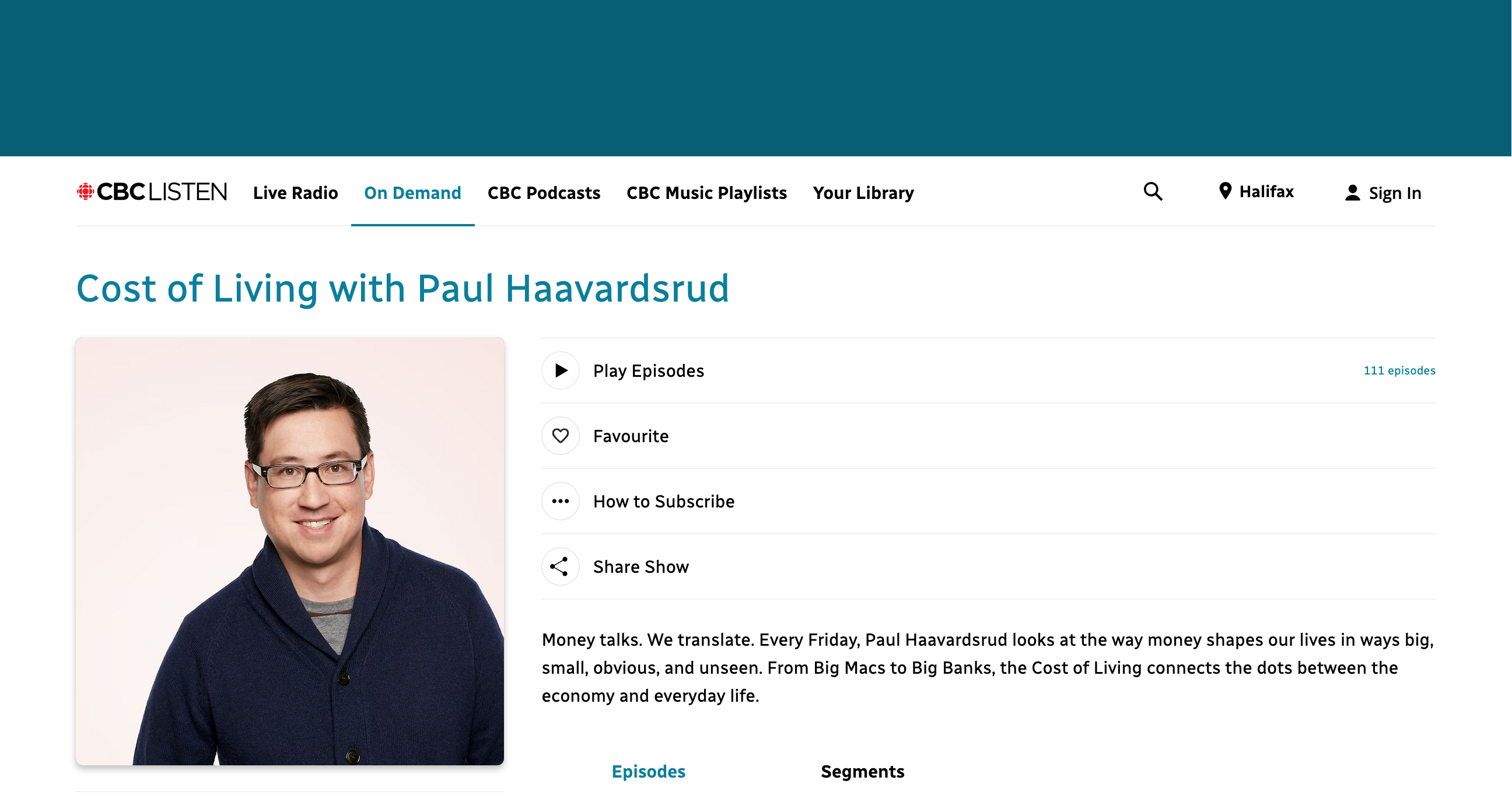
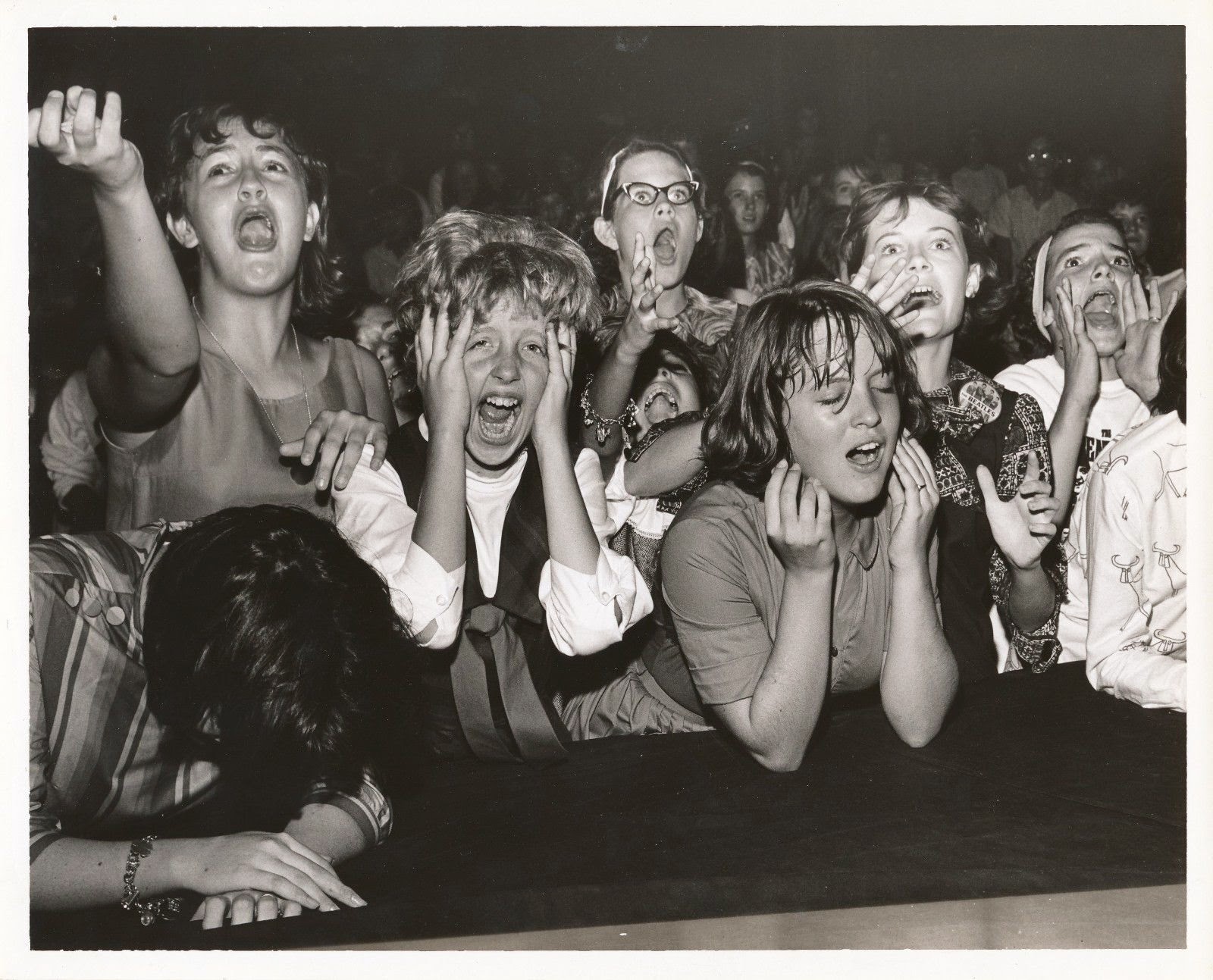
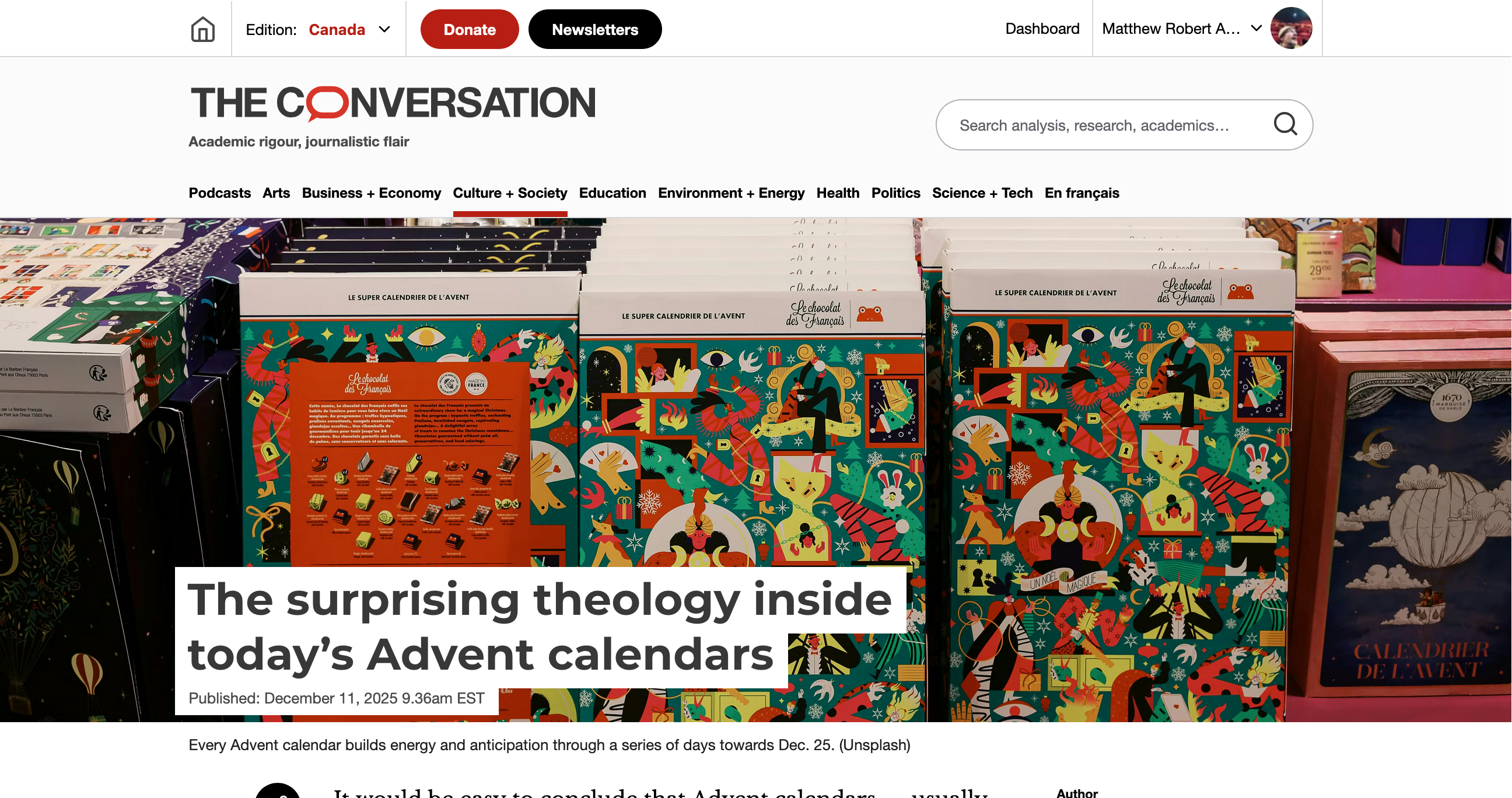
This last week I had the pleasure of appearing on a segment of the CBC Radio program “Cost of Living“ — about Advent Calendars. OK, I say, “pleasure,” but some of you are as avid about Radio One as me, so you know it was more akin to whatever was happening at those early Beatles’ concerts:
Cost of Living with Paul Haavardsrud airs across the country on Sundays at noon, and is rebroadcast Tuesdays at 11:31 a.m. It’s also on-demand on podcast platforms and CBC Listen. We enjoy the show, so it was quite a thrill when CBC producer Leah Hendry contacted me to ask my thoughts on Advent and on Advent Calendars. Being me, I had a LOT of thoughts. I probably wrote and researched as much as I would for a university lecture! Of course, most of it didn’t make it on to the episode. Cost of Living is a highly-scripted production, so I knew my part would be distilled to a few quick clips. As a life-long fan of CBC Radio, and someone who already felt fortunate to appear on Nova Scotia, Montreal, and Saskatchewan CBC shows a number of times, it was a real honour to “go national!” As my friend Ken Wilson put it, “you’re famous! You’re on the national network!”
It just so happened that I heard the segment live when I was in the car, headed to town. So I pulled over, grabbed my phone, and recorded the five minutes for posterity.
Now, you may not be enamoured of listening to the radio as a background to turn signals and shifting back-seat groceries and windshield washer antifreeze. The sound quality isn’t bad for something captured on an Android device after taking off my gloves. But it is “real time, in-the-car” audio.
So if, like me, you prefer your CBC programs polished, and in full, then have a listen to the entire half-hour Dec 5, 2025 episode of Cost of Living. You can listen to it HERE.
On the CBC clip I said I wanted a whiskey calendar. But we actually have these ones pictured, with chocolate and cat treats, originating from Europe (IKEA) and from BC. What kind of advent calendars are you using this year? Let me know in the comments! On a more spiritual level, I’ve been following Ray Aldred’s daily advent devotions “Alongside Hope,” the Lutherans Connect Advent series, as well as enjoying occasional advent reflections from Sheila O’Handley, a real life hermit from Cape Breton whom I had the pleasure of meeting with my class this fall.
So, whether reading, listening, reflecting, or just eating chocolate…happy advent!
Bonus Cat Content: Theodore in the Snow
Apropos of nothing else in this post, but in celebration of the fact that the first major snowstorm of the season hit recently, here’s a fun 12-second video for you of our not-so-feral-anymore cat Theodore, who sleeps in the house at night now. Today Sara took this video of his joy jumping back out into the deep new-fallen snow. She missed the part where he rolled crazily around in it when he first dashed out. It’s like a child’s celebration of winter. Enjoy!
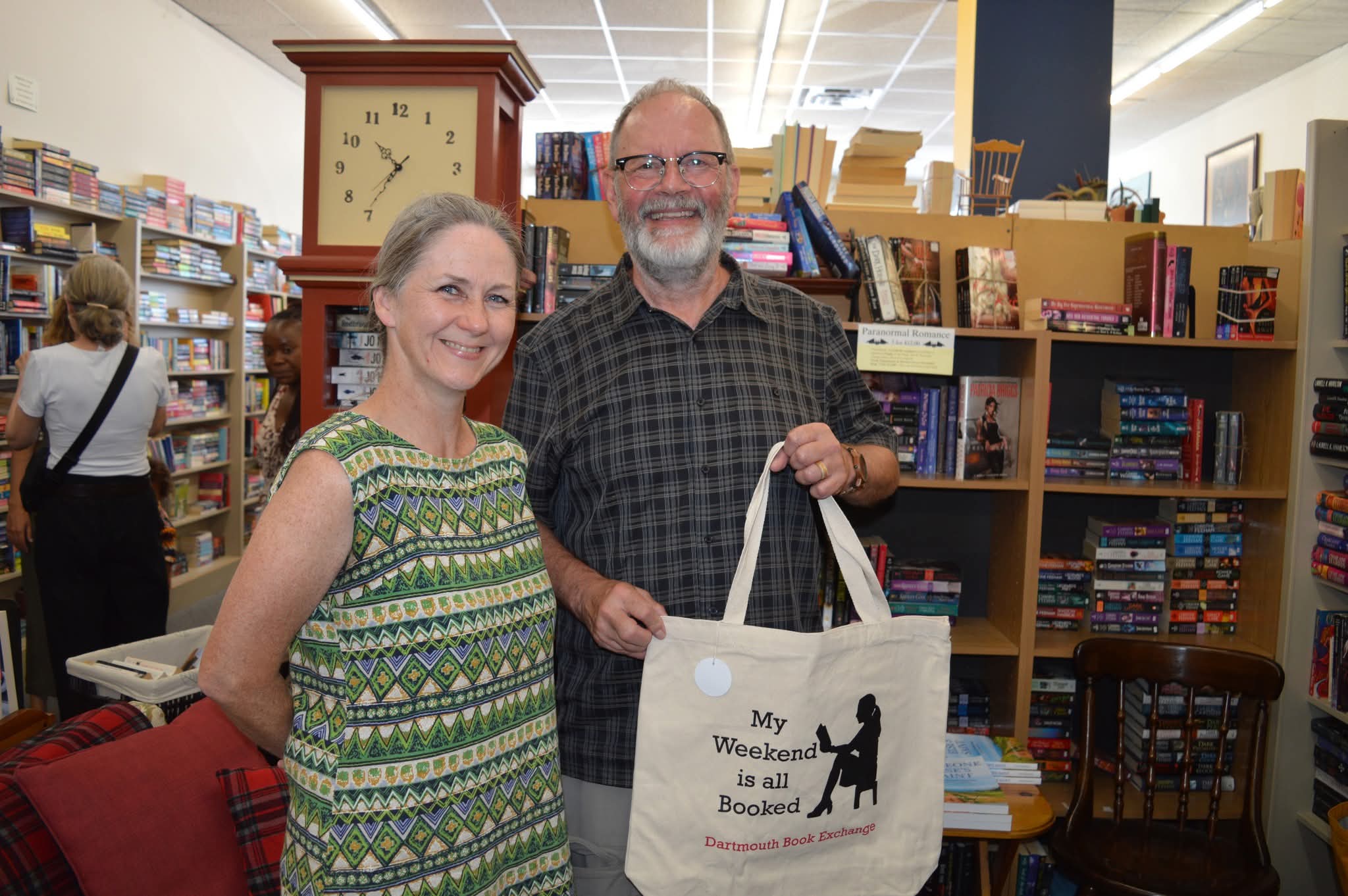
She had never heard of my book, nor I of hers (although apparently I was the first to recognize the Sappho reference in her title). We exchanged our books accompanied by firm promises to read and report back.
Somehow my one-year strokeaversary slipped by without a blog post, even though Sara and I marked it privately. Now here we are: way past twelve months. Already to 14 and counting.
I’m not sure why I didn’t push myself to post a one-year column on the actual day.
Well….that won’t be happening anytime soon, although I still hold out hope. While I can walk farther and faster than at any point since my brain damage, my best distance is a couple of kilometres with a limp. It’s hardly 100 km in a week like we did in 2024, striding into a new coastal village every afternoon in the late-afternoon sunshine.
I also dreamt that at one year post-stroke the part of my body the slowest to recover, my left hand, would be fully back in use. I imagined somehow I’d be chording smoothly on guitar, holding my mug of tea, and most importantly, typing. The truth is that yes, I can actually DO all those things, sort of! It’s a miracle. And I recognize that miracle when I’m properly “glass-half-full” thinking. For instance, I’ve typed this blog-post using both hands.
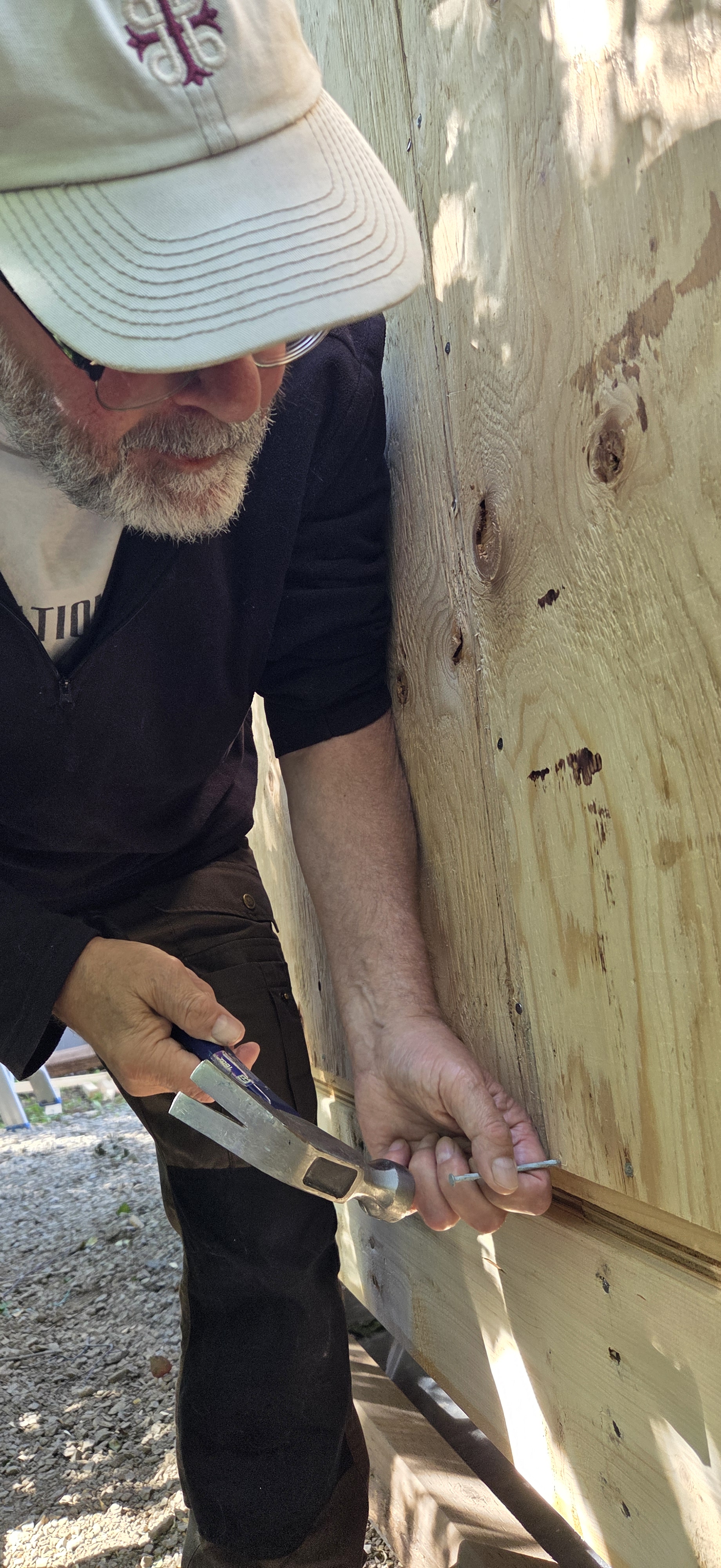
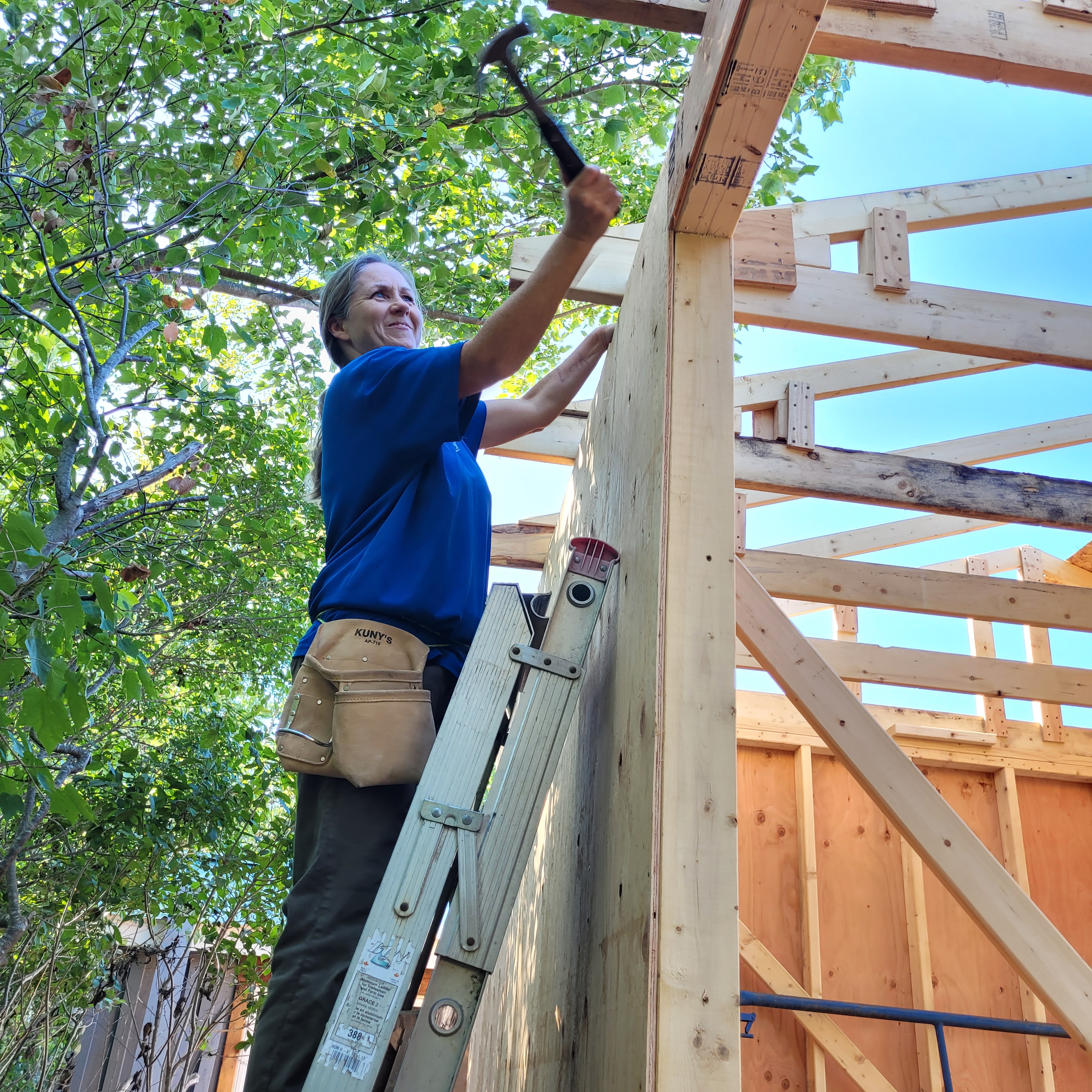
But the deeper truth is more nuanced. Chording is still slow….usually too slow for a song to really feel like a proper song. A full cup of tea is dangerous to hold in my left hand for too long – and a hot cast iron pan more dangerous still! But I’m able to reach, and lift, and manipulate more with that hand every week. I can now screw the milk and toothpaste lids off and on as a leftie. I regularly empty the dishwasher with my left hand as therapy. I can almost snap my fingers and make the Vulcan salute. Holding a nail in September while hammering was sometimes an act of faith. But the nails got in. Eventually.
Typing is not as slow as it was. But it’s still tedious, difficult, and tends toward errors. Sara says that she can tell my typing has improved because in the last month I’ve written a lot more pieces – articles, reviews, and the like. “You must feel more comfortable composing,” she remarked. “You’re getting back to your enthusiasm for new ideas.”
I feel that too. This fall I taught an online course on Leonard Cohen and St Paul, and had a wonderful time with my adult students. My classes about early Christian asceticism at StFX are fun, and recently I took first-year kids on a tour of the Saint Ninian Cathedral, being sure to point out features I write about in my book “Someone Else’s Saint.” Sara and I each gave keynote presentations on subsequent weeks at different institutions in Halifax, which was a chance for trips “to the big city” and mini-holidays.
When she read what I just wrote above, Sara pointed out that maybe it wasn’t disappointment that stopped me after all. Maybe I let the 12-month blogpost slide simply because my fall has been so incredibly busy. True enough. But the anniversary didn’t pass completely unmarked.
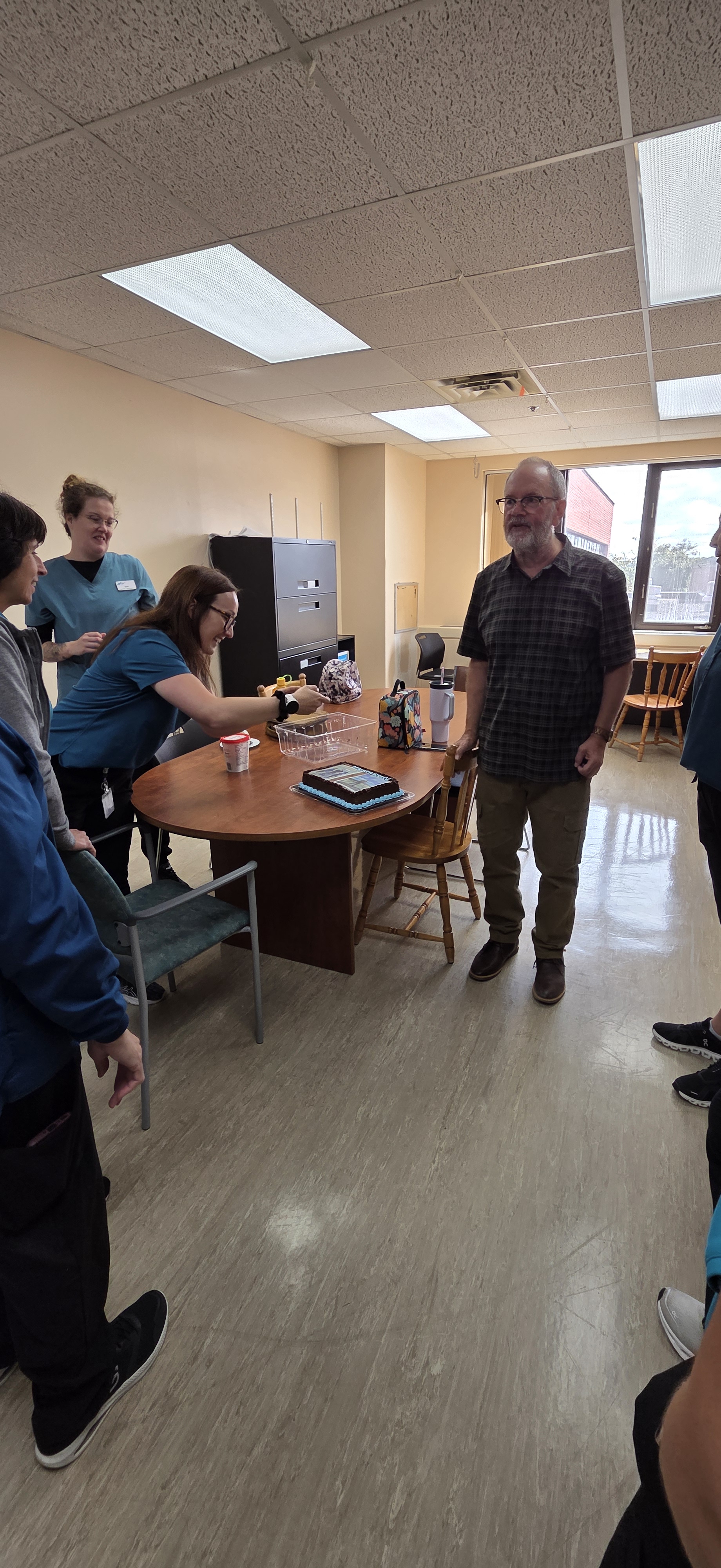
It turned out that I had a follow-up appointment at the hospital one year to the day from my initial TIA – Trans Ischemic Attack, September 16th. So I ordered two cakes from our local Sobeys and Sara and I took them in to mark the day: one for the physio ward, since that’s where I’ve spent so much time post-discharge, and the other for St. Martha Regional Hospital’s third-floor hospital wing, where I lived for almost four months last fall.
Those cakes turned out to be a pretty good metaphor for the hospitalization and recovery process, and for the nature of institutions. On the physio wing, it turned out that almost all of the Occupational Therapists and Physiotherapists who’ve worked with me this past year were there. To a chorus of “oohs” and “aahs” the cake was quickly divvied up. There was lots of laughter and shared memories, and many thanks and congratulations given and received. It was wonderful.
However, when I carried my one-year cake to the nurses’ station, it was a different story. That day, none of the faces looked familiar at all, except my own GP, who was at the desk. Apparently, there’s been quite a bit of turnover recently on the ward. A nurse politely thanked me for the cake, took it, and congratulated me on my recovery. Sara and I stood around a minute or two awkwardly, then left. I’m sure the staff there that day enjoyed the sweets. But through no fault of theirs, they didn’t know me from Adam. There was no one at the desk from “my” past, no one who shared my memories, and no one to mark with me those tumultuous months that were so significant.
That’s life, I guess. In the end, our experiences change us profoundly. Sometimes permanently. But for everyone else, things can sometimes go back to normal pretty quickly.
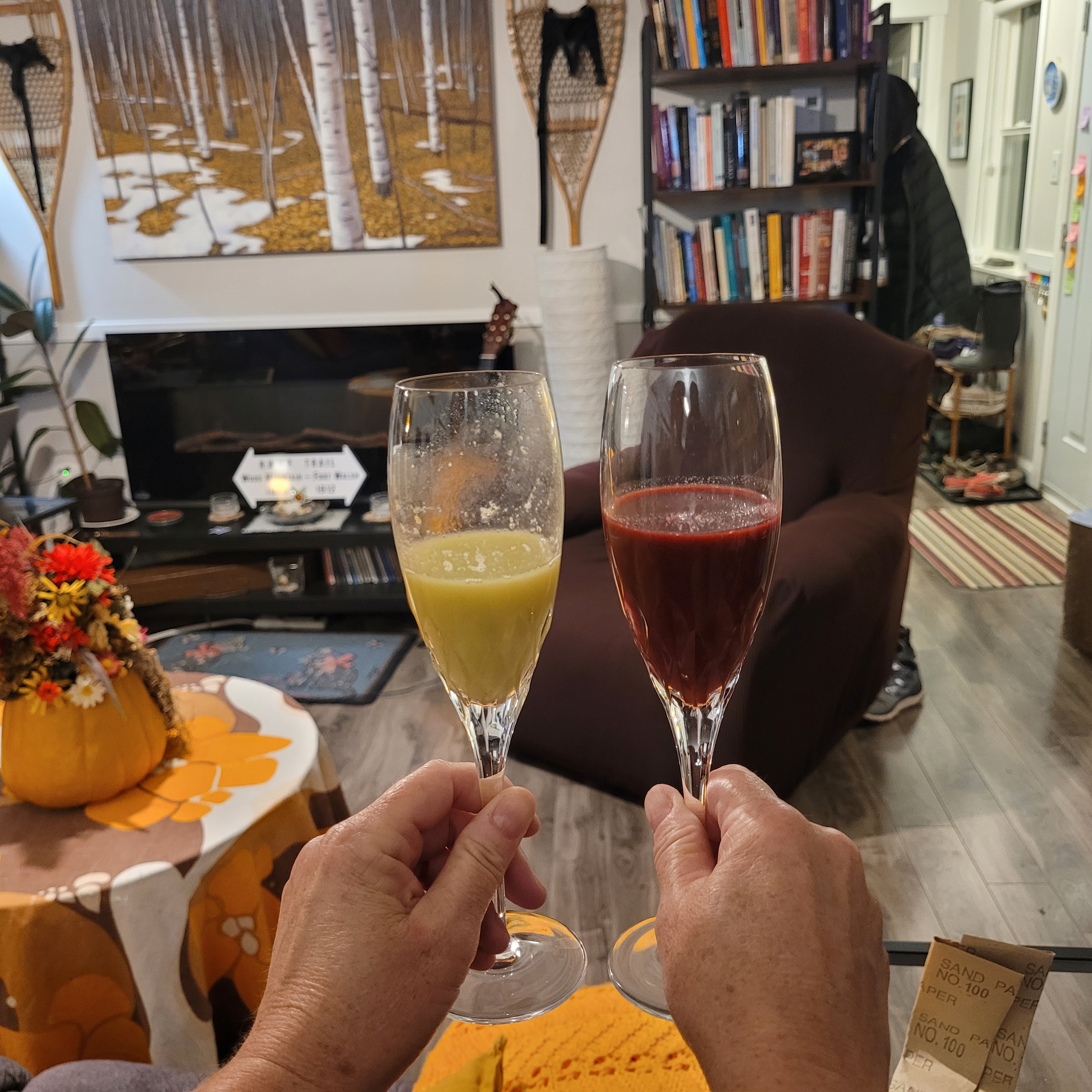
Speaking of major life-changes this fall: in October, Sara’s parents moved back to Moncton for the winter, after a wonderful, but very busy, summer of cooking, canning, and building. I took a very quick, very short trip to Montreal to hug my kids after their own family tragedy: the untimely death of my ex, their mom. Sara and I made our first juice from our first grapes, and filled our pantry with summer’s jellies. Since then my own step-mother, Mary Anderson (Hattum) passed away, along with another good friend in Saskatchewan, John McPhail. Oh yes, and a feral cat we’re calling Theodore seems to have adopted us, on and off….
Things aren’t the same as a year ago in so many ways, some large, some small. I keep having to learn and relearn the lesson that life is beautiful, often fragile, and that the time to tell folks you love and appreciate them is right now.
I feel very fortunate to be alive, and thankful every day for the chance to experience this world in all its confusing glory. Strangely enough, I believe my life has been enriched by my stroke a year ago, and by the struggles that have followed. I appreciate you who have accompanied me through this year (plus a couple of months). As the leaves drop, the Grey Cup finishes (yay SK!) and November tilts toward Advent and Christmas, I hope you find some love and joy in these days as well.
All Germans idealize the North American “West”and North American landscapes. Germany is a crowded country that has lost so much of its own “wildness” but still maintains a strong national mythology of origins around it. And yet …
All Germans love to read, and as a bonus, as truly civilized people are multilingual and can often read English books like mine, unlike most anglophones and folks like me, who struggle with anything more than simple tourist directions auf deutsch…
SO. After all these expectations, how did the review turn out?
Thanks to Google translate, you can read on for yourself….
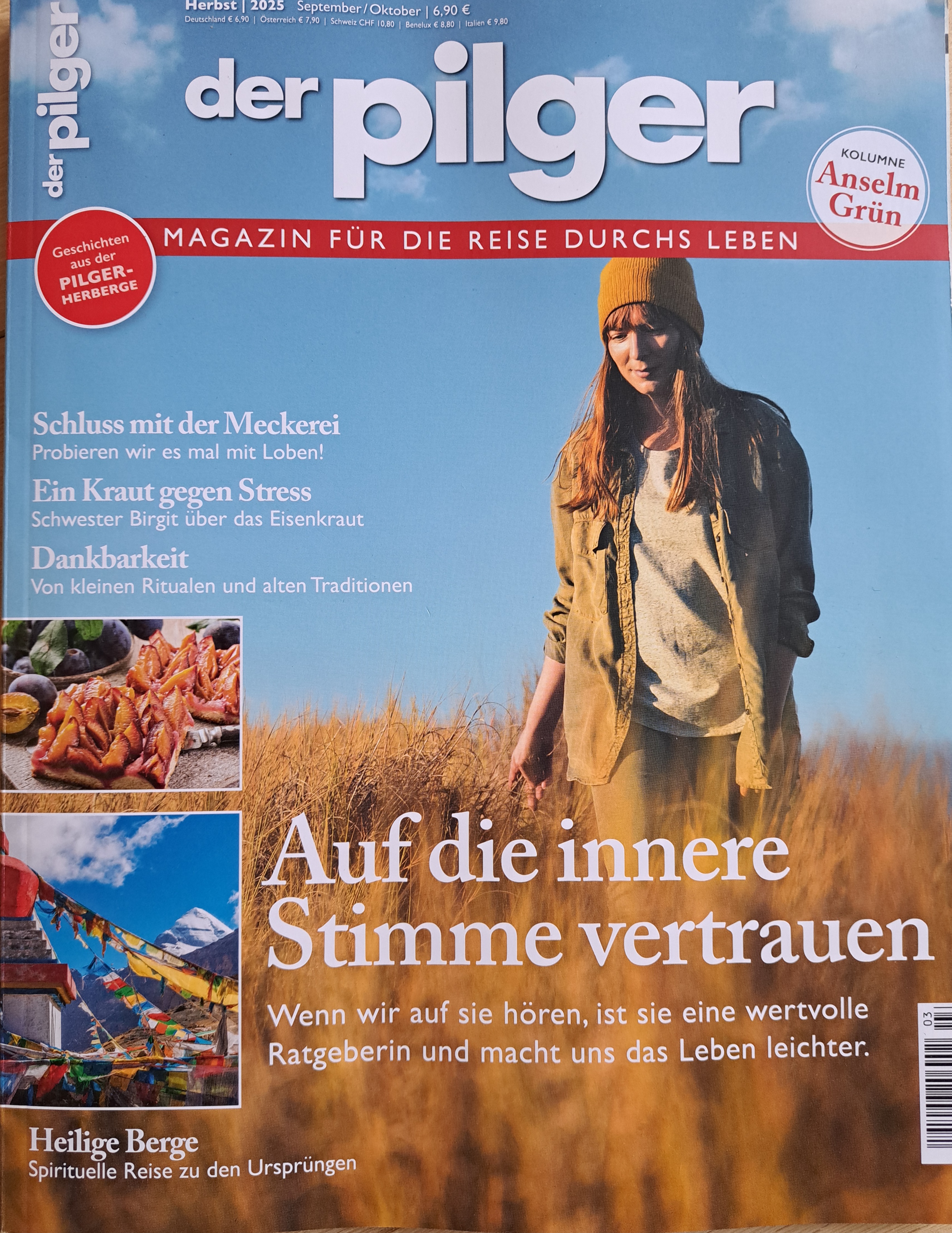
The Review
p. 43 New Pilgrim Perspectives:
“A devout Muslim embarks on the Way of St. James, and a Canadian professor and long-time pilgrim follows the trail of spiritual wandering in the vastness of the Midwest. Two inspiring book recommendations from Protestant pastor and passionate pilgrim Traugott Roser.“
“The Search for a Lost Home (Die Suche nach einem verlorenen Zuhause)“
“Matthew Anderson, Professor of New Testament at Concordia University in Montreal, is an experienced pilgrim who has also led his Canadian students through Spain, France, England, and Norway and has made a name for himself as a documentary filmmaker on pilgrimage. After many trips to Europe, he wonders whether pilgrimage is also possible in North America and what pilgrimage might mean there. In his new book, “The Good Walk – Creating New Paths on Traditional Prairie Trails,” he tells a compelling story of humanity’s age-old paths through the prairie of the Middle West. It is an account of a painful yet healing search for home: “Pilgrimage together with others—in the broadest sense understood as spiritually motivated hiking—is a way of searching for a lost home.” Anderson is a descendant of settlers who farmed…
(P. 45) and built small towns on the supposedly deserted plains of Saskatchewan (see photo above), and [the region once called] the Northwest Territories. Since 2015, Anderson and his wife Sara have been traveling the trails once used by traders, settler treks, and the Northwest Mounted Police, a paramilitary force commissioned by the Canadian government. But Anderson not only gets close to the story of his own family, descendants of white European immigrants, but also of the people who lived there before and were deprived of their land through sham treaties, displacement, and targeted extermination.
Pilgrimage: intercultural and interfaith
Anderson is accompanied on his journey by various companions, including Don Bolen, the Catholic Archbishop of the Diocese of Regina. Descendants of the First Nations, the Lakota, the Nakota, and the Nehyawak (Cree) accompany them or host them, as do descendants of settlers and the Métis, descendants of European-Indigenous marriages, who historically mediated between cultures as fur traders and are now considered an independent nation.
Anderson sees his hikes through the vast landscapes as pilgrimages to places whose history has been partly forgotten, partly erased. This also changes the landscape and its perception itself: through narratives and archaeological evidence, places of living memory emerge.
The places create new relationships and deepen old ones. In this way, the pilgrims come into contact with the spiritual world, [sometimes] with the elders and wise men of the Indigenous peoples, [sometimes] with their own family history, and [always] with nature. Through Christian and Indigenous rituals, the pilgrimage becomes an intercultural and religiously unifying experience. At the same time, it is a painful journey that ties in with the tradition of penitential pilgrimage: The extermination of the North American bison took place in the vastness of the prairie. This deprived the Indigenous people of their livelihood, and thousands starved to death while faced with the government’s deliberate inaction. It is equally painful when the pilgrims encounter survivors from the church-run boarding schools (of both Catholics and Protestants):
On behalf of state authorities, children were taken from their families and Nations and placed in Christian schools. Only in recent years did the public learn of the graves of thousands of nameless children who did not survive the ordeal.
Reward for Physical and Mental Effort
The paths across the prairie demand physical and mental effort from the pilgrims, but they also reward them: through community, forgiveness, and understanding. Matthew Anderson ultimately even succeeds in finding peace for his deceased parents and for his sister, who died very young. The pilgrim’s path is a good path, and with the project Anderson describes, a new, very unique pilgrimage tradition begins in Canada.
I couldn’t put either book down; it was precisely the different perspectives of both authors that inspired me to consider my own pilgrimage
I couldn’t put either book down; it was precisely the different perspectives of both authors that inspired me to consider my own pilgrimage on the Way of St. James in a new and more profound way: as a consciously religious experience, as a path to encounter God, and as a path to reconciliation.”
Dr. Roser’s Own Pilgrim Book
I wouldn’t be much of a friend, if at this point I didn’t mention that Traugott has published his own pilgrim book. It’s in German, titled Hola! bei Kilometer 410: Mit Allen Sinnen auf dem Jakobsweg (Hola! At kilometre 410 with all senses on the Camino de Santiago).
I wonder if a rather free, but still good, translation might be: “Hola! Fully aware and alive at kilometre 410 of the Camino de Santiago.” It’d be great to see this valuable book out for the English-language reader as well! (By the way, the other book he reviewed with mine in the above article sounds fascinating).
Traugott does all kinds of interesting teaching and research, including (like me) teaching Bible and Film classes. He is also an ethicist who teaches about ethics in healthcare and palliative care.
Thanks, Traugott, for the great review. Buen Camino! Looking forward to walking with you some day soon!
What better therapy than dancing with Gabe? (video below)
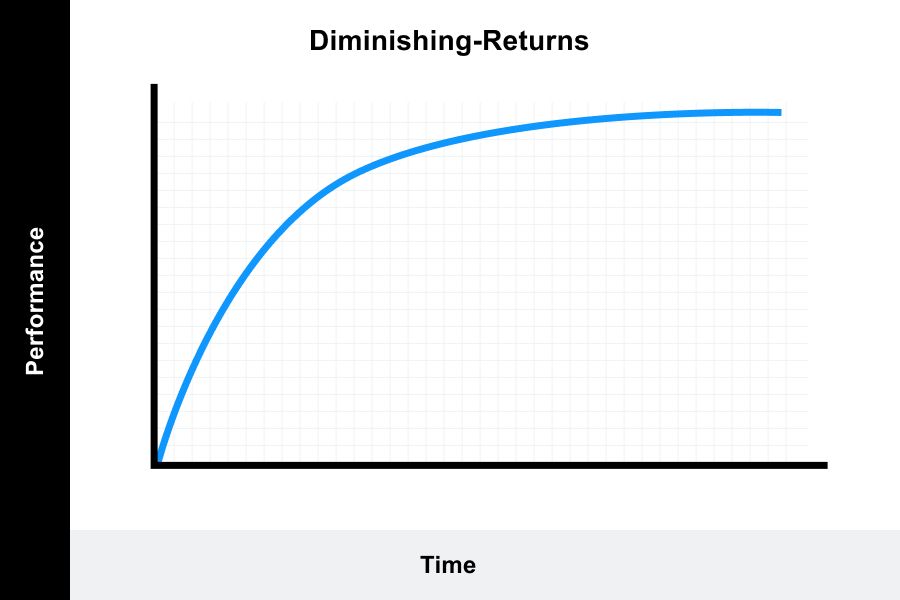
As the ONE-YEAR anniversary of my stroke approaches – wow! – my recovery continues to follow the quick rise and flattening curve (see below) that the medical staff predicted for me, as for other stroke survivors. And it’s true – eleven months in, the changes are more subtle. However, every week there inevitably still turns out to be some marked improvement. My physio supervisor, Jessica, tested me last week and told me I’m much stronger in my leg than just a month ago, and my left arm has also strengthened considerably in recent weeks. The Theraband exercises must be helping.
My recovery has gone far, far beyond what many of my doctors and medical team initially predicted in the dire days of last fall. With Sara’s urging, I continue to believe that the curve will never flatten out completely. As the book Stronger After Stroke maintains, there never needs to be a complete plateau to recovery, for a stroke survivor who is fortunate enough to have good support, a stabilized health condition, and dogged determination to work together with the brain’s natural plasticity.
So on this 11th-month strokeaversary, here’s some of what recovery has looked like!
Theraplaying
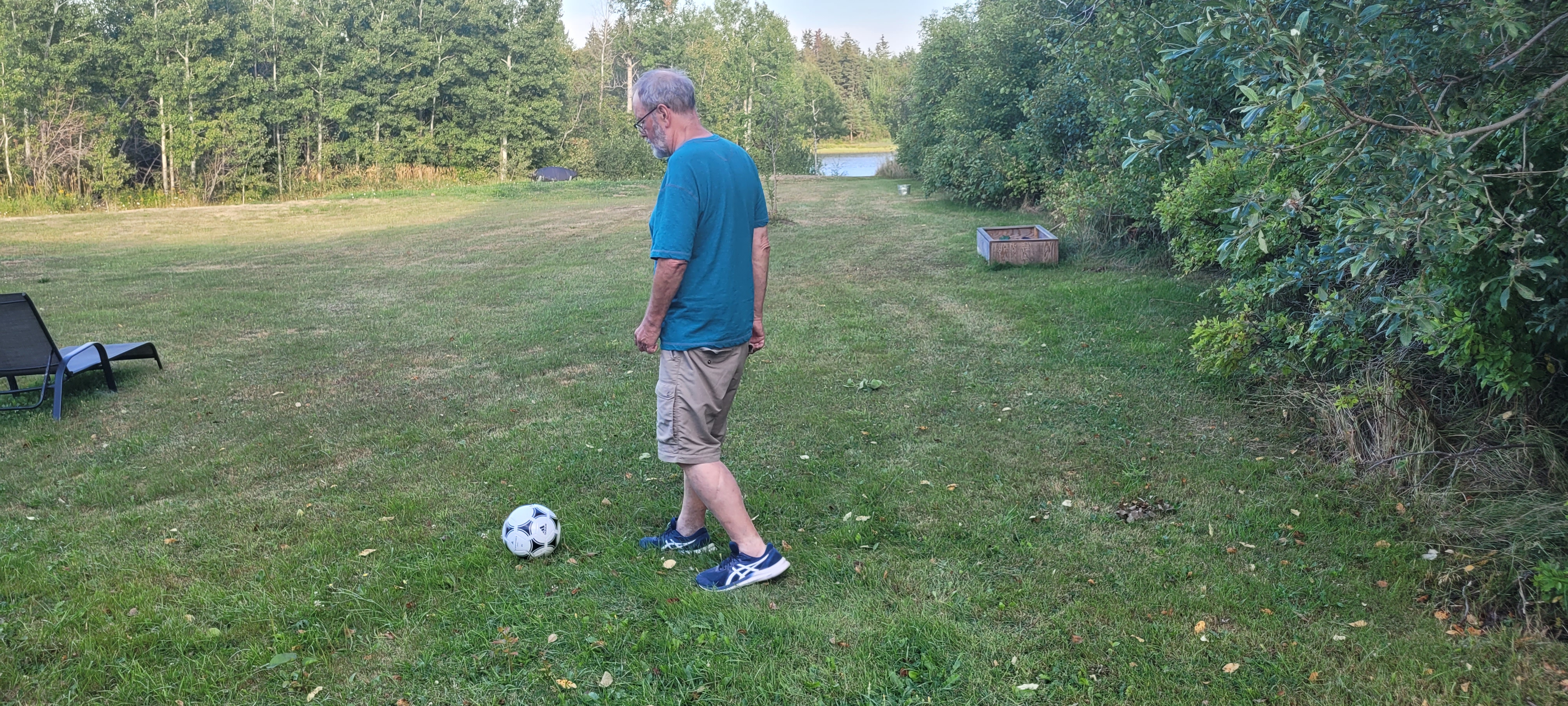
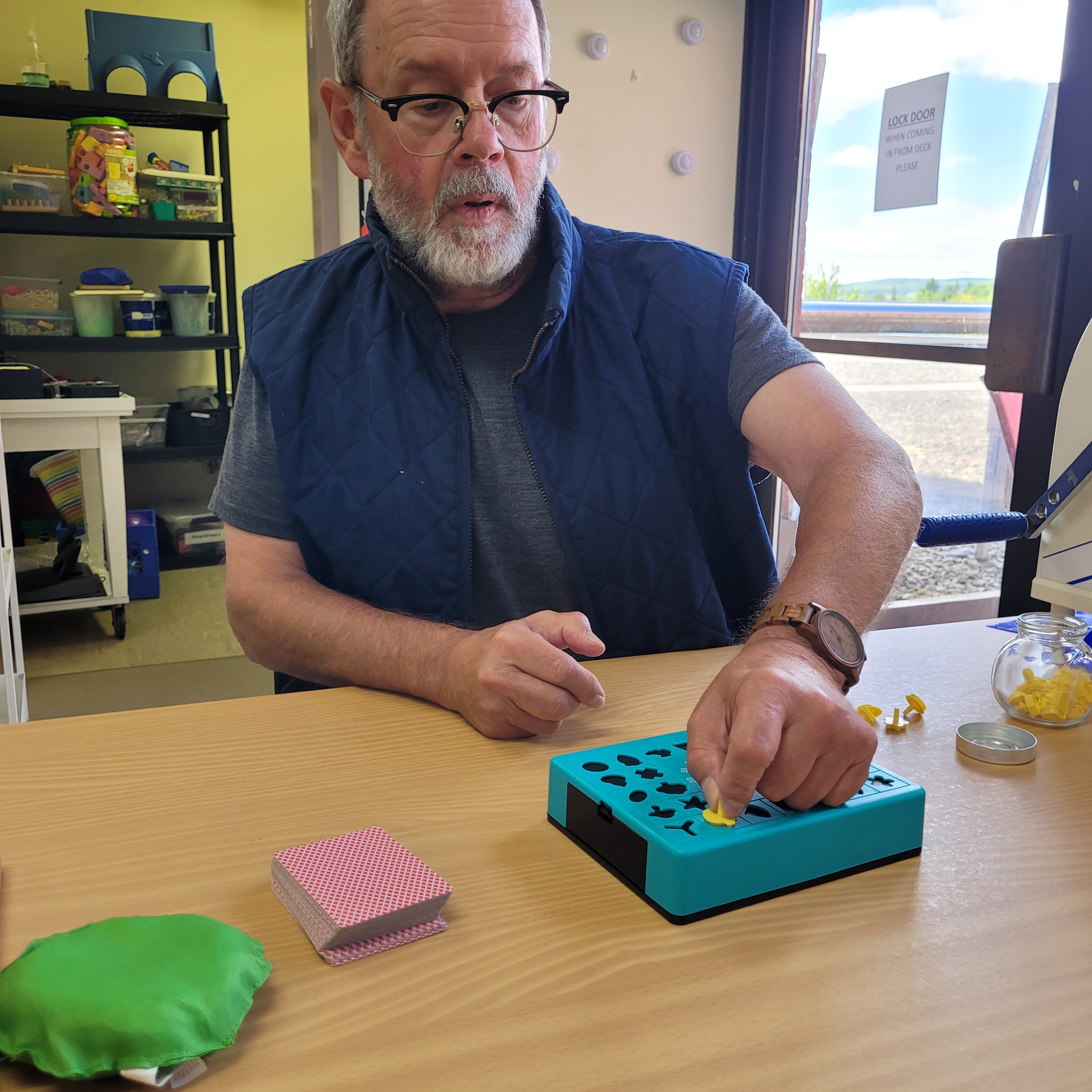
The wonderful physical therapy and occupational therapy folks at St. Martha’s Regional Hospital are starting to hint that I can’t be an outpatient forever. Of course, they’re right. “As much as we like you and look forward to our sessions,” they tell me, “we have to make room in our case load for new patients…” The hospital has been incredibly generous, and I’ve come to really love my outpatient team. I moved from two sessions a week to one only this last month. Colin, the smart and thoughtful tech who took over from the equally helpful physio tech Janna, is now regularly kicking a soccer ball with me. The catch: I have to use only my left foot. I’m finding that soccer and the funny-face bean-bag toss are my favourite therapy activities. Like a toddler, I’m improving my balance, coordination, and hand movements through play, which makes it seem (almost) easy.
Medicating
After my heart surgery in April to close a PFO (the hole between the upper chambers of my heart), the Halifax surgeon put me on precautionary Plavix, to guard against post-operative complications. I just came off of it and I couldn’t be happier. I’ve been bruising after every blood test (one time the blood actually spurted out) and also when I bump or ding myself as so often happens in summer gardening and construction season. I remain on low-dose Aspirin and a suite of blood pressure pills. But my GP and the cardio team at the hospital have dialled back even these a bit, and now I can crouch and stand up without threatening to black out. Sitting on my haunches to look in a cupboard reminds me of my old self.
Straightening
It was Lindsay, the incredibly gifted and helpful Occupational Therapist at the Nova Scotia Rehabilitation Centre in Halifax, who suggested “Oval 8 Finger Splints” for my left hand’s fingers most reluctant to recover – my ring finger and my pinkie. My pinkie has been broken a few times over the years of basketball and tended to go its own way even before the stroke. I find the splints helpful at the end of a busy day when my fingers tend to curl and stiffen. My typing is improving slightly, although when my left hand quickly tires, those two fingers droop and tend to type their own messages.
Hearing
Of the many effects of the stroke, one of the most subtle has been a slight alteration in my hearing, or more accurately perhaps, my brain’s processing of what I hear. I’ve noticed more trouble understanding Sara when she’s in another room, or there’s ambient noise.
At the same time, my need to focus more carefully on whatever I’m doing so as not to lose balance, trip, or drop something, means my ability to multitask, including “listening, while…,” has diminished. And, I’m not young anymore.
So my audiologist appointment finally came through. The audiologist took me into a sealed quiet room, ran tests on both ears, then gave a series of tests I had to respond to.
The results? Apart from the normal post-stroke inability to multitask because of increased need for concentration, my ears are typical old guy’s ears: some age-related hearing loss, and that’s it.
I actually enjoyed the challenge of having four numbers spoken at once into both ears and having to try to correctly identify them!
Canning
When Gabe, my youngest, came to visit in August with Ray, they said they wanted to do some jelly-making like we did last year. The Saskatoons were done and it was a bit early for the chokecherries, but the jelly turned out well.
Our place is prolific for berries despite the scary and record-breaking drought. I spent hours picking Saskatoons earlier in the season, and our strawberries and grapes are plentiful.
Holding boughs with my left hand while picking berries with my right turns out to be good therapy, too.
Dancing
Gabe’s visit this month also gave me a chance to re-learn and re-try the swing steps we’ve done so many years together, and also to re-learn some of the guitar chords my fingers have forgotten, from all the songs we used to play together. I’m thankful.
If you watch the video (click on the photo below), you’ll see how my face goes mask-like (not direct stroke damage but because I’m concentrating on not falling), my left arms wants to pull in and tighten, and I lose my balance briefly. But overall, what a joy, and what an improvement! Sara has been keeping up my dance therapy since Gabe left…
Reading
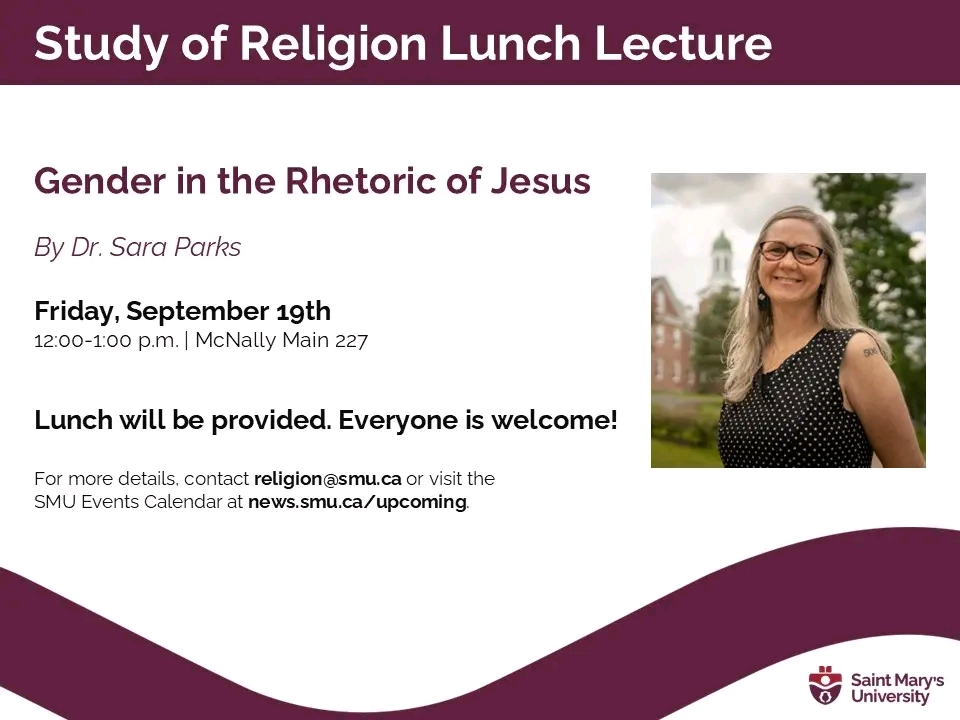
My worlds overlapped recently when The Canada Lutheran asked Sara to write a column for their regular Q&A feature. As usual, Dr. Sara Parks, who is a consummate teacher and communicator, produced something interesting, academically solid, and pitched perfect for non-academics. Have a read below.
I recently finished Tanis MacDonald’s wonderful book Straggle. I highly recommend it – it’s full of beautiful writing and profound observation. And Tanis’s thoughts on “ungainly” walking fit my new post-stroke life so well….
Travelling, Walking, & Celebrating
This was also the month that I took my first solo plane trips. I’d been invited west to celebrate the tenth anniversary of our Wood Mountain – Cypress Hills trek in the summer of 2015, featured in my book The Good Walk (URP, 2024). The Saskatchewan History and Folklore Society, which has spearheaded the walks since, was having its board meeting at Wood Mountain in conjunction with the event.
Even though Sara could not accompany me to hoist bags, hold my hand and generally be my security blanket, I was lucky that my brother Mark and sister-in-law Barbara (a recently-retired physio) were there to meet me in Regina. We stayed in their camper at Woodboia Camp near the Wood Mountain Historic Site (the NWMP Fort at Wood Mountain). That’s where Hugh Henry, Richard Kotowich, Hayden Thomassin and I started out 10 years ago to walk the 350-km North-West Mounted Police Patrol Trail (Traders’ Road) across Treaty Four territory.
10 years later, posing with Hugh Henry of the Sask History and Folklore Society
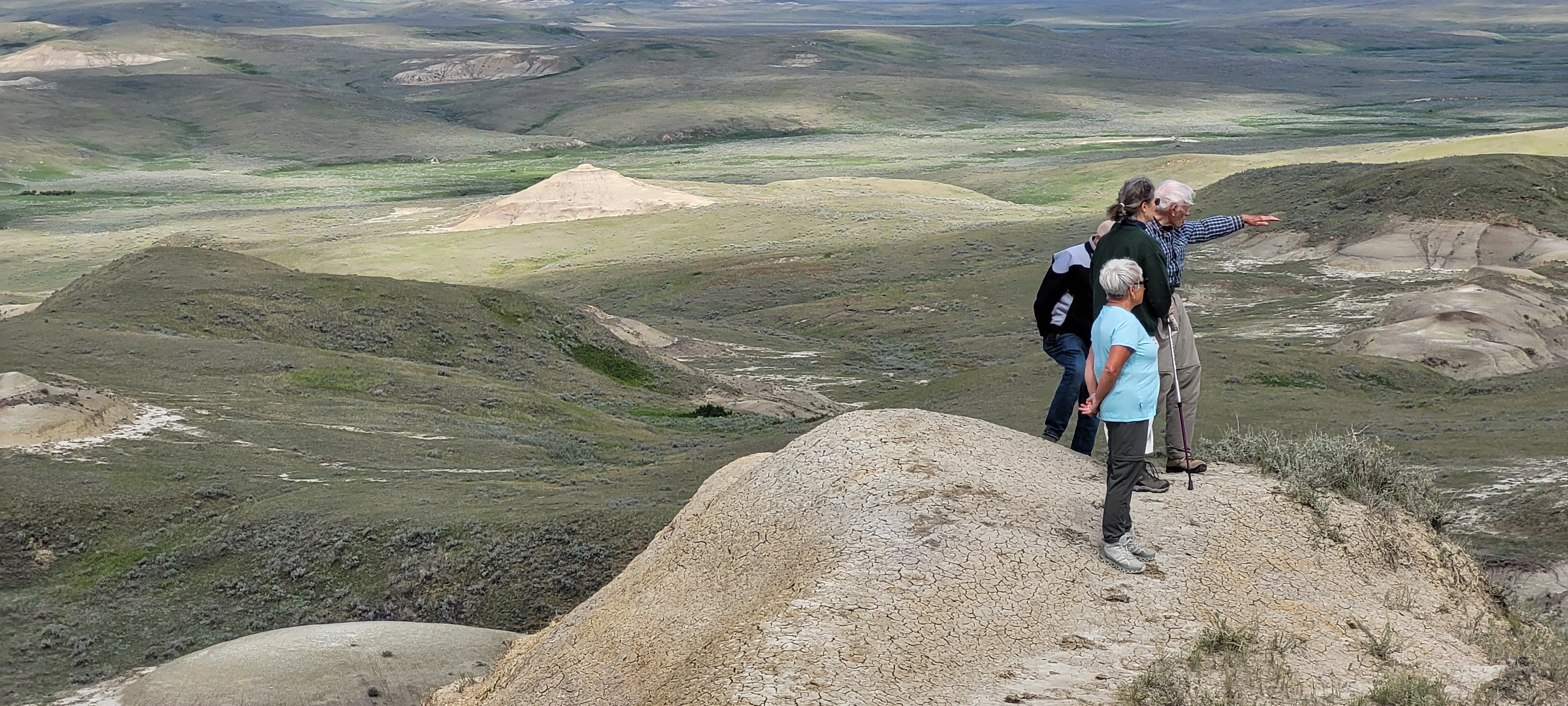
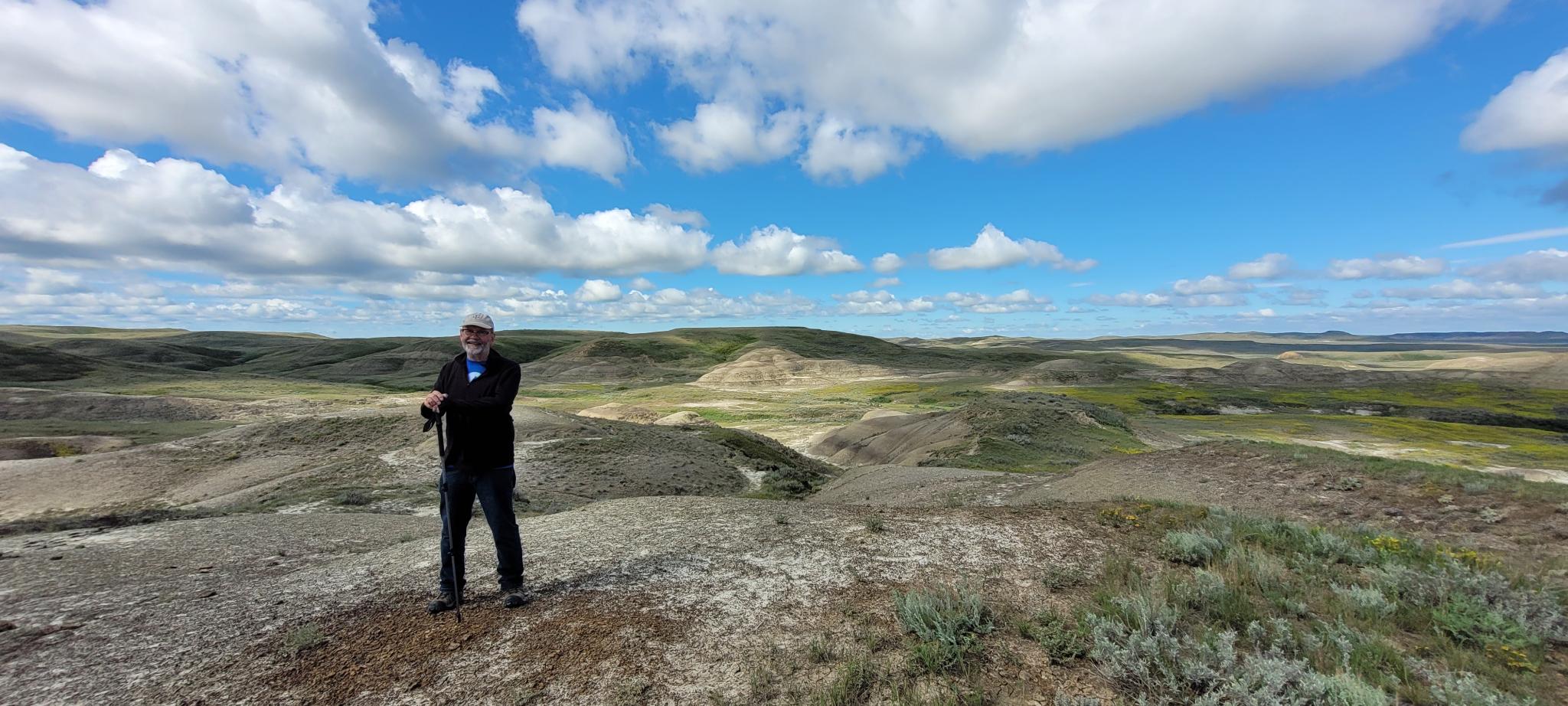
Among the highlights of my trip was visiting the Badlands in the “East Block” at Grasslands National Park. If you ever have the chance, be sure to visit this incredible place.
One of the most significant tests of my recovery was putting on my hiking boots (this time, with elastic laces) and re-walking a portion of the trail from Wood Mountain to the Lakota First Nation. Ten years ago, we did the three miles easily in the morning. This time, I cut out when the trail got muddy and hard to walk, and rejoined later. I managed to walk about a mile and a half in total.
Another highlight was meeting Dr. Claire Thomson, who led us around the historic site at Wood Mountain and gave both an academic and a personal history of the area. Dr Thomson is a descendant of one of the early North-West Mounted Police officers, and of his Lakota wife. Her PhD research on the Lakota history of Wood Mountain won the prize for best doctoral thesis in Canadian Studies recently…I quoted her in The Good Walk and was delighted to meet her in person.
My life as an author looks like it will keep me busy into the fall as well. In September the Atlantic School of Theology is hosting me for a series of six online lectures on Leonard Cohen and Saint Paul, following up on my book Prophets of Love (MQUP, 2023). You can find more info on those lectures by clicking the “Almost Like the Blues” link HERE.
This week my interview with CBC Radio One Cape Breton’s Wendy Bergfeldt came out on the afternoon show “Main Street.” God bless the public broadcaster! I was excited for my first Nova Scotia CBC interview…and our talk went so well it was broadcast over three separate afternoons! It was wonderful meeting Wendy – it turns out we have LOTS in common: growing up from Scandinavian settler grandparents in SK, attending the U of S in Saskatoon during the same years, living in the UK for a while, and then settling in Nova Scotia. Oh, and did I mention? A shared interest in decolonization, history, and pilgrimage! I’ll post the links to the interview soon. (In case you missed it, my earlier CBC Montreal interview with Sonali Karnick can be heard here).
Next Month: One Year
Soon it will be a full year since my stroke. I’ll be marking the occasion, for sure. Will I be celebrating? I’m not sure what to say.
My stroke cost me a lot that I haven’t yet regained: my sense of secure balance, my ability to walk long distances, to run, to dance smoothly, and to play songs smoothly on the guitar. And crucially, I can’t type with both hands like I used to, which is how I’ve written my essays, lectures, and books.
BUT: the stroke helped me realize what a community of support is around me, how good so many people are, what an incredible partner I have, and how precious life and health is. I’m thankful every day for just being able to walk and speak (and pee and shower!), teach, read, think, and do what passes for a “normal” life for me. Much less all that’s listed above.
In the end, it’s all gift. Because of my stroke last fall, I realise that now more than ever.
So, see you next month! I wonder what surprises await?
Sara found a more elegant solution for dripping juice than the complicated ladder-thingy I typically used.




























 somethinggrand