Categories
Uncategorized

Rhubarb Wine among the Saints

cactus on the plain

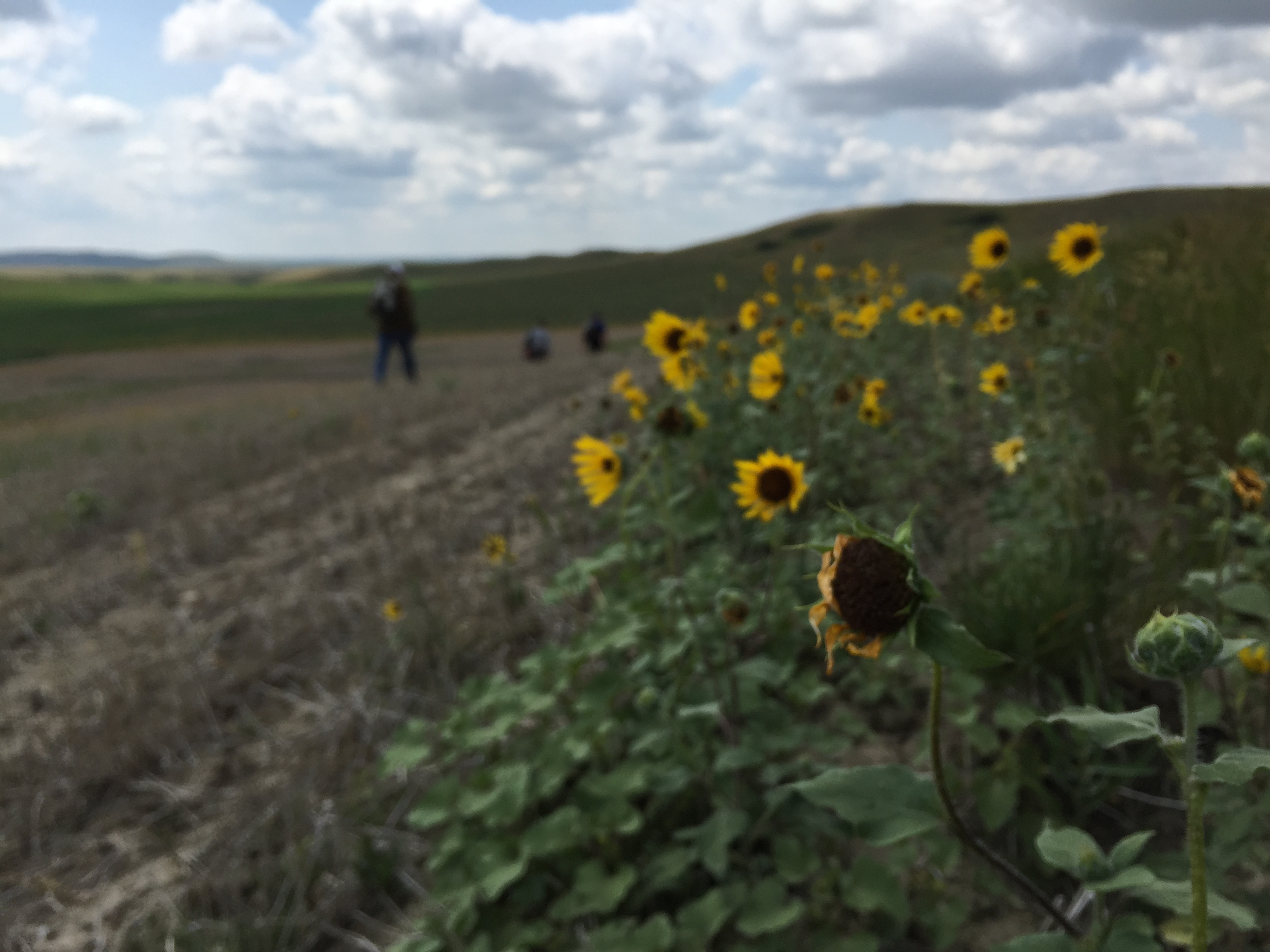
Tonight we;re in a grove between caragana hedges, on the Duke farm near Eastend SK. Now that the dark has descended, it feels like a secret, hidden place, with only the sound of cicadas and crickets to accompany my typing. No coyotes as yet, although the moon is full and just waiting for their chorus. The farm is located along the Frenchman River, with the steep walls of the valley rising miles away at either side of a great, wide, flood plain. We walked that plain all day….tawny hills on the left and the right, white mud cliffs that leave your fingers stained, and a river I wanted several times to jump into for some kind of break from the heat. For the first time this trip, we’ve had to contend with mosquitoes, so setting up tents was a hurried affair.

Fortunately, we have a gazebo, and that’s where I shelter to write this. The others have gone to sleep – funny how a full day of walking makes for fatigue as soon as the sun sets. For a late supper we put together Madonna’s lentil soup, Hugh’s beans, Kathryn’s broccoli salad and some British Army ration soup. We ate the resulting mix, out of the pot, with gusto. But the best part of the meal was rhubarb white wine, from the Cypress Hills winery, donated to us by Curt and Lorie Gronhovd, the incredibly kind hosts with whom we stayed last night.

Over dinner (and the wine) we talked about saints and First Nations, about the connection between the Egyptian desert fathers and the Irish monks, and between those monastics and a pilgrimage here and now in south-west Saskatchewan. I guess it’s no mistake that this is, also, a semi-desert that we walk through. Fifteen miles today in land that, like the Biblical wildernesses, reduces the walker to the essentials. When the land is so sparse and the cactus and short grasses (and some cattle skeletons) are all you see, the wind blows and I think of Ezekial calling the four winds at the Lord’s behest, or Christ in the desert. Or Saint-Anthony, seeking white martyrdom in the wilds of Egypt.

Tomorrow we walk to Chimney Coulee, so named for the chimneys left behind by the Métis hivernants who built a settlement there in the mid 1870s. They say there are ghosts there, of the Assiniboine who died scavenging after Cowlie, the Hudson’s Bay trader, hurriedly left in 1873. I guess we’ll find out tomorrow night. For tonight there’s the moon, the mosquitoes, the dark, and the wind through the caraganas. And thoughts of the saints and their time of testing and of encountering the divine in a wilderness not so different from this one.

rhubarb wine

whitemud

Categories
Uncategorized

Alive and Well

IMG_0215

There’s something exciting and exhilarating about taking shelter in the back of a van, the back gate up providing a temporary roof, watching the driving rain come down so hard you don’t dare step out into it. It feels just a bit precarious when the lightning is so loud and close you take your feet off the ground just in case there’s a nearby strike. Wondering if the tent you’ve set up under the caraganas will hold up and stay dry (especially since your sleeping bag is already in the tent. You can see the fabric of the fly bouncing from the weight of the downpour, the heavy rain spraying from the roof). But it’s also, somehow, comforting. You are – mostly – dry, the threatened wetness in your boots and the moisture seeping down your back balanced by the carrot and coriander soup mixed with long grain rice (British Army rations) that you’ve saved from the fire and are now eating, steaming hot, straight from the pot.

I’m alive and well. Both. I’m learning once again that the two are not always the same thing.

After the rain, a rainbow comes out over the Frenchman River valley, also known as Whitemud. The valley is so wide you can see both sides of the arc touching down. Golden light floods the river plain from the west. There are horses – perhaps a dozen – charging around the field beside us, kicking up their back legs, perhaps in relief at the temporary respite from the storm. It’s one of the most beautiful sights I’ve ever seen, their manes and tails flying against the dark sky.

The clouds close again and the rain settles in – 7/10ths by morning. I’m awakened several times by flashes of light and loud booms, and sometimes by the horses in the Green’s trailer, whose movements also sound like thunder. At 6:45 am Hugh and I meet in our rain ponchos in the drizzle, trying to decide what to do. Bishop Don’s tent has flooded. The horse folks are calling it a day before starting and starting to pack up. It will be impossible to get through the riverbank grass and lower bogs in any case, so we decide to postpone the half-day river section of the walk. We confer with the rancher, Terry Jensen, a cowboy so stoic he looks as though he would be unperturbed if a spaceship landed on his property. He owns as it might be good to wait. We drive up and out of the valley before the road becomes impassable. It’s the first day we’ve had to change plans. Flexibility, I tell myself, is one of the marks of a pilgrim.

IMG_0203

Categories
Uncategorized

Prejudice and the Land

sage and grasslands best

There’s a whole vocabulary that I’m learning on this pilgrimage – a language that maybe I should have learned when I lived here, but never did. Lots of farmers and ranchers know this language. Hugh knows it. It’s the vocabulary of place, of the creatures and growing things on this tawny plain.

I have a beginner’s knowledge. I know words like meadowlark and magpie, speargrass and mule deer. But there’s so much more to know. Lark bunting. Buck brush. Short-horned lizard. Swainson’s hawk. The various geographical formations. Any of the myriad of songbirds that fly up as we approach.

Trevor Herriot read from his book at our Val Marie event tonight. We had a great crowd, including friends who drove down all the way from Saskatoon to be there. Trevor emphasized that growing to love something is learning the words that describe its complexity and colour. It’s just natural to give words to what we respect and care for.

I have body, movement and narrative on this trek – now I need words to describe the terrain (my pilgrimage class students know this quartet very well). It has always seemed to me that prejudice between people most often arises from ignorance, and is most often solved when we really get to know someone from that “other” group. Maybe it’s the same with land. Our ignorance can lead to a kind of unconscious prejudice against the very earth that sustains us. Walking, and watching, and learning, mean we become friends. Like the young woman I interviewed tonight who is living three months in a teepee, as did her Métis grandfather. “In a teepee,” she told me, “I’m not shutting out nature or inspecting it like some kind of outsider. A prairie dog burrowed up under my bed frame the other night. Nature is coming to inspect me, sometimes literally, and is welcoming me.”

Categories
Uncategorized

Smudgings and Graveyards

country church

This is day two without electricity so I will keep it short. We’re camped right now beside a graveyard, at a small Greek Orthodox church on the NWMP trail. When he could see us far off, struggling through the heat on the final stretch of our 15 miles or so today, a man at the church rang the bell to call us home. Now it’s dark. The graveyard beside our tents overlooks the vast open prairie. There are little solar lights beside the graves, which is perhaps nice, but a touch freaky for us in the tents.

Today was also the day that we were sent off by two RCMP officers, one in serge, and then smudged at the Lakota First Nation as we walked through. Not only that, but we happened to arrive at lunch and were given a wonderful hot meal by them.

So much to say, but not now. After all those miles, many of them through thigh-high grasses and rough pasture (fell into a badger hole once), it’s time for sleep.

field walking

Categories
Uncategorized

Kahnawake Morning

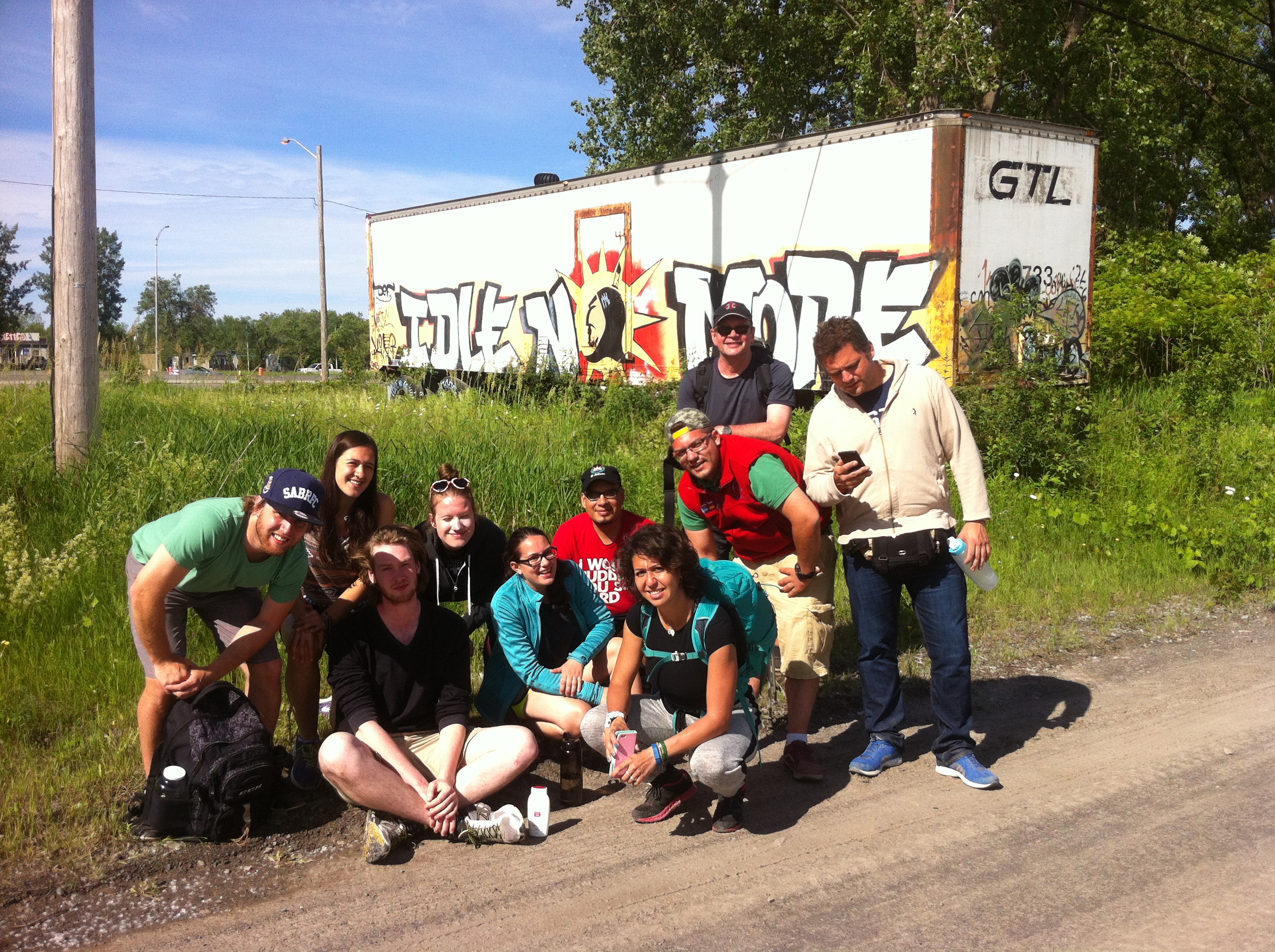
Idle No More trailer shot

The long boom of a lake freighter’s horn woke me up this morning, and within a minute, even from my bed I could feel its massive bulk sliding past just a few metres away on the Seaway. There is something in the air, a vibration that shakes you, when something that big is in motion, so close.

Apart from the freighter, however, it’s quiet here this morning in Kahnawake Mohawk Territory. Sparrows and red-winged blackbirds flit back and forth in the grass along the seaway, calling out to each other. Garter snakes and frogs fight their battle for survival under the cover of leaf and deadfall. After 35 kilometres of walking in the heat and seeing new sights the last two days, my sunburned students are just waking up.

Our group of pilgrims exemplify urban Montreal, and especially Concordia: the students speak Arabic and Spanish, Ukrainian and Armenian in addition to English and French. Some have complicated family backgrounds spanning several continents. One carries a First Nations identity card. A few have shared family histories of oppression and displacement. As ‘hyphenated Canadians’, the questions they ask of the Mohawk are particularly insightful: how is it possible to share land and not lose identity? How will a Mohawk policy of not allowing mixed marriages to remain in Kahnawake work? Do you have your own passports? Why don’t you call yourselves Canadian?

This is a pilgrimage in so many ways. A journey of discovery of ourselves and of others, born on the feet, felt in the heart and mind.

Categories
Uncategorized

Every Day a Bit More Real

Pine Cree Park 2014

While I plan conferences and teach pilgrimage classes here in Montreal, my colleague Hugh Henry has been doing the heavy lifting of contacting folks along our planned walking route in Saskatchewan. Some of the on-the-ground details remain to be determined. But the route is set, and those who would like to walk with us for a day, a few days, or longer, are encouraged to contact the SK Historical and Folklore Society, at http://shfs.ca/contact/   for more information and to register their names for the walk.

Today I met with two young film-makers who would like to be part of the project. Some of you may hear from them soon, as they are setting up a crowd-funding site.

In the meantime, here is the tentative itinerary:

NWMP Trail – Walk Schedule

July 17   arrive at Wood Mountain Post Prov. Historic Site  Accommodation: camp at Wood Mountain Regional Park (adjacent to Post – pool, showers, food service)  Activities: tour Wood Mountain Post; Rodeo and Ranch Museum; NWMP cemetery

July 18 trek ‘commissioning’ event in morning at Wood Mountain Post; walk through W. M. First Nation to Orthodox church south of Glentworth  distance: est 13 miles/21 km  Accommodation: tenting at church yard; hotel in Glentworth (food service)  Bike Hwy 18 – 19 mi./29 km to Glentworth

July 19 from church to McCord     distance: est. 12 mi /19 km Accommodation: tenting at campground next to McCord museum (store and service station in town)  Bike Hwy 18 – 8 mi./13 km to McCord

July 20 from McCord to Mankota   distance: est. 11 mi /17.5 km Accommodation: hotel in Mankota. or tenting in town; showersOther events: public presentation about history of NWMP Trail markers; reconsidering the history  Bike Hwy 18 – 11 mi. to Mankota

July 21 from Mankota to Walker farmyard     distance: est. 13 mi / 21 k Accommodation: tenting in Walker farmyard  Bike Hwy 18 – 41mi. to Val Marie

July 22 from Walker farm to farm at corner of Hwy 18, E of Val Marie. distance: est. 14 mi / 22.5 km Accommodation: tenting in farmyard    

 July 23 from farm to Val Marie. distance: est. 9 mi / 14 km  Accommodation: Val Marie hotel / convent / The Crossing, campground in town  

 July 24 rest day in Val Marie Activities – visit Grasslands N.P. interpretive centre; Prairie Wind and Silver Sage; etc. Program in evening – presentations at Prairie Wind & Silver Sage (Museum); campfire sing-along Note: `Sleep under the Stars` event at Grasslands National Park on July 25.

 July 25 from Val Marie to Range 15/16 road.       distance: est. 13 mi /21 km Accommodation: tenting in abandoned farmyard

 July 26 from Range 15/16 road to Jensen family ranch. distance: est. 13 mi /21 km Accommodation: tenting in Jensen Ranch yard

 July 27 from Jensen Ranch along Frenchman; detour to Bible Camp. distance: est. 8 mi / 13 km Accommodation: Riverview Bible Camp on Hwy #37, south of Frenchman (toilets, showers, campfire)

July 28 from Bible Camp to Gronhovd farm. distance: est. 13 mi / 21 k Accommodation: tenting in Gronhovd yard

July 29 Gronhovd farm to Wig farm (?) along Frenchman river. distance: est. 13 mi / 21 kmAccommodation: tenting at farmyard  

July 30 Wig farm (?) to Chimney Coulee. distance: est. 14 mi / 22.5 km Accommodation: tenting at Chimney Coulee  

 July 31 Chimney Coulee to Eastend. distance: est. 3.5 mi / 5 km Accommodation: Cypress Hotel, Riverview Motel, B&Bs, camp at Pine Cree Reg. Park

August 1 Rest day in Eastend SHFS-sponsored field trips and presentations (archaeology, geology, paleontology, local history, etc.). Communal supper (café or catered) Accommodations: hotel, motel, B&B, Park

Aug. 2  from Eastend to Ravenscrag corner, Hwy 13. distance: est. 13 mi /21 km  Accommodation: tenting in Arnal farmyard

Aug. 3  from Ravenscrag corner to farm near Robsart. distance: est. 11 mi /18 km  Accommodation: tenting in farmyard near Robsart

Aug. 4  from Robsart to Cypress Lake. distance: est. 15 mi / 24 km Accommodation: tenting at Cypress Lake (no facilities)

Aug. 5             morning at Lake; Cypress Lake to Brost Ranch distance: est. 6 mi / 9.5 km Accommodation: tenting at Clint Brost ranch.     NWMP patrol station (Cottonwood Coulee ?)

Aug. 6  Brost ranch to Parsonage Ranch. distance: est. 14 mi / 22.5 km Accommodation: tent at Parsonage Ranch

Aug. 7   Parsonage Ranch to Ft. Walsh distance: est. 5 mi / 8 km Event: welcoming celebration

 *Home*


Notes

  1. Walkers are responsible for providing all of their personal needs. A support vehicle will follow walkers to carry food, bedding and other supplies. Note the towns passed along the route and the possibility of booking motel or related accommodations. (On your own for this.)
  1. Suggested bike route at beginning of trek is on paved Hwy and parallels the NWMP Trail. There is the opportunity to join walkers during stops at Wood Mountain, McCord, Mankota or Val Marie. Daily travel distances and pace to be determined by individual bikers.
  1. There may be opportunities to trace the Trail on horseback, along dirt roads or through pastures. Details on dates and locations will be determined after landowners have been consulted, and may be affected by weather events.
  1. The daily walk schedule may be affected by weather, so distances and stops are approximate. Also, the number of walkers able to access cultivated fields may be restricted by landowners.

NWMPT map SHFS

Categories
Uncategorized

Stiles and Kissing Gates

down to the river fording

Some fences mark a human boundary, some a physical frontier. This fence was one of the latter. Instead of keeping apart two rocky fields that are otherwise indistinguishable, or two similar flocks of sheep, the fence at the lower field boundary marked a sharp dividing line between field and forest, between hillside and deep valley, and between sunlight and shadow.

Our group of six crossed the stile, the first across uncharacteristically waiting on the other side of the fence until we were all together. By unspoken consent joviality had been replaced by solidarity. The overgrown path and lack of certainty made us pack animals.

For someone who grows up in the Canadian west, crossing a fence inevitably means grasping strands of barbed wire in hand, stretching the space between the lowest and middle strands as wide as possible, and then squatting and pivoting your back end while you lift a foot and squeeze through, back straight and derriere high, in hopes that no piece of shirt or pants will catch a barb and tear. There are very few stiles in Canada because there are very few public walking paths on private land. In England the history of the stile and the history of the citizen fight to keep public paths open are one and the same. Most UK stiles – certainly the ones we crossed – are built by property owners under legal compulsion.

Most stiles are ingenious in their simplicity. Usually, they consist of a post and a step on both sides of a fence: one step up, then hold the pole for support, swing one leg over to the step on the other side, then the other leg, and Bob’s your uncle. With a stile there’s no need to remember to close a gate, and there’s never any concern about a jammed lock or unworkable mechanism. The livestock have no chance to get out and repairs consist only of replacing a board every few years. The wooden step stile may be primitive, but it’s hard to improve on a model of such basic efficiency.

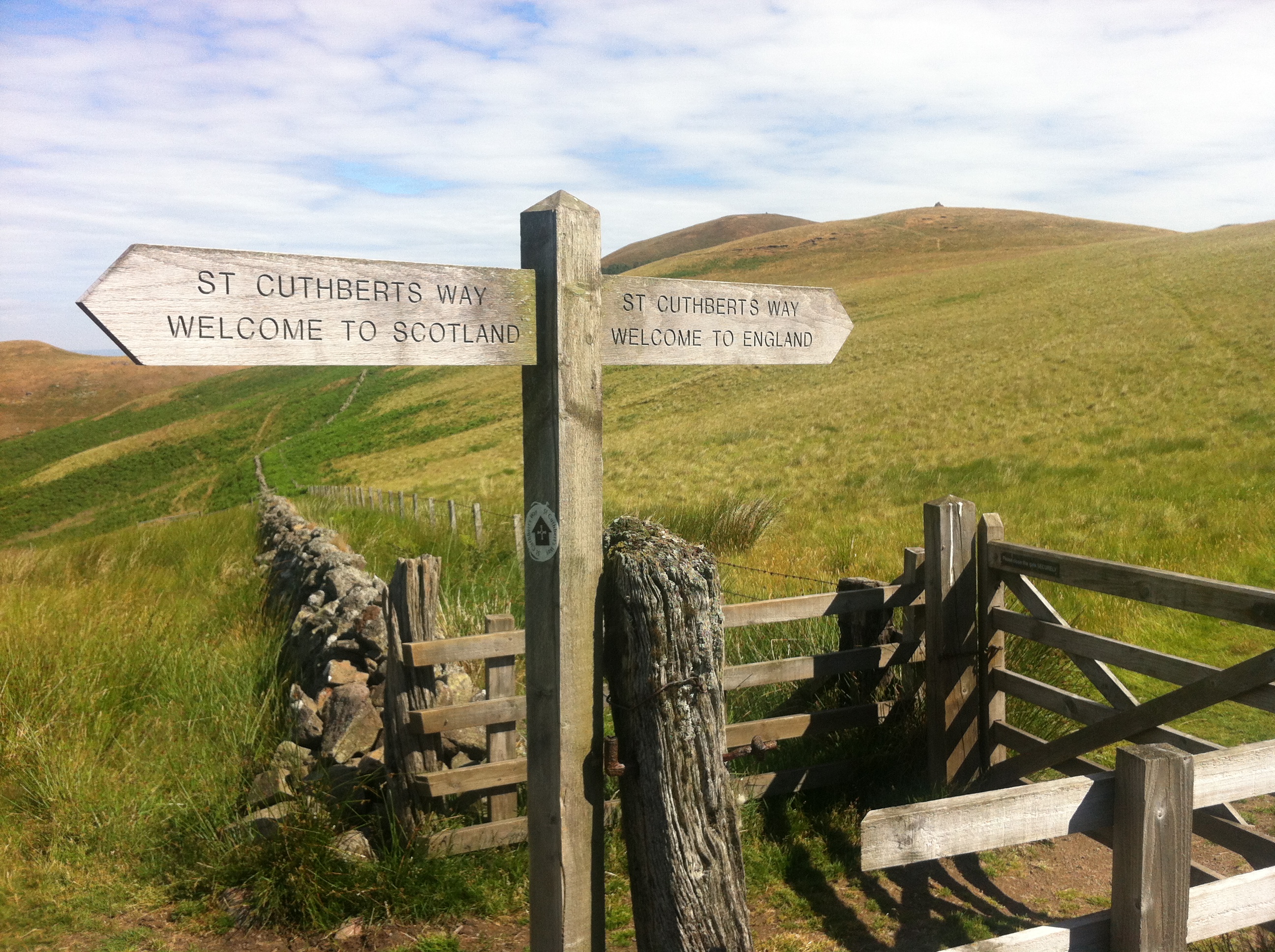
Perhaps my favourite gate is the one on St. Cuthbert’s Way, at the dry-stone fence, edged by thistle and grass, that marks the border between England and Scotland. It was a bit lonely a location, on the top of a knoll and across a valley from a Bronze Age ring fort, but the day I reached it I felt a sense of occasion crossing, and missed having someone there to share it with. There should have been a pub, as there had been, and a good one, back in Kirk Yetholm. Instead there were cattle, and stinging nettle, and burnt-yellow grass, so I kept on.

the border

Another common form of fence crossing in the UK is what is known as the ‘kissing gate’, so called because there is a gate in the fence that swings free between two fixed posts, just to the point of being able to touch, or ‘kiss’ each post. If you were looking at a kissing gate from above, you would see a walker step to the gate, push it against the far post, step into the small space at the open end of the “vee”, then push the gate back against the post just crossed, and exit through the cleared path on the other side. The point of a kissing gate is that a person can step into and through the pocket that is protected from the swing. But any four-legged creature cannot.

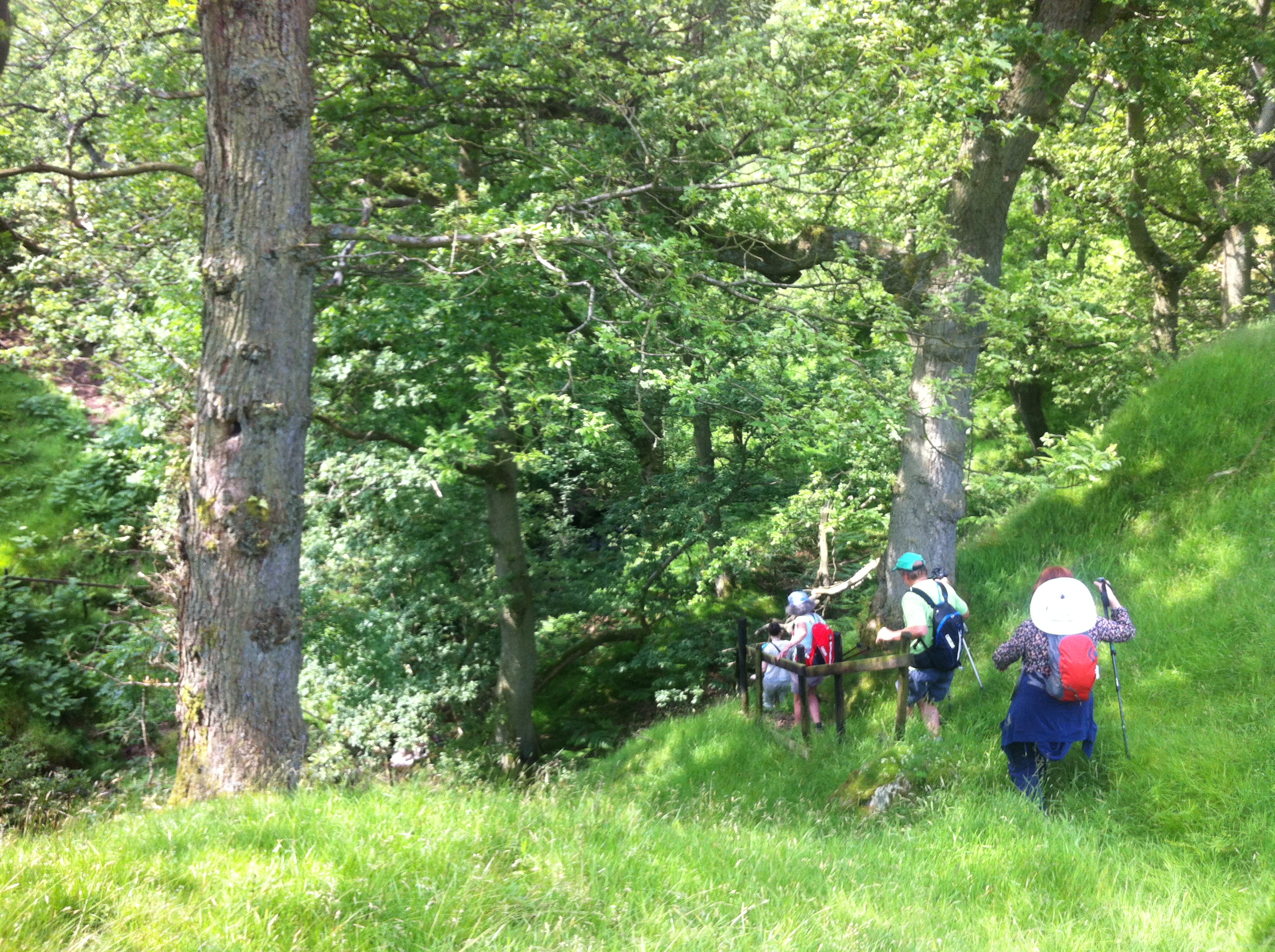
For the walker, the most reassuring thing about a stile or a kissing gate is that it’s proof, physical evidence in wood and sometimes steel that this is, if not the path, at least a path intended for walkers. From where it crossed the fence into forest, the Northdale trail we had decided to take led sharply downhill. As our eyes adjusted to the gloom we stepped carefully over exposed roots and clean river stones that skittered and clattered and slid underfoot. There was a close, fragrant feel to the air. I could feel the suddenly coolness on my skin; despite the trees there was a slight breeze from the north; the valley acting as a funnel for air from the high moor country, perhaps from whatever springs fed the stream we could hear below us.

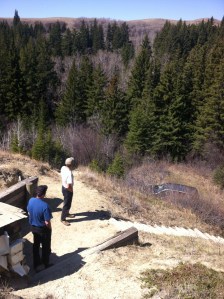
For a path we had chosen because of a lack of options and not for any particular markings, this one at first seemed quite promising. When we had walked only a short distance we saw that were stairs cut into the earth and banked by wood, and because of the steep descent someone had installed first a wooden railing, then a rope alongside the path at waist height. Just when we were feeling heartened the stairs split, each path descending a different direction. It was the classic dilemma: left or right? We chose left, descending another two sets of earthen stairs to a wooden bridge that couldn’t have been more than a few decades old. The stream would likely have been passable without the bridge by jumping from boulder to boulder across the pools and alternating rapids, but the cool forest air and shadow meant that most of the rock surface was slickly moss-covered. Boots would not have held. Someone would have gone in, or bruised or snapped a bone.

On the far side of the bridge was an ascent as steep as the bank we had just come down. After a few yards of climbing, the path disappeared under high ferns. We slowed, wading through the green, unwilling to risk falling into a hole, or worse, down some unseen rock face. For a few minutes we slowly tested the brush for any hint of trail, but it was clear no one had been through in some time. Whatever path was once there had disappeared. We turned back, first descending to the bridge, then back up again to the forest junction, somewhat anxious. Now there was only one option.


Categories
Uncategorized

From Old Montreal to Kahnawake: a 34-km pilgrimage to combat ignorance

A group of Theological Studies students at Concordia bridge cultural — and physical — divides

Posted on June 18, 2014
|
By: Matthew Anderson
Pilgrimage

Photos by Matthew Anderson


Last weekend Matthew Anderson, an assistant professor in Concordia’s Department of Theological Studies and the Loyola College for Diversity and Sustainability, and Sara Terreault, a lecturer in the Department of Theological Studies, led a group of students on a walking pilgrimage from Old Montreal to the Kahnawake Mohawk Territory.

From Saturday through Monday, they toured churches and First Nations institutions, learning about the people and the cultures they represent. Anderson compiled this account.

Plotting a 34-kilometre walking route between Old Montreal and the Kahnawake Mohawk Territory was difficult. But the hardest part turned out to be the last few kilometres.

Sara Terreault, a lecturer in Theological Studies, and I were temporarily stymied at city hall in Sainte-Catherine, a city near Kahnawake on Montreal’s South Shore.

“Oh, no, you can’t walk to Kahnawake from here unless the police stop traffic and you use the highway,” a clerk said. “I’ve lived here for 30 years, and I can tell you that it’s just not possible.”

Only a couple of minutes later, we discovered a service road footpath connecting the communities along the river. The problem is clearly not impassible terrain, but something else. Maps of the town end at the border and show a blank space to the west, where Kahnawake lies. When there is a blockade or a political crisis, this benign ignorance on the part of many non-Indigenous Montrealers can turn into outright suspicion or hostility, as clearly happened during the so-called Oka Crisis of 1990.

What’s the solution to such a conundrum? Part of it may begin with simply putting one foot in front of the other.

Pilgrimage

Students move between two destinations — and two cultural realities.

In a study I’m presenting in July at the Sacred Journeys conference at Mansfield College, Oxford, I propose that the dynamics of a trek offer a unique way to bridge cultural differences. Our research shows that walking combats ignorance of the cultural “other” not only in the shared experience of the journey, but also by allowing us to feel in our own bodies the distance from — and proximity to — these supposedly foreign places.

This is an experience that travelling by motor vehicle just doesn’t offer.

Taking steps to combat ignorance

This summer, Terreault is teaching a course on pilgrimages in the Department of Theological Studies. Along with me, she organized the 34-kilometre walk from Old Montreal and Kahnawake, which we undertook this past weekend.

To test how walking pilgrimages change the cultural suppositions of those who undertake them, she required her students to critically engage with pilgrimage theories during their trek between the historic destinations.

Notre-Dame-de-Bon-Secours Chapel

Participants tour Old Montreal’s Notre-Dame-de-Bon-Secours Chapel, once a popular site for Christian pilgrims.

The walk began on Saturday morning, with a tour of Old Montreal’s iconic 17th-century Notre-Dame-de-Bon-Secours Chapel, a structure built at the behest of St. Marguerite Bourgeoys that served as a pilgrimage site for the first Christian inhabitants of what was then called Ville-Marie.

From there, we walked the 23 or so kilometres to Sainte-Catherine, where we stayed in the basement of Église Sainte-Catherine d’Alexandrie. Early the next morning, we began the roughly 10-kilometre trek to Kahnawake.

While there, we visited the shrine of Kateri Tekakwitha, who became the first Indigenous North American saint with her canonization in 2012. We learned more about Tekakwitha from Orenda Boucher (BA 09, MA 13), who is working on a PhD thesis on Mohawk spiritual expressions.

Later, we toured the Kahnawake Cultural Centre with Tom Deer, its cultural liaison officer, before we ended our time in the territory with a visit to the Kahnawake Longhouse, a place for traditional religious expression. We also had the privilege of spending some time with Kenneth Deer, a Kahnawake journalist and educator who is involved with the United Nations Permanent Forum on Indigenous Issues.

Our pilgrimage concluded on Monday with our walk back to Montreal. Terreault was moved by the entire weekend.

“It’s humbling as well as instructive to see how warmly we were welcomed throughout our journey,” she said. “Communitas is a technical term used in pilgrimage studies that refers to the spontaneous emergence of fellow-feeling among people journeying together, regardless of social or other differences. There was certainly a sense of that about our entire trip.”

Ultimately, the voyage we undertook was not so much to a destination as between two cultural self-understandings and the physical spaces that exemplify them. It’s important to note that the walk was part of Concordia’s ongoing mandate of public outreach.

On our journey, we crossed densely urban, suburban and industrial zones, as well as parks and recreational areas, rediscovering parts of what was once an important historical Montreal trail. But as much as we were retracing the past, our eyes were definitely on this route’s future. Our political leaders, including those of the First Nations communities, are asking us to learn from each other.

Walking is a singularly powerful way to begin to do exactly that.

article from Concordia NOW, at http://www.concordia.ca/cunews/main/stories/2014/06/18/from-old-montrealtokahnawakea34kmpilgrimagetocombatignorance.html

Categories
Uncategorized

Dreaming of Pilgrims

escapees
It’s wonderful to know artists. Some time ago I woke up after a dream in which I had watched a woman in a medieval scriptorum ‘break open’ a Celtic Gospel manuscript and draw medieval figures leaving the manuscript even as modern pilgrims came in to explore. As we were preparing for our Pilgrimage Conference at Concordia (May 3-4) I told two artist friends: Janice Poltrick Donato and Cindy Walker. Janice drew my dream! And I wrote a poem to the escapees. What a fun way to prepare for an academic conference! (Janice and Cindy will be unveiling the full artistic creation and working on it at the conference in reaction to the academic papers – we’re calling the process peregraffiti)

To the escapees from the Lindisfarne manuscript:

When you stepped through the wall it must have surprised you
to see…..
Well, to see nothing at first,
just space,
blank front and behind, if blankness has direction.
Your eyes scratching for purchase,
anything…
here no richly knotted, woven gold, no winding serpents swallowing tails,
no clever labyrinths of animal overlaying cross,
no tight little fecund world,
Just horizon.

It must have been a shock.
After all, most escapes automatically come with dreams:
I don’t know,
rich tapestries lining a foreign street, a feast heavy with laughter,
kisses stolen,
a light-dappled meadow honeyed by bird-calls.
Something, at least.

Poor you. You got nothing.

Or rather, you got space –
line-free, free-lining, free-wheeling space,
the pilgrim’s only promise: space to walk:
stories unfurling like steps
stretching ahead.

13Ap27_Mtl_ (18)