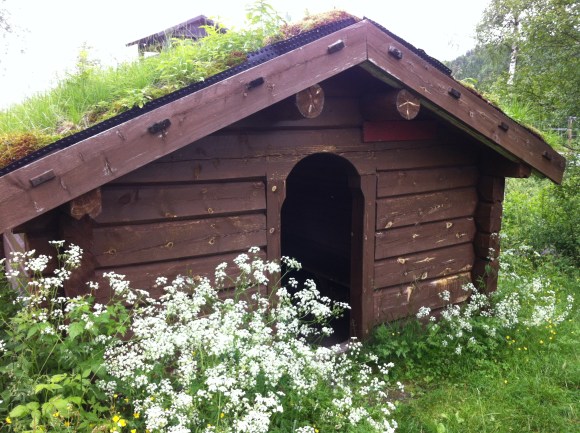
This hostel is accredited, begins the promotional blurb for Meso Gård , and recommended by the National Pilgrim Centre. It has met the same requirements, and holds the same standard, as the pilgrim accommodation along Camino de Santiago. But a Spanish pilgrim who comes to Norway will find themselves, not in a bunk room in barren and dusty Castrojeriz, but in a typical sod-roofed, log-cabin style Norwegian hostel in the Rennesbund district along the St-Olaf’s Way, where a river rushes by, birds are singing, mountain flowers bloom around you and everything is green. Meso is a world away from a Spanish albergue. And the differences aren’t just in the lack of Rioja and dust (the first to better deal with the second).
Those who planned the St-Olav Weg have tried to make it familiar. The elements are as standardized as the boarding procedure at airports. There is a passport, obtained from an official pilgrim centre and sized appropriately for tucking into a backpack, local business stamps validating one’s walk along the trail, trail markers along paths and roads and paint slashes on rocks to guide the way, ‘pilgrim meals’ offered at some local restaurants, and several revitalized ancient routes (traceable on a smart-phone app) toward a cathedral city celebrating a medieval saint.
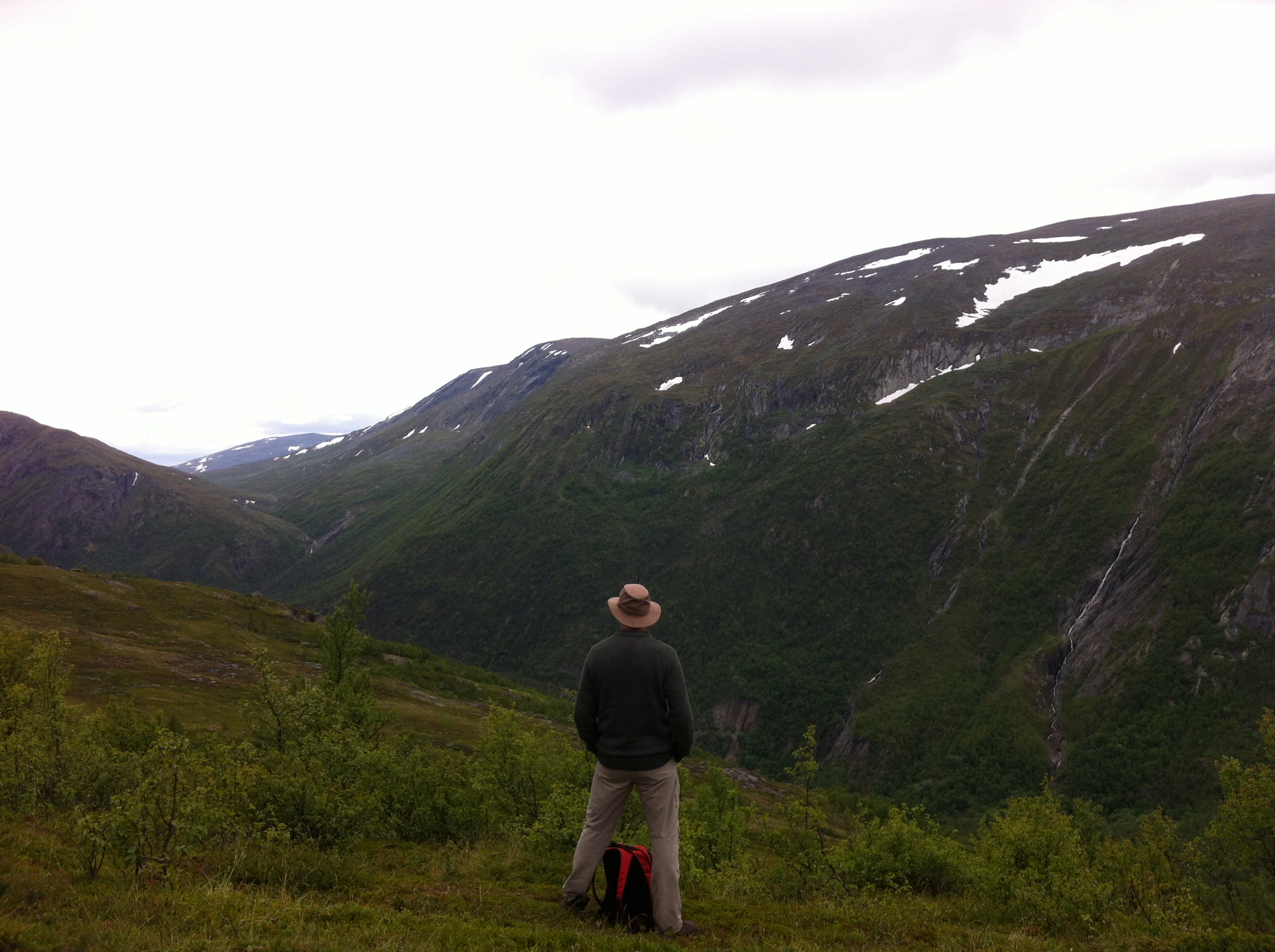
Yet the similarities between the two pilgrimage routes are overshadowed by differences as high as Norway’s mountains. The mountains, in fact, may be the most obvious initial difference, at least from the Camino Frances part of the Spanish trail. It’s been less than two weeks since I walked with five other Canadians from Dovre, in the Dovrefjell district of Norway, 250 or so kilometres to Trondheim. As far as I know, we were the first group of Canadians ever to walk this way as pilgrims. Unlike my experiences on the crowded Camino Frances, there were very few others we met. Those we did echoed our experience of a satisfying but extremely tough walk through conditions more like the high Rockies than the Meseta. In part because of an unusually late, cold and wet spring, we forded swollen mountain streams, jumped from hillock to hillock through kilometres of bog, and in sections of the trail found ourselves going days without seeing other human beings, much less a store to purchase supplies. We fell down, we froze, we saw incredible beauty, one of our group broke her ankle among the endless tree roots. It may be ancient, but it was not an urban walk. Café con leche? Forget it, unless you have a thermos, some farm experience and can catch one of the abundant sheep or goats.
Because it is still early in the redevelopment of the St-Olaf Way, one of the most fascinating parts of the walk, for me, was how we met those still trying to put their mark on how the trail will develop. I felt like we were there at the beginnings of something important. We met chapel builders who want to make sure there will be a spiritual component to the walk, officials who seek the ‘new spirituality’, walkers interested primarily in ecology and environment, and others who are developing their businesses in hopes of increasing numbers of high-tech backpackers showing up at their doorsteps.
All of which raises some interesting questions. What gives a particular pilgrimage its unique character? Is there such a thing as a more or less authentic pilgrimage? It seems to me that the inevitable conflict of values in this birthing of a European pilgrimage route is useful, because it helps bring about something that, however it borrows from the past, is new. As my friend Allen Jorgenson noted, the role of land, and of landscape, is more important than some of us have realized. Maybe we should be talking about pilgrimscapes, and how the outer journey influences the shape of the inner one.
Whatever the medieval St-Olaf route once was, there is now a struggle for its modern identity. It is definitely not the Camino. What it will be remains to be seen.