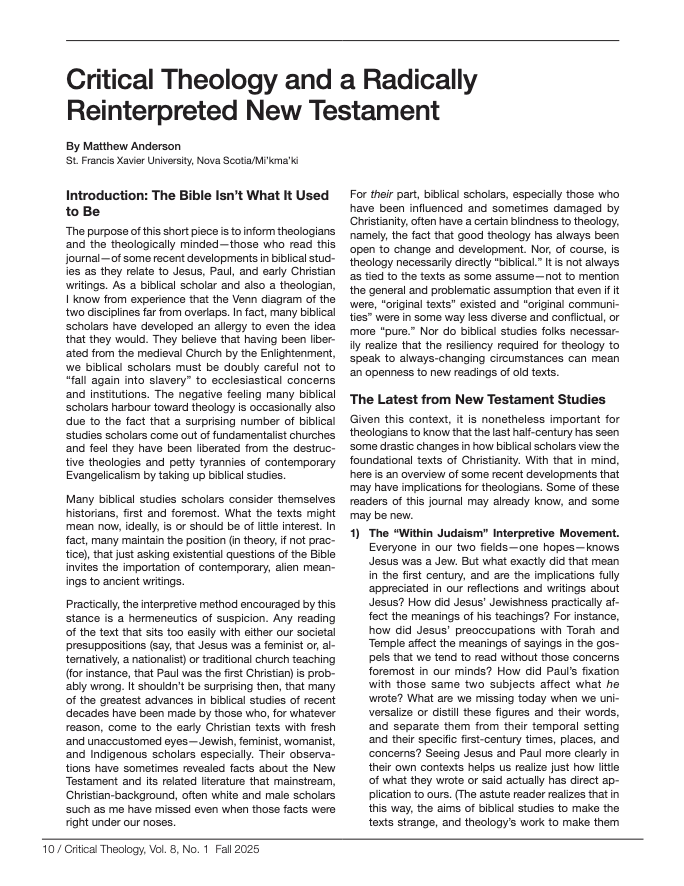
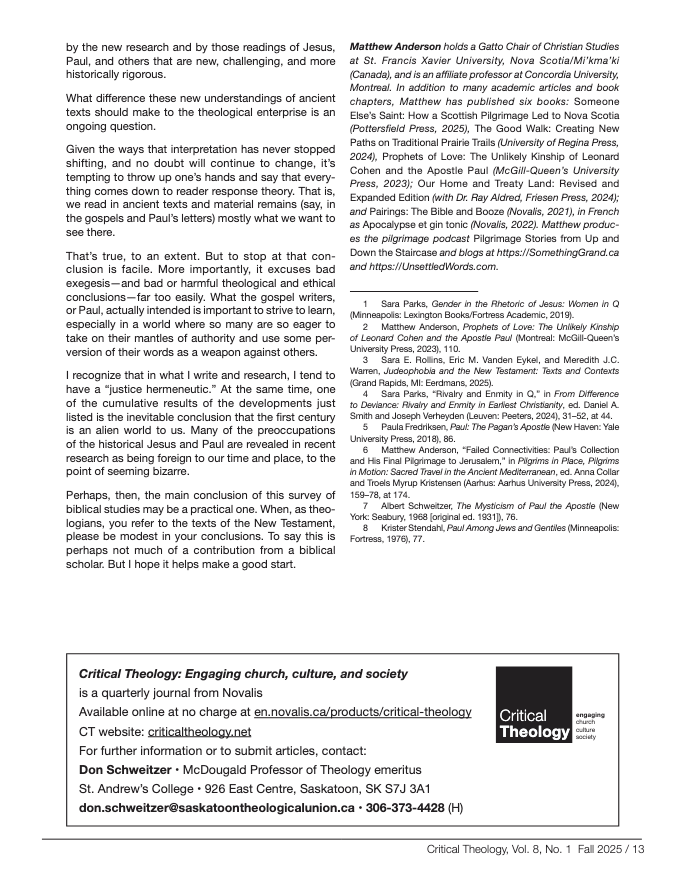
Last fall my friend Dr Christine Jamieson asked if I might contribute to an upcoming issue she was editing for the Canadian-based journal Critical Theology. I wrote a short piece inviting theologians to consider what implications might arise for their work from recent research in New Testament, early Christian, and early Jewish studies. While academics produce excellent work both in Theological Studies and in Biblical Studies in Canada and around the world, they often don’t talk to each other, as I pointed out. I’m fortunate to be working and teaching as a Gatto Chair of Christian Studies at Saint Francis Xavier University, Nova Scotia. This means I can pursue biblical studies research while attuned (I hope!) to the “engaging church, culture, society” that Critical Theology’s byline promises.
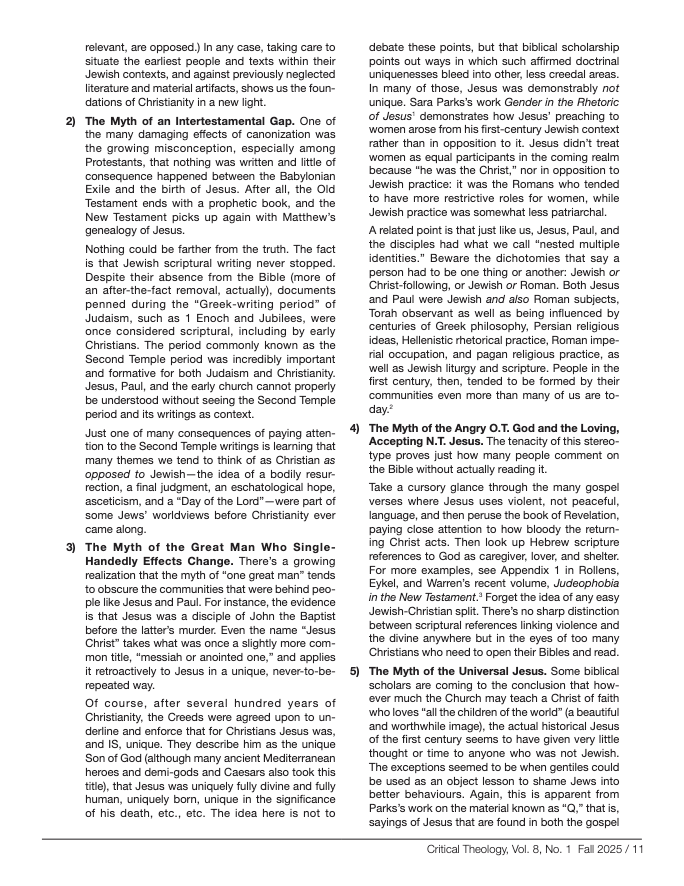
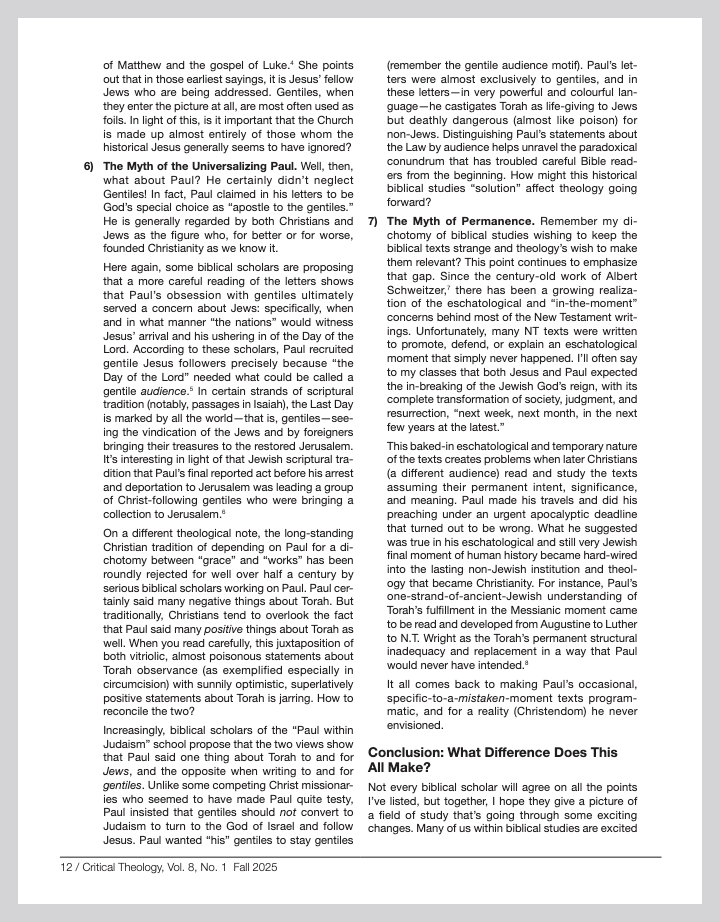
The journal issue came out in November. I was delighted to see my article there, and I wanted to share it. What I didn’t know was that Critical Theology has recently become open access, meaning it’s no longer hidden to everyone except subscribers. Thanks to Novalis Press for making the journal available – coincidentally, Novalis was the publisher for my first book, Pairings: The Bible and Booze.
You can read Richard’s stirring defense in the open access issue HERE. I’m reproducing my own short article below for your convenience. But I recommend the whole issue to you! And I thank Christine for inviting me to be a part of this worthwhile project.
Good reading!
“The aims of biblical studies to make the [New Testament] texts strange, and theology’s work to make them relevant, are opposed”
“taking care to situate the earliest people and texts within their Jewish contexts and against previously neglected literary and material artifacts, shows us the foundations of Christianity in a new light”
“Paul made his travels and did his preaching under an urgent apocalyptic deadline that turned out to be wrong”
“Many of the preoccupations of the historical Jesus and Paul are revealed in recent research as being foreign to our time and place to the point of seeming bizarre”
All Germans idealize the North American “West”and North American landscapes. Germany is a crowded country that has lost so much of its own “wildness” but still maintains a strong national mythology of origins around it. And yet …
All Germans love to read, and as a bonus, as truly civilized people are multilingual and can often read English books like mine, unlike most anglophones and folks like me, who struggle with anything more than simple tourist directions auf deutsch…
SO. After all these expectations, how did the review turn out?
Thanks to Google translate, you can read on for yourself….
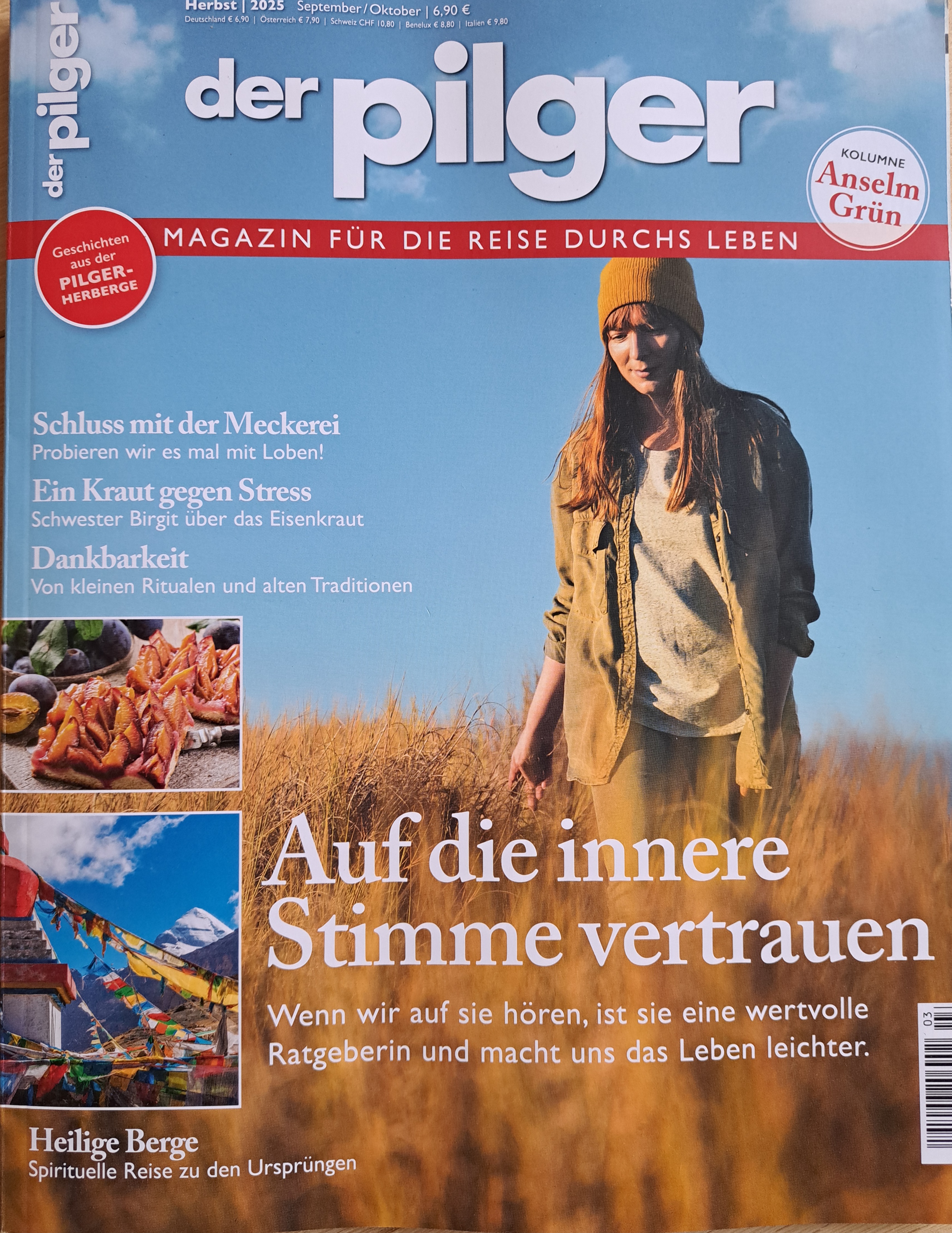
The Review
p. 43 New Pilgrim Perspectives:
“A devout Muslim embarks on the Way of St. James, and a Canadian professor and long-time pilgrim follows the trail of spiritual wandering in the vastness of the Midwest. Two inspiring book recommendations from Protestant pastor and passionate pilgrim Traugott Roser.“
“The Search for a Lost Home (Die Suche nach einem verlorenen Zuhause)“
“Matthew Anderson, Professor of New Testament at Concordia University in Montreal, is an experienced pilgrim who has also led his Canadian students through Spain, France, England, and Norway and has made a name for himself as a documentary filmmaker on pilgrimage. After many trips to Europe, he wonders whether pilgrimage is also possible in North America and what pilgrimage might mean there. In his new book, “The Good Walk – Creating New Paths on Traditional Prairie Trails,” he tells a compelling story of humanity’s age-old paths through the prairie of the Middle West. It is an account of a painful yet healing search for home: “Pilgrimage together with others—in the broadest sense understood as spiritually motivated hiking—is a way of searching for a lost home.” Anderson is a descendant of settlers who farmed…
(P. 45) and built small towns on the supposedly deserted plains of Saskatchewan (see photo above), and [the region once called] the Northwest Territories. Since 2015, Anderson and his wife Sara have been traveling the trails once used by traders, settler treks, and the Northwest Mounted Police, a paramilitary force commissioned by the Canadian government. But Anderson not only gets close to the story of his own family, descendants of white European immigrants, but also of the people who lived there before and were deprived of their land through sham treaties, displacement, and targeted extermination.
Pilgrimage: intercultural and interfaith
Anderson is accompanied on his journey by various companions, including Don Bolen, the Catholic Archbishop of the Diocese of Regina. Descendants of the First Nations, the Lakota, the Nakota, and the Nehyawak (Cree) accompany them or host them, as do descendants of settlers and the Métis, descendants of European-Indigenous marriages, who historically mediated between cultures as fur traders and are now considered an independent nation.
Anderson sees his hikes through the vast landscapes as pilgrimages to places whose history has been partly forgotten, partly erased. This also changes the landscape and its perception itself: through narratives and archaeological evidence, places of living memory emerge.
The places create new relationships and deepen old ones. In this way, the pilgrims come into contact with the spiritual world, [sometimes] with the elders and wise men of the Indigenous peoples, [sometimes] with their own family history, and [always] with nature. Through Christian and Indigenous rituals, the pilgrimage becomes an intercultural and religiously unifying experience. At the same time, it is a painful journey that ties in with the tradition of penitential pilgrimage: The extermination of the North American bison took place in the vastness of the prairie. This deprived the Indigenous people of their livelihood, and thousands starved to death while faced with the government’s deliberate inaction. It is equally painful when the pilgrims encounter survivors from the church-run boarding schools (of both Catholics and Protestants):
On behalf of state authorities, children were taken from their families and Nations and placed in Christian schools. Only in recent years did the public learn of the graves of thousands of nameless children who did not survive the ordeal.
Reward for Physical and Mental Effort
The paths across the prairie demand physical and mental effort from the pilgrims, but they also reward them: through community, forgiveness, and understanding. Matthew Anderson ultimately even succeeds in finding peace for his deceased parents and for his sister, who died very young. The pilgrim’s path is a good path, and with the project Anderson describes, a new, very unique pilgrimage tradition begins in Canada.
I couldn’t put either book down; it was precisely the different perspectives of both authors that inspired me to consider my own pilgrimage
I couldn’t put either book down; it was precisely the different perspectives of both authors that inspired me to consider my own pilgrimage on the Way of St. James in a new and more profound way: as a consciously religious experience, as a path to encounter God, and as a path to reconciliation.”
Dr. Roser’s Own Pilgrim Book
I wouldn’t be much of a friend, if at this point I didn’t mention that Traugott has published his own pilgrim book. It’s in German, titled Hola! bei Kilometer 410: Mit Allen Sinnen auf dem Jakobsweg (Hola! At kilometre 410 with all senses on the Camino de Santiago).
I wonder if a rather free, but still good, translation might be: “Hola! Fully aware and alive at kilometre 410 of the Camino de Santiago.” It’d be great to see this valuable book out for the English-language reader as well! (By the way, the other book he reviewed with mine in the above article sounds fascinating).
Traugott does all kinds of interesting teaching and research, including (like me) teaching Bible and Film classes. He is also an ethicist who teaches about ethics in healthcare and palliative care.
Thanks, Traugott, for the great review. Buen Camino! Looking forward to walking with you some day soon!
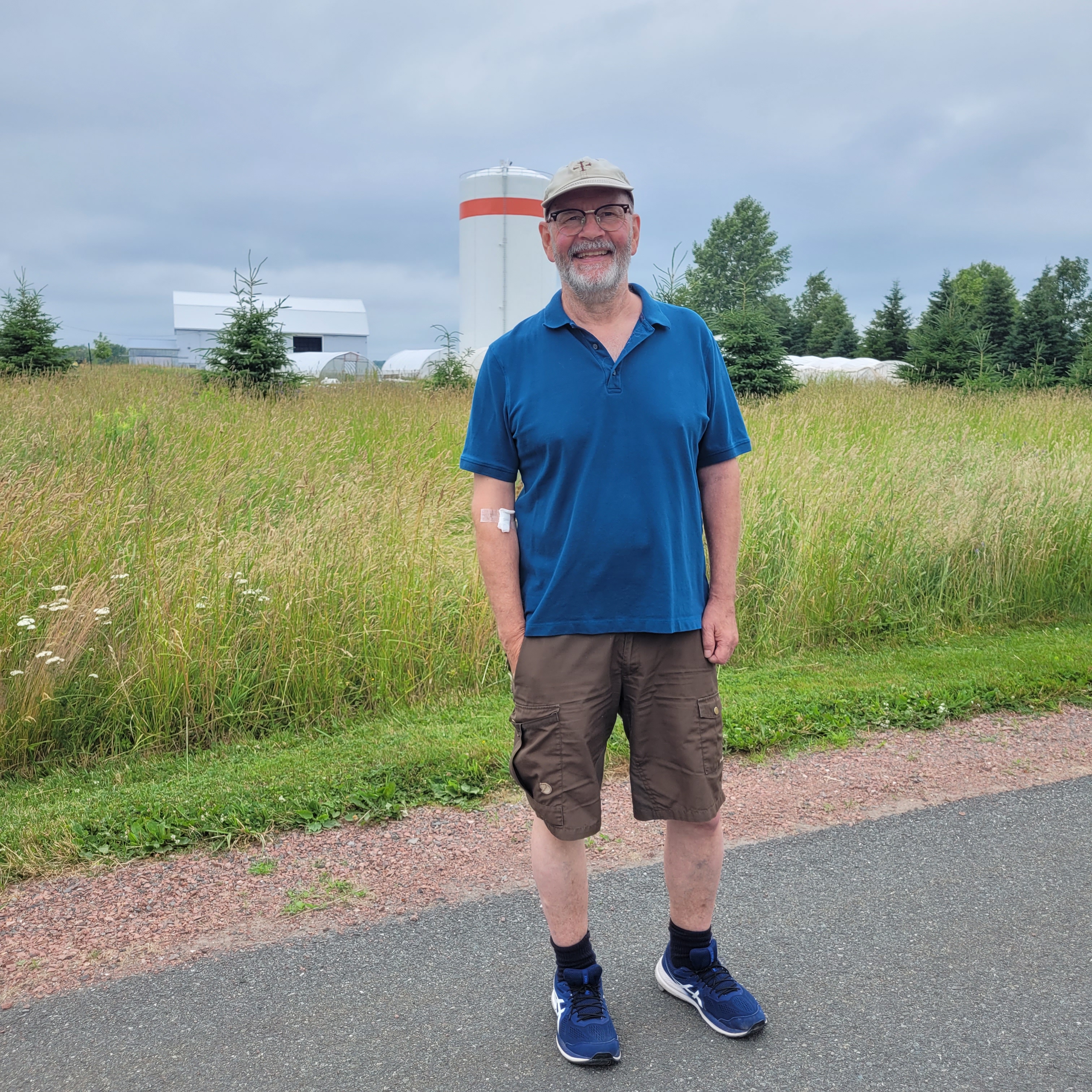
So, something fairly big for me happened recently. Following my stroke ten months ago, I would look out the hospital window from my wheelchair and see people–strolling on their lunch-breaks, walking their dogs, or jogging–up and down the small hill that leads from the hospital to the Bethany Gardens and farm owned by the sisters of St. Martha. At that time, I was a ‘two-person transfer’ and couldn’t walk a meter, let alone a kilometer. “See that hill?” I said to Sara. “I’m going to walk up it with you one day. That’s my goal.” There’s a small tower at the top. My dream was to touch that tower like Rocky finally able to take the steps from the iconic movie. It felt impossible, but I fervently envisioned getting to the top of that hill, giving thanks for my recovery–and being outside, right side up, and on my own two feet.
This week, it finally happened. Sara and I were running separate errands on a busy day and we both wound up in the vicinity of the hospital at the same time. We decided to meet for tea at the volunteer-run BreakAway Cafe that helps pay for new medical equipment. Last fall Sara had been there pretty well every single day to see me, and she still had a free coffee on her hospital coffee card. It had been a while since we’d both been at St. Martha’s together since my stay. After our drink and my medical appointment, Sara said, “is today the day?” and looked meaningfully at the hill. And we set off. It was surreal to make it all the way to the top.
It wasn’t entirely as envisioned. My gait wasn’t as smooth and confident as I’d imagined from my wheelchair in September. I was winded by the slope and had to stop to catch my breath. (That certainly wouldn’t have happened pre-stroke to this long-distance pilgrim!) And when we got to the top it turned out there was no way to actually touch the tower, which turns out to sit behind fences, cattle, and construction.
Even dreams that come true don’t usually do so in the ways we’ve imagined.
But – it felt wonderful to reach the top just the same! And I was thankful every step.
“Telltale Heart“
(apart from the title, what’s below doesn’t actually have much to do with the Edgar Allen Poe short story, which is frighteningly narrated here, if you’re interested)
Today I was at the hospital for another important step in recovery. I’m still doing physio at St. Martha’s at least twice a week…odd to remember how when I was new to Antigonish I used to think I should go see the place because I’d never been inside. But this morning wasn’t physio. After three tries and two different technicians, they got an IV line into my arm for what’s called an “agitated saline contrast,” or echocardiogram bubble test, pumping “bubbles” into my vein, then watching them travel to the heart to see if my surgery in April had really closed the hole between my heart’s upper chambers.
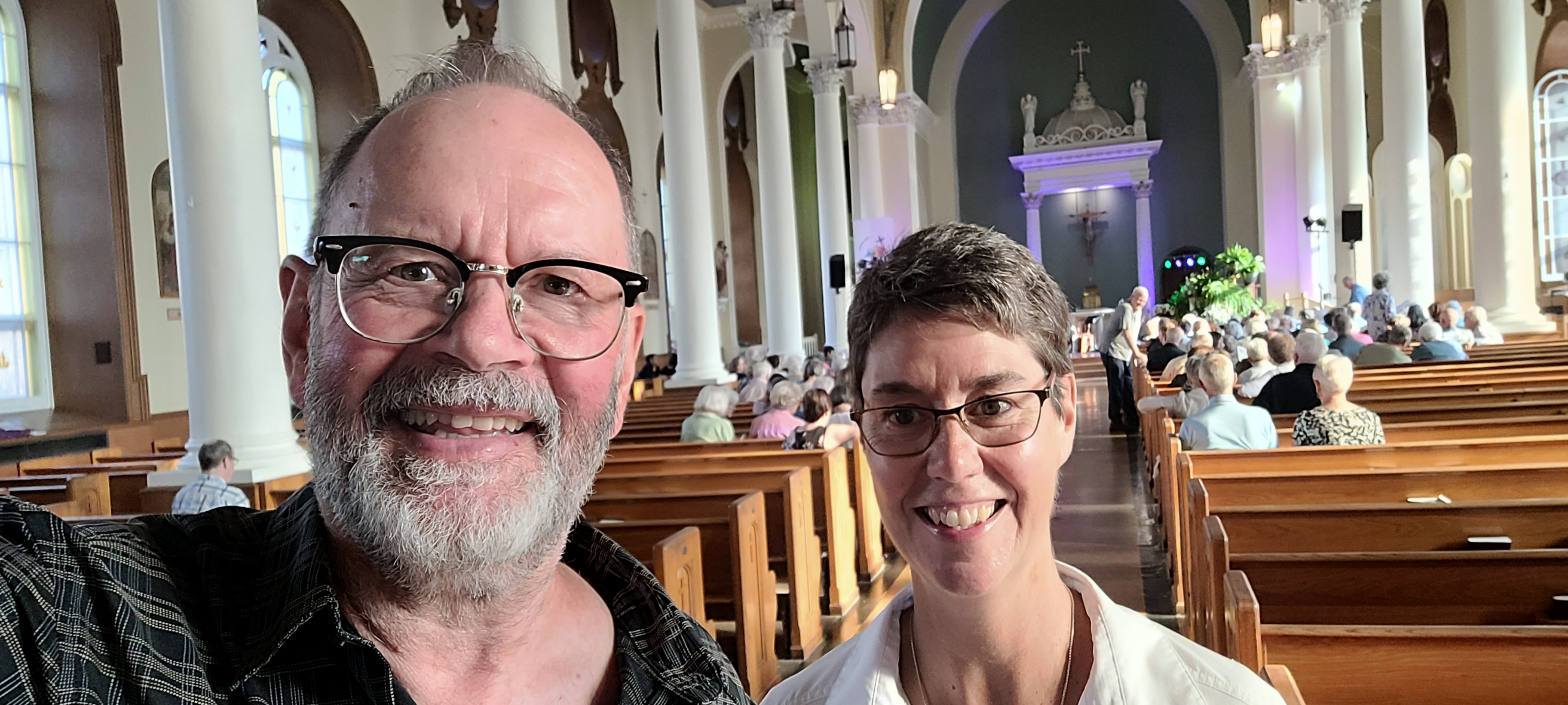
The great news: it had. No bubbles got through. This means that now no future clots can sneak through there, either. I said thank you to Dr Amy Hendricks, and told her she plays a mean piano and violin (I had been surprised to see her perform in a wonderful concert at St Ninian Cathedral). She laughed and said thank you, and that everyone needs to have a few hobbies on the side. That’s life in a small town. (Pictured are my friend and fellow pilgrim Sister RéAnne and I at the concert before it began).
This week I also got my Botox shot for leg spasticity. Or rather six shots, into my left calf, as I lay on my stomach on a clinic bed in Halifax. There was no immediate change, except some mild flu-like symptoms I’m presently experiencing. Apparently it takes 4-6 weeks for the poison to reach full efficacy and (we hope) work its wonders. However, tonight I feel like my leg already swings a bit easier, which might be psychosomatic. In any case, convincing my plastic brain to accept that my leg can be trusted again is apparently part of the point. We’ll see!
I’m starting to be able to do some slow and basic typing with my left hand. Just barely. Soon the hand tires and my xpinxkixe finger (there it is, doing it again), starts drooping and hitting errant keys and I have to go back to one hand. But… it’s a start. The trick is holding my left hand in the air without the fingers curling in (spasticity) or the whole hand dropping, then adding to that the coordination of using fingers to distinguish between the “a” and the “d” keys when they are only beginning to remember their connection to my brain…
“The Gatto Came Back”
Okay, that heading holds a fairly obscure pun, but IYKYK. (If you don’t, click here for “Gatto”; and watch Canadian entertainer Fred Penner sing the song here !)
My two universities have both been incredibly supportive through these months of stroke and stroke recovery. Firstly, Concordia’s Dept of Theological Studies and its chair, Dr. André Gagné, worked to renew for one last time my status as an “affiliate assistant professor” there. I love still being associated this way with Montreal, even though the thought of a trip to the big city and taking public transit in my present condition gives me the heeby-jeebies.
Second, Saint Francis Xavier (StFX) and my colleagues here in the Religious Studies department have been nothing short of wonderful. In addition to taking over my teaching last fall, interim chair Dr Robert Kennedy dropped by with a stunning white orchid from the department after my heart surgery. You may recall that they also sent flowers and cards during my hospital stay, and Sara got gift certificates for take-out and ready-meals from our then Dean of Arts office and the department. Recently, the University also made “a big deal” of my winning a Sask Book Award with a special news release. New colleague Dr Gerjan Altenburg invited me fishing with him and his son. And this last week, Dr. Erin Morton, Associate Vice-President, Research, Graduate and Professional Studies, and head of the Gatto Chair Committee, confirmed that my application for a one-year extension of my chairship was approved. This means that the research travel and meetings for which I had funding will not be lost to my months in hospital. I’m incredibly grateful!
“Running Back to Saskatoons”
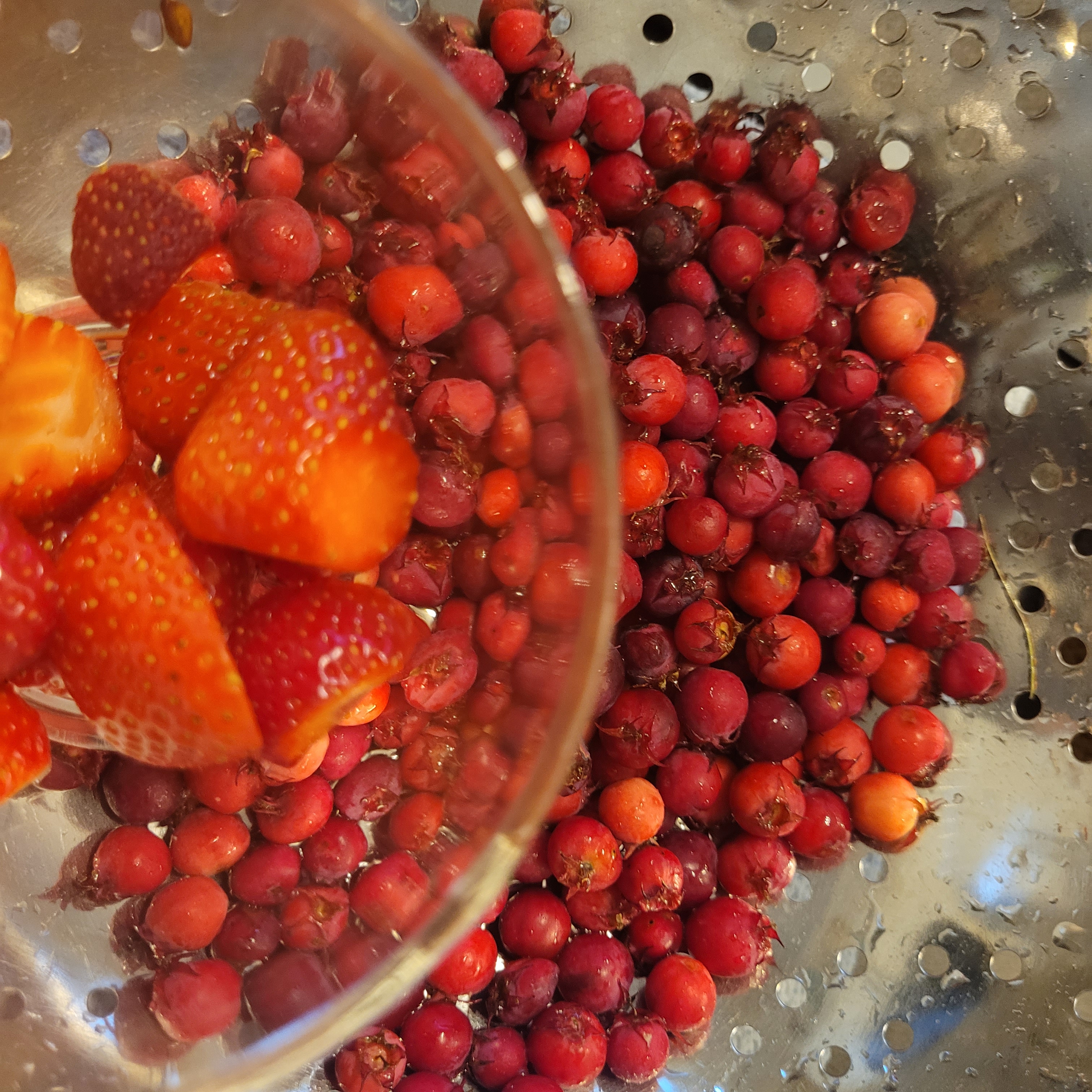
I’ve been hanging ’round hospitals” is one of the lines from the 1972 The Guess Who song “Running Back to Saskatoon,” which also mentions libraries, grease monkeys, and Moosomin SK. But it’s actually now that I’m home from the hospital that I’ve really been able to enjoy Saskatoon (or as they say here in Nova Scotia, “serviceberry”) season.
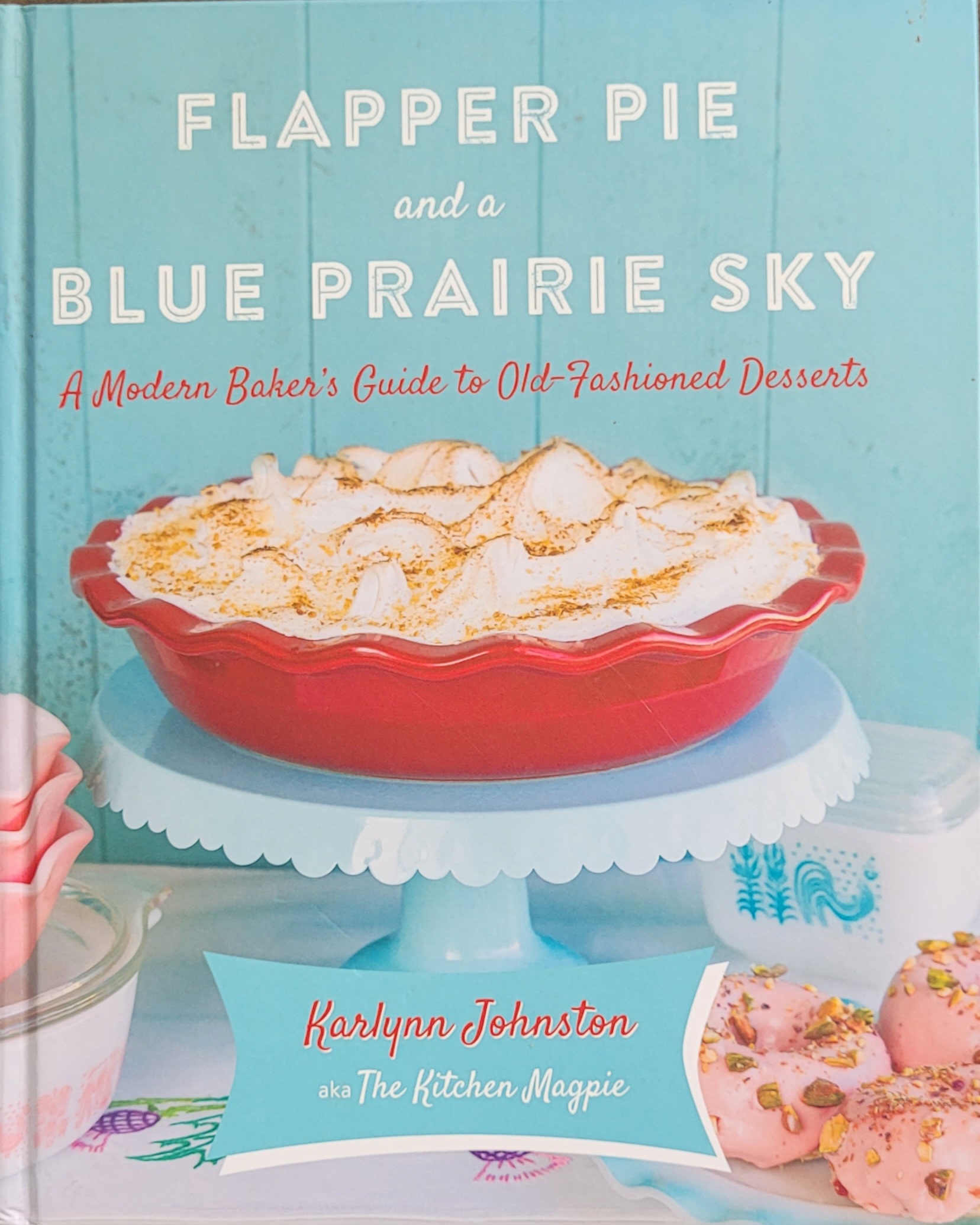
It’s a good year here on our three acres for Saskatoons, even if you’d laugh to watch how slow I am to pick them. My first attempt at a Saskatoon crumble was only okay (not enough berries). But today is Saskatoon pie day. I followed a recipe from the beautiful – and fun – cookbook Flapper Pie and a Blue Prairie Sky, which devotes several pages to Saskatoons and their place in prairie cuisine and culture.
It’s not a beautiful pie…I used a store crust, and my thumb marks disappeared in the baking. But it’s mine. And what I really wanted to say was not so much about Saskatoons (or pies!) as the feelings that arose in me this year as I picked the deep purple berries. The other evening I was out during the “golden hour” with my plastic pail. Somewhere in the near distance I could hear children playing. A rooster crowed from one of the nearby farms, and the songbirds – we have a lot of song sparrows, vireo, yellow warblers and more – were calling to each other.
Despite the mosquitoes, deer flies, and ticks, suddenly there was so much peace and joy welling up inside that I could feel it like a physical presence. Here I was, standing on my feet, reaching with both hands, however awkwardly, for berries, and tasting the sweetness of this land where I live.
I feel incredibly blessed to be living, period, and to be living in the country. Yes, the power goes out sometimes, yes, there are critters, some great, mostly small, to be aware of and learn to live with, yes, there is grass cutting and incessant yard care, and yes, there are no bakeries or restaurants or cool little take-out spots just around the corner like I enjoyed in Montreal. But there are other pleasures, like sitting with tea looking out at the little bit of salt water that fingers in at the foot of our yard, like watching herons rise up into flight or eagles float lazily overhead. Like tossing ripe Saskatoons into your mouth and hearing the soft tap-tap-tap of a downy woodpecker somewhere deeper in the bush. And feeling alive and connected to it all.
The 2009 album “These Are the Moments” by local Cape Breton group The Rankin Family contains the song “Fare Thee Well Love” – which is my wish to you, in your moments, whatever and wherever they are..
That’s a snapshot of what’s been happening. It’s been ten months since the event that overturned my life last fall. That one moment of garbled speech, of a tingle running down my arm, of Sara running for the Aspirin and calling 911, has led to all these moments since.
Isn’t it profound how a single moment can change our lives, and how often that happens, in some form or another?
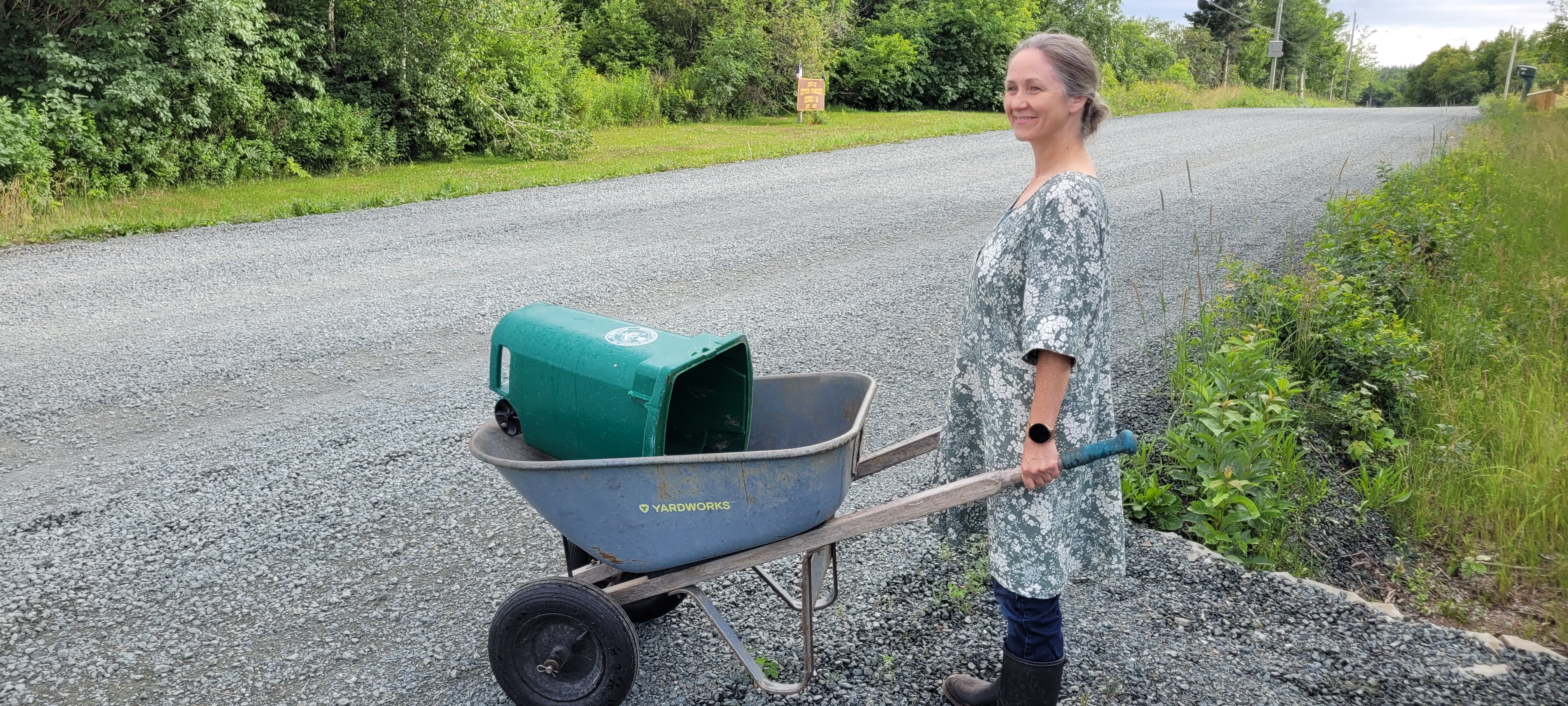
And yet life still goes on, until it doesn’t. And for this moment now, I’m thankful. And thankful to you for taking a moment to read this. Tonight is garbage night. Time to head out with the wheelbarrow, and then maybe try that pie…
[Update: As they say in the Maritimes, it was some good.]
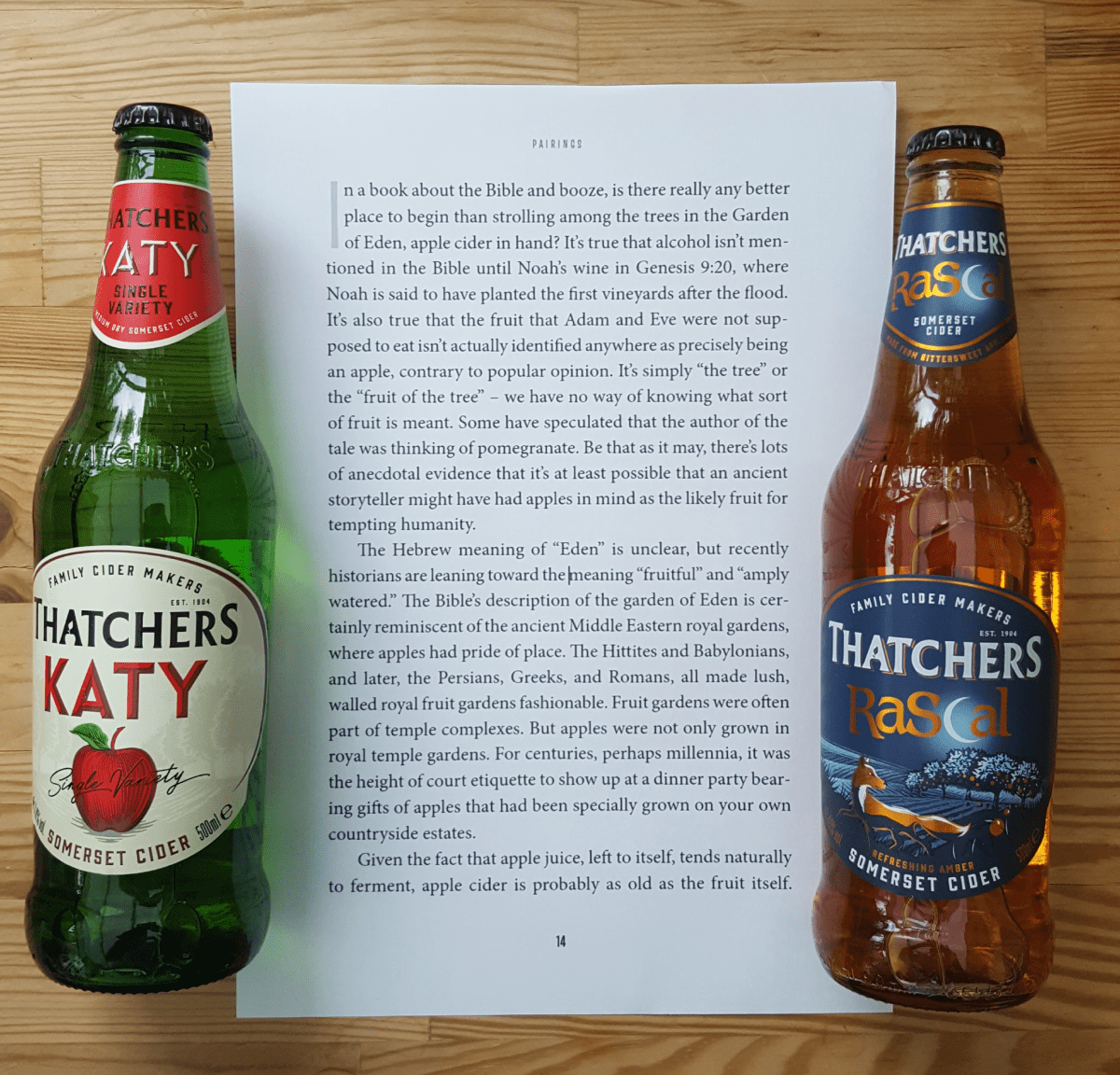
You can find a good cider almost anywhere apples are grown, but England has some of the best. In today’s post, I’m serving up these two Thatchers ciders—Rascal and Katy—with a sampler from chapter one of my book Pairings: The Bible and Booze. Why this pairing? Two simple reasons:
1/ “Rascal” is yet another in a steady stream of apple cider branding that portrays the product as “sinfully good,” “temptingly tasty,” and “devilishly delicious.” Notice a theme here? Without necessarily mentioning the Garden of Eden, many cider companies rely on advertising and logos that “tap into” images of apples and temptresses that we think are from Genesis. But are they really biblical? This brings us to the second cider…
2/ “Katy” is the name of one of the biblical scholars I quote in the chapter – Dr Katie B. Edwards, Hebrew Bible specialist, BBC broadcaster, and author of Admen and Eve: The Bible in Contemporary Advertising. In Admen and Eve, she shows how Eve has been so consistently portrayed in art and in advertising as a “femme fatale” that we forget that that’s NOT how she’s actually portrayed in Genesis! There are many other ways of reading the story of the Garden of Eden without linking an apple (iffy) with Eve as solely responsible for original sin (look to the Church Fathers for that one).
Katie was kind enough to write an endorsement for the back cover of Pairings.
You can read more about Genesis 2-3, Katie, and the secret history of apples, in chapter one of Pairings: the Bible and Booze, “Low-Hanging Fruit: Apple Cider and the Second Creation Account.” Each chapter of the book pairs a specific drink with a specific biblical text. Chapter one pairs the Genesis creation accounts with either a fermented cider, like one of these Thatchers, or an alcohol-free farmer’s market cider, like the ones you can buy from Rougemont Quebec, or in the Okanagan, or the Niagara Peninsula, or the Annapolis Valley.
I can hardly believe it. I’ve been writing for decades. I’ve written short stories, academic papers, sermons, presentations, blog posts, a novel, and non-fiction memoirs and travelogues. I’ve been fortunate to have both academic articles and short stories published. But it’s been a waiting game to see whether a publisher would ever pick up one of the book-length manuscripts. Now it’s finally happened — a publisher said YES, and it wasn’t the manuscript I expected! But I’m SO happy that Novalis Press took a chance on Pairings: The Bible and Booze. One of the editors wrote: “I loved it! In fact I couldn’t put it down.”
Pairings will be out soon in Canada and the US, and will be coming out in French a few months later (translated by my friend Sabrina Di Matteo). It’s the first time I’ve signed a book contract. I even received the Press’s standard advance (completely unexpected for someone used to academic publishing). I admit it: it’s a thrill!
Not long ago they sent me some possible book covers. The one I picked (see above) is the choice the Press went with as well. It kind of looks like a Bible, doesn’t it? I love the retro feel, the woodcut approach. And the old-school Bible colour.
So what’s in the book? Here’s what my pitch said: “The manuscript represents the latest biblical studies research. Its commentary on popular biblical texts – arguing tongue-in-cheek for why they should be twinned with certain drinks – is a delicious “taster” for both. Pairings feels like an excellent dinner conversation shot through with a gentle sense of humour.” I added that “Pairings: The Bible and Booze turns our natural curiosity about dissimilar items and our thirst for the old truths into a lively and inspiring book about the Bible.”
See for yourself….here’s the Table of Contents! Each chapter offers up two tasty suggestions – one alcohol and one alcohol-free – to match a passage. Some biblical studies types, friends of mine, have seen the pairings. They often disagree with my choice of drinks…but that’s part of the fun! You may have other pairings to suggest too, once you start to read. I’d love to hear your suggestions.
I hope to hold a physical copy in my hands very soon. I can’t wait. Look for more news in the coming weeks!
How do you walk a pilgrimage during these months of restricted travel? I’ve been walking up and down my staircase in Nottingham England, and dreaming of pilgrimages past! To share those stories I’m releasing my first-ever podcast, “Pilgrimage Stories from Up and Down the Staircase.” Each episode features a different trail, or a different character I’ve met. I’ll introduce you to enthralling paths in Norway, Scotland, England, Iceland, Canada and Indigenous territories, and provide some of the resources you’ll need to walk them. All the while I’ll be telling the stories of the fascinating individuals I’ve walked with and met along the way, and sharing snatches of our conversations, songs, and experiences.
Thursday, July 30, 2020, at 5 pm Montreal time, I’m releasing the first episode: “Walking the St Olav Way.” In the 17-minute episode you’ll hear snatches of our struggle up and down mountains and jumping late-spring run-off streams and boggy marshes. You’ll meet a friendly Norwegian border agent and a marathon German pilgrim struggling to understand his life. You’ll sit with us in rustic Budsjord Gård and hear fellow pilgrim Kathryn singing as we walked. I hope you’ll listen in to this first episode, and to the others as they come out every Thursday! The series “Pilgrimage Stories from Up and Down the Staircase” will be available wherever you find your podcasts.
To find out more about St Olav before listening to the episode, why not check out some of these resources?
The official St Olav website, which you can find here, is a wealth of beautiful images and practical info (look for the English-language option)
In 2011, Alison Raju wrote The Pilgrim Guide to Trondheim, available at this website.
For my article about the history of the Trail and its modern-day recovery as well as some photos of our 2013 trek, see the International Journal of Religious Tourism and Pilgrimage, here.
For an article about the health benefits of walking the St Olav Way, written by a Norwegian scholar of pilgrimage in the same journal, see this link.
I’m looking forward to sharing my experiences with you on the “Pilgrimage Stories From Up and Down the Staircase” podcast!
Trying to bring one’s worlds together is the work of a lifetime, as fulfilling as it is challenging. I’m a biblical studies scholar interested in earliest Christianity and late Second-Temple Judaism. I research pilgrimage and journey, and try to walk paths and learn about the Land wherever I am. I’m also a Canadian trying to face some of the injustices against Indigenous peoples which created and help sustain my country. I’ve learned a lot, and I’m still learning, from First Nation and Métis friends, and from reading Cree, Métis, Maori, Haudenosaunee, and Anishinaabe authors and scholars.
Out of this mix comes this reflection on reading the Bible through an “Aware-Settler” lens. If you’d like to know more about my own work on this, you can find the full academic paper published by Journal of Interdisciplinary Biblical Studies here: https://hcommons.org/deposits/item/hc:26771/
If you’d like to know more about my sources, a Cree scholar whose methods have been of great help to me is Margaret Kovach Sakewew p’sim iskwew and her book: Indigenous Methodologies: Characteristics, Conversations, and Contexts (Toronto: University of Toronto Press, 2009). I can’t recommend it highly enough.
Here is a film (a powerpoint with voice-over) about “Aware-Settler Biblical Scholarship.” My apologies that the sound for the first slide has somehow been cut off – it was simply me introducing myself as from Concordia University, Montreal, and a research associate at University of Nottingham, UK. If you listen hard enough, there’s also a cat and a train making an appearance in the background.
For some great photos and the reportage of these four students who walked part of the way with us, click on the link below… (and be sure to watch the very short video!)
Last Saturday, October 26, a group of eleven, mostly Settler Canadians, walked the Seaway between 25-30 km from Kahnawà:ke’s Cultural Centre to Montreal. I’m a Settler scholar from Treaty Four territory, and I planned this walk as a “bodily territorial acknowledgement,” in preparation for our Theology in the City Conference at Concordia this week. We pilgrims were a mixed group – a Buddhist monk, two professors, two undergraduate students, a doctoral student, and a writer! With the knowledge and approval of the Traditional Longhouse of the Mohawk Nation at Kahnawà:ke, we began with a smudge led by Dr Christine Jamieson (Interior Salish – Boothroyd Nation) – Christine teaches Indigenous spirituality in our Dept of Theological Studies. Then we were off! We were blessed by the nicest day of the week: sunny, dry, and warm. We were enthusiastic walkers who made good time, and were back in Montreal by supper. I’m thankful for the good conversations and quiet moments of beauty and contemplation along the way. Thanks also to the enthusiastic reporters from the Concordian, led by Jad Abukasm, who walked the first leg with us and enjoyed breakfast at our table at the Sunnyside Diner (formerly Friendly’s) in Kahnawà:ke!
Tomorrow, September 16, is the feast day of Saint Ninian. In July, together with Christine Ramsay, Ken Wilson, and Sara Parks, I walked the Whithorn Way in Scotland, the medieval Royal pilgrimage route to St Ninian. To honour Saint Ninian Day here’s a short video of that pilgrimage!











 I’ll introduce you to enthralling paths in Norway, Scotland, England, Iceland, Canada and Indigenous territories, and provide some of the resources you’ll need to walk them. All the while I’ll be telling the stories of the fascinating individuals I’ve walked with and met along the way, and sharing snatches of our conversations, songs, and experiences.


 somethinggrand