Categories
stroke-recovery

4-month Strokeaversary: Back to the Future

Back to Work

As I got out of the passenger seat with my backpack, and teetered through the snowstorm, slightly off balance, to teach my first class in over four months at Saint Francis Xavier University, Sara rolled down the window and looked proudly yet worriedly on. I went a few steps, then stopped and glanced back. “It’s like being in grade one!” I shouted. She laughed. “That’s what I was thinking!”

That first class, and those in weeks since, have gone well, all things considered, four months after a major stroke. I have over 50 lovely students for RELS 210 Bible and Film. I do find I have to stop speaking sometimes to swallow and to catch my breath, problems I never had before. And I’m exhausted at the end of the 75 minutes. When I go to leave the amphitheatre through the doors located at the top/back, I need to look for which side has a handrail to the right. But I find I can stand for almost the whole lecture. Kudos to the current chair of our department, Dr. Robert Kennedy, for suggesting that for the first part of term at least, I do half of my teaching online to save energy.

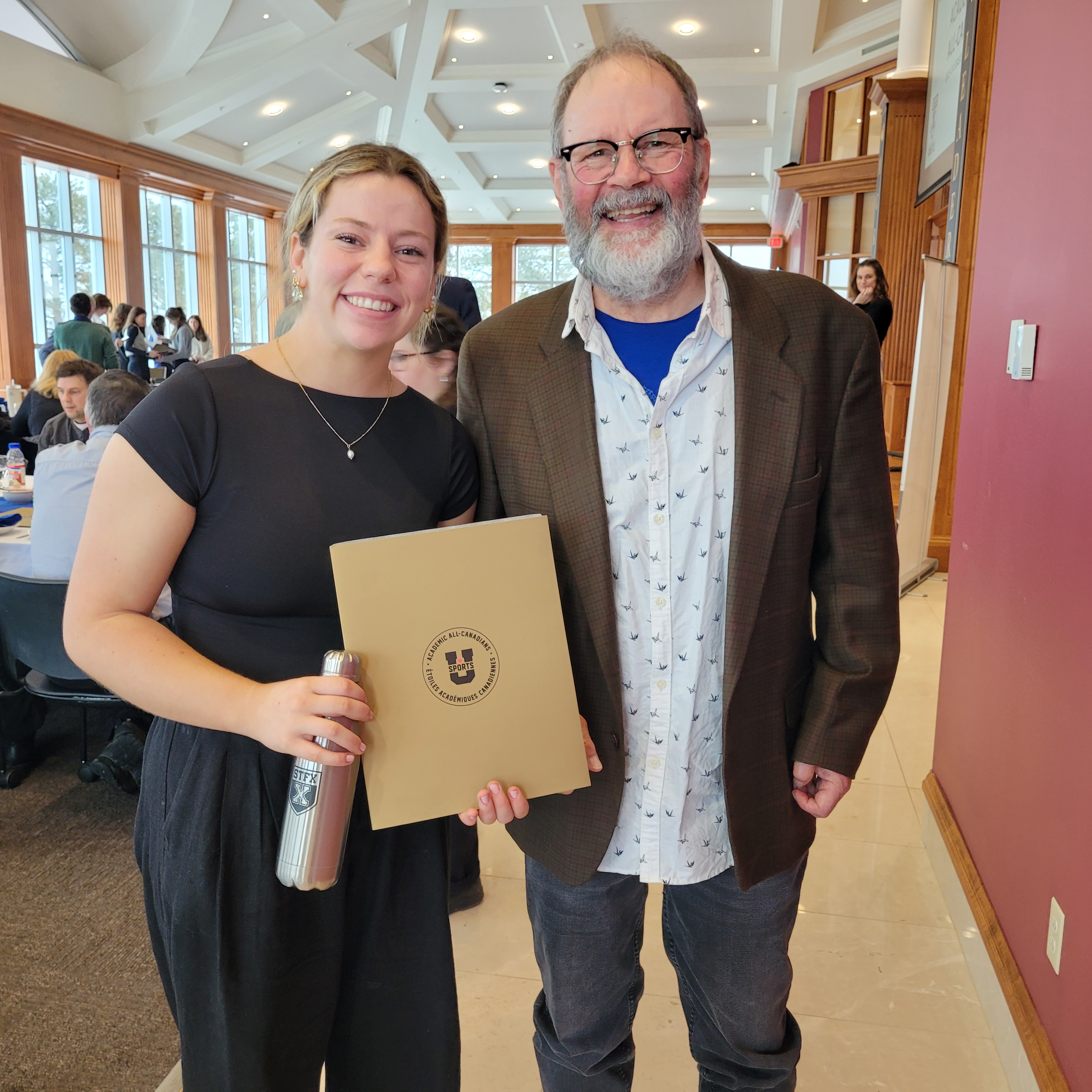
I was privileged last week to be invited by Katie Murphy, a member of StFX’s rugby team who’s been in several of my classes, to attend the Academic All-Canadian Awards breakfast as her one guest. Each Academic All-Canadian is a student athlete who maintains an average over 80% while excelling at their sport. They get to invite one favourite prof to the breakfast. Sara had the honour of being invited too, by another scholar-athlete, Myro Zastavnyy, who plays soccer. He got the highest mark in her New Testament class last term. All went fine, but a trip back and forth to a buffet table with breakfast in hand presents challenges I’ve never had to deal with before. Katie was a great help. She quipped, “once a server, always a server,” as she carried her own breakfast and some of mine back to our table.
Back to Mobility

Recently, I took my first solo drive in four months. As the kind clerk from the Nova Scotia Motor Vehicle Division assured me: “since your medical has come in all clear, there’s no reason you can’t drive right now. Just be sure to take the test again.” I have to retake both my written and road tests before the end of February, or my license will be suspended.

Off I went. It felt great – and a little scary – to be back motoring out in the big wild world all on my own like that. My first independent excursion since September. I took advantage of my first solo trip to head all the way to town to buy a pair of pull-on winter boots. I can now do up zippers fairly consistently (thanks to my friend Ken Wilson‘s gift of zipper pulls). But tying shoes? I managed to do one lace for Sara’s father’s 90th in Moncton. But it took me over five minutes, tired me right out, and even then it was loose. Pull-on boots for now.

I love two things about the photo of my prayer below from Winston Parks’s big birthday. One is that the Mayor of Moncton, Dawn Arnold, is behind me. Sara has admired her for decades, and tagged her in the facebook invitation. It was a privilege to have her there. The other is that two different members of my family, my son Daniel and my sister-in-law Barbara, when they saw the photo on the right, instantly celebrated the fact that I was holding my remarks in my left hand.

Back to the Hospital (as an outpatient)

Twice a week I drive myself to St. Martha’s Hospital. There I spend a half-hour under Jay’s watchful eye: walking on my heels, walking backwards, side-stepping, and doing high leg-lift marching that reminds me of what we used to do in high-school sports practise.

I still don’t have the left-foot strength to walk consistently on my toes, nor is my “normal” gait that smooth. But I’m getting better every week. After physio, my new Rehabilitation Assistant, Janna, takes over and guides me through 45 minutes of hand and finger exercises. I’m VERY fortunate to still be receiving this level of care! (Please, for my sake and yours, never vote for a party that has designs to privatise healthcare any more than some provinces already are!)

Back Home

This weekend, for the first time, I ventured across our driveway to spent an hour “working out” (I use that term gently) in our crowded insulated shed. Before Christmas, my brother and sister-in-law cleared space and set up the recumbent bicycle and the treadmill (from Sara’s parents’ recent move to an apartment) for me. It was great to listen to a podcast and just get my legs going. There have been both mice and a resident squirrel inside that space in the last year. We cleaned it thoroughly last summer and employed many mouse-proofing tactics, but while I pedalled I kept my eye out just in case.

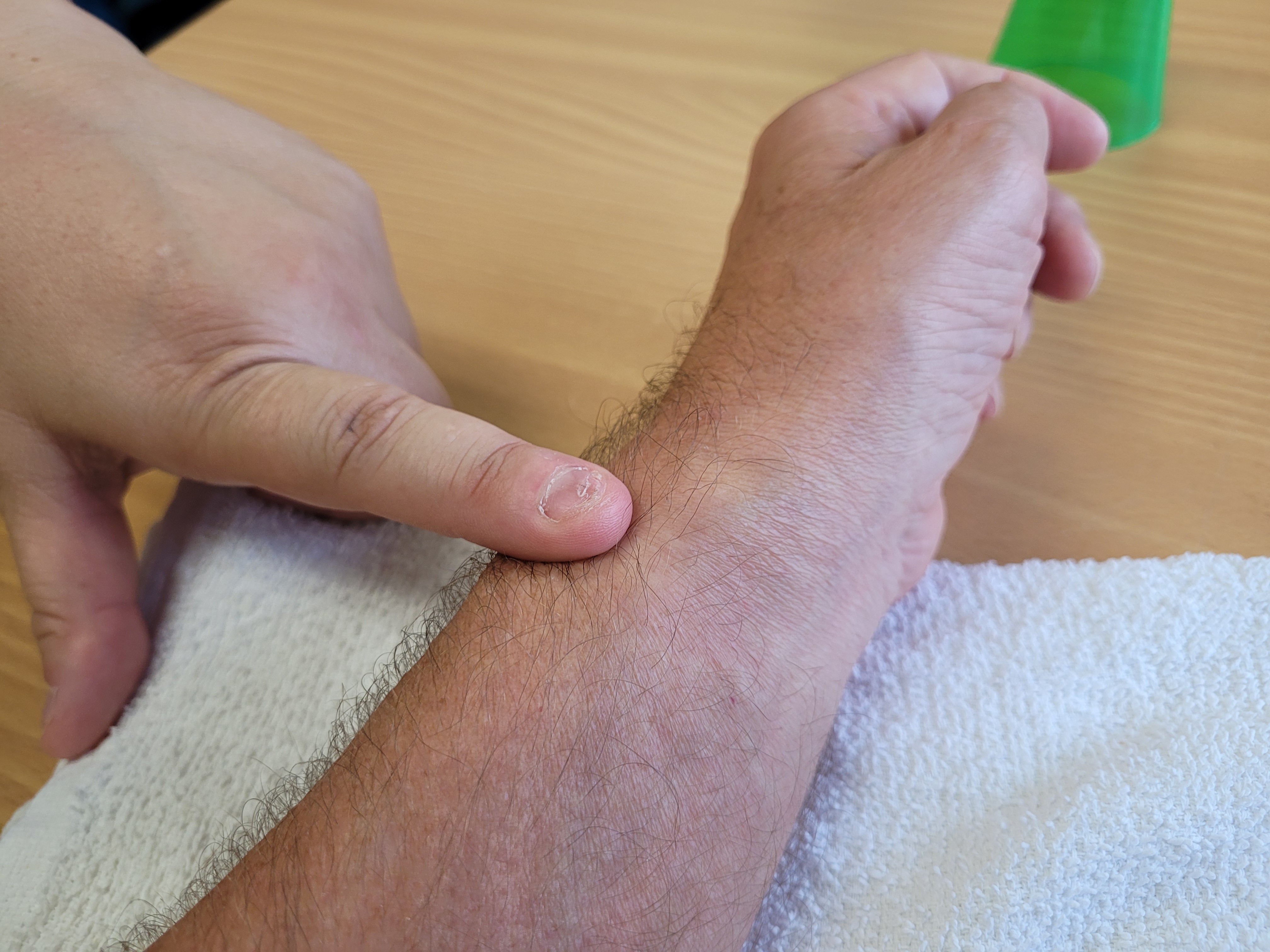
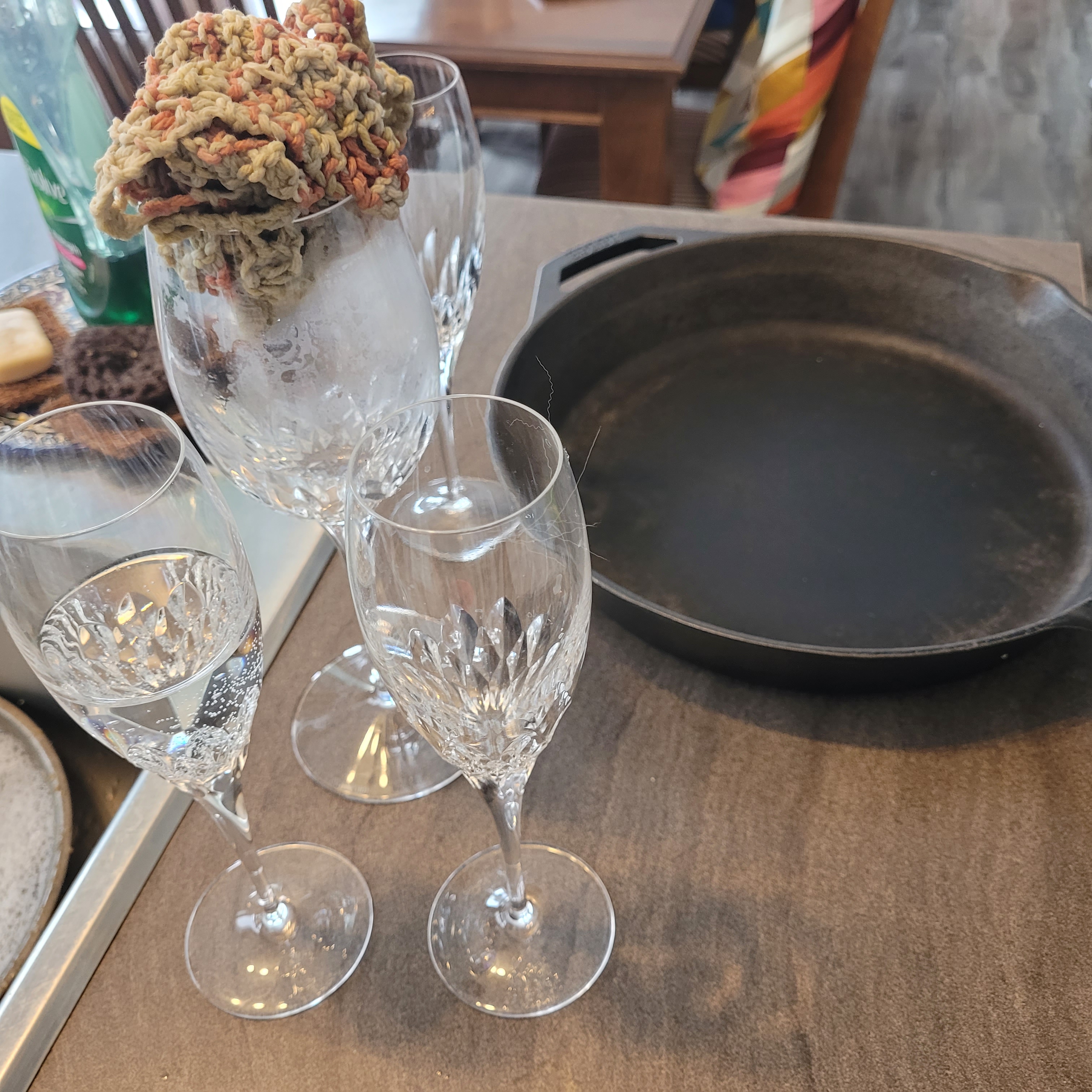
I have a full home physio routine which includes wrist exercises, doing leg lifts and arm raises, and giving my left hand the “TENS” treatment of low-level electrical current at least 30 minutes a day. I can now sometimes pick up pennies off a table with my left hand and drop them into a pill bottle, arm extended. Although I still have to use my right hand to guide my left, I can now make clearer chords on my guitar. You should see me wipe a counter! It’s a messy business. A big part of my home-work is using my left hand as much as possible to do daily tasks. I think it’s funny that as spastic as I am, Sara still trusts me to wash the crystal (and so close to the cast iron).
In some ways, it’s my expectations that are now changing. Rather than being surprised (and overjoyed) simply to be able to move my arm and hand again at all, these days more and more I find myself reaching for something, say a bar of soap, with my left hand without thinking. Then I’m surprised (and slightly disappointed) when my arm won’t extend that far, or my arm won’t straighten or fingers won’t open enough to grab it. My left hand looks and acts rather like one of those arcade claw machines, like in the movie Toy Story.

On my new low-sodium regime, I allow myself to buy these salted veggie-stix on one condition: I’m only allowed to eat them with my left hand!

I can finally, sometimes, extend my arm straight forward in a “cheers” motion. But I would never be able to hold a heavy pint of German beer in that position! I’m lifting a three pound weight for bicep curls and doing tricep work with a stretch band. Laughably light loads, but a start!

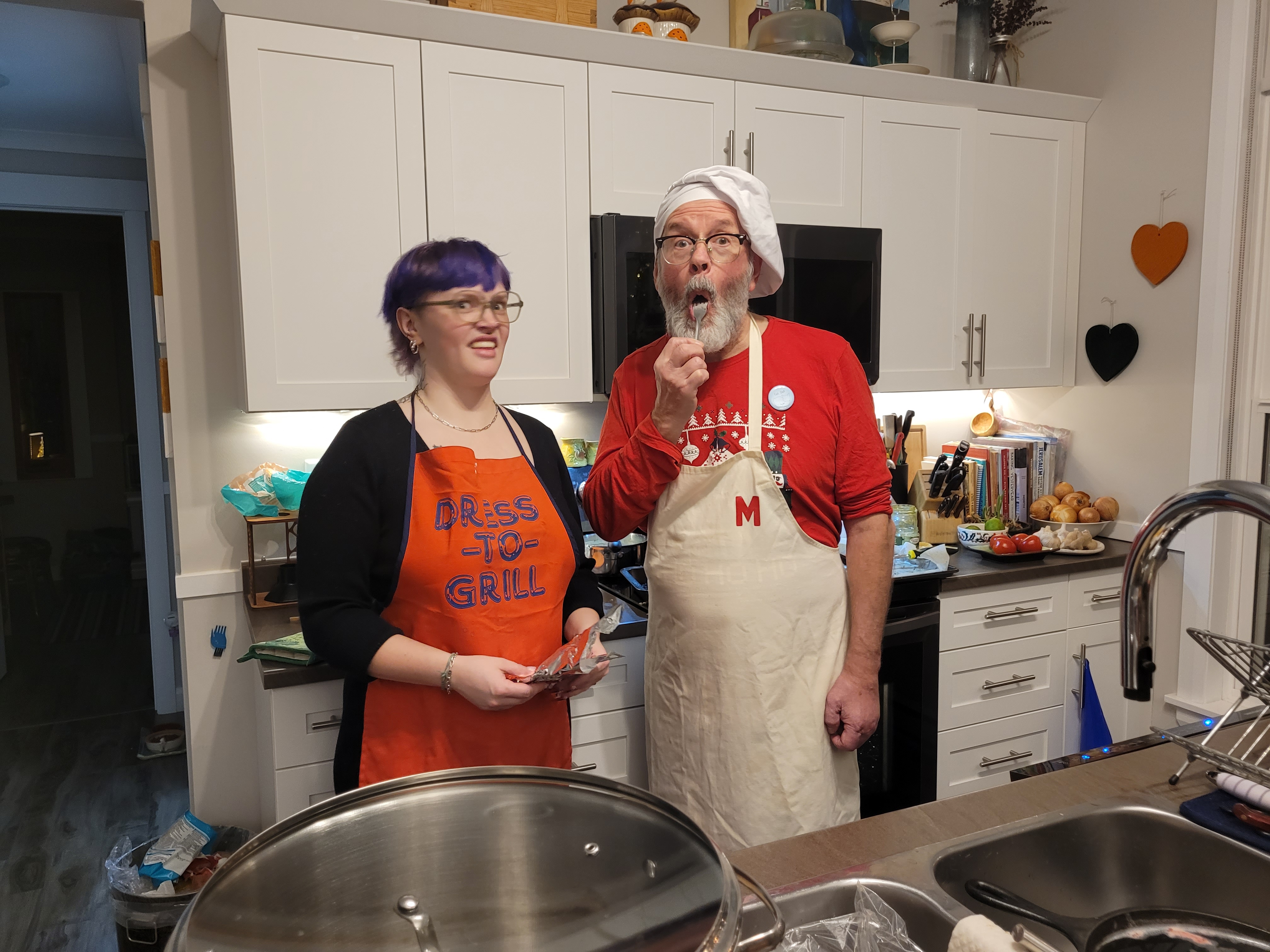
And now that I’m home, I’m noticing some more subtle stroke effects. My eyesight isn’t quite as good as before the stroke. My taste buds continue to be “off” especially around sugars and bread products (that might be the COVID I caught in hospital). And my hearing is slightly, but noticeably, worse…not so much in terms of volume, but when trying to distinguish “t”s, “d”s and the like. I keep reminding myself of how fortunate I am, and how much more damage the stroke might have done. I can use both arms for a hug. That’s worth a lot! And cooking can be the most fun home therapy of all (photo below from my youngest – Gabe’s – visit with us over Christmas, which was a joy). I’m glad that Sara didn’t mind that all my (few) presents for her were from the hospital gift shop!
Back to Writing

All fall in the hospital, it was hard to concentrate on my research project on Jerome with my fatigue, frequent interruptions, and (most welcome!) intensive rehab regime. It was Sara’s suggestion that I use some of my isolation time to get back into writing smaller things, like poetry. I came up with a small collection, which I’m submitting to a provincial competition this week. I can’t share it here (since it must be “unpublished work”), but please keep your fingers crossed for me.

I also turned around the copy-edited proofs for Someone Elses’ Saint: How a Scottish Pilgrimage Led to Nova Scotia, due out in Spring 2025.

My big question mark is typing. If I can figure out a less sensitive keyboard for practise, I’d like to try typing while including my curly-fingered left hand, just to keep those left muscle memories alive. That’s on the to-do list. I sometimes use dictation, but that isn’t the way I am most comfortable composing and the results end up different!

Back to Gratitude

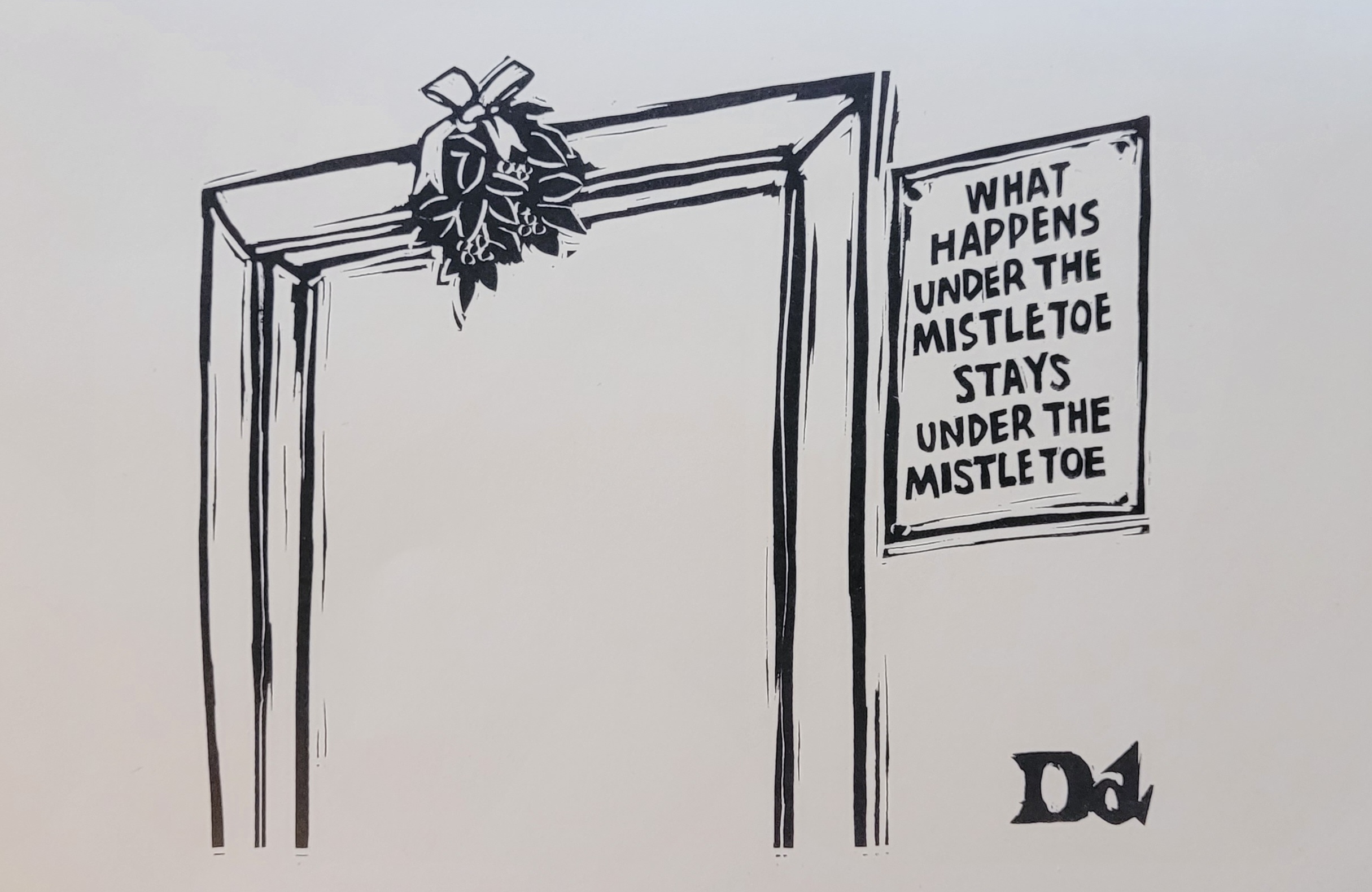
I’m still SO humbled for the ways I was supported all through my time in hospital by so many of you. Thank you! I get rushes of gratitude when I see the cards or when someone contacts me to check on how I’m doing. The postal strike gave us a kind of unexpected blessing, in that here we are in January and I’m still getting cards that were hibernating during the strike. Special recent thanks to Nadine and Phil for the so-very thoughtful box of individually wrapped and labelled goodies, and to George Greenia, who made it an Advent discipline last fall to mail us a steady stream of fun little cards of support, only to have them stack up with Canada Post and arrive all at once this week! Those of you who know George know that in addition to his kind heart he has a cheeky sense of humour. I’ll leave you with one of his mailings as an example!
I was also touched when our friend Amanda texted Sara the week after I got home, to ask, “When is Matthew’s weekly stroke report coming out? Mom and I look forward to it every Sunday.” What a miracle, to write one’s experiences and hopes into the ether, and have them land in the hearts of others.

Categories
Uncategorized

A Room of One’s Own: strokeaversary week 9

I remember walking from Melrose Scotland, to Holy Island, England, in 2013. After some extremely hot and tiring days, the path took me up a 300-metre ascent to a rocky outcrop. (There was also the small matter of a pasture with bulls, which can happen when you have the “Right of Responsible Access” to pastureland–but that’s another story.) At the top I stopped to catch my breath. Turning to see the view, I realised that there on the distant horizon two valleys over, I could make out the ruins of the Roman fort where I’d stopped on my first morning of pilgrimage, two days before.

That’s how this week feels. The pilgrimage through my stroke is hardly over. But this week I’m seeing how far I’ve come. The parallel bars (below) that not so long ago represented the greatest distance I could possibly shuffle are now where I try balancing while standing on my left leg without support. I have more strength in that leg every day. Without use of my left hand and arm to steady myself, my balance is off. But the distance? No problem.

Although the physios aren’t recommending I do this at home, Lee is making me practise climbing stairs one per foot, like you probably walk them, instead of like a toddler does. This week she had me kicking a soccer ball back and forth with her (I had to hold on to a railing for support, but my left leg did quite well.) For the first time since my stroke I did up the button on a pair of jeans on my own. And I might only be able to “bench press” a featherweight aluminum cane. But the simple fact my left arm can even hang on is a major win. And for the first time this week, I could sometimes push my arm straight ahead on a table. “Cheers” is getting closer!

I’m thankful that the newly-conscripted neurons in my brain that agreed to take over the management of my arm and hand are beginning to sort out their new roles. But I have to be patient: I was so anxious to force my wrist to flex in my room that my hand swelled up like a balloon. I suffered painful cramps until it recovered. Sara suggested, since I am so eager to use all my time working on recovery, that I do it in other ways than “extreme boot camp” (as she put it) and instead take some time each day to be consciously grateful to my brain and my awakening left side. It’s great advice, so I’ve added that to my routine.

Lee, who works mainly with my legs, says she’s amazed at my progress. She hasn’t seen this video of me bringing my own tea to the couch at home on my “weekend pass” today, without cane or walker. I’m not sure what she’d think!

When I was watching this video and bemoaning the lack of fluidity in my step Sara reminded me that just six weeks ago it required two people to hoist me out of bed and get me to the washroom. Looking back brings perspective.

There’s no news yet about “Handcamp”…. they’re waiting on word of whether I’m eligible. But I’m booked in Halifax at the end of the month for a preliminary cardio assessment, a first step to the procedure to close the hole in my heart that may have let a clot pass to the brain.

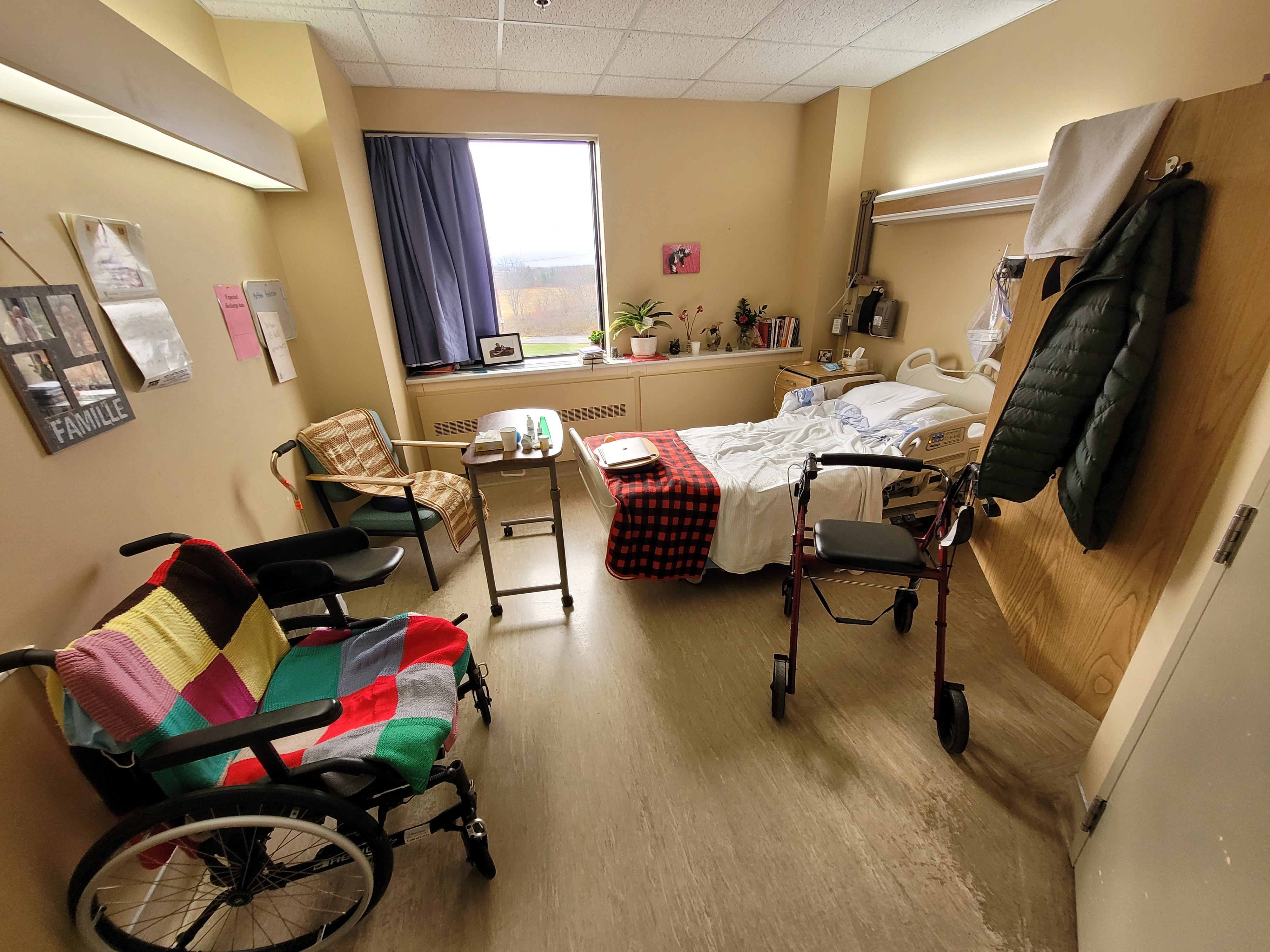
Having a room to myself is making a world of difference. The previous week, with little rest day or night, I was looking “increasingly frazzled and worn,” in the words of one nurse. Now I sleep well most nights. During the day there’s peace, so I can read, listen to CBC, write (working on some poetry), or do my physio. I also feel more comfortable video-chatting with the kids, and I attended my own class by Zoom this week when Elizabeth Castelli graciously came to talk to them about early Christian ascetic women patrons. Now Sara can even bring her meal and share the whole evening, as her schedule allows. From a place of stress, my hospital room has become an oasis for healing.

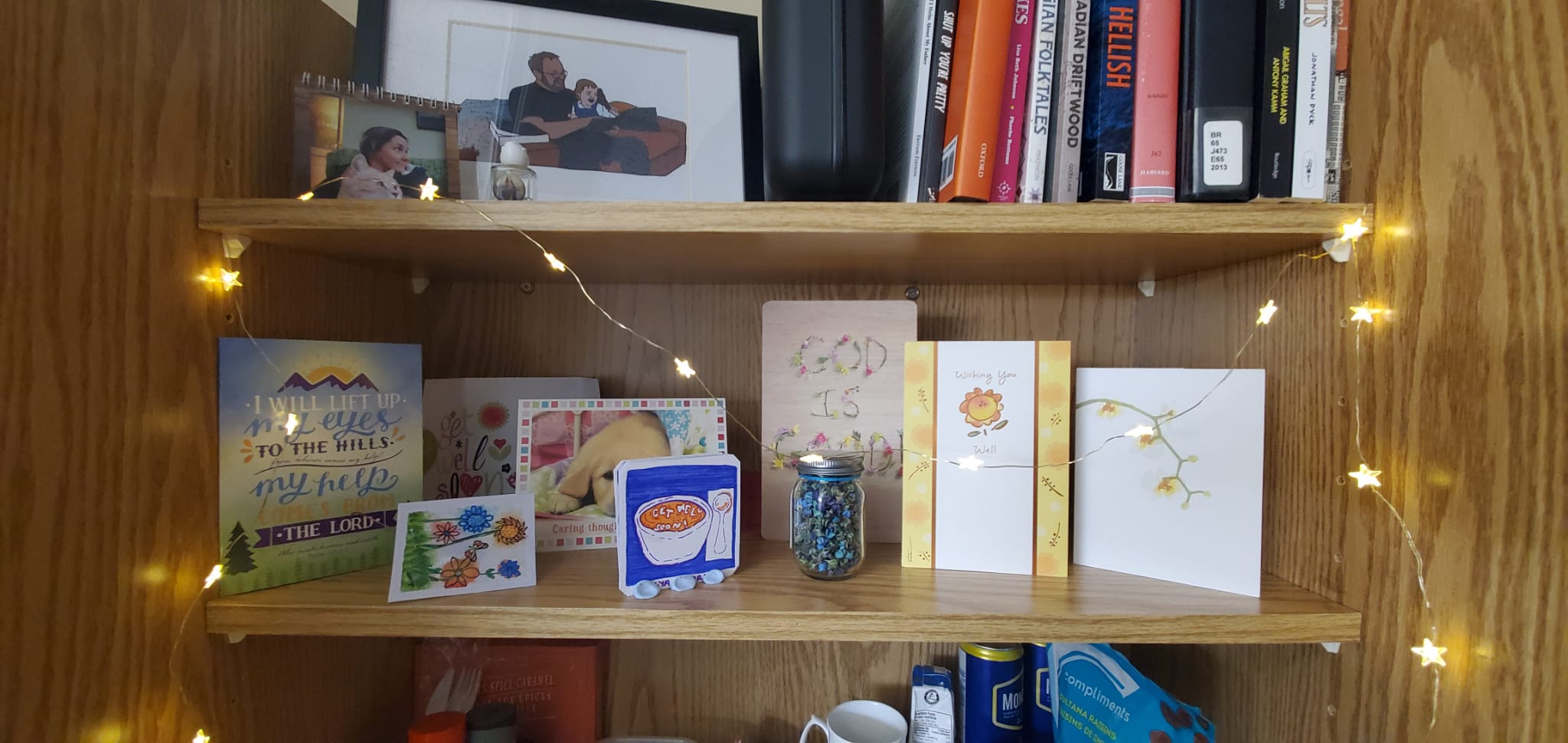
I’m thankful to the physio team – Lori, Lee, Ria, Lina, and Abby – who are so patient with me day after day. They were the ones who pushed for a room where I would get the rest my brain needs to recover. The staff know that my dogged motivation comes from being supported by so many of you. One of the orderlies looked at my shelf of cards and said “well, aren’t YOU well-loved!” That comment gave me a physical rush of warmth and comfort.

Several of you recommended recently that I read Daniel Levitin’s just-published “I Heard There Was a Secret Chord: Music as Medicine.” Coincidentally, Levitin and I had an email exchange last spring, when he asked me something about Prophets of Love: The Unlikely Kinship of Leonard Cohen and the Apostle Paul. We exchanged books by mail. So I’m reading Secret Chord now, and feeling the recuperative power of music every day (see below). I should tell Levitin I’ve had a stroke, and how applicable his research is for me.

That healing power of music is definitely helping release some of the frozenness of my left side. I’ll sign off this week’s update with the clip below, more evidence of how far I’ve travelled with this stroke. I love to dance… and in my own room, now I can. Or better, we can. If you know me, you know this has GOT to be good for my recovery!

[Click here for my podcast about that walk from Melrose, Scotland, to Holy Island.]

Categories
Uncategorized

Leonard and Paul’s All in a Weekend Interview

Last weekend I had the pleasure of chatting with Sonali Karnick on CBC Radio One about “Prophets of Love: The Unlikely Kinship of Leonard Cohen and the Apostle Paul.” You can find the interview HERE. Sonali is a wonderful interviewer! We’ve chatted so many times that it felt to me a bit like a quick convo with a friend about my latest news. I hope you enjoy our visit as much as I did!

Categories
Uncategorized

Our Own Green Acres

Have you heard of the 1960s TV comedy series “Green Acres”? It starred Eddie Albert as Oliver Wendell Douglas and Eva Gabor as Lisa Douglas. Oliver and Lisa were a socialite New York City couple who moved from their urban penthouse apartment in Manhattan to a run-down place in the country to fulfill Oliver’s dreams of being a farmer. Oliver would drive the tractor wearing a suit and tie, and Lisa did chores in lace nighties or designer dresses while wearing her pearls. The locals were anything but yokels, and a lot of the plotlines revolved around Eddie getting himself into some pickle and having to be bailed out by bemused neighbours and their advice. (For those interested in such things, there was an interesting subplot with the locals and Lisa being able to hear the theme music and credits, while Eddie was blissfully unaware).

I barely remember the show. But it must have stuck somewhere. More than once this last year, while out trimming bushes or picking up wood or fixing a mower I’ve found myself humming “Goodbye city life, Green Acres we are there.”

Our two acres in Pomquet Nova Scotia (Mi’kma’ki territory) has no run-down century farmhouse, but a Kent mini-home. But after decades of living in Montreal, Nottingham, and Dublin, what I see when I look up is as different from the storefronts and sidewalks and constant traffic I’d grown used to as Green Acres was from the Big Apple. Here, the nights are quiet and dark – so still you can sometimes hear the blood in your ears. Two packs of coyotes often sing across the river to each other at dusk. On afternoon “golden hours” the light suffuses our marshy inlet, turning trees and water into some kind of Flemish Renaissance painting. The big excitement now is not a new café or a street festival, but five blue herons at once, a bald eagle low overhead, or the day we spied a pair of puffins in the salt marsh. Or eggs left on our doorstep by the neighbour, so fresh they’re still warm.

“Next year we’ll harvest some of those.”

From not owning a car for over twenty years, we now have two. Our bikes, once our main mode of commuting, sit idle, but we spend more time than we’d like on the ride-on mower. I’ve had to re-remember habits I’d forgotten: how to brace a gas can so it doesn’t tip over in the trunk, how to file the points and clean up a spark plug, changing oil, raking and shovelling and planting. How to safely burn brush, and the best way to cook sausages over the embers. I haven’t consulted a bus schedule in months – but we check the wind speeds and rainfall every day.

A year ago this month, when we moved back to Canada and first saw this land, there were ripe chokecherries filling the bushes along the driveway. We had five suitcases, our cat Sweet Pea, and each other, but nothing else. “Next year,” I told myself, “Next year we’ll harvest some of those.”

Things always happen more slowly than one would like. In just one year we haven’t even scratched the surface of our dreams and “druthers”. But this week I made chokecherry jelly. Plenty of mosquito bites went into getting those berries. But that first bite of a fresh roll with chokecherry jelly was just about perfect. These really are “green acres.” And we really are there.

Categories
Uncategorized

Matthew Anderson appointed part-time Director of Camino Nova Scotia!

(by Dr Rob Fennell AST)

Atlantic School of Theology is pleased to announce the appointment of Rev. Dr. Matthew Anderson as the new Director of Camino Nova Scotia!

Matthew is a professor, podcaster, filmmaker, the author of three books, a Lutheran minister, and a pilgrim with thousands of miles on his boots. In 2015, he helped inaugurate annual treks across Treaty territories on the prairies with Indigenous guidance, and from 2014 the first Old Montreal to Kahnawà:ke Mohawk Territory pilgrimage for students. His podcast “Pilgrimage Stories from Up and Down the Staircase” is on all your podcast platforms.

This summer, Wood Lake Publishing releases Matthew’s newest book, Our Home and Treaty Land: Walking Our Creation Story (co-written with Dr Ray Aldred). Matthew’s pilgrimage blog is at https://somethinggrand.ca. There you can also find his documentary on the Camino de Santiago.

The appointment begins immediately

Matthew is excited to be moving with his wife Dr Sara Parks to the North Shore of Nova Scotia, and can’t wait to explore the land and meet other pilgrims with Camino Nova Scotia! His appointment begins on June 27, 2022.

Atlantic School of Theology and Camino Nova Scotia are grateful to the Province of Nova Scotia’s Department of Communities, Culture, Tourism and Heritage for funding that has made possible Matthew Anderson’s appointment and the expansion of Camino Nova Scotia, for the benefit of all Nova Scotians and visitors to Nova Scotia. We are also grateful to the Office of Gaelic Affairs for its ongoing support of Camino Nova Scotia: Slighe nan Gàidheal | Gaels’ Trail.

photo from Camino NS Cape Breton pilgrimage

(header image credit: image mrbanjo1138 Flickr Creative Commons)

Categories
Uncategorized

On the Benefits of Walking

Photo of walker Harold Steppuhn, by Matthew R Anderson

A friend asked if I had any recommendations for books or articles on the benefits of walking. Do I? Of course–too many, as I discovered when trying to make a list! So here, for others who may be interested, is a very partial catalogue (under construction) of books and articles in English or translated to English. Some are about specific paths or trails, some are thematic, some meditative, some memoir, some scientific, and many have more than one of these ingredients. My favourite books in this genre combine memoir, humour, historical reminiscence, and observations about walking. So that’s what I’ve also tried to write.

Solvitur ambulando: it is solved by walking

Some suggestions

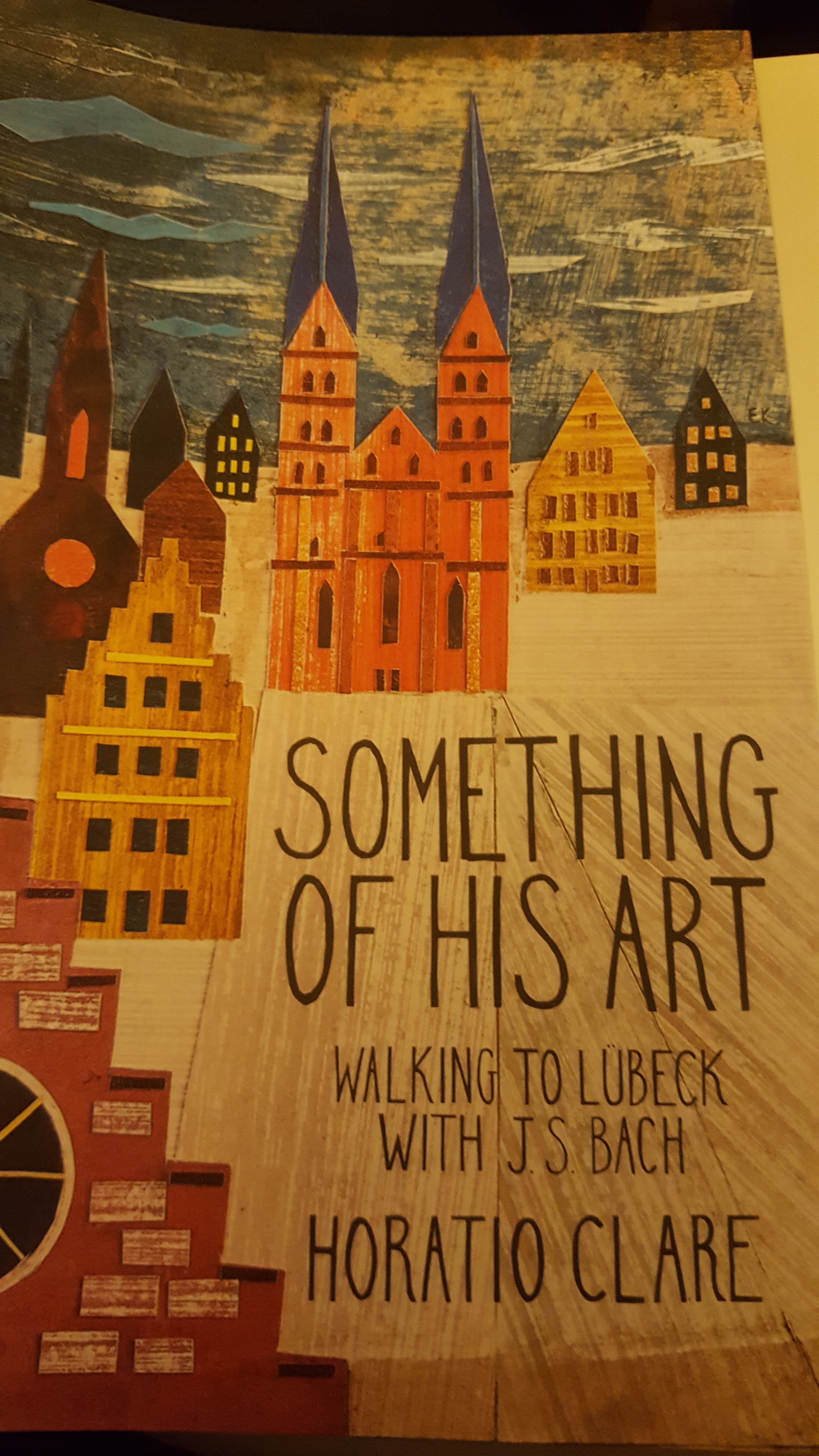
Horatio Clare, Something of His Art: Walking to Lübeck with J.S. Bach (Dorset: Little Toller, 2018). Nice BBC-style writing (there are podcasts of this as well) about following Bach’s footsteps through paths.

Linda Cracknell, Doubling Back: Ten Paths Trodden in Memory (Glasgow: Freight Books, 2014). Good memoir of esp Scottish trails, combined with travelogue and literary commentary. Available (through a new publisher) on Amazon.

Annie Dillard, Pilgrim at Tinker Creek (San Francisco: Harper and Row, 1974). In some ways, this book helped start the “new nature writing” and its emphasis on walking. Or it picked up on Thoreau, since it’s really about walking and observing in a small area. A classic.

Dwayne Donald, “We Need a New Story: Walking and the wâhkôtowin Imagination,” Journal of the Canadian Association for Curriculum Studies (JCACS) La Revue de l’association canadienne pour l’étude du curriculum (RACÉC) Vol. 18, No. 2, (2021): 53-63. Focusses from nêhiyaw (Cree) perspective on the uses of walking as a way of changing things, including attitudes and history of settlement.

Nancy Louise Frey, Pilgrim Stories: On and Off the Road to Santiago (Berkeley: University of California Press, 1998). This entertaining, well-written book is specifically about the Camino de Santiago as “therapeutic walking”

Frédéric Gros, A Philosophy of Walking (New York: Verso, 2014). Gros focusses on the history of walking and philosophical thinking.

M. Brennan Harris (2019) “The Physiological Effects of Walking Pilgrimage,” International Journal of Religious Tourism and Pilgrimage: Vol. 7: Iss. 1, Article 9. doi:https://doi.org/10.21427/q6de-av43 Available at: https://arrow.tudublin.ie/ijrtp/vol7/iss1/9. Pretty much what it says, and interesting from an exercise scientist’s point of view.

Trevor Herriot, The Road is How: A Prairie Pilgrimage through Nature, Desire, and Soul. HarperCollins, 2014. I know Trevor and have walked with him. He’s a good writer and a keen observer of humanity and nature, and passionate about the environment and justice for Indigenous peoples.

Werner Herzog, Of Walking in Ice. Translated by Martje Herzog and Alan Greenberg (Minneapolis: University of Minnesota Press, 2015). Short and interesting, this account details Herzog’s journey north on foot to visit a supposedly dying friend.

Erling Kagge, Silence in the Age of Noise (New York: Pantheon, 2017). (translated from the Norwegian). Lovely reflection, on the meditative aspects of walking.

Gideon Lewis-Kraus, A Sense of Direction: Pilgrimage for the Restless and the Hopeful (New York: Penguin/Riverhead, 2012). Details three different pilgrimages including Hasidic pilgrimages, in extremely well-written, urban “New Yorker” style. Emphasis on the “restless” part of the title.

Robert Macfarlane, The Old Ways (London: Penguin, 2013). The prototypical English countryside walking book. A classic must-read of the genre, about the English countryside, full of interesting and educational asides.

Lisbeth Mikaelsson, “Pilgrimage as Post-secular Therapy.” Scripta Instituti Donneriani Aboensis 24 (2014): 259–273. Pretty much what it says, as academic treatment.

Robert Moor, On Trails: An Exploration (New York: Simon and Schuster, 2016). An entertaining and well-written general exploration, tending toward the environmental and natural place of walking, rather than the historical.

O’Mara, Shane In Praise of Walking (Bodley Head, 2019). Haven’t read this yet but absolutely will, since it’s by a fellow Dubliner. From a neuroscientist!

Thelma Poirier, Rock Creek (Regina SK: Coteau Books). Poetic explorations of land and history from Poirier’s three day walk to the source of the creek in Wood Mountain. In the tradition of Nan Shepherd and Annie Dillard.

Nan Shepherd, The Living Mountain (Aberdeen: University of Aberdeen Press, 1977). A classic meditation on place and our longing for connection to the natural world, set in the Cairngorm Mountains, Scotland. Walking-and noticing-locally.

Leanne Betasamosake Simpson, As We Have Always Done: Indigenous Freedom Through Radical Resistance (Minneapolis: University of Minnesota Press, 2017); See chapter 9 “Land as Pedagogy.” From Anishinaabe perspective, on land as teacher (walking has a place but secondary, in this treatment)

Rebecca Solnit, Wanderlust: A History of Walking (New York: Penguin, 2000). I still think this is the greatest book of this genre, by a fantastic, insightful, author concerned not only with walking but also with justice.

Solnit, A Field Guide to Getting Lost (New York: Penguin, 2005). Great, but not as good as Wanderlust (or maybe I just compare everything to that).

Thoreau (need I say more?)

Edmund White, The Flâneur: A Stroll Through the Paradoxes of Paris (New York: Bloomsbury, 2001). Interesting for being a perspective about the history and philosophy of urban walking.

Raynor Winn, The Salt Path. (London: Penguin, 2019). More on a specific set of English historic paths, with general observations about walking.

There are LOTS of popular articles about the benefits of walking. A smattering, in no particular order:

https://www.health.harvard.edu/staying-healthy/5-surprising-benefits-of-walking

https://www.theguardian.com/lifeandstyle/2019/jul/28/its-a-superpower-how-walking-makes-us-healthier-happier-and-brainier (based on the book In Praise of Walking by Shane O’Mara; there is a BBC podcast featuring this writer here: https://www.bbc.co.uk/programmes/articles/51SPhn5FKSYRnQNswfnWsN2/8-reasons-why-we-should-all-walk-more )

And last but not least, Matthew Anderson (that’s me!!) The Good Walk. A memoir of how we launched the long-distance pilgrimages that Canadians and Indigenous folks have been taking almost yearly since on traditional trails across the prairies. I’m looking for a publisher!

Categories
Uncategorized

Pairings: Drinking Cider in the Garden of Eden

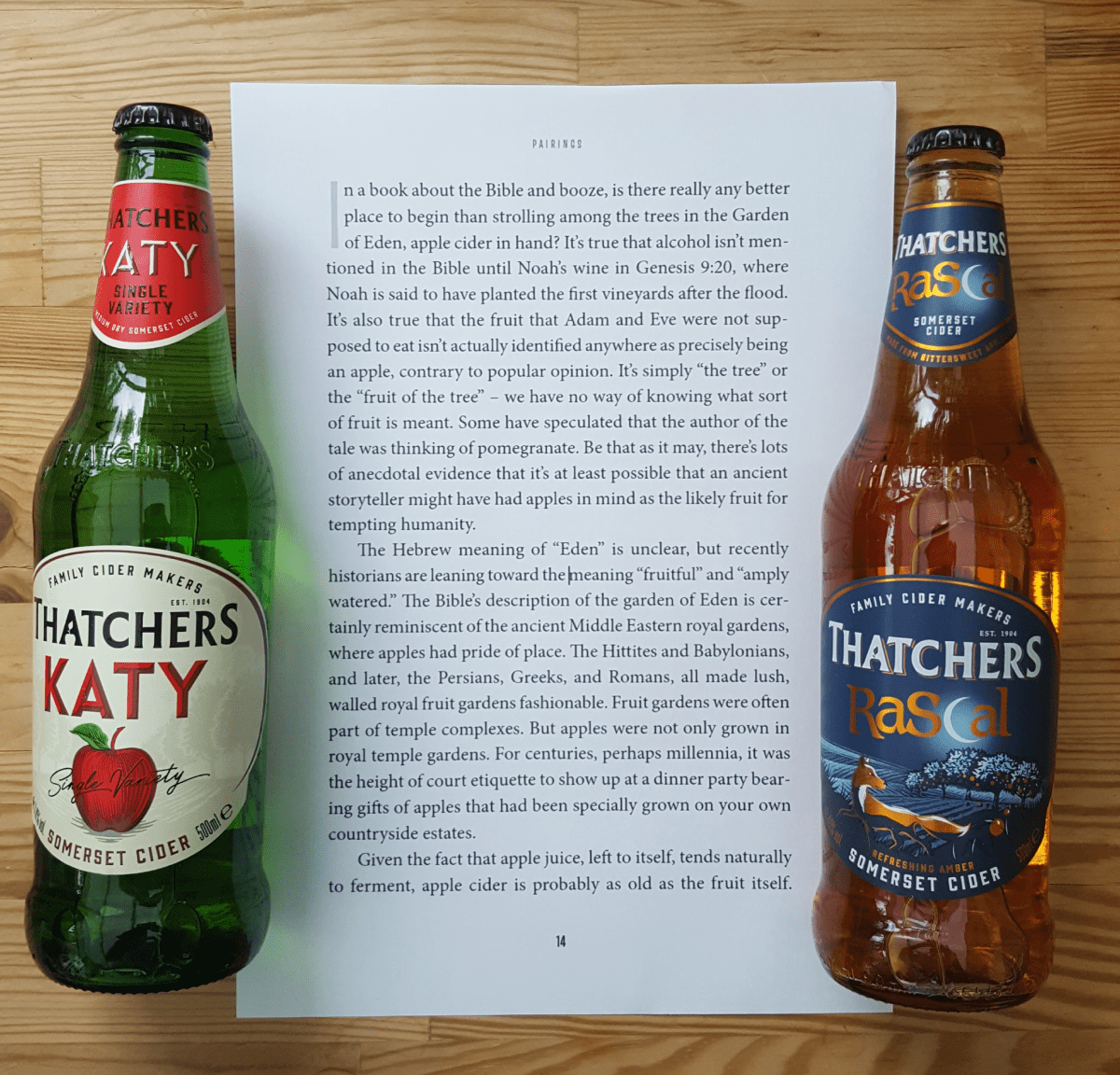
You can find a good cider almost anywhere apples are grown, but England has some of the best. In today’s post, I’m serving up these two Thatchers ciders—Rascal and Katy—with a sampler from chapter one of my book Pairings: The Bible and Booze. Why this pairing? Two simple reasons:

1/ “Rascal” is yet another in a steady stream of apple cider branding that portrays the product as “sinfully good,” “temptingly tasty,” and “devilishly delicious.” Notice a theme here? Without necessarily mentioning the Garden of Eden, many cider companies rely on advertising and logos that “tap into” images of apples and temptresses that we think are from Genesis. But are they really biblical? This brings us to the second cider…

2/ “Katy” is the name of one of the biblical scholars I quote in the chapter – Dr Katie B. Edwards, Hebrew Bible specialist, BBC broadcaster, and author of Admen and Eve: The Bible in Contemporary Advertising. In Admen and Eve, she shows how Eve has been so consistently portrayed in art and in advertising as a “femme fatale” that we forget that that’s NOT how she’s actually portrayed in Genesis! There are many other ways of reading the story of the Garden of Eden without linking an apple (iffy) with Eve as solely responsible for original sin (look to the Church Fathers for that one).

Katie was kind enough to write an endorsement for the back cover of Pairings.

You can read more about Genesis 2-3, Katie, and the secret history of apples, in chapter one of Pairings: the Bible and Booze, “Low-Hanging Fruit: Apple Cider and the Second Creation Account.” Each chapter of the book pairs a specific drink with a specific biblical text. Chapter one pairs the Genesis creation accounts with either a fermented cider, like one of these Thatchers, or an alcohol-free farmer’s market cider, like the ones you can buy from Rougemont Quebec, or in the Okanagan, or the Niagara Peninsula, or the Annapolis Valley.

Order your copy at https://en.novalis.ca/products/pairings !

Categories
Uncategorized

Walking to Lübeck

On the recommendation of Ken Wilson, I’m reading Something of his Art, a 100-page book by English-Welsh author and broadcaster Horatio Clare about a walk from Arnstadt to Lübeck, Germany. In October 1705, at the age of 20, a rebellious young Johann Sebastian Bach headed north on foot to pay a surprise visit to the elder organist and Baroque composer Dieterich Buxtehude. Clare and two others from the BBC recreated that walk, also setting out in the fall. The record of their trip – you can listen to a BBC podcast series about it – contains Clare’s reflections on everything from Bach’s temperament (students of the day carried rapiers to defend themselves) to ways that the autumn countryside – and our world – have changed because of climate degradation.

Ken loved the book; he told me I would too. He was right.

Clare walked 230 miles, roughly the distance we’ve covered in our treks on Treaty Four and Treaty Six territories. I’ve had the pleasure of singing works by both Bach and Buxtehude in various choirs over the years. And I’m a Lutheran, affected by years of hearing Bach, and by some of the same theological worldviews that inspired the composer.

But you don’t have to be musical or a Lutheran (or even a walker) to love this book: Horatio Clare is a rare treasure of an author. His rich descriptions will have you hearing the sound of their feet “through thick cushions of beech leaves, gold and bronze and red,” and seeing Lower Saxony “intricate and melancholy in the rain.” You’ll learn about Bach. More than that, you’ll find yourself walking along Thuringian trails greeting local farmers, or entering old-town Erfurt in the golden twilight. Anyone who has ventured on long treks will feel a thrill of recognition in Clare’s words: “Coming into town as night falls is a wonderful feeling after a day’s walk. You move through the streets, your eyes sharpened by the length of the day’s views, your feet tired and your muscles worked, alert and fatigued at once.”

Categories
Uncategorized

How the Meaning of a Pilgrimage Never Stops Changing (even when the walk is over)

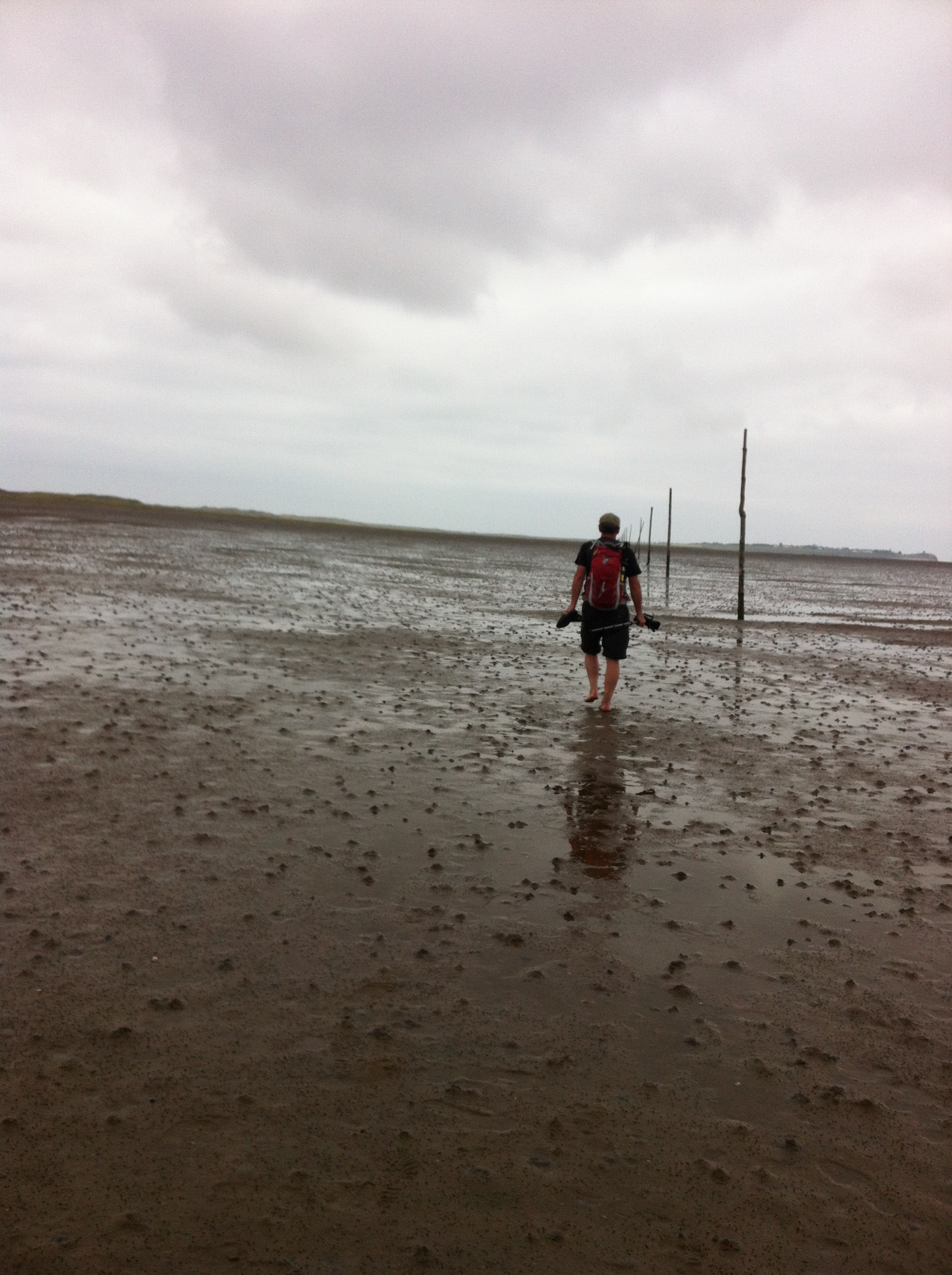
Have you ever had nagging doubts about whether you behaved properly at some event? Or thought back on an experience, only to realize you now think about it in an entirely different way than you once did? It can happen in pilgrimages too. It was enlightening to check back with Ásta Camilla Gylfadóttir about our 2016 trek with her and a group of other Icelanders from Bær to Skálholt. I’ve been worried that with our English-language needs and our massive tourist luggage we eight Canadians “spoiled it” for the Icelanders that year. But for Milla, our walk is only a bright memory. For her, the fact that there were Canadians along on the Pílagrimar only made it better. I can’t tell you how liberating our recent Zoom chat turned out to be.

Gabriel from back making wings day twoWhich makes me realize once again that there are many parts to a walking pilgrimage: the journey is only one of them. A big part of any pilgrimage is narrative: the stories that gave rise to the pilgrimage (at Lourdes, for instance, the Marian appearance to Bernadette), but also the stories that come out of the experience of the pilgrims. Like the dozens of crutches left in Brother André’s chapel at St Joseph’s Oratory, Montreal, or the hundreds of pilgrim blogs, videos, books, and poems arising from the Camino de Santiago in Spain, these later stories “layer on” to the original narratives, making the original journeys richer, more complex, and more about the present. A pilgrimage stays ever-present – and ever meaningful – in its re-telling and sharing. For that I’m thankful.
My pilgrimage podcast is now available on Spotify and on TuneIn, as well as Apple Podcasts (some episodes missing) and it’s hosted on Podbean!

Iceland from inside church day one

Categories
Uncategorized

Meeting Saint Clare on the way to Holy Island

I just posted the second episode in my podcast series “Pilgrimage Stories from Up and Down the Staircase”! In these 20 minutes you come along for the first part of the walk along the St. Cuthbert Way from Melrose Scotland to Holy Island, England. You’ll meet Chris and Clare, and find out why she’s Saint Clare, to me. I hope you enjoy the show, which you can find on Podbean here, and on Apple podcasts, here!

walking to Holy Island