Categories
Uncategorized

Things You Wish You Hadn’t Said on Radio from Iceland

Iceland troll head by falls
My short TV appearance on Icelandic TV, filmed at the end of our walk (at the end of the report in Icelandic)
http://www.visir.is/-gengu-berfaett-sidasta-spolinn-i-pilagrimagongu-/article/2016160729463
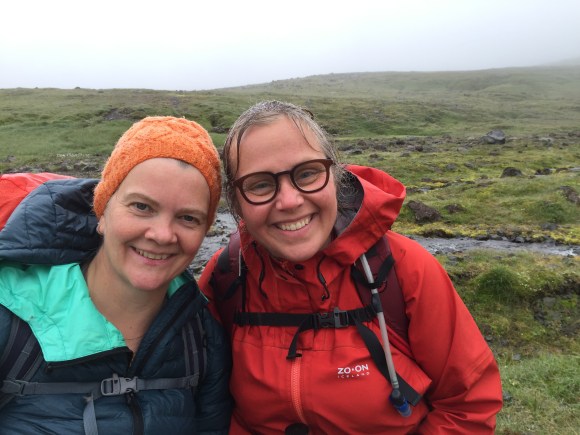
I was feeling somewhat exhausted when CBC Radio One’s All in a Weekend called me on the trail for a follow-up interview while we were high up on ‘bone-breaker’ trail after having been briefly lost in the clouds (by the way, Gabriel had to shout out to me how to say “bye” in Icelandic, but they cut that part). The “troll” comment was a reference to the big, happy rock-and-roll guy! #thingsyouwishyoucouldtakeback

http://www.cbc.ca/news/canada/montreal/programs/allinaweekend/a-walk-across-iceland-1.3692927

There was also an earlier interview on CBC radio about Iceland, just before leaving:

http://www.cbc.ca/news/canada/montreal/programs/allinaweekend/pilgrimage-to-iceland-1.3692347

Concordia (and theological studies) has been getting some good coverage out of the 2016 Icelandic pilgrimage!

Categories
Uncategorized

Fresh Trout after the Prestergatta


Day two of our pilgrimage through Iceland: We’re sitting, eight Canadians and ten Icelanders, at one long table. Our host, Hulda Gudmundsdottír, who has put us in her renovated barn (barn being a word that hardly describes the luxury of the place) comes around as we finish our meal of lake trout, potato salad and greens. Did you like the fish? She asked. I went out and caught it with my son in nets, three days ago.

The fish is only one of the wonders of this place. Elínborg Sturludottr led us along the prestergatta today, the priests’ path from the small church where we had our matins (morning devotions) to the even tinier church where we had our vespers (evening devotions). Our other priest guide, Floki Kristinsson tells us that the morning church was built on the site where Rudolf, the English monk who had accompanied St Olaf up to his death in 1030, came that same year to Iceland and started the first monastery. The Icelanders are a fun group, their humour in contrast to the starkness of this land. For the first time today, we came across what we Canadians call real trees. The Icelanders told us: what do you do if you’re lost in a forest in Iceland? Stand up. At which they laughed uproariously. We climbed up and out of the fjord this morning, 1000 feet, and came down the valley to this beautiful lake setting. In passing we were offered an unexpected afternoon coffee and some sort of sweet flatbread, by an Icelander who is interested in our pilgrimage. This place, including the people, is truly a place of wonders.

An extra treat on this blogpost: fellow pilgrim, Ásta Camilla Gylfadóttir, reads a short Icelandic folktale titled: The church builder at Reyn. Click on this link for her lovely diction and accent!

July 20 afternoon coffee
July 20 afternoon coffee traditional Icelandic cottage
Categories
Uncategorized

CBC Interview on Icelandic pilgrimage

turning at the crater

July 2016 interview with CBC Radio One Montreal show ‘All in a Weekend’ hosted by the gracious and thoughtful Nantali Ndongo, about my pilgrimage to Iceland: http://www.cbc.ca/news/canada/montreal/programs/allinaweekend/pilgrimage-to-iceland-1.3692347

Categories
Uncategorized

Jihad and I on Pilgrimage

2016-06-04 13.55.39

It’s been over a month now since I joined Prof Sara Terreault and her class for the third annual pilgrimage between Montreal and Kahnawake Mohawk Territory. The students were fantastic – interesting and interested, willing to learn and to dive into anything (even, sometimes, the water). Jihad T was a student in the class and was gracious enough to join me for two interviews, one in French on Radio-Canada (see the “interviews” link above) and the other in English, on CBC One’s ‘Home Run’ program. Thanks to M, who made the interview available to us! Have a listen! 

Categories
Uncategorized

Crossing the Line

clouds and direction sign over SC SK

“Well, you know, it’s just across the Line,” my aunt said to me, about a town in North Dakota that my cousins were visiting. I haven’t heard that word for a while. In Montreal they don’t use it. But I grew up in Saskatchewan hearing it. “The Line”. Do you know where that word for the US border comes from, I asked my aunt? “No idea,” she answered.

Today is national aboriginal day. The 20th such day, and the first since the Truth and Reconciliation Commission issued its recommendations. Though it’s a small thing, one of the things we who are Settlers can do to mark this day is to remember where some of our words come from. They’re signs of a history willfully forgotten.

I grew up in Treaty Four land – except there were no “Indians”. The First Nations were, for me, like the ancient Egyptians: important people no longer around. What I DIDN’T know, because it wasn’t in my schoolbooks or taught in my classes, or talked about by my parents or grandparents, was that the original inhabitants had only been gone 85 years or so when I was born. The big secret I learned only years later was that they had been pushed off the land they had just signed title to, to make way for people like my grandparents and me.

Using the word “The Line” for the border is a relic of the days not so long ago when the 49th parallel was called “The Medicine Line” by the First Nations, especially the Lakota. They could cross it and the American Army, who were fighting a vicious battle with them south of the border, would not follow. This was good medicine, and at the time, the Canadian government was generally respected for such protection. Soon enough, our government starved the Lakota back south, and pushed the so-called ‘Canadian Indians’ north by starvation, an intentional policy to make an “Indian-free” land-belt for the railroad and its Settlers.

When we say “the Line” for the border, we echo those days. Even better, then: let us actually remember them – with honesty, apology, and intent to make good what was wrongly done.

Categories
Uncategorized

Mirror-Pilgrimage Day

Paroisse St-Lambert angels
photo: M. Anderson, Paroisse St-Lambert, 2016

Today is mirror-pilgrimage day. There are many forms of pilgrimage. But what most people think of is fairly straightforward: 1. travel to some holy place, 2. receive a benefit, and  3. return home, changed, usually with 4. tokens of the visit.

Not today. This is a strange day, at least in Christian tradition. Yesterday was Good Friday, the remembrance of Jesus’ crucifixion. Tonight’s Vigil and tomorrow morning’s Easter Sunday are all about resurrection. But there are some missing hours there. What did Jesus do in between?

The Jesus Testament (I stole this term from my friend Allen Jorgenson) is strangely quiet about this dark, in-between, un-day. Jesus-believers eventually came up with the doctrine of katábasis, the so-called descensus ad inferna – the descent to hell. To me it’s the perfect mirror-pilgrimage: 1. Jesus, the ultimate pilgrim, travels not to the place of holiness but to the place of ultimate UNholiness. There, instead of receiving a benefit from some saint’s surplus of merit, the tradition is that 2. Jesus shared the benefit of his own, breaking the walls of hell and liberating all the captives of Satan. And instead of bringing back a compostela in 3. the resurrection, 4. Jesus’ pilgrim badge, his keepsake, was the long train of ‘souls’ he brings back with him on Easter morning.

Mirror-pilgrimage day. Don’t go out and buy a card. As a new holiday I don’t think it has a lot of traction. But it’s an interesting thought.


Categories
Uncategorized

And I Have Felt a Presence

2015-07-26 10.57.57

For I have learned

To look on nature, not as in the hour

Of thoughtless youth; but hearing oftentimes

The still, sad music of humanity,

Nor harsh nor grating, though of ample power

To chasten and subdue. And I have felt

A presence that disturbs me with the joy

Of elevated thoughts; a sense sublime

Of something far more deeply interfused,

Whose dwelling is the light of setting suns,

And the round ocean and the living air,

And the blue sky, and in the mind of man


(William Wordsworth, Tintern Abbey, July 13, 1798)

Categories
Uncategorized

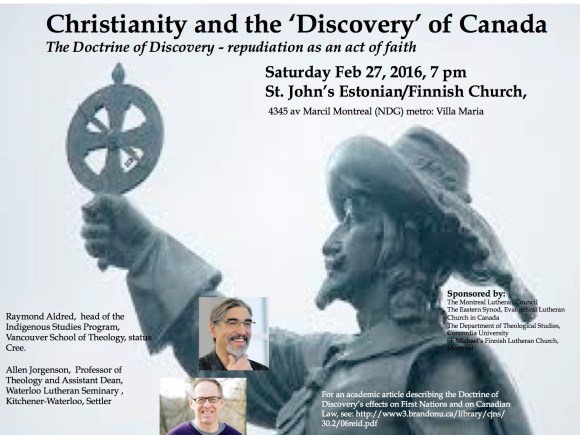
Repudiating the ‘Doctrine of Discovery’

Coming in February 2016. Watch for more details!

poster one JPEG version

Categories
Uncategorized

Miss Lily’s Cafe

2015-11-26 16.44.41

The man who met us at the screendoor to Miss Lily’s Cafe was in his late 40s perhaps, wearing a tee-shirt, with a greying beard and ponytail, and smile lines around his eyes. He looked tired. He held the screen open, but only partly, blocking entrance with his body. “I’m sorry,” he said, not unkindly, “we’re closed. We’ve had a big day already. It’s Thanksgiving.”

“Oh. Okay. We saw the sign saying open,” I told him. “We know a lot of places are shut down early today but thought maybe we were finally in luck.”

“I guess I forgot to change that,” the man shrugged. “Sorry. We’re cleaning up now.”

“We were really hoping for a cup of tea,” my friend added.

Miss Lily’s Café had looked so inviting from the highway. It’s a rambling, log-cabin bungalow of a building, dark logs with white calking, a big front veranda and a red roof. We’d driven off the highway on a long curve that took us by a chapel – no cross but a big red heart on the steeple – and a few other cottages and outbuildings. Given the fact that when we pulled in we were the only car at Miss Lily’s, the truth was that we’d suspected it was already closed. But there were still iron patio tables out on the wooden deck, and streamers of American flags shared space around the windows with various Christmas nick-knacks. A stuffed snowman in an elf-costume stood sentry by the door, alongside a Christmas tree decorated in sparkling balls and straw ribbons. The place was too Smoky Mountain, and too enchanting, not to at least knock on the door.

“Oh for God’s sakes,” came a woman’s voice from inside. “Let’s just give them some tea.” The man turned his head around and said something to the woman, and then held open the door.

The woman –  Miss Lily? – was sitting with her feet up at a little table inside. She had a glass of beer in front of her and a huge piece of some kind of pie, smothered in meringue. “Y’all just relax,” she said to us, although she didn’t move herself. “He’ll get something going for you.” She was going over some figures on a sheet of paper when she noticed me eying her pie. “Do you like coconut cream?” she asked.

“Love it,” I responded.

“And get them some pie while you’re in there!” she yelled to the man.

Within a few minutes we were set up with a pot of tea and two very large pieces of pie out on the deck. The afternoon Tennessee sun, and the tea, warmed us in spite of the cool mountain air.

When we finished we carried our cups and plates in to the café. Lily was still going over her figures, feet up.

“Did you like the pie?” she asked. I didn’t dare tell her that there had almost been too much. I told her the truth – it was delicious. There were probably still flakes of the tasty crust in my beard. “What do we owe you?” I asked. She waved her hand at us.

The holiday, clearly so important to everyone around us, had to that point in the day meant almost nothing to the two of us – a Canadian and a European, both foreigners. But hospitality is universal. “Happy Thanksgiving” Miss Lily smiled.

2015-11-26 16.22.41

Categories
Uncategorized

Pilgrimage and Tourism

sunset at Round Lake Aug 2015

this is the second part in Sara and my discussion of pilgrimage, where we focus on the differences – and similarities – between pilgrimage and tourism, and Sara introduces the ‘Grand Tour’