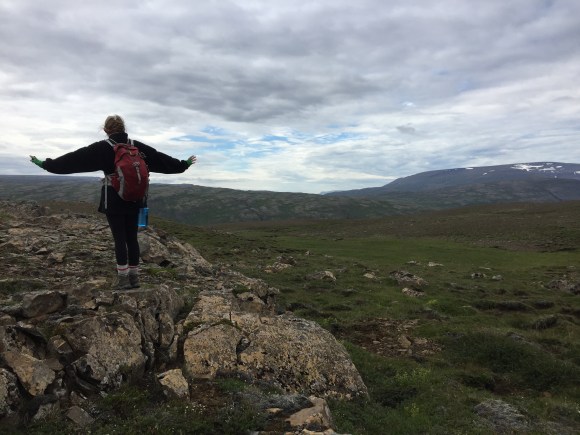
Have you ever had nagging doubts about whether you behaved properly at some event? Or thought back on an experience, only to realize you now think about it in an entirely different way than you once did? It can happen in pilgrimages too. It was enlightening to check back with Ásta Camilla Gylfadóttir about our 2016 trek with her and a group of other Icelanders from Bær to Skálholt. I’ve been worried that with our English-language needs and our massive tourist luggage we eight Canadians “spoiled it” for the Icelanders that year. But for Milla, our walk is only a bright memory. For her, the fact that there were Canadians along on the Pílagrimar only made it better. I can’t tell you how liberating our recent Zoom chat turned out to be.
Which makes me realize once again that there are many parts to a walking pilgrimage: the journey is only one of them. A big part of any pilgrimage is narrative: the stories that gave rise to the pilgrimage (at Lourdes, for instance, the Marian appearance to Bernadette), but also the stories that come out of the experience of the pilgrims. Like the dozens of crutches left in Brother André’s chapel at St Joseph’s Oratory, Montreal, or the hundreds of pilgrim blogs, videos, books, and poems arising from the Camino de Santiago in Spain, these later stories “layer on” to the original narratives, making the original journeys richer, more complex, and more about the present. A pilgrimage stays ever-present – and ever meaningful – in its re-telling and sharing. For that I’m thankful.
My pilgrimage podcast is now available on Spotify and on TuneIn, as well as Apple Podcasts (some episodes missing) and it’s hosted on Podbean!
I just posted the second episode in my podcast series “Pilgrimage Stories from Up and Down the Staircase”! In these 20 minutes you come along for the first part of the walk along the St. Cuthbert Way from Melrose Scotland to Holy Island, England. You’ll meet Chris and Clare, and find out why she’s Saint Clare, to me. I hope you enjoy the show, which you can find on Podbean here, and on Apple podcasts, here!
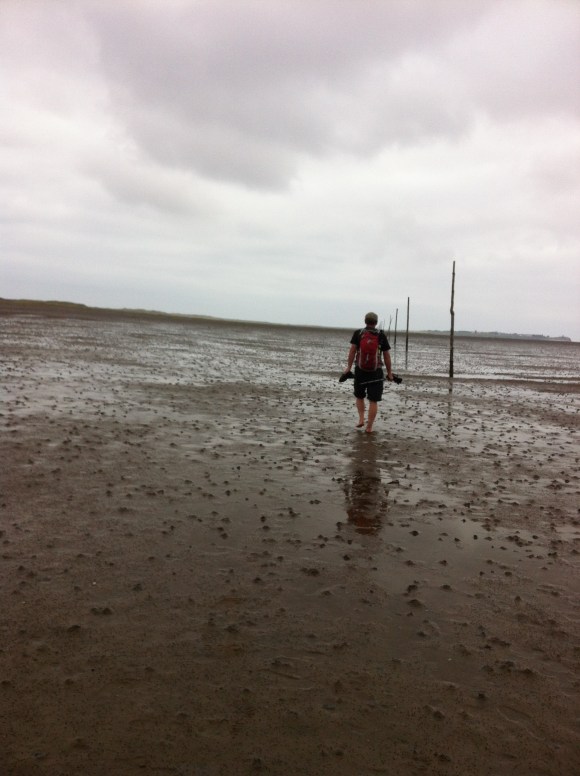
How do you walk a pilgrimage during these months of restricted travel? I’ve been walking up and down my staircase in Nottingham England, and dreaming of pilgrimages past! To share those stories I’m releasing my first-ever podcast, “Pilgrimage Stories from Up and Down the Staircase.” Each episode features a different trail, or a different character I’ve met. I’ll introduce you to enthralling paths in Norway, Scotland, England, Iceland, Canada and Indigenous territories, and provide some of the resources you’ll need to walk them. All the while I’ll be telling the stories of the fascinating individuals I’ve walked with and met along the way, and sharing snatches of our conversations, songs, and experiences.
Thursday, July 30, 2020, at 5 pm Montreal time, I’m releasing the first episode: “Walking the St Olav Way.” In the 17-minute episode you’ll hear snatches of our struggle up and down mountains and jumping late-spring run-off streams and boggy marshes. You’ll meet a friendly Norwegian border agent and a marathon German pilgrim struggling to understand his life. You’ll sit with us in rustic Budsjord Gård and hear fellow pilgrim Kathryn singing as we walked. I hope you’ll listen in to this first episode, and to the others as they come out every Thursday! The series “Pilgrimage Stories from Up and Down the Staircase” will be available wherever you find your podcasts.
To find out more about St Olav before listening to the episode, why not check out some of these resources?
The official St Olav website, which you can find here, is a wealth of beautiful images and practical info (look for the English-language option)
In 2011, Alison Raju wrote The Pilgrim Guide to Trondheim, available at this website.
For my article about the history of the Trail and its modern-day recovery as well as some photos of our 2013 trek, see the International Journal of Religious Tourism and Pilgrimage, here.
For an article about the health benefits of walking the St Olav Way, written by a Norwegian scholar of pilgrimage in the same journal, see this link.
I’m looking forward to sharing my experiences with you on the “Pilgrimage Stories From Up and Down the Staircase” podcast!
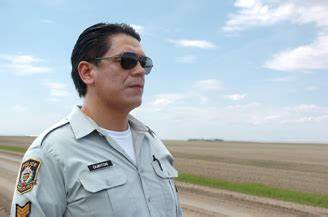
Lorne Cardinal as Sergeant Davis Quinton of Dog River SK
Mostly because I haven’t owned a television in years, it’s taken me this long to get around to watching Corner Gas. I grew up in southern Saskatchewan. That alone should have made me an instant fan of the idyllic, nothing-happens-but-life comedy set in small-town Dog River (Rouleau) SK. It’s only now, holed up for the pandemic in a rental place in England with a flat-screen TV and a subscription to Amazon Prime, that we’re watching the six seasons of the CTV hit that first aired in 2004, produced by and starring Brent Butt.
There are no spoiler alerts in what I’m about to say. I haven’t seen the whole series yet, so I might be surprised by what’s to come. But so far, I love the show. It’s fun – and funny. It’s also tweaking my academic side. As a non-Indigenous person and a Canadian, I’m watching Corner Gas while at the same time working on several academic articles and peer reviews about decolonizing settler attitudes. I can’t help paying special attention to two characters in the show, Sergeant Davis Quinton, played by Lorne Cardinal, an award-winning Nêhiyaw (Cree) actor, and Paul Kinistino, owner of the Dog River Hotel and Bar. The latter was played first by playwright and actor Mark Dieter of Peepeekisis First Nation, and later replaced by the character of Phil Kinistino (played by Erroll Kinistino of Ochapowace First Nation). The last few episodes I’ve seen have been especially fun for the nuance and playfulness Cardinal is bringing to the character of Davis, who is becoming one of my series favourites.
In an article in the Anishinabek News, Keith Corbiere describes how as an Indigenous viewer the character of Sergeant Davis Quinton offered him a role-model different from the Hollywood trope of the stoic, silent “screen Indian.” From my non-Indigenous perspective I can add that Davis equally subverts the “strong silent cop” trope I grew up with as the son of a one-time small-town police officer in Swift Current, just down the highway from Rouleau. As an academic, I’m intrigued by the choice made by Butt to cast the roles of Dog River’s police officer and hotel/tavern owner with Indigenous actors. Perhaps this was accidental, but I doubt it. It strikes me as subversive, and positive. As Butt would also have experienced, in the small prairie towns in which I grew up both those roles were more often in conflict with Indigenous persons than embodied by them.
So far at least, Corner Gas never mentions the Indigeneity of two of its major characters, and occasionally of extras in the crowd scenes. It seems intent on a “normalization” of Indigenous presence in the fictional Dog River. As Cardinal said in an interview in 2004 in Windspeaker: “you don’t hear the flute or the eagle scream when I come onto the screen.” In a novel I’m putting the finishing touches on, I try in a similar way to incorporate the Wəlastəkwewiyik (or Maliseet) peoples of the St-Lawrence without focusing on them, normalizing the positive interactions between non-Indigenous characters and the Maliseet, and so tacitly recognizing Indigenous resurgence and presence.
In a quick library search and again on Google I found almost no reference to Corner Gas in relation to Indigenous issues. It would be interesting to know whether Indigenous actors, directors, and producers feel the historic sitcom’s portrayal of active Indigenous presence in southern Saskatchewan/Treaty Four territory is a positive step in decolonizing our Canadian attitudes, or a utopian portrayal of harmony that is ultimately troublesome to real-life 21st-century concerns…especially when Indigenous groups were “cleared” from those plains by Canadian government action in the 1870s. I imagine Lorne Cardinal has some thoughts on that. In the meantime, during this Covid-19 outbreak and in a time of social-distancing, I’m enjoying being a late-comer to Corner Gas’s fan-base.
Trying to bring one’s worlds together is the work of a lifetime, as fulfilling as it is challenging. I’m a biblical studies scholar interested in earliest Christianity and late Second-Temple Judaism. I research pilgrimage and journey, and try to walk paths and learn about the Land wherever I am. I’m also a Canadian trying to face some of the injustices against Indigenous peoples which created and help sustain my country. I’ve learned a lot, and I’m still learning, from First Nation and Métis friends, and from reading Cree, Métis, Maori, Haudenosaunee, and Anishinaabe authors and scholars.
Out of this mix comes this reflection on reading the Bible through an “Aware-Settler” lens. If you’d like to know more about my own work on this, you can find the full academic paper published by Journal of Interdisciplinary Biblical Studies here: https://hcommons.org/deposits/item/hc:26771/
If you’d like to know more about my sources, a Cree scholar whose methods have been of great help to me is Margaret Kovach Sakewew p’sim iskwew and her book: Indigenous Methodologies: Characteristics, Conversations, and Contexts (Toronto: University of Toronto Press, 2009). I can’t recommend it highly enough.
Here is a film (a powerpoint with voice-over) about “Aware-Settler Biblical Scholarship.” My apologies that the sound for the first slide has somehow been cut off – it was simply me introducing myself as from Concordia University, Montreal, and a research associate at University of Nottingham, UK. If you listen hard enough, there’s also a cat and a train making an appearance in the background.
For some great photos and the reportage of these four students who walked part of the way with us, click on the link below… (and be sure to watch the very short video!)
Last Saturday, October 26, a group of eleven, mostly Settler Canadians, walked the Seaway between 25-30 km from Kahnawà:ke’s Cultural Centre to Montreal. I’m a Settler scholar from Treaty Four territory, and I planned this walk as a “bodily territorial acknowledgement,” in preparation for our Theology in the City Conference at Concordia this week. We pilgrims were a mixed group – a Buddhist monk, two professors, two undergraduate students, a doctoral student, and a writer! With the knowledge and approval of the Traditional Longhouse of the Mohawk Nation at Kahnawà:ke, we began with a smudge led by Dr Christine Jamieson (Interior Salish – Boothroyd Nation) – Christine teaches Indigenous spirituality in our Dept of Theological Studies. Then we were off! We were blessed by the nicest day of the week: sunny, dry, and warm. We were enthusiastic walkers who made good time, and were back in Montreal by supper. I’m thankful for the good conversations and quiet moments of beauty and contemplation along the way. Thanks also to the enthusiastic reporters from the Concordian, led by Jad Abukasm, who walked the first leg with us and enjoyed breakfast at our table at the Sunnyside Diner (formerly Friendly’s) in Kahnawà:ke!
Tomorrow, September 16, is the feast day of Saint Ninian. In July, together with Christine Ramsay, Ken Wilson, and Sara Parks, I walked the Whithorn Way in Scotland, the medieval Royal pilgrimage route to St Ninian. To honour Saint Ninian Day here’s a short video of that pilgrimage!
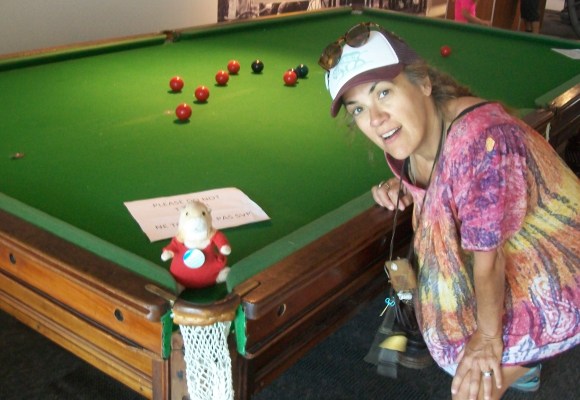
See this stuffed prairie dog? Apparently, it has a name: “Matthew”. I just received photos of this mascot all along the route of the Humboldt-Fort Carleton Trail Walk in 2019. Each of them with cute little captions. In 2015, Hugh Henry and I began this tradition by trekking the 350-km Traders’ Road, or North-West Mounted Police Patrol Trail (NWMPT) in Treaty 4 Territory, SW Sask. It was likely the first time the trail had been walked in over a century.
“Matthew in the Bull’s Eye”
In 2017 we walked the Swift Current to Battleford Trail, another 350 km; near Battleford there were lots of issues with access and trespassing (see above). In 2018 we walked the Frenchman’s Trail, from Mortlach to Gravelbourg. I was surprised that there was a Welsh couple serving Fish’n’Chips in Mortlach (see photo below).
Matthew Passed Out
This year, Hugh and the Saskatchewan History and Folklore Society (SHFS) planned a journey from Humboldt to Fort Carleton. I’m still in England; this was the first year I just couldn’t make it. No country bars and pool-tables for me this August. But apparently I was there in spirit.
Rack-em Up Matthew
If you’d like to read more about the walk they took – without me – you can read a great day-by-day description (I did) on Ken Wilson’s blog at https://readingandwalking.wordpress.com/.
Matthew: medical distress
The photo I found the funniest is just above. I had quite a bit of foot trouble on the way to Battleford in 2017, culminating in a full-on leg infection. I was using duct-tape for my blisters, in the vain hope it can fix EVERY problem! Live and learn! Mostly, I’m thankful for good friends and for being remembered on a pilgrimage I couldn’t walk. They knew I was thinking about them. And how wonderful, to be thought of in return.
Pilgrimage has two directions. At least, usually it does: Sara Terreault can explain better than me how the ancient Irish (Insular) monks went on peregrinations or wanderings with no intention of returning home. But for the rest of us, to every “there,” there is usually a “back again.” Thank goodness! Whithorn said goodbye with a noisy overnight storm that made me get up to close my window against the sideways rain, then clearing and becoming coyly sunny and warm just as we left. Above is our view from breakfast in the Mansefield Inn. It was once the parsonage to the church converted into a Gulf gas station and garage (below). Fortunately, the conversion of the parsonage was a better job.
Free Church Gas PumpsThe Steam Packet Inn, Isle of Whithorn
The folks here are rightly proud of where they live. In our 45 minute taxi to the closest train, the driver told story after story, some of which I can repeat, then briefly turned off the taxi’s meter to take us a few hundred yards off-route to see Kennedy Castle. Once on the train, Ken, Christine, and I headed north to Glasgow. My son Daniel once told me how strange it felt to see a pilgrimage “undone” by being in a motorized vehicle heading back to the starting point. I liked seeing some of the sights again from our Scottish Railway car, including these children at one junction waving at the train.
waving at the train as we made our way home
There were unmarked grassy places along the coast where courageous Scots were drying out tents, and I wondered if these were examples of the “Right of Responsible Access.”
Glasgow Central Train Station
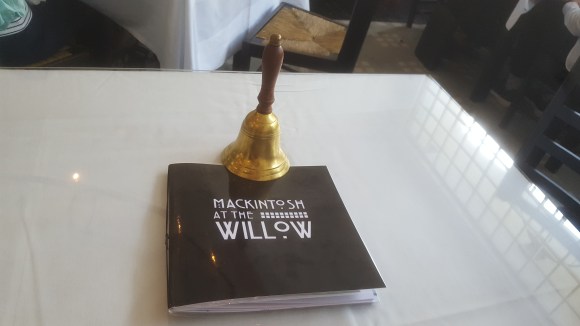
Glasgow Central Station is one of those beautiful, soaring Victorian train stations. We dropped off Ken and Christine’s things, then they accompanied me to the bus station to catch my bus to the airport. On the way we stopped for tea at a replica tearoom done up in the style of Charles Rennie Mackintosh, Glasgow’s famous early 20th century architect. Now I’m waiting to board a prop plane back to East Midlands.
Charles Rennie Mackintosh (or at least a tea-room dedicated to him)saying goodbye at the bus station
Can one really say that they get to know a place in a short week, even while walking? We covered 120 km, more or less. We saw a lot of mud and stones, beached jellyfish and sheep and cattle and dark woods, barley fields and brambles. Walking is different from seeing land from a train. But both, as Ken reminded me, are different from actually spendingtime, which is how you make an “anywhere” a “somewhere.” It’s partly by telling stories, and remembering, that we create a sense of place. So that’s the next task for me, as a pilgrim returning from the Whithorn Way. I was happy to share Christine and Ken’s company throughout this long walk. PS: It’s interesting that, after a week researching the Right of Responsible Access in Scotland, on my return to Nottingham Google Maps led me right through a new car parking lot that SHOULD also be a footpath. I wound up exercising my right and hopping the barrier to walk through.
 Which makes me realize once again that there are many parts to a walking pilgrimage: the journey is only one of them. A big part of any pilgrimage is narrative: the stories that gave rise to the pilgrimage (at Lourdes, for instance, the Marian appearance to Bernadette), but also the stories that come out of the experience of the pilgrims. Like the dozens of crutches left in Brother André’s chapel at St Joseph’s Oratory, Montreal, or the hundreds of pilgrim blogs, videos, books, and poems arising from the Camino de Santiago in Spain, these later stories “layer on” to the original narratives, making the original journeys richer, more complex, and more about the present. A pilgrimage stays ever-present – and ever meaningful – in its re-telling and sharing. For that I’m thankful.
 I’ll introduce you to enthralling paths in Norway, Scotland, England, Iceland, Canada and Indigenous territories, and provide some of the resources you’ll need to walk them. All the while I’ll be telling the stories of the fascinating individuals I’ve walked with and met along the way, and sharing snatches of our conversations, songs, and experiences.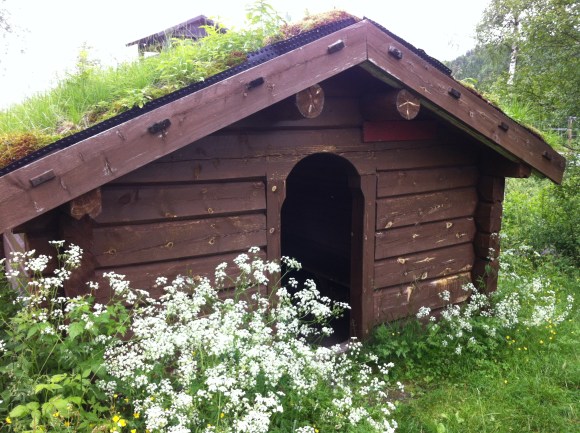
 As an academic, I’m intrigued by the choice made by Butt to cast the roles of Dog River’s police officer and hotel/tavern owner with Indigenous actors. Perhaps this was accidental, but I doubt it. It strikes me as subversive, and positive. As Butt would also have experienced, in the small prairie towns in which I grew up both those roles were more often in conflict with Indigenous persons than embodied by them.









 somethinggrand