Tomorrow, September 16, is the feast day of Saint Ninian. In July, together with Christine Ramsay, Ken Wilson, and Sara Parks, I walked the Whithorn Way in Scotland, the medieval Royal pilgrimage route to St Ninian. To honour Saint Ninian Day here’s a short video of that pilgrimage!
Tag: pilgrim
Categories
Like Being There


See this stuffed prairie dog? Apparently, it has a name: “Matthew”. I just received photos of this mascot all along the route of the Humboldt-Fort Carleton Trail Walk in 2019. Each of them with cute little captions. In 2015, Hugh Henry and I began this tradition by trekking the 350-km Traders’ Road, or North-West Mounted Police Patrol Trail (NWMPT) in Treaty 4 Territory, SW Sask. It was likely the first time the trail had been walked in over a century.

In 2017 we walked the Swift Current to Battleford Trail, another 350 km; near Battleford there were lots of issues with access and trespassing (see above). In 2018 we walked the Frenchman’s Trail, from Mortlach to Gravelbourg. I was surprised that there was a Welsh couple serving Fish’n’Chips in Mortlach (see photo below).
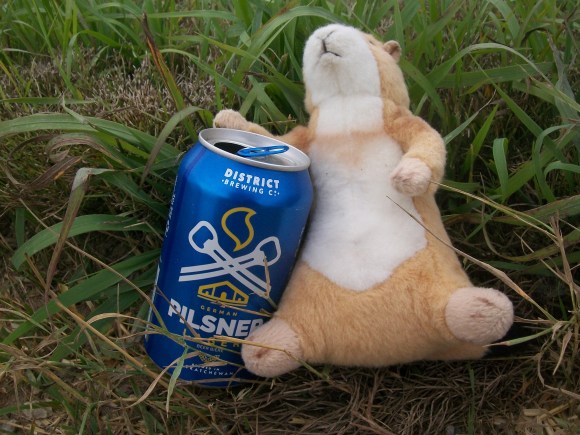
This year, Hugh and the Saskatchewan History and Folklore Society (SHFS) planned a journey from Humboldt to Fort Carleton. I’m still in England; this was the first year I just couldn’t make it. No country bars and pool-tables for me this August. But apparently I was there in spirit.
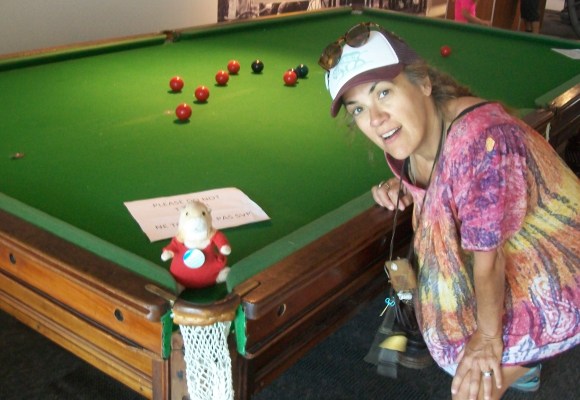
If you’d like to read more about the walk they took – without me – you can read a great day-by-day description (I did) on Ken Wilson’s blog at https://readingandwalking.wordpress.com/.

The photo I found the funniest is just above. I had quite a bit of foot trouble on the way to Battleford in 2017, culminating in a full-on leg infection. I was using duct-tape for my blisters, in the vain hope it can fix EVERY problem! Live and learn! Mostly, I’m thankful for good friends and for being remembered on a pilgrimage I couldn’t walk. They knew I was thinking about them. And how wonderful, to be thought of in return.
Categories
On Ninian’s Cliffs
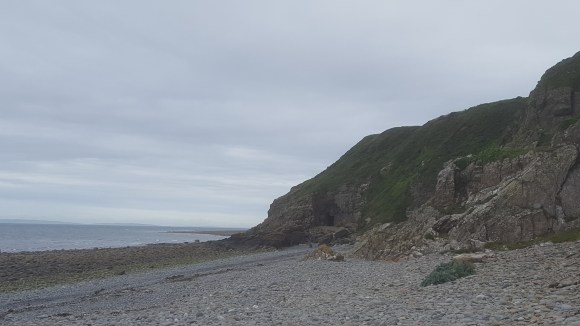
 Today was a vertiginous day. It’s the perfect word, although I had to look it up. Vertiginous has two meanings, both true today: extremely high and steep, and suffering from vertigo. I don’t know how the Scots do it. We had just passed through a short section – the worst – where the path was within two metres of the edge and a stumble could easily topple you down 200-feet onto the rocks. A couple ambled toward us with a dog tied to the woman’s waist. When we said hi, she cheerily told us “he has to be tied up. He’s a naughty dog and we had to call the coast guard to fetch him a couple weeks ago.” Hmm.


I’m now thoroughly convinced Ninian existed; after all, on finishing the walk all the way from Ninian’s Cave to Ninian’s Chapel on the Isle of Whithorn, about seven miles away, we had tea in his café. More seriously, the ancient stones, including altar stones, found in the cave (which is now partially caved-in) testify to its age. At our end point, the medieval chapel of St Ninian (below) was the place where pilgrims arriving by sea were welcomed and gave thanks for safe arrivals. Unlike us, they weren’t crazy enough for the cliffs; most ancient and medieval pilgrims arrived by sea and only walked a short distance to the shrine.

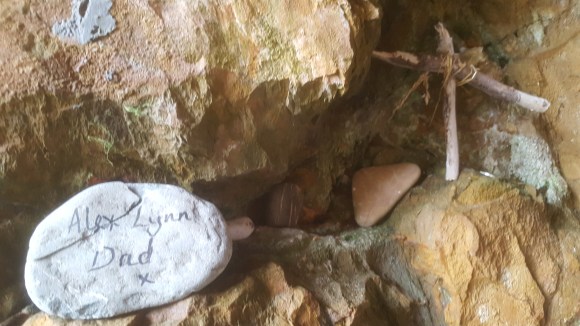
Having walked some ancient pilgrim routes that don’t seem that tied to religion anymore, I was struck today by the signs that people still take Ninian’s cave and Ninian’s chapel seriously. Some leave stones with names at the chapel, or insert rocks or prayers in the ancient surf-side cave.
Nini

Chris and Clare joined our walk today. I met them six years ago on the St Cuthbert’s walk. Clare brought wonderful home-made cake. I’m thankful to see them again after so long. 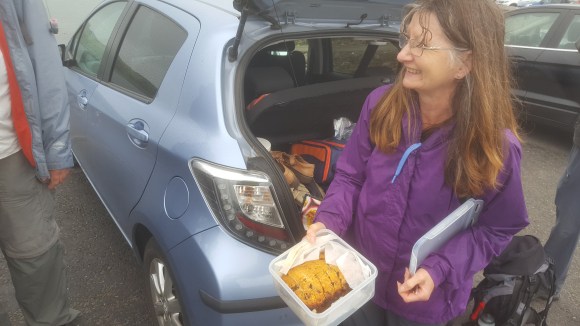
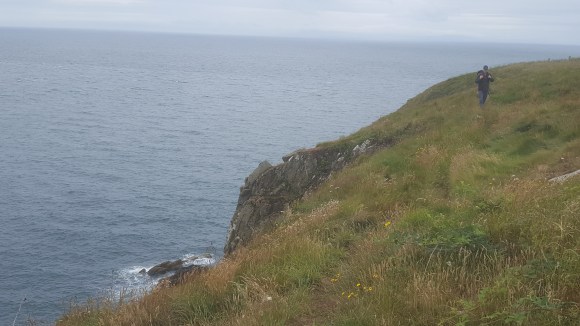
We’ve run out of Ninian destinations in this part of the peninsula, so I guess that means this pilgrimage is over. We’ll go out for a celebratory pint and dinner this evening, then tomorrow start making our respective ways home. The pilgrimage has been short, but has had many pleasures and a few trials. And will provide me material for a long time to come! I’ve enjoyed walking with Christine and Ken. Next time in Saskatchewan, which is perhaps not quite as vertiginous!
(for more photos and another perspective on today, see Ken’s blog at https://readingandwalking.wordpress.com/2019/07/21/whithorn-way-day-six/)

Categories
Why Do the Scots Do It?

We experienced several pilgrims’ miracles today. Firstly, after starting out in Barrhill the rain held off until just after our mid-day snack (after a full Scottish breakfast a snack was all we needed). That was fantastic.  Secondly, we arrived at our “hikers’ shed” only to find that the lovely & picturesque village of New Luce has no pub, no restaurant, and no store – although all are planned – and that the owners of our accommodation hadn’t been warned we were wanting supper. They very kindly found a can of soup. We were planning to make do with that and some crackers until local walker and walking activist Peter Ross showed up at our door, asking if we needed anything and offering a ride for groceries. Finally, owing to the fact that a local rented cottage won’t receive its guest for a couple days, we got a place to shower! New Luce has got to be the most lovely little village we’ve come across – it’s vying for the flower award for the UK this year.

We met some of the local residents on a main street festooned with flowers. They told us that New Luce has received substantial funds from the local windfarms we walked through all day (see the first photo above) and that they are using the money to purchase the pub, cafe etc and to redevelop.

We were soaked, again, and Ken was especially suffering from the wet boots and socks of yesterday’s rain-soaked walk. So it was a pleasure to get an offer from Peter for a ride to groceries. Peter talked the whole way about EU politics (where he has represented Scotland) and Scottish Right to Access. 
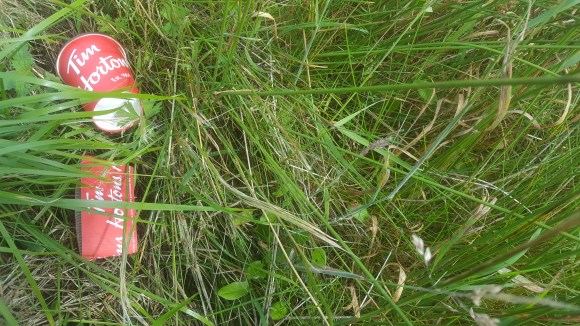
Peter is the president of the regional Right to Access group. I grilled him about why the Scots are interested in the Right of Responsible Access. He surprised me by saying that for him, it has to do with a/paths, and b/local development. I thought about our walks in Saskatchewan and how they also have to do with recovering important paths and may someday lead to development.  By the way, Peter told us that all the garbage we’d seen on the coast was NOT Scottish: “a lot of that’s drifted in from Dublin and Liverpool and Belfast with the prevailing currents,” he told us, “But we Scots have to clean it up.” On the walk today we came across a poignant reminder, in rural Scotland, of Canada’s international garbage. We could hardly believe what we were seeing!
A lot of sheep today. And some of the signs were funny as well. We never saw any children at the fence lines, but lots of sheep and goats watched us pass.
The monks, royals, and common folk who walked this path would have stopped at Glenluce Abbey, whose ruins we will walk to tomorrow morning. I also plan to ask Peter, who will walk with us, more questions about walking and local development.
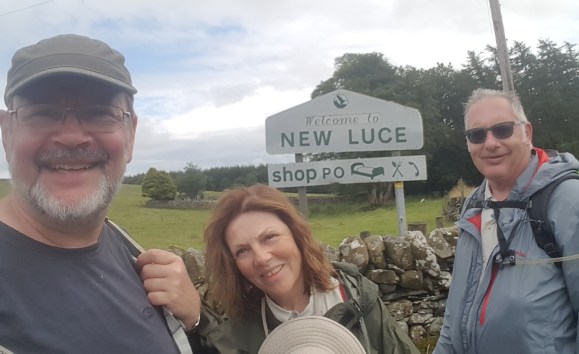
If you’re interested in more photos and another angle on the day, see Ken’s blog at: https://readingandwalking.wordpress.com/2019/07/18/whithorn-way-day-three/
Categories
Anticipating Walking

For years I dreamt of walking Treaty Four territories, what is now south-west Saskatchewan. Only in 2013-2014 did I find a trail (the Traders’ Road, or North-West Mounted Police Patrol Trail), a guide and fellow walker (Hugh Henry, of the SK History and Folklore Society), and feel in my bones a reason (un-settling Settler narratives) to make it finally happen. Ken Wilson is also interested in Settler preparation for reconciliation; he and I walked together from Swift Current to Battleford in 2017 and from Mortlach to Gravelbourg in 2018. Ken recently set his scholarly lens on an article I wrote for a volume in pilgrimage back in 2013, just before that first 350-km journey across the prairies. A serious academic, Ken has highlighted the article’s best parts. In case you’re interested, I’m posting his post, here:
Categories
The St. Olaf Way Norway

I’m SO happy to see this article finally in print! In May 2013 we began walking this incredible trail only weeks after I had had surgery for prostate cancer in Montreal, and so soon after Norwegian spring thaw that the train to take us to the trail head was washed out, and we had to ford more than a few run-off streams on our way! Find out more here about the extraordinarily beautiful St. Olaf Way, as told from the perspective of a group of Scandinavian-background Canadians who walked a long portion of it in 2013. Pilgrimage, diaspora, national memory, political sainthood, therapy walking, history, church-state relations, and stunning views of mountain-top Norway….they’re all here! https://arrow.dit.ie/ijrtp/vol7/iss1/7/
Categories
Luther and Pilgrimage
I just published an article! If you’re interested in a/pilgrimage b/Luther c/European early modern history d/romanticism e/the Grand Tour e/tourism …. or just about any combination of the above, or just in some interesting academic reading, have a gander! Here’s the URL – free for reading or download!
https://arrow.dit.ie/ijrtp/vol7/iss1/6/
Matthew
Categories
Walking and Owning
Walking focuses not on the boundary lines of ownership that break the land into pieces but on the paths that function as a kind of circulatory system connecting the whole organism. Walking is, in this way, the antithesis of owning. (Solnit, Wanderlust, 162)
 I’d counted on getting my bearings from the Hayfield UK info stop. I had to think again! On April 24 1932, after decades of on-again, off-again confrontations, 400 members of the British Workers Sports Federation started trekking up from their campsites here toward “the forbidden mountain.” The mass trespass of Kinder Scout plateau’s private land became the tipping point in the fight for the right to walking access across private lands. This plaque commemorating the walkers is affixed to the wall of an old stone quarry at the head of the trail. No one is fighting for the right to walk across Saskatchewan. There are no walkers’ groups, no mass rambling movement and no one in Swift Current or Saskatoon is trying to escape the grimy factory life of Sheffield and Manchester in the early 20th century. But there ARE historic, important trails across the prairie. They also deserve public access. And Canada has an important issue that the 1930s British ramblers never faced – the question of Indigenous access.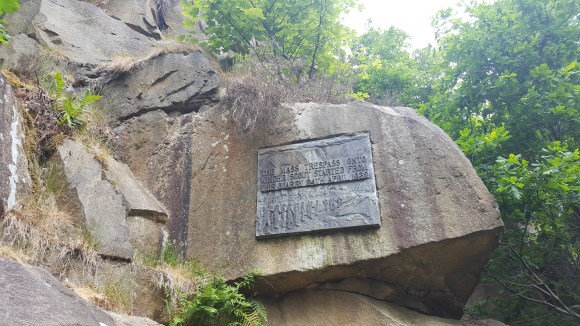
Categories
Geography & Wonder

There is the geography we know and can trace topographically, made up of distance and terrain and movement. For instance, knowing it is about 14 miles (22 km) to the next town, there is a mountain in the way, and a pub and a pint await us there. But there’s another geography as well, one that exists off the maps even though it overlaps them, a geography of uncertainty, of bodily ache, of imagination and story and solitude, and sometimes, if we’re fortunate, of wonder.
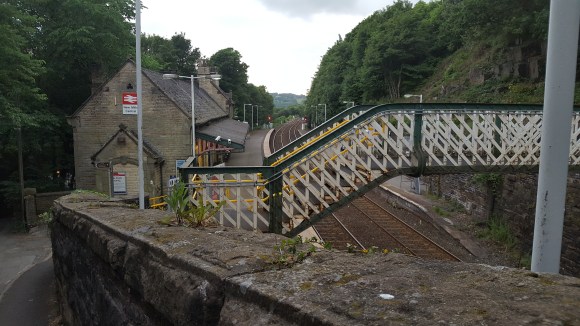
Since the Romantic era at least, wonder is the most gratifying of reactions to a view, natural or human. The walker cannot plan on wonder. But there are ways in which we open ourselves up to it and make ourselves available. In my experience those ways start with being silent, and with not over-planning a walk. That’s the way I felt when I woke up in Hayfield, in England’s Peaks District, the morning of the Kinder Trespass hike. Ready, but not completely prepared.
Categories
The Pilgrims and the Pope

“The pilgrims of the Spanish-speaking countries pray for you, Holy Father,” intoned an Archbishop (I think that’s what he was?). Below where I sat sweating under the an unseasonably hot Roman sun, perhaps a thousand of the massed faithful erupted into cheers and flag-waving. Pope Francis leaned forward in his plain leather chair, speaking into the mic in Italian. In his address, he reminded us that we are not slaves, but “children, and pilgrims.” I noticed that the metal roof above his head was hinged. I’m guessing that, if there was a danger, the entire roof section could swing down as a shield. This Pope seems uninterested in shielding. A group beside me, from Michigan, fanned themselves. One of the younger women looked up from her smart phone: “I found a lunch spot but it’s at least three-quarters of a mile away. Can you walk that far?” An older man – her father? – lifted his baseball cap and grumbled: “It’s part of being a pilgrim, I guess.” So much pilgrim language. Meanwhile Pope Francis had left his chair. He looked much happier than he had while separated from the crowds. Now he beamed, reaching out to touch people, extending his arms in blessing, shaking hands, smiling broadly. All around me, people were lifting children over their heads, pressing rosaries forward, shouting: “Pappi! Pappi!” Francis leaned over the barrier to a couple in full wedding dress, the young man grinning from ear to ear. The bride, all in white, pressed a photo into the Pope’s hand. As I watched, he blessed it, then, while he blessed the couple as well, a man in a black suit behind him took the photo from his hand, and passed it to another black suit, who handed it to a third man in sunglasses, who walked away from the scrum, idly checking his cell phone. He opened a white plastic bin and placed the photo inside. To my mind, all the elements of pilgrimage came together in that moment: presence, story, a holy terrain, and a material and spiritual transaction. The young couple, via their photo, had reached their pilgrim destination. As had I.
With thanks to my fellow pilgrim, Archbishop Don, for arranging my participation.
 somethinggrand