Categories
Uncategorized

Far from One’s Earthly Home

(this is a guest blog posting on postmodernism and pilgrimage, by Sara Terreault, my friend and pilgrimage studies colleague. Her thoughts were inspired by the questions and comments posed by another of our friends and colleagues, E. Moore Quinn. Their back-and-forth conversation was too good, and too detailed, to leave in the comments section!  MA)

Hi Eileen,

Fancy meeting you here: do you come here often? 🙂

Great questions.  I should be grading papers but cannot resist jumping in.  Here goes, a few note-form thoughts in response to your thoughts:

1) “postmodernism (cultural orientation)/postmodernity (historical time period)”: well, literally “after modernism/modernity”.  So applies to cultures that have been shaped by modernism (or in short, the so-called “Enlightenment Project”), but have grown suspicious of modernist assumptions and values, so

1a) Enlightenment Project, a meta-culture (birthing the so-called universalist  “metanarrative”) consisting of : i) anthropology: human person as primarily (or ideally) interior, individual, rational, and, once freed from the tutelage of superstition (incl “religion”) capable of solving all human issues by exercise of rationality); ii) epistemology: rational, objectivist empiricism, privileges scientific method;  iii) ontology: materialist, immanentist.  Implications: the eclipse of the transcendent, the spiritual/religious, the affective.
1b) Romanticism (late 18/early 19th c.) a reaction/response to the hyper-rationalism of the Enlightenment, but which nonetheless retains the individualist interiority of Enlightenment anthropology … however privileges affectivity, intuition, arts and artists, rather than empiricist rationality and science.  Romanticism has an ambiguous relationship to “religion” and I think we can see there the roots of the contemporary postmodern “spiritual but not religious” (re-opens the door to the re-entry of transcendent reality, but not through traditional “religion”).
1c) Finally: postmodernism: disparate cultural movements that have challenged the assumptions and values of the Enlightenment  and  to some degree Romanticism.  It is paradoxically both hyper-modern and anti-modern.
1d) postmodernity: When is this? This will be endlessly debated, but it makes sense to me to place this post WW2, when all the certainties of modern hopefulness in humans and their “brave new world” lay in ruins after the horrors of two world wars, genocide, totalitarianism, atomic weaponry: our lovely individualist, scientific rationalism has *not* saved us after all. Now what?  Western (modernist) culture fragments into many small cultures (mini narratives) privileging the local, the plural, the diverse, the contingent, the social
2) Shrines, relics, pilgrimage and postmodernity: I’ll suggest that the “shrine” is the in-dwelling place of the divine, “relics” are the meaning-imbued and empowered material memory of the holy one (saint) and the holy experience (in this case, pilgrimage); and “pilgrimage” is physical (or in some cases only spiritual) journey for and to self-transcendence.
2a)  i. The shrine may indeed be spatially located, architecturally realised.  But it is also (at least in Christian tradition) interior, spiritual and personal: “You are the temple of the Holy Spirit” (1 Corinthians).  For postmodern people, the secularity of modernity means that attachment to and experience of traditional religion is often thin or very thin.  Yet the desire for and valuing of the transcendent is nonetheless strong, but is expressed largely privately (religion having been banished from the public square).  So the interior understanding of shrine is “natural” to us postmoderns (we are perhaps just a little bit gnostic in our tendencies …).  We may structure our spirituality on aspects (and in the case of pilgrimage), on locations of traditional religions) but we do this largely individually, partially, and with great focus on interiority. ii. peregrini:  I totally agree that postmodern pilgrimage’s “interior shrine” is in many ways like that of the Celtic peregrini pro Christo whose pilgrim journeys were not toward any wrldly centre, that is toward any spatially/materially located shrine, but rather away from the “centre” of the earthly home, familiarity, comfort etc. Their “destination” is not spatial/material/earthly but rather eschatological, and their only earthly material shrine is their own pilgrim bodies. iii) Relics: the material and sacramental traces of holy people, places, memories.  Not a long way from a strand of hair in a locket, or a pilgrim badge or tattoo, or a burden stone to be left on the road, or a postcard or souvenir …
Your further thoughts?


Categories
Uncategorized

When the Shrine becomes the Self

Allen pondering

a ten minute conversation with Sara Terreault, at Concordia, Montreal, about what makes post-modern pilgrimage post-modern!

Categories
Uncategorized

Interview with Cristina

A wide range of thoughts on pilgrimage, from the way space creates thought, to an Australian nun’s summons to a new field.

https://vimeo.com/145929829

Categories
Uncategorized

How I was Saved by a Sense of Belonging

through the trees onto prairie

My dilemma: I know from my own experience that being a pilgrim on a certain bit of the planet helps a person identify better with that bit of the planet. I’m not Norwegian. But I feel more of a connection to Norway having walked several hundred kilometres of the mountains and streams my ancestors knew. I AM a prairie person – sort of, still – even after thirty years in Quebec. Remembering my appartenance (belonging) to the prairie was hard-won with every gust of wind, every blade of speargrass burrowing into my foot, every sunburn, every call of the coyotes at night and every Pils beer consumed in a prairie tavern. If you haven’t tried it, do. It’s great. Not just the Pils. The whole pilgrim experience.

So my thesis for the conference to be held at the College of William and Mary, in Virginia, is simple: walking pilgrimage helps ‘ground’ people like me as Canadians, in our land, so long as we are mindful of the land’s history and of its First Peoples (in other words, so long as we walk honestly).

Then I remembered that “pilgrim” actually comes from the word ‘foreigner’ or ‘alien’. How can a foreigner gain more of a sense of belonging by practicing their pilgrimage (ie foreignness)? I thought my paper was ruined. I stewed on this for several days before it occurred to me. For Newcomers like me, being a pilgrim describes my status EXACTLY. The foreigner (pilgrim) doesn’t own land. Pilgrims only go on by humbly accepting generosity from the land and its inhabitants. The pilgrim needs to be in relationship with others, or they perish. Belongingness (if there is such a word) is reversed. Not the land to me, but me to the land. For a non-First Nations person like me, it means seeing that my belonging to this land in Canada has always been by hospitality. It ONLY comes through recognizing my foreign-ness and the ways in which I have been invited to share in belonging TO the land, by those – ie First Nations – who have belonged to it for so long already.

That makes a whole lot more sense. I think I can present that at the conference.

Lyndon walking with paint

Categories
Uncategorized

The Problem of the Definition of Pilgrimage – one half of a dialogue

Craig Baird boom shot Cypress L walkers (photo courtesy of Craig Baird)

(please click on the link)     https://vimeo.com/140200976

A conversation over morning tea at Concordia’s Dept of Theological Studies between Matthew R. Anderson (on camera) and Sara Terreault (staying off camera).

Categories
Uncategorized

Un pèlerin des temps modernes retrace les pas de ses ancêtres

IMG_0215

You can find here the radio broadcast of my interview with Radio-Canada, in French, as well as a photo essay by William Burr, also in French, about the trail and our pilgrimage.

http://ici.radio-canada.ca/emissions/pour_faire_un_monde/2014-2015/chronique.asp?idChronique=380260

Categories
Uncategorized

A Musical Moment

Kathryn Scott, Madonna Hamel and Matthew Anderson try to remember the words and harmonies to Java Jive. We were camping overnight at Chimney Coulee, near Eastend SK, and half-way through our group’s 350 km trek along the North West Mounted Police Patrol trail. This is a moment from a summer 2015 pilgrimage organized by Hugh Henry and Matthew Anderson. The video was shot by James Page, photographer, from Val Marie SK. on the NWMP Patrol Trail pilgrimage July 30, 2015

Categories
Uncategorized

markers on the way

NWMP patrol trail marker. Val Marie, Saskatchewan. 49°14'48
NWMP patrol trail marker. Val Marie, Saskatchewan. 49°14’48” N 107°41’57” W

There were times, walking, where I forgot about our guides on the trail – the North West Mounted Police  markers that Everett Baker put up in 1960 and 61. After all, that was over 50 years ago. Even eight foot concrete posts don’t always last that long, when neglected. We couldn’t always find them. Sometimes they’d been knocked down by cattle or vandalized. And sometimes, to avoid walking on crop, or because they haven’t been seen for decades, we just couldn’t find them. But Hugh, who is responsible for the posts on behalf of the SK History and Folklore Society, always had them in mind. In our three weeks of walking we found about 25 that were not on their maps or databases. Every time Hugh would kneel by the post and get the GPS coordinates for their survey. More than once he looked like an old-time pilgrim, kneeling at a roadside shrine. Which, in a sense, those posts are.

The magnificent post photos were taken by Branimir Gjetvaj, whose photography website is http://www.branimirphoto.ca. The photo of Hugh kneeling is mine.

Hugh kneeling before marker

NWMP patrol trail marker. Val Marie, Saskatchewan. 49°15'43
NWMP patrol trail marker. Val Marie, Saskatchewan. 49°15’43” N 107°46’39” W
Categories
Uncategorized

Some Kind of Weather Coming

Some kind of weather coming

That’s a prairie way of saying it. The expression can mean anything from hot temperatures to a tornado, and is usually delivered with the same inflection no matter which.

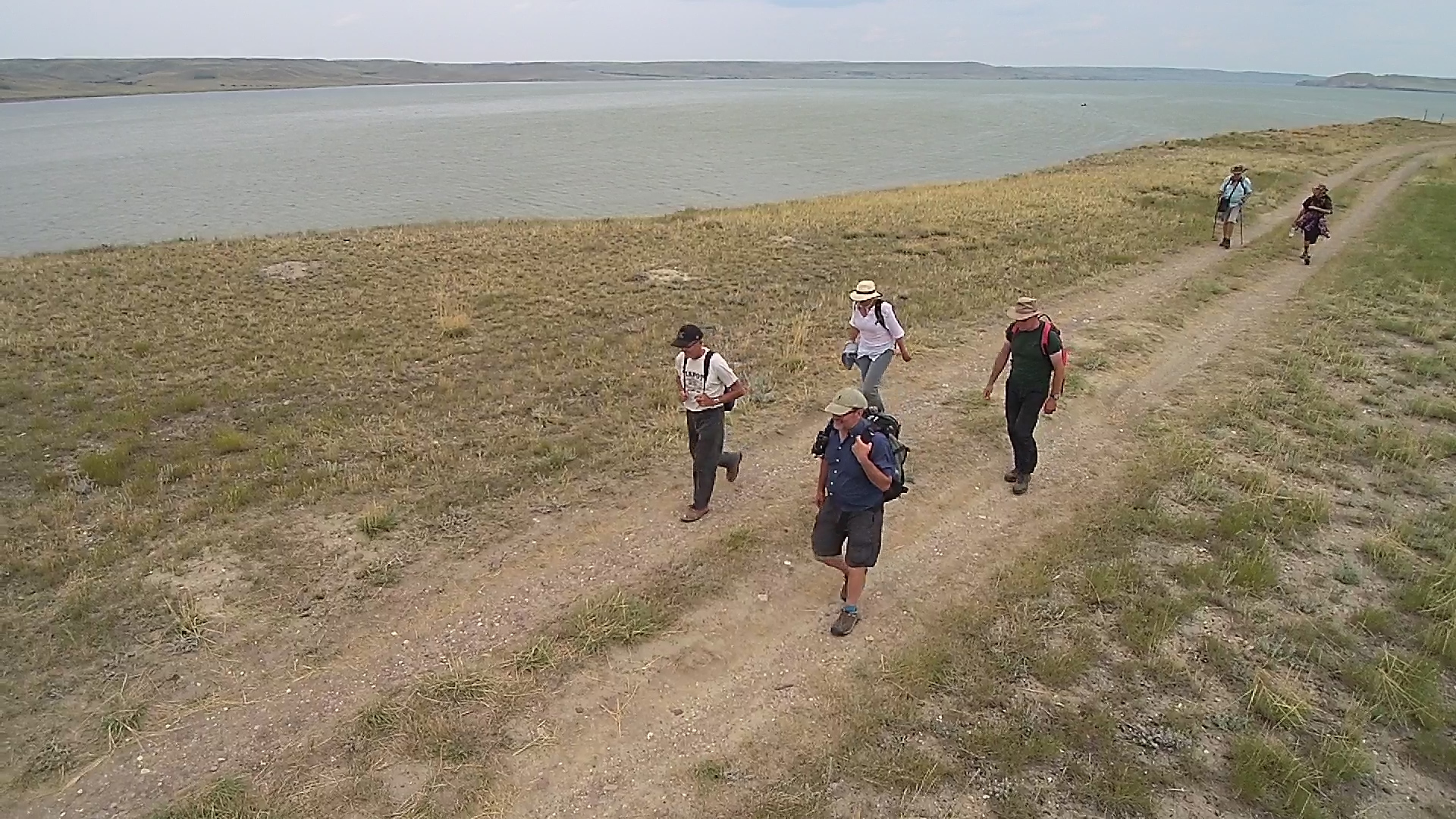
I found myself saying it on the second last day of the NWMP trail pilgrimage. We were walking atop a tableland of prairie grass. We’d slowed to look at tepee rings – about a dozen of them, stretching across several high hills. Just then there’d been a magical moment, as a small herd of unbroken horses wheeled counterclockwise around us at full gallop, circling to come up right behind Madonna, who was behind us and so intently peering at some of the rocks that she didn’t notice the animals, clustered and shivering, in turn peering at her. Then suddenly the horses were gone again, and we found ourselves looking up at an increasingly black, roiling cloud that stretched from one horizon to the other. A group of cattle nearby starting lowing – a plaintive, anxious sound. A muscular north wind came up, and with it the first drops of rain, pelting hard and from an angle. Some kind of weather coming.

We were too far from any coulees to take shelter, and there were no trees (not that trees would have been a good idea anyway). Gwenanne had found a small cut in the prairie, a few meters deep, and the group of us huddled in there. I still had some hot tea, but when the skies started growling thunder, some of us went to our elbows. The cattle were making very unhappy, frightened sounds. Rain beat down and lightning cracked. “It’s the bear principle,” I joked, “you don’t have to be faster than the bear, just faster than the other person.” “Good, well one time to be happy I’m the shortest,” announced Madonna.

We found out later there was an extreme weather warning for wind and thunderstorms for our area at that moment. Just like the prairies, I thought, to give us such an experience on the second last day of trekking. The wind was so strong that the storm blew over, and drying out happened quickly, although the temperature had dropped precipitously. It was a howling, cold, night, and by the time the vehicles were moved and the tents put up we only had time for some soup. Communitas in a crowded van. I crawled in to my tent and listened a while to the gusts buffeting the nylon and straining at the stakes. Then I put in earplugs and borrowed in. Getting used to the prairie isn’t just beautiful sunsets and endless days of watching deer spring out of the valleys. It’s also this. A reminder just before parting. Some kind of weather.

Matthew post storm

Categories
Uncategorized

Eating like a Horse

stag watching us

It’s raining lightly, tonight, at the Brost ranch. While there was still light, we headed past the ranch-house beside us, and down a grassy path to an old monument half-hidden about a half-kilometre away in the trees. It’s a small, mostly-forgotten concrete marker that says “North West Mounted Police post Cottonwood Coulee, 1878-1885”. The rancher told us it was there. Hugh knew there was such a marker, from the Everett Baker slides, taken in the 1950s and 60s. No one knows when the marker dates from. As we stood on the site of the old fort, over the hill, the sun was setting in brilliant golds and reds. Do you see that? asked Madonna, pointing. From the top of the coulee, a stag is watching us, framed against a sky like a painting.

Tonight’s dinner was a good example of communitas. Each of us brought something to the table – the Jorgensons brought pasta and pesto, Rick his hamburgers and onions, Madonna a lentil casserole, and I had my rations. we made a feast of it, laughing and teasing each other. Two days left in the walk, and I am disturbed that my mind is already starting to turn away from blisters and feet and the history of these hills to scheduling back in Montreal. Food tastes so good when you’ve waked so far for it, I think.

Speaking of eating, on our way back from the monument, the yard is full of horses, together with some cattle and a donkey. One of the horses is so interested in my camera that s/he looks like they want to eat it. We get back, only to hear from Gwenanne that one of the horses was nibbling at our tents. The ranchers tell a story of a local hunter who left his new truck in the field only to come back and find it scratched and all the plastic eaten off. Apparently, the horses like to nibble. As I write this, it’s dark, and there are horse sounds all around. I will move the van somewhere closer to the tent, and hope for the best.The group head off to sleep. There’s a neighing sound, somewhere close by. “I’d better check,” Madonna laughs nervously. “They might be eating my tent by now”.

communitas dinner