Categories
Uncategorized

The birthing of a pilgrimage

Allen ponderingThis hostel is accredited, begins the promotional blurb for Meso Gård , and recommended by the National Pilgrim Centre. It has met the same requirements, and holds the same standard, as the pilgrim accommodation along Camino de Santiago. But a Spanish pilgrim who comes to Norway will find themselves, not in a bunk room in barren and dusty Castrojeriz, but in a typical sod-roofed, log-cabin style Norwegian hostel in the Rennesbund district along the St-Olaf’s Way, where a river rushes by, birds are singing, mountain flowers bloom around you and everything is green. Meso is a world away from a Spanish albergue. And the differences aren’t just in the lack of Rioja and dust (the first to better deal with the second).

Those who planned the St-Olav Weg have tried to make it familiar. The elements are as standardized as the boarding procedure at airports. There is a passport, obtained from an official pilgrim centre and sized appropriately for tucking into a backpack, local business stamps validating one’s walk along the trail, trail markers along paths and roads and paint slashes on rocks to guide the way, ‘pilgrim meals’ offered at some local restaurants, and several revitalized ancient routes (traceable on a smart-phone app) toward a cathedral city celebrating a medieval saint.

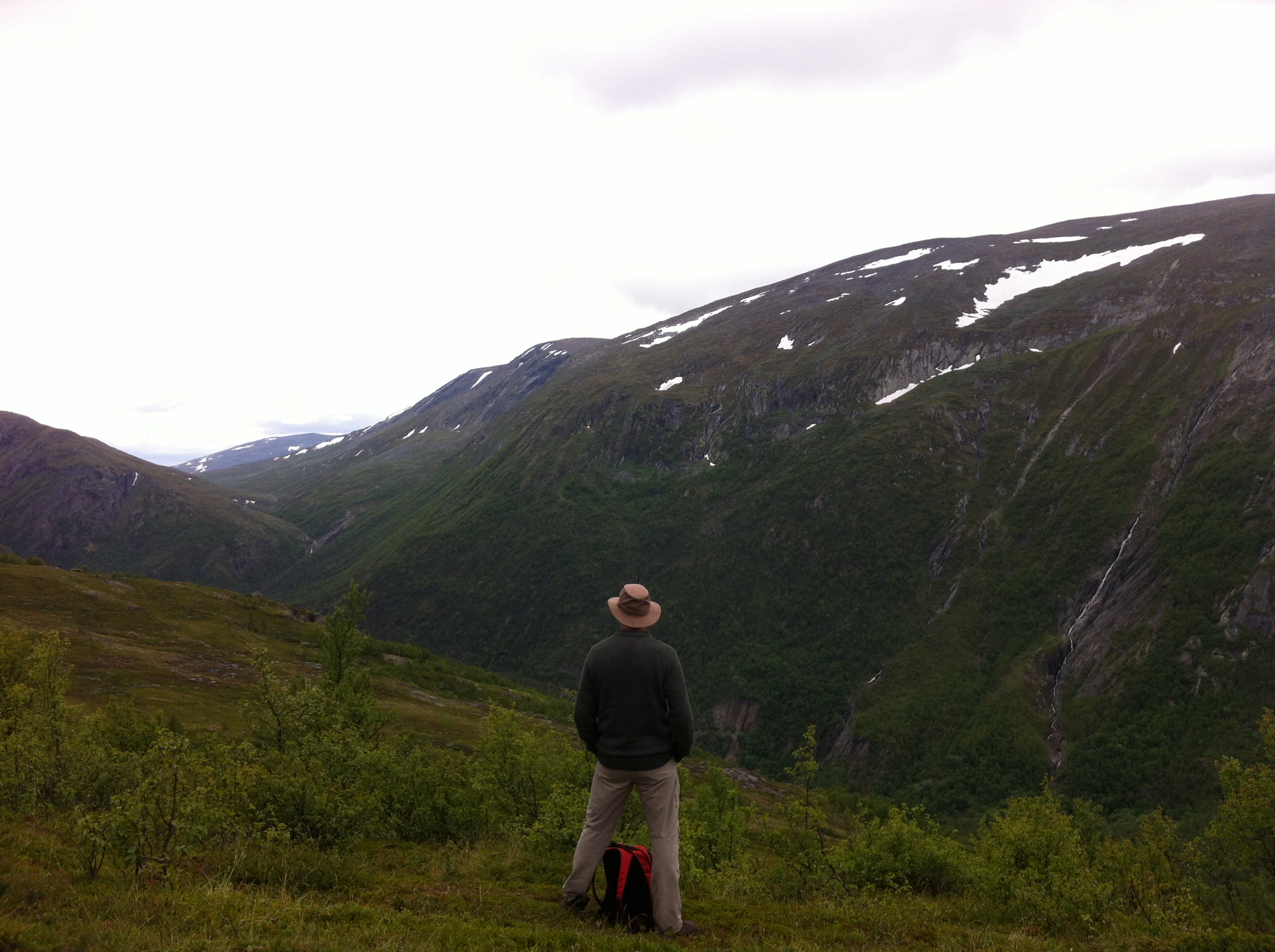
Yet the similarities between the two pilgrimage routes are overshadowed by differences as high as Norway’s mountains. The mountains, in fact, may be the most obvious initial difference, at least from the Camino Frances part of the Spanish trail. It’s been less than two weeks since I walked with five other Canadians from Dovre, in the Dovrefjell district of Norway, 250 or so kilometres to Trondheim. As far as I know, we were the first group of Canadians ever to walk this way as pilgrims. Unlike my experiences on the crowded Camino Frances, there were very few others we met. Those we did echoed our experience of a satisfying but extremely tough walk through conditions more like the high Rockies than the Meseta. In part because of an unusually late, cold and wet spring, we forded swollen mountain streams, jumped from hillock to hillock through kilometres of bog, and in sections of the trail found ourselves going days without seeing other human beings, much less a store to purchase supplies. We fell down, we froze, we saw incredible beauty, one of our group broke her ankle among the endless tree roots. It may be ancient, but it was not an urban walk. Café con leche? Forget it, unless you have a thermos, some farm experience and can catch one of the abundant sheep or goats.

Because it is still early in the redevelopment of the St-Olaf Way, one of the most fascinating parts of the walk, for me, was how we met those still trying to put their mark on how the trail will develop. I felt like we were there at the beginnings of something important. We met chapel builders who want to make sure there will be a spiritual component to the walk, officials who seek the ‘new spirituality’, walkers interested primarily in ecology and environment, and others who are developing their businesses in hopes of increasing numbers of high-tech backpackers showing up at their doorsteps.

All of which raises some interesting questions. What gives a particular pilgrimage its unique character? Is there such a thing as a more or less authentic pilgrimage? It seems to me that the inevitable conflict of values in this birthing of a European pilgrimage route is useful, because it helps bring about something that, however it borrows from the past, is new. As my friend Allen Jorgenson noted, the role of land, and of landscape, is more important than some of us have realized. Maybe we should be talking about pilgrimscapes, and how the outer journey influences the shape of the inner one.

Whatever the medieval St-Olaf route once was, there is now a struggle for its modern identity. It is definitely not the Camino. What it will be remains to be seen.
Alpine shelter

Categories
Uncategorized

The Hidden Pilgrim

sunset in Budsjord
Our first night in the mountains of central Norway, we found ourselves in the absolutely idyllic Budsjord Gard, a small farm converted into a pilgrim and traveler centre. Centre is too grand a word: one of the buildings is a former horse stable where five beds are lined up in the five stalls. The night we stayed there our eldest traveling companion was put up in one of the former granges, where even short people have to stoop to go in the door, there are holes in the walls (a temperature problem on a very cold June night) and there is a nearly-foot wide gap between the entrance and top stone stair, a hole through which it would be a 2 meter fall to the ground below. The common bathroom is a renovated interior in an old building entered through a hobbit-sized door, where a bedrock piece of granite sticks up through part of the floor in front of the wash basin. Several of the buildings have the overgrown turf roofs typical of old Norwegian farm out-buildings. I absolutely loved the place.

Add to the charm of the scenery a wide-eyed young Norwegian woman who with breathless sweetness told us that it was her first day on the job and we were her first pilgrims, and a one-armed and grizzled German pilgrim who arrived mid-way through out meal, asked for food and lodging and told us, wiping the sweat from his brow with his stump as he ate his supper that he was a former marathon runner and on the St-Olaf way was averaging 25 miles a day through the mountains. Especially impressive given that the range is traversed with swollen spring streams. Between the German’s lively and intelligent face and the almost unbelievable open-eyed innocence of the hostess it was all I could do to wait until the poor man had eaten to pull out my camera and ask them both for interviews.

I asked all the usual questions of the German pilgrim. Despite his obvious intensity and the wonderful character evident in his face, I was a bit disappointed with what I got: a listing of distances, mostly. I put away the camera.

Later, I bumped into the German outside the washroom. He motioned to me. “Listen,” he said to me in his half-English, half-German. “I didn’t say this inside. But I have another reason for going on this pilgrimage. I am walking 500 km to find out if God exists.” What I was thinking was: why does this always happen? But I fought the urge to go get my equipment. Not entirely happy, I just stayed put and listened. “34 years ago,” he said, “there was a young man – me – who had an accident and was – how do you say it – not with it, with life I mean. Out of life for three days. I was between death and life, and somehow I came back to life. Now I want to know why. Now I walk to find out if there is a God and if God brought me back as an accident, or for some reason.” “Do you want to tell me that on camera?” I ask him. “No.” he says, “But I want you to know.”

Categories
Uncategorized

At Norwegian Customs

When it’s my turn at the customs booth the uniformed official in the booth asks why I’m visiting Norway. “The Saint-Olaf trail,” I say. Then, when her face registers nothing, I add: “I’m going to walk on the St-Olaf way from Dovre to Trondheim.” I’m careful to pronounce the “h” in Trondheim as a “y”, the way I’ve heard it done. “So you’ll be coming back to Oslo?” she asks. She’s not looking at me, making a point of it, flipping through the pages, checking where I’ve been on this passport. “No, flying out from Trondheim.” I get to say that “y” twice, a secret pleasure. “When do you leave the country?” This still looking at my passport as if it contains some secret unknown to me but that she has to discover.
She’s about my age, I realize, or only very slightly older, in her mid 50s, maybe. I think I see in her face the same kind of lines I know from my childhood among the Scandinavian settlers in the Canadian west where I grew up. But maybe that’s the romantic part of me, stretching to make some connection in this land whose people and language seems so foreign to me, even though half my genes come from this soil. “In 13 days” I answer. I wonder if there’s a problem. Then, because my default is always to try to make contact, even when I shouldn’t, I add: “I hope, at least. Depends on how it goes on the Way.” She reaches for her stamp without any indication that she’s even heard what I’ve said. Then, as she pushes the official imprint of Norway down onto the paper, she looks up and, almost unbelievably, smiles, a big broad smile. “So you’re a pilgrim?” she asks. Despite my attempts to introduce just that subject, I’m caught off guard. “I guess so,” I answer awkwardly. “Enjoy your time in Norway. Have a good trip.” She hands me back the passport, the words “Canada” on the top, facing me. Then when she looks up at me, I hesitate in place, wondering if there’s more of this conversation to come, until I realize she’s actually looking through me to the person behind me. “Next,” she calls out.

Categories
Uncategorized

Dreaming of Pilgrims

escapees
It’s wonderful to know artists. Some time ago I woke up after a dream in which I had watched a woman in a medieval scriptorum ‘break open’ a Celtic Gospel manuscript and draw medieval figures leaving the manuscript even as modern pilgrims came in to explore. As we were preparing for our Pilgrimage Conference at Concordia (May 3-4) I told two artist friends: Janice Poltrick Donato and Cindy Walker. Janice drew my dream! And I wrote a poem to the escapees. What a fun way to prepare for an academic conference! (Janice and Cindy will be unveiling the full artistic creation and working on it at the conference in reaction to the academic papers – we’re calling the process peregraffiti)

To the escapees from the Lindisfarne manuscript:

When you stepped through the wall it must have surprised you
to see…..
Well, to see nothing at first,
just space,
blank front and behind, if blankness has direction.
Your eyes scratching for purchase,
anything…
here no richly knotted, woven gold, no winding serpents swallowing tails,
no clever labyrinths of animal overlaying cross,
no tight little fecund world,
Just horizon.

It must have been a shock.
After all, most escapes automatically come with dreams:
I don’t know,
rich tapestries lining a foreign street, a feast heavy with laughter,
kisses stolen,
a light-dappled meadow honeyed by bird-calls.
Something, at least.

Poor you. You got nothing.

Or rather, you got space –
line-free, free-lining, free-wheeling space,
the pilgrim’s only promise: space to walk:
stories unfurling like steps
stretching ahead.

13Ap27_Mtl_ (18)

Categories
Uncategorized

Those Surprising Vikings

At the Anderson family reunion I attended years ago, when the heavy-set, ruddy blonde prairie farmers I’m from passed me a 24 of beer and told me I have Viking blood coursing through my veins, I don’t think they realised how confusing that could be. Now, having fought my way through several books and a couple of BBC documentaries on the subject, I’m less sure than ever.


What’s a descendent of those who were the scourge of Europe through the not-so-dark Dark Ages to do? We’re having a full-blown identity crisis. The wonderful, recently released History channel series “Vikings” takes some of the usual turns (rough and ready adventurers with lots of facial hair – at least, the men. Blood and gore. Plenty of sex). And yet, despite some caricatures, the greater truth the series portrays is this: it turns out that being a Viking meant above all being, believe it or not, complex.


If only we’d thought about it, we’d have suspected the former “pillage and plunder” paradigm too simple to be true. How could a small band of tattooed berserkers really be responsible not only for the sack of monasteries and cities all over northern Europe (and as far as Byzantium), but also for positive changes: the design of beautiful and advanced sea- and river-craft, the exploration of waters as far as North America, a fashion craze in costume jewelry – then, not now – the minting of coinage, and a process of urbanization that led to the establishment of quite a number of NEW cities? And why should small farmers who only wanted gold and slaves have become quite so good at setting out grid-lines and building churches? It may be a surprise to the neo-pagan “revivalists” to find out – should they ever care to – that the various hyphenated Scandinavians of the British Isles and Normandy were in part responsible for the 11th century re-flowering of Christianity.


My Norse relatives will hear more about this as I travel through Ireland and Norway on pilgrimage this summer. But the first to be surprised is me: I thought I had my ancestors pegged. It turns out they were more than just a hardy lot. They were often violent warriors of fortune, yes. But just as often, many of them were travelers and settlers, artists and urban planners, the pious and the pilgrims of their days. Learning as they traveled. That latter part doesn’t just sound like a heritage. That sounds like a plan.

Image

Categories
Uncategorized

NEW trailer for my upcoming documentary!

Error
This video doesn’t exist
w