Categories
Uncategorized

The Way is Made by Walking

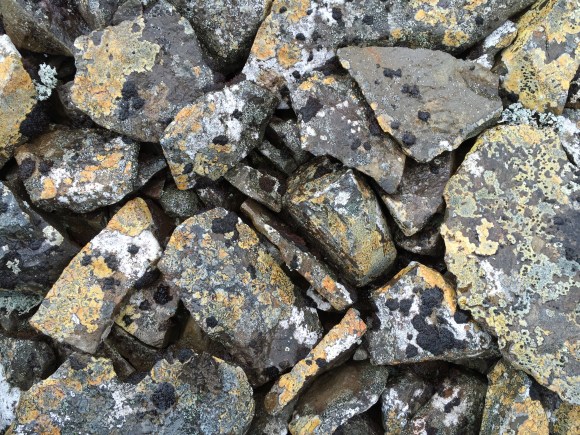
field of stones

Bare details don’t tell it all: Bær to Lundur, 17 km, Oddsstadir to Fitjar, 12.2. There is a map, but no obvious trail. Elínborg, Hulda and Floki, with few others, dream of a trail walked by Icelanders and others, to mark faith, and history, and friendship. They have planted posts over the years to help guide the way. But unlike the Camino, unlike even St Olaf’s, here there is rarely a visible path. A Spanish poet wrote that “the way is made by walking”. And isn’t that the way it is with life? The way is made by walking. And so is the trust, and the faith, and the community, and the hope. And the pilgrim.

made by walking.jpg

fording the stream

map of route

Categories
Uncategorized

Pilgrimage Gross

moss on rocks detail

Somewhere between Hvalfjördur and Thingvillir (the double ‘l’ pronounced with a d/t sound, thus Thing-vit-leer) we were drenched in mist, rain, and mud. And, since our day ended up being an almost 30 km scramble over what the Icelanders call ‘leg-breaker trail’ (Leggjabrjótur), by the time we were done we were sore and wet and cold in every possible way. And dirty. When my daughter looked at some of the clothes we’d been wearing, she coined the term: pilgrimage-gross.

Which got me thinking about appearances, pilgrimage, Icelanders and North Americans. Nowhere we stayed had the kind of full-length, or even half-length, mirrors so common in North America. There was a kind of self-acceptance and natural toughness to the Icelanders with whom we walked, an easy gracefulness that seems to come from closer contact with the natural environment. What’s more, I noticed that the folks we set out with became more handsome and beautiful as we shared the trials and the trail together. So even though our clothes (and especially our boots!) became progressively more ‘pilgrimage gross’, a kind of ‘pilgrim beauty’ shone even more through the mud, mist and cold, and was everywhere present in the people and the land.

Jonina meditates

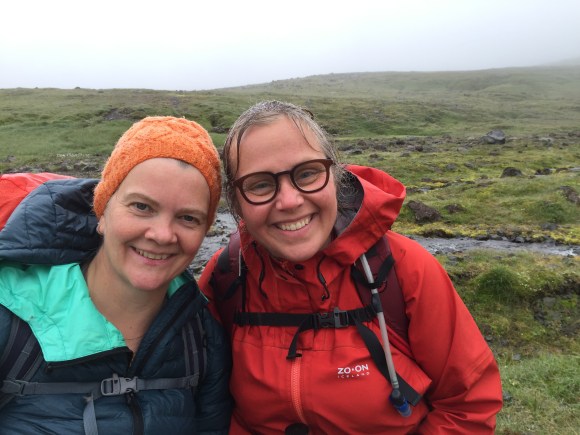
Ertla and Elinborg in mist


Categories
Uncategorized

Things You Wish You Hadn’t Said on Radio from Iceland

Iceland troll head by falls
My short TV appearance on Icelandic TV, filmed at the end of our walk (at the end of the report in Icelandic)
http://www.visir.is/-gengu-berfaett-sidasta-spolinn-i-pilagrimagongu-/article/2016160729463
I was feeling somewhat exhausted when CBC Radio One’s All in a Weekend called me on the trail for a follow-up interview while we were high up on ‘bone-breaker’ trail after having been briefly lost in the clouds (by the way, Gabriel had to shout out to me how to say “bye” in Icelandic, but they cut that part). The “troll” comment was a reference to the big, happy rock-and-roll guy! #thingsyouwishyoucouldtakeback

http://www.cbc.ca/news/canada/montreal/programs/allinaweekend/a-walk-across-iceland-1.3692927

There was also an earlier interview on CBC radio about Iceland, just before leaving:

http://www.cbc.ca/news/canada/montreal/programs/allinaweekend/pilgrimage-to-iceland-1.3692347

Concordia (and theological studies) has been getting some good coverage out of the 2016 Icelandic pilgrimage!

Categories
Uncategorized

Fresh Trout after the Prestergatta


Day two of our pilgrimage through Iceland: We’re sitting, eight Canadians and ten Icelanders, at one long table. Our host, Hulda Gudmundsdottír, who has put us in her renovated barn (barn being a word that hardly describes the luxury of the place) comes around as we finish our meal of lake trout, potato salad and greens. Did you like the fish? She asked. I went out and caught it with my son in nets, three days ago.

The fish is only one of the wonders of this place. Elínborg Sturludottr led us along the prestergatta today, the priests’ path from the small church where we had our matins (morning devotions) to the even tinier church where we had our vespers (evening devotions). Our other priest guide, Floki Kristinsson tells us that the morning church was built on the site where Rudolf, the English monk who had accompanied St Olaf up to his death in 1030, came that same year to Iceland and started the first monastery. The Icelanders are a fun group, their humour in contrast to the starkness of this land. For the first time today, we came across what we Canadians call real trees. The Icelanders told us: what do you do if you’re lost in a forest in Iceland? Stand up. At which they laughed uproariously. We climbed up and out of the fjord this morning, 1000 feet, and came down the valley to this beautiful lake setting. In passing we were offered an unexpected afternoon coffee and some sort of sweet flatbread, by an Icelander who is interested in our pilgrimage. This place, including the people, is truly a place of wonders.

An extra treat on this blogpost: fellow pilgrim, Ásta Camilla Gylfadóttir, reads a short Icelandic folktale titled: The church builder at Reyn. Click on this link for her lovely diction and accent!

July 20 afternoon coffee
July 20 afternoon coffee traditional Icelandic cottage
Categories
Uncategorized

CBC Interview on Icelandic pilgrimage

turning at the crater

July 2016 interview with CBC Radio One Montreal show ‘All in a Weekend’ hosted by the gracious and thoughtful Nantali Ndongo, about my pilgrimage to Iceland: http://www.cbc.ca/news/canada/montreal/programs/allinaweekend/pilgrimage-to-iceland-1.3692347

Categories
Uncategorized

Jihad and I on Pilgrimage

2016-06-04 13.55.39

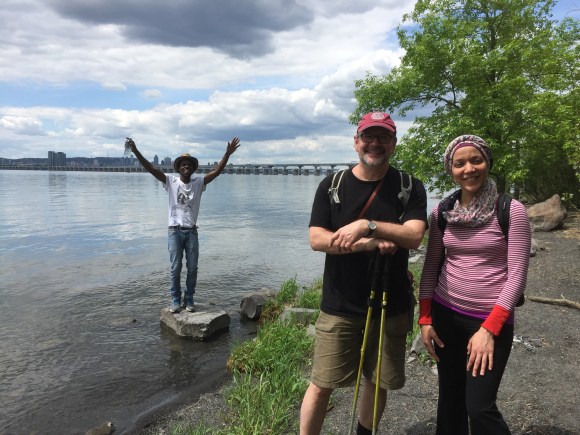
It’s been over a month now since I joined Prof Sara Terreault and her class for the third annual pilgrimage between Montreal and Kahnawake Mohawk Territory. The students were fantastic – interesting and interested, willing to learn and to dive into anything (even, sometimes, the water). Jihad T was a student in the class and was gracious enough to join me for two interviews, one in French on Radio-Canada (see the “interviews” link above) and the other in English, on CBC One’s ‘Home Run’ program. Thanks to M, who made the interview available to us! Have a listen! 

Categories
Uncategorized

And I Have Felt a Presence

2015-07-26 10.57.57

For I have learned

To look on nature, not as in the hour

Of thoughtless youth; but hearing oftentimes

The still, sad music of humanity,

Nor harsh nor grating, though of ample power

To chasten and subdue. And I have felt

A presence that disturbs me with the joy

Of elevated thoughts; a sense sublime

Of something far more deeply interfused,

Whose dwelling is the light of setting suns,

And the round ocean and the living air,

And the blue sky, and in the mind of man


(William Wordsworth, Tintern Abbey, July 13, 1798)

Categories
Uncategorized

Far from One’s Earthly Home

(this is a guest blog posting on postmodernism and pilgrimage, by Sara Terreault, my friend and pilgrimage studies colleague. Her thoughts were inspired by the questions and comments posed by another of our friends and colleagues, E. Moore Quinn. Their back-and-forth conversation was too good, and too detailed, to leave in the comments section!  MA)

Hi Eileen,

Fancy meeting you here: do you come here often? 🙂

Great questions.  I should be grading papers but cannot resist jumping in.  Here goes, a few note-form thoughts in response to your thoughts:

1) “postmodernism (cultural orientation)/postmodernity (historical time period)”: well, literally “after modernism/modernity”.  So applies to cultures that have been shaped by modernism (or in short, the so-called “Enlightenment Project”), but have grown suspicious of modernist assumptions and values, so

1a) Enlightenment Project, a meta-culture (birthing the so-called universalist  “metanarrative”) consisting of : i) anthropology: human person as primarily (or ideally) interior, individual, rational, and, once freed from the tutelage of superstition (incl “religion”) capable of solving all human issues by exercise of rationality); ii) epistemology: rational, objectivist empiricism, privileges scientific method;  iii) ontology: materialist, immanentist.  Implications: the eclipse of the transcendent, the spiritual/religious, the affective.
1b) Romanticism (late 18/early 19th c.) a reaction/response to the hyper-rationalism of the Enlightenment, but which nonetheless retains the individualist interiority of Enlightenment anthropology … however privileges affectivity, intuition, arts and artists, rather than empiricist rationality and science.  Romanticism has an ambiguous relationship to “religion” and I think we can see there the roots of the contemporary postmodern “spiritual but not religious” (re-opens the door to the re-entry of transcendent reality, but not through traditional “religion”).
1c) Finally: postmodernism: disparate cultural movements that have challenged the assumptions and values of the Enlightenment  and  to some degree Romanticism.  It is paradoxically both hyper-modern and anti-modern.
1d) postmodernity: When is this? This will be endlessly debated, but it makes sense to me to place this post WW2, when all the certainties of modern hopefulness in humans and their “brave new world” lay in ruins after the horrors of two world wars, genocide, totalitarianism, atomic weaponry: our lovely individualist, scientific rationalism has *not* saved us after all. Now what?  Western (modernist) culture fragments into many small cultures (mini narratives) privileging the local, the plural, the diverse, the contingent, the social
2) Shrines, relics, pilgrimage and postmodernity: I’ll suggest that the “shrine” is the in-dwelling place of the divine, “relics” are the meaning-imbued and empowered material memory of the holy one (saint) and the holy experience (in this case, pilgrimage); and “pilgrimage” is physical (or in some cases only spiritual) journey for and to self-transcendence.
2a)  i. The shrine may indeed be spatially located, architecturally realised.  But it is also (at least in Christian tradition) interior, spiritual and personal: “You are the temple of the Holy Spirit” (1 Corinthians).  For postmodern people, the secularity of modernity means that attachment to and experience of traditional religion is often thin or very thin.  Yet the desire for and valuing of the transcendent is nonetheless strong, but is expressed largely privately (religion having been banished from the public square).  So the interior understanding of shrine is “natural” to us postmoderns (we are perhaps just a little bit gnostic in our tendencies …).  We may structure our spirituality on aspects (and in the case of pilgrimage), on locations of traditional religions) but we do this largely individually, partially, and with great focus on interiority. ii. peregrini:  I totally agree that postmodern pilgrimage’s “interior shrine” is in many ways like that of the Celtic peregrini pro Christo whose pilgrim journeys were not toward any wrldly centre, that is toward any spatially/materially located shrine, but rather away from the “centre” of the earthly home, familiarity, comfort etc. Their “destination” is not spatial/material/earthly but rather eschatological, and their only earthly material shrine is their own pilgrim bodies. iii) Relics: the material and sacramental traces of holy people, places, memories.  Not a long way from a strand of hair in a locket, or a pilgrim badge or tattoo, or a burden stone to be left on the road, or a postcard or souvenir …
Your further thoughts?


Categories
Uncategorized

7-7 and Walking Remembrance

Kings Cross Paddington London 2015

Today I’m in London. Ten years ago this morning, 52 people were killed and over 700 injured in the infamous Tube bombings. One of the bombs was not in the underground but on a bus at Tavistock Square, only a couple of hundred meters from where I am writing this.

On the bus returning from Waterloo Station this morning there was a sign encouraging passengers to join in a minute of silence. Another suggestion: that all passengers disembark from whatever they were riding, one stop before their destination, in order to walk the final short distance to their destination. “Remember while you walk.”

Walking slows us down. It can – at times – be that unaccustomed slowness that makes us think, remember,and maybe reconsider.

angel from St Pancras church London 2015

Categories
Uncategorized

Stiles and Kissing Gates

down to the river fording

Some fences mark a human boundary, some a physical frontier. This fence was one of the latter. Instead of keeping apart two rocky fields that are otherwise indistinguishable, or two similar flocks of sheep, the fence at the lower field boundary marked a sharp dividing line between field and forest, between hillside and deep valley, and between sunlight and shadow.

Our group of six crossed the stile, the first across uncharacteristically waiting on the other side of the fence until we were all together. By unspoken consent joviality had been replaced by solidarity. The overgrown path and lack of certainty made us pack animals.

For someone who grows up in the Canadian west, crossing a fence inevitably means grasping strands of barbed wire in hand, stretching the space between the lowest and middle strands as wide as possible, and then squatting and pivoting your back end while you lift a foot and squeeze through, back straight and derriere high, in hopes that no piece of shirt or pants will catch a barb and tear. There are very few stiles in Canada because there are very few public walking paths on private land. In England the history of the stile and the history of the citizen fight to keep public paths open are one and the same. Most UK stiles – certainly the ones we crossed – are built by property owners under legal compulsion.

Most stiles are ingenious in their simplicity. Usually, they consist of a post and a step on both sides of a fence: one step up, then hold the pole for support, swing one leg over to the step on the other side, then the other leg, and Bob’s your uncle. With a stile there’s no need to remember to close a gate, and there’s never any concern about a jammed lock or unworkable mechanism. The livestock have no chance to get out and repairs consist only of replacing a board every few years. The wooden step stile may be primitive, but it’s hard to improve on a model of such basic efficiency.

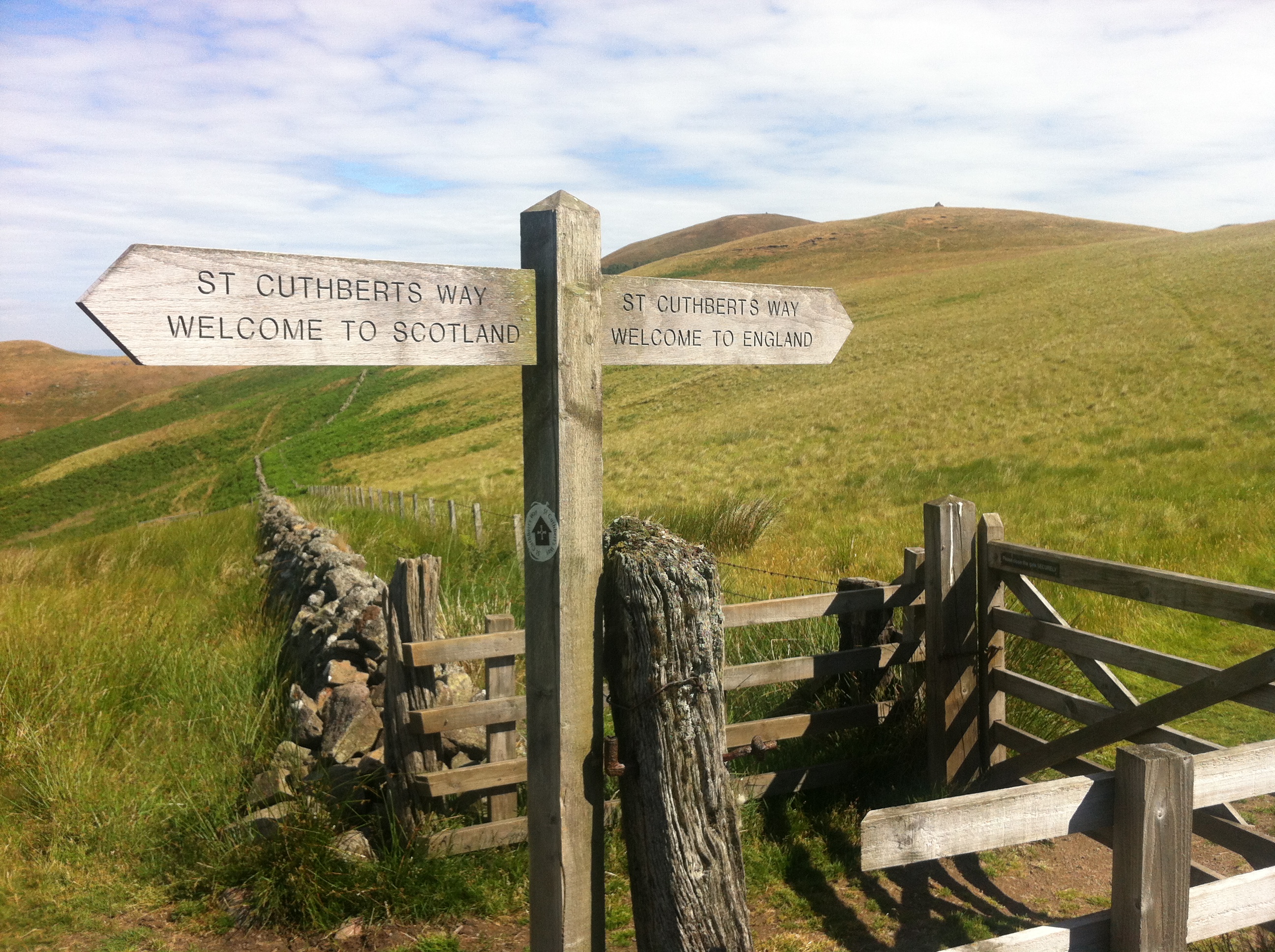
Perhaps my favourite gate is the one on St. Cuthbert’s Way, at the dry-stone fence, edged by thistle and grass, that marks the border between England and Scotland. It was a bit lonely a location, on the top of a knoll and across a valley from a Bronze Age ring fort, but the day I reached it I felt a sense of occasion crossing, and missed having someone there to share it with. There should have been a pub, as there had been, and a good one, back in Kirk Yetholm. Instead there were cattle, and stinging nettle, and burnt-yellow grass, so I kept on.
the border

Another common form of fence crossing in the UK is what is known as the ‘kissing gate’, so called because there is a gate in the fence that swings free between two fixed posts, just to the point of being able to touch, or ‘kiss’ each post. If you were looking at a kissing gate from above, you would see a walker step to the gate, push it against the far post, step into the small space at the open end of the “vee”, then push the gate back against the post just crossed, and exit through the cleared path on the other side. The point of a kissing gate is that a person can step into and through the pocket that is protected from the swing. But any four-legged creature cannot.

For the walker, the most reassuring thing about a stile or a kissing gate is that it’s proof, physical evidence in wood and sometimes steel that this is, if not the path, at least a path intended for walkers. From where it crossed the fence into forest, the Northdale trail we had decided to take led sharply downhill. As our eyes adjusted to the gloom we stepped carefully over exposed roots and clean river stones that skittered and clattered and slid underfoot. There was a close, fragrant feel to the air. I could feel the suddenly coolness on my skin; despite the trees there was a slight breeze from the north; the valley acting as a funnel for air from the high moor country, perhaps from whatever springs fed the stream we could hear below us.

For a path we had chosen because of a lack of options and not for any particular markings, this one at first seemed quite promising. When we had walked only a short distance we saw that were stairs cut into the earth and banked by wood, and because of the steep descent someone had installed first a wooden railing, then a rope alongside the path at waist height. Just when we were feeling heartened the stairs split, each path descending a different direction. It was the classic dilemma: left or right? We chose left, descending another two sets of earthen stairs to a wooden bridge that couldn’t have been more than a few decades old. The stream would likely have been passable without the bridge by jumping from boulder to boulder across the pools and alternating rapids, but the cool forest air and shadow meant that most of the rock surface was slickly moss-covered. Boots would not have held. Someone would have gone in, or bruised or snapped a bone.

On the far side of the bridge was an ascent as steep as the bank we had just come down. After a few yards of climbing, the path disappeared under high ferns. We slowed, wading through the green, unwilling to risk falling into a hole, or worse, down some unseen rock face. For a few minutes we slowly tested the brush for any hint of trail, but it was clear no one had been through in some time. Whatever path was once there had disappeared. We turned back, first descending to the bridge, then back up again to the forest junction, somewhat anxious. Now there was only one option.