Categories
Uncategorized

“Der Pilger (The Pilgrim)” reviews The Good Walk

Gotta love those Germans…
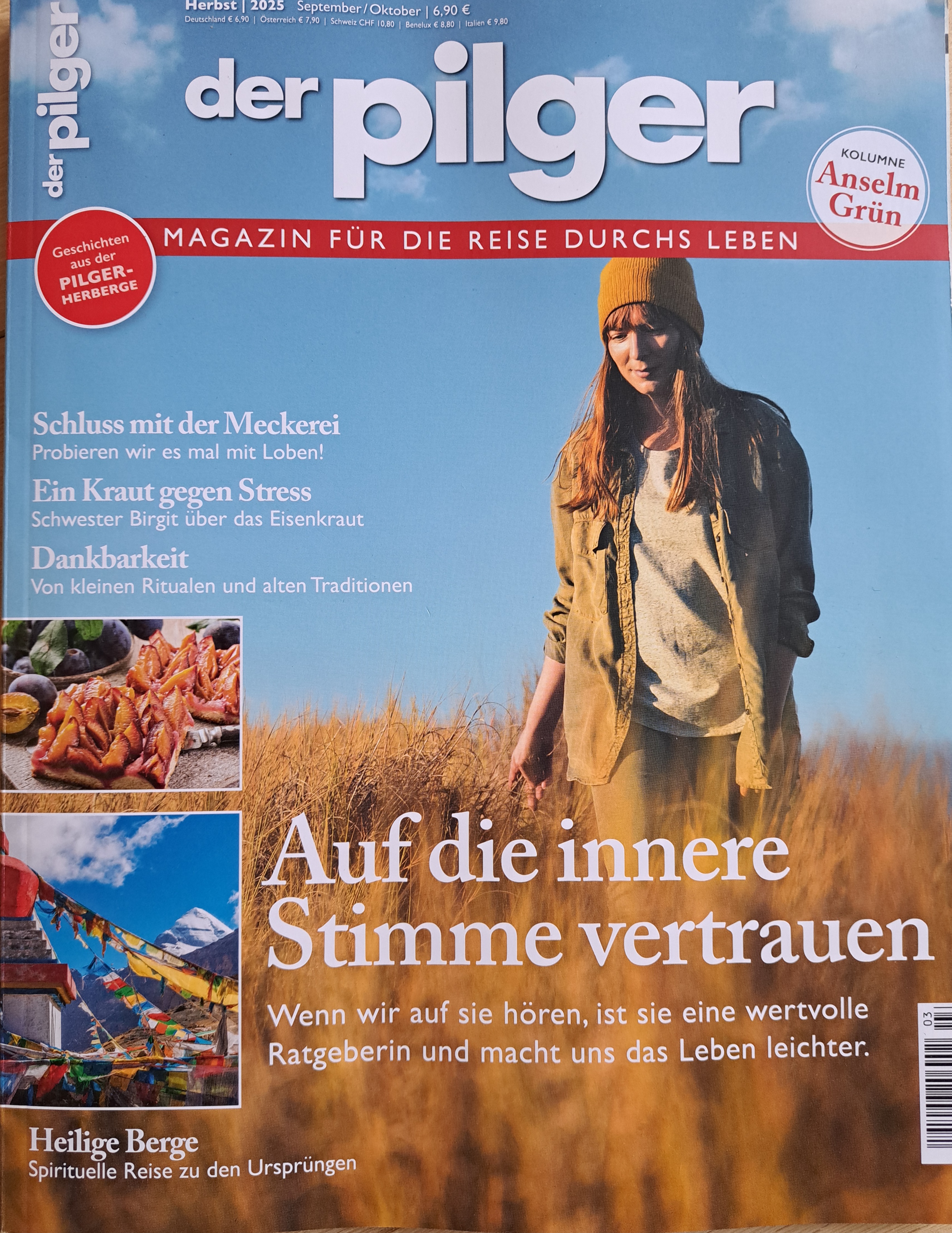
When my friend Traugott Roser contacted me to let me know he’d written a review of The Good Walk, for the magazine Der Pilger (The Pilgrim), I was overjoyed!

My hopelessly naive generalizations about Germans include that…

All Germans are fit and athletic and they LOVE walking and pilgrimages. So they’ll eat up The Good Walk. The book that really ignited the contemporary rise of the Camino was Hape Kerkeling’s fun and incredibly popular I’m Off Then: Losing and Finding Myself on the Camino de Santiago, first published in German and a sensation there.,

All Germans idealize the North American “West” and North American landscapes. Germany is a crowded country that has lost so much of its own “wildness” but still maintains a strong national mythology of origins around it. And yet …

All Germans are aware of and sensitive to Indigenous sovereignty and concerns, and …

All Germans love to read, and as a bonus, as truly civilized people are multilingual and can often read English books like mine, unlike most anglophones and folks like me, who struggle with anything more than simple tourist directions auf deutsch

SO. After all these expectations, how did the review turn out?

Thanks to Google translate, you can read on for yourself….

The Review

p. 43 New Pilgrim Perspectives:

A devout Muslim embarks on the Way of St. James, and a Canadian professor and long-time pilgrim follows the trail of spiritual wandering in the vastness of the Midwest. Two inspiring book recommendations from Protestant pastor and passionate pilgrim Traugott Roser.

The Search for a Lost Home (Die Suche nach einem verlorenen Zuhause)

“Matthew Anderson, Professor of New Testament at Concordia University in Montreal, is an experienced pilgrim who has also led his Canadian students through Spain, France, England, and Norway and has made a name for himself as a documentary filmmaker on pilgrimage. After many trips to Europe, he wonders whether pilgrimage is also possible in North America and what pilgrimage might mean there. In his new book, “The Good Walk – Creating New Paths on Traditional Prairie Trails,” he tells a compelling story of humanity’s age-old paths through the prairie of the Middle West. It is an account of a painful yet healing search for home: “Pilgrimage together with others—in the broadest sense understood as spiritually motivated hiking—is a way of searching for a lost home.” Anderson is a descendant of settlers who farmed…

(P. 45) and built small towns on the supposedly deserted plains of Saskatchewan (see photo above), and [the region once called] the Northwest Territories. Since 2015, Anderson and his wife Sara have been traveling the trails once used by traders, settler treks, and the Northwest Mounted Police, a paramilitary force commissioned by the Canadian government. But Anderson not only gets close to the story of his own family, descendants of white European immigrants, but also of the people who lived there before and were deprived of their land through sham treaties, displacement, and targeted extermination.

Pilgrimage: intercultural and interfaith

Anderson is accompanied on his journey by various companions, including Don Bolen, the Catholic Archbishop of the Diocese of Regina. Descendants of the First Nations, the Lakota, the Nakota, and the Nehyawak (Cree) accompany them or host them, as do descendants of settlers and the Métis, descendants of European-Indigenous marriages, who historically mediated between cultures as fur traders and are now considered an independent nation.

Anderson sees his hikes through the vast landscapes as pilgrimages to places whose history has been partly forgotten, partly erased. This also changes the landscape and its perception itself: through narratives and archaeological evidence, places of living memory emerge.

The places create new relationships and deepen old ones. In this way, the pilgrims come into contact with the spiritual world, [sometimes] with the elders and wise men of the Indigenous peoples, [sometimes] with their own family history, and [always] with nature. Through Christian and Indigenous rituals, the pilgrimage becomes an intercultural and religiously unifying experience. At the same time, it is a painful journey that ties in with the tradition of penitential pilgrimage: The extermination of the North American bison took place in the vastness of the prairie. This deprived the Indigenous people of their livelihood, and thousands starved to death while faced with the government’s deliberate inaction. It is equally painful when the pilgrims encounter survivors from the church-run boarding schools (of both Catholics and Protestants):

On behalf of state authorities, children were taken from their families and  Nations and placed in Christian schools. Only in recent years did the public learn of the graves of thousands of nameless children who did not survive the ordeal.

Reward for Physical and Mental Effort

The paths across the prairie demand physical and mental effort from the pilgrims, but they also reward them: through community, forgiveness, and understanding. Matthew Anderson ultimately even succeeds in finding peace for his deceased parents and for his sister, who died very young. The pilgrim’s path is a good path, and with the project Anderson describes, a new, very unique pilgrimage tradition begins in Canada.

I couldn’t put either book down; it was precisely the different perspectives of both authors that inspired me to consider my own pilgrimage

I couldn’t put either book down; it was precisely the different perspectives of both authors that inspired me to consider my own pilgrimage on the Way of St. James in a new and more profound way: as a consciously religious experience, as a path to encounter God, and as a path to reconciliation.”

Dr. Roser’s Own Pilgrim Book

I wouldn’t be much of a friend, if at this point I didn’t mention that Traugott has published his own pilgrim book. It’s in German, titled Hola! bei Kilometer 410: Mit Allen Sinnen auf dem Jakobsweg (Hola! At kilometre 410 with all senses on the Camino de Santiago).

I wonder if a rather free, but still good, translation might be: “Hola! Fully aware and alive at kilometre 410 of the Camino de Santiago.” It’d be great to see this valuable book out for the English-language reader as well! (By the way, the other book he reviewed with mine in the above article sounds fascinating).

Traugott does all kinds of interesting teaching and research, including (like me) teaching Bible and Film classes. He is also an ethicist who teaches about ethics in healthcare and palliative care.

Thanks, Traugott, for the great review. Buen Camino! Looking forward to walking with you some day soon!

Categories
Uncategorized

Walking the Land: a Canada 150 post

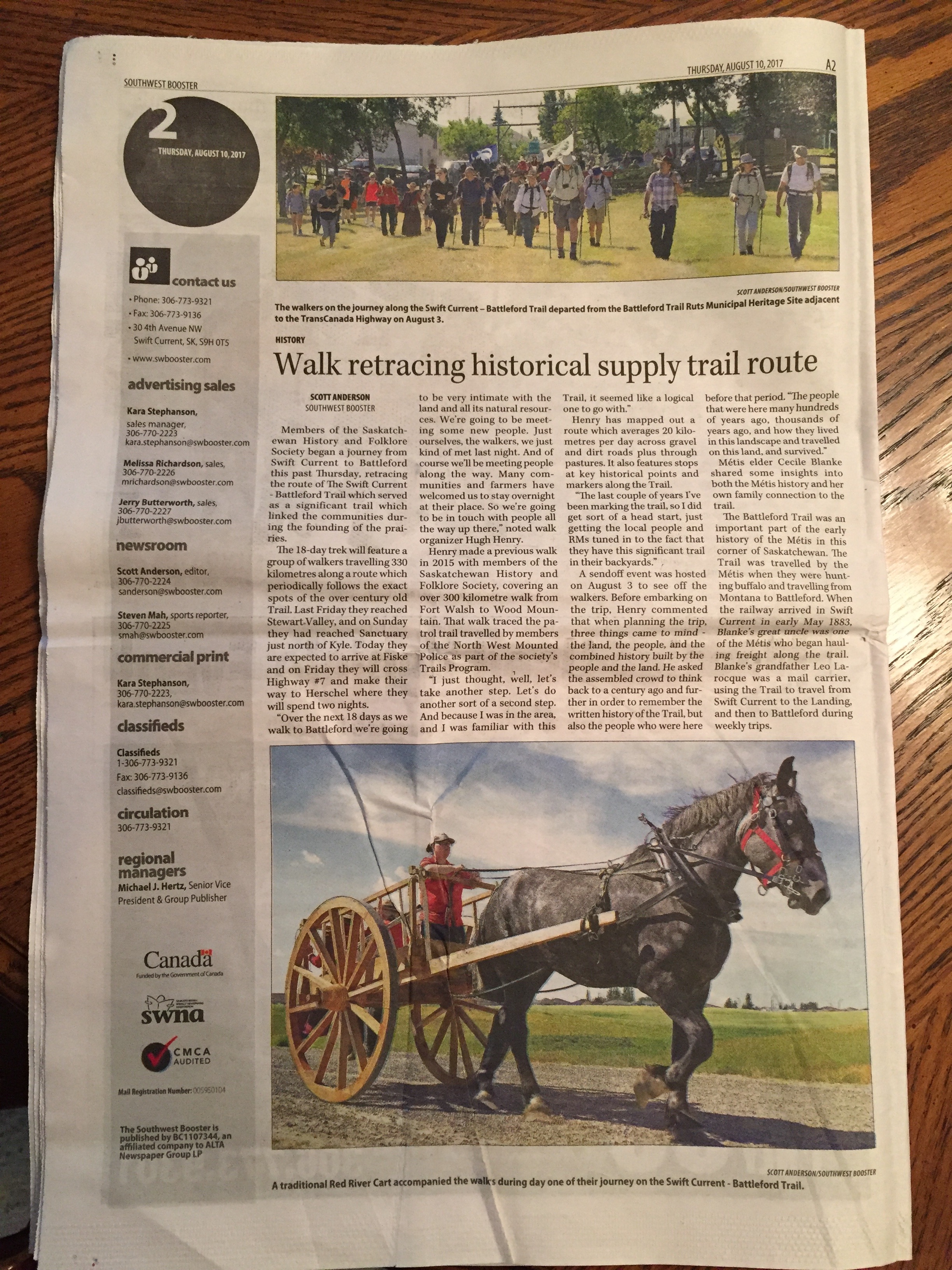
Heritage Saskatchewan sponsored film-maker Kristin Catherwood, who made this short film for the Canada 150 year. It features me and Hugh Henry, talking about the importance of the Swift Current – Battleford Trail, the 350 km trek we finished in August 2017. Thanks Kristin!

Categories
Uncategorized

17 Days

This article appeared a week after we set out, but we never saw it until finishing the trail!

Booster Article

Categories
Uncategorized

It Matters to Me

It Matters Metis Flag

This is what Sharon Pasula’s tee-shirt from the Truth & Reconciliation Commission says. It’s the reason we’re walking. Sharon drove from Edmonton to join us in Herschel. She led us in a smudge the day after Rick (who had led us regularly) returned home to Regina. It matters to me. It matters to us, that the trail we walk has been used for hunting, for freighting, and for settling. It matters to us that a trail that now sits on private land be remembered as of public interest. It matters to us that we remember the three groups that used the trail – First Nations, Métis, and Newcomers (including the military) – and recognize and remember the positive contributions and also the failures and mistakes made along this trail. Most of all, the land matters to us. It doesn’t belong to us. We belong to it. As with the Métis flag Sharon carries, it matters.

Categories
Uncategorized

Before Even Starting to Walk – a Surprise!

culture camp poster 2.1 -reduced size

Madonna Hamel, a friend of mine and an artist from Val Marie, sent me this poster. The rich Métis culture and heritage of the northern Great Plains will be marked, in a small way, on August 3, 2017 as a group of us begin our walk from Swift Current to Fort Battleford. The Battleford Trail is important to Métis history, and so also to the history (and the present-day) of all Canadians. More on that coming up! In the meantime, I’m looking forward to learning more from this vital community!

Categories
Uncategorized

Every Day a Bit More Real

Pine Cree Park 2014

While I plan conferences and teach pilgrimage classes here in Montreal, my colleague Hugh Henry has been doing the heavy lifting of contacting folks along our planned walking route in Saskatchewan. Some of the on-the-ground details remain to be determined. But the route is set, and those who would like to walk with us for a day, a few days, or longer, are encouraged to contact the SK Historical and Folklore Society, at http://shfs.ca/contact/   for more information and to register their names for the walk.

Today I met with two young film-makers who would like to be part of the project. Some of you may hear from them soon, as they are setting up a crowd-funding site.

In the meantime, here is the tentative itinerary:

NWMP Trail – Walk Schedule

July 17   arrive at Wood Mountain Post Prov. Historic Site  Accommodation: camp at Wood Mountain Regional Park (adjacent to Post – pool, showers, food service)  Activities: tour Wood Mountain Post; Rodeo and Ranch Museum; NWMP cemetery

July 18 trek ‘commissioning’ event in morning at Wood Mountain Post; walk through W. M. First Nation to Orthodox church south of Glentworth  distance: est 13 miles/21 km  Accommodation: tenting at church yard; hotel in Glentworth (food service)  Bike Hwy 18 – 19 mi./29 km to Glentworth

July 19 from church to McCord     distance: est. 12 mi /19 km Accommodation: tenting at campground next to McCord museum (store and service station in town)  Bike Hwy 18 – 8 mi./13 km to McCord

July 20 from McCord to Mankota   distance: est. 11 mi /17.5 km Accommodation: hotel in Mankota. or tenting in town; showersOther events: public presentation about history of NWMP Trail markers; reconsidering the history  Bike Hwy 18 – 11 mi. to Mankota

July 21 from Mankota to Walker farmyard     distance: est. 13 mi / 21 k Accommodation: tenting in Walker farmyard  Bike Hwy 18 – 41mi. to Val Marie

July 22 from Walker farm to farm at corner of Hwy 18, E of Val Marie. distance: est. 14 mi / 22.5 km Accommodation: tenting in farmyard    

 July 23 from farm to Val Marie. distance: est. 9 mi / 14 km  Accommodation: Val Marie hotel / convent / The Crossing, campground in town  

 July 24 rest day in Val Marie Activities – visit Grasslands N.P. interpretive centre; Prairie Wind and Silver Sage; etc. Program in evening – presentations at Prairie Wind & Silver Sage (Museum); campfire sing-along Note: `Sleep under the Stars` event at Grasslands National Park on July 25.

 July 25 from Val Marie to Range 15/16 road.       distance: est. 13 mi /21 km Accommodation: tenting in abandoned farmyard

 July 26 from Range 15/16 road to Jensen family ranch. distance: est. 13 mi /21 km Accommodation: tenting in Jensen Ranch yard

 July 27 from Jensen Ranch along Frenchman; detour to Bible Camp. distance: est. 8 mi / 13 km Accommodation: Riverview Bible Camp on Hwy #37, south of Frenchman (toilets, showers, campfire)

July 28 from Bible Camp to Gronhovd farm. distance: est. 13 mi / 21 k Accommodation: tenting in Gronhovd yard

July 29 Gronhovd farm to Wig farm (?) along Frenchman river. distance: est. 13 mi / 21 kmAccommodation: tenting at farmyard  

July 30 Wig farm (?) to Chimney Coulee. distance: est. 14 mi / 22.5 km Accommodation: tenting at Chimney Coulee  

 July 31 Chimney Coulee to Eastend. distance: est. 3.5 mi / 5 km Accommodation: Cypress Hotel, Riverview Motel, B&Bs, camp at Pine Cree Reg. Park

August 1 Rest day in Eastend SHFS-sponsored field trips and presentations (archaeology, geology, paleontology, local history, etc.). Communal supper (café or catered) Accommodations: hotel, motel, B&B, Park

Aug. 2  from Eastend to Ravenscrag corner, Hwy 13. distance: est. 13 mi /21 km  Accommodation: tenting in Arnal farmyard

Aug. 3  from Ravenscrag corner to farm near Robsart. distance: est. 11 mi /18 km  Accommodation: tenting in farmyard near Robsart

Aug. 4  from Robsart to Cypress Lake. distance: est. 15 mi / 24 km Accommodation: tenting at Cypress Lake (no facilities)

Aug. 5             morning at Lake; Cypress Lake to Brost Ranch distance: est. 6 mi / 9.5 km Accommodation: tenting at Clint Brost ranch.     NWMP patrol station (Cottonwood Coulee ?)

Aug. 6  Brost ranch to Parsonage Ranch. distance: est. 14 mi / 22.5 km Accommodation: tent at Parsonage Ranch

Aug. 7   Parsonage Ranch to Ft. Walsh distance: est. 5 mi / 8 km Event: welcoming celebration

 *Home*


Notes

  1. Walkers are responsible for providing all of their personal needs. A support vehicle will follow walkers to carry food, bedding and other supplies. Note the towns passed along the route and the possibility of booking motel or related accommodations. (On your own for this.)
  1. Suggested bike route at beginning of trek is on paved Hwy and parallels the NWMP Trail. There is the opportunity to join walkers during stops at Wood Mountain, McCord, Mankota or Val Marie. Daily travel distances and pace to be determined by individual bikers.
  1. There may be opportunities to trace the Trail on horseback, along dirt roads or through pastures. Details on dates and locations will be determined after landowners have been consulted, and may be affected by weather events.
  1. The daily walk schedule may be affected by weather, so distances and stops are approximate. Also, the number of walkers able to access cultivated fields may be restricted by landowners.

NWMPT map SHFS

Categories
Uncategorized

My Corner of Gloryland

 John Golling (Grandpa) as young man 1          farm-2-new-homeland

This week I’ve been seeing some of the old photos of my grandparents and their parents before them, and hearing stories of the first European settlers on this prairie. My grandparents, like most of their neighbors, were hard-scrabble, tough immigrants. Before electricity, before water lines, before roads even, they came. They came for the promise of land. Most of them were not as romantic about the countries they had left as we, their grandchildren, are. After all, they’d made the decision to go. In the words sung by Archie and the Boys (see below), the old time band that played today at my father’s care home in Herbert SK, they wanted, not the old, but the new: their own ‘piece of gloryland’. And the Government of Canada was happy to promise it to them.

The posters advertising the new homeland, however, neglected to mention that there were already people living here. The nomadic First Nations and mobile Metis were not used to, nor invited into, this new world of fences and property title and cattle rather than bison. A combination of starvation and forced removal cleared the land of Aboriginal peoples so that my grandparents – more fortunate pawns, but pawns nonetheless – in a continental political-economic development scheme, could take their place.

Did it turn out to be Gloryland? Saskatchewan is a great place. But we are all – First Nations and settlers alike, but particularly First Nations, still feeling the aftershocks of that great removal. To me, the posters advertising a new homeland in the Canadian West for European immigrants aren’t just art. They’re chilling propoganda.

(Photo is of John Samuel Golling, my grandfather. Thanks to Archie and the Boys for their music and their permission to post!)

Categories
Uncategorized

Two Smooth Stones

photo

I have in my jacket pocket two smooth stones – river pebbles, worn by years of exposure first to running water, and then to wind, snow, rain and sun. When I picked them up they were still so warm from the late autumn Saskatchewan sun that I could put my hand in my pocket and feel the warmth lingering there.

The stones come from the foot of the first concrete marker in the North West Mounted Police Trail. It was at the Wood Mountain historical site, site of the Wood Mountain trading post, and of the original boundary survey camp. It’s a three-hour drive south and east of Regina, on increasingly small roads, where I met local historian and NWMPT curator Hugh Henry.

Technically, the young, untested recruits from Ontario started further east. In their second-hand gear and with their quick training , they were so poorly-equipped for the harsh environment facing them that by the time they reached Wood Mountain they’d already see a number of their horses die and had been beaten down by storm, swamp, and pest. Jim Daschuk, author of Clearing the Plains, told me how the SK First Nations still recount how the NWMP recruits contracted lice and fleas so badly that they had to teach them how to take off their clothes and put them onto ant hills where the ants could eat the lice and thus relieve the young military force. The thought of the future red-coated pride of Canada buck-naked on the open prairie on their first expedition west to “save” the Indians says a lot about how our history needs to be revisited.

Between Hugh Henry, Jim Daschuk, Kathy Grant, Brenda Peterson and others I learned a lot about the NWMP trail this visit. I’m hoping that some of us will walk the trail in the next year or two, not just to commemorate the brave and young Ontario men who came west, but also the Metis, and First Nations peoples who were there already to meet them, who had walked the trail, and who would soon be pushed off the very land they then called their own.