A wide range of thoughts on pilgrimage, from the way space creates thought, to an Australian nun’s summons to a new field.
Categories
A wide range of thoughts on pilgrimage, from the way space creates thought, to an Australian nun’s summons to a new field.

My dilemma: I know from my own experience that being a pilgrim on a certain bit of the planet helps a person identify better with that bit of the planet. I’m not Norwegian. But I feel more of a connection to Norway having walked several hundred kilometres of the mountains and streams my ancestors knew. I AM a prairie person – sort of, still – even after thirty years in Quebec. Remembering my appartenance (belonging) to the prairie was hard-won with every gust of wind, every blade of speargrass burrowing into my foot, every sunburn, every call of the coyotes at night and every Pils beer consumed in a prairie tavern. If you haven’t tried it, do. It’s great. Not just the Pils. The whole pilgrim experience.
So my thesis for the conference to be held at the College of William and Mary, in Virginia, is simple: walking pilgrimage helps ‘ground’ people like me as Canadians, in our land, so long as we are mindful of the land’s history and of its First Peoples (in other words, so long as we walk honestly).
Then I remembered that “pilgrim” actually comes from the word ‘foreigner’ or ‘alien’. How can a foreigner gain more of a sense of belonging by practicing their pilgrimage (ie foreignness)? I thought my paper was ruined. I stewed on this for several days before it occurred to me. For Newcomers like me, being a pilgrim describes my status EXACTLY. The foreigner (pilgrim) doesn’t own land. Pilgrims only go on by humbly accepting generosity from the land and its inhabitants. The pilgrim needs to be in relationship with others, or they perish. Belongingness (if there is such a word) is reversed. Not the land to me, but me to the land. For a non-First Nations person like me, it means seeing that my belonging to this land in Canada has always been by hospitality. It ONLY comes through recognizing my foreign-ness and the ways in which I have been invited to share in belonging TO the land, by those – ie First Nations – who have belonged to it for so long already.
That makes a whole lot more sense. I think I can present that at the conference.

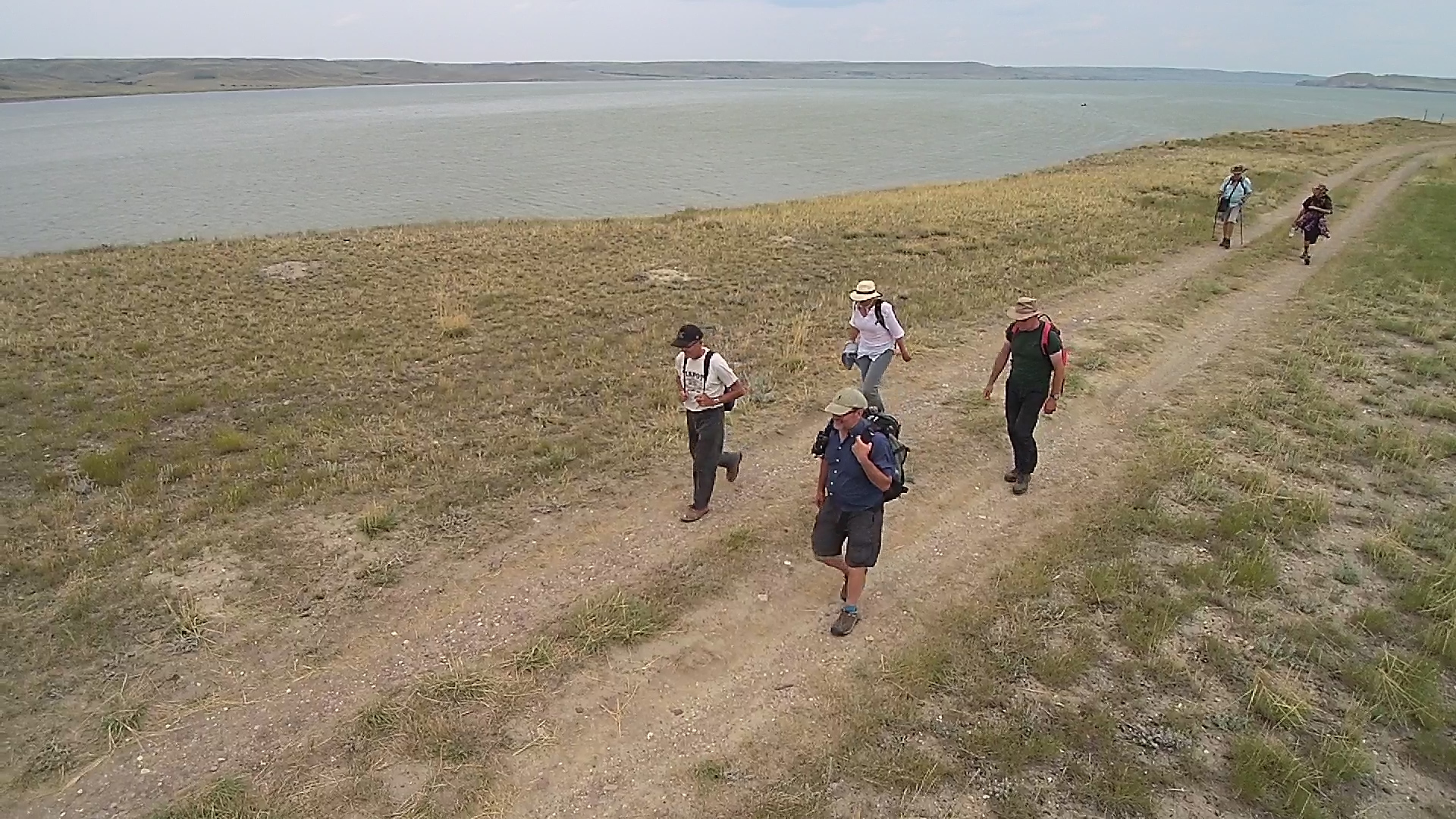 (photo courtesy of Craig Baird)
(please click on the link) https://vimeo.com/140200976
A conversation over morning tea at Concordia’s Dept of Theological Studies between Matthew R. Anderson (on camera) and Sara Terreault (staying off camera).

There were times, walking, where I forgot about our guides on the trail – the North West Mounted Police markers that Everett Baker put up in 1960 and 61. After all, that was over 50 years ago. Even eight foot concrete posts don’t always last that long, when neglected. We couldn’t always find them. Sometimes they’d been knocked down by cattle or vandalized. And sometimes, to avoid walking on crop, or because they haven’t been seen for decades, we just couldn’t find them. But Hugh, who is responsible for the posts on behalf of the SK History and Folklore Society, always had them in mind. In our three weeks of walking we found about 25 that were not on their maps or databases. Every time Hugh would kneel by the post and get the GPS coordinates for their survey. More than once he looked like an old-time pilgrim, kneeling at a roadside shrine. Which, in a sense, those posts are.
The magnificent post photos were taken by Branimir Gjetvaj, whose photography website is http://www.branimirphoto.ca. The photo of Hugh kneeling is mine.


That’s a prairie way of saying it. The expression can mean anything from hot temperatures to a tornado, and is usually delivered with the same inflection no matter which.
I found myself saying it on the second last day of the NWMP trail pilgrimage. We were walking atop a tableland of prairie grass. We’d slowed to look at tepee rings – about a dozen of them, stretching across several high hills. Just then there’d been a magical moment, as a small herd of unbroken horses wheeled counterclockwise around us at full gallop, circling to come up right behind Madonna, who was behind us and so intently peering at some of the rocks that she didn’t notice the animals, clustered and shivering, in turn peering at her. Then suddenly the horses were gone again, and we found ourselves looking up at an increasingly black, roiling cloud that stretched from one horizon to the other. A group of cattle nearby starting lowing – a plaintive, anxious sound. A muscular north wind came up, and with it the first drops of rain, pelting hard and from an angle. Some kind of weather coming.
We were too far from any coulees to take shelter, and there were no trees (not that trees would have been a good idea anyway). Gwenanne had found a small cut in the prairie, a few meters deep, and the group of us huddled in there. I still had some hot tea, but when the skies started growling thunder, some of us went to our elbows. The cattle were making very unhappy, frightened sounds. Rain beat down and lightning cracked. “It’s the bear principle,” I joked, “you don’t have to be faster than the bear, just faster than the other person.” “Good, well one time to be happy I’m the shortest,” announced Madonna.
We found out later there was an extreme weather warning for wind and thunderstorms for our area at that moment. Just like the prairies, I thought, to give us such an experience on the second last day of trekking. The wind was so strong that the storm blew over, and drying out happened quickly, although the temperature had dropped precipitously. It was a howling, cold, night, and by the time the vehicles were moved and the tents put up we only had time for some soup. Communitas in a crowded van. I crawled in to my tent and listened a while to the gusts buffeting the nylon and straining at the stakes. Then I put in earplugs and borrowed in. Getting used to the prairie isn’t just beautiful sunsets and endless days of watching deer spring out of the valleys. It’s also this. A reminder just before parting. Some kind of weather.

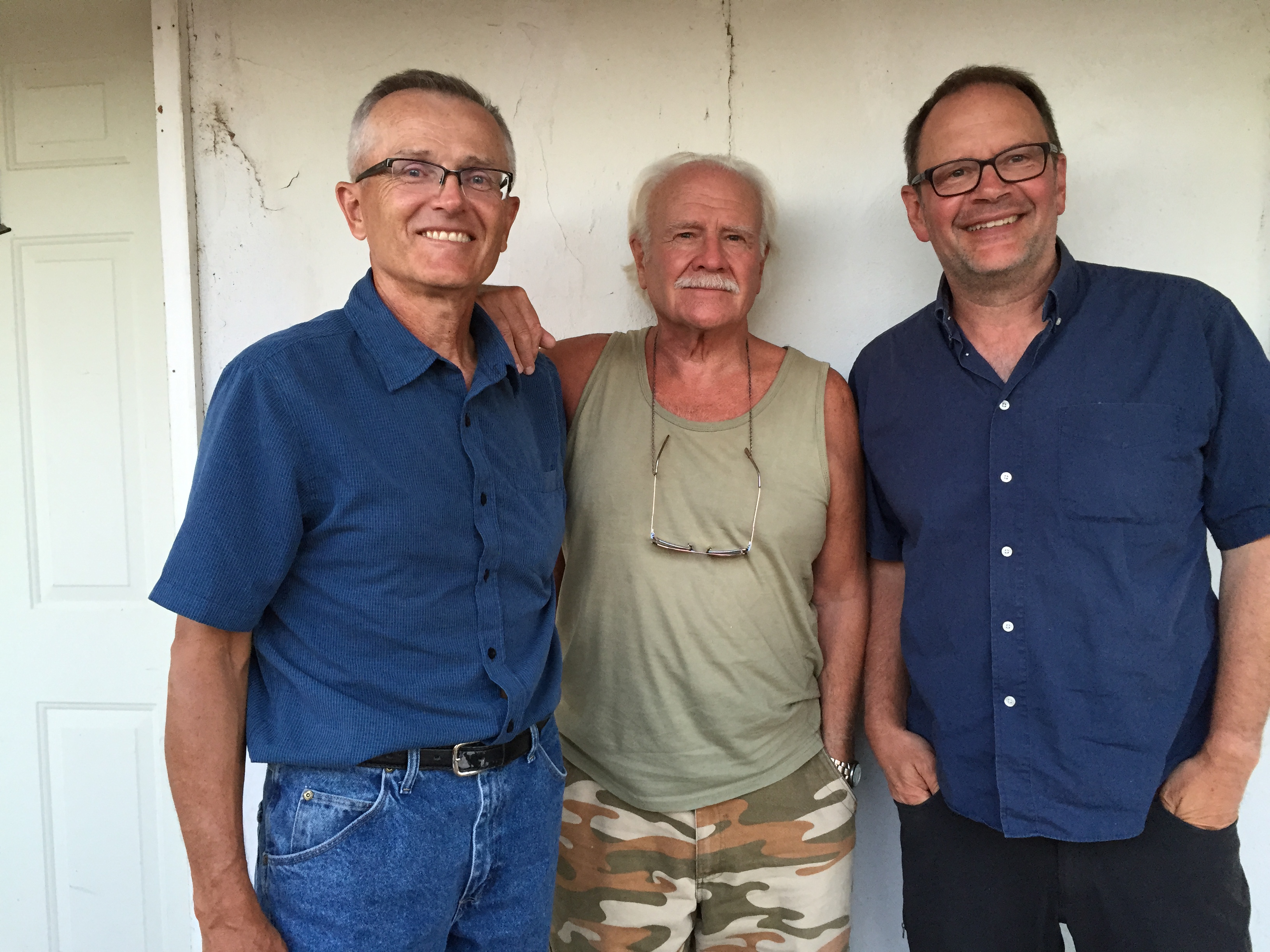
An example of one of my interviews with a self-professed “old timer”:
My father used to hunt deer year-round. Didn’t care a bit for the hunting licenses. He was a generous man and would hunt deer and give them to all of the neighbours. No one had much money then, so the meat was welcome, but my mother used to fret about his illegal hunting and give him trouble over it. Then one day the policeman came to the door on horseback after a long ride. He was tired and hungry and my father, always hospitable, asked him to stay to eat. Mom had a huge venison roast in the oven. She brought it out and served it, shaking with fear that father would be clapped into jail for poaching. The policeman finished eating, wiped his mouth, said “that was one of the finest beef dinners I’ve ever eaten”, got on his horse, and rode away.
Max Mirau, Swift Current, an old friend of my father’s.

There’s no better way to reach a destination than to ford a stream and arrive on its banks. Even if you don’t have to. Stew Tasche, writer and producer of “The Cypress Hills will never be the Same”, and his wife Cindy arrived at Chimney Coulee this morning just as we were packing up our tents. They walked with us the short, half-day, five miles into Eastend. It was like Stew knew every inch of the way. “We used to cycle out here and find old NWMP shell cartridges”. “That’s where my uncle lived. The Metis chimneys were still here when I came out to see him.”
When we crested the hill and looked down on wooded Eastend, Hugh asked if we’d like to ford the Frenchman River at the old crossing, rather than walk across the bridge. Since I’ve been looking at that water enviously for days, he didn’t have to ask twice. We inched down the steep incline, came to the water……
“That’s the highest and fastest I’ve seen it in a long time,” Cindy said. Stew agreed. Eventually, probably because he’d suggested it, Stew grabbed a thick pole of a branch and inched across. He was fine and so we followed, one by one. We came to the ranch-house that has been in his family for generations, the first house in Eastend.
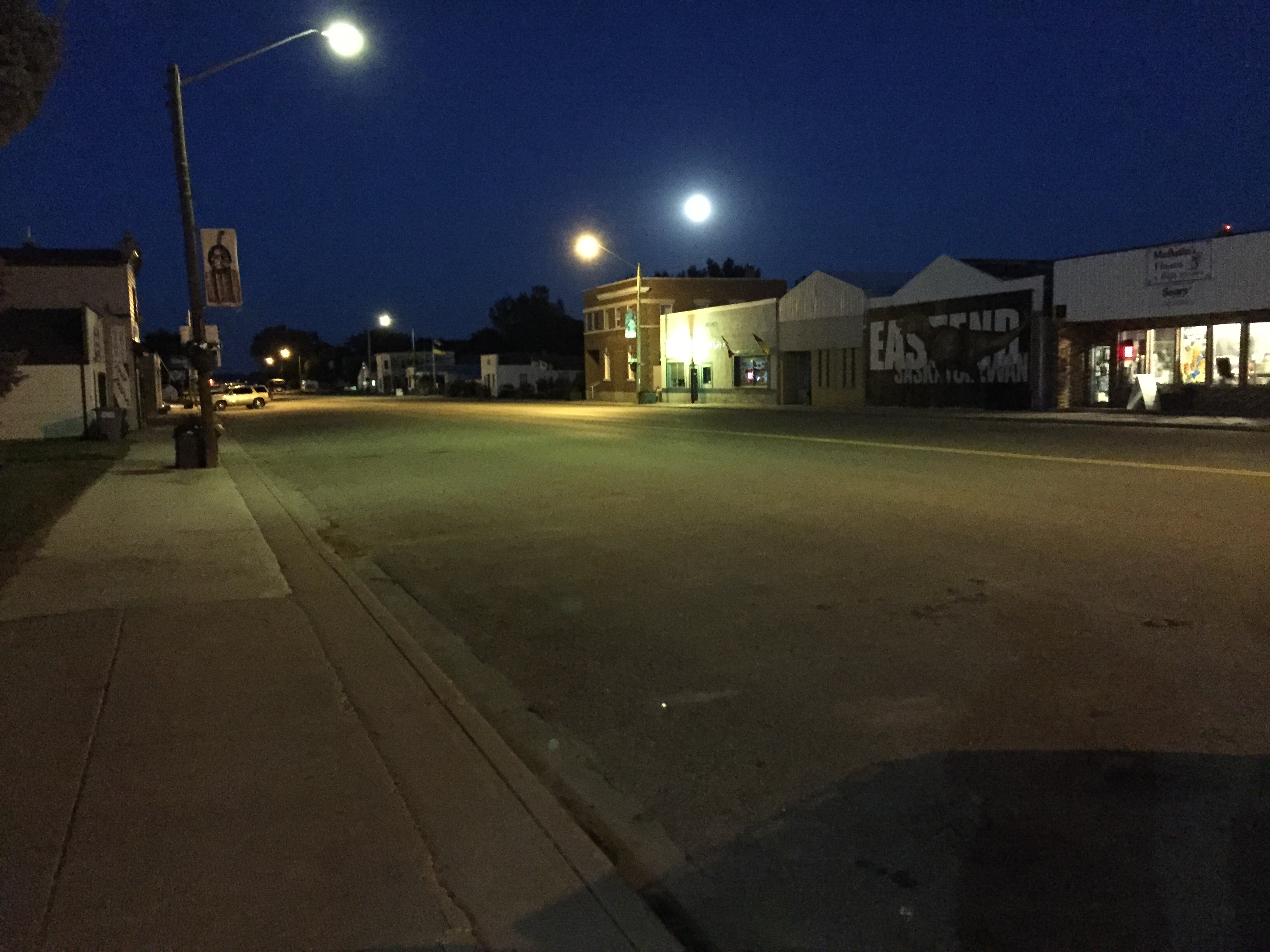
And for me, eventually, to the motel, for the first shower in many days, a working toilet, and a cold beer. Ed, one of the owners, was playing blues in the other room when I got to the desk, and couldn’t hear me ring. When he found out I was one of the NWMP walkers, he gave me the family rate. Tonight is Friday night. Tomorrow the SK History and Folklore Society have a number of events scheduled, finishing with a banquet and readings by author Candace Savage. I’m looking forward to meeting this author who has so changed the way I see my prairie homeland. But in the meantime, it’s a blue moon, a very quiet town, and I’m going to sleep comfortable and clean in the Riverside Motel.
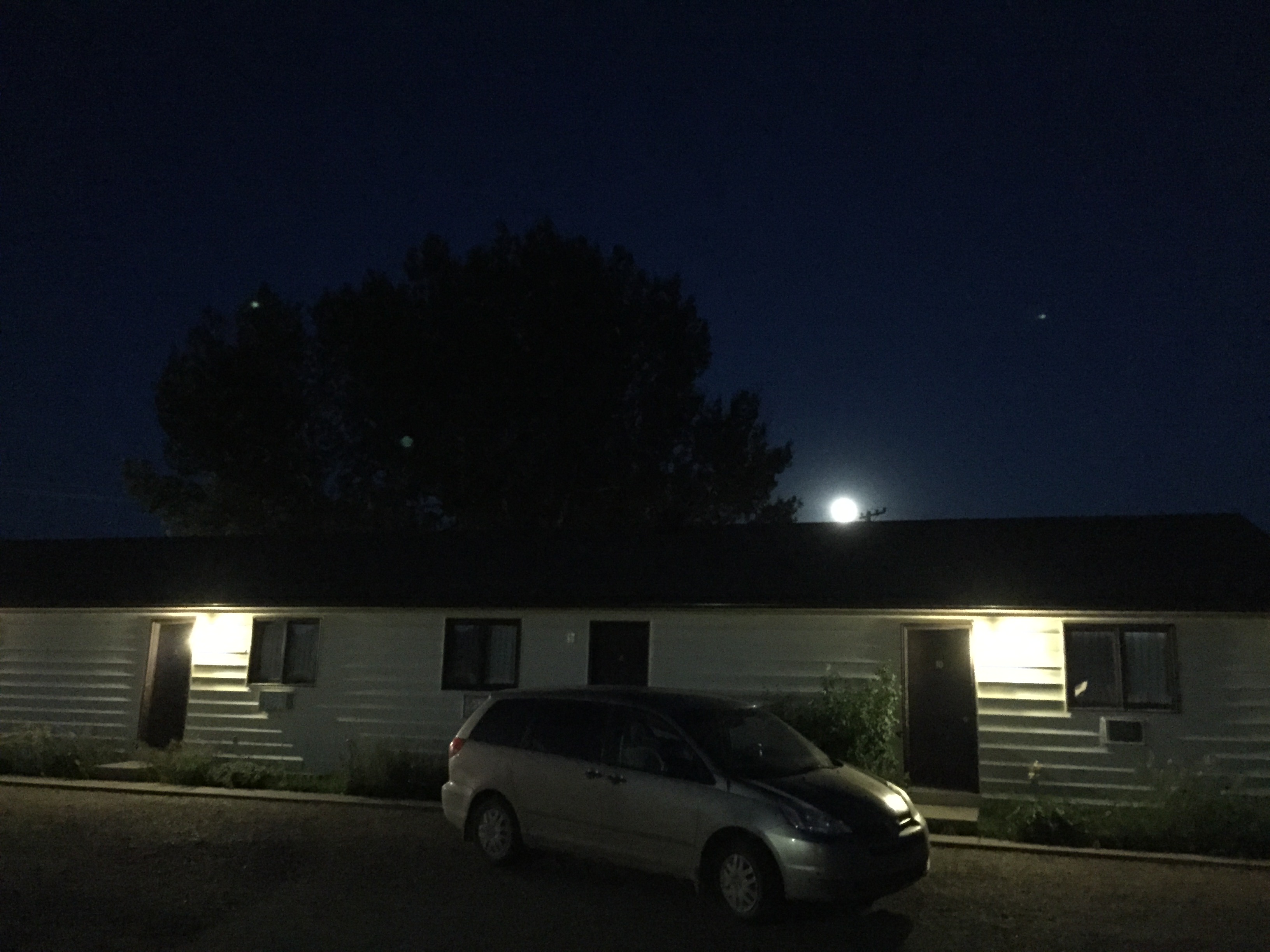

Tonight we;re in a grove between caragana hedges, on the Duke farm near Eastend SK. Now that the dark has descended, it feels like a secret, hidden place, with only the sound of cicadas and crickets to accompany my typing. No coyotes as yet, although the moon is full and just waiting for their chorus. The farm is located along the Frenchman River, with the steep walls of the valley rising miles away at either side of a great, wide, flood plain. We walked that plain all day….tawny hills on the left and the right, white mud cliffs that leave your fingers stained, and a river I wanted several times to jump into for some kind of break from the heat. For the first time this trip, we’ve had to contend with mosquitoes, so setting up tents was a hurried affair.
Fortunately, we have a gazebo, and that’s where I shelter to write this. The others have gone to sleep – funny how a full day of walking makes for fatigue as soon as the sun sets. For a late supper we put together Madonna’s lentil soup, Hugh’s beans, Kathryn’s broccoli salad and some British Army ration soup. We ate the resulting mix, out of the pot, with gusto. But the best part of the meal was rhubarb white wine, from the Cypress Hills winery, donated to us by Curt and Lorie Gronhovd, the incredibly kind hosts with whom we stayed last night.
Over dinner (and the wine) we talked about saints and First Nations, about the connection between the Egyptian desert fathers and the Irish monks, and between those monastics and a pilgrimage here and now in south-west Saskatchewan. I guess it’s no mistake that this is, also, a semi-desert that we walk through. Fifteen miles today in land that, like the Biblical wildernesses, reduces the walker to the essentials. When the land is so sparse and the cactus and short grasses (and some cattle skeletons) are all you see, the wind blows and I think of Ezekial calling the four winds at the Lord’s behest, or Christ in the desert. Or Saint-Anthony, seeking white martyrdom in the wilds of Egypt.
Tomorrow we walk to Chimney Coulee, so named for the chimneys left behind by the Métis hivernants who built a settlement there in the mid 1870s. They say there are ghosts there, of the Assiniboine who died scavenging after Cowlie, the Hudson’s Bay trader, hurriedly left in 1873. I guess we’ll find out tomorrow night. For tonight there’s the moon, the mosquitoes, the dark, and the wind through the caraganas. And thoughts of the saints and their time of testing and of encountering the divine in a wilderness not so different from this one.


There’s something exciting and exhilarating about taking shelter in the back of a van, the back gate up providing a temporary roof, watching the driving rain come down so hard you don’t dare step out into it. It feels just a bit precarious when the lightning is so loud and close you take your feet off the ground just in case there’s a nearby strike. Wondering if the tent you’ve set up under the caraganas will hold up and stay dry (especially since your sleeping bag is already in the tent. You can see the fabric of the fly bouncing from the weight of the downpour, the heavy rain spraying from the roof). But it’s also, somehow, comforting. You are – mostly – dry, the threatened wetness in your boots and the moisture seeping down your back balanced by the carrot and coriander soup mixed with long grain rice (British Army rations) that you’ve saved from the fire and are now eating, steaming hot, straight from the pot.
I’m alive and well. Both. I’m learning once again that the two are not always the same thing.
After the rain, a rainbow comes out over the Frenchman River valley, also known as Whitemud. The valley is so wide you can see both sides of the arc touching down. Golden light floods the river plain from the west. There are horses – perhaps a dozen – charging around the field beside us, kicking up their back legs, perhaps in relief at the temporary respite from the storm. It’s one of the most beautiful sights I’ve ever seen, their manes and tails flying against the dark sky.
The clouds close again and the rain settles in – 7/10ths by morning. I’m awakened several times by flashes of light and loud booms, and sometimes by the horses in the Green’s trailer, whose movements also sound like thunder. At 6:45 am Hugh and I meet in our rain ponchos in the drizzle, trying to decide what to do. Bishop Don’s tent has flooded. The horse folks are calling it a day before starting and starting to pack up. It will be impossible to get through the riverbank grass and lower bogs in any case, so we decide to postpone the half-day river section of the walk. We confer with the rancher, Terry Jensen, a cowboy so stoic he looks as though he would be unperturbed if a spaceship landed on his property. He owns as it might be good to wait. We drive up and out of the valley before the road becomes impassable. It’s the first day we’ve had to change plans. Flexibility, I tell myself, is one of the marks of a pilgrim.