

See this stuffed prairie dog? Apparently, it has a name: “Matthew”. I just received photos of this mascot all along the route of the Humboldt-Fort Carleton Trail Walk in 2019. Each of them with cute little captions. In 2015, Hugh Henry and I began this tradition by trekking the 350-km Traders’ Road, or North-West Mounted Police Patrol Trail (NWMPT) in Treaty 4 Territory, SW Sask. It was likely the first time the trail had been walked in over a century.

In 2017 we walked the Swift Current to Battleford Trail, another 350 km; near Battleford there were lots of issues with access and trespassing (see above). In 2018 we walked the Frenchman’s Trail, from Mortlach to Gravelbourg. I was surprised that there was a Welsh couple serving Fish’n’Chips in Mortlach (see photo below).

This year, Hugh and the Saskatchewan History and Folklore Society (SHFS) planned a journey from Humboldt to Fort Carleton. I’m still in England; this was the first year I just couldn’t make it. No country bars and pool-tables for me this August. But apparently I was there in spirit.

If you’d like to read more about the walk they took – without me – you can read a great day-by-day description (I did) on Ken Wilson’s blog at https://readingandwalking.wordpress.com/.

The photo I found the funniest is just above. I had quite a bit of foot trouble on the way to Battleford in 2017, culminating in a full-on leg infection. I was using duct-tape for my blisters, in the vain hope it can fix EVERY problem! Live and learn! Mostly, I’m thankful for good friends and for being remembered on a pilgrimage I couldn’t walk. They knew I was thinking about them. And how wonderful, to be thought of in return.
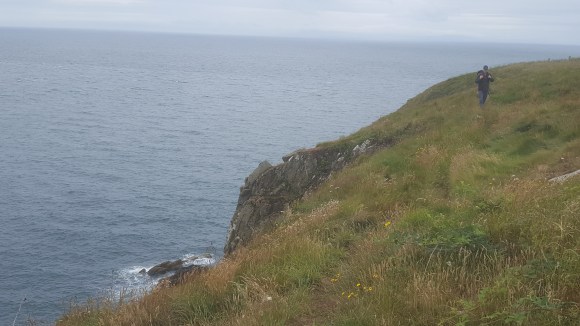
 Today was a vertiginous day. It’s the perfect word, although I had to look it up. Vertiginous has two meanings, both true today: extremely high and steep, and suffering from vertigo. I don’t know how the Scots do it. We had just passed through a short section – the worst – where the path was within two metres of the edge and a stumble could easily topple you down 200-feet onto the rocks. A couple ambled toward us with a dog tied to the woman’s waist. When we said hi, she cheerily told us “he has to be tied up. He’s a naughty dog and we had to call the coast guard to fetch him a couple weeks ago.” Hmm.






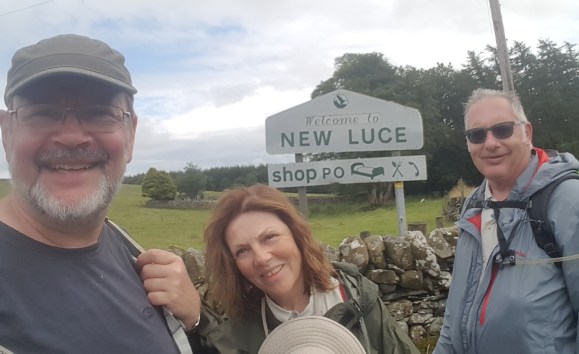
 Secondly, we arrived at our “hikers’ shed” only to find that the lovely & picturesque village of New Luce has no pub, no restaurant, and no store – although all are planned – and that the owners of our accommodation hadn’t been warned we were wanting supper. They very kindly found a can of soup. We were planning to make do with that and some crackers until local walker and walking activist Peter Ross showed up at our door, asking if we needed anything and offering a ride for groceries. Finally, owing to the fact that a local rented cottage won’t receive its guest for a couple days, we got a place to shower! New Luce has got to be the most lovely little village we’ve come across – it’s vying for the flower award for the UK this year.


 By the way, Peter told us that all the garbage we’d seen on the coast was NOT Scottish: “a lot of that’s drifted in from Dublin and Liverpool and Belfast with the prevailing currents,” he told us, “But we Scots have to clean it up.” On the walk today we came across a poignant reminder, in rural Scotland, of Canada’s international garbage. We could hardly believe what we were seeing!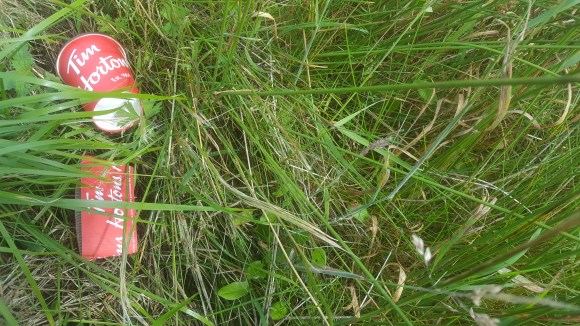







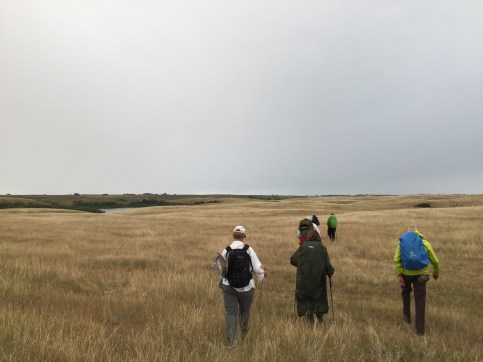


 I’d counted on getting my bearings from the Hayfield UK info stop. I had to think again! On April 24 1932, after decades of on-again, off-again confrontations, 400 members of the British Workers Sports Federation started trekking up from their campsites here toward “the forbidden mountain.” The mass trespass of Kinder Scout plateau’s private land became the tipping point in the fight for the right to walking access across private lands. This plaque commemorating the walkers is affixed to the wall of an old stone quarry at the head of the trail. No one is fighting for the right to walk across Saskatchewan. There are no walkers’ groups, no mass rambling movement and no one in Swift Current or Saskatoon is trying to escape the grimy factory life of Sheffield and Manchester in the early 20th century. But there ARE historic, important trails across the prairie. They also deserve public access. And Canada has an important issue that the 1930s British ramblers never faced – the question of Indigenous access.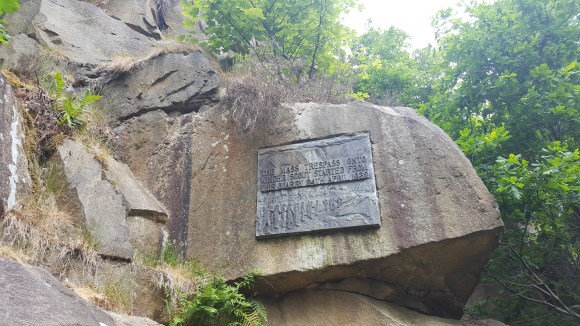

 somethinggrand