Categories
Uncategorized

My Corner of Gloryland

 John Golling (Grandpa) as young man 1          farm-2-new-homeland

This week I’ve been seeing some of the old photos of my grandparents and their parents before them, and hearing stories of the first European settlers on this prairie. My grandparents, like most of their neighbors, were hard-scrabble, tough immigrants. Before electricity, before water lines, before roads even, they came. They came for the promise of land. Most of them were not as romantic about the countries they had left as we, their grandchildren, are. After all, they’d made the decision to go. In the words sung by Archie and the Boys (see below), the old time band that played today at my father’s care home in Herbert SK, they wanted, not the old, but the new: their own ‘piece of gloryland’. And the Government of Canada was happy to promise it to them.

The posters advertising the new homeland, however, neglected to mention that there were already people living here. The nomadic First Nations and mobile Metis were not used to, nor invited into, this new world of fences and property title and cattle rather than bison. A combination of starvation and forced removal cleared the land of Aboriginal peoples so that my grandparents – more fortunate pawns, but pawns nonetheless – in a continental political-economic development scheme, could take their place.

Did it turn out to be Gloryland? Saskatchewan is a great place. But we are all – First Nations and settlers alike, but particularly First Nations, still feeling the aftershocks of that great removal. To me, the posters advertising a new homeland in the Canadian West for European immigrants aren’t just art. They’re chilling propoganda.

(Photo is of John Samuel Golling, my grandfather. Thanks to Archie and the Boys for their music and their permission to post!)

Categories
Uncategorized

Of stories and spaces

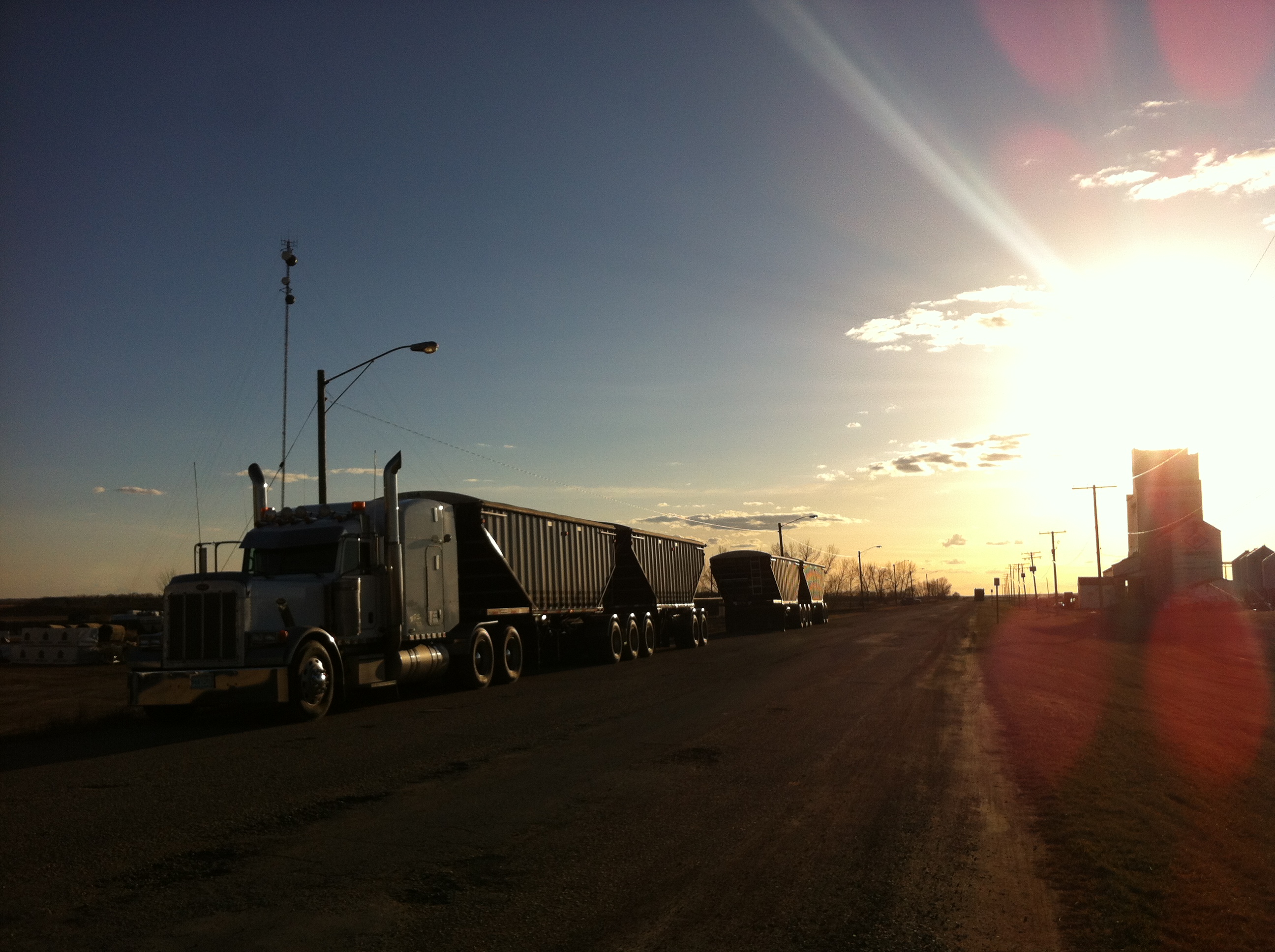
Herbert with semi trailer

We human beings find our sense of place by attaching it to stories. “This happened here, and then under the oak trees, or by the prairie slough, or on the top of Mont Tremblant, this other thing happened.” Places without narratives are just spaces, the blanks at the edges of our maps, unknown and unknowable.

Airports, for the sake of safety and convenience, do everything they can to tell the same story everywhere in the world. Boarding pass – security – gate – runway. If it weren’t for the constant human drama – families saying goodbye at the entry, the security fellow flirting with his colleague, the noisy high-school group on their way somewhere – airports, with their standardized everything, risk becoming mere spaces, simple stops on the way to real places like home-towns and vacations, and reunions and the city of your new job.

Here’s what excites me: if it’s the story that turns a space into a place, that means that if we add to the story, we can add to the place. A harmful story, of wrongs done and injustice, can change, at least a bit, in the retelling. We can tell OUR story of that space, and if in our story there is at least some hope, and some openness, and some healing, then maybe… Maybe the place itself changes too.

Still thinking of how it will feel to walk the North West Mounted Police Trail in July.

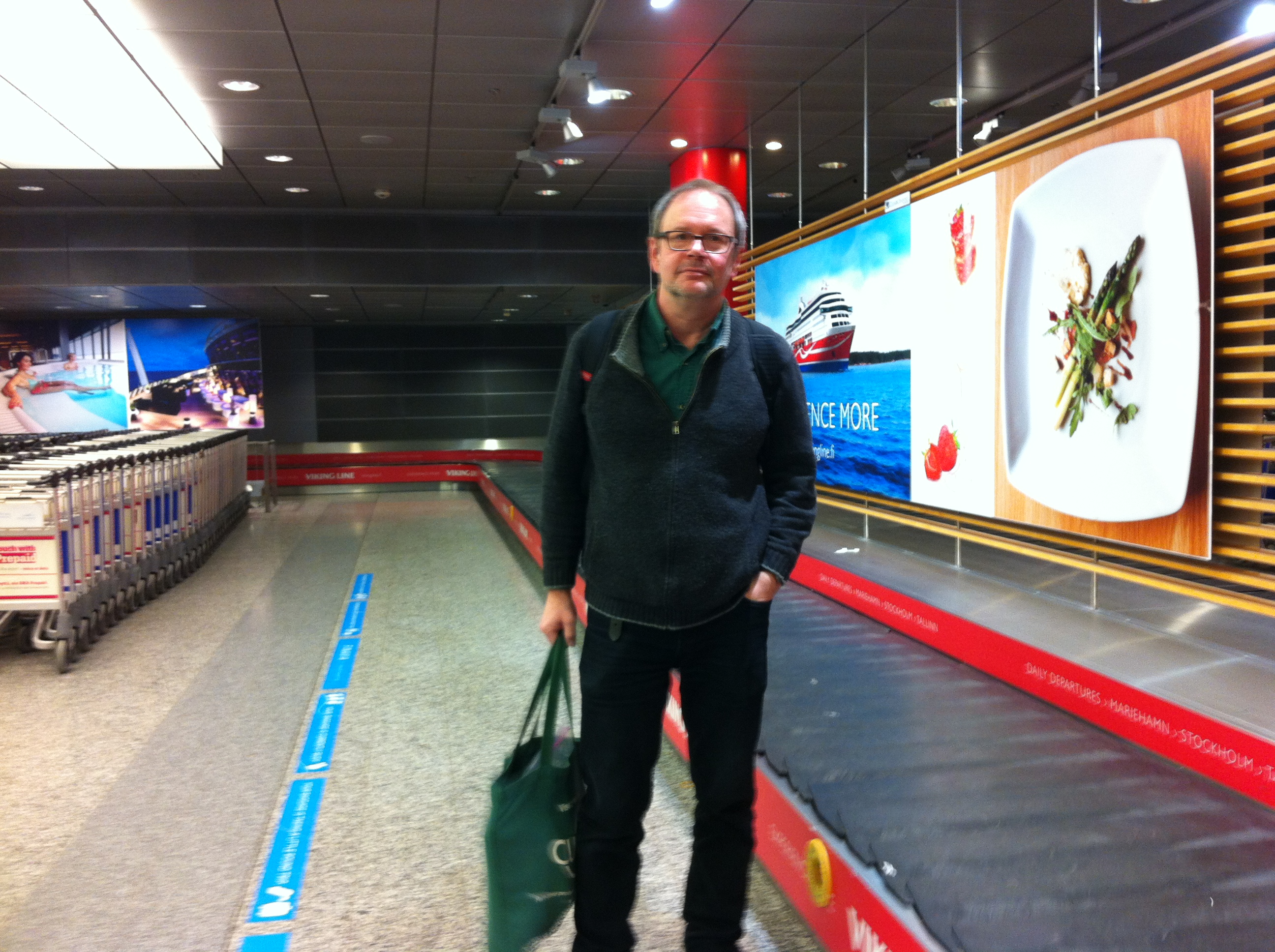
waiting at the baggage Helsinki

Categories
Uncategorized

Dream-walking the Trail

NWMP trail map Eastend

This week I sat down and traced a trail across southern Saskatchewan. I had help: two photocopied RM (rural municipality) maps provided by Hugh Henry of the SK Historical and Folklore Society. For a few hours over a couple of glasses of good Spanish wine I guess-timated how far we could walk in a day, where we might stop, where there might be abandoned farmyards or churches with outhouses, where we could park an RV and when we might hit a small town where there would be showers. Then I sent the schedule off to Hugh, who with his better knowledge of the land made some important corrections, and suggested places where we might need horses to scout the trail ahead of us.

Wow. Just having the 20 day schedule in front of me makes this summer’s walk seem so much more real. Outside it was -19 in urban Verdun. But in my mind’s eye the prairie grass waved, the heat beat down on us, and we looked for miles and miles over rolling prairie toward Val Marie, or Mankota, or Eastend.

“Build it and they will come” are the famous words from Shoeless Joe, Kinsella’s novel, also about the plains, that became “Field of Dreams”. We are building it, step by step, in our imaginations. We will see when, and how, we actually walk this path of dreams.

NWMP Trail general

Categories
Uncategorized

Love and the Rhythm of Walking

From Paul Salopek’s most recent post. Paul is a Pulitzer-prize winning journalist who writes the “Out of Eden” blog for National Geographic, while walking the world. He’s now in Turkey. This beautiful piece of writing is taken from “The Geography of Desire” post, at: http://outofedenwalk.nationalgeographic.com/2015/01/05/the-geography-of-desire

“There comes an old, old longing while walking through the world. Walking, you learn each new landscape the way you might explore the face of a lover—up close, by grazing your fingertips over the features, without distraction, with a sort of doomed attentiveness, acutely aware that each mile sliding by is gone forever, knowing it won’t hold. The best walking and writing must happen this way. You begin to move forward, eyes closed.”

Categories
Uncategorized

Soon Enough

IMG_1587

The few lights that are on in my apartment this January 1 evening don’t so much illuminate it as provide a counterpoint to the darkness. There are candles here and there, gusts of winter wind at the door. We are at the change of years, a liminal moment, a threshold time. Folks don’t go out much today. Everyone prefers to stay at home with soup, maybe a movie. It’s quiet on my street. My boots, recently repaired, sit at the door. Soon enough, we tell ourselves.

This year will be, I hope, a good year for pilgrimage. I’ve heard from Concordia University that the Vieux Montreal – Kahnawake student walk that’s part of our Department’s summer-term class on Pilgrimage will most likely be accepted for what’s called the “FundOne” initiative. That means that Concordia will advertise our 34-km pilgrimage for crowd funding, to help pay the costs of the students. Old Montreal is so close to the Mohawk territory, and yet so far away. If you’d like to contribute something to help this worthwhile walk, there will be a chance!

Our own conference will take place May 8-9 at Concordia, under the title “Indigenizing Pilgrimage”. This doesn’t mean only Aboriginal and First People’s pilgrimage, although it certainly includes that. It will be about ALL the ways we can, and should, from Sussex to Saskatchewan, connect our intentional, transformative journey to the actual physical places through which we move. Sara and Christine and I managed to get both of the keynote speakers we had dreamt of having – Raymond Aldred, a Treaty Eight Cree and professor in Calgary, and Simon Coleman, a pioneer pilgrimage scholar and professor at the U of T. It will be a great event.

And in July, if all goes well, I will be walking, together with Hugh Henry of the SK History and Folklore Society, and some – how many? – others, 300 km across the southern plains and low hills of Saskatchewan, tracing with our feet the North West Mounted Police Trail. Raymond Aldred has said of the First Nations’ need to recover their past that “when you have no history you have no future.” I am hoping that it is equally true of those of us who are from settler stock, that when we re-visit, re-walk, and remember our past in a new way, particularly by remembering the generations of ill treatment of First Peoples, we might also re-imagine and re-create our future together in new ways as well.

There is another gust of wind at the door. It is winter in Canada/Turtle Island, but that doesn’t keep the pilgrimages from beginning. I’m feeling the itch to walk.


Categories
Uncategorized

The Watchful Trees

up close painting

The Watchful Trees (Ode to a Prairie Birch Wood)

Matthew Anderson Nov 2014

++

I could lose myself here.

Paper-bark peeling

white bone from the green,

your quiet, revealing

what I might have to mean.

++

Here the dead are not buried.

It’s all boom and bust.

A hardy, short-lived pioneer species

is what they call us.

Come to break the treaties.

++

My leaving stopped the dying.

It stanched the blood-flow.

You were rooted, you had to stay,

I learned to fly; I had to go.

At least if they ask, that’s what I’ll say.

++

I’ll tell them the story

of how hard you grew me up,

my birthright a knife,

instead of a cup.

Sharpened steel to hold close, in case of real life.

++

I could lose myself here.

Your paper-bark peeling

back ghosts and regrets. Such blood in this place.

Your quiet, revealing,

what I still have to face.

(painting by Janice Donato)

Categories
Uncategorized

Two Smooth Stones

photo

I have in my jacket pocket two smooth stones – river pebbles, worn by years of exposure first to running water, and then to wind, snow, rain and sun. When I picked them up they were still so warm from the late autumn Saskatchewan sun that I could put my hand in my pocket and feel the warmth lingering there.

The stones come from the foot of the first concrete marker in the North West Mounted Police Trail. It was at the Wood Mountain historical site, site of the Wood Mountain trading post, and of the original boundary survey camp. It’s a three-hour drive south and east of Regina, on increasingly small roads, where I met local historian and NWMPT curator Hugh Henry.

Technically, the young, untested recruits from Ontario started further east. In their second-hand gear and with their quick training , they were so poorly-equipped for the harsh environment facing them that by the time they reached Wood Mountain they’d already see a number of their horses die and had been beaten down by storm, swamp, and pest. Jim Daschuk, author of Clearing the Plains, told me how the SK First Nations still recount how the NWMP recruits contracted lice and fleas so badly that they had to teach them how to take off their clothes and put them onto ant hills where the ants could eat the lice and thus relieve the young military force. The thought of the future red-coated pride of Canada buck-naked on the open prairie on their first expedition west to “save” the Indians says a lot about how our history needs to be revisited.

Between Hugh Henry, Jim Daschuk, Kathy Grant, Brenda Peterson and others I learned a lot about the NWMP trail this visit. I’m hoping that some of us will walk the trail in the next year or two, not just to commemorate the brave and young Ontario men who came west, but also the Metis, and First Nations peoples who were there already to meet them, who had walked the trail, and who would soon be pushed off the very land they then called their own.

Categories
Uncategorized

An ancient guide

ancient pilgrim stone at stream ford

Images arise of our way through this lost wood: grainy scenes of leaf and thorn, rock and shadows dappled with mid-day sunlight, the colours everywhere we look overly-rich and lush, the earth moist in our nostrils, the movements of my fellow pilgrims as we descend through the understory of the wood truncated and choppy, like characters in one of those films already ancient by the time it was shown us in high school. The six of us step carefully under a few large oaks casting their great shadows, after which are clearings floored by dead leaves under ash and alder, some of the saplings garlanded with bushes of holly of an impossibly deep green, leaves sharp, glinting like glossy plastic. Where there is shade, there are deep ferns. Most reach our waists although some reach up into blossoms at nearly head-height. At the bottom of the valley the ferns clear and the stream, having changed direction long before we did, meets us once more, this time running south through the ferns and high grasses. We do not know where we should be going, but there is a wooden step-bridge here also, and this time, something else. “Look, look!” shouts Sara, leaning in and pointing in excitement at something half-hidden in the grass on the far side of the planking. It is a boulder, placed on its end so that comes up to her waist, moss-covered, and with paint-like blotches of thick white here and there across its face. The moss covers but doesn’t quite conceal cut marks. “A cross!” Sara traces the ancient lines so we can see, “it’s a pilgrim marker. We must be on the right path.”

There in the upper left quadrant of the standing stone is the cross, cut clear and deep. It’s a sign from others, medieval pilgrims perhaps, or travelers across the moors from centuries past. There’s nothing like a sign to bring speed to our step. The others have already started up the slope. I hesitate. The stone looks old, and there are other cuts there, less distinct. On the top of the boulder cup-marks, and to the right of the cross another line, and then another below it, like a peaked hat or a bird in flight. Britain is full of carved stones, and a medieval pilgrim cross, old as it is, would be a relative newcomer to the long history of rock art. Cup markings and rings can date from the Neolithic or the Bronze Ages.

The others have moved quickly through the deep ferns. This time there is no hesitation. We may not know where the trail is, but we do know the top of the hill. I’m trailing the group, who shout down their encouragement to move on. The moors await us.


Categories
Uncategorized

Stiles and Kissing Gates

down to the river fording

Some fences mark a human boundary, some a physical frontier. This fence was one of the latter. Instead of keeping apart two rocky fields that are otherwise indistinguishable, or two similar flocks of sheep, the fence at the lower field boundary marked a sharp dividing line between field and forest, between hillside and deep valley, and between sunlight and shadow.

Our group of six crossed the stile, the first across uncharacteristically waiting on the other side of the fence until we were all together. By unspoken consent joviality had been replaced by solidarity. The overgrown path and lack of certainty made us pack animals.

For someone who grows up in the Canadian west, crossing a fence inevitably means grasping strands of barbed wire in hand, stretching the space between the lowest and middle strands as wide as possible, and then squatting and pivoting your back end while you lift a foot and squeeze through, back straight and derriere high, in hopes that no piece of shirt or pants will catch a barb and tear. There are very few stiles in Canada because there are very few public walking paths on private land. In England the history of the stile and the history of the citizen fight to keep public paths open are one and the same. Most UK stiles – certainly the ones we crossed – are built by property owners under legal compulsion.

Most stiles are ingenious in their simplicity. Usually, they consist of a post and a step on both sides of a fence: one step up, then hold the pole for support, swing one leg over to the step on the other side, then the other leg, and Bob’s your uncle. With a stile there’s no need to remember to close a gate, and there’s never any concern about a jammed lock or unworkable mechanism. The livestock have no chance to get out and repairs consist only of replacing a board every few years. The wooden step stile may be primitive, but it’s hard to improve on a model of such basic efficiency.

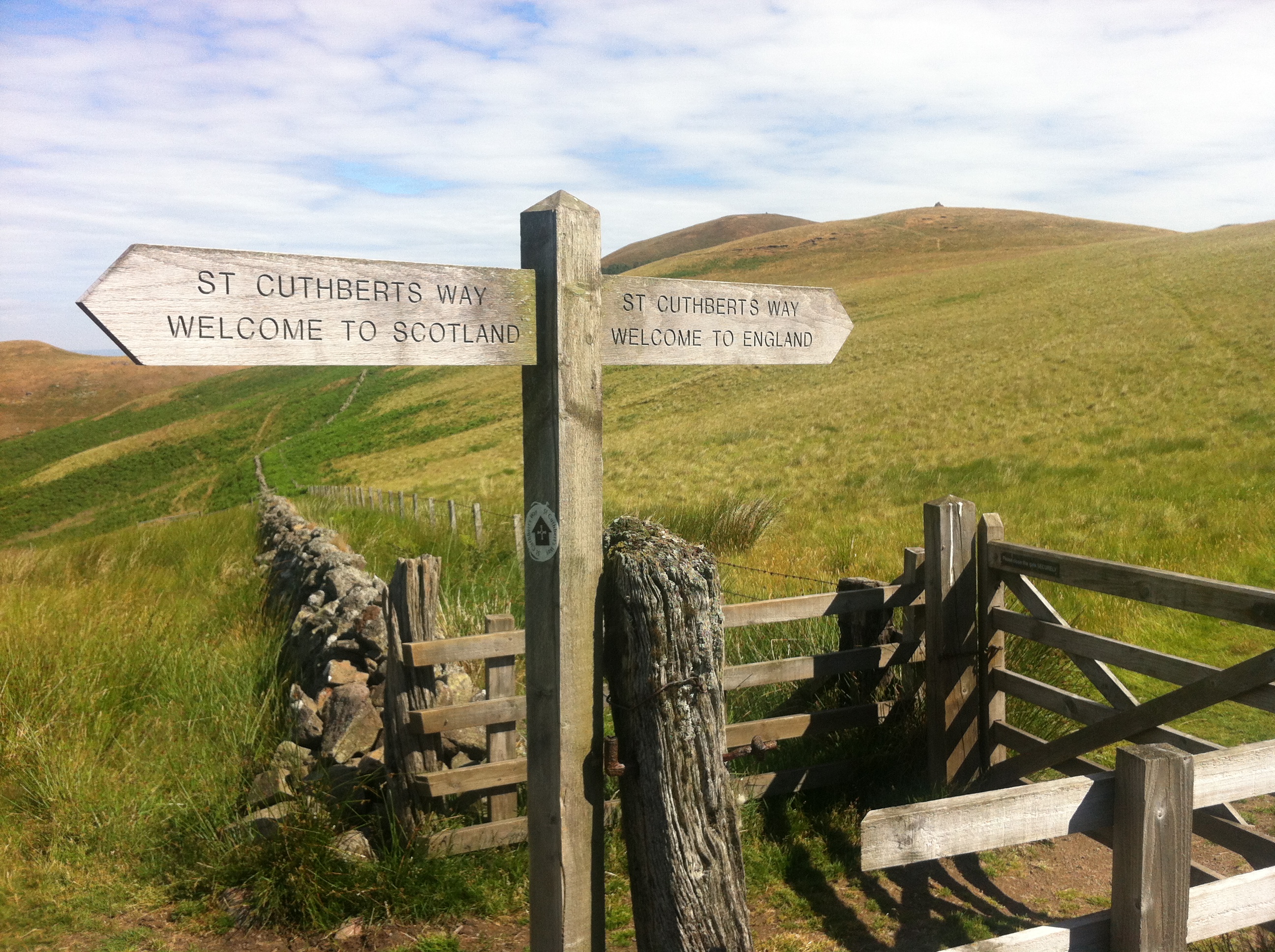
Perhaps my favourite gate is the one on St. Cuthbert’s Way, at the dry-stone fence, edged by thistle and grass, that marks the border between England and Scotland. It was a bit lonely a location, on the top of a knoll and across a valley from a Bronze Age ring fort, but the day I reached it I felt a sense of occasion crossing, and missed having someone there to share it with. There should have been a pub, as there had been, and a good one, back in Kirk Yetholm. Instead there were cattle, and stinging nettle, and burnt-yellow grass, so I kept on.
the border

Another common form of fence crossing in the UK is what is known as the ‘kissing gate’, so called because there is a gate in the fence that swings free between two fixed posts, just to the point of being able to touch, or ‘kiss’ each post. If you were looking at a kissing gate from above, you would see a walker step to the gate, push it against the far post, step into the small space at the open end of the “vee”, then push the gate back against the post just crossed, and exit through the cleared path on the other side. The point of a kissing gate is that a person can step into and through the pocket that is protected from the swing. But any four-legged creature cannot.

For the walker, the most reassuring thing about a stile or a kissing gate is that it’s proof, physical evidence in wood and sometimes steel that this is, if not the path, at least a path intended for walkers. From where it crossed the fence into forest, the Northdale trail we had decided to take led sharply downhill. As our eyes adjusted to the gloom we stepped carefully over exposed roots and clean river stones that skittered and clattered and slid underfoot. There was a close, fragrant feel to the air. I could feel the suddenly coolness on my skin; despite the trees there was a slight breeze from the north; the valley acting as a funnel for air from the high moor country, perhaps from whatever springs fed the stream we could hear below us.

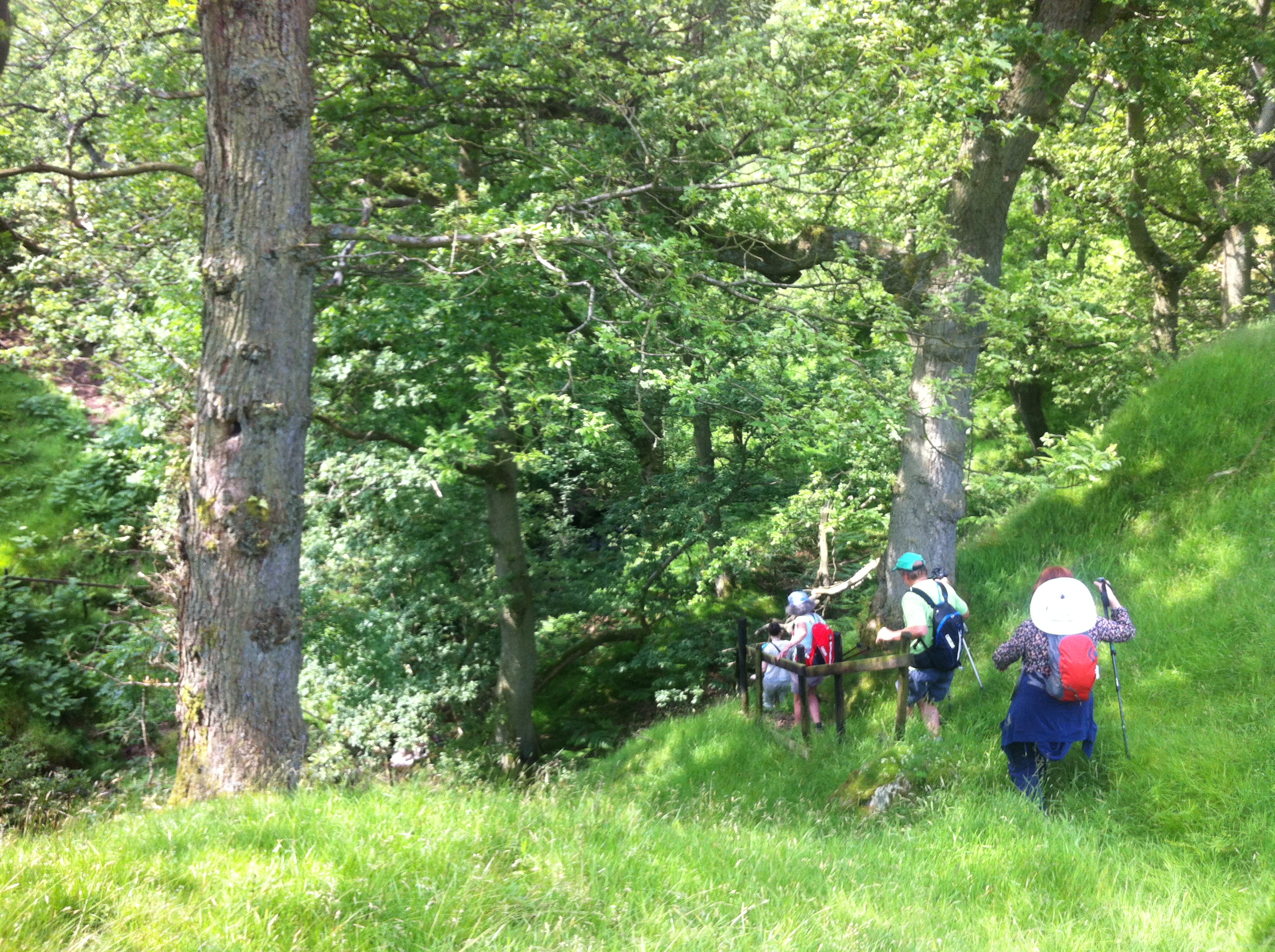
For a path we had chosen because of a lack of options and not for any particular markings, this one at first seemed quite promising. When we had walked only a short distance we saw that were stairs cut into the earth and banked by wood, and because of the steep descent someone had installed first a wooden railing, then a rope alongside the path at waist height. Just when we were feeling heartened the stairs split, each path descending a different direction. It was the classic dilemma: left or right? We chose left, descending another two sets of earthen stairs to a wooden bridge that couldn’t have been more than a few decades old. The stream would likely have been passable without the bridge by jumping from boulder to boulder across the pools and alternating rapids, but the cool forest air and shadow meant that most of the rock surface was slickly moss-covered. Boots would not have held. Someone would have gone in, or bruised or snapped a bone.

On the far side of the bridge was an ascent as steep as the bank we had just come down. After a few yards of climbing, the path disappeared under high ferns. We slowed, wading through the green, unwilling to risk falling into a hole, or worse, down some unseen rock face. For a few minutes we slowly tested the brush for any hint of trail, but it was clear no one had been through in some time. Whatever path was once there had disappeared. We turned back, first descending to the bridge, then back up again to the forest junction, somewhat anxious. Now there was only one option.


Categories
Uncategorized

Waiting for a Sign

while finding our way

Walking a partially sign-posted pilgrimage trail is a bit like living out Kierkegaard’s leap of faith in miniature, a hundred times a day. While walking the trail, there is a process that you go through between signs, a crisis of faith and doubt. When the arrow or the sign is first spotted, you feel a natural sense of relief. You launch yourself out and away from the waymarker, your feet sturdy and your mind at ease, but only for a moment. Soon enough comes a fence corner, a split in the path, a field empty of indications or a stile that is unmarked, and you must decide: is it that you have missed a marker somewhere, that the marker was never placed where it could have been useful, or was perhaps lost or knocked down (over the years I have found many markers in ditches, knocked down by sheep or cattle, or behind overgrown bushes), or is it that you have somehow unwittingly strayed from the path and should retrace your steps?

This is the moment – or rather, one of the many moments in a pilgrim walker’s day – of decision. Paths are rarely uniformly sign-posted. From the point on the path where you hesitate, it could well be that the anticipated marker is just over the horizon; at the next junction or field corner. Or it could be that somewhere, a hundred or two hundred paces back you have missed a sign or a deviance in the trail that you should have caught. The slowness of walking, which is normally, I would argue, one of its advantages, begins to work against you. Any decision, whether to push forward or to backtrack, is an investment both in time and in precious energy. In a ten-hour walk on a secluded trail, too many bad investments can mean the difference between success and unpleasantness, discomfort and perhaps even in some rare cases, disaster.

Modern technology, and especially the nearly ubiquitous smart phone with its built-in GPS location systems, would seem to have made the pilgrim’s Kierkegaardian dilemma obsolete. Even if a sign-post is missing, the map function of a phone should be able to show the pilgrim where he or she is, at least closely enough to avoid much more than a few fields’ length of detour. Unfortunately (or fortunately, depending upon one’s view of such things) there was no mobile phone coverage in the Rosedale valley. We were on our own with terrain and map.

We passed a farm that we thought might have been Northdale Farm, but was not. Now we knew we were seriously off the trail. We looked at the maps, but they made little sense. We talked, but never argued. Six cooks and still the stew was okay. The trail continued on through a field north of the house and barn and then petered out in the second field, turning into what seemed to be only an animal track. We spread out, all six looking in different directions uphill, and down. In the downhill far corner of the field closest to the wooded gully was a gate. It looked like there may have been a sign there; certainly there seemed to be a trail. We headed downhill.

There was no sign. Then again, there never had been any St Hilda signs per se. On the other side of the valley the earth rose up again to the heights of the moors. Our trail was on that other side. We knew that much at least, and that to get there we’d have to cross the valley. There was no sign, but there was a path. The woods were thick with underbrush, the trail overgrown. The sounds of water came from somewhere down below. We decided to risk it.