Tomorrow, September 16, is the feast day of Saint Ninian. In July, together with Christine Ramsay, Ken Wilson, and Sara Parks, I walked the Whithorn Way in Scotland, the medieval Royal pilgrimage route to St Ninian. To honour Saint Ninian Day here’s a short video of that pilgrimage!
Tag: Matthew Anderson
Categories
Like Being There


See this stuffed prairie dog? Apparently, it has a name: “Matthew”. I just received photos of this mascot all along the route of the Humboldt-Fort Carleton Trail Walk in 2019. Each of them with cute little captions. In 2015, Hugh Henry and I began this tradition by trekking the 350-km Traders’ Road, or North-West Mounted Police Patrol Trail (NWMPT) in Treaty 4 Territory, SW Sask. It was likely the first time the trail had been walked in over a century.

In 2017 we walked the Swift Current to Battleford Trail, another 350 km; near Battleford there were lots of issues with access and trespassing (see above). In 2018 we walked the Frenchman’s Trail, from Mortlach to Gravelbourg. I was surprised that there was a Welsh couple serving Fish’n’Chips in Mortlach (see photo below).

This year, Hugh and the Saskatchewan History and Folklore Society (SHFS) planned a journey from Humboldt to Fort Carleton. I’m still in England; this was the first year I just couldn’t make it. No country bars and pool-tables for me this August. But apparently I was there in spirit.
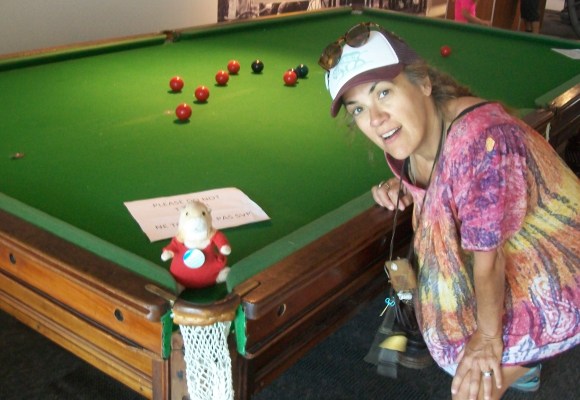
If you’d like to read more about the walk they took – without me – you can read a great day-by-day description (I did) on Ken Wilson’s blog at https://readingandwalking.wordpress.com/.

The photo I found the funniest is just above. I had quite a bit of foot trouble on the way to Battleford in 2017, culminating in a full-on leg infection. I was using duct-tape for my blisters, in the vain hope it can fix EVERY problem! Live and learn! Mostly, I’m thankful for good friends and for being remembered on a pilgrimage I couldn’t walk. They knew I was thinking about them. And how wonderful, to be thought of in return.
Categories
There and Back Again: Whithorn Way
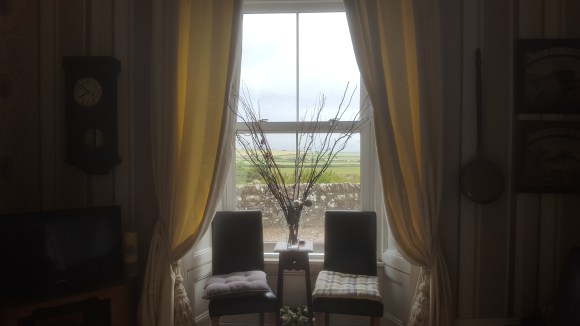
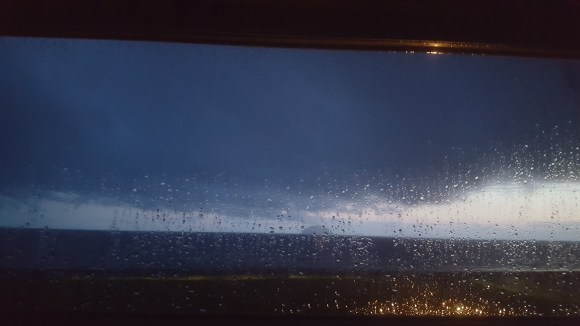
Pilgrimage has two directions. At least, usually it does: Sara Terreault can explain better than me how the ancient Irish (Insular) monks went on peregrinations or wanderings with no intention of returning home. But for the rest of us, to every “there,” there is usually a “back again.” Thank goodness! Whithorn said goodbye with a noisy overnight storm that made me get up to close my window against the sideways rain, then clearing and becoming coyly sunny and warm just as we left. Above is our view from breakfast in the Mansefield Inn. It was once the parsonage to the church converted into a Gulf gas station and garage (below). Fortunately, the conversion of the parsonage was a better job.

The folks here are rightly proud of where they live. In our 45 minute taxi to the closest train, the driver told story after story, some of which I can repeat, then briefly turned off the taxi’s meter to take us a few hundred yards off-route to see Kennedy Castle. Once on the train, Ken, Christine, and I headed north to Glasgow. My son Daniel once told me how strange it felt to see a pilgrimage “undone” by being in a motorized vehicle heading back to the starting point. I liked seeing some of the sights again from our Scottish Railway car, including these children at one junction waving at the train.

There were unmarked grassy places along the coast where courageous Scots were drying out tents, and I wondered if these were examples of the “Right of Responsible Access.”

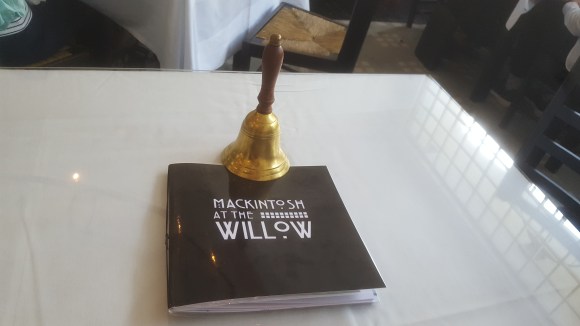
Glasgow Central Station is one of those beautiful, soaring Victorian train stations. We dropped off Ken and Christine’s things, then they accompanied me to the bus station to catch my bus to the airport. On the way we stopped for tea at a replica tearoom done up in the style of Charles Rennie Mackintosh, Glasgow’s famous early 20th century architect. Now I’m waiting to board a prop plane back to East Midlands.

Can one really say that they get to know a place in a short week, even while walking? We covered 120 km, more or less. We saw a lot of mud and stones, beached jellyfish and sheep and cattle and dark woods, barley fields and brambles. Walking is different from seeing land from a train. But both, as Ken reminded me, are different from actually spending time, which is how you make an “anywhere” a “somewhere.” It’s partly by telling stories, and remembering, that we create a sense of place. So that’s the next task for me, as a pilgrim returning from the Whithorn Way. I was happy to share Christine and Ken’s company throughout this long walk. PS: It’s interesting that, after a week researching the Right of Responsible Access in Scotland, on my return to Nottingham Google Maps led me right through a new car parking lot that SHOULD also be a footpath. I wound up exercising my right and hopping the barrier to walk through.

Categories
On Ninian’s Cliffs
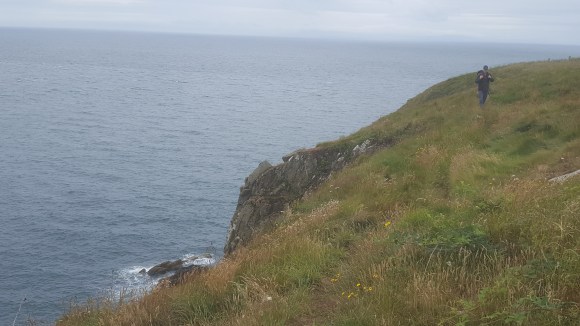
 Today was a vertiginous day. It’s the perfect word, although I had to look it up. Vertiginous has two meanings, both true today: extremely high and steep, and suffering from vertigo. I don’t know how the Scots do it. We had just passed through a short section – the worst – where the path was within two metres of the edge and a stumble could easily topple you down 200-feet onto the rocks. A couple ambled toward us with a dog tied to the woman’s waist. When we said hi, she cheerily told us “he has to be tied up. He’s a naughty dog and we had to call the coast guard to fetch him a couple weeks ago.” Hmm.


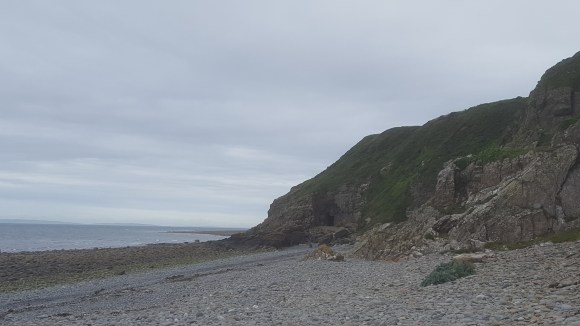
I’m now thoroughly convinced Ninian existed; after all, on finishing the walk all the way from Ninian’s Cave to Ninian’s Chapel on the Isle of Whithorn, about seven miles away, we had tea in his café. More seriously, the ancient stones, including altar stones, found in the cave (which is now partially caved-in) testify to its age. At our end point, the medieval chapel of St Ninian (below) was the place where pilgrims arriving by sea were welcomed and gave thanks for safe arrivals. Unlike us, they weren’t crazy enough for the cliffs; most ancient and medieval pilgrims arrived by sea and only walked a short distance to the shrine.

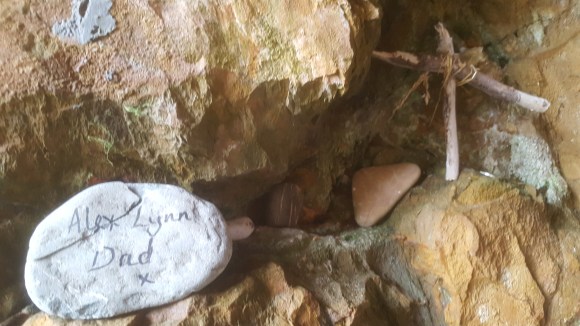
Having walked some ancient pilgrim routes that don’t seem that tied to religion anymore, I was struck today by the signs that people still take Ninian’s cave and Ninian’s chapel seriously. Some leave stones with names at the chapel, or insert rocks or prayers in the ancient surf-side cave.
Nini

Chris and Clare joined our walk today. I met them six years ago on the St Cuthbert’s walk. Clare brought wonderful home-made cake. I’m thankful to see them again after so long. 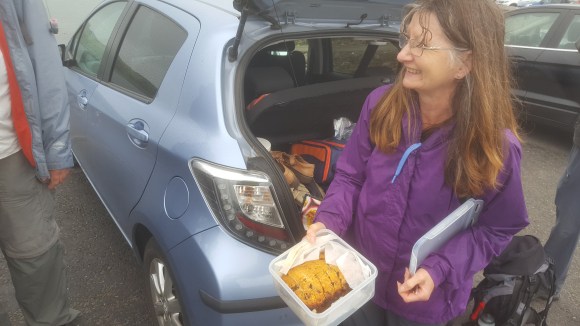
We’ve run out of Ninian destinations in this part of the peninsula, so I guess that means this pilgrimage is over. We’ll go out for a celebratory pint and dinner this evening, then tomorrow start making our respective ways home. The pilgrimage has been short, but has had many pleasures and a few trials. And will provide me material for a long time to come! I’ve enjoyed walking with Christine and Ken. Next time in Saskatchewan, which is perhaps not quite as vertiginous!
(for more photos and another perspective on today, see Ken’s blog at https://readingandwalking.wordpress.com/2019/07/21/whithorn-way-day-six/)

Categories
Arriving (Sort of…)
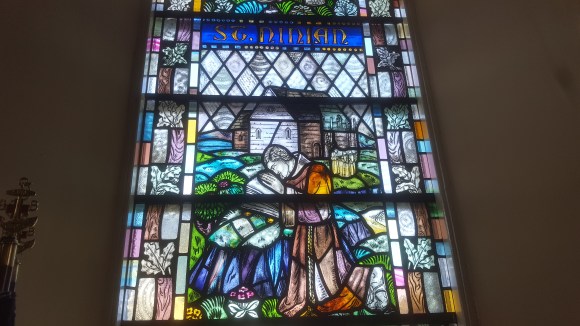 At the church in the ruins of Whithorn Abbey, no one was there to greet us. But the doors were open. Inside was Ninian, the fifth century saint, in stained glass, and a desk of pilgrim stuff. “Welcome to all pilgrims” said a little sign. “Please accept our certificate.” I wasn’t going to take one. We walked nine miles today, and overall already quite a distance. However I didn’t come as a pilgrim, but as a researcher and walker.
  Christine and Ken, despite being not as officially religious as me, picked up a copy, filled it out, and got me to sign on with them. That made it feel somehow like a group recognition.
  Was the certificate the sign of our “arrival” at the end of the pilgrimage? Not really: tomorrow we go to St Ninian’s Cave, where stone fragments of fifth and sixth century altar pieces have been found. Maybe it’s there. From the cave we walk our final 11 miles around the coast to the Isle of Whithorn. The destination there is really the Steam Packet Inn, a pub overlooking the harbour. Not especially religious, but tasty.
We did find someone at the Whithorn Centre, on main street in Whithorn, where pedestrians have to watch not only for cars, but also for tractors pulling hay-wagons to the huge feedlots bordering town. There we had tea and coffee-cake and met Julia Muir Watt, author of “Walk the Whithorn Way,” a guidebook complete with maps we probably could have used en route here. They had a display about Ninian and also of the history – Celtic, Anglo-Saxon, Norse, and Scottish – of this area. But was the gift shop our destination? No. We trekked back to the small museum, where we met a warm and informative guide who walked me around the space, showing me the many early stones that have been recovered from Ninian’s Cave, chapel and the Abbey.  The endless looping stonework knots are reminiscent of Ireland and of Lindisfarne, brought to Whithorn in part by Norse Christians out of Ireland. From the back of the museum I walked into the crypt where a line of Bishops were buried, and finally into the grotto that once held St Ninian’s bones. I admit: this felt like more of a destination than anywhere else. It felt like a holy place. The fact that whatever bones were there were lost during the Reformation doesn’t bother me much. 21st century western pilgrims aren’t fixated on a saint’s body, but more on their own. And mine, especially my ankles, have felt the distance.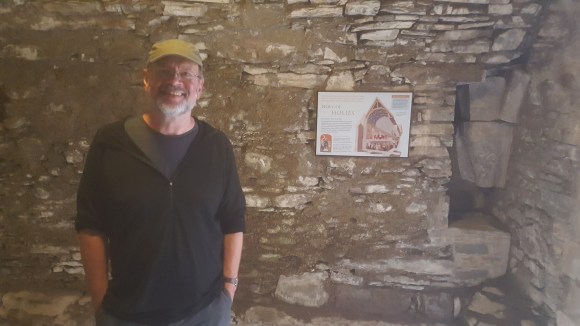
We stumbled across other holy stones on our way here. The OS map indicated “standing stones” just off the path and we found the Drumtroddan Standing Stones, only one of which is still standing, which may date back anywhere from 2-5,000 years, long before even St Ninian. 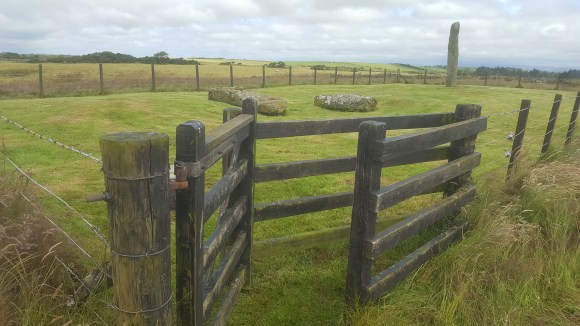 On the subject of Ninian: I’ve long had a semi-teasing argument going with Sara Terreault, who teaches pilgrimage and Insular (Celtic) Christianity, that St Ninian never even existed, but was a made-up figure. Not that I held that firmly, but I knew it was a good way to tease her. I will have to come up with something else. The presence of the Latinus Stone,
  with a name in both Latin and the local Celtic language indicates Christianity at Whithorn by about 450 CE. Although there may be little hard evidence of Ninian, there is so much circumstantial reference, in addition to Bede’s account, that one has to accept that a late Roman-age Briton helped introduce official Christianity to what is now Scotland. Even the cab driver who brought us home tonight knew the whole story and could provide the arguments, in addition to other interesting tidbits. As his BMW sped by within inches of stone walls he pointed to them and told us that French Prisoners of War from Napoleon were forced to build them for the Scots.
  When we first arrived, this dog, who lives at our B&B, couldn’t wait to find out who the visitors were.
Our B&B is the gracious Mansfield House, the former parsonage of this Whithorn Church, out of service since 1925, which has been repurposed in a way that will definitely NOT make it a shrine, except perhaps for kitsch:
I’m thankful I have one last day of walking with Christine and Ken. We’ve covered a lot of miles together, both here and in Saskatchewan. For more on today, and completely different comments and pictures, see Ken’s blog at https://readingandwalking.wordpress.com/2019/07/20/whithorn-way-day-five-arrival/

Categories
The Land of Speaking Stones

“During the time of the Enclosures,” Peter Ross told us, “they just ripped up the prehistoric hill tombs to use the stones. So when you see these stone fences you may be looking at ancient history – pieces of a paleolithic grave.” Today started out lovely, but by early afternoon turned into another cold, wet, miserable afternoon. The barometer in Glenluce announced storms, 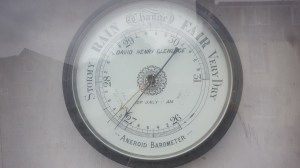 and we ended our 15 miles with sodden boots, frozen and shivering from a cold and steady Scottish wind.
 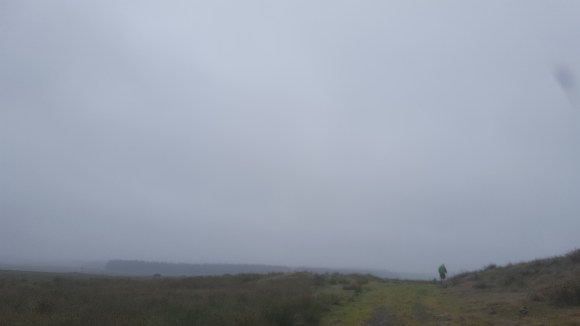 We crossed the Galloway Moors in a solid drizzle interrupted only by cattle, horses, sheep, goats and rams. Some of whom were in a hurry to get past us on the narrow tracks.
 If there was a theme to the day, it was the incredible human history of Galloway, this sparsely-inhabited piece of Scotland responsible for 40% of its cattle, most of its lumber exports, and – according to Peter, who joined us – most of Robert the Bruce’s army. Peter met us at the remains of Glenluce Abbey. He told us he would do his best to speak “standard English,” but couldn’t help flipping into an “Och, aye” when he got excited – as he often did – about the subject of paths and people in this part of the country.
 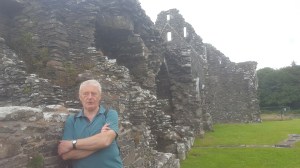 At times I’d only figure out what he was saying a few sentences after he’d finished. But it was the most fascinating compendium of history and politics, things like the fact that path rights on the seacoast had to take into account Robert the Bruce’s unusual title to his troops, that they owned the sea “as far as you can throw a spear out into the surf.” The Whithorn Way took us by the Abbey, whose stones were ripped down by locals during the Reformation to build the neighbouring farmhouses and the Lord’s manor. We walked by two different Lochs (lakes) where Peter pointed out islands that were, in the late bronze age, Crannogs.
 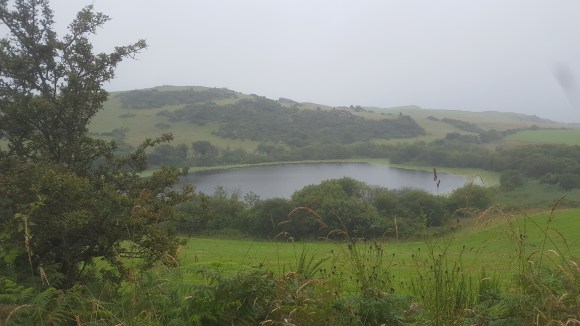 A Crannog is an artificial island built by a stone or bronze-age family which pushed alder trees down into the mud, then filled them in with rocks and stones so they had a home relatively safe from attack in the middle of the lake. Archaeologists can radio-carbon date and ring-date the trees used in building these islands to determine when the ancient Picts built these island homes.
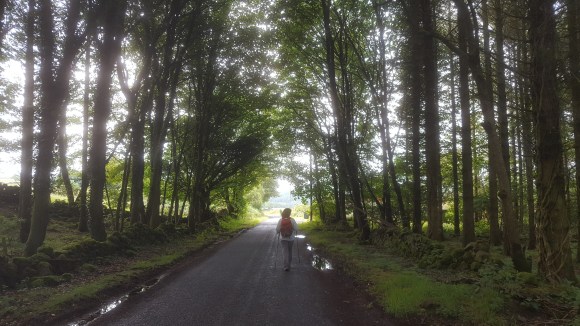
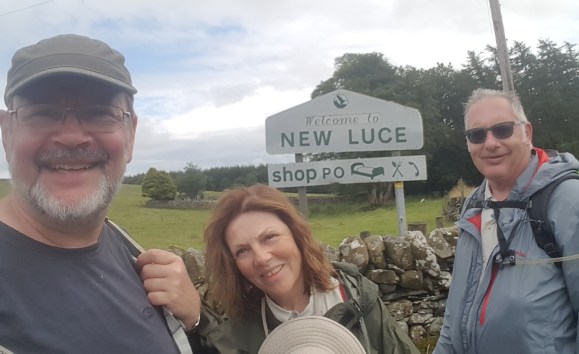
Our safe and secure home last night was Nadav’s Shed, where we had a comfortable sleep, interrupted in the early morning only by neighbourhood roosters, and visited by little rabbits. There was no accommodation on the trail itself, so tonight we were picked up off the moors by the owners of the Craighlaw Arms Hotel. They kindly dried our clothes for us and served some of the best food I’ve had in a long while. Haven’t had veggies for days, so the ginger chicken stir fry with Thai yellow curry was extraordinary. Tomorrow is supposed to be a short day. I’m hoping it’s as sunny again as these photos I took when we started out this morning south from New Luce. 
for more on this day’s walk, and a different perspective, see Ken’s blog at https://readingandwalking.wordpress.com/2019/07/19/whithorn-way-day-four
Categories
Why Do the Scots Do It?

We experienced several pilgrims’ miracles today. Firstly, after starting out in Barrhill the rain held off until just after our mid-day snack (after a full Scottish breakfast a snack was all we needed). That was fantastic.  Secondly, we arrived at our “hikers’ shed” only to find that the lovely & picturesque village of New Luce has no pub, no restaurant, and no store – although all are planned – and that the owners of our accommodation hadn’t been warned we were wanting supper. They very kindly found a can of soup. We were planning to make do with that and some crackers until local walker and walking activist Peter Ross showed up at our door, asking if we needed anything and offering a ride for groceries. Finally, owing to the fact that a local rented cottage won’t receive its guest for a couple days, we got a place to shower! New Luce has got to be the most lovely little village we’ve come across – it’s vying for the flower award for the UK this year.

We met some of the local residents on a main street festooned with flowers. They told us that New Luce has received substantial funds from the local windfarms we walked through all day (see the first photo above) and that they are using the money to purchase the pub, cafe etc and to redevelop.

We were soaked, again, and Ken was especially suffering from the wet boots and socks of yesterday’s rain-soaked walk. So it was a pleasure to get an offer from Peter for a ride to groceries. Peter talked the whole way about EU politics (where he has represented Scotland) and Scottish Right to Access. 
Peter is the president of the regional Right to Access group. I grilled him about why the Scots are interested in the Right of Responsible Access. He surprised me by saying that for him, it has to do with a/paths, and b/local development. I thought about our walks in Saskatchewan and how they also have to do with recovering important paths and may someday lead to development.  By the way, Peter told us that all the garbage we’d seen on the coast was NOT Scottish: “a lot of that’s drifted in from Dublin and Liverpool and Belfast with the prevailing currents,” he told us, “But we Scots have to clean it up.” On the walk today we came across a poignant reminder, in rural Scotland, of Canada’s international garbage. We could hardly believe what we were seeing!
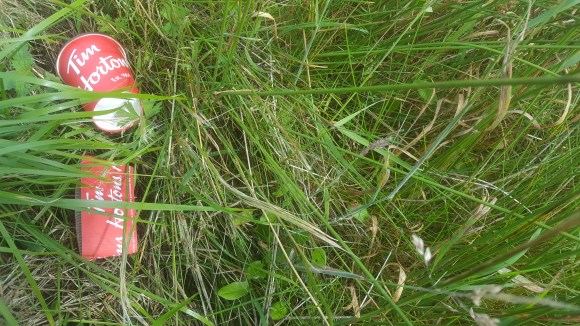
A lot of sheep today. And some of the signs were funny as well. We never saw any children at the fence lines, but lots of sheep and goats watched us pass.
The monks, royals, and common folk who walked this path would have stopped at Glenluce Abbey, whose ruins we will walk to tomorrow morning. I also plan to ask Peter, who will walk with us, more questions about walking and local development.
If you’re interested in more photos and another angle on the day, see Ken’s blog at: https://readingandwalking.wordpress.com/2019/07/18/whithorn-way-day-three/
Categories
Getting On Like Swans
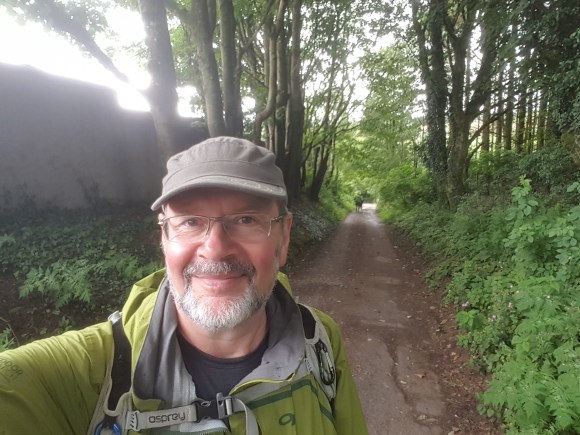
Today was a wet, wet, cold and rainy day. We walked from Maybole on a highway in the rain, which never really stopped. We’ve found everyone here very, very, friendly:

After some country trails we came to Kirkoswald, a village named for the Oswald Church that sits on the overlooking hill. The church, like so many other places we’ve seen in Ayrshire, boasts a connection to Robbie Burns, who spent one year of schooling here (why only one? The sign doesn’t say). Robert the Bruce was also baptized here. The building was designed by Robert Adam, who was building a nearby castle at the time. He put two swans on the corners for the founding family, the Kennedys (you can see them below).
Swans are a good theme for the day. We walked toward the coast, into increasingly foul weather. Due to some overly vague directions, we got lost, swam through a field of wet barley and then were covered with nettle and bramble stings trying to get back to some kind of walking path.
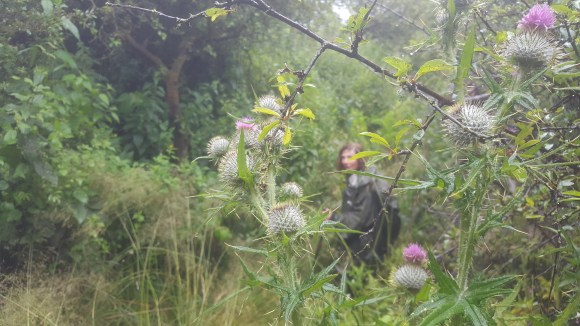
On arriving at the Ayrshire Coastal Path I saw swans sitting placidly in the tossing sea, head into the gale winds. So that’s what we did too. By the time we’d reached Girvan we were soaked right through to the skin. Then some. I was shaking with cold.

But life will always win out, as this little patch of green pushing up the asphalt proves. And we did too, persevering until we reached Girvan. We were dripping pools of rainwater on arrival.
Tomorrow is supposed to be another Scottish-soaked day. Here’s hoping our clothes dry enough overnight to be bearable after breakfast. I’m VERY thankful, now, for this warm room, some tea, and some time to relax out of the wind and rain. In the window of a house we passed were two small swans to greet those on the sidewalk. From my window right now I can see the fog-lights winking on the mountain in the sea, Craig Ailsa, which accompanied this portion of our journey (when the rain lifted enough for us to see it).
Categories
Rock-hopping the Whithorn Way

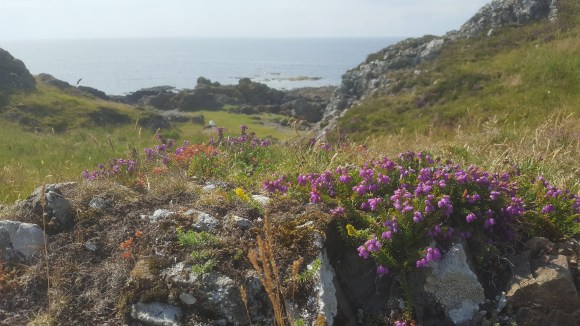
“From Canada, are ye?” said the nice woman at the coffee shop. “Canada’s beautiful. I’ve been to Ottawa. We’re from here.” She shrugged, smiled: “It’s nice enough.” Seemed like a typically-Scottish understatement to me – this is the view they enjoy just outside the coffee shop. We were exhausted after a day of walking along the Whithorn Way along the ocean, rock-hopping just above the receding tide-line and scrambling over sea-algae. I’m here on a Concordia University Part-Time Faculty Association grant to see about the Scottish “Right of Responsible Access.” The key, said our Scottish host John Henderson, is that word: responsible.

It didn’t take long to see that the Scots, like Canadians, have some trouble with the “responsible” part of their relationship with the natural world. The legislation establishing The Right of Access in Scotland is recent – nine years old and part of the devolution of power to Scotland. As would be the case if we were fortunate enough in Canada to adopt similar legislation, the educational curve is still ahead. We saw lots of garbage on our shoreline scramble, even though the views were magnificent otherwise.
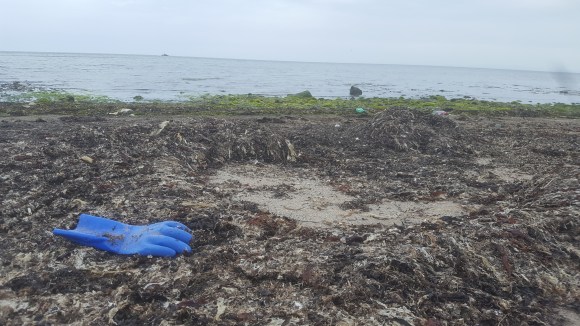
Maybe Scots, like Canadians, haven’t yet learned how beautiful, fragile, and important the natural world around them is. Finns, for instance, are taught to respect nature from kindergarten. Learning to enjoy berries, mushrooms, and views, and not disturb others, especially landowners, seems to be in Finnish DNA. In Scotland we passed what appeared to be an “Open Access” camp on the beach (see below, in the distance) and while the folks were practicing their rights, their garbage seemed to be a problem.

Still, one can hope. Local organizations had both cleaned up the last part of today’s walk, and had also set up trail markers. We hadn’t seen any markers on the first leg and had had to backtrack several times as a result. This is probably how Responsible Access is best lived-out: by community groups that operate locally to remind citizens to both get out on the land, and to leave no trace except their paths.
for more on the journey, see Ken Wilson’s blog Reading and Walking at https://readingandwalking.wordpress.com/
Categories
Anticipating Walking

For years I dreamt of walking Treaty Four territories, what is now south-west Saskatchewan. Only in 2013-2014 did I find a trail (the Traders’ Road, or North-West Mounted Police Patrol Trail), a guide and fellow walker (Hugh Henry, of the SK History and Folklore Society), and feel in my bones a reason (un-settling Settler narratives) to make it finally happen. Ken Wilson is also interested in Settler preparation for reconciliation; he and I walked together from Swift Current to Battleford in 2017 and from Mortlach to Gravelbourg in 2018. Ken recently set his scholarly lens on an article I wrote for a volume in pilgrimage back in 2013, just before that first 350-km journey across the prairies. A serious academic, Ken has highlighted the article’s best parts. In case you’re interested, I’m posting his post, here:
 somethinggrand