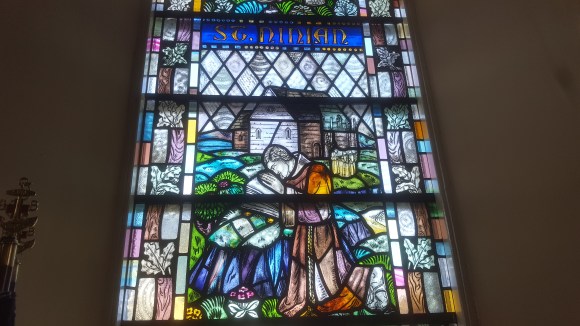
 At the church in the ruins of Whithorn Abbey, no one was there to greet us. But the doors were open. Inside was Ninian, the fifth century saint, in stained glass, and a desk of pilgrim stuff. “Welcome to all pilgrims” said a little sign. “Please accept our certificate.” I wasn’t going to take one. We walked nine miles today, and overall already quite a distance. However I didn’t come as a pilgrim, but as a researcher and walker.
  Christine and Ken, despite being not as officially religious as me, picked up a copy, filled it out, and got me to sign on with them. That made it feel somehow like a group recognition.
  Was the certificate the sign of our “arrival” at the end of the pilgrimage? Not really: tomorrow we go to St Ninian’s Cave, where stone fragments of fifth and sixth century altar pieces have been found. Maybe it’s there. From the cave we walk our final 11 miles around the coast to the Isle of Whithorn. The destination there is really the Steam Packet Inn, a pub overlooking the harbour. Not especially religious, but tasty.
We did find someone at the Whithorn Centre, on main street in Whithorn, where pedestrians have to watch not only for cars, but also for tractors pulling hay-wagons to the huge feedlots bordering town. There we had tea and coffee-cake and met Julia Muir Watt, author of “Walk the Whithorn Way,” a guidebook complete with maps we probably could have used en route here. They had a display about Ninian and also of the history – Celtic, Anglo-Saxon, Norse, and Scottish – of this area. But was the gift shop our destination? No. We trekked back to the small museum, where we met a warm and informative guide who walked me around the space, showing me the many early stones that have been recovered from Ninian’s Cave, chapel and the Abbey.  The endless looping stonework knots are reminiscent of Ireland and of Lindisfarne, brought to Whithorn in part by Norse Christians out of Ireland. From the back of the museum I walked into the crypt where a line of Bishops were buried, and finally into the grotto that once held St Ninian’s bones. I admit: this felt like more of a destination than anywhere else. It felt like a holy place. The fact that whatever bones were there were lost during the Reformation doesn’t bother me much. 21st century western pilgrims aren’t fixated on a saint’s body, but more on their own. And mine, especially my ankles, have felt the distance.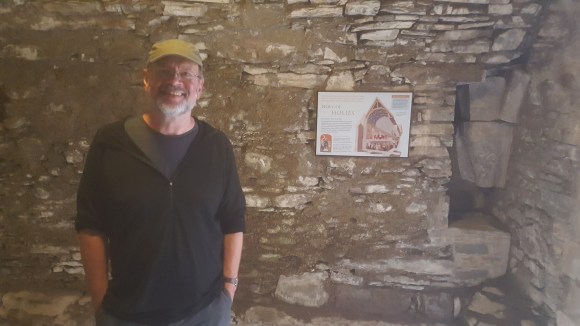
We stumbled across other holy stones on our way here. The OS map indicated “standing stones” just off the path and we found the Drumtroddan Standing Stones, only one of which is still standing, which may date back anywhere from 2-5,000 years, long before even St Ninian. 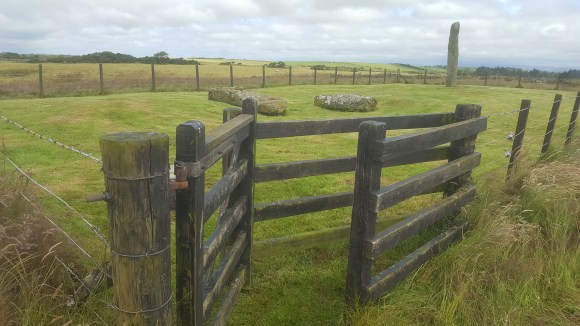 On the subject of Ninian: I’ve long had a semi-teasing argument going with Sara Terreault, who teaches pilgrimage and Insular (Celtic) Christianity, that St Ninian never even existed, but was a made-up figure. Not that I held that firmly, but I knew it was a good way to tease her. I will have to come up with something else. The presence of the Latinus Stone,
  with a name in both Latin and the local Celtic language indicates Christianity at Whithorn by about 450 CE. Although there may be little hard evidence of Ninian, there is so much circumstantial reference, in addition to Bede’s account, that one has to accept that a late Roman-age Briton helped introduce official Christianity to what is now Scotland. Even the cab driver who brought us home tonight knew the whole story and could provide the arguments, in addition to other interesting tidbits. As his BMW sped by within inches of stone walls he pointed to them and told us that French Prisoners of War from Napoleon were forced to build them for the Scots.
  When we first arrived, this dog, who lives at our B&B, couldn’t wait to find out who the visitors were.
Our B&B is the gracious Mansfield House, the former parsonage of this Whithorn Church, out of service since 1925, which has been repurposed in a way that will definitely NOT make it a shrine, except perhaps for kitsch: 
I’m thankful I have one last day of walking with Christine and Ken. We’ve covered a lot of miles together, both here and in Saskatchewan. For more on today, and completely different comments and pictures, see Ken’s blog at https://readingandwalking.wordpress.com/2019/07/20/whithorn-way-day-five-arrival/


 and we ended our 15 miles with sodden boots, frozen and shivering from a cold and steady Scottish wind.
 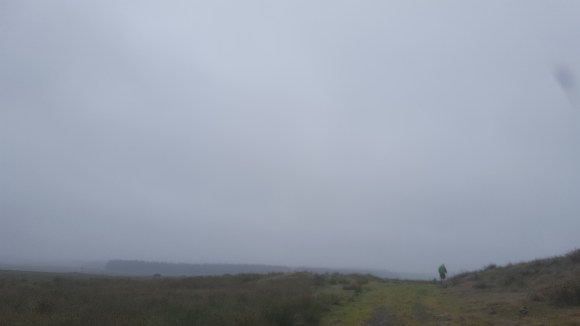 We crossed the Galloway Moors in a solid drizzle interrupted only by cattle, horses, sheep, goats and rams. Some of whom were in a hurry to get past us on the narrow tracks.
 If there was a theme to the day, it was the incredible human history of Galloway, this sparsely-inhabited piece of Scotland responsible for 40% of its cattle, most of its lumber exports, and – according to Peter, who joined us – most of Robert the Bruce’s army. Peter met us at the remains of Glenluce Abbey. He told us he would do his best to speak “standard English,” but couldn’t help flipping into an “Och, aye” when he got excited – as he often did – about the subject of paths and people in this part of the country.
 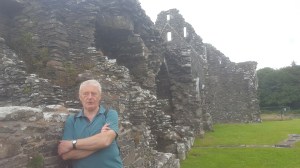 At times I’d only figure out what he was saying a few sentences after he’d finished. But it was the most fascinating compendium of history and politics, things like the fact that path rights on the seacoast had to take into account Robert the Bruce’s unusual title to his troops, that they owned the sea “as far as you can throw a spear out into the surf.” The Whithorn Way took us by the Abbey, whose stones were ripped down by locals during the Reformation to build the neighbouring farmhouses and the Lord’s manor. We walked by two different Lochs (lakes) where Peter pointed out islands that were, in the late bronze age, Crannogs.
 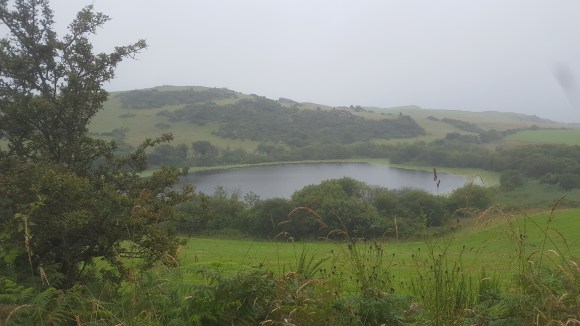 A Crannog is an artificial island built by a stone or bronze-age family which pushed alder trees down into the mud, then filled them in with rocks and stones so they had a home relatively safe from attack in the middle of the lake. Archaeologists can radio-carbon date and ring-date the trees used in building these islands to determine when the ancient Picts built these island homes.

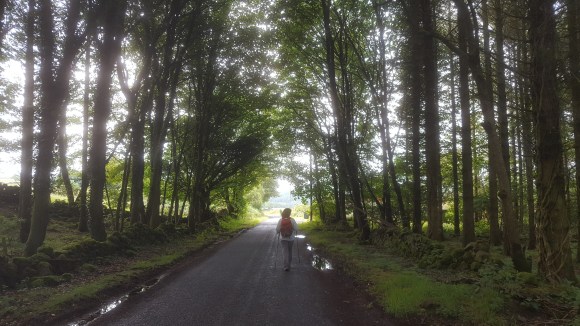

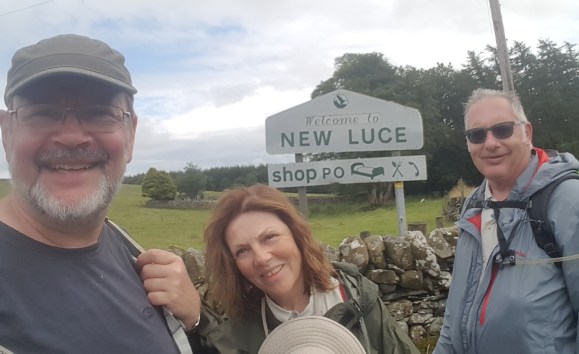
 Secondly, we arrived at our “hikers’ shed” only to find that the lovely & picturesque village of New Luce has no pub, no restaurant, and no store – although all are planned – and that the owners of our accommodation hadn’t been warned we were wanting supper. They very kindly found a can of soup. We were planning to make do with that and some crackers until local walker and walking activist Peter Ross showed up at our door, asking if we needed anything and offering a ride for groceries. Finally, owing to the fact that a local rented cottage won’t receive its guest for a couple days, we got a place to shower! New Luce has got to be the most lovely little village we’ve come across – it’s vying for the flower award for the UK this year.


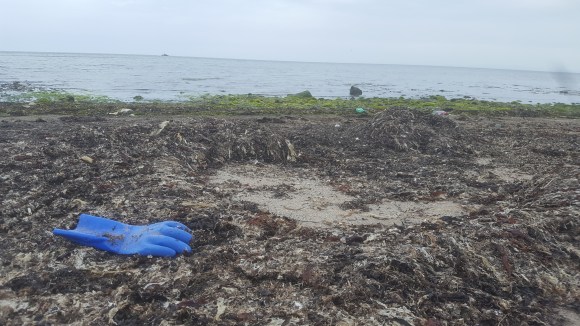
 By the way, Peter told us that all the garbage we’d seen on the coast was NOT Scottish: “a lot of that’s drifted in from Dublin and Liverpool and Belfast with the prevailing currents,” he told us, “But we Scots have to clean it up.” On the walk today we came across a poignant reminder, in rural Scotland, of Canada’s international garbage. We could hardly believe what we were seeing!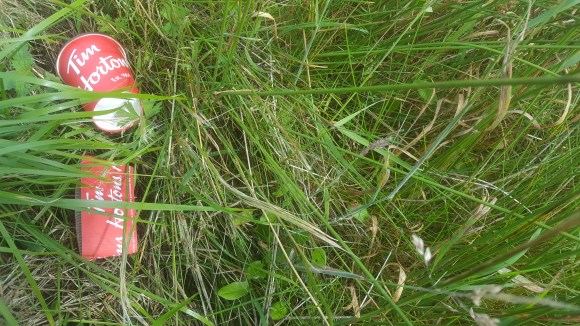











 somethinggrand